Clinical, Psychosocial and Scientific Note
Journal of
Epilepsy and ClinicalNeurophysiology
J Epilepsy Clin Neurophysiol 2010;16(2):80-86
Associação Brasileira de Epilepsia (ABE)
Filiada ao International Bureau for Epilepsy
IBE Promising Strategies Program 2008:
“Epilepsy at School: Teaching the Teachers”
– Educational Plan of the “
Associação Brasileira de Epilepsia
”
with Teachers of Elementary School
Laura Guilhoto*, Heloise Martins*, Marcos Vidal-Dourado*, Erika Almeida*, Sueli Mesquita*, Carlos Tavares*, Katia Lin*, Veriano Alexandre Jr.*, Alzira Castro*, Alice Masuko*, Adriana Mendonça**, Maria Helena Martins**, Marcos Galvez**, Marluce Camarinho**,
Natalina Mateus**, Rose Jurjuck**, Elza Márcia Yacubian*
ABSTRACT
Introduction: The aim of this study is to evaluate trough questionnaires the knowledge about epilepsy of Elementary School teachers obtained in the “Promising Strategies Program 2008” from International Bureau for Epilepsy entitled “Epilepsy at School. Teaching the Teachers.” performed by the official Brazilian branch “Associação Brasileira de Epilepsia” (ABE). Methods: A questionnaire was developed by ABE and it is composed by 35 objective questions concerning the following areas: concepts and definition of epilepsy and its causes (10); treatment and adverse effects of antiepileptic medication (10); popular stigma about epilepsy (5); activities of people with epilepsy (PWE) (5); and finally, first-aid during and after an epileptic seizure (5). The questionnaire was presented in phase (ph) 1 to teachers before the lecture “Epilepsy: Causes, symptoms and treatment” given by a health professional from ABE trough classical live class (CC) or by video-conference (VC) on “Rede do Saber’s site” (http://www.rededosaber.sp.gov.br/portais/NotíciasConteúdo/tabid/369/language/ pt-BR/IDNoticia/851/Default.aspx) and afterwards in ph 2. The results were compared to a control group of 66 teachers that did not attend any lecture. Results: Classical class was given in four different cities of Brazil and VC was performed in the state of Sao Paulo and was transmitted to 74 different cities, including Sao Paulo city, this latter with 12 sites; 1,153 teachers were instructed either by CC 25% (288) or VC 75% (865). Most (78.5%) were female, aged between 18 to 68 years (mean 41.4); 76.6% attended University and 21.1%, graduate studies; 50% affirmed to know a PWE. The mean of right answers in ph 1 in CC was 78.4% (±10.1) and VC, 79.8% (±8.6) and in ph 2 in CC, 86.5% (±6.4) and VC, 86.8% (±7.1), reflecting increased knowledge in ph 2 (p<0.001) in the 2 strategies (control group: ph 1, 78.2%±7.4; ph 2, 79.6%±8.6; p>0.05). Comparison of variability of the combined action (CC+VC) between ph 1 (79.5%±8.6) and 2 (86.8%±6.8) was 9.9%±13.9 (p<0.001) (control group 2.3%±10.2; p<0.001, compared to CC+VC). The topics “popular stigma” and “first aid during seizures” had the lowest correct scores in ph 1 (CC+VC), 74.6% and 72.8%, respectively (control group 78.8±10.2 and 67.9±17.5). The highest gain (35.6%) in ph 2 was observed in “first aid” (control group 0.8±27.2, p<0.001) and the lowest (0.1%), in “popular stigma” (control group 1.7±26.4, p>0.05). There was a significant variation in the topic “first aid” in CC, 41.1% compared to VC, 33.3% (p=0.009).
**Associação Brasileira de Epilepsia (ABE), Oficial Brazilian Chapter of the International Bureau for Epilepsy.
Conclusion: The educational plan of the “Associação Brasileira de Epilepsia” revealed good performance of the teachers of Elementary School without significant differences between the types of presentation (CC/VC), although CC was more efficient to teach first aid during epileptic seizures. The topic “Popular stigma about epilepsy knowledge” has not improved after the lectures and this subject still needs further research and efforts for better understanding and action planning.
Keywords: Education; epilepsy; survey; teacher; school.
RESUMO
Programa IBE Promising Strategies 2008: “Epilepsia nas Escolas: Ensinando os Professores” – Plano Educacional da Associação Brasileira de Epilepsia com Professores de Educação Básica
Objetivos: Avaliar através de questionários o conhecimento obtido pela ação educativa com professores de Educação Básica intitulada “Epilepsia nas Escolas: Ensinando os Professores” no programa “Promising Strategies 2008” do International Bureau for Epilepsy realizado pelo capítulo oficial brasileiro, a Associação Brasileira de Epilepsia (ABE). Métodos: Questionário foi desenvolvido pela ABE com 35 questões objetivas abrangendo os tópicos: conceitos e definições da epilepsia (10); tratamento e reações adversas de medicações antiepilépticas (10); atividades físicas e profissionais da pessoa com epilepsia (PCE) (5); conhecimento popular estigmatizante (5); cuidados básicos durante e após a crise (5). O questionário foi aplicado antes (Fase 1) e depois (Fase 2) da palestra “Epilepsia: Causas, Sintomas e Conduta” por aula presencial (AP) e videoconferência (VC) na “Rede do Saber” (http://www.rededosaber.sp.gov.br/portais/NotíciasConteúdo/tabid/369/language/pt-BR/IDNoticia/851/ Default.aspx). Os resultados foram comparados a um grupo controle de 66 professores que não assistiram à aula sobre epilepsia. Resultados: Aula presencial foi ministrada em quatro cidades brasileiras e VC foi transmitida a 74 cidades do estado de São Paulo, incluindo a capital, esta última com 12 sítios de transmissão. Foram instruídos 1.153 educadores por AP 25% (288) e VC 75% (865). A maioria (78,5%) era do sexo feminino, com idades de 18 a 68 anos (média 41,4); 76,6% cursaram ensino superior e 21,1%, pós-graduação; 50% afirmou conhecer PCE. A média de acertos na fase 1 em AP foi de 78,4% (±10,1) e VC, 79,8% (±8,6) e na fase 2 em AP 86,5% (±6,4) e VC, 86,8% (±7,1), refletindo aumento do conhecimento na fase 2 (p<0,001) nas 2 estratégias (grupo controle: fase 1, 78,2%±7.4; fase 2, 79,6%±8.6; p>0,05). A comparação da variação da ação conjunta (AP+VC) entre fase 1 (79,5%,±8,6) e 2 (86,8%,±6,8) foi de 9,9%±13,9 (p<0,001) (grupo controle 2.3%±10.2; p<0,001, comparado a CC+VC). Os tópicos “conhecimento estigmatizante” e “cuidados básicos” tiveram menor índice de acerto na fase 1 (AP+VC), 74,6% e 72,8%, respectivamente (grupo controle 78,8±10,2 e 67,9±17,5). No entanto, o maior ganho (35,6%) na fase 2 se deu em “cuidados básicos” (grupo controle 0,8±27,2, p<0,001) e o menor (0,1%), em “conhecimento estigmatizante” (grupo controle 1,7±26,4, p>0,05). Houve significante variação do tópico “cuidados básicos” em AP 41,1% comparada à VC 33,3% (p=0,009). Conclusão: A ação educativa da ABE mostrou bom aproveitamento dos educadores sem diferenças significativas entre os modos de divulgação (AP/VC), porém AP foi mais eficiente em ensinar cuidados básicos na crise epiléptica. O tópico “Conhecimento Popular Estigmatizante sobre Epilepsia” não mostrou aumento após a aula, sendo necessários esforços conjuntos em pesquisa e planejamento estratégico nessa área.
Unitermos: Educação; epilepsia; questionário; professores; escola.
INTRODUCTION
It is well known that children with epilepsy suffer prejudice at school and this fact is responsible for much of the stigma in adult life. Teacher’s knowledge about epilepsy can have a direct impact on students regarding school and social achievements and consequently, employment and networking links in adult life. Despite this important role of the educator, little research is done in this field in the whole world, especially with intervention programs. Most of the studies from different countries refer insufficient training of the teachers about epilepsy, as well as, potentially prejudice concepts about the condition.1-9
Teachers play a fundamental role in order to accept diversity and to fight against discrimination, and as they are not well informed and trained regarding epilepsy, Associação Brasileira de Epilepsy (ABE) proposed an intervention
program in elementary schools in Sao Paulo state, called “Epilepsy at School: Teaching the Teachers” that was one of the programs selected for the Promising Strategies Program of the International Bureau for Epilepsy in 2008.10
This program is composed by a lecture with simple didactic visual resources concerning the following infor- mation about epilepsy: 1) basic aspects of brain anatomy; 2) definition; 3) causes; 4) epidemiology; 5) diagnosis; 6) treatment; 7) first-aid during a seizure; 8) psychological and social consequences; 9) wrong mythos in epilepsy; 10) world-wide International League Against Epilepsy campaign “Epilepsy Out of the Shadows”.
comparing two methods of presentation, classical live class and video-conference.
METHODS
A pilot questionnaire regarding experience, and comfort with epilepsy with 23 questions was developed by ABE and it was presented to one public school in a poor suburb of Sao Paulo city.11 Afterwards it was developed
a new questionnaire by ABE experts composed by 35 questions concerning the following topics: A - Concepts and Definition of Epilepsy and its Causes (10); B - Treatment and Adverse Effects of Antiepileptic Medication (10); C - Popular Stigma about Epilepsy (5); D - Activities of People with Epilepsy (PWE) (5); E - First Aid during and after an Epileptic Seizure (5).12 Respondents had to indicate
if the statements were right or wrong. The questionnaire and its topics are presented in Table 1.
Table 1. Questionnaire about epilepsy showing questions and their related topics.
Questionnaire about Epilepsy
( ) True ( ) False Topic
1. Epilepsy is a spiritual problem. C
2. Epilepsy can lead to mental retardation. C
3. Epilepsy is a type of craziness. C
4. Epilepsy is a disturb originated in the brain. A
5. Epilepsy is a contagious problem. A
6. Epileptic seizures are the manifestation of abnormal discharges in the neurons of the brain. A
7. Epilepsy does not need a medical treatment. B
8. Drugs for epilepsy do not need to be taken every day. B
9. If the person has any side effect such as somnolence, he does not need to tell his doctor, because this is very common. B 10. If the person has any side effect he must stop to take it immediately. B 11. When the person achieves the control of the seizures he does not need to see the doctor and can stop the medication by his own. B
12. Nervousness may cause epilepsy. C
13. Some food may cause epilepsy. A
14. Emotional problems may be the cause of epilepsy. C
15. Flashing lights (in night clubs), emotional problems, sleep deprivation, alcohol intake, fever or infections may facilitate the occurrence of epileptic seizures.
A
16. People with epilepsy should not work. D
17. Epilepsy is a hereditary problem. A
18. The child with epilepsy should have, always as possible, a normal life. D
19. Epileptic seizures usually start and stop by themselves and they do not need speciic intervention, such as to take the person to the
hospital in a hurry.
E
20. During epileptic seizures it is necessary to open the mouth of the person in order that he does not bite his tongue. E
21. Young people with epilepsy must not practice sports. D
22. Each part f the brain is responsible for a distinct function and the epileptic seizure may have different manifestations according to the affected cerebral area.
A
23. In the nervous system, the neurons communicate by electric and chemical impulses and the epileptic seizure is an abnormality of the electrical brain activity.
A
24. The detailed description of the epileptic seizure to the physician is fundamental in order to make the correct diagnosis as well as to prescribe the correct treatment.
B
25. Any lesion can lead to epilepsy. A
26. A person with epilepsy may present learning dificulties, mainly if he is not receiving appropriate treatment for his condition. D
27. Epileptic seizure is the same thing as epilepsy. A
28. During an epileptic seizure it is important to give immediately a glass of water and sugar to stop the seizure and to tranquilize the patient. E 29. The person with epilepsy may control the seizures only by his own will. B 30. Most of the people with epilepsy have good control of the epileptic seizures if they follow correctly the treatment by the doctor with
discipline.
B
31. There is a surgical procedure to treat epilepsy when this is not controlled with drugs and this type of treatment is available in the Brazilian Public Health System.
B
32. It is necessary to tap gently the person during an epileptic seizure and to open his hands as well as throw water in his face and try to force him to stand up in order to stop the seizure.
E
33. It is necessary to hidden from the child and his roommates the fact that he has epilepsy. B 34. Children usually get scared with the epileptic seizure and in order to protect them it is better not to comment what happened. E
35. People with epilepsy cannot drive. D
The questionnaire was presented in phase 1 to teachers before the lecture “Epilepsy: Causes, Symptoms and Treatment” given by a health professional from ABE and afterwards in phase 2. The lecture was given either trough classical live class (CC) or video-conference (VC). Video-conference was broadcast in an educational site (Rede do Saber) held bytheEducational Authorities of Sao Paulo state which promotes divulgation of their programs(http:// www.rededosaber.sp.gov.br/portais/NotíciasConteúdo/ tabid/369/language/pt-BR/IDNoticia/851/Default.aspx).
This prospective study was performed with the lecture group (n=1,153) and a control group (n=66). Both groups were assessed twice: the lecture group before and after it; the control group answered the questionnaire before and after a lecture about other topic, and afterwards an Epilepsy lecture was available only for educative purposes and not with the aim of measuring its efficacy.
Primary outcome measure was increase in knowledge about epilepsy using the questionnaire and the main hypothesis was that greater increase of knowledge in the lecture group compared to control group. Statistical analysis consisted of Fisher exact test and t-Student test for independent samples for categorical and continuous variables, respectively; comparisons before and after the lecture were performed using McNemar chi-square test and Paired T test for categorical and continuous variables, respectively. Influence of variables in the topics of the questionnaire was analyzed by ANOVA. Level of statistical significance was set at p < 0.05 in all tests.
RESULTS
Classical class was given in four different cities of Brazil and VC was performed in the state of Sao Paulo and was transmitted to 74 different cities, including Sao Paulo city,
this latter with 12 sites; 1,153 teachers were instructed either by CC 25% (288) or VC 75% (865).
Most teachers (78.5%) were female, aged between 18 to 68 years (mean 41.4) and 50% affirmed to know a PWE. They had at least 12 years of education; 76.6% attended University and 21.1%, graduate studies. Mean time of teaching experience was 13.1 years (SD 8.8) and 75% of the surveyed teachers had at least 5 years of experience. The demographic data is shown in Table 2.
The mean of right answers in phase 1 in CC was 78.4% (±10.1) and VC, 79.8% (±8.6) and in phase 2 in CC, 86.5% (±6.4) and VC, 86.8% (±7.1), reflecting increased knowledge in phase 2 (p<0.001) in the 2 strategies (control group: phase 1, 78.2%±7.4; phase 2, 79.6%±8.6; p>0.05). Comparison of variability of the combined action (CC+VC) between phase 1 (79.5%±8.6) and 2 (86.8%±6.8) was 9.9%±13.9 (p<0.001) (control group 2.3%±10.2; p<0.001, compared to CC+VC). Graph 1 shows the comparison between phases 1 and 2.
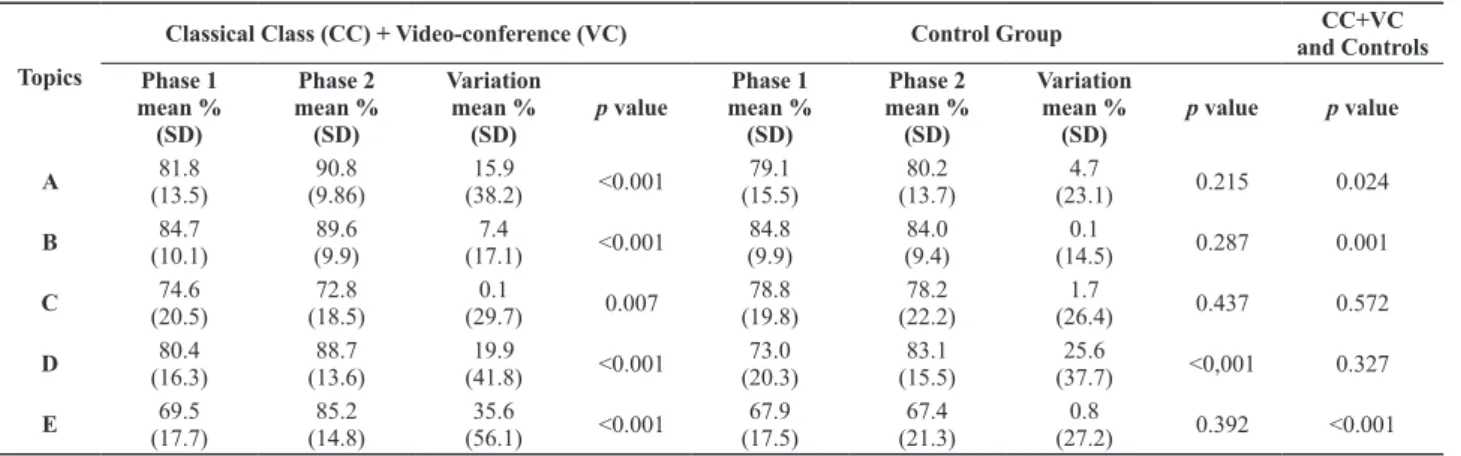
The areas in which there was a greater improvement in knowledge of the surveyed teachers between phases 1 and 2 were, “First-aid during an Epileptic Seizure” (mean variation 35.6%, p<0.001; compared to controls p<0.001), followed by “Activities of PWE” (mean variation 19.9%, p<0.001; compared to controls p=0.327), and finally “Concepts and Definition of Epilepsy and its Causes” (mean variation 15.9%, p<0.001; compared to controls p=0.024) and “Treatment and Adverse Effects of Antiepileptic Medication” (mean variation 7.4%, p<0.001; compared to controls p=0.001). In the topic “Popular Stigma about Epilepsy” there was a decrease in the number of correct answers after the lecture (mean variation 0.1%, p=0.007; compared to controls p=0.001). Graph 2 shows the variation before and after the lecture in the several surveyed topics.
Table 2. Demographic data
Demographic data CC+VCTotal Classical Class (CC) Video- Conference (VC) Control group controls CC+VC and
p value
N 1,153 25.0% 75.0% 66
Gender 0.645
Male 21.5% 15.7% 23.4% 24.2%
Female 78.5% 84.3% 76.6% 75.8%
Age (yrs.) (mean) 41.4 45.4 40.1 40.4 0.454
Schooling years 0.429
College 76.6% 71.5% 78.3% 74.2%
Graduate studies 21.1% 21.5% 21.0% 25.8%
Position 0.098
Teacher/assistant 88.0% 78.8% 90.9% 97.0%
Coordinator/ director 9.0% 13.0% 7.7% 3.0%
Other 3.0% 8.2% 1.4% 0.0%
Experience time (yrs.) (mean) 13.1 15.2 12.5 12.7 0.708
Know people with epilepsy 0.034
Yes 50.0% 50.4% 49.9% 41.5%
No 43.4% 43.0% 43.5% 43.1%
The topics “Popular Stigma” and “First Aid during Seizures” had the lowest correct scores in phase 1 (CC+VC), 74.6% and 72.8%, respectively (control group 78.8±10.2 and 67.9±17.5). The highest gain (35.6%) in phase 2 was observed in “First Aid” (compared to control group 0.8±27.2, p<0.001) and the lowest (0.1%), in “Popular Stigma” (compared to control group 1.7±26.4, p>0.05). There was a significant variation in the topic “First Aid” in CC, 41.1% compared to VC, 33.3% (p=0.009).
DISCUSSION
Previous studies, including developing and developed countries, have reported insufficient knowledge about
Table 3. Comparison between phases 1 and 2 in lecture and control groups.
Topics
Classical Class (CC) + Video-conference (VC) Control Group CC+VC
and Controls Phase 1
mean % (SD)
Phase 2 mean %
(SD)
Variation mean %
(SD)
p value
Phase 1 mean % (SD)
Phase 2 mean % (SD)
Variation mean %
(SD)
p value p value
A 81.8
(13.5)
90.8 (9.86)
15.9
(38.2) <0.001
79.1 (15.5)
80.2 (13.7)
4.7
(23.1) 0.215 0.024
B (10.1)84.7 (9.9)89.6 (17.1)7.4 <0.001 84.8 (9.9)
84.0 (9.4)
0.1
(14.5) 0.287 0.001
C 74.6
(20.5)
72.8 (18.5)
0.1
(29.7) 0.007
78.8 (19.8)
78.2 (22.2)
1.7
(26.4) 0.437 0.572
D 80.4
(16.3)
88.7 (13.6)
19.9
(41.8) <0.001
73.0 (20.3)
83.1 (15.5)
25.6
(37.7) <0,001 0.327
E (17.7)69.5 (14.8)85.2 (56.1)35.6 <0.001 67.9 (17.5)
67.4 (21.3)
0.8
(27.2) 0.392 <0.001
Topics: A - Concepts and Definition of Epilepsy and its Causes; B - Treatment and Adverse Effects of Antiepileptic Medication; C - Popular Stigma about Epilepsy; D - Activities of People with Epilepsy; E - First Aid during and after an Epileptic Seizure.
Graph 1. Total score (%) of control and studied groups before and after lecture trough two types of presentation: classical class and video-conference (ANOVA).
Graph 2. Percent of correct answers in the five topics of the questionnaire before and after the lecture (Paired t-test, one tail).
epilepsy among teachers and their willing in im- proving this situation trough specific material about the subject, including lectures or public awareness campaigns.13-16
In our study there was an overall improvement in knowledge among the teachers after the lecture about epilepsy. This finding was similar in the study done by Appolone et al. in 1979 with non medical professionals, including teachers, which demonstrated that those who attended a workshop about epilepsy improved significantly more than the two control groups in their knowledge of and comfort with the condition.17 A long term effect was also
The area most impacted was “First Aid during an Epileptic Seizure” which rose from 71.1 to 89% of correct answers between phase 1 and 2. This fact probably reflects the low knowledge of first-aid care in the general population probably superposed to the stigma of the epileptic seizure. Several studies have reported the lack of knowledge of teachers regarding the first measures during a seizure. 19-22 Another area of great impact was “Activities of PWE”,
which got 88.7% of correct answers in phase 2 (mean variation 19.9%), although it was statistically non significant compared to the control group (p=0.327). Probably in these two areas the information was easier to the teachers to learn because the principles were transmitted as true “rules” and they were based either in scientific or legal aspects.
The topics “Concepts and Definition of Epilepsy and its Causes” and “Treatment and Adverse Effects of Anti- epileptic Medication” showed good improvement (mean variation 15.9% and 7.4%; compared to controls p=0.024 and p=0.001, respectively) but somewhat inferior to the previous mentioned areas. This probably reflects the broad range of definitions and treatment options in the field of epilepsy with several syndromic pre- sentations.
The poor results in phase 2 observed in the topic “Popular Stigma about Epilepsy” may be caused by three factors: 1) inadequate questions; 2) difficulties of health professionals to transmit this information in a simple and direct way to lay people; 3) specific nosological problems in this area of medicine. Regarding the questions, we noticed that there are difficulties in understanding the difference between the terms “to cause” and “to predispose” the occurrence of an epileptic seizure. Problems in communication between Health and School personnel were also referred by other authors that have found better tolerance and greater knowledge among higher educated teachers.23-24
Another fact to contribute to these nosological problems in this area of medicine is the fact that epilepsy is included in the area of Mental Health by the World Health Organization.25
CONCLUSION
We observed that teachers of these surveyed Elementary Schools in Brazil, had basic knowledge about epilepsy, which could be increased after the specific lecture given by the “Associação Brasileira de Epilepsia”. There were no significant differences between the types of presentation (CC/VC), although CC was more efficient to teach first aid during epileptic seizures. Popular stigma about epilepsy knowledge has not improved after the lectures and this subject still needs further research and efforts for better understanding and action planning.
ACKNOWLEDGMENTS
We acknowledge the help of Patricia Guilhem de Almeida Ramos for statistical analysis.
International Bureau for Epilepsy (Promising Strategies Program 2008); Companhia de Seguros Aliança do Brasil;
Secretaria da Educação do Estado de São Paulo, Brazil for support.
REFERENCES
Tosetti MFV, Campos MA, Bauer CR,
1. Araujo MM, Pedrazolli S, Silva YB, Montovani C, Haddad MS, Poetcher A, Cukiert A, et al. Knowledge about epilepsy among teachers and epileptic patients. Arq Neuropsiquiat 1991;49:255-9.
Bishop M, Boag EM. Teachers – knowledge about epilepsy and 2.
attitudes toward students with epilepsy: Results of a national survey. Epilepsy & Behavior 2006;8:397-405.
Herranz Fernández J
3. L, Lastra Martínez LA, González González A, Capa García L, Granda Alonso C, Moustafa I, Villegas Moriega M, Arteaga Manjón-Cabeza R. Knowledge and attitude of professors concerning epilepsy. Evaluation of a survey conducted on 4,099 professors of Cantabria. An Esp Pediatr 1990;33(6):523-7. Hsieh L, Chiou H. Comparison of Epilepsy and Asthma Perception 4.
Among Preschool Teachers in Taiwan. Epilepsia 2001;42(5): 647-50.
Holdsworth L, Whitmore K. A study of children with epilepsy 5.
attending ordinary schools. II: Information and attitudes held by their teachers. Dev Med Child Neurol 1974;16(6):759-65. Kaleyias J, Tzoufi M, Kotsalis C, Papavasiliou A, Diamantopoulos N. 6.
Knowledge and attitude of the Greek educational community toward epilepsy and the epileptic student. Epilepsy Behav 2005;6(2):179-86. Madsen L
7. P. Danish primary school teachers’ knowledge about epilepsy in children. Ugeskr Laeger 1996;158(14):1977-80.
Mielke J, Adamolekun B, Ball D, Mundanda T. Knowledge and 8.
attitudes of teachers towards epilepsy in Zimbabwe. Acta Neurol Scand 1997;96:133-7.
Ojinnaka NC. Teachers’ perception of epilepsy in Nigeria: a 9.
community-based study. Seizure 2002;11: 386-91.
International Bureau for Epilepsy. Promising Strategies Program 10.
2008. International Epilepsy News. Dublin: International Bureau for Epilepsy 2007;(4):14-6.
Guilhoto LMFF, Nobre C, Cássia Nobre, Silva ARCO, Tavares 11.
C. Educative action of elementary school teachers about epilepsy in suburbs of São Paulo city – Union of extremes specialists and educators. J Epilepsy Clin Neurophysiol 2007;13:143-7.
Martins HH, Guilhoto LM, Dourado MV, Lin K, Alexandre V, 12.
Almeida ED, Mesquita S, Tavares C, Yacubian EM. Epilepsy at School. Educative Action of Associação Brasileira de Epilepsia with Elementary School Teachers in Sao Paulo City, Brazil. Epilepsia 2009;50(Suppl. 11):6. (Abstract).
Antoniuk SA, Santos LHC, Baú C, Brotto ML, Lezcano PS, Almeida 13.
T, Baú V, Bruck I. Atitudes e Preconceitos sobre as Epilepsias em uma População de Pais e Professores de Curitiba. J Epilepsy Clin Neurophysiol 2005;11(1):49-52.
Bannon MJ, Wildig C, Jones PW. Teachers’ perceptions of epilepsy. 14.
Archives of Disease in Childhood 1992;67:1467-71. Dantas F
15. G, Cariri GA, Cariri GA, Ribeiro Filho AR. Knowledge and attitudes toward epilepsy among primary, secondary and tertiary level teachers. Arq Neuropsiquiatr 2001;59(3-B):712-6.
Gadow KD. School Involvement in the Treatment of Seizure 16.
Disorders. Epilepsia 1982;23:215-24.
Appolone C, Romeis J, Gibson P, McLean W, Howard G.
17. An epilepsy
workshop for professionals. Epilepsia 1979;20(2):127-32.
Miyake S, Yamashita S, Yamada M, Iwamoto H. Schoolchildren with 18.
for Teachers at Intervals of 12 Years. The Japanese Journal of Psychiatry and Neurology 1991;45(2):487-9.
Kankirawatana P. Epilepsy Awareness Among School Teachers in 19.
Thailand. Epilepsia 1999;40(4)497-501.
Millogo A, Siranyan AS. Knowledge of epilepsy and attitudes towards 20.
the condition among school teachers in Bobo-Dioulasso (Burkina Faso). Epileptic Disord 2004;6:21-6.
Ndour D, Diop AG, Ndiaye M, Niang C, Sarr MM, Ndiaye IP. A 21.
survey of school teachers’ knowledge and behavior about epilepsy, in a developing country such as Senegal. Rev Neurol (Paris) 2004;160(3):338-41.
Associação Brasileira de Epilepsia – ABE
Rua Botucatu, 740 – Vila Clementino – CEP 04023-900 – São Paulo – SP – Brasil Fone: (11)5549-3819 – e-mail: [email protected] – www.epilepsiabrasil.org.br
Pala I, Vankar GK. Epilepsy and teachers: a survey. Indian J Pediatr 22.
1997;64(2):211-4.
Birbeck GL, Chomba E, Atadzhanov M, Mbewe E, Haworth A. 23.
Zambian teachers: what do they know about epilepsy and how can we work with them to decrease stigma? Epilepsy Behav 2006;9(2): 275-80.
Bishop
24. M, Slevin B. Teachers’ attitudes toward students with epilepsy: results of a survey of elementary and middle school teachers. Epilepsy Behav 2004;5(3):308-15.
<http://www.who.int/mental_health/neurology/epilepsy/en/index. 25.