ORIGINAL ARTICLE
Nebivolol reduces central blood pressure in stage I
hypertensive patients: experimental single cohort study
Nebivolol reduz pressão arterial central em pacientes hipertensos estágio I:
estudo experimental de coorte única
Renan Oliveira Vaz-de-Melo
I, Luiz Tadeu Giollo-Júnior
II, Débora Dada Martinelli
III, Heitor Moreno-Júnior
IV,
Marco Antônio Mota-Gomes
V, José Paulo Cipullo
VI, Juan Carlos Yugar-Toledo
VI, José Fernando Vilela-Martin
VIIHypertension Clinic, Department of Internal Medicine, Faculdade de Medicina de São José do Rio Preto (Famerp), São Paulo, Brazil
ABSTRACT
CONTEXT AND OBJECTIVES: Assessment of central blood pressure (BP) has grown substantially over re-cent years because evidence has shown that re-central BP is more relevant to cardiovascular outcomes than peripheral BP. Thus, diferent classes of antihypertensive drugs have diferent efects on central BP despite similar reductions in brachial BP. The aim of this study was to investigate the efect of nebivolol, a β-blocker with vasodilator properties, on the biochemical and hemodynamic parameters of hypertensive patients.
DESIGN AND SETTING: Experimental single cohort study conducted in the outpatient clinic of a univer-sity hospital.
METHODS: Twenty-six patients were recruited. All of them underwent biochemical and hemodynamic evaluation (BP, heart rate (HR), central BP and augmentation index) before and after 3 months of using nebivolol.
RESULTS: 88.5% of the patients were male; their mean age was 49.7 ± 9.3 years and most of them were overweight (29.6 ± 3.1 kg/m2) with large abdominal waist (102.1 ± 7.2 cm). There were signiicant
de-creases in peripheral systolic BP (P = 0.0020), diastolic BP (P = 0.0049), HR (P < 0.0001) and central BP (129.9 ± 12.3 versus 122.3 ± 10.3 mmHg; P = 0.0083) after treatment, in comparison with the baseline values. There was no statistical diference in the augmentation index or in the biochemical parameters, from before to after the treatment.
CONCLUSIONS: Nebivolol use seems to be associated with signiicant reduction of central BP in stage I hypertensive patients, in addition to reductions in brachial systolic and diastolic BP.
RESUMO
CONTEXTO E OBJETIVOS: A avaliação da pressão arterial central (PAc) tem crescido substancialmente nos últimos anos porque as evidências mostraram que PAc central é mais relevante para os desfechos cardiovasculares do que pressão arterial (PA) periférica. Assim, diferentes classes de anti-hipertensivos têm efeitos diferentes sobre PAc apesar de reduções semelhantes na PA braquial. O objetivo foi investigar o efeito do nebivolol, β-bloqueador com propriedades vasodilatadoras, nos parâmetros bioquímicos e hemodinâmicos de pacientes hipertensos.
TIPO DE ESTUDO E LOCAL: Estudo de coorte única experimental realizado em ambulatório de hospital universitário.
MÉTODOS: Todos os 26 pacientes recrutados foram submetidos à avaliação bioquímica e hemodinâmica (PA, frequência cardíaca, FC, PAc, augmentation index) antes e após três meses usando nebivolol.
RESULTADOS: 88,5% dos indivíduos eram do sexo masculino, com média de idade de 49,7 ± 9,3 anos, predominância de sobrepeso (29,6 ± 3,1 kg/m2) e aumento da cintura abdominal (102,1 ± 7,2 cm). Houve
diminuição signiicativa da PA sistólica periférica (P = 0,0020) e diastólica (P = 0,0049), da FC (P < 0,0001) e da PAc (129,9 ± 12,3 x 122,3 ± 10,3 mmHg, P = 0,0083) após o tratamento em comparação aos valores basais. Não houve diferença no augmentation index, nem nos parâmetros bioquímicos antes e após o período de tratamento.
CONCLUSÕES: O uso de nebivolol parece estar associado à redução signiicativa da PAc em hipertensos estágio 1, além da redução da pressão sistólica e diastólica braquial.
IMD. Resident in Internal Medicine, Hospital de
Base, Faculdade de Medicina de São José do Rio Preto (Famerp), São Paulo, Brazil.
IIBSc. Master’s Student and Physiotherapist,
Hospital de Base, Faculdade de Medicina de São José do Rio Preto (Famerp), São Paulo, Brazil.
IIIBSc. Nurse, Hospital de Base, Faculdade de
Medicina de São José do Rio Preto (Famerp), São Paulo, Brazil.
IVMD, PhD. Full Professor, Department of Internal
Medicine, Cardiovascular Pharmacology Laboratory, School of Medical Sciences, Universidade Estadual de Campinas (Unicamp), Campinas, São Paulo, Brazil.
VMD. Full Professor, Universidade Estadual
de Ciências Médicas de Alagoas (Uncisal), Maceió, Brazil.
VIMD, PhD. Collaborating Professor, Department
of Internal Medicine, Faculdade de Medicina de São José do Rio Preto (Famerp), São Paulo, Brazil.
VIIMD, PhD. Adjunct Professor, Head of
Department of Internal Medicine and Coordinator of Hypertension Clinic, Faculdade de Medicina de São José do Rio Preto (Famerp), São Paulo, Brazil.
KEY WORDS:
Adrenergic beta-antagonists. Vasodilator agents. Arterial pressure. Pulse wave analysis. Hypertension.
PALAVRAS-CHAVE:
Antagonistas adrenérgicos beta. Vasodilatadores.
Pressão arterial. Análise de onda de pulso. Hipertensão.
INTRODUCTION
Recent evidence has shown that central blood pressure (BP) is more relevant for predicting cardiovascular (CV) outcomes than peripheral pressure in the brachial artery.1-4 Since the publication of the Conduit Artery Function Evaluation (CAFE) study,1 the importance of assessments of arterial function and central blood pressure (BP) has increased substantially. Although brachial BP is a powerful predictor of CV morbidity and mortality,3,4 this mea-surement does not relect the pressure in the central circulation.5 It has been shown that central BP is normally lower than periph-eral BP, and many studies have shown a consistent relationship between central systolic BP and cardiovascular mortality. In addi-tion, despite similar reductions in brachial BP, diferent classes of antihypertensive drugs have diferent efects on the central BP and arterial stifness.6 Recent studies have shown that vasodilator anti-hypertensive drugs,1,7,8 such as renin-angiotensin system (RAS) inhibitors and calcium channel blockers, have a more favorable efect on indices of arterial stifness than do older β-blockers, and particularly atenolol.9,10 It is conceivable that newer β-blockers with additional vasodilation properties may have favorable efects on arterial stifness, compared with atenolol.
One such drug is nebivolol, a third-generation beta 1-selec-tive β-blocker, which has favorable efects on carbohydrate and lipid metabolism, as well as on endothelial function and on oxidative stress. In recent studies, nebivolol was shown to improve artery stifness to a greater extent than older β-blockers. It has been shown to have vaso-dilation properties in humans and animals.11-14 Among its properties are its ability to increase the bioavailability of nitric oxide (with con-sequently improvement of endothelial function), its antiproliferative efect and its ability to decrease oxidative stress.15,16 Because endothe-lial dysfunction and increased arterial stifness play an important role in the early atherosclerotic processes and are associated with poor outcomes and increased mortality, independently of blood pressure, the ability of nebivolol to enhance the release of endothelium-derived nitric oxide, and consequently improve endothelial function and arte-rial stifness,7,8 may have signiicant clinical implications for the use of this agent in treating hypertension and cardiovascular diseases.
OBJECTIVE
he aim of this study was to analyze the 12-week efect of nebivo-lol treatment on hemodynamic (BP, heart rate (HR), central BP and augmentation index) and biochemical parameters in stage I hypertensive patients without previous treatment.
METHODS
Study design, setting and sample
A total of 33 patients from our outpatient hypertension clinic who were interested in entering the study were initially screened for
eligibility; among these, seven did not satisfy the inclusion/exclu-sion criteria. hus, the sample for participation in this single-group prospective cohort study was composed of 26 stage I hypertensive patients. Stage I hypertension was deined as systolic BP ≥ 140 and < 160 mmHg and/or diastolic BP ≥ 90 and < 100 mmHg. Subjects presenting age < 18 years, hypertensive patients treated previously, obesity, alcohol abuse, current corticosteroid treatment, history of asthma, peripheral vascular disease, chronic kidney disease, sec-ondary hypertension, unstable angina or previous myocardial infarction, previous stroke, heart failure, atrioventricular block, bradycardia < 50 bpm, pregnancy, uncontrolled diabetes mellitus
or insulin therapy, neoplasia, history of drug abuse or any other clinical conditions associated with poor prognosis were excluded.
Eligible participants visited our clinical research labora-tory at 7:00 am after a 12-hour fast, to undertake the proto-col procedures. Anthropometric variables were measured and blood was sampled for the lipid profile and routine laboratory parameters (hemoglobin, hematocrit, platelets, leukocytes, glutamic oxaloacetic and pyruvic transaminases, serum creat-inine, glucose, urea and total bilirubin). LDL-cholesterol was calculated using the Friedewald formula.17 Furthermore, all patients underwent BP recordings and determination of cen-tral aortic BP in the consultation office, and determination of the augmentation index by means of applanation tonometry on peripheral arteries, as described below. All the latter mea-surements were made in a quiet room with controlled air tem-perature (approximately 22 °C).
Treatment with nebivolol started after confirmation of the inclusion criteria. The patients received nebivolol at a dose of 5 mg/day. Follow-up visits for BP measurements, physical examination and study medication dispensation were made every month. The study participants’ adherence to the ther-apy administered was assessed at the follow-up visits by means of tablet counts. At the end of the study (three months), the baseline measurements were repeated for all of the 26 patients evaluated initially.
Assessments
ORIGINAL ARTICLE |
Pulse-wave analysis
Central blood pressure and augmentation index
Arterial pulse waveforms from the let radial artery were measured noninvasively by means of an automated tonometry system (HEM-9000 AI; Omron Healthcare Co. Ltd., Kyoto, Japan), ater the par-ticipants had rested in a seated position for 10 minutes. Pulse-wave analyses were performed at least three times and the mean of the measurements was calculated. he radial arterial waveforms from this device were used to calculate the augmentation index (AIx). he irst systolic peak (SBP1) and the late (second) systolic peak (SBP2) were automatically identiied using the fourth-deriv-ative wave as the second and third zero crossing points, respec-tively. he augmentation index (AIx) was deined as the ratio of the height of SBP2 to that of SBP1. he brachial BP and heart rate (HR) were measured simultaneously in the right brachial artery using an oscillometric device incorporated in the HEM-9000 AI device. Late systolic BP in the radial artery, as an index of central BP, was calculated using the following equation: rSBP2 = r-AIx. (brachial systolic BP – brachial diastolic BP) + brachial diastolic BP. he HR-adjusted augmentation index (AIx(75)) was calculated by adjusting AIx at an inverse rate of 4.8% for each ten-beats-per-minute increment in heart rate. All measurements were performed by a single examiner, ater the subject had fasted for at least eight hours, both before and ater three months of nebivolol use.19,20
Sample-size calculation
A power analysis calculation was conducted using the site http://www.lee.dante.br/pesquisa/amostragem/calculo_ amostra.html. Assuming an error of 0.01 and a study power of 80%, the calculated size of the sample required in order to reject the hypothesis of nullity was 23.
Statistical analysis
Descriptive analysis was performed for qualitative variables, and quantitative results are presented as means ± standard deviations. he Wilcoxon test was used to compare quantitative variables before and ater treatment with nebivolol, among these stage I hypertensive patients without previous treatment. All statistical analyses were performed using the Minitab 15.0 statistics sot-ware. For all tests, a P-value < 0.05 was considered signiicant.
Ethical authorization
his study was approved by the Research Ethics Committee of the Medical School and was registered under no. 312/2008. he study protocol was approved by the National Ethics Committee (CONEP-372/2007). Informed consent was obtained from all participants, in relation to both the treatment and the biochemi-cal and hemodynamic evaluation.
RESULTS
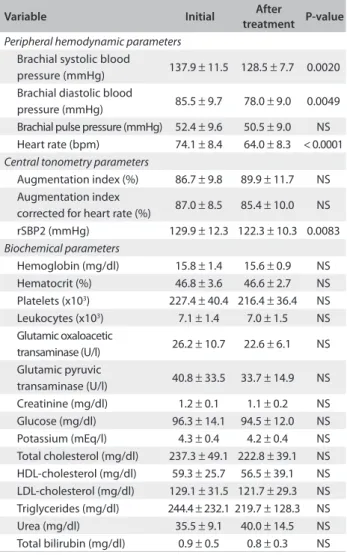
he sample was composed of 26 patients (88.5% male) with a mean age of 49.7 ± 9.3 years, who were predominantly over-weight (29.6 ± 3.1 kg/m2) and had large abdominal waist cir-cumference (102.1 ± 7.2 cm). Signiicant decreases in systolic BP (P-value = 0.0020) and diastolic BP (P-value = 0.0049) were observed during the treatment with nebivolol, and these were asso-ciated with decreases in heart rate (P-value < 0.0001) and central BP (P-value = 0.0083) (Table 1). here was no diference in the AIx, with or without correction for heart rate, during the treatment period.
Table 1 displays the routine biochemical characteristics and the
pulse pressure, heart rate, SBP and DBP levels at brachial artery level and tonometry parameters (AIx, AIx(75) and central BP). Body mass index, abdominal waist measurement, fasting plasma glucose, serum lipids and other biochemical parameters did not difer between before
Table 1. Comparison of hemodynamic (peripheral and central) and biochemical parameters before and after treatment with nebivolol among stage I hypertensive patients
Variable Initial After
treatment P-value
Peripheral hemodynamic parameters
Brachial systolic blood
pressure (mmHg) 137.9 ± 11.5 128.5 ± 7.7 0.0020 Brachial diastolic blood
pressure (mmHg) 85.5 ± 9.7 78.0 ± 9.0 0.0049 Brachial pulse pressure (mmHg) 52.4 ± 9.6 50.5 ± 9.0 NS Heart rate (bpm) 74.1 ± 8.4 64.0 ± 8.3 < 0.0001
Central tonometry parameters
Augmentation index (%) 86.7 ± 9.8 89.9 ± 11.7 NS Augmentation index
corrected for heart rate (%) 87.0 ± 8.5 85.4 ± 10.0 NS rSBP2 (mmHg) 129.9 ± 12.3 122.3 ± 10.3 0.0083
Biochemical parameters
Hemoglobin (mg/dl) 15.8 ± 1.4 15.6 ± 0.9 NS Hematocrit (%) 46.8 ± 3.6 46.6 ± 2.7 NS Platelets (x103) 227.4 ± 40.4 216.4 ± 36.4 NS Leukocytes (x103) 7.1 ± 1.4 7.0 ± 1.5 NS Glutamic oxaloacetic
transaminase (U/l) 26.2 ± 10.7 22.6 ± 6.1 NS Glutamic pyruvic
transaminase (U/l) 40.8 ± 33.5 33.7 ± 14.9 NS Creatinine (mg/dl) 1.2 ± 0.1 1.1 ± 0.2 NS Glucose (mg/dl) 96.3 ± 14.1 94.5 ± 12.0 NS Potassium (mEq/l) 4.3 ± 0.4 4.2 ± 0.4 NS Total cholesterol (mg/dl) 237.3 ± 49.1 222.8 ± 39.1 NS HDL-cholesterol (mg/dl) 59.3 ± 25.7 56.5 ± 39.1 NS LDL-cholesterol (mg/dl) 129.1 ± 31.5 121.7 ± 29.3 NS Triglycerides (mg/dl) 244.4 ± 232.1 219.7 ± 128.3 NS Urea (mg/dl) 35.5 ± 9.1 40.0 ± 14.5 NS Total bilirubin (mg/dl) 0.9 ± 0.5 0.8 ± 0.3 NS
and ater treatment. Figure 1 shows a comparison of hemodynamic parameters (peripheral and central) between the basal and the fol-low-up evaluations among the patients treated with nebivolol. In this study, nebivolol signiicantly reduced brachial BP and central BP, even though the AIx and biochemical parameters remaining unchanged.
DISCUSSION
In the present study, we examined the 12-week efect of nebivolol on biochemical and tonometry parameters among stage I hyper-tensive patients without previous treatment. To our knowledge, this is the irst study on Brazilian individuals to evaluate the benei-cial efects of nebivolol on the hemodynamic proile, and it showed worthwhile reductions in peripheral and central blood pressure.
his study investigated in detail the potential efects of nebivolol, a beta-1 selective beta-blocker, on aortic stifness, wave relections and central hemodynamic parameters in patients with mild hypertension that had never been treated. In this study, nebivolol signiicantly reduced brachial and central BP, even though the AIx remained unchanged.
Brachial BP measurement is considered to be the best method for screening for and diagnosing clinical hyperten-sion. However, over recent years, assessment of CV risk in sub-jects with hypertension has led to development of more sophis-ticated methods of BP measurement, such as central BP.21 Currently, several arguments suggest that central BP is more relevant than peripheral (brachial) BP for determining CV risk assessments.19,21,22 he pressure wave generated by the let ven-tricle travels down the arterial tree and then is relected at any discontinuity of the arterial wall, especially multiple-resistance arterioles and their bifurcations. hus, the pressure waveform recorded at any site of the arterial tree is the sum of a forward travelling waveform generated by let ventricular ejection and a backward travelling wave, relected at peripheral sites.21,22 As a consequence of transmission of the pressure wave and relec-tions, SBP and pulse pressure (PP) are ampliied by as much as 10-15 mmHg when moving from the aorta to the brachial artery. his phenomenon, which is not taken into consideration in published clinical guidelines, has three major consequences, Figure 1. Comparison of systolic blood pressure, diastolic blood pressure, central systolic blood pressure and augmentation index before and after treatment with nebivolol in stage I hypertensive patients.
Systolic blood pressure before and after treatment with nebivolol
in stage I hypertensive patients
Before After
100 120 140 160
P = 0.0020
Blood pressure (mmHg)
Diastolic blood pressure before and after treatment with nebivolol
in stage I hypertensive patients
Before After
60 70 80 90 100 110
P = 0.0049
Blood pressure (mmHg)
Central systolic blood pressure before and after treatment with nebivolol in stage I hypertensive patients
Before After
100 110 120 130 140 150
P = 0.0083
Blood pressure (mmHg)
Augmentation Index before and after treatment with nebivolol
in stage I hypertensive patients
Before After
70 80 90 100 110
P = NS
Augmentation index (%)
ORIGINAL ARTICLE |
which relate to CV complications of hypertension, the choice of antihypertensive drugs and HR regulation.
Regarding CV complications, when large-conduit arter-ies are healthy and compliant (young individuals), the relected wave merges with the incident wave in the proximal aorta mostly during diastole, thereby augmenting aortic DBP and supporting coronary perfusion. In contrast, when the arteries are stif (old individuals), wave travel is faster and the relected wave merges earlier with the incident wave, thus augmenting aortic systolic rather than diastolic pressure. As a result, let ventricular ater-load is increased and coronary illing is compromised. his pathophysiological mechanism supports the idea that central BP is superior to peripheral BP for predicting CV risk and that it acts on CV risk independently of atherosclerosis and other traditional CV risk factors.19,21,22
he choice of drug treatment for hypertension is also inlu-enced by wave relections: both by their amplitude (i.e. the pro-portion of the incident wave which is relected) and by their tim-ing. Acutely, vasodilator drugs reduce the amplitude of wave relections and hence SBP.21 his situation is observed typically with nitrates, but may also occur with SRA inhibitors or calcium channel blockers. With the presence of chronic hypertension, arterial and arteriolar remodeling modiies the baseline char-acteristics (geometry, distensibility and structure) of relection sites, particularly at the arteriolar level. Under drug treatment, central SBP will be consistently reduced if vascular remodeling and relection coeicients are adequately corrected (by means of SRA or calcium channel blockade), but will remain elevated if the structures of the microvasculature and the relection coeicients remain poorly modiied despite drug treatment (β-blockers).21
It is well accepted that calcium channel blockers and drugs acting on the RAS improve endothelial function and arterial stif-ness.22-24 On the contrary, β-blockers have failed to show positive efects on vascular function and central hemodynamic parame-ters.1,25,26 For this reason, recent studies have questioned whether β-blockers are still an appropriate therapy for uncomplicated hypertension.1,25,27 Since β-blockers are a heterogeneous class of drugs with diferent pharmacological and physiological prop-erties, it may not be possible to extrapolate the results gathered from these studies using atenolol, to other drugs of the same class. It has been well demonstrated that regardless of similar reduc-tions in brachial BP, there are several diferences between the cur-rently available β-blockers.
Our results, along with other recent indings, support the conclusion that nebivolol has vascular efects that are more favorable than those of irst and second-generation β-blockers. In a double-blind randomized study comparing nebivolol and metoprolol, Kampus et al.8 demonstrated that there was a sig-niicant reduction in brachial BP with a sigsig-niicant reduction in
central BP only in the nebivolol group. In untreated hypertensive patients randomized to receive nebivolol or atenolol, Mahmud et al. observed a signiicant reduction in the brachial BP and pulse wave velocity associated with a signiicant reduction in AIx in the nebivolol group.7 Polónia et al. showed that for similar brachial BP and aortic stifness, treatment with nebivolol was associated with lower central systolic BP than treatment with atenolol.6 On the other hand, Vitale et al. showed that nebivolol was not infe-rior to the angiotensin-receptor blocker irbesartan for improving endothelial function, arterial stifness and central hemodynamic parameters in uncomplicated hypertensive patients.28
Studies on Caucasian and African-American subjects have suggested that the less effective central blood pressure control and consequently lower cardiovascular protection with older β-blockers may be due to an adverse effect from heart rate lowering on arterial wave reflection.29 Because of the vasodi-lator effect, the reduction in heart rate with nebivolol is lower than with other β-blockers, which leads to decreased wave reflection and improvement in arterial stiffness.30 Peripheral vasodilation also may contribute towards reducing the cardiac afterload, and towards reverting adverse arterial remodeling. Moreover, arterial stiffness is linked to endothelial dysfunc-tion and reduced bioavailability of nitric oxide,11 a phenom-enon that can be reduced with drugs that increase nitric oxide production, such as nebivolol. Our findings would support this mechanism and would explain the decrease in central aortic pressure observed in this study.
he present study had several limitations. hese included the duration of follow-up, lack of a control group and the study design. If the patients had been followed for a longer time, per-haps we would have observed changes in the AIx. he lack of a comparison group, in our viewpoint, was the main limitation of this study. he randomised, placebo-controlled, and double blind trial represents the gold standard in evidence based medi-cine. However, this does not invalidate the signiicant results of central BP reduction ater 12 weeks of treatment with nebivo-lol. Although brachial BP remains the principal tool used for the clinical diagnosis and monitoring of hypertension, there is an increasing body of evidence demonstrating that central BP mea-surement may be a better prognostic marker for hypertension.
algorithms based on central BP can be recommended for clini-cal practice.
CONCLUSIONS
In summary, nebivolol presents a favorable efect as an antihyper-tensive drug with possible additional capacity to improve arterial stifness by reducing central BP, a characteristic not exhibited by other β-blockers.
REFERENCES
1. Williams B, Lacy PS, Thom SM, et al. Diferential impact of blood pressure-lowering drugs on central aortic pressure and clinical outcomes: principal results of the Conduit Artery Function Evaluation (CAFE) study. Circulation. 2006;113(9):1213-25.
2. Roman MJ, Devereux RB, Kizer JR, et al. Central pressure more strongly relates to vascular disease and outcome than does brachial pressure: the Strong Heart Study. Hypertension. 2007;50(1):197-203.
3. Roman MJ, Devereux RB, Kizer JR, et al. High central pulse pressure is independently associated with adverse cardiovascular outcome the strong heart study. J Am Coll Cardiol. 2009;54(18):1730-4.
4. Protogerou AD, Papaioannou TG, Blacher J, et al. Central blood pressures: do we need them in the management of cardiovascular disease? Is it a feasible therapeutic target? J Hypertens. 2007;25(2):265-72.
5. Wang JG, Staessen JA, Franklin SS, Fagard R, Gueyier F. Systolic and diastolic blood pressure lowering as determinants of cardiovascular outcome. Hypertension. 2005;45(5):907-13.
6. Polónia J, Barbosa L, Silva JA, Bertoquini S. Diferent patterns of peripheral versus central blood pressure in hypertensive patients treated with β-blockers either with or without vasodilator properties or with angiotensin receptor blockers. Blood Press Monit. 2010;15(5):235-9. 7. Mahmud A, Feely J. Beta-blockers reduce aortic stifness in
hypertension but nebivolol, not atenolol, reduces wave relection. Am J Hypertens. 2008;21(6):663-7.
8. Kampus P, Serg M, Kals J, et al. Diferential efects of nebivolol and metoprolol on central aortic pressure and left ventricular wall thickness. Hypertension. 2011;57(6):1122-8.
9. Agabiti-Rosei E, Porteri E, Rizzoni D. Arterial stifness, hypertension, and rational use of nebivolol. Vasc Health Risk Manag. 2009;5(1):353-60. 10. Boutouyrie P, Achouba A, Trunet P, Laurent S; EXPLOR Trialist Group.
Amlodipine-valsartan combination decreases central systolic blood pressure more efectively than the amlodipine-atenolol combination: the EXPLOR study. Hypertension. 2010;55(6):1314-22.
11. Wilkinson IB, Franklin SS, Cockcroft JR. Nitric oxide and the regulation of large artery stifness: from physiology to pharmacology. Hypertension. 2004;44(2):112-6.
12. Zanchetti A. Clinical pharmacodynamics of nebivolol: new evidence of nitric oxide-mediated vasodilating activity and peculiar haemodynamic properties in hypertensive patients. Blood Press Suppl. 2004;1:17-32.
13. Ignarro LJ, Byrns RE, Trinh K, Sisodia M, Buga GM. Nebivolol: a selective beta(1)-adrenergic receptor antagonist that relaxes vascular smooth muscle by nitric oxide-and cyclic GMP-dependent mechanisms. Nitric Oxide. 2002;7(2):75-82.
14. Veverka A, Nuzum DS, Jolly JL. Nebivolol: a third-generation beta-adrenergic blocker. Ann Pharmacother. 2006;40(7-8):1353-60. 15. de Groot AA, Mathy MJ, van Zwieten PA, Perters SL. Involvement of
the beta3 adrenoceptor in nebivolol-induced vasorelaxation in the rat aorta. J Cardiovasc Pharmacol. 2003;42(2):232-6.
16. Gielen W, Cleophas TJ, Agrawal R. Nebivolol: a review of its clinical and pharmacological characteristics. Int J Clin Pharmacol Ther. 2006;44(8):344-57.
17. Friedewald WT, Levy RI, Fredrickson DS. Estimation of the concentration of low-density lipoprotein cholesterol in plasma, without use of the preparative ultracentrifuge. Clin Chem. 1972;18(6):499-502.
18. Mancia G, De Backer G, Dominiczak A, et al. 2007 Guidelines for the Management of Arterial Hypertension: the Task Force for the Management of Arterial Hypertension of the European Society of Hypertension (ESH) and of the European Society of Cardiology (ESC). J Hypertens. 2007;25(6):1105-87.
19. Laurent S, Cockcroft J, Van Bortel L, et al. Expert consensus document on arterial stifness: methodological issues and clinical applications. Eur Heart J. 2006;27(21):2588-605.
20. Vaz-de-Melo RO, Pimenta AG, Giollo Júnior LT, et al. Fatores associados ao aumento no índice de incremento de pressão radial em indivíduos hipertensos [Factors associated with increased radial augmentation index in hypertensive individuals]. Arq Bras Cardiol. 2011;97(3):241-8.
21. Safar ME, Jankowski P. Central blood pressure and hypertension: role in cardiovascular risk assessment. Clin Sci (Lond). 2009;116(4):273-82. 22. Agabiti-Rosei E, Mancia G, O’Rourke MF, et al. Central blood
pressure measurements and antihypertensive therapy: a consensus document. Hypertension. 2007;50(1):154-160.
23. Morgan T, Lauri J, Bertram D, Anderson A. Efect of diferent antihypertensive drug classes on central aortic pressure. Am J Hypertens. 2004;17(2):118-23.
24. Schneider MP, Delles C, Klingbeil AU, et al. Efect of angiotensin receptor blockade on central haemodynamics in essential hypertension: results of a randomised trial. J Renin Angiotensin Aldosterone Syst. 2008;9(1):49-56.
25. Lindholm LH, Carlberg B, Samuelsson O. Should beta blockers remain irst choice in the treatment of primary hypertension? A meta-analysis. Lancet. 2005;366(9496):1545-53.
26. Bangalore S, Messerli FH, Kostis JB, Pepine CJ. Cardiovascular protection using beta-blockers: a critical review of the evidence. J Am Coll Cardiol. 2007;50(7):563-72.
ORIGINAL ARTICLE |
28. Vitale C, Marazzi G, Iellamo F, et al. Efects of nebivolol or irbesartan in combination with hydrochlorothiazide on vascular functions in newly-diagnosed hypertensive patients: the NINFE (Nebivololo, Irbesartan Nella Funzione Endoteliale) study. Int J Cardiol. 2012;155(2):279-84.
29. Kamran H, Salciccioli L, Bastien C, et al. Efect of beta blockers on central aortic pressure in African-Americans. J Am Soc Hypertens. 2011;5(2):94-101.
30. Cockcroft J. A review of the safety and eicacy of nebivolol in the mildly hypertensive patient. Vasc Health Risk Manag. 2007; 3(6):909-17.
Acknowledgement: The authors wish to thank Torrent-Brazil for inancial support
Source of funding: This study was supported by grants from Torrent-Brazil (Estudo APROVO Protocolo APV-C006)
Conlict of interest: None
Date of irst submission: April 23, 2013
Last received: October 14, 2013
Accepted: October 18, 2013
Address for correspondence: José Fernando Vilela-Martin Av. Anísio Haddad, 7.700 — casa 129 Condomínio Village Santa Helena São José do Rio Preto (SP) — Brasil CEP 15093-000