RESUMEN
Estudio transversal que tuvo como objeivo evaluar la comodidad de los cuidadores de pacientes con cáncer. Pariciparon 88 cui -dadores de pacientes en atención ambula-toria de un hospital oncológico. Para la re-colección de los datos, se uilizó el General Comfort Quesionnaire (GCQ) validado para el portugués. La puntuación media del GCQ de los cuidadores fue de 203,9. Las mejo-res puntuaciones de comodidad estaban relacionadas con la edad y la ocupación del cuidador; los aspectos posiivos fueron senirse amado, comodidad ísica del pa -ciente y de su ambiente y la espiritualidad del cuidador. Las peores puntuaciones fue-ron observadas en los cuidadores que no ienen trabajo remunerado o descanso. Se concluye que la escala GCQ puede ayudar a ideniicar factores que interieren en la comodidad de los cuidadores de pacientes con cáncer, así como ideniicar las necesi -dades que permitan la intervención de los profesionales de la salud.
DESCRIPTORES Neoplasias Cuidadores Saisfacción personal Calidad de vida Enfermería oncológica RESUMO
Estudo transversal cujo objetivo foi ava-liar o conforto de cuidadores de pacien-tes com câncer. Envolveu 88 cuidadores de pacientes em atendimento ambula-torial de um hospital especializado em oncologia. Utilizou-se o General Comfort Questionnaire (GCQ) validado para o português. Verificou-se que o escore mé-dio do GCQ dos cuidadores foi de 203,9. Os melhores escores de conforto estive-ram relacionados à idade e ocupação do cuidador; os aspectos positivos do forto envolveram sentir-se amado, o con-forto ambiental e físico do paciente e a espiritualidade do cuidador. Cuidadores que não exerciam atividade remunerada ou lazer apresentaram piores escores de GCQ. Concluiu-se que escala de GCQ pode ajudar a identificar fatores que in-terferem no conforto dos cuidadores de pacientes com câncer, assim como neces-sidades que permitam a intervenção dos profissionais de saúde.
DESCRITORES Neoplasias; Cuidadores Saisfação pessoal Qualidade de vida Enfermagem oncológica ABSTRACT
Cross-secional study, carried out at the out -paient clinic of an oncology hospital. Data were collected from 88 caregivers of cancer paients using the Caregiver General Com -fort Quesionnaire (GCQ) to assess the care -givers’ comfort. The care-givers’ GCQ score mean was 203.9; beter comfort scores was associated with age, care ime and current occupaion; posiive aspects of comfort were related to the fact that caregivers felt loved, to paients’ physical and environmental comfort and to caregivers’ spirituality. 203.9; beter comfort scores were associated with age of the caregiver and current occupaion; posiive aspects of comfort were related to the fact that caregivers felt loved, to paients’ physical and environmental comfort and to caregivers’ spirituality. Caregivers, who didn’t have a paid job or leisure’s aciviies showed a worse GCQ. The GCQ scale can help to iden-ify factors that interfere in caregivers’ com -fort, as well as needs that can be modiied through health professionals’ intervenions.
DESCRIPTORS Neoplasms Caregivers
Personal saisfacion Quality of life Oncologic nursing
O
riginal
a
rticle
1 Undergraduate student, School of Nursing, São Paulo University, São Paulo, SP, Brazil. [email protected] 2 Associate Professor, School of
Nursing, São Paulo University, São Paulo, SP, Brazil. [email protected] 3 Associate Professor (Emeritus) University of Akron, Adjunct Faculty, Ursuline College.
DOI: 10.1590/S0080-623420140000200012
Cancer patients caregivers comfort
Daniela de Araújo Lamino1, Ruth Natalia Teresa Turrini2, Katharine Kolcaba3 CONFORTO DE CUIDADORES DE PACIENTES COM CÂNCER
INTRODUCTION
The evolution of cancer and its consequences for patients are well known, but there is a lack of research assessing the impact of the disease on the primary caregivers’ well-being. These caregivers tend to be fam-ily members, assume care tasks and spend most time with patients.
Disease progression weakens patients and increases
their dependence, turning caregivers’ activities
increas-ingly necessary and often stressful(1). Prolonged
in-volvement in care activities may have a negative effect on caregivers’ physical and emotional health and can be intensified with the disease progression, the impos-sibility of cure and the approximation of death. The ac-cumulation of tasks or socioeconomic difficulties could decrease the caregivers’ global well-being.
Taking care of a relative with advanced cancer gen-erates physical and emotional tiredness, stress and
oth-er health problems(2). The principal caregivers describe
the lack of freedom to do things beyond patient care, feelings of solitude and tiredness as negative aspects of care delivery(3).
Caregivers acknowledge positive aspects of care. Elderly cancer patients’ caregivers had described care as an act of self-giving and protecting the other, with faith as a motivation for care that grants their personal
and family growth(4) and an opportunity to express their
love through care delivery to a family member.
Measuring well-being and identifying variables that can influence primary caregivers’ quality of life can guide the construction of adequate interventions to help them in this phase. One of the ways to assess well-being is through perceived comfort.
Comfort is a subjective and individual concept, com-prising physical, environmental, social and psycho-spiri-tual aspects. Comfort is holistic and can occur to a greater or lesser extent depending on different factors, involv-ing individuals and their personal perceptions. Hence,
physical symptoms, organization of the environment,
interpersonal relations, individual beliefs and values are
related with patients and caregivers’ experiences(5-6).
The comfort concept has been explored in literature according to patients’ personal perceptions and has
also been used as a synonym of well-being(7-8).
Kolcaba’s comfort theory departs from the premise that the comfort experience involves a sense of ease (a state of tranquility, satisfaction or contentment), relief (the experience of having a specific need relieved) and transcendence (a state in which someone overpasses problems or pain); it can be experienced in four con-texts: physical, psycho-spiritual, environmental and
General Comfort Questionnaire (GCQ), an instrument to measure comfort and identify positive and negative aspects involved in care delivery to a patient with ad-vanced cancer. The questionnaire has two versions: one for use with patients and the other with caregivers.
The GCQ was translated and validated for use in
Brazilian terminal cancer patients(8). The questionnaire
was first tested in a group of 133 informal caregivers of women with terminal gynecological or breast cancer.
The multidimensional aspects involved in the gener-al comfort of care patients’ primary caregivers through the use of scales have received little attention in litera-ture. The goal of this study is to assess the comfort of cancer patients’ primary caregivers and verify the as-sociation between comfort and variables related to pa-tients, the disease and the principal caregivers.
METHOD
This cross-sectional study was carried out at the oncology outpatient clinic of a governmental oncology
teaching hospital between October 2008 and July 2009, in São Paulo city (Brazil). The sample was composed of
the principal caregivers of cancer patients under out-patient follow-up. A Cohen’s d of 0.3 was found
signifi-cant with 80% power and 95% confidence level, result
-ing in a sample of 88 patients. Inclusion criteria for the caregivers were: over 18 years of age and serving as
the principal caregiver for a cancer patient with func-tional capacity measured by Karnofsky scale less than or equal to 50.
Approval for the project was obtained from the
Institutional Review Board at the hospital where data collection took place (process Nº. 0644/08). Caregiv -ers who met the inclusion criteria and agreed to par-ticipate were informed about the research aims, the guarantees of anonymity, the freedom to participate
in the research or not, and signed the Informed Con -sent Term.
Data collection procedures
Caregivers of patients with Karnofsky scores of no greater than 50 were contacted in the waiting room for outpatient care. Principal caregivers were identified by the patients when communication was possible, or by another companion present at the time of data collec-tion. The researcher assisted the caregiver during data collection as needed such as reading the instruments to them, so as to deal with illiteracy, low education or reading difficulty problems.
marital status, tumor site, diagnosis date, current treat-ment and patient’s functional capacity. The patients’ functional capacity was described with the help of the
Karnofsky Scale(9), which assesses the ability to perform
activities of daily living. This score can range from 0 to 100, where 0 means death and 100 good health. The caregiver’s questionnaire was completed during the interview with the caregiver, with questions on the subject’s socio-demographic data, care time and other functions performed.
The version of the GCQ validated for Portuguese
language was used(8) to assess comfort. This scale
con-tains 49 items that assess the caregiver’s comfort in the physical, social, psycho-spiritual and environmen-tal dimensions. The GCQ is a multidimensional
instru-ment to identify caregivers’ different needs. Scores
can range from 49 (very little comfort) to 294 (excel-lent comfort). Each item in the questionnaire includes a six-point Likert scale, with one meaning the care-giver totally disagrees and six that the carecare-giver total-ly agrees with the assertion in each of the questions.
Statistical analyses
For data analysis, SPSS (Statistical Package for Social Science®) software was adopted. Central trend mea -sures were used for the quantitative variables. Comfort
was analyzed through means and standard deviations (SD). The Mann-Whitney or Kruskal-Wallis test was ap -plied to check the difference in mean scores for the
study variables with significance set at 5%. Correlation of Spearman was used to the continues variables (age, familiar income, timing of care, time for diagnoses). Re -liability of the GCQ was tested with Cronbach’s alpha.
RESULTS
Characterisics of the caregivers
A total of 88 caregivers were interviewed. Female caregivers predominated (n=74; 84.4%), younger than 50 (n=54; 61.4%; range 18 to 81) and gaining less than three minimum wages (n=44; 50.0%). At the ime of data collec
-ion, the minimum wage was about US$250. Approximate
-ly 76.0% (n=67) lived with a partner, 90.0% (n=79) were religious, 54.5% (n=48) had at least two children, 38.6% (n=34) were partners and 39.8% (n=35) the paients’ chil
-dren, 61.4% (n=54) received help from another person to deliver care, mainly siblings or children, 78.0% (n=69) did not have any leisure and 71.6% (n=63) did not have a paid job. Average ime as caregiver was 20.3 months (median
27.2; range from 1 to 144), with half of them serving in this role for less than eight months.
Characterisics of the paients
Paients were mostly women (n=45; 51.1%), older than 50 (n=72; 81.8%; range 25 to 90) and living with a partner (n=62; 70.5%). Digesive (n=32; 36.4%), urological (n=13; 14.8%) and head and neck tumors (n=9; 10.2%) were the most prevalent cancer and 55.7% (n=49) had a Karnofsky funcional capacity of 40. The diagnosis of 49.4% (40/81) of paients was reached in the last twelve months.
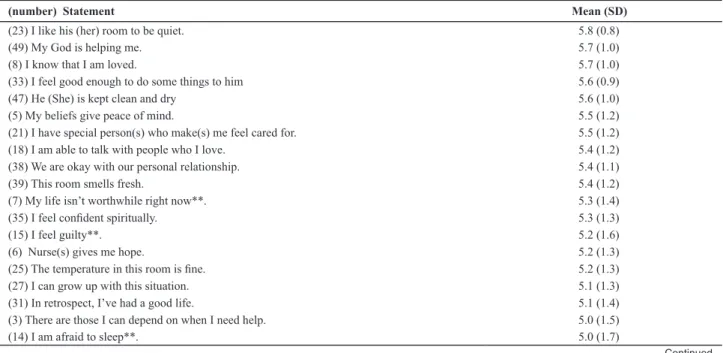
The reliability of the caregivers’ GCQ scale was 0.814. Great variaion was found in GCQ score (140-263), with an average of 203.9 (SD=22.4). The mean score for each item ranged between 1.2 and 5.8. The means and stan
-dard deviaions for each item that was scored at 1 and 6
are presented in Table 1.
Continued...
Table 1 - Means and standard deviations for each item of the GCQ scale - São Paulo, 2009
(number) Statement Mean (SD)
(23) I like his (her) room to be quiet. 5.8 (0.8)
(49) My God is helping me. 5.7 (1.0)
(8) I know that I am loved. 5.7 (1.0)
(33) I feel good enough to do some things to him 5.6 (0.9)
(47) He (She) is kept clean and dry 5.6 (1.0)
(5) My beliefs give peace of mind. 5.5 (1.2)
(21) I have special person(s) who make(s) me feel cared for. 5.5 (1.2) (18) I am able to talk with people who I love. 5.4 (1.2) (38) We are okay with our personal relationship. 5.4 (1.1)
(39) This room smells fresh. 5.4 (1.2)
(7) My life isn’t worthwhile right now**. 5.3 (1.4)
(35) I feel conident spiritually. 5.3 (1.3)
(15) I feel guilty**. 5.2 (1.6)
(6) Nurse(s) gives me hope. 5.2 (1.3)
(25) The temperature in this room is ine. 5.2 (1.3)
(27) I can grow up with this situation. 5.1 (1.3)
(31) In retrospect, I’ve had a good life. 5.1 (1.4)
(3) There are those I can depend on when I need help. 5.0 (1.5)
Items beter scored that reached the score 6 were mainly
related to environmental and spiritual aspects, while those with score 1 were preferably related to aspects in the social dimension of comfort. Considering the total of 49 items of
the scale, in 40.8% (n=20) of them, caregivers signed in the
Likert scale the higher score, while half of the caregivers
as-signed the lower score to only 14.3% (n=7) of items.
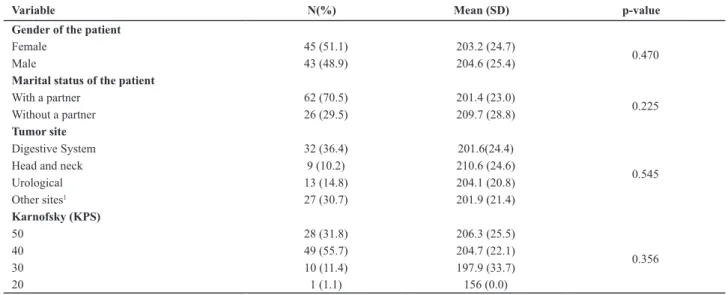
The correlaion between the caregivers’ score of GCQ and the age of the paient didn’t show any signiicant
result (r=0.083; p=0.083) even to the ime for diagnoses (r=0.07; p=0.536) that ranged from 1 to 468 months. Sta
-isically signiicant diference was not found between others paient and disease characterisics and the caregi -vers’ mean GCQ score (Table 2).
Analyzing the mean GCQ scores according to caregiver characterisics (Table 3), a staisically signiicant diferen -ce was observed between the caregivers’ mean GCQ score
and current occupaion (p=0.05) variable.
Continuation...
(number) Statement Mean (SD)
(41) I am able to tell people what I need. 5.0 (1.5)
(4) I worry about my family.** 1.1 (0.4)
(34) I think about his (her) discomforts constantly. ** 1.4 (0.9) (36) I need to be better informed about his (her) condition.** 1.9 (1.6) (24) I would like to see the doctor more often.** 2.1 (1.6) (45) His (her) emotional state let me sad. ** 2.1 (1.8)
(46) I think for the future.** 2.1 (1.7)
(48) I worry about inancial concerns.** 2.1 (1.6)
**inverted items
Table 2 - Mean and standard deviation of GCQ score of principal caregivers according to social demographic and clinical characteris-tics of the patients - São Paulo, 2009
Variable N(%) Mean (SD) p-value
Gender of the patient
Female 45 (51.1) 203.2 (24.7)
0.470
Male 43 (48.9) 204.6 (25.4)
Marital status of the patient
With a partner 62 (70.5) 201.4 (23.0)
0.225
Without a partner 26 (29.5) 209.7 (28.8)
Tumor site
Digestive System 32 (36.4) 201.6(24.4)
0.545
Head and neck 9 (10.2) 210.6 (24.6)
Urological 13 (14.8) 204.1 (20.8)
Other sites1 27 (30.7) 201.9 (21.4)
Karnofsky (KPS)
50 28 (31.8) 206.3 (25.5)
0.356
40 49 (55.7) 204.7 (22.1)
30 10 (11.4) 197.9 (33.7)
20 1 (1.1) 156 (0.0)
1 Bone, soft tissues, lung, breast, skin, brain, spinal cord, gynecologic and ophthalmologic tumors and lymphomas.
Table 3 - Mean and standard deviation of GCQ score of principal caregivers according to their social demographic characteristics - São Paulo, 2009
Variable N(%) Mean (SD) p-value
Gender
Female 74 (84.4) 207 (26.3)
0.276
Male 14 (15.3) 210 (15.3)
Marital status of the patient
With a partner 67(76.1) 201.7 (24.2)
0.212
Without a partner 21 (23.9) 211 (26.6)
Religion
Catholic 44 (50.0) 202.4 (24.1)
0.326
Evangelic 24 (27.3) 200.2 (25.3)
Others1 11 (12.5) 217.4(24.4)
DISCUSSION
The instrument used to assess the caregiver’s comfort
showed a good internal consistency. The scale permited a quanitaive analysis of cancer paient caregivers’ com
-fort, the ideniicaion of factors interfering in the caregiv
-ers’ comfort and of needs that can be modiied through health professionals’ intervenions.
The paients’ socio-demographic and morbidity char
-acterisics were not related to the caregivers’ comfort, although the caregiver for the paient with the lowest Kar
-nofsky funcional capacity, i.e. the most care-dependent, obtained the lowest GCQ score. Descripions in literature report that paients’ decreased funcional capacity can in -crease depression in caregivers(10).
Because of the paients’ dependence level, most of
the caregivers received help from another person for care. Other studies show that, when present, extra help
always comes from a relaive(11), similar to the present
study results.
It was observed that iming of care posiively afects caregivers’ comfort. This inding reveals that, over ime, caregivers gain coping mechanisms or ways of adaping to the disease and rouines, which enhances comfort.
The lower GCQ scores in female and younger caregiv-ers were also found among caregivcaregiv-ers of breast cancer
paients(8). Ages over 50 years favorably afected caregiv
-ers’ comfort, as younger caregivers, perhaps due to their
lack of life experience, faced greater diiculies to deal
with the onus of care. Having a paid job also showed to
be a posiive factor for caregivers, in view of evidence that keeping up a producive acivity in the job market enhanc
-es self--esteem and pr-eserv-es individuality, contribuing to
greater well-being and quality of life.
Like in the present study, a research involving
care-givers for cancer paients undergoing chemotherapy ob -served that most informal caregivers were also female,
the paients’ partners or children, and younger than 50.
Although the study assessed caregivers’ quality of life, the
authors ideniied that male caregivers had a beter quality
of life, mainly in the psychological and social domains(12).
A study developed in a chemotherapy unit of a uni-versity hospital in Turkey with family caregivers found that
40.0% of them were younger than 35 years, 58.9% were female, 38.4% of caregivers were the son or daughter of the paient and 32.1% had been caring to the paient for over a year. Results of logisic regression analysis con
-cluded that factors that had an efect on the quality of life
were being under 50 years, having a low income and
be-ing the spouse and parent of the paient(13).
Great variaion in income was found in this study. Half
of the caregivers not only reported a low income, but also showed lower comfort. A Korean study with family
caregivers of terminal ill cancer paients showed that the
percentage of not working among family caregivers was
almost two fold higher than in general populaion and the main reason was for caregiving; 32.3% of them reported extreme faigue. Providing care for terminal cancer pa
-ients instead of working worsens the economic condi
-ions of family caregivers with lower monthly incomes(14). Religious beliefs can support people at imes of cri
-sis and, in this study, most caregivers menioned being
religious.
A study with caregivers of paients with advanced can
-cer in a palliaive care outpaient clinic found that spiri -tuality and religiosity helped them cope with their loved one’s illness, and many reported that spirituality and
reli-giosity had a posiive impact on their loved one’s physical and emoional symptoms(15).
Continuation...
Variable N(%) Mean (SD) p-value
Number of children
Up to 1 40 (45.5) 205.8 (22.6)
0.580
2 a 5 48 (54.5) 203.3 (26.8)
Familiar relationship
Partner 34 (38.6) 201.6 (23.0)
0.782
Son (daughter) 35 (39.8) 203.6 (26.6)
Other2 19 (21.6) 208.5 (25.9)
Receive help to care
Yes 54 (61.4) 204.4 (23.6)
0.781
No 34 (38.6) 203.1 (27.3)
Leisure
Yes 19 (21.8) 212.8 (21.5)
0.093
No 69(78.2) 201.4 (25.4)
Work
Yes 25 (28.4) 213 (26.5)
0.05
No 63 (71.6) 200.3 (23.5)
The identification of positive aspects influencing caregivers’ comfort reveals factors that can be encour-aged during assistance to caregivers and families, per-mitting behavioral modifications, strengthening and stimulating caregivers to achieve the best possible comfort as the disease evolves and as patients’ depen-dence increases.
Negative influences on caregivers’ comfort were related to family and financial issues concern, com-munication difficulties and patients’ discomfort. These results show the impact of care delivery to a cancer pa-tient on caregivers’ comfort, as well as efficient com-munication and support needs, factors that health professionals’ interventions can modify through
indi-vidualized actions. Trust, hope, availability and kind -ness need to be transmitted to the caregivers, contrib-uting to a better comfort.
Caregivers’ communication with their relatives and friends, and greater knowledge on the disease have been described as positive strategies for the
caregiv-ers(16). Caregivers want more attention from health
professionals(17) and need to receive clear information
on the patient(18). In this context, nurses can support
patients and families by identifying and enhancing
their strong points, mobilizing patients and families’
coping resources(19).
Family caregivers of advanced cancer patients get involved in symptom management and are almost fully responsible for domestic routines. Caregivers’ roles negatively affect their health and interfere in their anxi-ety and energy level. However, they find an important meaning in their role, and feel relatively well prepared to deliver care(20).
CONCLUSION
As time goes by, caregivers also experience an adap-tation process to the transformations that the disease progression imposes and to the patients’ increased care demands.
The small number of caregivers for paients with re
-duced funcional capacity is one of the study limitaions. Due to the paients’ dependence and low purchasing power, they may have faced diiculies in atending out
-paient follow-up. Follow up for the -paients in this study was transferred to a new hospital specialized in oncol -ogy, which may have enhanced assessments of items
re-lated to the environment. Some interviewees, with low educaion levels, faced reading diiculies, needing help from the interviewer to ill out the instrument, which
may have biased the answers.
Implicaions for nursing
The quesionnaire used in this research enabled to idenify caregivers’ comfort needs, as well as posiive and negaive care aspects that can guide the construcion of nursing intervenions. The ideniied posiive aspects should be simulated and valued in caregivers, so as to enhance resilience and reduce sufering. Prevenion and awareness-raising programs can be put in pracice for can
-cer paients, addressing the use of their internal resourc
-es, simulaing them towards overcoming and adaptaion to diicult situaions.
The use of mulidimensional holisic assessment in
-struments with cancer paients’ caregivers can be useful in muli-professional teams’ of clinical pracice as they
seek to improve care delivery to caregivers.
REFERENCES
1. Paim J, Travassos C, Almeida C, Bahia L, Macinko J. O sistema
de saúde brasileiro: história, avanços e desaios. The Lancet Saúde no Brasil [Internet]. 2011 [citado 2012 jun. 24]. Dispo
-nível em: htp://download.thelancet.com/latcontentassets/ pdfs/brazil/brazilpor1.pdf
2. Favoreto CAO. A práica clínica e o desenvolvimento do cuida
-do integral à saúde no contexto da atenção primária. Rev APS. 2008;11(1):100-108.
3. Matumoto S, Fortuna CM, Kawara LS, Mishima SM, Pereira
MJB. Nurses’ clinical pracice in primary care: a process under construcion. Rev Laino Am Enferm. 2011; 19(1):123-30.
4. Lunardi VL, Barlem ELD, Bulhosa MS, Santos SSC, Lunardi Filho
WD, Silveira RS, et al. Sofrimento moral e a dimensão éica no trabalho da enfermagem. Rev Bras Enferm. 2009; 62(4):599-603.
5. Maestro FJ, Marinez-Romero M, Vazquez-Naya JM, Pereira J,
Pazos A. Ethical and legal issues in the clinical pracice of pri -mary health care. Front Biosci. 2013;5:435-45.
6. Le Boterf G. Desenvolvendo a competência dos proissionais. Porto Alegre: Artmed; 2007.
7. Paganini MC, Egry EY. The ethical component of profes-sional competence in nursing: an analysis. Nurs Ethics.
2011;18(4):571-82.
8. Brasil. Ministério da Educação; Conselho Nacional de
9. Fernandes JD, Silva RMO, Teixeira GA, Florencio RMS, Silva LS,
Rebouças LCC. Aderência de cursos de graduação em enfer
-magem às diretrizes curriculares nacionais na perspeciva do SUS. Esc Anna Nery Rev Enferm. 2013;17(1):82-9.
10. Bordignon SS, Lunardi VL, Dalmolin GL, Tomaschewski JG,
Lunardi Filho WD, Barlem ELD, et al. Questões éicas do co
-idiano proissional e a formação do enfermeiro. Rev Enferm UERJ. 2011;19(1):94-9.
11. Kälvemark Sporrong S, Arnetz B, Hansson MG, Westerholm
P, Höglund AT. Developing ethical competence in health care organizaions. Nurs Ethics. 2007;14(6):825-37.
12. Ramos FRS, Brehmer LCF, Vargas MAO, Schneider DG, Drago LC. Ethics constructed through the process of nurse training:
concepions, spaces and strategies. Rev Laino Am Enferm.
2013; 21(n.spec):113-21.
13. Burgai JC, Leonello VM, Bracialli LAD, Oliveira MAC. Estra -tégias pedagógicas para o desenvolvimento da competência
éico-políica na formação inicial em Enfermagem. Rev Bras Enferm. 2013;66(2):282-6.
14. Polit DF, Beck CT. Fundamentos de pesquisa em enferma
-gem: avaliação de evidência para a práica da enfermagem.
Porto Alegre: Artmed; 2011.
15. Grupo Hospitalar Conceição. Atenção à Saúde [Internet].
Porto Alegre; 2012 [citado 2012 jun. 24]. Disponível em: ht -tp://www.ghc.com.br/default.asp?idMenu=atencao_saude
16. Zoboli ELCP, Fortes PAC. Bioéica e atenção básica: um peril
dos problemas éicos vividos por enfermeiros e médicos do Programa Saúde da Família, São Paulo, Brasil. Cad Saúde Pú -blica. 2004;20(6):1690-99.
17. Lillemoen L, Pedersen R. Ethical challenges and how to develop support in primary health care. Nurs Ethics.
2012;20(1):96-108.
18. Laabs C. Moral problems and distress among nurse
prac-iioners in primary health care. J Am Acad Nurs Pract. 2005;17(2):76-84.
19. Cronqvist A, Nyström M. A theoreical argumentaion
on the consequences of moral stress. J Nurs Manag. 2007;15(4):458-65.
20. Eizenberg MM, Desivilya HS, Hirschfeld MJ. Moral distress
quesionnaire for clinical nurses: instrument development. J Adv Nurs. 2009;65(4):885-92.
21. Grady C, Danis M, Soeken KL, O’Donnell P, Taylor C, Farrar
A, et al. Does ethical educaion inluence the moral ac
-ion of pracicing nurses and social workers? Am J Bioeth. 2008;8(4):4-11.
22. Cerit B, Dinç L. Ethical decision-making and professional
behavior among nurses: a correlaional study. Nurs Ethics.
2012;20(2):200-12.
23. Sletebo A, Haugen Bunch E. Ethics in nursing homes: expe
-rience and casuistry. Int J Nurs Pract. 2004;10(4):159-65.
24. Andrews DR. Fostering ethical competency: an ongoing staf development process that encourages professional growth
and staf saisfacion. J Conin Educ Nurs. 2004;35(1):27-33.
25. Pauly B, Varcoe C, Storch J, Newton L. Registered nurses’
percepions of moral distress and ethical climate. Nurs
Ethics. 2009;16(5):561-73.
26. Brasil. Ministério da Saúde; Secretaria de Gestão do Traba
-lho e da Educação na Saúde, Departamento de Gestão da Educação em Saúde. Políica Nacional de Educação Perma
-nente em Saúde [Internet]. Brasília; 2009 [citado 2012 jun. 24]. Disponível em: htp://bvsms.saude.gov.br/bvs/publica
-coes/poliica_nacional_educacao_permanente_saude.pdf
Acknowledgments
e
rratum
As published in Volume 48, number 2 of 2014,on pages 278 to 284, the published references of the aricle “Cancer paients caregivers comfort”, should be excluded; therefore, the following list should be considered:
1. Wong RK, Franssen E, Szumacher E, Connolly R, Evans M, Page B, et al. What do paients living with advanced cancer and their
carers want to know? – a needs assessment. SupportCareCancer. 2002;10(5):408-15.
2. Chavez ARM, Vasconcelos AM. O cuidador no provimento do cuidado ao paciente com câncer avançado no Insituto Nacional do
Câncer [resumo de tese]. RevBrasCancerol. 2006;52(1):111.
3. Lahan CF. Percepção de perdas e ganhos subjeivos entre cuidadores de pacientes atendidos em um programa de assistência
domiciliar [dissertação]. São Paulo: Faculdade de Medicina, Universidade de São Paulo; 2003.
4. Vieira MCU. Senimentos, saberes e fazeres do cuidador principal do idoso com câncer [dissertação]. Maringá:
UniversidadeEs-tadual de Maringá; 2006.
5. Kolcaba KY. A taxonomic structure for the concept comfort. Image J Nurs Sch. 1991;23(4):237-40.
6. Kolcaba KY. The theory of holisic comfort for nursing. J AdvNurs. 1994;19(6):1178-84.
7. Mussi FC, Friedlander MR, Arruda EN. Os signiicados da palavra conforto segundo a perspeciva do paciente com infarto agudo
do miocárdio. Rev Laino AmEnferm. 1996;3(4):19-39.
8. Rezende VL, Derchain SFM, Botega NJ, Vial DL. Revisão críica dos instrumentos uilizados para avaliar aspectos emocionais, ísicos
e sociais do cuidador de pacientes com câncer na fase terminal da doença. Rev Bras Cancer. 2005;51(1):79-87.
9. Karnofsky DA, Burchenal JH. The clinical evaluaion of chemotherapeuic agents. In: MacLeod CM, editor. Evaluaion of chemo-therapeuic agents. New York: Columbia University Press; 1949.
10. Grunfeld E, Coyle D, Whelan T, Clinch J, Reyno L, Earle CC, et al. Family caregiver burden: results of a longitudinal study of breast
cancer paients and their principal caregivers. Can Med Assoc J. 2004;170(12):1795-801.
11. Hinton J. Can home care maintain na acceptable quality of life for paients with terminal cancer and their relaives?Palliat Med.
1994;8(3):183-96.
12. Alptekin S, Gönülü G, Yücel I, Yaris F. Characterisics and quality of life analysis of caregivers of cancer paients. Med Oncol.
2010;27(3):607-17.
13. Turkoglu N, Kilic D. Efects of care burdens of caregivers of cancer paients on their quality of life. Asian Paciic J Cancer Prev.
2013;13(8):4141-5.
14. Seon YK, Yoon-Jung C, Young RD, Sam YK, Sang YP, Hyun SJ, et al. Employment status and work-related diiculies among family
members of terminally ill paients compared with the general populaion. Asian Pac J Cancer Prev. 2013;14(1):373-9.
15. Delgado-Guay MO, Parsons HA, Hui D, De la Cruz MG, Thorney S, Bruera E. Spirituality, religiosity, and spiritual pain among care-givers of paients with advanced cancer. Am J HospPalliat Care. 2013;30(5):455-61.
16. Steele RG, Fitch MI. Coping strategies of family caregivers of home hospice paients with cancer. OncolNurs Forum. 1996;23(6):955-60.
17. Osse BH, Vernooij-Dassen MJ, Schadé E, Grol RP. Problems experienced by the informal caregivers of cancer paients and their
needs for support. Cancer Nurs. 2006;29(5):378-88; quiz 389-90.
18. Shirayama H, Iuchi M, Asada H, Yokoi H, Fujita T. The inluence of family willingness to home palliaive care. GanTo Kagaku Ryoho.
2006;33Suppl 2:341-4.
19. Khalili Y. Ongoing transiions: the impact of a malignant brain tumor on paient and family. Axone. 2007;28(3):5-13.
20. Aranda SK, Hayman-White K. Home caregivers of the person with advanced cancer: an Australian perspecive. Cancer Nurs.