* Extracted from the master’s dissertation “Custo da rotatividade da equipe de enfermagem em hospital de ensino”, Programa de Pós-Graduação em Enfermagem, Faculdade de Medicina de São José do Rio Preto, 2014.
1 Faculdade de Medicina de São José do Rio Preto, Programa de Pós-Graduação em Enfermagem, São José do Rio Preto, SP, Brazil. 2 Faculdade de Medicina de São José do Rio Preto, Departamento de Enfermagem Especializada, São José do Rio Preto, SP, Brazil.
Received: 06/02/2015 Approved: 12/29/2015
ORIGINAL ARTICLE DOI: http://dx.doi.org/10.1590/S0080-623420160000100014
ABSTRACT
Objective: To map the sub processes related to turnover of nursing staf and to investigate and measure the nursing turnover cost. Method: his is a descriptive-exploratory study, classiied as case study, conducted in a teaching hospital in the southeastern, Brazil, in the period from May to November 2013. he population was composed by the nursing staf, using Nursing Turnover Cost Calculation Methodology. Results: he total cost of turnover was R$314.605,62, and ranged from R$2.221,42 to R$3.073,23 per employee. he costs of pre-hire totaled R$101.004,60 (32,1%), and the hiring process consumed R$92.743,60 (91.8%) he costs of post-hire totaled R$213.601,02 (67,9%), for the sub process decreased productivity, R$199.982,40 (93.6%). Conclusion: he study identiied the importance of managing the cost of staf turnover and the inancial impact of the cost of the employee termination, which represented three times the average salary of the nursing staf.
DESCRIPTORS
Nursing, Team; Personnel Turnover; Personnel Administration, Hospital; Costs and Cost Analysis.
Cost of nursing turnover in a Teaching Hospital*
Custo da rotatividade da equipe de enfermagem em hospital de ensino Costo de la rotatividad del equipo de enfermería en hospital de enseñanza
Paula Buck de Oliveira Ruiz1, Marcia Galan Perroca2, Marli de Carvalho Jericó2
How to cite this article:
Ruiz PBO, Perroca MG, Jericó MC. Cost of nursing turnover in a Teaching Hospital. Rev Esc Enferm USP. 2016;50(1):101-8. DOI: http://dx.doi.org/10.1590/ S0080-623420160000100014
Corresponding author: Paula Buck de Oliveira Ruiz Praça do Arpoador, 320
Cost of nursing turnover in a Teaching Hospital INTRODUCTION
Nursing Turnover is a global concern, however, its deinition and measurement vary according to the authors used(1-2). It is deined and presented in literature in diferent
ways, as the luctuation between the hiring and termination of employees(3), or just by the number of employees
termi-nated in relation to the number of employees who work at the institution(4).
he causes of turnover are related to external phenom-ena (supply and demand in the labor market and economic situation) and internal phenomena (salary policy, types of supervision and organizational conditions)(5).
here is a lack of consensus regarding the optimal rate of turnover, but what must be considered is that there should not be losses to the harmony of the institution. When this value is null, it demonstrates a stagnation of the institution, and if this rate is high, it leads to losses in productivity(6). It
is considered that an optimal turnover rate would be one in which the institution can retain their quality staf, replacing those with poor performance(3).
Healthcare organizations spend a lot of money to re-place nurses and lose intellectual capital when they quit, showing as a consequence potential productivity losses associated with this turnover(7). A study conducted in the
United States estimated the cost of hiring new nurses, to the institution, at US$856 million per year, ranging from US$1.4 to US$2.1 billion for society. However, this esti-mate may be low, as they included only the costs associated with the hiring of new nurses(8).
here are few national(9-10) and international(2-4,7) studies
exploring the cost of turnover, as well as the use of a standard methodology for the survey of expenditures/investments. In Brazilian literature, it is proposed that the calculation of cost is composed by primary, secondary and tertiary costs. he pri-mary costs are related to the termination of each employee and their replacement by another, secondary costs are related to extra-labor and extra-operational expenditures, and the tertiary costs consist of estimated costs and parallel efects related to turnover(3). Hiring process studies, training and termination of
direct costs of labor showed the time taken by professionals and their monetary value(9-10), and also the materials consumed
in each step of the process(10).
Internationally, studies propose diferent methodologies for calculating cost of turnover. Some use the stages of hir-ing to calculate the cost of turnover(11). Other authors estimate
the direct and indirect costs based on the management model, which considers hiring, their productivity and termination. his model recognizes characteristics of the patient, nurses and hospital unit involved in the professional productivity(12).
Nursing Turnover Cost Calculation Methodology (NTCCM) is divided into two categories of cost: pre-hire (recruitment, vacancies and hiring) and post-hire practices (training, decreased productivity of the new employees during their learning curve, and termination)(4). In other
research, similar to NTCCM, ive subcategories were used, except for the decreased productivity of the new employees during their learning curve and termination(11).
Turnover is an international concern due to high cost to health organizations and to afect the work environment in relation to the quality of care and patient/collaborator safe-ty. However, among the turnover studies, the ones related to its cost, due to its complexity, are still little investigated.
In this respect, the objectives of the study were to map the sub processes related to turnover of nursing staf and to measure the cost of turnover of nursing staf.
METHOD
he research is exploratory and descriptive, classiied as case study(12), with quantitative characteristics. It was
con-ducted in a large teaching hospital (720 beds), located in the Southeast region of Brazil, in the period from May to November 2013. he hospital performs, on average, 46.000 visits per month, it has 5.259 employees, and is a reference to 102 municipalities in the northwestern region of São Paulo State.
he investigated places were 12 inpatient units (six clinics and six surgical), 15 specialized units (nine semi-intensive and intensive care units, two emergency units, two surgical centers, one materials and sterilization center and one hemodialysis unit) and one diagnostic and therapeutic service unit (En-doscopy). he clinics and health units that are not part of the structure of the hospital complex were excluded. he popula-tion was composed by members of the nursing staf (nurses, technicians and assistants), except residents.
Data collection was conducted after formal authoriza-tion from the hospital, signatures of the Consent Form of participants in accordance with the Research Ethics Com-mittee (nº 96,830/2012).
he calculation of the turnover rate was conducted by means of the equation proposed by Hospital Quality Con-trol (HQC), which considers the number of people who are hired and terminated in the institution(13). Only the external
turnover rates were considered, therefore, internal turnover and reassignments were excluded.
Turnover=
n° of employees hired + n° of employess terminated
x=100
2
n° of employess per period/month
he methodology used was Nursing Turnover Cost Calculation Methodology (NTCCM), composed by two categories of cost pre-hire and post-hire. his methodology was developed in early 1990s and has been reined for ap-plication in Nursing(4). he pre-hire cost encompasses three
activities) was conducted through interviews with profes-sionals in human resources (HR) and Permanent Education Center (PEC).
he calculation of productivity measurement comprised four steps:
Step 1: Preparation of instrument and appropriateness of content – To measure the reduction of productivity of new sub-processes and pre-turnover (termination), using instruments based on the Nursing Interventions Classii-cation (NIC)(14). Six specialties with mapped interventions
have been identiied in the literature: emergency unit, adult intensive care, medical and surgical clinics, Operating room, pediatrics, multi-occupancy patient rooms and hemodialy-sis. For the others, endoscopy, neurology, palliative care unit, semi-intensive care, ICUs (cardiac adult and pediatric, and neonatal) transplant (kidney and bone marrow), and inter-ventions were mapped considering the suggestions of the NIC. In the Materials and Sterilization Center (MSC), the recommended competencies were used by the Brazilian Society of Nursing in the Operating Room (BSNOR)(15).
Step 2: Validation of instruments – After listing, the in-terventions were forwarded to an expert opinion on NIC language used. Subsequently, a meeting was held with the
nurses and clinic Manager of each area according to the zip code. At this point, representative interventions were selected for the nursing practice in each specialty.
Step 3: Criteria and score deinition – three criteria were adopted for assessment, the planning of resource consumption, following the steps of Standard Operating Procedure (SOP) and intervention in a timely manner. he scores of the interventions ranged from zero to four: (0) Intervention was not performed; (1) it does not meet the criteria; (2) it meets a criterion; (3) it meets two criteria; (4) it meets three criteria.
Step 4: he estimated time of the nurse/supervisor for orientation of newly-hired professional.
he implementation of the instrument for measuring the productivity of each employee newly-hired or terminat-ed was performterminat-ed (after pre-test), with the participation of the manager nurse or unit clinic, nurse of the zip code area and the researcher who did the record in the instrument.
Calculations of costs were performed (table 2) based on the Brazilian currency (R$) and the conversion to dollar was done in September 2015, when R$ 1.00 corresponded to U$3.81 dollars.
he composition for the calculation of costs/employees is shown in chart 1.
Chart 1 – Costs Composition of sub-processes. From May to August 2013, São José do Rio Preto, SP, Brazil.
Costs Composition Sub-processes Calculating the cost/sub-process
Hourly cost of labor = base salary and social charges (20.1%), divided by the monthly working hours
Recruitment Recruitment cost per employee = total cost/ n° registered applications
Hiring Contract cost per employee = total cost/n° interviews
Orientation/Training Training cost = total cost/n° training hours
Terminations Termination costs = total cost/n° of terminations
Overtime = hourly cost of the Professional category
+ 100% Vacancies Vacancies per employee cost = total cost/n° of terminations Orientation time = hourly cost of Professional
category (days of the week) Decreased Productivity of nurses
No productivity cost per employee = total cost/n° hired
Decreased productivity of newly hired = percentage difference between performance achieved and estimated (90 days), for 90% of productivity(13)
Decreased Productivity Decreased Productivity of the termination =
percentage difference between performance achieved and estimated (30 days), for 90% of productivity (13)
No productivity cost per employee = total cost/n° terminated
*n°- Number
he total estimated cost of turnover was obtained by the sum of the pre and post-hire costs. he turnover/employee cost has been calculated by dividing the total costs by the sum of the hired professionals and terminations/month.
It was not considered for the calculation the turnover costs with supplies in hire sub process
–
R$13.30 used in group dynamic, tests and interviews and also the ori-entation/training–
R$93.50 - related to the material in the integration period of newly hired professionals. his exclusion was due to the use of remaining oice suppliesof school kits which are distributed to the employees of the institution.
RESULTS
Cost of nursing turnover in a Teaching Hospital
Table 1 – Distribution of hired and terminated nursing staff, according to Professional category, turnover rate and inpatient units.
From May to August 2013 - São José do Rio Preto, SP, Brazil.
May June July August Total M (SD)
Category* H T H T H T H T H T H T
Nurse - 2 - 1 2 1 3 - 5 4 2.5 (0.5) 1.3 (0.6) Technician 10 8 10 1 9 5 4 4 33 18 8.3 (2.9) 4.5 (2.9) Assistant 6 3 8 10 6 2 18 1 38 16 9.5 (5.7) 4 (4.1)
Total 16 13 18 12 17 8 25 5 76 38 19 (3.2) 9.5 (3.7)
N° of employees 1,411 1,479 1,492 1,492 5,050 1,469 Turnover rate (%) 1.03 0.98 0.84 1.06 1.11 0.98
Unit
ICU 8 3 6 9 6 1 15 1 35 14 8.8 (4.3) 3.5 (3.8) Specialized 6 10 11 2 9 7 8 4 34 24 8.5 (2.1) 5.8 (3.5)
DTS - - - 1 1 - -
-NA 2 - 1 - 1 - 2 1.5 (0.6)
-Total 16 13 18 12 17 8 25 5 76 38
*H- Hired; T- Terminated; Tx- Tax; DTS- Diagnostic and herapeutic Service; NA- Not Answered.
Table 2 shows that the costs of the pre-hire process were R$101,004.60, and the sub process vacancies accounted for
R$92,743.60 (91.8%) and the extra hour of activity ranged from R$13,694.90 to R$32,771.58.
Table 2 – Distribution of the costs of sub processes related to pre-hire of nursing staff (R$). From May to August 2013, São José do Rio
Preto, SP, Brazil.
Pre-hire cost May June July August Total %
Recruitment
Application registration 182.21 171.90 367.86 158.14 880.11 54.7 Application selection 221.12 108.80 59.67 161.45 551.04 34.2 Telephone Contact 67.68 36.63 20.09 54.36 178.76 11.1
Total cost 471.01 317.33 447.61 373.95 1.609.90 1.6
Recruitment/employee cost 8.88 6.34 4.18 8.12 6.28
Vaccancies
Measure extra working hour 32,771.58 18,098.81 13,694.90 14,316.83 78,882.12 85.1 Measure temp. contract 3.465.37 3.465.37 3.465.37 3.465.37 13,861.48 14.9
Total cost 36,236.95 21,564.18 17,160.27 17,782.20 92,743.60 91.8
Vaccancies/employee cost 2,787.45 1,797.01 2,145.03 3,55.44 2,572.20
Selection and hire
Telephone contact 155.98 70.9 60.27 92.17 379.32 5.7 Perform tests 334.90 459.29 334.9 334.9 1.463.99 22.1 Perform group dynamic 415.36 138.45 138.45 138.45 830.71 12.5 Perform Interview 518.99 286.98 522.88 348.27 1.677.12 25.2 Prepare documentation 886.98 484.75 350.66 577.57 2.299.96 34.6
Total cost 2,312.21 1,440.37 1,407.16 1,491.36 6,651.10 6.6
Contract cost/employee 42.81 49.66 82.77 46.60 51.16
Total pre hire cost 39,020.17 23,321.88 19,015.04 19,647.51 101,004.60 32.1
he costs relating to post-hire process (Table 3) totaled R$213,601.02, and the sub-process of decreased produc-tivity of the 68 newly hired professional in the trial period
was R$199,982.40. he time spent by the nurse supervisor applying orientation to newly hired professionals ranged from R$21,712.72 to R$43,292.33.
Table 3 – Distribution of the costs of sub-processes related to post-hire process of nursing staff (R$). From May to August 2013, São
José do Rio Preto, SP, Brazil.
Post-hire cost May June July August Total %
Orientation and training
Perform integration PCE 664.29 664.29 687.19 675.76 2.691.53 79.8 Perform integration HR 170.77 170.77 170.77 170.77 683.08 30.2
Total cost 835.06 835.06 857.96 846.53 3.374.61 1.6
Training/employee cost 21.91 21.91 21.94 22.04 21.83
Decreased productivity of newly-hired professional
No productivity 16,962.68 18,239.36 17,072.92 18,951.60 71,226.56 35.6 Perform orientation 28,474.57 21,712.72 35,276.22 43,292.33 128,755.84 64.4
Total cost 45,437.25 39,952.08 52,349.14 62,243.93 199,982.40 93.6
No productivity cost/Employee 3,495.17 2,350.12 3,489.94 2,706.25 2,856.89
Decreased productivity of terminated professionals
No productivity 3,661.62 2,376.97 2,662.78 1,046.25 9,747.62 4.6
No productivity cost/Employee 305.13 216.08 532.55 209.25 295.38
Termination
Perform termination interview 169.82 156.75 104.50 65.31 496.39 0.2
Termination/employee Cost 13.06 13.06 13.06 13.06 46.93
Total cost post-hire 50,103.75 43,320.86 55,974.38 64,411.27 213,601.02 67.9
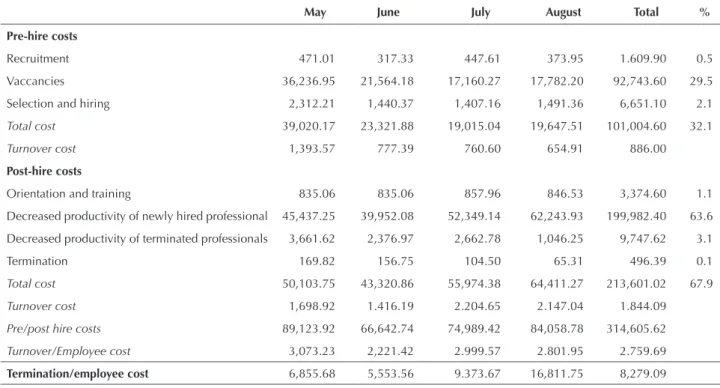
he total cost of turnover (processes of pre and post-hire) was R$314,605.62. he pre-hire costs represented 32.1% and post-hire 67.9% of the total. he turnover/
employee cost ranged from R$2,221.42 to R$ 3,073.23 and the cost of termination/employee was R$5,553.56 to R$16,811.75 (Table 4).
Table 4 – Distribution of costs related to pre and post-hire processes of the nursing staff (R$). From May to August 2013, São José do
Rio Preto, SP, Brazil.
May June July August Total %
Pre-hire costs
Recruitment 471.01 317.33 447.61 373.95 1.609.90 0.5 Vaccancies 36,236.95 21,564.18 17,160.27 17,782.20 92,743.60 29.5 Selection and hiring 2,312.21 1,440.37 1,407.16 1,491.36 6,651.10 2.1
Total cost 39,020.17 23,321.88 19,015.04 19,647.51 101,004.60 32.1
Turnover cost 1,393.57 777.39 760.60 654.91 886.00
Post-hire costs
Orientation and training 835.06 835.06 857.96 846.53 3,374.60 1.1 Decreased productivity of newly hired professional 45,437.25 39,952.08 52,349.14 62,243.93 199,982.40 63.6 Decreased productivity of terminated professionals 3,661.62 2,376.97 2,662.78 1,046.25 9,747.62 3.1 Termination 169.82 156.75 104.50 65.31 496.39 0.1
Total cost 50,103.75 43,320.86 55,974.38 64,411.27 213,601.02 67.9
Turnover cost 1,698.92 1.416.19 2.204.65 2.147.04 1.844.09
Pre/post hire costs 89,123.92 66,642.74 74,989.42 84,058.78 314,605.62
Turnover/Employee cost 3,073.23 2,221.42 2.999.57 2.801.95 2.759.69
Cost of nursing turnover in a Teaching Hospital DISCUSSION
Turnover of nursing has a big inancial impact for healthcare organizations, their rates vary according to the type of institution, private or public(11). In this study, the
turnover rate was lower - MD 0.99% - than those presented in 37 general unsealed hospitals, participants of HQC - MD 2.17% - over the same period(13).
he global perspective on turnover rates in England is approximately 10%(16); ranging from 12 to 21% of a research
including ten European countries(11) and are around 20%
in Canada(17). International Classiication for annual
turn-over rates in health organizations relates how low variations 4-12%, moderate 12-21% and high 22-44%(18).
Turnover is a multifactorial event, there is not a number that deines this ideal rate, since it depends on the indi-viduality of each institution and also the external market(11).
Taking these aspects into consideration, it is expected that the turnover rate does not reach levels that lead to compro-mised quality, rising costs and patient safety.
he pre-hire related costs totaled 32.1% of the expenses generated in turnover, in which the sub-process vacancies (overtime and temporary contract) was the most present, with 29.5%. An integrative review of literature showed that the cost of vacancies is more costly, regardless of cost methodology(11). In other researches conducted in the
Unit-ed States, Australia, Canada and New Zealand, this igure reached 68% of direct costs(12).
A study conducted in the United States, during one year, showed that the values of the direct costs caused by turn-over vary widely. In an estimate, it was concluded that for hospitals, the recruitment cost per nurse/month was a total of US$241.67(4) for nursing staf, in our study it was R$6.28
(US$ 1.76). Regarding the sub-process cost of recruiting/ month, this research showed R$402.48 for the nursing staf, higher value than those found in the national research of the nursing technicians category (R$191.18)(10).
Recruit-ment plays a central role supplying the selection process of the institution with the highest number of candidates and, if ineicient, possibly brings losses for the institution, and high turnover rates(3).
After recruitment, the selection of candidates takes place, and for that sub-process there was an expense cost/ month of R$1,662.78. A national study found that for the hiring process, this sub-process was the most consumed re-source/month, around R$1,138.890(10). he proper selection
process will bring high productivity to the institution, lower turnover rates, ensuring return on investment applied to this activity. However, the recruitment and selection activities do not end when the candidate is hired, but, after the process of integration and adaptation of the institution(3).
For the sub-processes of orientation and training, in this investigation, there was an investment/month of R$ 843.65. In a national study, the admission training/month was R$ 268.90(11). his sub-process aims to develop
favor-able attitudes to the institution and meet the information needs for the new institution(19). Human capital should be
well developed and the training becomes a lucrative source
because, since it enriches the human heritage in the institu-tion, reducing their time to adapt and the initial turnover(3).
he greatest burden presented in this study was related to post-hire process - 67.9% - and the lower productivity of the newly hired professional was the most expensive, with 63.6%. he scarcity of research related to objective or sub-jective measure of the productivity of newly hired profes-sionals makes the comparison of data to be done only with international studies, which reported costs for this process up to 64%(11). Turnover contributes to an increase in the
organization’s costs, loss of productivity and organizational ineiciency by replacing a skilled employee. he awareness of leaders is diverted and increases the consumption time to monitor the newly hired, expending resources that could be directed to other inancial initiatives/policies(4).
In the present study, we identiied that the estimated annual cost of turnover per employee (nursing staf ) will be R$33,116.28 (US$ 8,961.93). Recent international studies have shown great variability in their indings, where expen-ditures per nurse/year are estimated at R$83,820.00 (US$ 22,000) and R$335,607.66 (US$ 88.086)(4,11-12,20).
When analyzing turnover rates and comparing their costs, it can be seen that the costs are directly proportional to that event. Internationally, researches reported that the rates range from less than 9.49% to a maximum of 250%(11),
while our study presents rates ranging from 0.84% to 1.06%. he costs presented by these studies, whether in American hospitals, in Europe, or only in an institution, range from US$5.8 million/year(20) to US$ 7.9 to 8.5 million/year(4).
Compared to the present study, which showed a lower turn-over rate, the total cost was R$314,605.62 (US$ 82,790.95) in four-month investigation. Performing an estimated total cost shown in the research for a year, the cost of turnover may reach R$943,816.86 (US$ 247,720.96).
hus, the results found in the literature revealed vari-ability in international studies and lack of data in national research on turnover cost, in terms of concept, professional nursing categorization, measurement and indicators. he re-search methodologies, data sources, and the cost of calcula-tion and coverage provide just the results of estimated costs. he case study method is limited in its applicability, but the validity of the results, since studies have shown that when taking infrastructure many results are similar. Another limita-tion relates to the use, for the irst time, at the nalimita-tional level, in an adapted form, the methodology Nursing Turnover Cost Calculation Methodology (NTCCM), and objective mea-surement of productivity not using the NIC. Still, there is a gap on the scope of the termination sub-process, in which activities related to the medical examination were not investi-gated, and also the termination of sub-process, with regard to activities related to registration, documentation, attendance at the approval in the Labor Courts.
CONCLUSION
his study provides the knowledge and mapping of processes and activities involved in turnover, advancing the management of nursing staf costs and innovating in the use of NIC to measure the productivity of newly hired profes-sionals and terminations. More than numerical results, we
believe in the need for improvements in personnel policies aimed at retaining nurses, especially in the irst year. his study has also contributed to the personal management and productivity analysis of newly hired professionals, as well as the costs involved.
RESUMO
Objetivo: Mapear os subprocessos relacionados à rotatividade da equipe de enfermagem e mensurar o custo da rotatividade da equipe de enfermagem. Método: Estudo exploratório-descritivo, na modalidade de estudo de caso, realizado em hospital de ensino do sudeste do Brasil, no período de maio a novembro de 2013. A população foi composta pela equipe de enfermagem, utilizando-se a metodologia para o cálculo de custo da rotatividade. Resultados: O custo total da rotatividade foi de R$314.605,62, e por colaborador variou de R$2.221,42 a R$3.073,23. Os custos decorrentes da pré-contratação totalizaram R$101.004,60 (32,1%), sendo que o processo vagas consumiu R$92.743,60 (91,8%). Os custos referentes à pós-contratação totalizaram R$213.601,02 (67,9%), e para o subprocesso de diminuição da produtividade, R$199.982,40 (93,6%). Conclusão: O estudo permitiu identiicar a importância do gerenciamento do custo da rotatividade de pessoal e o impacto inanceiro do custo do colaborador desligado, que representou três vezes o salário médio da equipe de enfermagem.
DESCRITORES
Equipe de Enfermagem; Reorganização de Recursos Humanos; Administração de Recursos Humanos em Hospitais; Custos e Análise de Custos.
RESUMEN
Objetivo: Mapear los subprocesos relacionados con la rotatividad del equipo de enfermería y medir el costo de la rotatividad del equipo de enfermería. Método: Estudio exploratorio-descriptivo, en la modalidad de estudio de caso, llevado a cabo en hospital de enseñanza del sudeste de Brasil, en el período de mayo a noviembre de 2013. La población estuvo compuesta del equipo de enfermería, utilizándose la metodología para el cálculo de costo de la rotatividad. Resultados: El costo total de la rotatividad fue de R$314.605,62 y, por colaborador, varió de R$2.221,42 a R$3.073,23. Los costos consecuentes de la pre contratación totalizaron R$101.004,60 (32,1%), siendo que el proceso plazas consumió R$92.743,60 (91,8%). Los costos referentes a la post contratación totalizaron R$213.601,02 (67,9%) y, para el subproceso de disminución de la productividad, R$199.982,40 (93,6%). Conclusión: El estudio permitió identiicar la importancia de la gestión del costo de la rotatividad de personal y el impacto inanciero del costo del colaborador alejado, que representó tres veces el sueldo medio del equipo de enfermería.
DESCRIPTORES
Grupo de Enfermería; Reorganización del Personal; Administración de Personal en Hospitales; Costos y Análisis de Costo.
REFERENCES
1. Tai TWC, Bame SI, Robinson CD. Review of nursing turnover research, 1977–1996. Soc Sci Med. 1998;47(12):1905-24.
2. Hayes LJ, O´Brien-Pallas L, Dufield C, Shamian J, Buchan J, Hughes F, et al. Nurse turnover: a literature review. Int J Nurs Stud.
2006;43(2):237-63.
3. Chiavenato I. Gestão de pessoas: o novo papel dos recursos humanos nas organizações. 3ª ed. Rio de Janeiro: Elsevier; 2008. 4. Jones CB. Revisiting nurse turnover costs. J Nurs Adm. 2004;34(12):562-70.
5. Medeiros CRG, Junqueira AGW, Schwingel G, Carreno I, Jungles LAP, Saldanha OMFL. A rotatividade de enfermeiros e médicos: um impasse na implementação da Estratégia de Saúde da Família. Ciênc Saúde Coletiva [Internet]. 2010 [citado 2014 jan. 08];15(Supl 1):1521-31. Disponível em: http://www.scielo.br/pdf/csc/v15s1/064.pdf
6. Stancato K, Zilli PT. Fatores geradores da rotatividade dos proissionais de saúde: uma revisão de literatura. Rev Adm Saúde.
2010;12(47):87-99.
7. Jones CB, Gates M. The costs and beneits of nurse turnover: a business case for nurse retention. Online J Issues Nurs. 2007;12(3):1-3.
8. Brewer CS, Kovner CT, Greene W, Tukov-Shuser M, Djukic M. Predictors of actual nurse turnover in a national sample of newly licensed
registered nurses employed in hospitals. J Adv Nurs. 2012;68(3):521-38.
9. Holanda FL, Cunha ICKO. Tempo de permanência de enfermeiros em um hospital-escola e valores monetários despendidos nos processos de admissão, desligamento e provimento de novo proissional. Rev Latino Am Enfermagem. 2005;13(5):642-7.
10. Okano HIH, Castilho V. Levantamento do custo do processo admissional de técnico de enfermagem de um hospital de ensino. Rev Esc
Enferm USP. 2007;41(3):492-9.
11. Yin L, Jones CB. A literature review of nursing turnover costs. J Nurs Manage. 2013;21(3):405-18.
12. O´Brien-Pallas L, Grifin P, Shamian J, Buchan J, Dufield C, Hughes F, et al. The impact of nurse turnover on patient, nurse, and system
Cost of nursing turnover in a Teaching Hospital
14. Núcleo de Apoio à Gestão Hospitalar. Programa CQH. Manual de indicadores de enfermagem. São Paulo: APM/CREMESP; 2006.
15. Buleck GM, Butcher HK, Dochterman JM. Classiicação das intervenções de enfermagem (NIC). 5a ed. Rio de Janeiro: Elsevier; 2010.
16. Sociedade Brasileira de Enfermagem em Centro Cirúrgico (SOBECC). Manual de Práticas Recomendadas da SOBECC. 6ª ed. São Paulo:
SOBECC; 2013.
17. Clancy J. Dignity Denied: long term care and Canada [Internet]. Nepean: National Union; 2008 [cited 2011 Ago 27]. Available from: http://www.nupge.ca/presidentscommentary/n05fe08e.htm
18. United to Improve America’s Health. The business case for workforce stability. New York: VHA; 2002.
19. Bucchi SM, Mira VL, Otrenti E, Ciampone MHT. Nurse instructor in the process of admission training of nurses in the Intensive Care Unit. Acta Paul Enferm. 2011;24(3):381-7.
20. Mukamel DB, Spector WD, Limcangco R, Wang Y, Feng Z, Mor V. The costs of turnover in nursing homes. Med Care. 2009;47(10):1039-45.