INTERNATIONAL RESEARCH CAPACITY BUILDING PROGRAM
FOR HEALTH RELATED PROFESSIONALS TO STUDY THE DRUG
PHENOMENON IN LATIN AMERICA AND THE CARIBBEAN
Maria da Gloria Miotto Wright1, Francisco Cumsille2, Maria Itayra Padilha3, Carla Arena Ventura4, Jaime Sapag5, Bruna Brands6, Hayley Hamilton7, Robert Mann8, Akwatu Khenti9
1 Ph.D. Former Coordinator Educational Development Program. Interamerican Drug Abuse Control Commission (CICAD), Secretariat for Multidimensional Security. Washington, USA. E-mail: [email protected]
2 Ph.D. Head of Interamerican Drug Observatory CICAD, OAS. Washington, USA. E-mail: [email protected]
3 Ph.D. Academic Coordinator of the OAS, Secretariat for Multidimensional Security (SMS), CICAD, Centre for Addiction and Mental Health, (CAMH) International Research Capacity Building Program from 2009 to 2013. Dean and Associate Professor of Nursing Department, Federal University of Santa Catarina, Florianópolis, Brazil. E-mail: [email protected]
4 Ph.D. Academic Coordinator of the OAS/SMS/CICAD-CAMH International Research Capacity Building Program in 2014, Associate Professor at the University of São Paulo at Ribeirao Preto, School of Nursing, Brazil. E-mail: [email protected] 5 Ph.D. Former Scholar of Transformative Global Health Ofice, CAMH. Toronto, Canada. E-mail: [email protected] 6 Ph.D. Senior Scientist. Ofice of Research and Surveillance, Drug Strategy and Controlled Substances Programme, Health
Canada and Public Health and Regulatory Policies CAMH, University of Toronto, Canada. E-mail: [email protected] 7 Ph.D. Investigator. CAMH, University of Toronto. Toronto, Canada. E-mail: [email protected]
8 Ph.D. Investigator. CAMH, University of Toronto. Toronto, Canada. E-mail: [email protected]
9 Doctor Student. Director, Transformative Global Health Ofice, CAMH. Toronto, Canada. E-mail: [email protected]
ABSTRACT: Most Organization of American States member states do not have a cadre of professionals with scientiic knowledge and research experience on drugs and related problems. Therefore, the Organization of American States started a partnership, irst with the University of Alberta/Canada and then with the Centre for Addiction and Mental Health in Toronto/Canada to train health related professionals to address this problem. The objective is to create a cadre of health and related professionals with scientiic and technical research knowledge to enable scientiic advances in the area of drug demand reduction. The program requires the development and implementation of a multicentric drug research proposal. The program has produced the following results: nine multicentric drug research studies implemented in 22 countries of Latin America and the Caribbean; 91 participants from 22 countries of Latin America and the Caribbean. This is the only program in the Americas offering continued advanced research training to university faculty and contributing to strengthen the undergraduate and graduates curriculum on drug issues and research capability in Latin America and the Caribbean.
DESCRIPTORS: Narcotics. Research. Capacity building. Latin America. Caribbean.
PROGRAMA INTERNACIONAL DE CAPACITAÇÃO EM PESQUISA PARA
PROFISSIONAIS DE SAÚDE SOBRE O ESTUDO DO FENÔMENO DAS
DROGAS NA AMÉRICA LATINA E CARIBE
RESUMO: A maioria dos países membros da Organização dos Estados Americanos não possui um conjunto de proissionais com experiência em pesquisa e conhecimento cientíico sobre drogas e problemas relacionados. Assim, a Organização dos Estados Americanos iniciou uma parceria, primeiro com a Universidade de Alberta/Canada, e depois, com o Centro de Adição e Saúde Mental em Toronto/ Canada, para capacitar proissionais das áreas relacionadas a saúde para desenvolverem pesquisas sobre o problema das drogas. O programa tem o objetivo de criar um grupo de proissionais de áreas relacionadas à saúde, com conhecimento cientíico e técnico em pesquisa, para favorecer avanços cientíicos na área de redução da demanda de drogas. O programa exige o desenvolvimento e implementação de uma proposta multicêntrica de pesquisa sobre drogas. O programa tem produzido os seguintes resultados: nove estudos multicêntricos de pesquisa sobre drogas desenvolvidos em 22 países da América Latina e Caribe e 91 participantes de 22 países de América Latina y Caribe. Este é o único programa das Américas que oferece contínuo treinamento em pesquisa avançada para professores de universidades, além de contribuir para fortalecer os currículos dos cursos de graduação e pós-graduação em questões relacionadas às drogas e a capacidade de pesquisa na America Latina e Caribe.
DESCRITORES: Entorpecentes. Pesquisa. Fortalecimento institucional. América Latina. Caribe.
PROGRAMA INTERNACIONAL DE CAPACITACIÓN EN
INVESTIGACIÓN PARA PROFESIONALES DE SALUD EN EL ESTUDIO
DEL FENÓMENO DE LAS DROGAS EN AMÉRICA LATINA Y CARIBE
RESUMEN: La mayoría de los países miembros de la Organización de los Estados Americanos no tienen un grupo de profesionales con experiencia en investigación y conocimiento cientíico en drogas y problemas relacionados. Así, la Organización de los Estados Americanos empezó, una asociación, primero con la Universidad de Alberta/Canadá y después con el Centro de Adición y Salud Mental en Toronto/Canadá para capacitar profesionales de áreas relacionadas a la salud para desarrollaren investigaciones sobre el problema de drogas. El programa tiene el objetivo de crear un grupo de profesionales de áreas relacionadas de la salud con conocimiento cientíico y técnico en investigación para favorecer los avances cientíicos en el área de reducción de la demanda de drogas. El programa requiere el desarrollo e implementación de una propuesta multicentrica de investigación sobre drogas. El programa tiene producido los siguientes resultados: nueve estudios multicentricos de investigación sobre drogas desarrollados en 22 países de América Latina y Caribe; 91 participantes de 22 países de América Latina y Caribe. Este es el único programa en las Américas que oferta continuamente el entrenamiento en investigación avanzada para profesores universitarios y contribuye para fortalecer los currículos de los cursos de pregrado y post grado en cuestiones sobre drogas y la capacidad de investigación en América Latina y Caribe.
DESCRIPTORES: Narcóticos. Investigación. Creación de capacidad. América Latina. Caribe.
INTRODUCTION
Illicit drug use is one of the top twenty global
health risk factors − a problem which affects ap -proximately 210 million people annually, with a related mortality rate of nearly 200,000.1 Issues stemming from the drug phenomenon include drug-related health problems, organized crime, violence and other social and economic problems.1
The drug phenomenon has become a complex, dynamic and multi-causal problem
that presents a dificult challenge to States and
their governments around the world. This phe-nomenon demands a comprehensive, balanced and multidisciplinary approach with a shared responsibility among those involved. Drug poli-cies for the hemisphere should focus not only on supply and control, but also on drug dependence. This new strategy explicitly recognizes that drug
dependence is a chronic disease − not unlike
diabetes, hypertension or asthma – all of which requires proper medical care to address various symptoms, as well as treat the underlying causes. Therefore, the new strategy recommends that drug dependence must be addressed as a core element of public health policy.2
A new and improved paradigm is required to address the underlying causes of the drug phenomenon in the States. This paradigm should focus on three main goals: (a) treating drug use as a matter of public health, (b) reducing drug consumption through information, education and prevention, and (c) repressing organized crime.3
Considering the need for innovative ap-proaches to deal with the drug phenomenon in the Americas, the purpose of this paper is to describe the collaboration between the Inter-American
Drug Control Commission (CICAD) and the Cen-ter for Addiction and Mental Health (CAMH) to implement the International Research Capacity – Building Program for Health Related Professionals to Study the Drug Phenomenon in Latin America and the Caribbean.
JUSTIFICATION
The challenges imposed by the drug phe-nomenon require the formulation of partnerships and innovative approaches towards educating health professionals in the Americas. The current global context requires specialized individuals who are able to analyze problems and propose empirically-based solutions and/or strategies for national and international audiences.
The majority of the countries in Latin Ameri -ca and in the Caribbean do not have a -cadre of
pro-fessionals with scientiic knowledge and research
experience regarding drug use and related issues.
These assets are important when conducting work
Speciically, in the region of the Americas,
94% of countries offered training pertaining to drug demand reduction (prevention and
treat-ment). Beneiciaries included professional and technical personnel working in areas of addic
-tion, such as police oficers, teachers, counselors,
prison guards, instructors and community leaders. A diverse range of topics was made available to participants, including: awareness of, and multi-disciplinary approaches to, drug addiction; appro-priate program application methods for diverse populations and environments; and refresher/ advanced training in prevention and treatment.4
Although some countries include a preven-tion component in the professional curricula of health and social sciences (nursing, public health,
social work, etc.), other countries continue to dem
-onstrate weaknesses in terms of accurately distin -guishing between drug prevention programs and ad hoc activities or interventions. Such activities, including conferences, lectures, symposium and contests, are not part of comprehensive prevention strategies. These countries need to focus efforts on capacity-building in order to develop and deliver appropriate prevention programs that will
facili-tate scientiic evaluations.4
Some international organizations have
de-veloped joint initiatives regarding drug depen -dence treatment and care, that stress that services must address drug use disorders in a pragmatic, science-based, and humanitarian way. To do so, this initiative calls for the development of a com-prehensive, health-based approach to drug policy that can reduce demand for illicit substances, relieve suffering, and decrease drug-related harm affecting multiple facets of society.5
There are few drug research capacity-pro-grams in the Americas that are continually offered
to health professionals. One of the irst research
agencies to adopt a public health, evidence-based approach to drug abuse and addiction is in the United States. Since its conception in 1990, this agency has built partnerships with countries, or-ganizations, and individual researchers to advance multinational cooperation, promote new research initiatives, expand international research capacity,
and share knowledge about drug abuse and addic
-tion. By promoting regional and global scientiic networks, this organization disseminates research methods and indings around the world, whilst
simultaneously introducing grantees to talented drug abuse researchers from other countries. Facil-itating this collaboration encourages the discovery
of evidence-based interventions, and contributes to global efforts to develop, adopt, and evaluate government policies, prevention programs, and treatment protocols that effectively address drug abuse and its consequences.6
Following this same line of orientation, the Organization of American States (OAS), the Sec-retariat for Multidimensional Security (SMS) and CICAD has partnered with the CAMH since 2006 to offer the International Research Capacity-Building Program for Health and Related Professionals to Study the Drug Phenomenon in Latin America and the Caribbean.As a unique experience in the Ameri-cas, this initiative has facilitated the training of Latin American and Caribbean university researchers in advanced drug research methodology. This train-ing enables researchers to conduct multicentric
studies regarding drug related issues speciically pertaining to ive programmatic areas of demand
reduction: promotion of healthy and sustainable lifestyles, prevention of drug use and abuse, treat-ment, rehabilitation and social integration.
FRAMEWORK
The complexities of the drug phenomenon demand the adoption and application of a broader and holistic perspective. The national, international and global consequences of the drug problems urge
each State in the hemispheric area to work together
in cooperation and partnership. This calls for a
framework that supports the analysis and decision making required for policy, program and project
design in accordance with this new perspective. Figure 1 presents the Critical-Holistic Inter-national Health Model7 applied to the analysis and
work of the drug phenomenon. This model offers a
multidimensional view, as well as a critical-holistic perspective of the interaction, integration and balance of the drug phenomenon components.
Ac-cording to this framework, the drug phenomenon
should be seen as the interrelationship between national and international dimensions, and the ultimate impacts at a global level.8 Therefore, the drug phenomenon is a social problem, with its de-terminants and conditioning factors ranging from ethical-legal, agro-ecological, cultural, spiritual,
economic, political and technological aspects −
all of which have an impact on the health of the individual, family and community. To understand these interrelationships, it is important to consider
four major concepts that affect the process of pol
The Critical-Holistic International Health Model (Figure 1) applied to the Drug Phenomenon
was used as a framework to support the design
and implementation of the International Research
Capacity-Building Program for Health and Related Professionals to Study the Drug Phenomenon in Latin America and the Caribbeanat CAMH, To-ronto, Canada.
Figure 1 - Critical-Holistic International Health Model applied to the Drug Phenomenon. USA, 20007
TECHNICAL AND FINANCIAL
COOPE-RATION
The new Hemispheric Drug Strategy9 recom-mends the promotion of international cooperation programs among member states in order to strength-en national policies and provide technical assistance. This will allow for the exchange of best practices and lessons learned when addressing the world drug problem in regards to institutional capacity, supply and demand reduction, and control measures.
The Plan of Action of the new Hemispheric Strategy10 states that international cooperation
should promote technical assistance, inancing, and
training to facilitate compliance with the
recom-mendations formulated under the framework of
the Multilateral Evaluation Mechanism (MEM). In addition, the strategy further expresses the need to strengthen government relationships by employ-ing academic and research institutions to generate evidence regarding the demand for drugs.
In 2005, ES/CICAD invited CAMH to collab-orate on the implementation of the International Research Capacity-Building Program for Health and Related Professionals to Study the Drug Phe-nomenon in Latin America and the Caribbean.
This was achieved through a technical and inan
-cial cooperation supported by the Government of Canada/Foreign Affairs and International Trade Canada (DFAIT). During 2003-2004, a pilot of the program was completed with 11 nurses and the support of the Faculty of Nursing at the University of Alberta/Canada.11
In 1986, the CICAD was established by the General Assembly of the OAS as the Western Hemisphere’s policy forum regarding all aspects of the drug phenomenon. CICAD’s core mission is to enhance the human and institutional capabilities
of its members to reduce the production, trafick -ing, and use and abuse of illegal drugs. Further, it sets out to address the health, social and criminal consequences of the drug trade.
CICAD is the OAS Secretariat that:
- Fosters multilateral cooperation regarding drug issues in the Americas.
- Executes action programs to strengthen the capacity of CICAD member states in order to prevent and treat licit and illicit drug abuse; combat production of illicit drugs; deny
traf-ickers their illegal proits.
- Develops and recommends minimum standards for drug-related legislation and treatment; measurement of both drug con-sumption and the cost of drugs to society; drug-control measures.
- Carries out regular multilateral evaluations of progress by member states in all aspects of the drug problem (Multilateral Evaluation Mechanism).
The CAMH is Canada’s leading addiction and mental health institution, as well as a Pan American Health Organization (PAHO) and World Health Organization (WHO) Collaborating Centre fully
afiliated with the University of Toronto. In June 2002, CAMH launched the Ofice of International
Health (OIH) to address the growing global burden of addiction and mental illness borne by under-resourced regions of the world. Since its creation,
the Ofice of Transformative Global Health (OTGH) has been working with countries in various regions
of the world including Africa, Latin America and the Caribbean (LAC), and South Asia to strengthen mental health and addiction capacity at local, re-gional and national levels.
TheInternational Research Capacity-Build-ing Program for Health and Related Professionals to Study the Drug Phenomenon in Latin America and the Caribbean has been implemented at CAMH through the OTGH from 2006 to present.
Educational program
The purpose of the International Research Capacity-Building Program for Health and Related Professionals to Study the Drug Phenomenon in Latin America and the Caribbean is to create a
cadre of health-related professionals with
special-ized scientiic knowledge and research skills in
regards to drug-related issues. These assets are to be applied at various levels, including policy
de-sign, decision making, research programs, project
implementation, and management and evaluation. The aims of the program are:
- To strengthen the scientiic knowledge and
technical research skills among university
faculty.
- To study the drug issues and related prob-lems at the levels of policy design,
decision-making and programs.
- To provide research management skills for
implementation, evaluation and knowledge
translation.
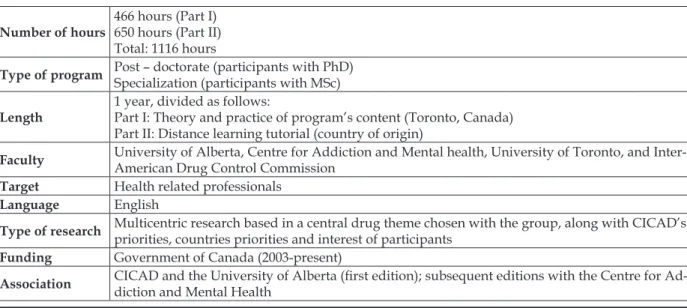
This one year academic program consists of 1116 hours - 466 hours of on-site training in Canada, and 650 hours to conduct a multicentric research
study in the countries of origin. The irst portion of the program dedicates two weeks to reinforcing lan
-guage skills (English and Spanish, depending on the
need) and provides a review of aspects of Canadian culture. This is followed by two months of in-class training at CAMH, as well as the formulation of a multicentric research study. Program faculty consists
of well known CAMH researchers and academics proicient in various areas the program. An adult
education learning format is employed in order to
enable learning and collaborative work with the ten
participants from various countries in Latin America and the Caribbean (see Table 1). The second com-ponent of the program pertains to the implementa-tion of the research study in the participants’ native countries during a period of eight and a half months.
Table 1 - General Characteristics of the Education Program, Toronto, Canada, 2014
Number of hours
466 hours (Part I) 650 hours (Part II) Total: 1116 hours
Type of program Post – doctorate (participants with PhD) Specialization (participants with MSc)
Length
1 year, divided as follows:
Part I: Theory and practice of program’s content (Toronto, Canada) Part II: Distance learning tutorial (country of origin)
Faculty University of Alberta, Centre for Addiction and Mental health, University of Toronto, and Inter-American Drug Control Commission
Target Health related professionals
Language English
Type of research Multicentric research based in a central drug theme chosen with the group, along with CICAD’s priorities, countries priorities and interest of participants
Funding Government of Canada (2003-present)
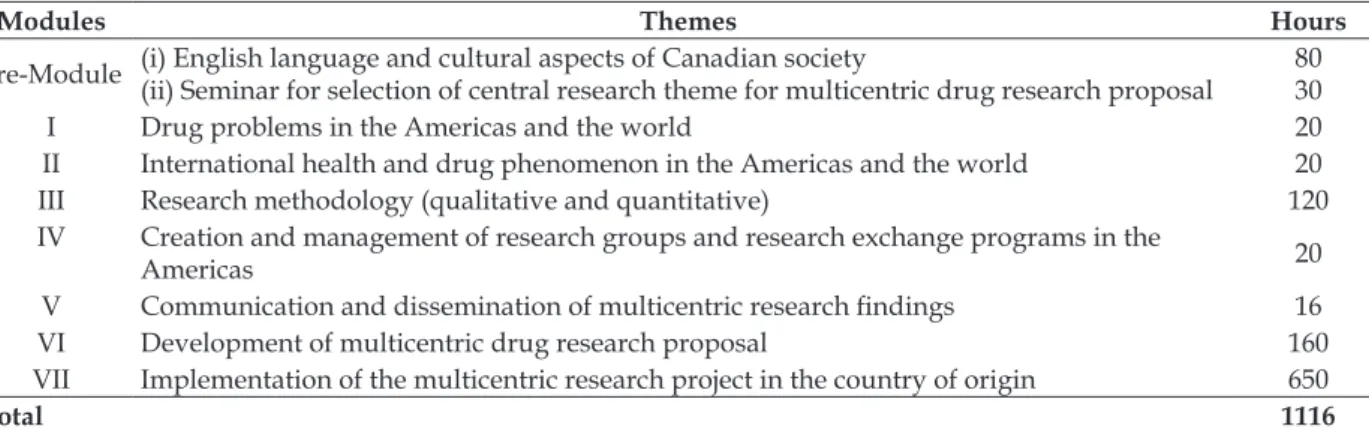
The on-site training component includes
sev-en sections: a one week pre-module to deine the
central theme of the multicentre study on drugs, followed by six academic modules (see Table 2): - Drug issues in the Americas and in the
world.
- International health and the drug phenom-enon in the Americas and the world.
- Research methodology (qualitative and quantitative).
- Creation and management of research groups and research exchange programs in the Americas.
- Communication and dissemination of
re-search indings.
- Development of research proposal.
Table 2 - Academic curriculum of the program. Toronto, Canada, 2014
Modules Themes Hours
Pre-Module (i) English language and cultural aspects of Canadian society
(ii) Seminar for selection of central research theme for multicentric drug research proposal
80 30
I Drug problems in the Americas and the world 20
II International health and drug phenomenon in the Americas and the world 20
III Research methodology (qualitative and quantitative) 120
IV Creation and management of research groups and research exchange programs in the
Americas 20
V Communication and dissemination of multicentric research indings 16
VI Development of multicentric drug research proposal 160
VII Implementation of the multicentric research project in the country of origin 650
Total 1116
A total of twenty two countries have been represented in the program from Latin America and the Caribbean from 2003-2013. The country with the highest representation in the program is
Brazil (19); followed by Colombia (9); Jamaica (9);
Nicaragua (8); Chile (7); El Salvador (5); Ecuador and Peru (4) each; Costa Rica, Guatemala, Guyana, and Mexico (3) each; Honduras, Panama, Trinidad & Tobago, and Uruguay (2) each; Argentina, Ba-hamas, Barbados, Belize, Paraguay, and Suriname (1) each .
After the irst offer in 2004, CICAD opened
the program to all health related areas, and partnered with CAMH in 2006 to establish the International Research Capacity-Building Pro-gram (IRCBP). The academic areas represented in the program are: Nursing (41), Psychology (16), Medicine (13); Public Health (5); Education
(4) Sociology and Social Work (2) each; Political
Sciences, Statistics, Pharmacy, International Re-lations, and Occupational Therapy only with (1) participant each.
Table 3 provides the titles of the multicentric drug studies conducted by participants in the pro-gram. Five groups of program participants chose university students as their sample population. One group examined the relationship between
drugs and violence among women, one group focused on the perspectives of family and familiars of illicit drugs users; another group on treatment centers, and another group on the urban attitudes. In addition, it is important to mention that pro-gram graduates have been involved in varying capacities in other studies developed by CICAD/ EDRS, The study on “Drugs, women and violence
in 12 countries of the Americas” inluenced the
implementation of two similar studies in Latin America, one of them entitled “The nexus between drugs and violence in the Americas: a gender perspective” (ES/CICAD/OID/CAMH/10
coun-tries – inal study, in process to be implemented). The ive studies related to university populations
presented critical information that has yet to be addressed in the studies implemented by CICAD/ OIDS. The study on perceptions of family and familiars, “Illicit grug use in Canada–Toronto: critical perspectives of family and familiars” was replicated in Canada by CAMH to address an
evidence gap for this subject in this country. The
study conducted in the treatment centers was
the irst multicentric study implemented in Latin
America and Caribbean countries related to this
subject. The study on urban attitudes is also the irst multicentric study carried out in Latin
Table 3 - Titles of multicentric studies from 2003-2013 of the IRCBP (Canada), Toronto, Canada, 2014
Year Program studies
2003-2004 “Women, drugs and violence in Latin America” (exploratory study I)
2006-2007 “Illicit drug use in seven Latin American countries: critical perspectives of family and familiars”. 2007-2008 “University student’s perceived norms about peers and drug use: a multicentric study from ive Latin
America countries”
2008-2009 “Simultaneous poly-drug consumption among undergraduate university students in six Latin Ameri-can countries and in one Caribbean country: gender, legal and social implications”
2009-2010 “A multicentric study of comorbidity between psychological distress and drug use among patients in treatment centers, in seven countries of Latin America and one country in the Caribbean: policy and program implications”
2010-2011 “Drug use among university students and its relationship with maltreatment during childhood in seven universities in Latin America and the Caribbean”
2011-2012 “The role of family relations, spirituality and entertainment in moderating the relationship between
peer inluence and drug use among university students in ive countries of Latin America and three
countries in the Caribbean.”
2012-2013 “Knowledge of consequences, academic performance and drug consumption among undergraduate university students in six Latin America and three Caribbean countries”
2013-2014 “Urban attitudes toward persons who use drugs in ive Latin America and ive Caribbean Countries”
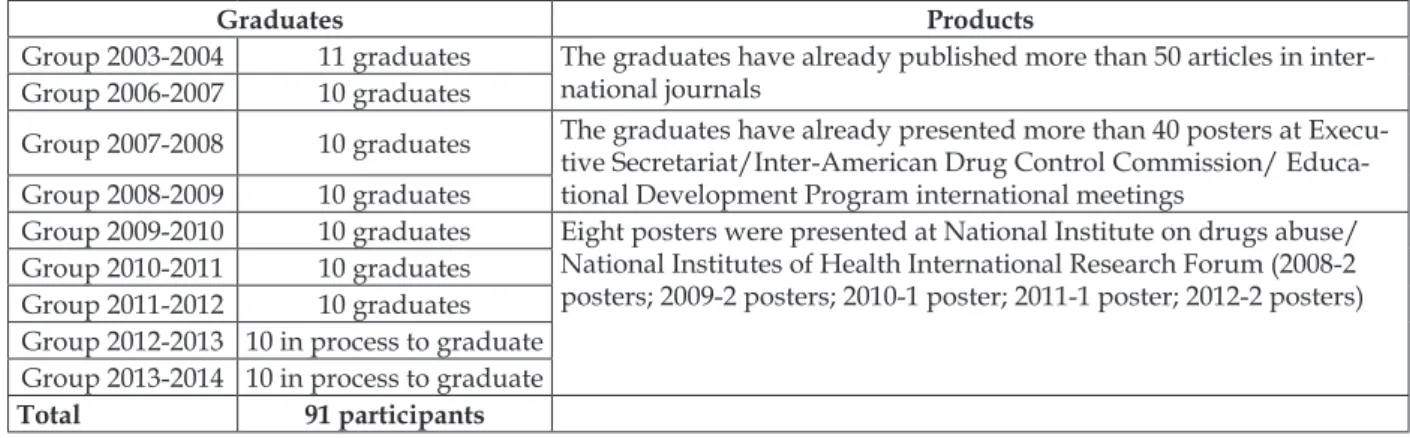
Table 4 summarizes the achievements of the program, with a total of 91 participants from 2003-2013. Further, it should be noted that more than 50
articles have been published in international jour
-nals, more than 40 posters have been presented at international and national conferences, and a total of 8 posters have been presented at the NIDA/NIH International Research Forum.
Table 4 - Graduates and Products of IRCBP from 2003-2013. Toronto, Canada, 2014
Graduates Products
Group 2003-2004 11 graduates The graduates have already published more than 50 articles in
inter-national journals
Group 2006-2007 10 graduates
Group 2007-2008 10 graduates The graduates have already presented more than 40 posters at Execu-tive Secretariat/Inter-American Drug Control Commission/ Educa-tional Development Program internaEduca-tional meetings
Group 2008-2009 10 graduates
Group 2009-2010 10 graduates Eight posters were presented at National Institute on drugs abuse/ National Institutes of Health International Research Forum (2008-2 posters; 2009-2 posters; 2010-1 poster; 2011-1 poster; 2012-2 posters)
Group 2010-2011 10 graduates
Group 2011-2012 10 graduates
Group 2012-2013 10 in process to graduate Group 2013-2014 10 in process to graduate
Total 91 participants
Challenges of the program
Even though there are many indications of success, the program faces several challenges on an ongoing basis. A central concern has been the provision of funding for the program. The Cana-dian Government has generously provided fund-ing on an annual basis, but longer-term fundfund-ing
commitments (e.g., for ive years) would facilitate
longer-term planning and permit extension of the program to address new issues.
Other challenges relate to the multinational and multilingual nature of the program. Partici-pants are drawn from Spanish, Portuguese and
English-speaking countries, and communica -tions challenges can arise when dealing with the complex theoretical and methodological considerations involved in carrying out a
multi-national research project. Participants may have
limited experience in conducting research, and in publishing results. This limited experience may be compounded when they return to their home
institutions and regular academic workloads, with
lengthy. Finally, communications among inves-tigators are necessary at different stages of the
projects, typically involving emailing, and this can
be slow because of the varying academic demands and schedules of investigators.
Impact of the program
In spite of the challenges that have been encountered in implementing and carrying out
the program, it has achieved remarkable success
on several fronts. The program has identified and fostered a group of exceptionally talented and committed faculty from Latin American and the Caribbean, and furthered their engagement in research on the drug phenomenon in the re-gion. Several of these individuals have pursued advanced research and professional training in Latin America and the Caribbean, North America and Europe and have been successful in obtain-ing very competitive fellowship support for this advanced training. In addition, the program has led to substantial research productivity in terms of presentations at national and international conferences and publications in international
journals.12 A cadre of active researchers on drug issues and demand reduction has been created in
Latin America and the Caribbean. Ongoing link -ages and interactions among these researchers are
being facilitated by the Latin American Network
of Researchers on Drugs and the newly-formed IRCBP Alumni Association. The existence of this cadre of researchers also creates important
op-portunities for a Pan-American network of drug researchers to facilitate knowledge transfer and
effective policy and program interventions, and to develop international programs of research.
Many participants have also taken on
academic leadership positions at their home institutions and in national drug commissions. Additionally, graduates have strengthened the drug-related aspects of undergraduate, graduate and professional programs in their home institu-tions, and have held leadership roles in CICAD-led initiatives to strengthen educational and profes-sional programs across the region.
External evaluation of the program
In 2012, CICAD/OAS hired an external evaluator to conduct a complete evaluation of the
program. The indings from the evaluation indi -cated that 99% of the participants have been able to comply with all the requirements of the program
(graduation, communication and dissemination of
the research indings and publications). It also indi -cated the International Research Capacity-Building Program (IRCBP) is highly relevant in helping to
satisfy an acknowledged need for evidence-based
research in Latin America and the Caribbean.
FINAL CONSIDERATIONS
In a relatively short period of time, the In-ternational Research Capacity-Building Program for Health and Related Professionals to Study the Drug Phenomenon in Latin America and the Ca-ribbean has achieved some exceptional successes.
The program has built lasting international links
among drug researchers in South/Central Amer-ica, the Caribbean and North America. Several
ambitious multinational research projects have
contributed substantially to our understanding of drug issues in LAC countries. Thus, the pro-gram has achieved and exceeded its goals, and continuation of the program will further serve the important purpose of increasing the research capacity necessary to implement and support effective drug demand reduction programs and policies in Latin America and the Caribbean, and in the Americas more generally.
Nevertheless, important challenges remain. The most critical is the need to obtain stable, multiyear funding to support the program. Ad-ditionally, expanding the capability of the program to support new multicentric studies by program
alumni would be a very signiicant advance, and
provide an important next step in creating and maintaining the research capacity necessary for effective efforts to address the drug phenomenon in the Americas.
ACKNOWLEDGMENT
OAS/SMS/CICAD-CAMH would like to express our sincerely thanks to the Government of
Canada/Foreign Affairs and International Trade
Canada for its continuing inancial support to the
program; to all Universities and National Drug Commissions authorities, and families of the participants for their collaboration, support and understanding of the importance and value of the program; to all faculty and advisors for their time,
collaboration, and support to make this program to exceed its academic and scientiic contribution
imposes; to the Coordinators and Administrative personnel of the program for their continued
col-laboration, dedication, and support to make this program possible and successful, and inally to
all population samples who participated in the different multicentric drug studies implemented by the participants of the program.
REFERENCES
1. United Nations Ofice on Drugs and Crime. World
Drug Report. Vienna: UNODC; 2011.
2. Organization of American States, Secretary for Multidimensional Security, Interamerican Drug Control Abuse Commission. Hemispheric drug strategy. Washington (DC): OAS; 2010.
3. Latin American Commission on Drugs and Democracy. Drugs and democracy: toward a paradigm shift [online]. 2011 [access 2012 Apr 10]. Available at: www.drogasedemocracia.org/ Arquivos/declaração_Ingles_site.pdf
4. Organization of American States, Secretariat for Multidimensional Security, Interamerican Drug Control Abuse Commission. Multilateral evaluation mechanism. hemispheric report. Washington (DC): OAS; 2011.
5. United Nations Office on Drugs and Crime, World Health Organization. Programme on drug dependence treatment and care. 2010 [access 2012 Apr 10]. Available at: www.unodcorg/docs/
treatment/unodc _WHO_ programme _ brochure _ English.pdf
6. National Institute of Health, National Institute of Drug Addiction. NIDA International Program. 2011 [access 2012 Apr 10]. Available at: http://grants.nih.
gov/guide/pa-iles/PA-12-040.html.
7. Wright MGM. A Critical-Holistic Paradigm for an Interdependent World. Am Behav Scient. 2000; 43(5):808-24.
8. Wright MGM. La contribución de la enfermería frente al fenómeno de las drogas y la violencia en
América Latina: un proceso en construcción. Ciencia
Enferm. 2002; 8(2):9-19.
9. Organization of American States, Interamerican Drug Control Abuse Commission. The Role of nur-sing profession and the drug phenomenon in Latin America. Washington (DC)/Florianópolis (SC): OAS/Universidade Federal de Santa Catarina; 2006. 10. Organization of American States, Secretary for
Multidimensional Security, Interamerican Drug Control Abuse Commission. Hemispheric drug strategy: plan of action 2011-2015.Washington (DC): OAS; 2011.
11. Wright MGM, Caufield C, Gray G, Olson J.
International research capacity-building programs for nurses to study the drug phenomenon in Latin America: challenges and perspectives. Rev Latino-Am Enfermagem. 2005; 13(2):1-8.
12. Wright MGM, Cumsille F, Khenti A, Padilha MI.
Editorial. Texto Contexto Enferm. 2012 Jan-Mar;
21(Special):11-2.
Corresponding Author: Akwatu Khenti Transformative Global Health Ofice Centre for Addiction and Mental Health Toronto, Canada