RESUMEN
Objeivo: Invesigar y evaluar las evidencias disponibles en la literatura respecto del em-pleo de la Escucha Terapéuica como estrate -gia de intervención en salud. Método: Revi -sión integradora, llevada a cabo en las bases de datos PubMed, CINAHL, The Cochrane Library, EMBASE, LILACS y APA PsycNET, sin restricciones de año o ipo de estudio. Los descriptores fueron combinados de disintas maneras para asegurar la búsqueda amplia de estudios primarios. Resultados: Entre las 15 publicaciones sobre Escucha Terapéui-ca, el 33% abordó el efecto de los entrena -mientos relacionados con las habilidades de escucha, el 27% estudió la efecividad de la escucha como intervención, el 20% exploró las experiencias de los sujetos en cuanto a las vivencias relacionadas con la escucha y el 20% abordó los aspectos diversos de la escucha. Conclusión: La mayor parte de los estudios iene nivel de evidencia de fuerte a moderado y, a pesar de abordar los disintos aspectos relacionados con la Escucha Tera -péuica, presentan en común el reconoci -miento de la necesidad de habilidades, por parte del profesional de salud, para el desar -rollo de un proceso de escucha eicaz.
DESCRIPTORES Relaciones interpersonales Relaciones profesional-paciente Comunicación
Atención al paciente Revisión
RESUMO
Objeivo: Invesigar e avaliar as evidências disponíveis na literatura a respeito do uso da Escuta Terapêuica como estratégia de intervenção em saúde. Método: Revisão in -tegraiva, realizada nas bases de dados Pub-Med, CINAHL, The Cochrane Library, EMBA -SE, LILACS e APA PsycNET, sem restrições de ano ou ipo de estudo. Os descritores foram combinados de diferentes formas para ga-ranir a busca ampla de estudos primários. Resultados: Dentre as 15 publicações sobre Escuta Terapêuica, 33% abordaram o efei-to de treinamenefei-tos sobre as habilidades de escuta, 27% estudaram a eicácia da escuta como intervenção, 20% exploraram as ex-periências dos sujeitos quanto às vivências relacionadas à escuta e 20% abordaram aspectos diversos da escuta. Conclusão: A maior parte dos estudos tem nível de evi-dência de forte a moderado e, apesar de abordarem diferentes aspectos relaciona -dos à Escuta Terapêuica, apresentam em comum o reconhecimento da necessidade de habilidades, por parte do proissional de saúde, para o desenvolvimento de um pro-cesso de escuta eicaz.
DESCRITORES Relações interpessoais Relações proissional-paciente Comunicação
Assistência ao paciente Revisão
ABSTRACT
Objecive: To invesigate and evaluate the available evidence in the literature regar-ding the use of Therapeuic Listening as a health intervenion strategy. Methods: Integraive review conducted on the follo-wing databases PubMed, CINAHL, The Co -chrane Library, EMBASE, LILACS and APA PsycNET without restricions of year or type of study. The keywords were combi-ned in diferent ways to ensure extensive search of primary studies. Results: Among the 15 studies on Therapeuic Listening, 33% addressed the efect of training on lis -tening skills, 27% focused on the eicacy of listening as an intervenion, 20% explored the experiences lived by the subjects regar -ding listening and 20% discussed various aspects of listening. Conclusion: Most studies have strong to moderate level of evidence, although addressing diferent as -pects related to Therapeuic Listening, they have in common the need for recogniion of skills on the part of health professionals, to develop an efecive process of listening.
DESCRIPTORS Interpersonal relaions Professional-paient relaions Communicaion
Paient care Review.
Therapeutic Listening as a health
intervention strategy: an integrative review
C
ritiCal
r
eview
Ana Cláudia Mesquita1, Emilia Campos de Carvalho2
A ESCUTA TERAPÊUTICA COMO ESTRATÉGIA DE INTERVENÇÃO EM SAÚDE: UMA REVISÃO INTEGRATIVA
LA ESCUCHA TERAPÉUTICA COMO ESTRATEGIA DE INTERVENCIÓN EN SALUD: UNA REVISIÓN INTEGRADORA
1 Nurse. PhD student at the School of Nursing, Ribeirão Preto University of São Paulo. Ribeirão Preto, SP, Brazil. 2 PhD in Nursing. Full professor, Ribeirão
INTRODUCTION
Researchers point to the need to develop interper
-sonal communication skills on the part of health pro
-fessionals, so they can establish relationships that pro
-vide benefits to patients and their family members(1).
In a research conducted by nurses about emotional support in palliative care, it was concluded that the appropriate use of communication skills is the basis of
emotional care of the individual and family experienc
-ing psychological and emotional stress(2). In another
study conducted with the objective of understanding
how women undergoing cancer chemotherapy per
-ceive nursing care, the researchers found that the way
patients reported perceiving the care provided by nurs
-ing exceeds the dimensions of technical procedures
and favors the establishment of a care relationship fac
-ing the disease(3).
In this context, the listening is presented as a strat
-egy of essenial communicaion for understanding the other person, it is a posiive aitude of warmth, interest
and respect, therefore, being considered therapeuic(4).
In the literature, some expressions are used to name lis
-tening as a therapeuic process: acive lis-tening(5), Full
or atenive listening(6), relecively listening(7), compre
-hensive listening(8), acively listening(9) and therapeuic
listening(5), term adopted for this review. Therapeuic
Listening can be deined as a method of responding to others in order to encourage beter communicaion and
clearer understanding of personal concerns. It is an ac
-ive and dynamic event that requires efort on the part
of the listener to idenify the verbal and nonverbal as
-pects of communicaion(10).
From the Person Centered Model, developed by Carl Rogers, the use of listening happens to value the person
as a subject who seeks and is able to develop him/her
-self(11). Therapeuic Listening is appreciated by various
psychological approaches and common sense, repre
-sening the basis of all responses efecively generaing
assistance(12). In care, listening can minimize the anguish
and alleviate the assisted sufering, because through a dialogue that is developed, it enables the individual to hear what he/she is saying, inducing him/her to a
self-relecion(13). The pracice of listening means recogniion
of the paient sufering, because the act of listening as
-sumes that there is something to listen to, ofering them
the opportunity to speak and express themselves(14).
Besides that, listening is an important tool for obtaining
informaion, for example, through the use of open ques
-ions, summaries and clariicaion(7).
However, although health professionals admit that the communicaion process is an important factor in
the care provided(15) and that listening is an essenial
skill when dealing with the paient(16), the knowledge of
communicaion strategies are scarce(15). Thus, it becomes
necessary to be deep in further relecion on listening as a therapeuic tool, so that it is not used indeinitely and
without purpose(17).
Considering that, even though its value is generally recognized, Therapeuic Listening has not been studied in
depth(14), the naional literature lacks studies that address
such intervenion and its importance as a prerequisite for a successful health meeing - with potenial therapeuic
value, especially in situaions in which no speciic medi
-cal intervenion is required(14) so, we pondered doing this
integraive review from the following quesion: What are the available evidence in the literature regarding the use of Therapeuic Listening as a health intervenion strategy? It is expected that nurses and other health professionals
may improve their knowledge about this technique of in
-terpersonal communicaion, as the professional-paient interacion to transmit atenion, compassion and comfort is considered important(15).
The present study aimed to invesigate and evaluate the available evidence in the literature regarding the use of therapeuic listening as a health intervenion strategy.
METHODS
This study is an integraive review, which since the 1980s have been published in the literature as a research
method(18). The integraive review can be understood as
an exhausive systemaic research of the scieniic litera
-ture for the purpose of, from exising studies, presening a comprehensive view of complex concepts, theories or
important health problems(19). It is noteworthy that the
integraive review is one of the research methods used in Evidence Based Pracice, which allows the incorporaion
of evidence into clinical pracice, reinforcing the impor
-tance of research in health care(20).
The steps for the development of this review were:
development of the research question; search for pri
-mary studies in the databases; data extraction of the studies; critical appraisal of selected studies; analysis
and synthesis of the results and presentation of re
-view(19). The guiding question of this review was: What
are the available evidence in the literature regarding the use of Therapeutic Listening as an intervention strategy in health?
The data collecion for this review was conducted in
December 2013. For the selecion of the studies, electron
-ic searches were conducted in the following databases: US Naional Library of Medicine (PubMed), Cumulaive Index
to Nursing and Allied Health Literature (CINAHL), The Co
-chrane Library, Excerpta Medica Database (EMBASE), Lain
American and Caribbean Literature on Health Sciences (LI
-LACS) and American Psychological Associaion (APA Psyc
The inclusion criteria delimited to studies pre-selecion
were: primary studies in English, Portuguese or Spanish, pub
-lished in journals that addressed therapeuic listening, not being established limit to the year or type of publicaion. The
process of study selecion was performed through the care
-ful reading of itles and abstracts, in a way that followed to be included the studies that met the inclusion criteria above.
The studies without abstracts were obtained in full for fur
-ther detailed analysis and delineaion of their eligibility. For the inal selecion of the studies, a full reading of the study
was performed, to make sure that those selected had Thera
-peuic Listening as a central focus of the study.
To collect and analyze the data, we used a validated
instrument(21), which was adapted to meet the study
objective. The instrument contained variables to an
-swer the guiding question of the study, so the topics of interest were: study title, authors, publication year, study setting, journal, objective, method, population/ sample, results, method of therapeutic listening use and level of evidence.
RESULTS
The inal sample consisted of 15 publicaions (Table 1) from internaional journals in the ield of health, being the oldest one published in 1955 and the latest one in 2013. Chart 2 presents a synthesis of the studies included in this review.
Table 1 - Distribution of publication selection of databases according to the inclusion criteria - Ribeirao Preto, SP, Brazil, 2013
Databases Result from search Pre-included Included
PUBMED 306 26 6
CINAHL 86 18 2
COCHRANE 20 4 0
EMBASE 135 7 2
LILACS 41 3 0
APA PsycNET 1104 16 5
Total 1691 73 15
Chart 2 - Summary box of the characteristics of the included studies in the review according to the objective, methodology and main results - Ribeirao Preto, SP, Brazil, 2013
Study Objective Methodology Main results
A1(22)
To observe if previous
informa-tion about the patient can inlu -ence the process of Therapeutic Listening performed by students and professionals of psychology.
Quasi-experimental study (n=19). One part of the subjects received only the instructions for participation in the study, while the other half also
received information about the patient.
Prior clinical information produced no
sig-niicant difference(0.01<p <0.05).
A2(23)
To investigate the effects of train-ing on the skills of Therapeutic
Listening of nursing students.
Quasi-experimental study (n=26). Training offering on communication with duration of 42 hours (6 hours exclusively dedicated to Therapeutic Listen).
There was an increase on Therapeutic
Listen-ing skills (p <0.0005) and reduced dificulty
of identifying the feelings of the respondent
(p <0.005).
A3(24)
To investigate the effect of two types of Therapeutic Listening responses about the emotional
reactions of patients.
Experimental study (n=55). The subjects were divided into groups. Randomized, one would play
the role of the patient, another the therapist and the other would observe the interaction. Orienta-tions were offered to “Patient” and “therapist” on
the context of the situation being simulated. The “therapist” was asked about the type of answer
that should be used in interaction
When using responses that allow alternative interpretations to the interpretation that the patient makes of the situation, this may
pres-ent less intense levels of anger (p<0.0001)
and depression (p=0.0105).
A4(25)
To evaluate the effectiveness of different training modes on Therapeutic Listening offered to undergraduates.
Experimental and Quasi-Experimental study (n=30). Participants were divided into three groups with different types of training on Thera-peutic Listening.
The drama group used approximately twice as much answers than therapeutic Listening
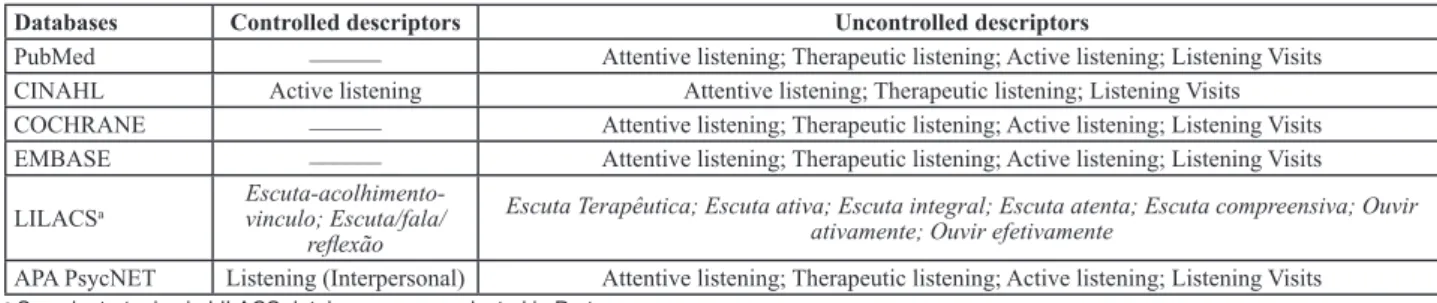
group without training (p<0.05). Chart 1 - Controlled and not controlled descriptors according to selected databases - Ribeirão Preto, SP, Brazil, 2013
Databases Controlled descriptors Uncontrolled descriptors
PubMed ______ Attentive listening; Therapeutic listening; Active listening; Listening Visits
CINAHL Active listening Attentive listening; Therapeutic listening; Listening Visits
COCHRANE ______ Attentive listening; Therapeutic listening; Active listening; Listening Visits
EMBASE ______ Attentive listening; Therapeutic listening; Active listening; Listening Visits
LILACSa
Escuta-acolhimento-vinculo; Escuta/fala/
relexão
Escuta Terapêutica; Escuta ativa; Escuta integral; Escuta atenta; Escuta compreensiva; Ouvir ativamente; Ouvir efetivamente
Among the included studies, seven (47%) are from
journals related to the ield of Psychology/Psychothera
-py (A1, A4, A8, A10, A11, A13 and A15), three (20%) are from the area of Occupaional Health (A5, A6 and A9), one (7%) from the area of Nursing Educaion (A2), two (13%) from the area of Health Technology (A7 and A12) and two (13%) are from journals of Social Service (A3) Maternal and Child Health (A14) (Box 2). As to the origin of the studies, ive (33%) were undertaken in the UK, four (27%) in the United States, three (20%) in Japan, two (13%) in Sweden and one (7%) in Canada.
As shown in Box 2, the most common study designs were experimental and quasi-experimental, with ive
publicaions each. It is noteworthy that, for this review, it is understood as experimental studies those with random allocaion of subjects in experimental and control groups
considering the exposure factor of interest by the invesi
-gator; quasi-experimental studies are very similar to the
experimental studies, however, they do not have charac
-terisics of randomizaion and/or control group(37).
Considering level of evidence, we used the classi
-icaion suggested by Melnyk and Fineout-Overholt(38),
which classiies the studies, from experimental design in seven levels: 1- systemaic review or meta-analysis of randomized controlled clinical trials; 2-: evidence from at least one randomized controlled trial well designed;
...Continuation
Study Objective Methodology Main results
A5(26)
To investigate the effects of a course on Therapeutic Listening on the attitude and the way to hear from business managers in the workplace.
Quasi-experimental study (n=60). Participants were offered two workshops on Therapeutic Listening, 16 hours each, with an interval of one month between each workshop.
The results showed that the skills related to therapeutic listening increased after the
second workshop (p<0.01).
A6(27)
To investigate the effects of train-ing on the skills of Therapeutic Listening of corporate managers.
Quasi-Experimental study (n=345). The partici-pants underwent a training program based on drama and discussions.
Both listening attitude (p<0.001) and listen
-ing skills (p<0.001) increased after train-ing.
A7(28)
To determine whether increased
postnatal support can inluence
the results of maternal and child health.
Experimental study (n=731). Mothers and newborns were divided into three groups with different types of postnatal support. One group received the Listening Visits.
There was no evidence of impact on the pri-mary outcomes of any intervention. Listening Visits was popular among women and was associated with improvement in some of the secondary outcomes.
A8(29)
To explore the experiences of women with postpartum depres-sion who received Listening Visits.
Qualitative Study (n=39). In-depth interviews were conducted with the participants.
Some conditions, such as good relationship with the visiting professional must be met for women to have a positive experience with Therapeutic Listening.
A9(30)
To investigate whether therapeu-tic Listening skills of supervi-sors are related to perceived job conditions and stress reactions of their subordinates.
Descriptive study (n=301). Supervisors (n=46) answered an instrument on attitudes and listening skills and subordinates (n=255) responded to two instruments: one about their working conditions and the other about their reactions to psychologi-cal stress.
Supervisors with high scores of attitudes and skills of Therapeutic Listening positively
inluence the perceived working conditions
and reactions to psychological stress of
sub-ordinates (p<0.05).
A10(31)
To investigate the effects of training modules with different workloads on therapeutic listen-ing skills of psychology students.
Experimental study (n=28). Groups with different training times used drama as a way of teaching Therapeutic Listening.
The therapeutic listening was also used for groups (p=0.74). Longer training time resulted in increased expression of feelings
by the advised (p<0.05) and greater in the information memory (p<0.01).
A11(32)
To evaluate the effectiveness of Listening Visits for postpartum women with depression.
Quasi-Experimental study (n=19). The moth-ers received up to six visits of Listening Visits. The variables investigated were: depression, life satisfaction and acceptability of treatment.
The measures of depression decreased
(p<0.0001, p=0.03, p=0.004); positive changes
in relation to life satisfaction were observed (p=0.01).Women considered the Listening Visits “very useful”.
A12(33)
To compare the eficacy of two
types of Antidepressant treat-ments (medication versus Listen-ing Visits) offered to women with postpartum depression.
Experimental study (n=254). The women were randomized into two groups: in one participants received an antidepressant (n=129), and on the other, Listening Visits.
At four weeks of treatment, the women from the group of antidepressants were more than
twice as likely to be better (p<0.001). How
-ever, there was no clear beneit relative to the
other groups (p = 0.19).
A13(34)
To explore the experiences of women with postpartum depres-sion who received Therapeutic Listening as treatment at home.
Qualitative Study (n=22). In-depth interviews were conducted with the participants.
Women with postpartum depression reported
Listening Visits as a useful but insuficient
intervention to treat depression.
A14(35)
To evaluate the feasibility, ac-ceptability and effectiveness of Therapeutic Listening offered to mothers of preterm infants.
Experimental study (n=23). The intervention was performed by a neonatal nurse, who made six vis-its to each participant. The variables investigated were: depression, anxiety, quality of life and acceptability of visits.
After the visits, symptoms of depression
(p<0.001) and anxiety (p<0.005) decreased.
Regarding quality of life, the results
sug-gested a signiicant improvement (p<0.001).
A15(36)
To explore the learning experi-ence of Students in Therapeutic Listening from a counseling course.
Qualitative Study (n=6). Interviews using a phenomenological approach were performed to articulate the learning experiences of the participants
The experiences of the irst year of the course
3- Evidence obtained from well-designed no-randomized clinical trials; 4- Evidence originated from well-designed cohort and case-control studies; 5- Evidence originated from systemaic review of descripive and qualitaive studies; 6- Evidence derived from a single descripive or qualitaive study; 7- Evidence from opinion of authoriies
and/or commitees of experts report. Most of the publica
-ions (40%) showed evidence level 2 (A3, A4, A7, A10, A12 and A14), followed by 33% with evidence level 3 (A1, A2, A5, A6 and A11) and 27% with evidence level 6 (A8, A9, A13 and A15). Given this classiicaion, the levels 1 and 2 are considered strong, 3 and 4 moderate and 5 to 7 weak
evidences(38), in other words 40% of studies have strong
evidence level, 33% moderate and 27% weak.
Most studies (33%) addressed the efect of training on the Therapeuic Listening skills (A2, A4, A5, A6 and
A10). The study A2(23), before being subjected to a train
-ing module on communicaion, students answered an
instrument that assesses the interpersonal skills of pro
-fessionals or students of health to conduct interviews.
The training lasted 42 hours, so that six hours were dedi
-cated exclusively to therapeuic listening. Ater train
-ing, paricipants completed the instrument again. In the pre-training 30.4% of students ideniied feelings of paricipants, while in the post-training the percentage was 78.5% (p<0.0005). The content of the messages was ideniied in 57% of the situaions before training and in 78.8% of the cases (p<0.0005). Sill, in the pre-training 6.4% of students were unable to idenify the feelings of
paricipants, while in the post-training this rate was re
-duced to 1.6% (p <0.005).
The study A4(25) diferent modes of Therapeuic Lis
-tening training were evaluated in an experimental and a quasi-experimental study. Twelve subjects paricipated in
the experimental study, this group had supervised drama
-izaion training, writen exercises and discussion. Anoth
-er twelve subjects paricipated in the quasi-exp-erimental study that used supervised dramaizaion. The third group received no training and had no prior knowledge about the Therapeuic Listening (n=6). In order to assess them, all paricipants had a consultaion and counseling of seven minutes with the paricipaion of a iciious paient. The result was that in 6 of the 10 categories of the instrument
used to assess students’ skills, the drama group used ap
-proximately twice the Therapeuic Listening answers than the untrained group (p<0.05).
The study A5(26) consisted of two workshops on Thera
-peuic Listening of sixteen hours each, which were divided into two days, with an interval of one month between
each workshop. The course was taught by business man
-agers through lectures, discussions and pracical aciviies. These aciviies were part of a training program in mental health. Paricipants completed an instrument, formulated by the authors of the study, which measured the efects of training on skills related to therapeuic listening, early at the beginning of the irst and at the end of the second
workshop. The results showed that the mean scores of the instrument increased signiicantly ater the second workshop (p<0.01).
The study A6(27) was about a training program for
Therapeuic Listening based on dramaizaions and dis
-cussions, developed by the authors of the research. Par
-icipants, corporate managers of middle educaion level,
were divided into groups of four or ive people. The train
-ing lasted one day. Paricipants answered an instrument
to measure skills and aitudes related to Therapeuic Lis
-tening before the start of training, one month and three months ater training. According to the results, the scores
of the subscales Listening Aitudes (p <0.001) and
Listen-ing skills (p<0.001) increased in both the irst and the third
month ater the training.
The study A10(31) used the dramaizaion of consulta
-ion and counseling as a way of teaching Therapeuic Listening. The paricipants were randomly allocated into three groups of training to pracice communicaion skills. One group received 14 hours of training. The other two groups had the same kind of training of the irst group,
however, the training was repeated, so that one group re
-ceived 28 hours and the other group 42 hours of course.
The results suggest that students used the Therapeu
-ic Listening ater diferent periods of training (p=0.74). Nevertheless, longer training ime resulted in increased
expression of feelings by the paricipants, so they report
-ed more emoions in the post-test than in the pre-test
(p<0.05). Sill, the result of the Recorded Informaion ver
-sus Interacion Time was in favor of the trained group of 42-hour course, which had the highest average recall of informaion from the students (p<0.01).
Researches on the efeciveness of Therapeuic Lis
-tening Visits as intervenion accounted for 27% of the
publicaions (A7, A11, A12 and A14). The study A7(28)
was an experimental study that compared the health outcomes of mothers and their newborns, which were divided into three groups: Support Health Visitor (SHV) Community Group Support (CGS) and control group. For the SHV a year of monthly Therapeuic Listening visits at Home was ofered. CGS consisted of local community groups that ofered services to women and their babies (daycare center, breasfeeding advice, among others). In the control group, they ofered rouine health services. According to the results, there were no diferences that
could not be atributed to chance in the primary out
-comes (maternal depression, injury in the child and ma
-ternal smoking). Regarding secondary outcomes, in rela
-ion to CGS and control groups, women’s SHV reduced
the number of doctor visits due to the child (mean difer
-ence= -0.21, 95% CI -0.38 to -0.04) increased use of ser
-vices ofered by health care providers and social workers (mean diference= 0.13, 95% CI 0.04 to 0.21) and had less concern about the child’s development (speech:
mean diference= 0.43, 95% CI 0.22 to 0.84; Alimenta
The study A11(32), women with depressive symptoms received up to six Therapeuic Listening visits at home. The variables invesigated were: depression, life saisfacion
and acceptability of treatment. Paricipants were inter
-viewed at three diferent moments: pre-visit (0 months), post-visit (2 months ater the visits) and follow-up (ive
months ater of the visits had started or three months af
-ter the last visit). According to the results, during the ive months between the pre and post-visit, the mean scores of all measures of depression decreased (p<0.0001; p=0.03; p=0.004). 63.2% of women were considered recovered and two thirds showed clinically signiicant improvement. Regarding life saisfacion, the results indicated posiive change in this variable over ime (p=0.01). The average of the instrument used to measure the acceptability of treatment was 5.7, indicaing that women considered the
Therapeuic Listening Visits as very useful.
The study A12(33), women diagnosed with postpartum
depression were randomly assigned to two groups: in one group the paricipant received an anidepressant (n=129)
and in the other, the paricipant received the Therapeu
-ic Listening Visits (n=125). Iniially, a series of four visits were ofered throughout four to six weeks. On the fourth
visit, the professional and the woman reviewed the prog
-ress and decided whether they should inalize visits or not
(women could go to the anidepressants group or alterna
-ive services), or would perform a second set of four vis
-its. In four weeks, the females from the anidepressants group were more than twice as likely to be beter when
compared to the ones who had received Therapeuic Lis
-tening Visits (odds raio=3.4; 95% CI 1.8 to 6, 5; p <0.001).
With 18 weeks of treatment, the proporion of improve
-ment in women was 11% higher in the group of anide
-pressants, however, there was no clear beneit of one group over another (Odds Raio = 1.5; 95% CI 0.8 to 2.6; p=0.19). Interviews with women revealed a preference for Therapeuic Listening Visits, however, they recognized that anidepressants could be necessary.
The study A14(35) evaluated the feasibility, acceptability
and efeciveness of Therapeuic Listening ofered to moth
-ers of premature infants hospitalized in a neonatal intensive care. The researchers’ hypothesis was that the Therapeuic Listening was associated with the clinical improvement of the mother, as well as improved self-perceived quality of life. The intervenion was performed by a neonatal nurse, who made six visits to each paricipant. Each visit lasted 45-60 minutes and was held in a hospital room that guarantee
privacy to women. The variables invesigated were: depres
-sion, anxiety, quality of life and acceptability of visits. Ater conducing the visits, symptoms of depression (p<0.001) and anxiety (p<0.005) declined signiicantly. Regarding quality of life, the results suggest a signiicant improvement in this variable (p<0.001). Most women who received visits (91.3%) rated them as excellent.
Among the included studies, only three (20%) used a qualitaive approach (A8, A13 and A15). Through in-depth
interviews, which allows the exploraion of one or more themes with greater lexibility, unlike what happens in the
case of the use of quesionnaires or a fully structured in
-terview, the A8(29) and A13(34) studies have atempted to
explore the experiences of women with postpartum de
-pression who received Therapeuic Listening Visits. Ac
-cording to the results of the A8 study(29), the factors that
made a posiive experience of the visits were: to agree
with the medical model for postpartum depression, hav
-ing a good relaionship with the professional who con
-ducts the visits, having the opportunity to make choices and the fact that the visits are developed as a clear and
lexible process. The indings of the study A13(34) indicated
that all paricipants reported that the Therapeuic Listen
-ing Visits were beneicial, although many of them were in need of addiional intervenion to control depressive symptoms. Sill, the efeciveness of visits appears to be
linked to the causes of depression, the way visits are con
-ducted and by whom they are performed. The researchers
concluded that women with postpartum depression con
-sider the Therapeuic Listening Visits as something useful, but insuicient for the treatment of depression.
In the study A15(36), through interviews, students in a
course on counseling were invited to relect on personal experiences lived during the irst year of the course. One of the themes that emerged during the interviews was about learning to listen, that is, becoming aware of what
you are doing when you are listening to. Some parici
-pants said they used to ilter what people said from his/ her own personal experiences. Another aspect revealed was about to listen to how relaionships were developed
with other people. Sill, paricipants referred to the reve
-laion of otherness, that is, listening as a reve-laion of the realiies of others. Finally, graduate students spoke about the diference between being able to listen and receiving informaion only.
In the study A1(22), psychology students and psycho -therapists paricipated in the research in order to observe
whether prior informaion about the paient can inlu
-ence the Therapeuic Listening process. Half of the parici
-pants in each group (students and professionals) received only the instrucions for paricipaion in the study, the other half, in addiion to the instrucions, also received some informaion about the paient. A real therapeuic tape-recorded interview was used as simulus material.
Ater hearing the statements of the paient, the parici
-pant should answer the following quesion: What did the
paient tell you? According to the results, most thera
-pists have more interpreive responses than students (0.01<p<0.05), however, analysis of the possible efect of
clinical informaion about the paient did not produce sig
-niicant diferences.
To conduct the study A9(30), supervisors responded
psychological stress. According to the indings, the subor
-dinates who worked with supervisors had high scores of
skills and aitudes for Therapeuic Listening, they report
-ed more favorable reacions to psychological stress (men: p=0.47; women: p=0.004) and greater control at work (male: p=0.026; female: p=0.007).
In the study A3(24) a series of experiments were per -formed in order to observe whether, in the process of
Therapeuic Listening, the way how answers are formu
-lated can interfere with afecive reacion of paients. Two types of answers were studied. In type A, responses are
neutral or imply the existence of alternaive interpreta
-ions, such as to how the paient react about a situaion. The researchers found that, paraphrasing the statements
of the paient in order to accept the interpretaion re
-garding alternaive interpretaions about a given situa
-ion, the paient may present less intense levels of anger (p<0.0001) and depression (p=0.0105) than if statements
are used in a way that assumes the accuracy of the inter
-pretaions of the paient.
DISCUSSION
Despite the recognized therapeuic value of listen
-ing(14), primary studies on this topic are scarce, ater all,
only 15 publicaions were found in the scieniic litera
-ture related to the purpose of this review. However, it is noteworthy that, although scarce, most of the studies reported levels of evidence that allow reliability in using their results(39).
It can be observed that a common point among most of the included studies, is the acknowledgment of skills on the part of health professionals, to develop a process of efecive listening. There are a number of ways to listen. One of them, for example, is when you listen to a friend or family situaion in which they are invited to ofer their points of view while listening with sympathy or makes
comments that aim to calm who is heard(40). Another way
would be when the individual seeks a professional to lis
-ten and advise or provide accurate informaion about their concerns, for example, when looking for a lawyer for legal issues. In this case, a specialized consuling is pro
-vided and the informaion is transmited. A third way of
listening, disinct from the other two, involves the absorp
-ion of the narraive of a person without ofering advice or informaion, so that, upon listening reports of diseases or life experiences from a psychological point of view, such
an aitude is therapeuic(40).
The Nursing Intervenions Classiicaion(9) presents the
intervenion Listening Visits, which was created in the UK
to circumvent barriers related to accessibility and accept
-ability of treatment for depression in women from ethnic
minoriies and low income(41-42). This intervenion consists
of using techniques from the non-direcive counseling as exploraion of a problem through the Therapeuic Listening
and resolving in collaboraion with the paient(32). Listen
-ing Visits presents itself as an efecive acivity in reduc-ing
the rates of anxiety and depression in women with post
-partum depression or mothers of premature babies(28,32,35).
For such women, this intervenion was beneicial, since it was presented as an opportunity to talk and concentrate
on their own feelings and circumstances(34). According to
researches, as oten, the individual just needs someone
to listen so he/she can arrange and organize their own ex
-perience and, even though the soluion to their problems seem distant or even impossible, simply talking about it
causes an immediate relief sensaion(43), which prevents
the individual to be without psychological structure by
experiencing a tension level above his/her limit(11). How
-ever, for the process of listening to develop saisfactorily, it is important that the professional has skills to provide emoional and pracical support to the paient, so he/she can idenify him/herself with the situaion and feel able to trust this professional providing care(29,34).
The Therapeuic Listening skill, an important com
-ponent of the communicaion process, involves under
-standing of what the other person says and feels and
then communicaing that understanding back to it(23).
The health team can and should provide the paient with quality care, however, for this to occur it is necessary
to assimilate communicaion skills(44) which are not ac
-quired empirically or with ime, but only with adequate
educaion(15). In this context, it is relevant to the study of
methods that can assist in the teaching of Therapeuic
Listening. According to the studies of this review that in
-vesigated the efeciveness of training on listening skills,
aciviies like dramaizaion(25,27,31), readings, pracical ac
-iviies, discussions about the process of listening, lec
-tures(23,26) between others, can contribute to the teach
-ing of this communicaion technique.
The lack of ability to pracice Therapeuic Listening can, for example, depend on how the statements are paraphrased to the paient, generaing feelings of anger
and depression(24). Knowing how to therapeuically listen
can have a posiive impact on the one listened, for ex
-ample, when assising them in the formulaion of more
favorable reacions to psychological stress(30). Finally, the
process of listening requires becoming aware of what
one is doing when he/she is listening, and understand
-ing that there is a diference between listen-ing and only
receiving informaion(36).
CONCLUSION
Based on the presented results, we can conclude that most of the included studies for this review have strong to
moderate level of evidence, allowing reliability of their re
-sults and, although addressing diferent aspects related to
Therapeuic Listening, they have in common the recogni
-ion of the need for skills on the part of health profess-ion
Among the 15 included studies, ive addressed the ef
-fect of training on the skills of Therapeuic Listening, four studied the eicacy of listening as an intervenion, three explored the experiences lived of the subjects related to
listening, and three discussed various aspects of listen
-ing (the inluence of prior informaion about the paient at the Therapeuic Listening process, the relaionship between aitudes and listening skills of supervisors and working condiions of psychological stress reacions of
their subordinates, and inally, how to formulate their an
-swers in the process of therapeuic listening, which can inluence the afecive reacion of paients).
One aspect that may have interfered with the results concerns the electronic search that was conducted in ive databases with the descriptors presented. The study, in
addiion to summarizing the evidence regarding the use of Therapeuic Listening as a health intervenion, provides a direcion for nurses and other health professionals to think about the use of such intervenion in their clinical pracice, as this presents itself as a beneicial intervenion for the welfare of the individual. However, it is important
to pay atenion to the need for training of health profes
-sionals to perform this acivity, since the lack of skills to conduct the Therapeuic Listening can cause harm to the paient. Further studies, especially experimental, should
consider the theoreical aspects that support this inter
-venion, they will explore in greater depth the efects of Therapeuic Listening applied in the context of health and meet potenial paient condiions that may inluence the achievement of expected results with this technique.
REFERENCES
1. Haes H, Teunissen S. Communicaion in palliaive care: a re
-view of recent literature. Curr Opin Oncol. 2005;17(4):345-50.
2. Skilbeck J, Payne S. Emoional support and the role of Clinical Nurse Specialist in palliaive care. J Adv Nurs. 2003;43(5):521-30.
3. Salimena AMO, Marins BR, Melo MCSC, Bara VMF. Como mulheres submeidas à quimioterapia anineoplásica per
-cebem a assistência de enfermagem. Rev Bras Cancerol. 2010;56(3):331-40.
4. Benjamim A. A entrevista de ajuda. São Paulo: Marins Fon
-tes; 1983.
5. Filgueiras SL, Deslandes SF. Evaluaion of counseling aciviies: analysis of a person-centered prevenion perspecive. Cad Saúde Pública. 1999;15 Suppl 2:121-31.
6. Lazure H. Viver a relação de ajuda: abordagem e práica de um critério de competência da enfermeira. Lisboa: Luso Di
-dacta; 1994.
7. Stefanelli MC. Estratégias de comunicação terapêuica. In: Ste
-fanelli MC, Carvalho EC. A comunicação nos diferentes contex
-tos da Enfermagem. 2ª ed. Barueri: Manole; 2012. p. 77-109.
8. Mucchelli R. A entrevista não-direiva. São Paulo: Marins Fonte; 1978.
9. Bulechek GM, Butcher HK, Dochterman JM, Wagner CM. Nur
-sing Intervenions Classiicaion (NIC). 6th ed. St. Louis: Else
-vier; 2013.
10. Watanuki MF, Tracy R, Lindquist R. Therapeuic listening. In: Tracy R, Lindquist R. Complementary alternaive therapies in nursing. New York: Springer; 2006. p. 45-55.
11. Souza RC, Pereira MA, Kantorski LP. Therapeuic listening: an essenial instrument in nursing care. Rev Enferm UERJ. 2003;11(1):92-97.
12. Bermejo Higuera JC. La escucha aciva em cuidados paliai
-vos. ARS Méd (Saniago). 2005;(11):119-36.
13. Brusamarello T, Capistrano FC, Oliveira VC, Mercês NNA, Matum MA. Cuidado a pessoas com transtorno mental e familiares: diagnósicos e intervenções a parir da consulta de enfermagem. Cogitare Enferm. 2013;18(2):245-52.
14. Fassaert T, Dulmen S, Schellevi F, Bensing J. Acive listening in medical consultaions: development of the Acive Liste
-ning Observaion Scale (ALOS-global). Paient Educ Couns. 2007;68(3):258-64.
15. Araújo MMT, Silva MJP. The knowledge about communica
-ion strategies when taking care of the emo-ional dimens-ion in palliaive care. Texto Contexto Enferm. 2012;21(1):121-9.
16. Santos L, Torres HC. Educaional pracices in diabetes melli
-tus: understanding the skills of health professionals. Texto Contexto Enferm. 2012;21(3):574-80.
17. Lima DWC, Silveira LC, Vieira AN. Listening in the treatment of psychological stress an integraive review. J Nurs UFPE on line [Internet]. 2012 [cited 2014 June 17];6(9):2273-80. Available from: htp://www.revista.ufpe.br/revistaenferma
-gem/index.php/revista/aricle/view/2632/pdf_1479
18. Roman AR, Friedlander MR. Revisão integraiva de pesquisa aplicada à enfermagem. Cogitare Enferm. 1998;3(2):109-12.
19. Whitemore R, Knal K. The integraive review: updated me
-thodology. J Adv Nurs. 2005;52(5):546-53.
20. Mendes KDS, Silveira RCCP, Galvão CM. Integraive literature review: a research method to incorporate evidence in health care and nursing. Texto Contexto Enferm. 2008;17(4):758-64.
22. Sommer GR, Mazo B, Lehner GFJ. An empirical invesigaion of therapeuic “listening”. J Clin Psychol. 1955;11(2):132-6.
23. Olson JK, Iwasiw CL. Efects of a training model on ac
-ive listening skills of post-RN students. J Nurs Educ. 1987;26(3):104-7.
24. Nugent WR, Halvorson H. Tesing the efects of acive liste
-ning. Res Soc Work Pract. 1995;5(2):152-75.
25. Lisper H, Rautalinko E. Efects of a six hour training of acive listening. Scand J Behav Ther. 1996; 25(3-4):117-25.
26. Kubota S, Mishima N, Ikemi A, Nagata S. A research in the efects of acive listening on corporate mental health training. J Occup Health. 1997;39(4):274-9.
27. Kubota S, Mishima N, Nagata S. A study of the efects of aci
-ve listening on listening aitudes of middle managers. J Oc
-cup Health. 2004;46(1):60-7.
28. Wiggins M, Oakley A, Roberts I, Turner H, Rajan L, Auster
-berry H, et al. The Social Support and Family Health Study: a randomised controlled trial and economic evaluaion of two alternaive forms of postnatal support for mothers living in disadvantaged inner-city areas. Health Technol Assess. 2004;8(32):iii,ix-x,1-120.
29. Shakespeare J, Blake F, Garcia J. How do women with pos
-tnatal depression experience listening visits in primary ca
-re? A qualitaive interview study. J Reprod Infant Psychol. 2006;24(2):149-62.
30. Mineyama S, Tsutsumi A, Takao S, Nishiuchi K, Kawakami N. Supervisors’ aitudes and skills for acive listening wi
-th regard to working condiions and psychological stress reacions among subordinate workers. J Occup Health. 2007;49(2):81-7.
31. Rautalinko E, Lisper HO, Ekehammar B. Relecive listening in counseling: efects of training ime and evaluator social skills. Am J Psychother. 2007;61(2):191-209.
32. Segre LS, Stasik SM, O’Hara MW, Arndt S. Listening vi
-sits: an evaluaion of the efeciveness and acceptability of a home-based depression treatment. Psychother Res. 2010;20(6):712-21.
33. Sharp DJ, Chew-Graham C, Tylee A, Lewis G, Howard L, An
-derson I, et al. A pragmaic randomised controlled trial to compare anidepressants with a community-based psycho
-social intervenion for the treatment of women with post
-natal depression: the RESPOND trial. Health Technol Assess. 2010;14(43):iii-iv, ix-xi, 1-153.
34. Turner KM, Chew-Graham C, Folkes L, Sharp D. Women’s ex
-periences of health visitor delivered listening visits as a tre
-atment for postnatal depression: a qualitaive study. Paient Educ Couns. 2010;78(2):234-9.
35. Segre LS, Chufo-Siewert R, Brock RL, O’Hara MW. Emoio
-nal distress in mothers of preterm hospitalized infants: a feasibility trial of nurse-delivered treatment. J Perinatol. 2013;33(12):924-8.
36. Lee B, Prior S. Developing therapeuic listening. Br J Guid Couns. 2013;41(2):91-104.
37. Polit DF, Beck CT. Essenials of nursing research: appraising evidence for nursing pracice. 8th ed. Philadelphia: Lippin
-cot Williams & Wilkins; 2014. Quanitaive research design; p. 149-75.
38. Melnyk BM, Fineout-Overholt E. Evidence based pracice in nursing & healthcare: a guide to best pracice. 2th ed. Phi
-ladelphia: Lippincot Williams & Wilkins; 2011. Making the case for evidence-based pracice; p.3-24.
39. Polit DF, Beck CT. Essenials of nursing research: appraising evidence for nursing pracice. 8th ed. Philadelphia: Lippin
-cot Williams & Wilkins; 2014. Fundamentals of evidence-based nursing pracice; p.20-39.
40. Jones AC, Cutclife JR. Listening as a method of addressing psychological distress. J Nurs Manag. 2009;17(3):352-8.
41. Segre LS, McCabe JE, Stasik SM, O’Hara MW, Arndt S. Im
-plementaion of an evidence-based depression treatment into social service seings: the relaive importance of ac
-ceptability and contextual factors. Adm Policy Ment Health. 2012;39(3):180-6.
42. Levy LB, O’Hara MW. Psychotherapeuic intervenions for depressed, low-income women: a review of the literature. Clin Psychol Rev. 2010;30(8):934-50.
43. Miranda CF, Miranda ML. Construindo a relação de ajuda. 10ª ed. Belo Horizonte: Crescer; 1996.