RESUmo
Esse estudo objeivou ideniicar a preva -lência de lesões por fricção (LF) em pacien -tes hospitalizados com câncer e avaliar os fatores demográicos e clínicos associados ao seu desenvolvimento. Estudo epidemio -lógico, de corte transversal, realizado no Insituto do Câncer do Estado de São Paulo Octavio Frias de Oliveira. Todos os pacien -tes adultos, internados entre 10 e 18 de abril de 2010, foram avaliados por meio de entrevista e exame ísico. Uilizou-se o teste Qui-Quadrado para comparação das variáveis demográicas e clínicas entre pa -cientes com e sem LF. Foram avaliados 157 pacientes: cinco apresentaram nove LF, acarretando prevalência de 3,3%. Quanto às variáveis demográicas, houve diferen -ça estaisicamente signiicaiva somente para o número de ilhos (p=0,027). Clini -camente, pacientes com LF apresentaram menores escores na escala de Karnofsky (p=0,031) e na Escala de Braden (p=0,026), além de comportamento pouco colabora -ivo (p=0,042). Esse estudo contribui para um melhor conhecimento acerca das LF em pacientes com câncer.
dEScRitoRES Prevalência Pacientes internados Neoplasias
Fricção
Ferimentos e lesões Enfermagem oncológica
Prevalence of skin tears among
hospitalized patients with cancer
O
riginal
a
r
ticle
AbStRAct
This study aimed to analyze the prevalen -ce of skin tears (ST) among hospitalized oncology paients and associated demo -graphic and clinical variables. This is an epidemiological cross-secional study type, performed at Octavio Frias de Oliveira Sta -te of São Paulo Cancer Insitu-te. All adult paients hospitalized from April 10th to 18th 2010 were evaluated by interview and physical examinaion. Chi-square test was used to compare demographic and cli -nical variables between paients with and without ST. Five paients among 157 had nine skin tears, resuling in a prevalence of 3.3%. Among demographic variables, only number of children showed staisically signiicant diference (p=0.027) betwe -en groups. Clinically, pai-ents with ST had lower Karnofsky scores (p=0.031), lower scores at Braden Scale (p=0.026) and less collaboraive behaviors (p=0.042) when compared to paients with no lesions. This study contributes to a beter knowledge of ST in oncology paients.
dEScRiPtoRS Prevalence Inpaients Neoplasms Fricion
Wounds and injuries Oncologic nursing
RESUmEn
Este estudio tuvo como objeivo evaluar la prevalencia de lesiones por fricción (LF) en pacientes ingresados con cáncer y variables demográicas y clínicas asociadas. Estudio epidemiológico fue desarrollado en el Insi -tuto de Cáncer del Estado de São Paulo Oc -tavio Frias de Oliveira. Los pacientes adul -tos ingresados del 10 al 18 de abril de 2010 fueron evaluados por medio de entrevista y examen ísico. El teste de Qui-cuadrado fue usado para comparar las variables de -mográicas y clínicas entre los grupos de pacientes con y sin LF. Cinco entre los 157 pacientes evaluados presentaron nueve LF, con prevalencia de 3,3%. Solamente el nú -mero de hijos presentó diferencia estadísi -ca signii-caiva (p=0,027) cuanto a variables demográicas. Clínicamente, pacientes con LF presentaron puntuaciones más bajas en las escalas de Karnofsky (p=0,031) y Braden (p=0,026) y menos comportamientos cola -boraivos (p=0,042). El estudio contribuye para el mejor conocimiento a cerca de LF en pacientes con cáncer.
dEScRiPtoRES Prevalencia Pacientes internos Neoplasias Fricción
Heridas y traumaismos Enfermería oncológica
Ana Flávia dos Santos Amaral1, Kelly cristina Strazzieri Pulido2,
Vera Lucia conceição de Gouveia Santos3
Prevalência de lesões Por fricção em Pacientes hosPitalizados com câncer
Prevalencia de lesiones Por fricciÓn en Pacientes hosPitalizados con cancer
intRodUction
Skin tears (ST) are traumaic injuries, caused by iso -lated fricion or accompanied by shear, and paricularly afect the elderly. They are related to the separaion be -tween the epidermal and dermal layers (parial thickness wounds) or to the separaion of both from underlying lay -ers (total thickness wounds)(1-5).
The most common injury sites are the upper extremi -ies, responsible for 80%. Other common areas are the lower extremiies, back and gluteal region(5-6).
Some paients are at greater risk for the occurrence of ST, including weak and dependent people, with mobil -ity and diet problems, people with weak skin, such as el -derly people and terminal paients. Dependent paients, who need help with their aciviies of daily living, are also vulnerable. Their injuries can result from rouine aciviies like bathing and grooming and take place during the trans -fer/reposiioning process(1-3,5-7).
As a result of aging, dermal thickness reduces by almost 20%(7), accompanied by
a decrease in sweat producion through the sweat and sebaceous glands, reduced pain percepion, tacile sensiivity, inlammatory response and ability to synthesize collagen.
(1-4) In addiion, many elderly people sufer
from comorbidiies that demand medica -ion intake, which can compromise skin in -tegrity, such as steroidal ani-inlammatory agents(1-2).
It is esimated that approximately 1.5 million ST afect insituionalized elderly people in the USA per year(8) and that, by
2030, there will be 8.1 million people at high risk of developing these injuries in the same
country(8). In ST prevalence research, authors(4-5,9) indicate
that they are more frequent than pressure ulcers and burns.
No studies were found in the literature that associ -ate the occurrence of ST in cancer paients. Besides the above aspects, which can also be present in this kind of paients, some authors(10-11) report skin alteraions as a
consequence of oncology treatment and the disease’s progression, entailing greater vulnerability to trauma and, consequently, to ST.
Despite the long history of this problem, high ST mor -bidity levels, increased longevity and rising incidence rates of chronic-degeneraive diseases, paricularly cancer, have simulated research development on this kind of wounds, with a view to the systemizaion of their nomenclature, eiology and classiicaion; prevenion and treatment. No study on ST was found in Brazil, using this terminology or not, paricularly among cancer paients.
Thus, the aim in this study was to idenify the preva -lence of ST in hospitalized cancer paients and assess the demographic and clinical factors associated with their de -velopment in this clientele.
mEtHod
This epidemiological and exploratory cross-secional research was performed at the hospitalizaion and inten -sive care units of Insituto do Câncer do Estado de São Paulo Octavio Frias de Oliveira (ICESP), which ofered 270 acive beds (44 in intensive care and 226 in hospitaliza -ion) at the ime of data collecion.
Inaugurated in May 2008, the ICESP is a social health organizaion the São Paulo State government created in partnership with Fundação Faculdade de Medicina da Uni -versidade de São Paulo. The insitute is one of the largest specialized cancer treatment hospitals in Lain America and exclusively atends paients through the Uniied Health Sys
-tem (SUS), forwarded from health services that are not specialized in oncology. Besides paient care, the ICESP is a teaching and re -search hospital, including studies on new drugs and innovaive cancer treatments.
Iniially, the project received approval from the Research Ethics Commitee at Uni -versity of São Paulo School of Nursing (Pro -cess No. 859/2009/CEP-EEUSP), followed by the Insitute’s authorizaion. All ethical aspects of research involving human beings were complied with.
Sample
All patients hospitalized at the time of data collection (on April 10th- 18th
2010) were included in the study, provided that they complied with the following criteria: age 18 years or older, being hospitalized at any of the specified units, not having injuries of other causes and accepting to participate in the study through the signing of the Informed Consent Term. It is highlighted that no dis -tinction in hospitalization time was made to include patients in the sample.
As it was impossible to collect data from all pa -tients hospitalized in the institution’s active beds on a single day, to comply with the study objectives and avoid the repeated assessment of the same patient, the researchers decided to assess 30 beds per day (10 per shift: morning, afternoon and night) for nine consecu -tive days during the study period. Thus, 183 patients were evaluated (not all 270 beds were occupied dur -ing data collection), 26 of whom were excluded due to wounds of other causes. Hence, in total, 157 patients were analyzed.
...high ST morbidity levels, increased longevity and rising
incidence rates of chronic-degenerative diseases, particularly
cancer, have stimulated research
development on this kind of wounds,
Data collecion
With the paients’ agreement to paricipate in the study, consultaion of paient iles, interviews with pa -ients and/or relaives and physical examinaion were used to collect sociodemographic and clinical data.
One of the lead researchers (who worked at the in -situion at the ime of data collecion) only interviewed the family members if paients were in no physical and/or cogniive condiions to answer.
The physical examinaion involved visual inspecion of the skin, speciically to look for injuries. With a view to a systemaic examinaion, without ignoring any body part, irst, the paient was placed in supine posiion, his/her clothes were removed and the following regions were in -spected: head, chest, abdomen, genitals, upper and lower limbs; then, in prone posiion: head, back, gluteal region, upper and lower limbs.
Two researchers collected the data: the stomal thera -pist (one of the authors) – the sole responsible for assess -ing all wounds found and classify the ST; and one under -graduate student who, for the sake of homogeneous data collecion, was trained: in theory, through an opional undergraduate subject on wound prevenion and treat -ment (she paricipated in a speciic seminar on ST); and in pracice through clinical work at the ICESP hospitalizaion units, under the stomal therapist’s supervision, for three consecuive days before data collecion started.
Data collecion instruments
The following instruments were used for data collec -ion: a quesionnaire for sociodemographic and clinical informaion; the Karnofsky Scale(12); the Braden Scale(13-14)
and the Brazilian Portuguese version of the STAR – Skin Tear Classiicaion System(15).
Quesionnaire
The quesionnaire to characterize the hospitalized cancer paients(16) included the following demographic
informaion: age, gender, race/color, origin, marital sta -tus, number of children, presence of caregiver, educaion, work and monthly family income; and clinical informaion: oncology diagnosis, presence of metastasis, oncology treatment (surgery, radiotherapy and/or chemotherapy), drug addicion, medicaion, visual and auditory acuity lev -els, body mass index, food and luid acceptance (asked to the paient and subjecively classiied as adequate, insuf -icient or exaggerated), vesicointesinal situaions, incon -inence devices, physical mobility, walking, edema, pres -ence of adhesive dressings and type of behavior (assessed according to the following subjecive criteria: aggressive reacion to daily care, psychomotor agitaion, collabora -ive or non-respons-ive).
Karnofsky Scale
As ST mainly afect weakened and dependent people, the Karnofsky scale was chosen to assess paients’ depen -dence level, assessing their performance of aciviies of daily living.
This scale, which was part of the study’s clinical aspects, was developed by Karnofsky et al.(12) and no
reference was identified on its formal adaptation and validation in Brazil. Its score ranges from 0 to 100 (100 corresponds to the absence of complaints and symp -toms and 0 to death). According to the original scale authors(12), patients can be classified as follows: indi -vidual apt for normal activities and work, without and special care need (80 to 100 points); individual inapt for work but apt to live at home and take care of many personal needs, requiring quite variable assistance and support (50 to 70 points); and individual inapt for self-care, demanding hospital or specialized self-care, with rap -id disease progression (0 to 40 points). For statistical analysis purposes, that classification was used in this research.
Braden Scale
Developed by Bergstrom et al.in 1987(13), and adapted
to Portuguese and validated by Paranhos and Santos in 1999(14), this scale was conceived to opimize prevenion
strategies for pressure ulcer.
The Braden scale consists of six subscales that address intrinsic and extrinsic factors which, when present, indi -cate the risk of developing pressure ulcers:
• sensory percepion – measures the individual’s capacity to feel and relieve the discomfort the pressure provokes; • acivity – evaluates the frequency of the individual’s movements out of bed;
• mobility – refers to movements in bed, so as to redistrib -ute the pressure;
• humidity – assesses the individual’s degree of exposure to potenial sources of humidity;
• tear and shear – assesses the extent to which the indi -vidual is exposed to shear strength.
Each subscale is scored according to the problems the paient presents. Except for the tear and shear subscale, which ranges from 1 to 3, the other subscales range from 1 to 4, and the total score range is between 6 and 23. Scores of 16 or lower indicate risk for pressure ulcer. The lower the score, the greater the risk exposure(13).
STAR – Skin Tear Classiicaion System
System. Published in 2007(4) and revised in 2010 by Car
-ville et al.(17), the STAR - Skin Tear Classiicaion Systemwas
elaborated to obtain a valid and universally accepted skin tear classiicaion system. Strazzieri-Pulido and Santos(15)
adapted and validated the STAR – Skin Tear Classiicaion System in Brazilian Portuguese in 2010. Like the original instrument, the Brazilian Portuguese version includes three parts:
• Guidelines of the STAR – Skin Tear Classiicaion System – with six topics related to care for the wound and neigh -boring skin.
• STAR – Skin Tear Classiicaion System – comprises ive photographs related to the ive ST categories, described as follows: Category 1a – a skin tear where the skin lap can be realigned to the normal anatomical posiion (with -out undue stretching) and the skin or lap color is not pale, dusky or darkened; Category 1b – a skin tear where the skin lap can be realigned to the normal anatomical posiion (without undue stretching) and the skin or lap color is pale, dusky or darkened; Category 2a - a skin tear where the skin lap cannot be realigned to the normal anatomical posiion (without undue stretching) and the skin or lap color is not pale, dusky or darkened; Cate -gory 2b - a skin tear where the skin lap cannot be re -aligned to the normal anatomical posiion (without un -due stretching) and the skin or lap color is pale, dusky or darkened; Category 3 – a skin tear where the skin lap is completely absent;
• Glossary of the STAR – Skin Tear Classiicaion System – located on the back of the instrument, includes the deini -ion of ST and related technical terms.
Staisical Analysis
For this study, prevalence or point-prevalence was deined as the total number of individuals afected by a given disease at a single point in ime(18). It should be high -lighted that, in this kind of study, measures do not need to be taken from all paients at the same ime(18). The follow -ing formula was used for calculaion purposes(18):
Prevalence coeficient =
No of known cases of a given disease x 100
Population
Considering the exploratory design and, although some of the variables of interest were established in the introductory chapter, due to the lack of speciic research on ST in hospitalized cancer paients, all demographic and clinical variables surveyed were included in the compara -ive tests between the groups with and without ST. For
these comparisons, the Chi-Square test was used, with a signiicance level of 5%. Given the low prevalence level, logisic regression analysis was not possible.
RESULtS
Among the 157 paients assessed: ive revealed nine ST (prevalence of 3.3%); two showed three injuries each. Among the nine ST found, category 3 was present ive imes, while the remaining categories (1a, 1b, 2a and 2b) each appeared one ime.
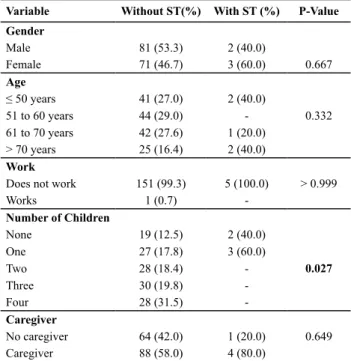
As for the characterisics of the paients with ST, three were women and three were over 60 years of age (Table 1). The oncology diagnoses were distributed among head and neck (2), colorectal (2) and bladder (1) cancer.
Table 1 – Comparison between patients with and without ST ac
-cording to demographic variables - São Paulo, 2010.
Variable Without ST(%) With ST (%) P-Value
Gender
Male 81 (53.3) 2 (40.0)
Female 71 (46.7) 3 (60.0) 0.667
Age
≤ 50 years 41 (27.0) 2 (40.0)
51 to 60 years 44 (29.0) - 0.332
61 to 70 years 42 (27.6) 1 (20.0)
> 70 years 25 (16.4) 2 (40.0)
Work
Does not work 151 (99.3) 5 (100.0) > 0.999
Works 1 (0.7)
-Number of Children
None 19 (12.5) 2 (40.0)
One 27 (17.8) 3 (60.0)
Two 28 (18.4) - 0.027
Three 30 (19.8)
-Four 28 (31.5)
-Caregiver
No caregiver 64 (42.0) 1 (20.0) 0.649
Caregiver 88 (58.0) 4 (80.0)
Table 1 shows no staisically signiicant diference concerning demographic variables, except for the number of children (p=0.027).
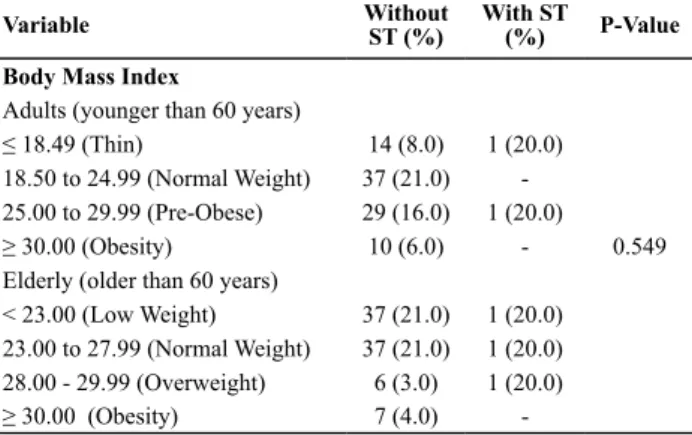
Table 2 – Comparison between patients with and without ST ac
-cording to clinical variables - São Paulo, 2010.
Variable Without ST (%) With ST (%) P-Value
Metastasis
No 100 (68.8) 3 (60.0) > 0.999
Yes 52 (34.2) 2 (40.0)
Surgery
No 62 (40.8) 2 (40.0) > 0.999
Yes 90 (59.2) 3 (60.0)
Chemotherapy
No 62 (40.8) 3 (60.0) 0.65
Yes* 90 (59.2) 2 (40.0)
Radiotherapy
No 104 (68.4) 3 (60.0) 0.654
Yes 48 (31.6) 2 (40.0)
Braden Scale
> 18 (No Risk) 79 (52.0)
-15 a 18 (Low Risk) 24 (15.8) 1 (20.0) 0.026
13 a 14 (Moderate Risk) 19 (12.5) 1 (20.0)
10 a 12 (High Risk) 11 (7.2)
-≤ 9 (Very High Risk) 19 (12.5) 3 (60.0)
Edema
No 96 (63.2) 2 (40.0) 0.365
Yes 56 (36.8) 3 (60.0)
Food/Fluid Acceptance
Adequate 51 (33.6) 1 (20.0) > 0.999
Insuficient 101 (66.4) 4 (80.0)
Bladder and bowel situation
Continent 81 (53.3) 1 (20.0)
Fecal/ anal incontinence 6 (3.9) - 0.157
Urinary incontinence 17 (11.2)
-Fecal and urinary incontinence 48 (31.6) 4 (80.0)
Physical Mobility
Normal 90 (59.2) 1 (20.0)
Decreased 57(37.5) 3 (60.0) 0.065
Absent 5 (3.3) 1 (20.0)
Walking
Normal 51 (33.6)
-Walking 58 (38.2) 2 (40.0) 0.188
Does not walk 43 (28.3) 3 (60.0)
Karnofsky Index
0 a 40 (Inapt for Self-Care) 75 (49.9) 5 (100.0)
50 a 70 (Inapt for Work) 61 (40.1) - 0.031
80 a 100 (Apt for Normal Activity
and Work) 16 (10.5)
-Behavior
Psychomotor Agitation 7 (4.6) 1 (20.0)
Collaborative 140 (92.1) 3 (60.0) 0.042
Non-responsive 5 (3.3) 1 (20.0)
Adhesive Dressing
No 10 (6.6) - > 0.999
Yes 142 (93.4) 5 (100.0)
Variable Without ST (%) With ST (%) P-Value
Body Mass Index
Adults (younger than 60 years)
≤ 18.49 (Thin) 14 (8.0) 1 (20.0)
18.50 to 24.99 (Normal Weight) 37 (21.0)
-25.00 to 29.99 (Pre-Obese) 29 (16.0) 1 (20.0)
≥ 30.00 (Obesity) 10 (6.0) - 0.549
Elderly (older than 60 years)
< 23.00 (Low Weight) 37 (21.0) 1 (20.0)
23.00 to 27.99 (Normal Weight) 37 (21.0) 1 (20.0)
28.00 - 29.99 (Overweight) 6 (3.0) 1 (20.0)
≥ 30.00 (Obesity) 7 (4.0)
-*Only four patients were receiving chemotherapy drugs during data collection. ST were not identiied in any of them.
diScUSSion
The study that analyzed the prevalence of ST in hospi -talized cancer paients in inedited in our context, not only because a recently established nomenclature(4,15) is used,
but also because of the clients analyzed, as most litera -ture, mainly internaionally, discusses this type of injury in insituionalized elderly people.
Clinical condiions like anorexia/cachexia, malnutri -ion, anemia, metabolic alteraions, reduced physical mo -bility, advanced age, circulatory disorders and neurologic diseases can compromise skin health(19). Speciically in
cancer paients, epidermal, dermal and collagen altera -ions may be associated with the use of anineoplasic agents(10) and skin reacions are frequent in breast cancer
paients submited to radiotherapy(11). In addiion, factors
like age, smoking, chronic condiions and concomitant anineoplasic treatment can cause changes in this type of paient’s healing process(11). When comparing the heal
-ing ime of paients with and without cancer, one study(20)
found that, at the end of a 24-week treatment period, wounds were healed for 44% of cancer paients and 78% of people without cancer, supporing the greater vulner -ability and weakness of cancer paients, and consequently of their skin.
In a descripive study of chronic paients at ten insitu -ions, aimed at describing the ST, idenifying risk factors for their occurrence and determining their healing rate, authors(3) found that ten paients displayed 31 ST. These
scale and, consequently, were at greater risk of develop -ing pressure ulcers(3). Self-care inability and the presence
of hardly collaboraive behavior, present among cancer paients with ST, support their more precarious global health condiions.
Therefore, besides the direct impact of the factors menioned on the skin and healing of cancer paients, greater limitaions to accomplish aciviies of daily living (31.9% versus 26.9%) and instrumental aciviies (49.5% versus 42.3%)(7) among these people should also be con -sidered, represening addiional risk factors for the devel -opment of ST, which may result from rouine aciviies, whether they are at home, at asylums or in hospital.
On the other hand, hospitalizaion also represents an important aggravaing factor for the deterioraion of dif -ferent aspects, including, besides mobility, nutriional sta -tus, which some authors(21) highlighted and which in this
study showed no diference between paients with and without ST.
The basic principle to avoid the occurrence of ST is to protect the skin against addiional risks and possible infec -ion(22-23). Moreover, skin hygiene and speciic cutaneous
lesion care can reduce treatment costs for advanced cancer paients, besides avoiding more complex treatments(19) .There -fore, health insituions’ use of a common protocol would be the best way to prevent these injuries(5-6). It is highlight -ed that, like pressure ulcers, ST also relect the quality of care delivery at an insituion(22). Efecive prevenion pro -tocols reduce the ime nurses spend on paient delivery, compleion of reports, other incidents and noiicaion of physicians and relaives about this kind of injuries(22).
A study(22) developed in the United States more than ive
years ago demonstrated that the implementaion of a skin care protocol, using mild cleaning and hydraion products, associated with team educaion and the use of a protec -ion system for high-risk paients, reduced ST at a nursing rehabilitaion center.
By 2030, people aged 65 years or older will represent 70% of all cancer paients and 65% of deaths due to the disease, characterizing an important populaion universe where prevenive measures are fundamental to avoid
greater sufering and a worse quality of life(7). As described
earlier, some factors (anorexia/cachexia, malnutriion, anemia, metabolic alteraions, reduced physical mobil -ity, circulatory disorders and neurologic diseases), which entail skin and other organ failures(19), are present in ad
-vanced cancer paients. Immunological response prob -lems also play a fundamental role in this stage, especially in paients undergoing coricoid and immunosuppressive treatments, also present among the hospitalized cancer paients in the study sample. As a result of the dying pro -cess, pathological changes afect the skin and sot issues, taking the form of color, appearance and integrity changes or as local pain. Health professionals should acknowledge that these changes could be unavoidable and happen de -spite prevenive measures(24). Prevenion and protecion,
and mainly comfort measures should certainly be priori -ized in that phase.
Despite the limitaions, mainly related to the sample – the study was developed at a single specialized hospi -tal, which also impeded more robust staisical tests – but also to data collecion from iles, which are not always complete, this study contributes to increase the knowl -edge on ST in cancer paients. Besides the replicaion of this research at other specialized oncology insituions, in -cidence studies are needed to assess speciic factors that predict their occurrence in these clients. Also, it is funda -mental for the nursing team to be prepared to recognize the risk factors associated with these lesions, also in this type of paients, elaboraing more adequate prevenive measures, which also need to be established beter, based on scieniically well-designed studies.
concLUSion
Despite a low prevalence rate (3.3%), based on this study, it was concluded that skin tears (ST) also represent a problem for hospitalized cancer paients. These lesions are associated with lesser independence and autonomy for self-care (p=0.031), the presence of agitated behav -ior or non-responsiveness (p=0.042), as well as greater risk for the concomitant development of pressure ulcers (p=0.026), with shear acing as a common factor in the genesis of both injuries.
REFEREncES
1. Ratlif CR, Fletcher KR. Skin tears: a review of the evidence to support prevenion and treatment. Ostomy Wound Manage. 2007;53(3):32-4, 36, 38-40.
2. Solway DR, Consalter M, Levinson DJ. Microbial cellulose wound dressing en the treatment of skin tears in the frail el -derly. Wounds. 2010;22(1):17-9.
3. Payne RL, Marin ML. Deining and classifying skin tears: need for a common language. Ostomy Wound Manage. 1993;39(5):16-20, 22-4, 26.
4. Carville K, Lewin G, Newall N, Haslehurst P, Michael R, Santa -maria N, et al. STAR: a consensus for skin tear classiicaion. Prim Intenion. 2007;15(1):8-25.
5. Baranoski S. How to prevent and manage skin tears. Adv Skin Wound Care. 2003;16(5):268-70.
7. Mohile SG, Xian Y, Dale W, Fisher SG, Rodin M, Morrow GR, et al. Associaion of a cancer diagnosis with vulnerability and frailty in older medicare beneiciaries. J Nat Cancer Inst. 2009;101(17):1206-15.
8. Malone ML, Rozario N, Gavinski M. The epidemiology of skin tears in insituionalized elderly. J Am Geriatr Soc. 1991;39(6):591-5.
9. LeBlanc KD, Orsted HL, Keast DH. Best pracice recommenda -ions for the prevenion and treatment of skin tears. Wound Care Canada. 2008;6(1):14-32.
10. Criado PR, Moure ERD, Sanches Junior JA, Brandt HRC, Pereira GLS. Reações tegumentares adversas relacionadas aos agentes anineoplásicos: parte II. An Bras Dermatol. 2010;85(5):591-608.
11. Pires AMT, Segreto RA, Segreto HRC. RTOG criteria to evalu -ate acute skin reacion and its risk factors in paients with breast cancer submited to radiotherapy. Rev Laino Am En -ferm. 2008;16(5):844-9.
12. Karnofsky DA, Abelmann WH, Craver LF, Burchenal JH. The use of nitrogen mustard in the palliaive treatment of cancer with paricular reference to bronchogenic carcinoma. Can -cer. 1948;1(4):634-56.
13. Bergstrom N, Braden BJ, Laguzza A, Holman V. The Braden scale for predicing pressure sore risk. Nurs Res. 1987;36(4):205-10.
14. Paranhos WY, Santos VLCG. Avaliação de risco para úlceras de pressão por meio da escala de braden, na língua portu -guesa. Rev Esc Enferm USP. 1999;33(n.esp):191-206.
15. Strazzieri-Pulido KC, Santos VLCG. Cultural adaptaion and validaion of STAR Skin Tear Classiicaion System for Brazilians [abstract]. Wound Ostomy Coninence Nurs J. 2011;38(3S):S92.
16. Strazieri-Pulido KC. Adaptação cultural e validação do in -strumento “Star Skin Tear Classiicaion System”, para a lín -gua portuguesa no Brasil [dissertação]. São Paulo: Escola de Enfermagem, Universidade de São Paulo; 2010.
17. Curin University of Technology; Silver Chain Nursing Asso -ciaion and School of Nursing and Midwifery. STAR Skin Tear Classiicaion System Guidelines [Internet]. Curin, Austra -lia; 2010 [cited 2012 Jan 16]. Available from: htp://www. awma.com.au/publicaions/2010_wa_star-skin-tear-tool-g-04022010.pdf
18. Fletcher RH, Fletcher SW. Epidemiologia clínica: elementos essenciais. 4ª ed. Porto Alegre: Artmed; 2006.
19. De Conno F, Ventafrida V, Saita L. Skin problems in advanced and terminal cancer paients. J Pain Symptom Manage. 1991;6(4):247-56.
20. McNess P, Meneses KD. Pressure ulcers and other chronic wounds in paients with and paients without cancer: a ret -rospecive, comparaive analysis of healing paterns. Osto -my Wound Manage. 2007;53(2):70-8
21. Trabal J, Leyes P, Forga MT, Hervas S. Quality of life, dietary intake and nutriional status assessment in hospital admit -ted cancer paients. Nutr Hosp. 2006;21(4):505-10.
22. Bank D, Nix D. Prevening skin tears in a nursing and reha -bilitaion center: an interdisciplinary efort. Ostomy Wound Manage. 2006;52(9):38-40,44,46.
23. Le Blanc K, Baranoski S. Skin tears: state of the science: con -sensus statements for the prevenion, predicion, assess -ment, and treatment of skin tears. Adv Skin Wound Care. 2011;24(9):2-15.