RESUMO
Estudo quani tai vo com o objei vo de idenifi car estressores, nível de estresse dos enfermeiros, estado geral de saúde e formas de enfrentamento ui lizadas pelos enfermeiros no ambiente de trabalho. Os dados foram coletados ui lizando-se três instrumentos: formulário para levanta-mento de ai vidades diárias; inventário de estratégias de coping; inventário sobre o estado geral de saúde. A população deste estudo foi composta de 143 enfermeiros e a maioria encontra-se com baixo nível de estresse (55,25%) e com estado regular de saúde (50,35%). Em relação às formas de enfrentamento, idenifi cou-se resolução de problemas como o fator de maior mé-dia. Concluindo, ações educai vas devem ser inceni vadas, a fi m de disponibilizar fer-ramentas para que o profi ssional desenvol-va estratégias de coping resolui vas em seu dia a dia, minimizando o efeito do estresse no seu estado de saúde e no seu trabalho.
DESCRITORES Enfermagem Estresse
Esgotamento profi ssional Adaptação psicológica Saúde do trabalhador
Stress, coping and health conditions
of hospital nurses
O
RIGINAL
A
R
TICLE
ABSTRACT
The objeci ve of this quani tai ve study was to ideni fy stressing factors, level of stress in nurses, overall health condii ons, and coping strategies used by nurses in the working environment. Data colleci on was performed using three instruments: a survey for daily aci vii es, an inventory of coping strategies, and an inventory for overall health condii ons. The populai on of this study was composed by 143 nurses, most of them with a low level of stress (55.25%) and with a regular health
condi-i on (50.35%). Regarding coping forms, problem solving was the factor of highest average. In conclusion, educai onal aci ons must be encouraged with an aim to off er tools for professionals to develop coping strategies in their everyday aci vii es, thus minimizing the eff ect of stress on their health condii ons and at work.
DESCRIPTORS Nursing
Stress
Burnout, professional Adaptai on, psychological Occupai onal health
RESUMEN
Estudio cuani tai vo que objei vó ideni -fi car estresores, nivel de estrés de los en-fermeros, estado general de salud y formas de afrontamiento ui lizadas por los enfer-meros en el ámbito laboral. Los datos se recogieron mediante tres instrumentos: formulario de averiguación de aci vidades diarias, inventario de estrategias de co-ping, inventario sobre el estado general de salud. La población del estudio se compuso de 143 enfermeros, la mayoría de ellos con bajo nivel de estrés (55,25%) y con estado regular de salud (50,35%). En relación a las formas de afrontamiento, se idenifi có a la resolución de problemas como el factor de media mayor. Concluyendo, deben inceni -varse acciones educai vas, a efectos de dis-ponibilizar herramientas para que el pro-fesional desarrolle estrategias de coping resolui vas en su coi diano, minimizando el efecto del estrés en su estado de salud y en su trabajo.
DESCRIPTORES Enfermería Estrés
Agotamiento profesional Adaptación psicológica Salud laboral
Laura de Azevedo Guido1, Graciele Fernanda da Costa Linch2, Luiza de Oliveira Pitthan3,
Juliane Umann4
ESTRESSE, COPING E ESTADO DE SAÚDE ENTRE ENFERMEIROS HOSPITALARES
ESTRÉS, COPING Y ESTADO DE SALUD ENTRE ENFERMEROS DE HOSPITAL
1Nurse. Ph.D. in Nursing, Adjunct Professor, Universidade Federal de Santa Maria. Substitute Coordinator of the Nursing Graduate Program. Santa Maria, RS,
Brazil. [email protected] 2Nurse. Master in Nursing. Doctoral Student in Nursing, Universidade Federal do Rio Grande do Sul. CAPES fellow. Porto
1428
Rev Esc Enferm USP 2011; 45(6):1427-31 www.ee.usp.br/reeusp/Stress, coping and health conditions of hospital nurses
Guido LA, Linch GFC, Pitthan LO, Umann J studying nurses’
stress in the hospital permits to reach a better understanding
of its causes, which contributes to clarify
everyday issues that these workers frequently deal with. INTRODUCTION
In view of the modern advancements, the innovai ons of organizai ons, techniques, and technologies, associated to the progressive and signifi cant increase in occupai onal stress, have required people to make constant adjust-ments, increase their awareness, and improve their skills to cope with evolui ons and manage stress. This dynamics, associated to the experience of each human being, results in new concepts; and, thus, emerges a need to learn new ways to deal with life, as well as theorei cal-philosophical concepi ons, perspeci ves of aci on, the development of awareness, and the necessary changes to improve quality of life (1).
With an aim to minimize stress, people use coping strategies, which are defi ned as cognii ve and behavioral eff orts to dominate, tolerate, or reduce demands(2). The way that people use coping strategies are, in part, deter-mined by their internal and external resources, which in-clude health, beliefs, responsibilii es, support, social skills, and material resources(2).
It is known that stress has become im-portant in the current life style. It is consid-ered to be a risk to one’s psychosocial well-being, and is ot en related to changes in the health status. Furthermore, stress can risk the health of the members of an
organiza-i on and aff ect workers’ performance, and cause low morale, high turnover, absentee-ism, and workplace violence(3) .
Therefore, the idenifi cai on of work stressors is a step towards change, because once available strategies to minimize its ef-fects are developed, they can make nurses’
daily work roui ne more produci ve, less i resome and, possible, increase their valorizai on as human beings and as professionals(1).
Hence, studying nurses’ stress in the hospital permits to reach a bet er understanding of its causes, which con-tributes to clarify everyday issues that these workers fre-quently deal with. There is, therefore, a need to improve knowledge to establish aci ons that are more consistent with the changes that have occurred in this workplace.
The objeci ve of this study is to know the situai ons that nurses ideni fy as common stressors in their work in the hospital sei ng, and to ideni fy their overall health status and the coping strategies they use at the workplace.
METHOD
This cross-seci onal study was developed at a Univ-eristy Hospital in the Southern Brazil; a public insi tui on considered a regional health reference, with approxi-mately 300 beds. Data colleci on was performed during
the second semester of 2006> The study populai on was comprised by all nurses, regardless of their posii on or role, who agreed to pari cipate in the study and provided writ en consent.
The three instruments below were used to collect the data, all of which were chosen aiming to meet the study objeci ves:
• Daily aci vii es survey form(4) – divided into two parts: the fi rst is used to characterize the nurses’ profi le; and the second consists of 51 items addressing the nurses’ daily aci vii es (possible stressors). Each item was rated as fol-lows: zero, for aci vii es that were not performed; one for low-stress aci vii es; four for medium-stress aci vii es, and seven for high-stress aci vii es. Stress levels were rated as low (3.0 and under), medium (3.1 to 4.0), and alarm (above 6.0).
Stress scores were determined in six areas: interper-sonal relai onship (area A); unit funci oning (area B); per-sonnel management (area C); nursing care (area D); unit coordinai on (area E); working condii ons (area F).
• Coping strategies inventory(5-6) – con-sists of a quesi onnaire containing 66 items, which address the thoughts and aci ons used to deal with internal or external de-mands due to a stressful event, focused on the use of coping strategies. Each item of-fers four answer choices, with zero corre-sponding to I did not use the strategy, one to I somewhat used it, two to I used it a lot, and three to I used it a great deal.
The eight scales suggested by the au-thors of the instrument were used, as fol-lows: confrontai on (Factor 1); distancing (Factor 2); self-control (Factor 3); seeking social support (Factor 4); accepi ng responsibility (Factor 5); escape-avoidance (Factor 6); planful problem solving (Factor 7); posii ve reappraisal (Factor 8).
- Overall health status inventory(7) – consisting of 48 items aiming at characterizing the possible changes to the individual’s physical health that occur after begin-ning the work shift in the hospital setting. It comprises 27 signs and symptoms that were scored according to their frequency: one for I did not realize; two I some-times have it; three I often have if; and four I always have it. To evaluate the health status of each nurse, the total sum of their answers was considered and rated as good (43 and under), regular (44 to 87), or bad (88 to 130).f
By organizing the data it was possible to correlate the total stress, total coping factor and each nurse’s overall health status.
The correlai on analysis between stress and health sta-tus showed poor correlai on (r = 0.30; p<0.05). However, there was no signifi cant correlai on between stress and coping (p>0.05). As for health status and coping, there was a signifi cant posii ve correlai on (r = 0.40; p<0.05). the studied populai on. The correlai on between variables
of interest and the data obtained with the research instru-ments was performed using Spearman’s Correlai on Coef-fi cient. All results were verifi es as to their stai si cal signifi -cance at a 5% level.
The study was developed with the research group: Work, Health, Educai on and Nursing under the line
Stress, Coping and Burnout, and complied with all the peri nent ethical and legal aspects, and was approved by the local Research Ethics Commit ee (protocol number 130/2004).
RESULTS
The present study populai on consisted of 143 nurs-es, which accounted for 89.93% of all nurses working at the referred hospital at the moment of the data
collec-i on. Most pari cipants were women (91.61%), in the age bracket between 41 and 50 years (46.85%), and married 68.53%.
As to the time since their graduation, it was found that 32.87% were equally distributed into three peri-ods, from one to 10 years, from 11 to 20 years, and from 21 to 30 years. It was observed that 52.45% of nurses had been working at the studied hospital for one to 10 years.
As to their i me working in the current unit, it was found that 71.33% of nurses were in the i me bracket of one to 10 years of work, followed by 19.58% who had been at the unit for 11 to 20 years.
Most nurses (62.24%) had been trained to work at the hospital, and 72.73% of them chose to work at the unit. It was found that 54.55% of nurses worked the day shit , with a mean weekly workload of 36 hours for 46.15%.
The data showed that 72.73% of nurses had a gradu-ate degree. In terms of having a second job, it was found that 64.34% did not. Furthermore, 58.74% had no i es with social classes.
Most nurses (55.25%) presented a low stress levels, followed by 34.26% with medium stress, and 10.49% in a state of alarm because of work stress. It is emphasized that none of the nurses were classifi ed as preseni ng a high stress level.
As to the areas, it was evidenced that Area C (person-nel management) has the highest mean (3.697±1.492), and is, therefore, the area causing the highest stress to the studied populai on. Area D (nursing care) showed the lowest stress, with a mean of 1.488 (±0.653).
Table 1 shows the items that nurses idenifi ed as caus-ing the lowest and highest stress in the diff erent stress areas.
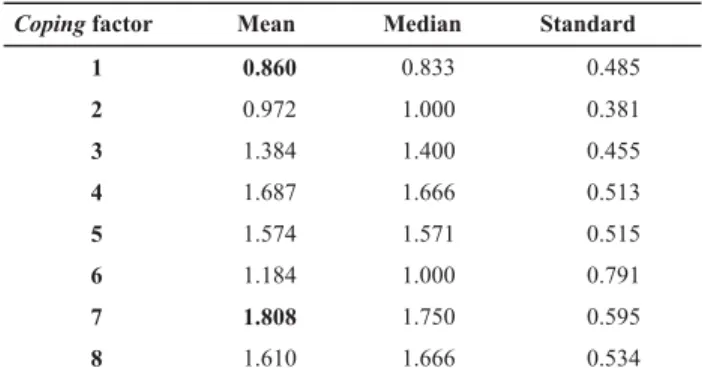
Table 2 lists the descripi ve measures for the coping factors, and shoes that problem solving (coping factor 7) has the highest mean, and that the least used factor, i.e., the one with the lowest mean, is confrontai on (factor 1).
Table 3 shows the data referring to the overall health status (OHS) of the study subjects, and it is observed that most nurses (50.35%) have regular health.
Table 1 – Items identifi ed as causing the greatest and lowest
stress in nurses, by stress areas - Santa Maria, RS - 2006
Table 2 – Descriptive measures of the coping variable by factor - Santa Maria, RS - 2006
Table 3 – OHS of nurses by level, frequency and percentage -
Santa Maria, RS - 2006 Stress
areas
Item of highest
Item of lowest stress
Area A Relationship with maintenance
Relationship with the Sterilization and Supply Center
Area B Asking for equipment review/repair
Replacing supplies
Area C Managing the nursing team
Training
Area D Cope with patient death Prescribing nursing care
Area E Managing health care quality
Preparing the unit monthly
Area F Performing tasks in the minimum available time
Participating in nursing department meetings
Copingfactor Mean Median Standard
1 0.860 0.833 0.485
2 0.972 1.000 0.381
3 1.384 1.400 0.455
4 1.687 1.666 0.513
5 1.574 1.571 0.515
6 1.184 1.000 0.791
7 1.808 1.750 0.595
8 1.610 1.666 0.534
Level of health status N %
0 – 43 Good 70 48.95
44 – 87 Regular 72 50.35
88 – 130 Bad 1 0.70
1430
Rev Esc Enferm USP 2011; 45(6):1427-31 www.ee.usp.br/reeusp/Stress, coping and health conditions of hospital nurses
Guido LA, Linch GFC, Pitthan LO, Umann J DISCUSSION
The prevalence of female nurses younger than 40 years was expected based on the fi ndings of other studies(1,8). It is known that nursing is a profession basically comprised by women, and for this reason, in addii on to their living with the dynamics of the organizai ons when developing their praci ce, they must also manage their personal lives as mothers and wives(9).
The fact of nurses working at the hospital, and current unit, for a long period of i me can be a reason why most of them showed a low stress level. It is understood that there is a relai onship between longer periods working at a place and lower stress, as nurses present more technical confi dence and control over situai ons of everyday
prac-i ce, in a way that they are no longer stressful(8). Similarly,
i me off ers support for the workers to adjust and make a bet er evaluai on of their praci ce, thus mediai ng the negai ve impact of stress over work(10).
As to having a graduate degree, it is evident that the studied nurses are concerned with their professional im-provement, and this characterisi c has been related to stress. A study that compared holding a graduate degree with the stress levels among nurses working in the ICU(8) found that nurses with a graduate degree presented high stress rates. However, other studies state that having a graduate degree increases self-esteem and helps improve performance, and, consequently, provides more security for nurses to cope with stressors at work(1,10).
In this study, most nurses presented low stress levels, which diff ers from previous studies(8,11-12), which can be directly related to the characterisi cs of the studied pop-ulai on, such as their choosing the work unit, holding a graduate degree, not having a second job, and also using problem-solving coping strategies. A previous study has shown that 70.84% of nurses who hold a second job pres-ent stress(12).
However, area C (personnel management) was the studied area that showed the highest mean, hence the highest stress, for the studied populai on. Being responsi-ble for people, as nurses are, demands more working i me and at eni on dedicated to interaci on, which increases the probability of stress caused by interpersonal confl icts. Therefore, nursing becomes a complex job involving great emoi onal tension, physical and psychological weariness, depending on the quality of the human relai onships, all of which are fact that contribute to triggering the stress process(1).
A study with nurses involved in managerial issues showed that these professionals presented chances six
i mes greater to have high stress levels compared to nurs-es working in other areas(13).
As to the coping strategies used, factor 7 is the one showing the most use of problem-centered strategies,
which suggests that the present study nurses face stress-ors using problem-solving skills. Therefore, using this strategy (problem solving) requires to defi ne the prob-lem, list the alternai ves, compare them to the expected outcomes, and then select and implement an appropriate aci on plan(5). In this sense, it is believed that the studied populai on use coping strategies eff eci vely and hence to maintain low stress levels. However, no stai si cally signifi -cant diff erence was found for the correlai on of these vari-ables (stress and coping).
Similarly, a study invesi gated nurses’ coping strategies and found evidence that these professionals suggested as problem-solving strategies aci vii es related to the plan-ning of work, rearranging pai ent schedules, distribui ng services, staffi ng, and creai ng programs for pari cipai on and for the evaluai on of health care quality by using pro-tocols, reducing the number of meei ngs, and reorganiz-ing work(14).
Studies diff er regarding the prevalence of problem-centered or emoi on-centered strategies(3,15). This con-fi rms that there is no such thing as eff eci ve or ineff eci ve coping, because the choosing among the diff erent strat-egies depends on the individuals, and their reaci ons to one same stressor can vary considerably. Therefore, it is esseni al to respect the pari cular characterisi cs of each worker.
It was found that a great number of professionals pres-ent a regular overall health status. These data agree with a study performed with nurses working with intensive care, which found low scores for these professionals’ health status, showing the posii ve evaluai ons that nurses had of themselves(15).
However, in this study, a posii ve correlai on was found between the health status of nurses and stress and cop-ing. Therefore, the fact that the studied subjects present a regular health status is directly related with the low stress level and their use of problem-centered coping strategies, which is understood as posii ve coping in the work stress process.
CONCLUSION
The study populai on consisted mostly of women (91.61%), working at the unit between one and ten years (52.45%) and holding a graduate degree (72.73%). It was also found that 64.34% did not hold a second job.
This study found that nurses presented a low stress level, and that personnel management (area C) s the area with the highest mean (3.69±1.49), therefore, causing the highest stress for the studied populai on.
As to the coping strategies that nurses use, it was found that problem solving (coping factor 7) had the high-est mean (1.80±0.59).
By organizing the data it was possible to correlate the total stress, total coping factor and each nurse’s overall health status. A poor posii ve correlai on was found tween stress and health status (r = 0.30; p<0.05), and be-tween health status and coping (r = 0.40; p<0.05). Howev-er, no signifi cant correlai on was observed between stress and coping.
The present study results can serve to encourage the implementai on of occupai onal health programs, with the purpose to minimize the eff ects of stress on nurses’ health status by ideni fying signs and symptoms.
Therefore, educai onal aci ons should be promoted so as to provide the tools for professionals to develop prob-lem-solving coping strategies in their everyday praci ce, thus minimizing the eff ect of stress on their health and on their work.
However, the results may have praci cal implicai ons as they help the studied insi tui on to reach a bet er un-derstanding about these issues, and point at indicators regarding work, which could encourage the development and implementai on of direct aci ons to improve work-ers’ heath status. Possible aci ons to minimize the eff ect from stress could improve nurses’ work, making it more produci ve and fulfi lling, guaranteeing the safety of both workers and pai ents.
REFERENCES
1. Guido LA. Stress e coping entre enfermeiros de Centro Cirúr-gico e Recuperação Anestésica. [tese doutorado]. São Paulo: Escola de Enfermagem, Universidade de São Paulo; 2003.
2. Schmidt DRC, Dantas RAS, Marziale MHP, Laus AM. Estresse ocupacional entre profi ssionais de enfermagem do bloco cirúrgico. Texto Contexto Enferm. 2009;18(2):330-7.
3. Rodrigues AB, Chaves EC. Fatores estressantes e estratégias de coping dos enfermeiros atuantes em oncologia. Rev Lai no Am Enferm. 2008;16(1):1-5.
4. Bianchi ERF. Stress entre enfermeiros hospitalares [tese livre-docência]. São Paulo: Escola de Enfermagem, Universidade de São Paulo; 1999.
5. Lazarus RS, Folkman S. Stress, appraisal, and coping. New York: Springer; 1984.
6. Savóia MG, Santana PR, Mejias NP. Adaptação do inventário de estratégias de coping de Folkman e Lazarus para o portu-guês. Psicol USP. 1996;7(1-2):183-201.
7. Chaves EC. Stress e trabalho do enfermeiro: a infl uência de caracterísi cas individuais no ajustamento e tolerância ao turno noturno [tese doutorado]. São Paulo: Insi tuto de Psico-logia, Universidade de São Paulo; 1994.
8. Guerrer FJL, Bianchi ERF. Caracterização do estresse nos en-fermeiros de Unidades de Terapia Intensiva. Rev Esc Enferm USP. 2008;42(2):355-62.
9. Spindola T, Santos RS. Mulher e trabalho: a história de vida de mães trabalhadoras de enfermagem. Rev Lai no Am Enferm. 2003;11(5):593-600.
10. Cavalheiro AM, Moura Junior DF, Lopes AC. Estresse de en-fermeiros com atuação em Unidades de Terapia Intensiva. Rev Lai no Am Enferm. 2008;16(1):1-8.
11. Bai sta KM, Bianchi ERF. Estresse do enfermeiro em Unidade de Emergência. Rev Lai no Am Enferm. 2006;14(4):534-9.
12. Pafaro RC, Mari no NMF. Estudo do estresse do enfermeiro com dupla jornada de trabalho em um Hospital de Onco-logia Pediátrica de Campinas. Rev Esc Enferm USP. 2004; 38(2):152-60.
13. Lindholm M. Working condii ons, psychosocial resources and work stress in nurses and physicians in chief managers’ posii ons. J Nurs Manage. 2006;14(2):300-9.
14. Mari ns LMM, Bronzai JAG, Vieira CSCA, Parra SHB, Boaventura Y. Agentes estressores no trabalho e sugestões para amenizá-los: opiniões de enfermeiros de pós-gradua-ção. Rev Esc Enferm USP. 2000;34(1):52-8.
15. Brit o ESB, Carvalho AMP. Stress, coping (enfrentamento) e saúde geral dos enfermeiros
16. que atuam em Unidades de Terapia Intensiva e problemas renais. Enferm Global. 2004;4(1):1-14.
The authors thank the State of Rio Grande do Sul Research Foundai on (FAPERGS) for the support and funding for the study. The authors thank the Graduate Studies and Research Pro-Rector’s Offi ce at Universidade Federal