Finite element analysis of composite
concrete-timber beams
Análise de vigas mistas de concreto e madeira
pelo método dos elementos initos
a School of Civil Engineering - PUC Campinas, Campinas, SP, Brasil; b Simworx Engenharia, Pesquisa e Desenvolvimento, Campinas, SP, Brasil.
Received: 03 Sep 2014 • Accepted: 22 May 2015 • Available Online: 7 Aug 2015
Abstract
Resumo
In the search for sustainable construction, timber construction is gaining in popularity around the world. Sustainably harvested wood stores carbon dioxide, while reforestation absorbs yet more CO2. One technique involves the combination of a concrete slab and a timber beam, where the two
materials are assembled by the use of lexible connectors. Composite structures provide reduced costs, environmental beneits, a better acoustic performance, when compared to timber structures, and maintain structural safety. Composite structures combine materials with diferent mechani
-cal properties. Their mechani-cal performance depends on the eiciency of the connection, which is designed to transmit shear longitudinal forces between the two materials and to prevent vertical detachment. This study contributes with the implementation of a inite element formulation for stress and displacement determination of composite concrete-timber beams. The deduced stifness matrix and load vector are presented along
to numerical examples. Numerical examples are compared to the analytical equations available in Eurocode 5 and to experimental data found in the literature.
Keywords: composite structures, inite element method and sustainable structures.
A madeira tem se destacado na produção de ediicações sustentáveis, principalmente pela possibilidade de emprego de madeiras provenientes de lorestas plantadas. A combinação de vigas de madeira com um tabuleiro de concreto armado ligados entre si por conexões lexíveis é uma alternativa que traz aumento de rigidez à estrutura, ameniza problemas de durabilidade, quando exposta às intempéries, e melhora seu desem
-penho acústico, se comparada à uma estrutura em madeira. As estruturas mistas são constituídas pela associação de materiais com diferentes propriedades mecânicas e seu desempenho mecânico depende da eiciência da ligação entre eles. Os conectores lexíveis são responsáveis
pela transmissão de forças de cisalhamento entre os dois materiais e por evitar o desprendimento vertical. Esta pesquisa desenvolveu e
imple-mentou uma formulação de elementos initos para cálculo dos esforços internos da estrutura mista de concreto e madeira. A matriz de rigidez e o vetor de carga deduzidos são apresentados juntamente com exemplos numéricos e seus resultados são comparados com as equações analíticas
do Eurocode 5 e resultados experimentais da literatura.
Palavras-chave: estruturas mistas, elementos initos e estruturas sustentáveis.
N. C. S. FORTI a
T. L. D. FORTI b
A. E. P. G. A. JACINTHO a
L. L. PIMENTEL a
1. Introduction
Composite structures combining materials with diferent mechani
-cal properties ofer an alternative to the civil construction industry. The technique provides reduced costs, environmental beneits and
a better acoustic performance when compared to timber struc-tures, while maintaining structural safety.
Concrete-timber composite systems may be applied to the
construc-tion of bridges, improving the bridge stifness, resulting in smaller
displacements and increasing natural frequencies of vibration.
The deck loor is composed of a concrete slab connected to timber
beams aiming for the two materials to work together. The level of stress transfer between the concrete slab and the timber beam
deines the mechanical behavior of the composite structure. It may
be considered as a monolithic structure, when there is no slip in the region of contact, or it may behave as a non-monolithic structure when relative longitudinal displacement is observed.
The concrete slab protects the timber beams against direct
weath-ering, surface abrasion and ire, improves the vibration perfor -mance and its maximum load when compared to timber bridges. The maximum load may increase by a factor of the order of two
and the stifness by three or four times according to CECCOTTI [1].
The relative lightness of composite materials and the possibility of using glued laminated timber (GLULAM) are factors that contribute to its prefabricated production.
1.1 Connection systems for concrete-timber
composite structures
TARANTINO and DEZI [2] describes the necessity of studying the
connection systems, which are responsible for transmitting the lon-gitudinal shear forces in the interface of the two combined materi-als along the length of the beam.
Analyzing the connection of timber components, RACHER [3]
highlights the major importance of the connection system, since
its behavior directly afects the distribution of forces in the compo -nents and, as a consequence, in the structure deformations.
According to SORIANO [4] the connection system may be char
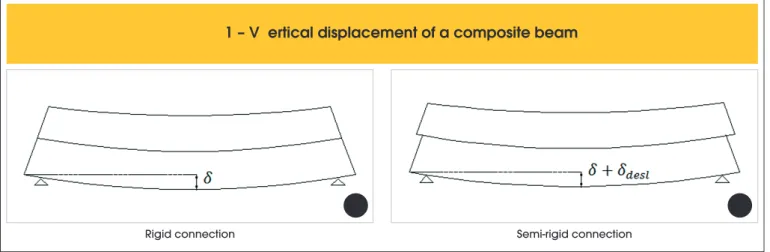
-acterized as rigid or semi-rigid (lexible), Figure [1]. An example of
rigid connection is the use of epoxy structural adhesive through-out the entire contact surface between the two materials,
GIR-HAMMAR and GOPU [5]. The rigid connection consists of the full
integration of the cross section and the structure behaves as a monolithic structure. Studies developed in Brazil, by directly gluing timber beams to structural elements of reinforced concrete, were
presented by NICOLAS [6]. SORIANO [4] also tested T-shaped
timber-concrete beams, where the timber web was glued to the concrete slab.
In the semi-rigid connection system, the attachment between the two materials may be done using steel pins, nails, screws, bolts
or metal proiles. The semi-rigid connection performs a partial in -teraction of the cross section, with a relative displacement (slip) between the two materials.
1.2 Models for the analysis of composite beams
The main mathematical models for describing the mechanical behavior of composite structures proposed in the literature are based on the equilibrium equations and on energy principles.
Un-like concrete-steel composite structures, there is insuicient stan
-dard speciication for timber structures. For concrete-steel structures, it can be cited the BS 5400 [7] or the Brazilian NBR8800/02 [8]. However, there is no Brazilian standard regarding
the design of concrete-timber structures. An international standard
that can be cited is the EUROCODE 5 [9].
1.2.1 The EUROCODE 5 model for the analysis of composite beams
Both the EUROCODE 5 [9] and the DIN 1052 [10] consider the lexibility of the connection system, and the relative displacement between the materials, by adopting an efective bending stifness
parameter
( )
efEI
which is calculated according to Equation [1].Equation [1] is a function of the shape of the cross section, the
Young’s modulus of the materials, the spacing of connectors and its slip modulus.
(1)
In Equation [1]
E
c,E
w,I
c,I
w,A
c andA
w are Young’s modulus, the moment of inertia and the cross section areas of the concreteA
B
Figur
1 – V ertical displacement of a composite beam
e
and timber elements respectively;
y
c is the partial factor of theslab, calculated according to Equation [2];
y
w=
1, 0
is the par-tial factor of the web;a
c anda
w are the distances indicated inFigure [2] calculated by Equations [3] and [4];
l
is the length of the beam,s
is the spacing of connectors andK
is the connector slip modulus.(2)
(3)
(4)
1.2.2 A variational formulation for concrete-timber composite beams
In the present work, the formulation presented in FORTI [11] and MASCIA et al. [12] was adopted. The formulation is based on the
principle of virtual works. Therefore, it can be easily implemented in
a computer solver using both the Finite Element Method (ODEN et al. [13]) and the Direct Stifness Method (GERE and WEAVER [14]).
Two consolidated theories for the analysis of beams are the Eul-er-Bernoulli’s beam theory and the Timoshenko’s beam theory
(SLHESSARENKO [15]). In this work, the Euler-Bernoulli’s beam
theory in two dimensions was adopted.
1.2.2.1 Principle of virtual work
The principle of virtual work is adopted to formulate the problem. The composite beam is considered as two independent beams connected (one made of concrete and the other of wood). The strain energy of the composite structure is given as the sum of the strain energy of the two beams and the strain energy of the connectors. Thus, the internal
virtual work of the structure is the sum of the three individual internal virtual work, i.e.,
TV
intC+
TV
intW+
TV
intS=
TV
ext, where indices C, W e Srefer to concrete, wood, and connectors, respectively.
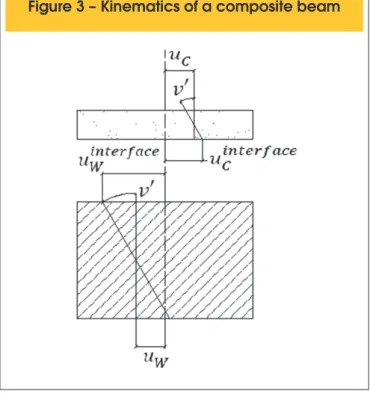
It is assumed the vertical displacement (
v x
( )
) of the two beams are equal and therefore, their derivatives are equal too. Under Euler-Bernoulli’s beam theory assumptions, the derivative of the vertical displacement is equal to the rotation of the cross section, and both beams have the same rotationθ
C=
θ
W=
v x
'
( )
. The shear force (force per unit of length) of the connectors is given asTs = K
D
u
, whereK
is the slip modulus of the connectors andD
u
is the relative displacement between the lower iber of the concrete beam and the upper iber of the timber beam. Figure [3] illustrates
this relative displacement.
The relative displacement (
D
u
)is calculated as:(5)
Since the rotation of both beams are equal, then:
(6)
Figur
2 – Cr oss section of a T-shaped
e
composite beam and normal
stresses on bending. Source: adapted
from the EUROCODE 5 [9]
A
Cross sectionB
Normal stressDeining
r
the distance between the gravity center of the beams, it comes that:(7)
The internal virtual work of the connector is then given as:
(8)
Adding the internal virtual work of the connector to those of concrete and timber beams, the composite beam formulation is stated as:
(9)
where the unknowns are the horizontal displacement of the iber in
the gravity center of the elements
u
c( )
x
andu
w( )
x
and the verti-cal displacementv x
( )
;δ
u
C,δ
u
W andδ
v
are their respective virtual dsiplacements.In FORTI [11], the variational formulation (Equation [9]) is solved using the Rayleigh-Ritz method. However, the Finite Element Method permits the application of this formulation to diferent types
of load and geometries of beams in a more general fashion and simplicity of use. Moreover, this approach is more suited to be in-serted in other software of structural analysis already available.
2. The inite element method
The Finite Element Method consists in adopting functions to ap -proximate the displacements
u
c( )
x
,u
w( )
x
andv x
( )
and also the virtual displacementsδ
u
c( )
x
,δ
u
w( )
x
andδ
v x
( )
. Adopting approximating base functions, permits the calculation of anap-proximate solution to the variational problem of Equation [9]. In this
work, two families of functions are employed: the piecewise linear functions and the cubic Hermite polynomials.
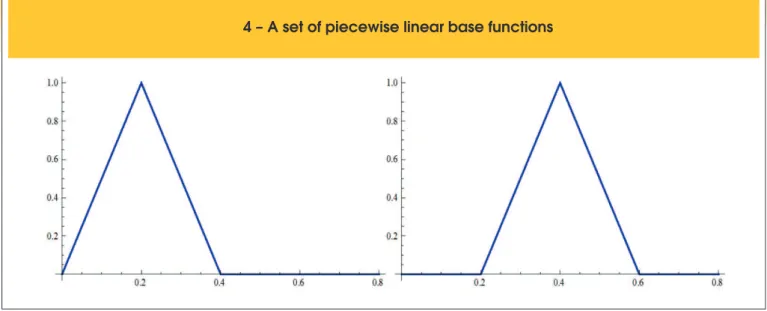
The piecewise linear base functions are deined as being linear
functions that take value of 1 in one of the nodes of the mesh and zero in all the other nodes. Also known as hat functions, one
ex-ample of two base functions is presented in Figure [4].
It can be noted the function has values diferent from zero in a
Figur
4 – A set of piecewise linear base functions
e
region formed by 3 nodes and has zero value in the rest of the domain. If each element of the mesh is formed by 2 nodes, then the function has local support to 2 neighbor elements and each element contributes with 2 functions, which are called shape
functions of the element (Figure [5]). The local support property
of the functions is employed in the construction of the element
stifness matrix.
The combination of the elements shape functions builds the
ap-proximate base functions. The deined linear functions has de -rivatives with piecewise constant values. Thus, the derivative of
the function is discontinuous between elements. It means the irst
derivative of the piecewise linear function is integrable over the
do-main, but its second derivative would not be deined in the nodes
of the mesh.
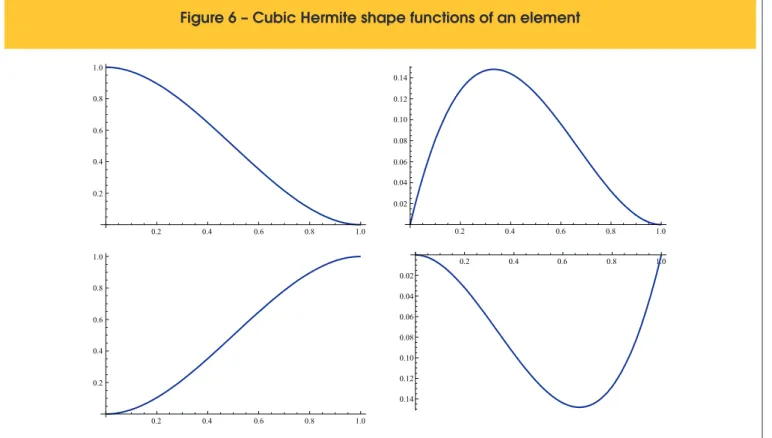
The cubic Hermite functions also have local support to the element and its neighbors. The properties of the Hermite functions involve the value of the function and its derivatives. The shape functions of
one element are plotted in Figure [6].
The irst function has the property of having value equal to 1 in the initial node of the element and zero in the inal node. Addi
-tionally, its irst derivative has zero value in both initial and inal
node. The second function has zero value in both nodes and its
irst derivative has value equal to 1 in the initial node and zero in the inal node. The third function has value equal to 1 in the inal node and the fourth function has value 1 for the irst derivative in the inal node, with zero value for the remaining values of function and irst derivatives in the nodes. These functions are particularly
important because they construct, in association to the neighbor
elements, functions having the irst derivative continuous over the
whole domain. Thus, these functions are integrable up to their sec-ond derivatives.
The inite element formulation is obtained substituting the displace -ment functions by the approximating functions, i.e.,
u
w@
å
nj=1a j
j j,1 n
w j j j
u
@
å
=b j
, andv
@
å
mj=1g f
j j. In the same manner, thevir-tual displacements are approximated by the same functions. Thus, the virtual displacement
δ
u
c is adopted as equal to each functioni
ϕ
and so on. Then, the inite element formulation is given as:(10)
The variational formulation requires the calculation of integral that
involves the irst derivatives of the horizontal displacements
u
c andu
w. Thus, one can observe the piecewise linear functions (hat functions) satisfy the necessary requirements to approximate thehorizontal displacements, since its irst derivatives are integrable
over the whole domain. Therefore, we adopted
ϕ
j as being hat functions, with the indexj
indicating the node of the mesh where the function has value equal to 1. The vertical displacement, how-ever, requires the second derivative to be integrable in order to sat-isfy the variational formulation. Thus, the cubic Hermite functions are candidates toφ
j, since their second derivatives are integrableFigure 6 – Cubic Hermite shape functions of an element
0.2 0.4 0.6 0.8 1.0
0.2 0.4 0.6 0.8 1.0
0.2 0.4 0.6 0.8 1.0
0.02 0.04 0.06 0.08 0.10 0.12 0.14
0.2 0.4 0.6 0.8 1.0
0.2 0.4 0.6 0.8
1.0 0.2 0.4 0.6 0.8 1.0
over the domain. In this work, the Hermite functions are adopted as shape functions to approximate the vertical displacement
v x
( )
. It is interesting to observe that in the Euler-Bernoulli’s formulation,the rotation of the cross section is equal to the i rst derivative of the
vertical displacement, i.e.,
θ
( )
x
=
v x
'
( )
. Then, one may note thatthe i rst and third Hermite functions plotted in Figure [6] refer to the
vertical displacement, while the second and fourth are related to
the section rotation because they have i rst derivatives with values
equal to 1 in the nodes.
Since the approximating functions have local support to the 2 neighboring elements connected to a node, the integrals over the domain
( )
0,
L
are indeed calculated only over the elements of support of the function. The formulation can be written, in matrix form, as:(11)
where the matrix K is composed by the sum of the matrices of each element. The solution vector
u
is given as:(12)
which is the union set of the horizontal and vertical displacements and rotation of each node of the mesh
{
u u v v
c,
w, , '
}
. The matrix of each element is described in the sequel.2.1 Element stiff ness matrix
The stif ness matrix is presented in parts, one for each term of the
internal virtual work: concrete, wood and connector.
The stif ness matrix associated to the concrete element is given by
the expression:
(13)
which gives, for each element of the mesh of length
L
e:(14)
or
The stif ness matrix associated to the timber element is given as:
It is interesting to observe that the stif ness matrices of the
con-crete and timber elements are, in fact, the same matrices one
would obtain from the Direct Stif ness Method. Adding the two matrices, we would have the stif ness matrix in the case the ele-ments were disassembled, where the bending stif ness would be
added while the horizontal displacements would remain indepen-dent. The interaction between the two materials, with a
conse-quent increase in the bending stif ness of the composite beam, is represented by the connector stif ness matrix. The connector
matrix is calculated from the equation of internal virtual work of the connector:
(15)
which, being integrated over the domain of one element of length e
L
, results in:Finally, the element stif ness matrix of a concrete-timber composite
beam is given as
k
=
k
c+
k
w+
k
s.The load vector is obtained from the external virtual work, which in this study is given as:
(16)
(17)
The nodal concentrated forces
P
i are added to the algebraic prob-lem by adding their values in their respective positions of the global load vector.2.2 Computational solver
The solver is implemented on C++ language, using some classes
from the inite element library PZ (DEVLOO [16]). In order to facilitate
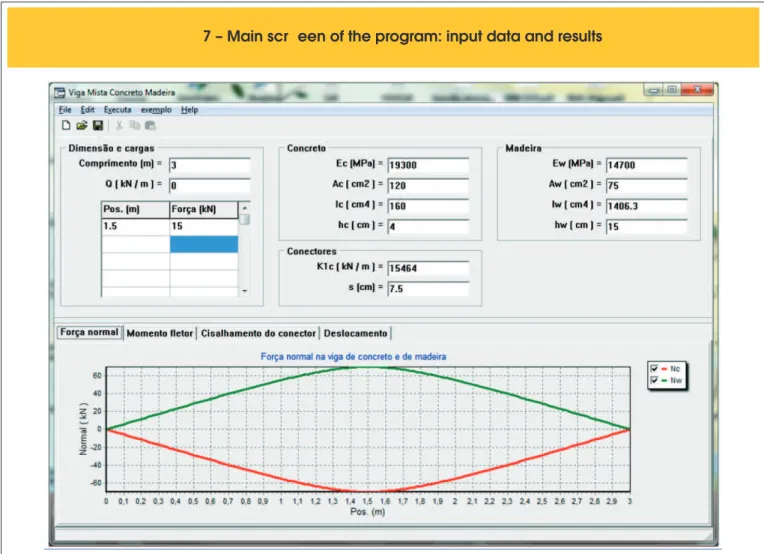
the use of the program, a graphical interface was implemented to
in-put data and visualize results. Figure [7] shows the main screen of the
program with the data to be input. The result graphics are the vertical displacement of the composite beam, bending moment and normal forces of each of the two beams and the connector shear force.
The implementation was veriied comparing its results to the re
-sults presented in FORTI [11]. FORTI [11] presents some numeri -cal results of the variational formulation and an analyti-cal solution
of the diferential equation from STEVANOVIC [17]. The results are
also compared to the experimental data of laboratory tests
(SO-RIANO [4]), with good agreement of results.
3. Results and discussions
The developed program is applied to the problem of a
concrete-timber beam presented in FORTI [11] for verifying the inite ele
-ment solver imple-mented. The results are also compared to those
obtained from the routines of the EUROCODE 5 [9].
The input data is described in Table [1] and in Figures [8] and [9].
The connection between the two materials was made with 41 hex bolts of ½”, with spacing of 7.5 cm. The slip modulus was obtained
from shear laboratory tests. SORIANO [4] performed 5 tests and
the average slip modulus under service load obtained was equal to ser
K =15464 N / mm. The ultimate modulus was Ku=10309 N / mm In the experimental test of SORIANO [4], there were two loads to be considered (Figure [8]): one uniformly distributed load, corre -spondent to the self-weight of the beam q = 0.36 N/mm, and a con-centrated force
P
k applied vertically in the middle of the beam. The vertical displacement was measured from the moment the concen-trated force was applied, i.e., the measured displacement does not include the vertical displacement caused by the self-weight of theFigur
7 – Main scr een of the program: input data and results
e
Table 1 – Properties of the components
of the composite beam
Concrete Timber
Cross section area (mm2) 12,000 7,500
Moment of inertia (mm4) 1,6 x 10⁶ 14.063 x 10⁶
E* (N/mm2) 19,300 14,700
*Longitudinal Young’s modulus obtained from a compressive test parallel to the fiber direction.
Connector slip modulus under service loading: K1c (ser) = 15.464 N/mm;
beam. Therefore, in the numerical analysis, only the concentrated force is simulated. This procedure is mathematically valid due to the linearity of the formulation adopted.
Table [2] complements the input data with the values of the force k
P
, which varied from 0 to 30 kN, and brings the comparison of theresults obtained in this work to those obtained from the literature.
Table [2] brings the following results:
1. SORIANO [4]: the displacements from the two experimental
tests (Exp. 1, Exp. 2, and the average values of the tests). It is worth noting that the structure collapsed in Exp. 1 and Exp. 2
Figure 8 – Geometry of the tested composite beams (dimensions in cm). (SORIANO [4])
Figure 9 – Boundary conditions of the tested beams
Table 2 – Results of vertical displacements at L/2 of the composite beam
Load (kN)
Experimental (mm)
Numerical (mm)
Analytical (mm)
Pk Exp.1 Exp.2 Average FORTI [11] Difference1 FEM Difference2 Eurocode 5 Difference3
0 0 0 0 0 0 % 0 0 % 0 0 %
5 4.13 4.43 4.28 3.96 7.5 % 3.96 7.5 % 3.91 8.6 %
10 8.34 8.72 8.53 7.92 7.2 % 7.92 7.2 % 7.81 8.4 %
15 12.26 13.01 12.64 11.88 6.0 % 11.88 6.0 % 11.72 7.2 %
20 16.76 17.76 1.26 15.84 8.2 % 15.85 8.2 % 15.62 9.5 %
25 22.94 23.68 23.31 19.80 15.1 % 19.80 15.1 % 19.53 16.2 %
30 30.61 29.08 29.85 23.76 20.4 % 23.76 20.4 % 23.44 21.5 %
1
Difference =
FORTI
11
[ ]
experimental average
Difference =
2experimentalaverage
-
FEM experimental average
experimentalaverage
-3
Difference =
Eurocode
5
experimental average
experimentalaverage
-when
P
k was equal to 37.811 kN and 36.694 kN, respectively;2. FORTI [11]: the results obtained from the variational formula -tion solved using the Rayleigh-Ritz method;
3. The results obtained in this work using the implemented inite element solver (FEM);
4. Calculating using the routines of the EUROCODE 5 [9], which deines an efective bending stifness parameter (Equation 1).
For this case the efective stifness
( )
2720, 0542 .
efEI
=
kN m
and the vertical displacement is calculated as
( )
3
48
kef
P L
EI
.Table [2] also brings the comparison of the displacements calcu
-lated by the diferent methodologies and the experimental results. Figure [10] illustrates the comparison of results shown in Table [2]. It can be observed that the displacement curve from the ex -perimental tests indicates a non-linear behavior beyond the point
where the force is
P
k=
20
kN
.Analyzing the data of Table [2], one can observe that:
n The inite element solution (FEM) of this work is equal to the
solution of FORTI [11]. This conclusion was expected, since
both works solve the same variational formulation. The agree-ment of results, in fact, verify the C++ code impleagree-mented, at least for this example.
n The numerical results are very similar to the experimental
results, conclusion already observed in FORTI [11]. The
values differ from less than 10% in the early stages of
load-ing. With the increase of the load
P
K, it can be observed the influence of the non-linear behavior of the materials and the consequent deviation of the results with a maxi-mum difference of about 20% whenP
k=
30
kN
, near the point of collapse of the tested beams. This result evidenc-es the quality of the variational formulation in reprevidenc-esenting the physical phenomenon while the structure is in the elastic domain.n The results from the routines of the EUROCODE 5 [9] are in
great agreement with the numerical solutions, with diferences
inferior to 1.5%. This is an evident quality of the analytical for-mulation, much simpler to be used.
The other results of the implemented program are presented in
Figures [11], [12], [13], and [14] for the simulation with
P
k=
15
kN
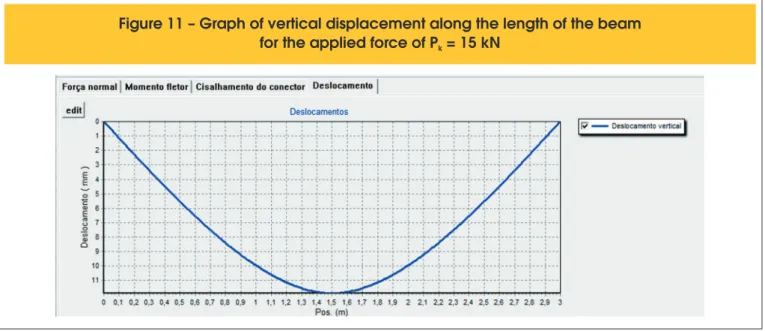
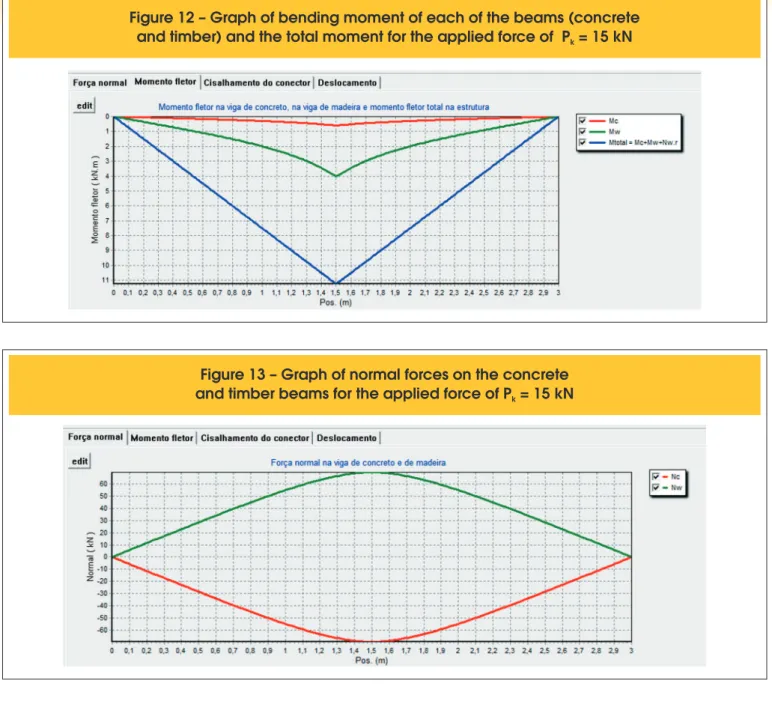
.Figure [11] shows the vertical displacement of the composite beam. Figure [12] brings the curves of the bending moment for the
concrete beam (
M
c)
, the timber beam (M
w) and the total bending moment (M
total)
. Figure [13] shows the graphics of normal forces. In the absence of interaction between the two beams, the sum of the bending moment of the concrete beam to the moment of the timber beam would be equal to the total bending moment. Thus, it is interesting to observe that the interaction between the beams re-duce the bending moment acting on each of the beams. However, there is the appearance of normal forces, which cancel each other. The normal force in the concrete beam is of compression and in the timber beam is of tension.Figure [14] presents the shear force of the connectors.
Figure 10 – Graph of vertical displacement
versus
the applied force P
kFigure 11 – Graph of vertical displacement along the length of the beam
for the applied force of P = 15 kN
kFigure 12 – Graph of bending moment of each of the beams (concrete
and timber) and the total moment for the applied force of P = 15 kN
kFigure 13 – Graph of normal forces on the concrete
and timber beams for the applied force of P = 15 kN
k4. Conclusions
The technological development of the process of design and construction of timber structures has improved the knowledge of the behavior of this material and its subsequent use in composite structures. The employment of composite concrete-timber struc-tures promotes the best use of the feastruc-tures of each material. This work contributes with an analysis of concrete-timber compos-ite beams. Two approaches for calculating the stress state of the
beam are compared. One is based on a inite element formulation
and the other is based on the analytical procedure of the standard EUROCODE 5.
The variational formulation, based on the principle of virtual work, accounts to the strain energy of the three main components of a composite beam: the reinforced concrete slab, the timber web and the connectors (or fasteners). The formulation is consistent and
satisies the equilibrium equations. It is coherent with laboratory
test results.
The procedure of the EUROCODE 5 is based on an efective bend
-ing stifness, which is function of the components of the composite
beam, specially the slip modulus of connectors.
The implementation of a inite element formulation enables the use
of the formulation in structural analysis programs. A software with user interface was developed and it is available to the community. Some examples were performed to compare the simulation results to the results obtained from the procedure of the EUROCODE 5.
It is observed great concordance of the results, which difer from
less than 1.5%.
This development promotes, through the development of the com-putational program, a wider propagation of the procedures of de-sign and the understanding of the mechanical behavior of com-posite beams, which may catalyze the use of this type of structure.
The inite element formulation presented may be applied to other
types of composite structures, for instance, a structure with a steel
proile web associated to a concrete slab.
5. References
[1] CECCOTTI, A. Timber-concrete composite structures. In: Tim -ber Engineering - STEP1. BLASS, H. J., AUNE, P., CHOO, B.S. et al., Almere: Centrum Hout, 1995, E13, p.1-12.
[2] TARANTINO, A. M., DEZI, L. Creep efects in composite beams with lexible shear connectors. Journal of Structural
Engineering- ASCE, New York, n. 8, v.118, p.2063-2081. Aug. 1992.
[3] RACHER, P. Mechanical timber joints - general. In: Timber
Engineering - STEP lecture C1. BLASS, H. J., AUNE, P., CHOO, B.S. et al., Almere: Centrum Hout, 1995, C1, p.1-10.
[4] SORIANO, J. Estruturas mistas de concreto e madeira: Análise de vigas e painéis e aplicações na construção civil. In Tese (Doutorado em Engenharia Civil) – Faculdade de En -genharia Civil, Universidade Estadual de Campinas, 2001.
[5] GIRHAMMAR, U. A., GOPU, V. K. A. Composite beam-columns
with interlayer slip-exact analysis. Journal of Structural Engineer-ing- ASCE, New York, n. 4, v.119, p.1265-1282. Apr. 1993.
[6] NICOLAS, E. A. Estudo de ligações em estruturas mistas
de concreto-madeira. Universidade Estadual de Campinas
– Faculdade de Engenharia Civil, Dissertação, 2001, p 103.
[7] BS 5400-5: Steel, concrete and composite bridges. Code of
practice for design of composite bridges. (AMD 3998) (with-drawn), 1979
[8] NBR 8800: Projeto de Estruturas de aço e de estruturas mis
-tas de aço e concreto de edifícios. Setembro, 2008. [9] EUROCODE 5 (prEN 1995-1-1): Design of timber structures.
Part 1-1: General – common rules and rules for buildings. Brussels, 2008.
[10] DIN 1052: Structural use of timber – part 1, 2 and 3. Berlin,
1988.
[11] FORTI, N. C. S. Análise numérica de vigas mistas em con
-creto e madeira. 2004. Tese (Mestrado) – Faculdade de En -genharia Civil, Universidade Estadual de Campinas, Campi-nas, 2004.
[12] MASCIA, NILSON T.; FORTI, NÁDIA C.S. ; SORIANO, JU
-LIO ; NICOLAS, ELIAS A. ; FORTI, TIAGO L.D. . Study of
concrete-timber composite beams using an analytical ap-proach based on the principle of virtual work and experimen-tal results. Engineering Structures, v. 46, p. 302-310, 2013.
[13] ODEN, J. T., CAREY G. F. e BECKER E. B. Finite Elements
– An introduction. Vol 1. Prentice Hall Inc. USA. 1981.
[14] GERE, J. M. e WEAVER, W. Analysis of framed structures.
1965.
[15] SLHESSARENKO, F. L. - Análise tridimensional de edifícios por elementos initos utilizando programação orientada a objetos. 1997. Tese (Mestrado) – Faculdade de Engenharia
Civil, Universidade Estadual de Campinas, Campinas, 1997.
[16] DEVLOO, P. R. B. . PZ An Object Oriented Environment For Scientiic Programming. COMPUTER METHODS IN AP -PLIED MECHANICS AND ENGINEERING, v. 150, n.1-4, p. 133-153, 1997.
[17] STEVANOVIC, B. Elastically coupled timber-concrete
beams. In INTERNACIONAL WOOD ENGINEERING CON
![Figure 8 – Geometry of the tested composite beams (dimensions in cm). (SORIANO [4])](https://thumb-eu.123doks.com/thumbv2/123dok_br/18860846.417900/8.892.58.832.70.601/figure-geometry-tested-composite-beams-dimensions-cm-soriano.webp)