DOI: 10.1590/1518-8345.1630.2871 www.eerp.usp.br/rlae
Effective Universal Coverage of Diabetes Mellitus Type 2 in Chile
Sara Guerrero-Núñez
1Sandra Valenzuela-Suazo
2Patricia Cid-Henríquez
2Objective: determine the prevalence of Effective Universal Coverage of Diabetes Mellitus Type
2 in Chile and its relation with the variables: Health Care Coverage of Diabetes Mellitus Type 2;
Average of diabetics with metabolic control in 2011-2013; Mortality Rate for Diabetes Mellitus;
and Percentage of nurses participating in the Cardiovascular Health Program. Method:
cross-sectional descriptive study with ecological components that uses documentary sources of the
Ministry of Health. It was established that there is correlation between the Universal Effective
Coverage of Diabetes Mellitus Type 2 and the independent variables; it was applied the Pearson
Coefficient, being significant at the 0.05 level. Results: in Chile Universal Health Care Coverage of
Diabetes Mellitus Type 2 (HbA1c<7% estimated population) is less than 20%; this is related with
Mortality Rate for Diabetes Mellitus and Percentage of nurses participating in the Cardiovascular
Health Program, being significant at the 0.01 level. Conclusion: effective prevalence of Universal
Health Coverage of Diabetes Mellitus Type 2 is low, even though some regions stand out in this
research and in the metabolic control of patients who participate in health control program; its
relation with percentage of nurses participating in the Cardiovascular Health Program represents
a challenge and an opportunity for the health system.
Descriptors: Diabetes Mellitus Type 2; Universal Coverage; Nursing; Primary Health Care.
1 Doctoral student, Facultad de Enfermería, Universidad de Concepción, Concepción, Bío Bío, Chile. Professor, Facultad Ciencias de la Salud,
Universidad de Atacama, Copiapó, Chile.
2 PhD, Full Professor, Facultad de Enfermería, Universidad de Concepción, Concepción, Bío Bío, Chile.
How to cite this article
Guerrero-Núñez S, Valenzuela-Suazo S, Cid-Henríquez P. Effective Universal Coverage of Diabetes Mellitus Type 2 in
Chile. Rev. Latino-Am. Enfermagem. 2017;25:e2871. [Access ___ __ ____]; Available in: ____________________.
Introduction
Deinition of Universal Health Coverage: “system capacity to respond to the health needs of a population,
which includes providing infrastructure, human
resources, health technologies (including medicines), and inancing”(1). Governments are responsible for
deciding which health services are necessary, ensuring
their universal availability, affordability, effectiveness
and quality(2). The member states of the World Health
Organization (WHO) committed to reach this Coverage
in 2005, are convinced that all people should have
access to the health services they need, without the risk
of economic loss or impoverishment(2).
Chile addressed this Coverage with strategies
such as the Explicit Health Guarantees Regime (EHGR),
contained in the law EHGR N° 19966(3), which standardizes
the care of prioritized pathologies, guaranteeing access, quality, opportunity and inancial support to the patients who suffer from those pathologies. Diabetes Mellitus
type 2 (DM2) is one of the guaranteed pathologies, due
to its morbidity and mortality rate, and among others, to
the economic expenses associated with complications.
In order to respond to the needs of population, it is
essential that (prestaciones en salud garantizadas) guaranteed health beneits be timely and good quality, that is to say, they must allowed to move from Universal
Coverage to Effective Coverage, since universal health coverage is not in itself a guarantee of eficacy and eficiency of care provided(4), it is better understood as
the coverage of health services and protection against inancial risks and it is still far from the goal of universal coverage(4). For this reason, it is necessary to develop
researches that design indicators for the evaluation of
policy progress of universal health coverage(4). A good
indicator is the Universal Effective Health Coverage(5),
since it guarantees all, in an equal way, the maximum
achievable level of health outcomes from a package of high quality services that also avoids inancial crises through the reduction of out-of-pocket costs(6). Effective
coverage is a part of a potential health gain, offered
to the population through the health system(5), it not
only considers a particular intervention or service, but
also determines that they are necessary to produce the
desired effect on the patient’s health(7).
The global prevalence of DM2 in 2013 was 8.3%
in adults, and it was projected to be 9.9% by 2030(8).
Forty six percent of people with DM2 have not been
diagnosed(9), which results in a complex situation,
considering that in 2012 Diabetes Mellitus was the ifteenth cause of premature death in both sexes(10).
According to the 2009-2010 National Health Survey
(NHS), the prevalence of DM2 in Chile was 9.4%
in 2009. The Basic Health Indicators (Chile 2013)
report, issued by the Health Statistics and Information
Department (HSID), indicated that in 2013, 33.8% of
diabetics participated in the health control program.
For this reason, the objective of national strategies was
to increase the proportion of people with controlled
diabetes. It was established as a goal to increase in
20% the effective coverage of diabetes mellitus type 2; the following igures were proposed: 29.8% in 2010, 31.8% in 2015 and 35.8% in 2020(11). Nurses
who participate in the Cardiovascular Health Program
(CVHP), care for people with DM2 according to the clinical guide and the list of guaranteed beneits. These guidelines barely account for the role of nursing, which
causes the wrong replacement of those professionals. Nonetheless, scientiic evidence demonstrates the signiicant role that nursing plays in the metabolic control of DM2(12-15).
The incorporation of the Universal Health Coverage
in the public policy and the low metabolic control of
diabetic people, guided the objective of this article,
which is to determine the prevalence of Effective
Universal Coverage of Diabetes Mellitus Type 2 in Chile
and its relation with the variables: Health Care Coverage
of Diabetes Mellitus Type 2, Average of diabetics with
metabolic control in 2011-2013, Mortality Rate for
Diabetes Mellitus, and Percentage of nurses participating
in the Cardiovascular Health Program.
Method
It is a cross-sectional descriptive study with
ecological components, systematizing national statistics
and from different regions of the country, during the years 2011 to 2013. Because the oficial statistics for the years 2014 and 2015 have not been published (only
preliminary documents), this period was not considered
in the research. The following reports, obtained from
the Ministry of Health, were used as documentary
sources: Basic health indicators - Chile 2013; Controlled
population (cardiovascular health program) by Region
and by the Health Service, SNSS 2011, 2012 and
2013; and Controlled population (cardiovascular health
program) according to compensation goals, by Region
and Health Service, SNSS 2011, 2012 y 2013, belonging
to HSID. The study did not require authorization from the
ethics committee or informed consent, since the HSID
reports were digitally available for public consultation. This study veriied the prevalence of Effective Universal Coverage of Diabetes Mellitus Type 2 in Chile
evaluate the variables, we worked with the universe
of the national and regional population and with the
universe of diabetic patients participating in the health
control program (Cardiovascular Health Program).
- Dependent variable: Effective Universal Coverage
of Diabetes Mellitus Type 2 (Percentage of patients
in metabolic control [HbA1c <7%], according to the
prevalence of Diabetes Mellitus type 2 at the national
and regional level).
- Independent variables: important variables were
selected with periodic measurement in the Cardiovascular
Health Program, they were: 1) Health Care Coverage
of Diabetes Mellitus Type 2 (Percentage of patients
participating in the health control program, according
to the prevalence of Diabetes Mellitus type 2 at the
national and regional level); 2) Average of diabetics with
metabolic control in 2011-2013 (mean percent of type
2 diabetic patients metabolically controlled, during the
years 2011-2013, that participate in the health control
program); 3) Mortality Rate for Diabetes Mellitus, which
was selected because it corresponds to a measurement
of the last effect produced by the disease that is of
national and international importance; and 4) Percentage
of nurses participating in the Cardiovascular Health
Program (Proportion of care provided by nurses in the
Cardiovascular Health Program). The latter variable was
incorporated because of researchers interest; this, was
due to the academic training of the researchers and to the scientiic evidence about the relevant participation of nursing professionals in the metabolic control Diabetes
Mellitus Type 2.
Statistical analysis was performed using the
statistical software SPSS 19.0, applying the Pearson’s Coeficient with signiicant value to the level of 0.05.
Results
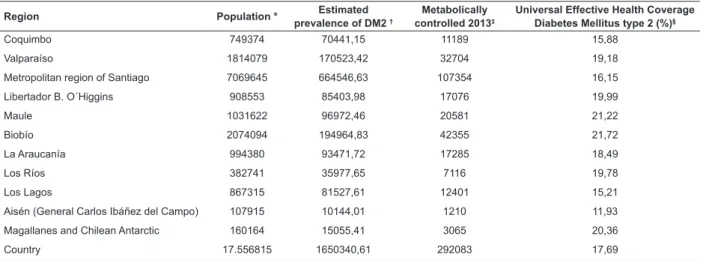
The descriptive statistics presented in Table 1, shows
that the dependent variable is the one with the lowest
variability (SD = 3.40%). In this regard, Table 2 shows that
the region of Antofagasta has the lowest Effective Universal
Coverage of Diabetes Mellitus Type 2 and the region of
Biobío has the highest. The same dependent variable has
an average (17.80%) that differs from that indicated in
Table 2, since the national values were extracted from
the HSID reports and not according to the calculation of
the regional average. This situation also occurs in Table 3,
which contains national values extracted from the same
statistics and not according to the regional average.
Regarding the independent variables, the percentage
of nurses participating in the Cardiovascular Health Program
has the highest variability (SD=11.20%); the region of
Maule stands out with the highest percentage and the
region of Antofagasta with the lowest. The variable Health
Care Coverage of Diabetes Mellitus Type 2 (SD=4.64%), in
the Antofagasta region has the highest percentage and the
Aisén region (General Carlos Ibáñez del Campo) the lowest.
The variable Mortality Rate for DM (SD=4.58 per 100,000
population), in the region of Atacama has the highest
mortality rate and the region of Tarapacá the lowest. Finally,
the average number of diabetics participating in metabolic
control in 2011-2013 presented the lowest variability
(SD=3.59%); the Atacama region has the highest
percentage and the region of Los Lagos the lowest.
Table 4 shows statistical relationships between
Effective Universal Coverage of Diabetes Mellitus Type 2 and
independent variables. The relationship with Mortality Rate for Diabetes Mellitus is signiicant at the 0.05 level and with the Percentage of nurses participating in the Cardiovascular Health Program is signiicant at the level of 0.01.
Table 1 - Descriptive statistics of the study variables. Chile, 2013
Variables N Minimum Maximum Mean Standard Deviation (SD)
Effective Universal Coverage of Diabetes Mellitus Type 2 15 10.81 21.72 17.80 3.40
Health Care Coverage of Diabetes Mellitus Type 2 15 29.13 44.49 35.02 4.64
Average of diabetics with metabolic control in 2011-2013 15 37.55 49.17 43.04 3.59
Mortality Rate for Diabetes Mellitus 15 10.88 27.25 17.90 4.58
Percentage of nurses participating in the Cardiovascular Health Program
15 16.13 56.71 29.08 11.20
Table 2 - Regional and national distribution of population, Estimated Prevalence of Diabetes Mellitus Type 2,
Metabolically controlled in 2013 and Universal Effective Health Coverage de Diabetes Mellitus type 2. Chile, 2013
Region Population * Estimated
prevalence of DM2 †
Metabolically controlled 2013‡
Universal Effective Health Coverage Diabetes Mellitus type 2 (%)§
Arica and Parinacota 179615 16883,81 3636 21,54
Tarapacá 336121 31595,37 4881 15,45
Antofagasta 594555 55888,17 6043 10,81
Atacama 286624 26942,65 5187 19,25
Table 4 - Correlation between Effective Universal Coverage of Diabetes Mellitus Type 2 and independent variables.
Chile, 2013
Correlation between variables V.D* V.I 1† V.I 2‡ V.I 3§ V.I 4||
V.D*
Pearson’s correlation 1 -0.043 0.237 0.591 0.642
Sig. (bilateral) 0.878 0.396 0.020 0.010
N 15 15 15 15 15
*V.D (Effective Universal Coverage of Diabetes Mellitus Type 2) †V.I 1 (Health Care Coverage of Diabetes Mellitus Type 2) ‡V.I 2 (Average of diabetics with metabolic control in 2011-2013) §V.I 3 (Mortality Rate for Diabetes Mellitus)
||V.I 4 (Percentage of nurses participating in the Cardiovascular Health Program)
Region Population * Estimated
prevalence of DM2 †
Metabolically controlled 2013‡
Universal Effective Health Coverage Diabetes Mellitus type 2 (%)§
Coquimbo 749374 70441,15 11189 15,88
Valparaíso 1814079 170523,42 32704 19,18
Metropolitan region of Santiago 7069645 664546,63 107354 16,15
Libertador B. O´Higgins 908553 85403,98 17076 19,99
Maule 1031622 96972,46 20581 21,22
Biobío 2074094 194964,83 42355 21,72
La Araucanía 994380 93471,72 17285 18,49
Los Ríos 382741 35977,65 7116 19,78
Los Lagos 867315 81527,61 12401 15,21
Aisén (General Carlos Ibáñez del Campo) 107915 10144,01 1210 11,93
Magallanes and Chilean Antarctic 160164 15055,41 3065 20,36
Country 17.556815 1650340,61 292083 17,69
* Extracted from Basic Health Indicators report - Chile 2013
† Prevalence obtained from Health Goals and Improvement of Primary Health Care for the year 2014 (9,4% according to the National Health Survey 2009-2010); DM2 (Diabetes Mellitus Type 2)
‡ Extracted from the report Population being controlled, cardiovascular health program, according to compensation goals, by Region and Health Service, SNSS 2013 (Diabetic people attending health control and metabolically controlled with HbA1c <7%)
§( Metabolically controlled in 2013 x 100)/ Estimated Prevalence of DM2
Table 3 - Regional and national distribution of Health Care Coverage of Diabetes Mellitus Type 2, Average of diabetics
with metabolic control in 2011-2013, Mortality Rate for Diabetes Mellitus and Percentage of Nurses Participating in
the Cardiovascular Health Program. Chile, 2013
Region Coverage DM2 (%)*
Average of diabetics with metabolic control in
2011-2013 (%)†
Mortality rate DM‡
Percentage of Nurses Participating CVHP(%)§
Arica and Parinacota 41.28 46.19 24.56 39.81
Tarapacá 36.50 47.30 10.88 21.80
Antofagasta 44.49 38.22 11.52 16.13
Atacama 38.94 49.17 27.25 21.60
Coquimbo 31.52 41.12 14.68 21.68
Valparaíso 41.98 44.39 19.52 25.01
Metropolitan region of Santiago 33.36 40.90 22.76 25.40
Libertador B. O´Higgins 31.41 47.20 18.50 17.94
Maule 32.52 41.74 19.89 56.71
Biobío 31.89 40.62 18.84 29.62
La Araucanía 31.30 42.52 15.94 37.17
Los Ríos 33.85 38.84 16.29 37.17
Los Lagos 31.48 37.55 18.43 29.20
Aisén (General Carlos Ibáñez del Campo) 29.13 45.80 13.22 17.09
Magallanes and Chilean Antarctic 35.72 44.07 16.34 39.95
Country 33.80 41.77 19.86 26.62
* Extracted from “Basic Health Indicators - Chile 2013”; DM2 (Diabetes Mellitus type 2)
† Obtained from “ Population in control, Cardiovascular health program for Region and Health Service, SNSS 2011, 2012 y 2013” and “ Population in control, Cardiovascular health program, according to compensation goals, for Region and Health Service, SNSS 2011, 2012 y 2013”
‡ Extracted from “Basic Health Indicators - Chile 2013” (Rate calculated for 17,556,815 inhabitants); DM (Diabetes Mellitus)
§ Obtained from “Controls according to health problem, by type of control, Region and Health Service, SNSS 2013”; CVHP (Cardiovascular Health Program).
Discussion
DM2 is a disease that has a cardiovascular risk,
which makes it in a public health problem at the national
and international level(16). In Chile as in other countries
the prevention and control of cardiovascular diseases is a
health priority. The national coverage of DM2 is 33.80%
(Table 3), which corresponds to the low percentage
of patients participating in the Cardiovascular Control
Health Program.
The effective coverage of Diabetes Mellitus type
2 in people, aged 15 years or more, is an indicator
that represents progress in Universal Health Coverage
policy for this disease; this indicator has allowed
the incorporation of a measurement according to its
prevalence. This coverage incorporates people with
controlled or compensated DM2 (HbA1c <7%) according
to the prevalence of the disease. Achieving this type
of coverage requires a supply of good quality health
services, according to the needs of the people, which
contributes to improve the health of the people receiving
the intervention. For this reason, it is necessary for
people to be aware of their needs and make use of the
services(7,17); therefore reducing personal expenses for
health (18).
In this context it is possible to situate the Effective
Universal Coverage of Diabetes Mellitus Type 2, since
it aims to reach HbA1c <7% in the estimated national
population with DM2. In this coverage is implicit the
concept of quality(5). The coverage must guarantee
health beneits to a universe of patients who need such care or health services, and not only to those who are
registered. In Chile, the coverage of noncommunicable
diseases is lower than that of other diseases, especially
when measuring effective coverage(19); for this reason it
is fundamental to work on coverage of pathologies such
as DM2. The Average of diabetics patients with metabolic
control in 2011-2013, at the national level is 41.77%,
but when considering the prevalence of DM2, it is
evident that less than 20% reach the Universal Effective
Health Coverage (17.69%). This level of coverage is a
reality that does not differ among the country regions.
For this reason and for epidemiological, social and health
policy in the country, this indicator presents a clear risk
of remaining at the same level, if persist inadequate
lifestyles and lack of comprehensive health strategies
that could impact on the diagnosis and treatment of
DM2; the lack of participation of patients in the health
control is another factor that must be improved.
Achieving the metabolic control in these people is a
challenge, because not all people are aware of their
health needs, or else they are the result of differences
in the quality of care received(17). For this reason, key
aspects in the management of DM2 with Universal
Effective Health Coverage are: population and health
systems must know the health needs; use of services
in a timely manner; develop a quality management
system. This should guarantee the standardization of
services and the integrality in the control of the DM2.
The two regions with the highest average of
diabetics with metabolic control in 2011-2013 (Atacama,
Tarapacá) stand out with a Health Care Coverage
of Diabetes Mellitus Type 2 higher than the national
average. Nonetheless, the Atacama region shows
the highest Mortality Rate for Diabetes Mellitus at the
national level (27.25 per 100,000 inhabitants), which
indicates that it is not being effective, due to several
factors that generate the increase of this indicator.
The Mortality Rate for Diabetes Mellitus presents a statistically signiicant relationship with the Effective Universal Coverage of Diabetes Mellitus Type 2, which
increases as Coverage increases; this could be attributed
to several variables, since that disease is associated
with cardiovascular risk factors, as well as social
determinants, which may increase the risk of becoming
ill or dying. Similar results were published in a prestigious
medical journal; the article indicates that the metabolic
control of patients with DM2 is not always associated
with decrease of cardiovascular events or mortality(20).
For that reason, it is important that the control of these
patients could move from a health management focused
on glucose to a management focused on cardiovascular
risk factors(21).
The variable Percentage of nurses participating
in the Cardiovascular Health Program presents the
greatest variability, this shows participation according to
the availability of professionals, and also to the priorities
raised by the health teams in their annual programming.
This variable is statistically related to Effective Universal
Coverage of Diabetes Mellitus Type 2, which increases
as the coverage increases. The participation of nursing
in interventions to achieve health goals can contribute
effectively to the achievement of regional and global
goals; the Universal Health Coverage is not an
exception(22). For this reason, The limited participation of
nursing at the national level in the CVHP (26.62%) is an obstacle for the effective coverage, since the scientiic evidence has demonstrated the important role that
nursing has in the metabolic control of DM2(12-15).
The Explicit Guarantees Regime and the list of speciic beneits are mainly oriented towards pharmacological aspects and medical care, limiting the
irst and second years, appears again the consultation or control by nurse, midwife or nutritionist, this time
incorporating group education by nurse, midwife or
nutritionist. These limitations and the non-determination
of actions and/or the non-existence of quality standards
aimed at comprehensive care, in addition to the
equivocal substitution of the role of the nurse by another
professional, determines the need to make changes in those beneits, which would improve the Universal Effective Health Coverage.
Proper management by professional nurses would
strengthen the health system, since it will contribute to
meet expectations of population, improving their health
status, and will also impact the policy of Universal Health
Coverage. In this way, this management intervenes
positively in health problems, such as low metabolic
control of diabetic patients: good functioning of the
health system generates effective responses to public
health problems and contributes to effective economic
management. Just as in Latin America the profound
socioeconomic inequalities and those of health, in
the 1990s, demanded health reforms that should
strengthened the Universal Health Coverage(23), the
current epidemiological, economic, social and political
scenario, among others, demands the implementation
of Effective Universal Coverage of Diabetes Mellitus Type
2, by means of the strengthening the current health beneits. To do this, systems need to improve: the base of knowledge, the combination of skills and the
availability and distribution of health workers(24).
This study presents limitations such as the
ecological fallacy, since the results concentrate a general
situation by region and at the country level, where
the relationships among variables do not necessarily
occur at the individual level. However, it is necessary
to recognize that the relationship between the Effective
Universal Coverage of Diabetes Mellitus Type 2 and the
Percentage of nurses participating in the Cardiovascular
Health Program could also be applied, considering scientiic evidence that conirms the important role of nursing in the metabolic control of this pathology(12-15).
In this regard, it would of interest to address the variable
percentage of nurses participating in the Cardiovascular
Health Program, not only to know participation in health
control, but also in other interventions, especially those belonging to the list of beneits, namely Group education in the treatment of the irst and second year. Unfortunately, the public statistics of the HSID
do not incorporate this information, which prevents a
comprehensive analysis.
Given the current scenario, it is essential that Chilean
APS responds to the great challenge of improving the
Effective Universal Coverage of Diabetes Mellitus Type
2, addressing this health problem in a comprehensive
manner, which may require that the list of health beneits be expanded. At the same time, it is necessary to encourage the active participation of professionals
such as nurses in solving these problems, knowing that the insuficiency of human resources becomes an obstacle to achieve the universal coverage(25). Such
insuficiency must be understood not only in terms of number of professionals, but also in its distribution. For
all the mentioned reasons, this study contributes to
critically analyze the policy implementation of universal
health coverage on this pathology, and facing the results
found, to enrich the health system with a new list of beneits that will help to achieve the maximum beneit in health and welfare for people with DM2. In that way, the
results allow to consider the management of care as a
fundamental pillar in the Effective Universal Coverage of
Diabetes Mellitus Type 2 and encourage the performance
of professional nurses beginning with health promotion
till treatment of the disease.
Conclusion
Effective Universal Coverage of Diabetes Mellitus
Type 2 - understood in this study as the effectiveness of
public policy in Universal Health Coverage with regard
to Diabetes Mellitus type 2 in Chile - continues to be
a challenge of health at the national level, due to its
low prevalence, even though some regions is in timely
diagnosis of this pathology. In accordance with this,
it is important to advance not only towards universal
coverage, but also with regard to effectiveness, because
the results show that coverage of this pathology, even
the metabolic control of patients attending the CVHP, are
not related to a better effective coverage.
On the other hand, Effective Universal Coverage
of Diabetes Mellitus Type 2 is positively related to
participation of nursing professionals in the CVHP.
The latter assertion becomes a challenge for nursing;
it implies the need of increasing its participation in
the care of the vulnerable population. Besides that, it
also constitutes a health opportunity, since it would
allow reorienting the annual programming of health,
giving priority to strategies that impel an approach
more active and participatory of nursing in the CVHP.
The researchers, consider important to carry out new
studies that address variables such as effectiveness and
participation of nursing; but also that these studies be
used to develop public policies aimed at the population
aiming to achieve maximum potential in health. It is also
essential to continue studying this type of coverage with
new variables that strengthen the understanding of the
References
1. Organización Mundial de la Salud (OMS), Organización
Panamericana de la Salud (OPS). Estrategia para el
acceso universal a la salud y la cobertura universal de
salud. 53° Consejo Directivo, 66a Sesión del Comité
Regional de la OMS para las Américas del 29 De Septiembre al 3 De Octubre del 2014. Documento oicial CD53/5 [Internet]. Washington, D.C.: OMS-OPS; 2014
[Acceso 2 Oct 2014] 26 p. Disponible en: http://www.
paho.org/HQ/index.php?option=com_content&view=art
icle&id=9774&Itemid=41062&lang=es
2. Organización Mundial de la Salud (OMS).
Investigaciones para una cobertura sanitaria universal,
Informe sobre la salud en el mundo 2013 [Internet].
Ginebra: OMS; 2013 [Acceso 14 Abr 2014]. 160 p.
Disponible en: http://www.who.int/whr/2013/report/
es/
3. Ley 19.966/2004 de 25 de agosto. Establece un
Régimen de Garantías en Salud. Ministerio de Salud de Chile (Minsal). Diario Oicial de 03/09/2004.
4. Mendes I, Ventura C, Trevizan M, Marchi-Alves L,
Souza-Junior V. Education, leadership and partnerships:
nursing potential for Universal Health Coverage. Rev.
Latino-Am. Enfermagem. [Internet]. 2016 Mar [Access
2016 Apr 4];24:e2673. Available from: http://www.
scielo.br/pdf/rlae/v24/0104-1169-rlae-02673.pdf
5. Ng M, Fullman N, Dieleman J, Flaxman A, Murray
C, Lim S. Effective Coverage: A Metric for Monitoring
Universal Health Coverage. PLoS Med. [Internet].
2014 Sep [Access 2016 Abr 5]; 11(9): e1001730.
Available from: http://journals.plos.org/plosmedicine/
article?id=10.1371/journal.pmed.1001730
6. Knaul F, González-Pier E, Gómez-Dantés O,
García-Junco D, Arreola-Ornelas H, Barraza-Lloréns
M, et al. Hacia la cobertura universal en salud:
protección social para todos en México. Salud Pública
México. [Internet].2013Mar-Abr [Acceso 2016 Mar
31];55(2):207-35. Disponible en : http://www.scielosp.
org/pdf/spm/v55n2/v55n2a13.pdf
7. Wagstaff A, Cotlear D, Hoang-Vu Eozeno P, Buisman L.
Measuring progress towards universal health coverage:
with an application to 24 developing countries. Oxf
Rev Econ Policy. [Internet]. 2016 [Access 2016 Mar
30];32(1):147-89. Available from: http://oxrep.
oxfordjournals.org/content/32/1/147.full
8. Whiting D, Guariguata L, Weil C, Shaw J. IDF diabetes
atlas: global estimates of the prevalence of diabetes for
2011 and 2030. Diabetes Res Clin Pract. [Internet]. 2011
Dec [Access 2015 Nov 10];94 (3): 311-21. Available
from: http://www.sciencedirect.com/science/article/pii/
S0168822711005912.
9. Federación Internacional de la Diabetes (FID). Atlas
de la Diabetes de la FID. 6° ed. [Internet]. FID; 2013
[Acceso 20 Nov 2014]. 160 p. Disponible en: http:// www.idf.org/sites/default/iles/SP_6E_Atlas_Full.pdf 10. Organización Mundial de la Salud (OMS). Estadísticas
Sanitarias Mundiales 2014, una mina de información
sobre salud Pública mundial [Internet]. Ginebra: OMS;
2014 [Acceso 19 Oct 2014]. 12 p. Disponible en: http://
apps.who.int/iris/bitstream/10665/112817/1/WHO_
HIS_HSI_14.1_spa.pdf
11. Ministerio de Salud (MINSAL). Estrategia nacional
de salud para el cumplimiento de los objetivos
sanitarios de la década 2011-2020. [Internet].
Santiago: MINSAL; 2011 [Acceso 14 Oct 2014]. 426
p. Disponible en: http://web.minsal.cl/portal/url/item/
c4034eddbc96ca6de0400101640159b8.pdf
12. Solano G, Pace A, García C, Castillo A. Efectos
de un protocolo aplicado por Enfermeras en el
control metabólico a personas con diabetes tipo
2. Cienc Enferm. [Internet]. 2013 [Acceso 2015
Dic 2]; 19(1): 83-93. Disponible en: http://www.
scielo.cl/scielo.php?script=sci_arttext&pid=S0717-95532013000100008&lng=es&nrm=iso&tlng=es
13. Ishani A, Greer N, Taylor B, Kubes L, Cole P, Atwood
M, et al. Effect of nurse case management compared
with usual care on controlling cardiovascular risk factors
in patients with diabetes. Diabetes Care. [Internet].
2011 Aug [Access 2015 Nov 15]; 34(8): 1689–94.
Available from: http://care.diabetesjournals.org/
content/34/8/1689.full.pdf+html
14. Houweling S, Kleefstra N, Hateren K, Groenier K,
Meyboom-de B, Bilo H. Can diabetes management be
safely transferred to practice nurses in a primary care
setting? A randomised controlled trial. J Clin Nurs.
[Internet]. 2011 Mar [Access 2015 Nov 18];20 (9-10):
1264–72. Available from: http://onlinelibrary.wiley.
com/doi/10.1111/j.1365-2702.2010.03562.x/pdf
15. Juul L, Terkildsen H, Frydenberg M, Kolding J,
Sandbaek A. Quality of type 2 diabetes management
in general practice is associated with involvement of
general practice nurses. Prim Care Diabetes. [Internet].
2012 Oct [Access 2015 Nov 01]; 6 (3): 221-8. Available
from: http://www.sciencedirect.com/science/article/pii/
S1751991812000368
16. Sandoval M. Importancia global y local de la diabetes
mellitus tipo 2. Rev Hosp Clín Univ Chile. [Internet].2012
[Acceso 2015 Dic 6]; 23 (3): 185-90. Disponible en:
https://www.redclinica.cl/Portals/0/Users/014/14/14/
Publicaciones/Revista/importancia_global_diabetes.pdf 17. Kutzin J. Health inancing for universal coverage and health system performance: concepts and implications
for policy. Bull World Health Organ. [Internet]. 2013 Aug
Received: May 11th 2016 Accepted: Jan. 16th 2017
Copyright © 2017 Revista Latino-Americana de Enfermagem
This is an Open Access article distributed under the terms of the Creative Commons (CC BY).
This license lets others distribute, remix, tweak, and build upon your work, even commercially, as long as they credit you for the original creation. This is the most accommodating of licenses offered. Recommended for maximum dissemination and use of licensed materials.
Corresponding Author: Sandra Valenzuela Suazo Universidad de Concepción Casilla 160-C
4130000, Concepción, Chile E-mail: [email protected]
http://www.scielosp.org/pdf/bwho/v91n8/0042-9686-bwho-91-08-602.pdf
18. Titelman D, Cetrángolo O, Acosta O. La cobertura
universal de salud en los países de América Latina:
cómo mejorar los esquemas basados en la solidaridad.
MEDICC Rev. [Internet]. 2015[Access 2015 Nov 20]; 17
(Supl 1): S68-S72. Disponible en: http://www.medicc.
org/mediccreview/index.php?issue=33&id=448&a=va
19. Aguilera X, Castillo-Laborde C, Nájera-De Ferrari
M, Delgado I, Ibañez C. Monitoring and Evaluating
Progress towards Universal Health Coverage in Chile.
PLoS Med. [Internet]. 2014 Sep[Access 2016 Abr
11];11(9): e1001676. Available from: http://journals.
plos.org/plosmedicine/article?id=10.1371/journal.
pmed.1001676
20. Gerstein H, Miller M, Byington R, Goff D, Bigger T,
Buse J, et al. Effects of intensive glucose lowering in
type 2 diabetes. N Engl J Med. Overseas Ed [Internet].
2008 Jun [Access 2015 Nov 28]; 358(24): 2545-59.
Available from: http://www.nejm.org/doi/full/10.1056/
NEJMoa0802743
21. Daly B, Kenealy T, Arroll B, Sheridan N, Scragg R.
Do primary health care nurses address cardiovascular
risk in diabetes patients?. Diabetes Res Clin Pract.
[Internet]. 2014 Nov[Access 2015 Dec 15]; 106(2):
212-20. Available from: http://www.sciencedirect.com/
science/article/pii/S0168822714003970
22. Martínez N. Enfermería en la cobertura universal
en salud: nuevos términos, viejas acciones. Rev Cub
Salud Publica. [Internet]. 2015[Acceso 2016 Mar
31];41(Supl 1):S69-S79. Disponible en: http://scielo.
sld.cu/scielo.php?script=sci_arttext&pid=S0864-34662015000500008&lng=en&nrm=iso&tlng=es
23. Atun R, Monteiro L, Almeida G, Cotlear D,
Dmytraczenko T, Frenz P, et al. Health-system reform
and universal health coverage in Latin America.
Lancet. [Internet]. 2015 Mar [Access 2015 Dec
26]; 385(9974):1230-47. Available from: http://
www.thelancet.com/pdfs/journals/lancet/PIIS0140-6736(14)61646-9.pdf
24. Frenk J. Señalando el camino hacia la cobertura
universal de salud: un llamado a la acción. MEDICC
Rev. [Internet].2015[Acceso 2015 Dic 5]; 17 (Supl
1): S62- S72. Disponible en: http://www.medicc.org/
mediccreview/index.php?issue=33&id=447&a=va
25. Mitano F, Arena C, Ribeiro Alexandre d’Auria M,
Bazilashe J, Fredemir P. Right to health: (in) congruence
between the legal framework and the health system. Rev.
Latino-Am. Enfermagem. [Internet]. 2016 Mar [Access
2016 Apr 10];24: e2679. Available from: http://www.