2010 May-Jun; 18(3):381-9 www.eerp.usp.br/rlae
Corresponding Author:
Lucienne Christine Estevez de Alencar SQN 108 K 202
Bairro Asa Norte
CEP: 70744-110 Brasília, DF, Brasil E-mail: [email protected]
Breast Milk Donation and Social Support: Reports of Women Donors
1Lucienne Christine Estevez de Alencar
2Eliane Maria Fleury Seidl
3The study aimed to characterize the behavior of human milk donation and to describe the
informal social and formal institutional support, according to reports from women donors.
It is an exploratory, cross-sectional, descriptive study using domicile interviews based on
structured and semi-structured scripts. The participants were 36 women enrolled in two
human milk banks of the public health system of the Federal District. Statistical analysis
of quantitative data and categorical content analysis of qualitative data were performed.
Categories of reasons that most influenced the frequency of expressing were: food, time
availability, negative emotions and fluid intake. The manual expressing technique was
reported as predominant. The use of breast shells was cited by almost a third of the donors.
Most frequent suggestions for improving institutional support were more attention and
support from the milk banks for the donor. The study may serve as a stimulus for the
implementation of technical and political strategies to encourage this practice.
Descriptors: Social Support; Milk, Human; Milk Banks; Gender and Health.
1 Paper extracted from Master’s Thesis “Doação de leite humano no Distrito Federal: aspectos psicossociais e experiências de mulheres
doadoras” presented to Instituto de Psicologia, Universidade de Brasília, DF, Brazil.
Instituto de Psicologia, Universidade de Brasília, DF, Brazil:
2 Nutritionist, M.Sc. in Psychology. E-mail: [email protected].
Doação de leite humano e apoio social: relatos de mulheres doadoras
O estudo objetivou caracterizar o comportamento de doação de leite humano e descrever
o apoio social informal e institucional, segundo relatos de mulheres doadoras. Trata-se de
estudo exploratório, descritivo, de corte transversal, com entrevista domiciliar baseada
em roteiros estruturado e semiestruturado. Participaram 36 mulheres cadastradas em
dois bancos de leite humano da rede pública de saúde do Distrito Federal. Foram realizadas
análises estatísticas descritivas de dados quantitativos e categorial de conteúdo dos dados
qualitativos. Categorias de motivos que mais inluenciaram na frequência da ordenha:
alimentação, disponibilidade de tempo, emoções negativas e ingestão de líquidos. A
ordenha manual foi referida como técnica predominante. O uso da “conchinha” foi citado
por quase um terço das doadoras. Sugestões mais frequentes para melhorar o apoio
institucional foram maior atenção e apoio dos bancos de leite às doadoras. O estudo
poderá servir de estímulo para implementação de estratégias técnicas e políticas que
favoreçam essa prática.
Descritores: Apoio Social; Leite Humano; Bancos de Leite; Gênero e Saúde.
Donación de leche humana y apoyo social: relatos de mujeres donadoras
El estudio objetivó caracterizar el comportamiento envuelto en la donación de leche
humana y describir el apoyo social informal e institucional, según relatos de mujeres
donadoras. Se trata de un estudio exploratorio, descriptivo, de corte transversal, con
entrevista domiciliar basada en guiones estructurados y semiestructurados. Participaron
36 mujeres registradas en dos bancos de leche humana de la red pública de salud del
Distrito Federal. Fue realizado el análisis estadístico descriptivo de los datos cuantitativos,
y el categórico de contenido de los datos cualitativos. Las categorías de motivos que más
inluyeron en la frecuencia de la extracción de leche: alimentación, disponibilidad de
tiempo, emociones negativas e ingestión de líquidos. La extracción de leche manual fue
referida como técnica predominante. El uso de la “conchita” fue citado por casi un tercio
de las donadoras. Sugerencias más frecuentes para mejorar el apoyo institucional fueron
mayor atención y apoyo de los bancos de leche a las donadoras. El estudio podrá servir
de estímulo para implementación de estrategias técnicas y políticas que favorezcan esa
práctica.
Descriptores: Apoyo Social; Leche Humana; Bancos de Leche; Género y Salud.
Introduction
In recent decades, the concept of social support has
been the study target of several Brazilian and foreign
researchers in the ield of health(1-2). An initial deinition
of the concept of social support indicates that it is
“information that leads individuals to believe that they
are cared for, loved, esteemed and that they belongs to
a social network with mutual obligations”(2).
Studies of social support focus the perception
concerning the availability and the type of support
received, also covering the satisfaction with it. Two
categories of support have prevailed in the literature:
instrumental and emotional. The irst category refers
to the availability of help to assist the person in the
management or resolution of practical situations or
quotidian operation, with material or inancial support or
various day to day activities. Emotional support consists
of behavior such as listening, providing attention or
keeping company which contribute to the person feeling
cared for and/or esteemed(1).
of social support. These may be informal (family,
friends, people of religious groups) and formal
(institutional, professional), however, they can also act
in a complementary way. Therefore, it is necessary to
consider these aspects in studies that investigate the
types of support received by people in the different
contexts of health, illness and vulnerability.
The concept of social support interfaces with that of
the social network, which has also guided studies in the
area of health. As an example, researchers have created
social network maps of breastfeeding women(3). The
results indicated the presence of strong bonds between
these women and people of the primary network such
as friends, neighbors, their mother, or the father of the
child, being those most involved with the mothers in
the breastfeeding process. The authors concluded that
the methodological framework of the social network can
facilitate a comprehensive approach towards this theme
in studies and professional interventions.
A question emerged in this study: how to structure,
both formally and informally, social support for women
donating breast milk? How does the woman perceive this
support? Initially, it is important to note that the woman
donor is in a time of life that may include adaptive
aspects, possibly with stressful features: the recent
experience of maternity; caring for the baby, often their
irst child; the donation being a continuous act over a
period of time unlike blood donation which takes place
in a single episode(4-5).
Another issue relates to the fact that the practice
of milk donation is consolidated from actions involving
public institutions - the Human Milk Bank (HMB), the
Fire Department (FD) -, implying regular relationships:
contacts at home for collection and provision of
necessary equipment such as jars for storage, masks
and caps. From this perspective, HMBs have, in recent
years, been made strategic elements in relation to the
promotion and encouragement of breastfeeding and the
donation of human milk, as well as representing driving
centers of state policy, undergoing a series of ideological
changes in their institutional practice, since the irst unit
deployed in the country in 1943(6). Thus, it is clear that
social support for the woman donor is related to public
health policies, including HMB and the FD, as well as their
families and individuals in their social bond. However,
it has peculiarities that are not well understood, such
as the perception of these women about the support
received by these social actors(7-8).
This study aimed to characterize the behavior of
donation and to describe the informal social and formal
institutional support, identifying the level of satisfaction
with the support received, according to reports from
women donors enrolled at two milk banks in the public
health system of the Federal District.
Methods
This work is part of a larger study conducted by the
irst author(9), under the guidance of the second author,
which aimed to identify the motives, beliefs and feelings
related to the practice of donation, from reports of
women donors, and was conducted between May 2005
and November 2006(8).
The project was irst submitted to the Research
Ethics Committee of the Health Secretariat of the Federal
District. Upon approval, a pilot study was conducted
with the aim of evaluating the adequacy of the interview
script prepared for the research and data collection
procedure proposed (interview in the domicile).
Interviews were conducted on the basis of structured
and semi-structured scripts, prepared for the study,
containing questions relevant to the research objectives.
The participants were 36 women enrolled in two HMBs
of the public health system of the Federal District. The
number of women represented 20.2% of the total 178
donors of the HMBs included in the study. Twenty seven
women were current donors and nine recent former
donors, based on the established criteria.
The descriptive statistical analysis of quantitative
data included measures of frequency, dispersion and
central tendency, using the software Statistical Package
for Social Sciences (SPSS) version 13.0. Regarding the
analysis of the qualitative data, analytical procedures for
categorical content were used(10).
The interviews were irst transcribed in their
entirety. Next, the open questions of all participants were
read horizontally. The verbal reports were analyzed and
categorized, based on their content by two independent
researchers (the researcher and supervisor), seeking
agreement of not less than 70% for the identiication,
naming and frequency of the categories. Excerpts from
the reports of the participants in the study were selected
as examples of the categories.
Results
The age range of participants was between 14
and 33 years (m=24.78; sd=5.22). A key issue dealt
with the frequency of extraction of milk by women participants, known by the technical name ‘expressing’.
Rev. Latino-Am. Enfermagem 2010 May-Jun; 18(3): 381-9.
the women expressed their milk more than once a day,
8.3% (n=3) reported expressing once a day and 19.4%
(n=7) reported that the frequency was variable.
As to how breast milk was being expressed by
the participants, it was observed that the technique
of expressing manually prevailed over others (n=22;
61.1%), which meets the technical standards for
human milk banks(11). However, almost one third (n=11;
30.5%) reported the use of breast shells, which has not
been recommended due to the possibility of negative
consequences as regards the risk of microbiological
contamination of the expressed milk. The use of the
manual or electric pump was reported for the remainder
of participants (n=3; 8.4%). When asked if any factor
interferes with expressing frequency, 83.3% (n=30) of
respondents answered yes, some of them referring to
more than one factor affecting this. Strictly speaking,
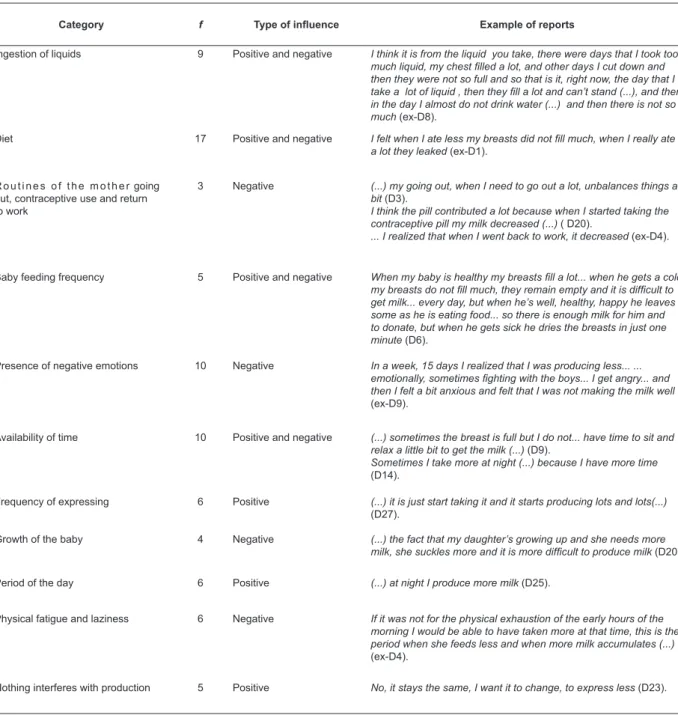
this frequency was related to milk production. Table
1 shows the factors related to the frequency of
expressing in categories, along with the classiication of the inluences as positive or negative on the aspects
mentioned. From the reports, the consideration as
to which factors could facilitate or prejudice milk
production was made.
Table 1 - Positive and/or negative inluences related to the frequency of expressing and milk production, according
to reports from participants
Category f Type of inluence Example of reports
Ingestion of liquids 9 Positive and negative I think it is from the liquid you take, there were days that I took too much liquid, my chest illed a lot, and other days I cut down and then they were not so full and so that is it, right now, the day that I take a lot of liquid , then they ill a lot and can’t stand (...), and then in the day I almost do not drink water (...) and then there is not so much (ex-D8).
Diet 17 Positive and negative I felt when I ate less my breasts did not ill much, when I really ate
a lot they leaked (ex-D1).
R o u t i n e s o f t h e m o t h e r going out, contraceptive use and return to work
3 Negative (...) my going out, when I need to go out a lot, unbalances things a
bit (D3).
I think the pill contributed a lot because when I started taking the contraceptive pill my milk decreased (...) ( D20).
... I realized that when I went back to work, it decreased (ex-D4).
Baby feeding frequency 5 Positive and negative When my baby is healthy my breasts ill a lot... when he gets a cold
my breasts do not ill much, they remain empty and it is dificult to get milk... every day, but when he’s well, healthy, happy he leaves some as he is eating food... so there is enough milk for him and to donate, but when he gets sick he dries the breasts in just one minute (D6).
Presence of negative emotions 10 Negative In a week, 15 days I realized that I was producing less... ...
emotionally, sometimes ighting with the boys... I get angry... and then I felt a bit anxious and felt that I was not making the milk well
(ex-D9).
Availability of time 10 Positive and negative (...) sometimes the breast is full but I do not... have time to sit and
relax a little bit to get the milk (...) (D9).
Sometimes I take more at night (...) because I have more time
(D14).
Frequency of expressing 6 Positive (...) it is just start taking it and it starts producing lots and lots(...) (D27).
Growth of the baby 4 Negative (...) the fact that my daughter’s growing up and she needs more
milk, she suckles more and it is more dificult to produce milk (D20).
Period of the day 6 Positive (...) at night I produce more milk (D25).
Physical fatigue and laziness 6 Negative If it was not for the physical exhaustion of the early hours of the morning I would be able to have taken more at that time, this is the period when she feeds less and when more milk accumulates (...)
(ex-D4).
Nothing interferes with production 5 Positive No, it stays the same, I want it to change, to express less (D23).
Regarding the frequency with which the HMBs
would collect the milk from the domiciles of the women
interviewed, 25 (69.4%) of them reported that this
occurred weekly and 11 (30.6%) reported a fortnightly
frequency. It is important to realize that, the frequency
of HMB collection depends on the organizational aspects
of the institution, such as the availability of transport
and human resources for this task. When questioned
about whether they knew what was happening with their
milk, after donating it to the HMB, 16 (44.4%) of them
reported that they did not know about the procedures
performed, 12 (33.3%) were poorly informed and
eight (22.2%) adequately informed, based on their
reports. With regard to receiving information about the
donation of human milk before the baby was born, 16
(44.4%) reported that they had received nothing. Nine
of them (25%) mentioned that this occurred during the
prenatal period and six (16.7%) received information
during previous pregnancies. On the occurrence of
doubts at the beginning of the process of donation, the
majority (n=24; 66.7%) reported hygienic and sanitary
procedures required in the expressing process, such as
carrying out the expressing, how to sterilize the materials
to store the milk at home, how long the milk could stay
in the shell, how to store the milk, where to put the milk
after expressing, use of mask and cap, why the baby can
not suckle on another woman donor.
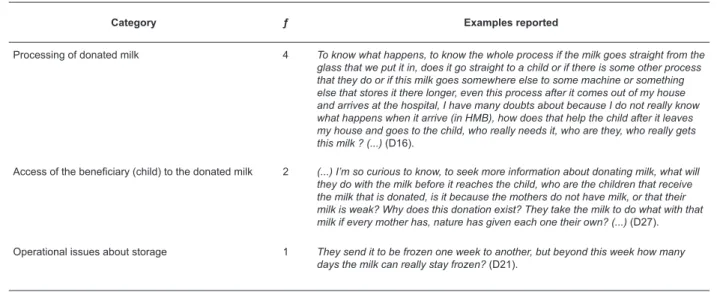
When questioned about the presence of doubts
about donation at the time of the survey, 29 (80.6%)
women responded that they did not have any, and seven
(19.4%) of them admitted that they still had doubts
about donating, which are categorized in Table 2.
Table 2 - Presence of doubts about donation at the time of the survey, according to participants
Category ƒ Examples reported
Processing of donated milk 4 To know what happens, to know the whole process if the milk goes straight from the glass that we put it in, does it go straight to a child or if there is some other process that they do or if this milk goes somewhere else to some machine or something else that stores it there longer, even this process after it comes out of my house and arrives at the hospital, I have many doubts about because I do not really know what happens when it arrive (in HMB), how does that help the child after it leaves my house and goes to the child, who really needs it, who are they, who really gets this milk ? (...) (D16).
Access of the beneiciary (child) to the donated milk 2 (...) I’m so curious to know, to seek more information about donating milk, what will they do with the milk before it reaches the child, who are the children that receive the milk that is donated, is it because the mothers do not have milk, or that their milk is weak? Why does this donation exist? They take the milk to do what with that milk if every mother has, nature has given each one their own? (...) (D27).
Operational issues about storage 1 They send it to be frozen one week to another, but beyond this week how many days the milk can really stay frozen? (D21).
Note. D = Donor
When asked about the support received from people
in their family environment regarding the act of donation,
32 women (88.9%) responded afirmatively. From the
descriptions of the types of support received, the reports
were categorized. Table 3 presents the categories, their
frequency and examples that relate behavior considered
by interviewees as support for donation.
Table 3 - Types of social support mentioned
Category Deinition f Example of reports
Perceived emotional support Support through verbal encouragement to donate
19 They say that it is beautiful the fact that you’re helping other babies, not
throwing away the milk, wasting it, just through words that (D7).
My mother said (...) “daughter, donate, because you’ve already been through this and it is horrible for a child to spend the day or night hungry, so donate if you have it to give” (ex-D6).
Rev. Latino-Am. Enfermagem 2010 May-Jun; 18(3): 381-9.
Category Deinition f Example of reports
Perceived instrumental or operational support
Help through concrete actions in practical aspects related to the donation: to seek containers, to help in expressing
9 My husband helps me, (...)the baby is feeding on the breast then he comes with the glass and holds it there (...) I’m taking from the other breast, then he is holding the glass, then he’ll put it in the fridge “oops already illed that glass!” (D25).
... my mother, any glass that she gets she reserved for milk (ex-D9).
Both modes of support: emotional and instrumental
4 (...) when our breasts are hardened they hurt a lot (...) my husband argued with me “you see you have to take the milk, get the milk, give massage because that will make your fever pass” (...) I took them, I massage my breasts and took the milk, but he always said “get the milk”, when my son fed on one side he took the glass, put on the other and the milk was illing the glass (ex-D3).
There is no clear expression of support
4 He (the husband of the donor) was not very encouraging, but didn’t say
don’t donate (...), he is neither very encouraging, nor against (...) (D22).
Table 3 - Continuation
Note: D = donor, ex-D = former donor
When invited to describe the support received from
the institutions involved in the donation process (HMB
and/or FD), 36.4% (n=12) of respondents answered that
they did not feel supported by either of these services.
Conversely, 30.3% (n=10) reported having received
support from HMB and 21.2% (n=7) from the FD and
HMB. Regarding the satisfaction of participants with the
support received by people in their social life and by
the institutions responsible, 91.7% (n=33) and 58.3%
(n=21) reported being satisied, respectively. In relation
to institutional support, ten women (27.8%) reported
dissatisfaction and ive (13.9%) reported being partially satisied. The following reports illustrate the satisfaction
with the institutional support received;
I think the girls who come to pick up the milk ... give
support, they seem to be close to us ... every time they come
they ask how I am, (..) the question of quarantine (...) I can’t
leave the house much and so whenever they came they would
ask how I was doing and if I was okay and they would give some
tips, their support was very gratifying (D8).
One report illustrates the partial level of satisfaction.
I think they should have more support... more incentive...
for people to donate... there are many people who don’t have
any initiative to donate, so I think if they could be encouraged
more... for us to donate, to look for some way, I do not know
how, to encourage more people, sometimes people can donate,
they want to donate but they don’t know how, there is very little
information and they end up not donating (D22).
Concerning dissatisfaction with institutional support,
the following report is illustrative.
No, I do not consider as a support no, I think they have
their interests that are in the milk but to support us, they do not
support, in my opinion. I am satisied with the milk donation, but
not with their support (D11).
The participants were unanimous in reporting
that they had not received a visit from a BLH worker
from where they were donors or are donating their
milk, in addition to the visits to collect milk stored
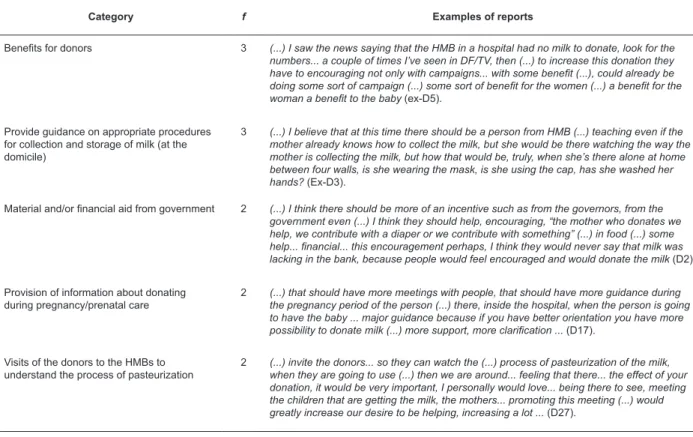
by donors. To improve the support of the HMBs and
FD for women donors, the participants made a series
of suggestions, when instigated by the researcher,
categorized in Table 4.
Table 4 - Suggestions from participants for improving institutional assistance to the donors
Category f Examples of reports
Greater attention and support of the institution (HMB) to donors
14 I think it would encourage them more if they came to talk, from time to time to visit ... I think
a conversation ... would give an incentive for those who had already stopped due to being discouraged (...) (D12).
Information campaigns in the media about milk donation
4 (...) I think it should have more divulgation (...) I think it should also have work... orienting
people about donating (...) I think that this shouldn’t be something that we have doubts about and have to search, I think it should be information that comes to us. This awareness has not been developed (...) the irst awareness that they are doing a lot of, is that of “breastfeed, breastfeed, breastfeed”, but the other of “donate if it is necessary, helps” does not have, I believe that if you do not have this it will be increasingly dificult (D3).
Table 4 - Continuation
Category f Examples of reports
Beneits for donors 3 (...) I saw the news saying that the HMB in a hospital had no milk to donate, look for the
numbers... a couple of times I’ve seen in DF/TV, then (...) to increase this donation they have to encouraging not only with campaigns... with some beneit (...), could already be doing some sort of campaign (...) some sort of beneit for the women (...) a beneit for the woman a beneit to the baby (ex-D5).
Provide guidance on appropriate procedures for collection and storage of milk (at the domicile)
3 (...) I believe that at this time there should be a person from HMB (...) teaching even if the
mother already knows how to collect the milk, but she would be there watching the way the mother is collecting the milk, but how that would be, truly, when she’s there alone at home between four walls, is she wearing the mask, is she using the cap, has she washed her hands? (Ex-D3).
Material and/or inancial aid from government 2 (...) I think there should be more of an incentive such as from the governors, from the
government even (...) I think they should help, encouraging, “the mother who donates we help, we contribute with a diaper or we contribute with something” (...) in food (...) some help... inancial... this encouragement perhaps, I think they would never say that milk was lacking in the bank, because people would feel encouraged and would donate the milk (D2).
Provision of information about donating during pregnancy/prenatal care
2 (...) that should have more meetings with people, that should have more guidance during
the pregnancy period of the person (...) there, inside the hospital, when the person is going to have the baby ... major guidance because if you have better orientation you have more possibility to donate milk (...) more support, more clariication ... (D17).
Visits of the donors to the HMBs to understand the process of pasteurization
2 (...) invite the donors... so they can watch the (...) process of pasteurization of the milk, when they are going to use (...) then we are around... feeling that there... the effect of your donation, it would be very important, I personally would love... being there to see, meeting the children that are getting the milk, the mothers... promoting this meeting (...) would greatly increase our desire to be helping, increasing a lot ... (D27).
Note: D = donor, ex-D = former donor
Faced with the question requesting an evaluation
of the experience of donating, 33 participants (91.7%)
said that it was positive. Of the 27 participants who were donating milk, 18 (66.7%) stated that they intended to
continue donating while they had an excess of milk.
Discussion
One of the main purposes of this study was to
achieve some understanding of the theme of human milk
donation, from reports of women donors. Therefore, we
included two HMBs considered coverage centers in the region, one of which stood out as a reference in the
Federal District.
It can be hypothesized that many potential donors
have their intentions frustrated, not being able to put into
practice their role as a donor. It is pertinent to suggest
that the routine of collection and the relationship between
HMBs-donor are being rethought in the light of issues raised by participants. Despite the reports of satisfaction
with the institutional support received, suggestions made
by them speak of the need to enhance technical support,
to receive and to monitor the donors(12), particularly
with regard to educational aspects and attention to the
woman which may even increase the time of donation and quality of milk collected. In this sense, the use of
breast shells emerges – a method that seems to favor
the process of expressing - but that has not been
recommended according to technical standards(11).
The process of taking the decision to donate can be
inluenced by the kind of assistance received, whether it
is humanized or not, and the valorization of autonomy,
highlighting that adequate communication has a
fundamental effect on this process. Another important
point, mentioned earlier, that deserves to be discussed
in the present study is the method of expressing. It is
preferable that the collection of human milk is made by
hand expressing manually, an electric or manual pump
may also be used, because the quality of human milk
collected, that is to be pasteurized, directly depends on
the hygienic and sanitary procedures applied during the
expressing(11).
In the group of women who reported expressing
more than once a day, the method of manual expressing
was prevalent, however, half the participants in this
group reported using the breast shell to extract their
milk. Focusing on the total sample, almost one third of
participants said that they make use of the breast shell.
This type of method makes the situation worrisome,
because the preference for this object is related,
according to the interviewees, to practicality, comfort
and time saving, eliminating the use of the cap and
Rev. Latino-Am. Enfermagem 2010 May-Jun; 18(3):381-9.
about the proper procedures recommended in the
scientiic literature(11).
It can be suggested, as an educational measure,
that information is provided to the donor by the
formal support network on the risks that may cause
contamination of raw, expressed human milk, especially
when collected in breast shells. This could contribute
signiicantly to avoid unnecessary expenses for the
HMBs because efforts are undertaken in the course of
the stages through which human milk passes before
being consumed. It is important that the HMBs receive
inancial input, as well as human resources, in order to
provide time to attend to the demands of the donors. It
is suggested that preventive actions are implemented,
through continuous monitoring of these women, at
least at the time the HMBs makes the irst domicile
collection.
As for factors that interfere with milk production,
it was noted that the aspects most cited by donors,
such as luid intake, type of diet, presence of negative
emotions, frequency of expressing and suckling of the
baby, are mentioned in the literature(7,13) as factors inluencing the increase or decrease in milk production,
indicating agreement between these responses and
the scientiic evidence. However, contraceptive use,
the mother going out and the return to labor activity
could be considered subjective variants that every
woman faces in her everyday life. Situations such
as lack of available time, physical exhaustion and
laziness to express milk are those cited categories
that deserve to be further studied, since expressing
manually demands a lot of care that takes time and,
depending on the tasks of the volunteers, may limit
the practice of donation. This explains the fact that
many women included in this study stated that they
could donate their milk more often, but did not.
From this perspective, educational activities could be
implemented by HMBs, irst, listening to the mothers and then educating them about the dificulties, offering
support and guidance for coping with them. This might
contribute to closer bonds between the HMBs and the
donors, and perhaps reduce the dificulties of the
mothers and contribute to increase the frequency of
expressing(13).
The precariousness of information for the donor
on the processing and fate of the milk donated to the
HMB is evident. As a result, it is suggested that, through
educational work by the HMBs with the donors of human
milk, the treatment given to raw human milk and the
main destinations that will receive the pasteurized milk,
are explained. To make discussions with women during
the prenatal period, to invite them to visit the HMB while
still pregnant, to take them to visit the maternity ward,
to show them who the consumers of donated human
milk are, and to invite them to observe, at the location,
the steps that the raw, donated human milk passes
through up to the moment it is consumed, are some
suggestions proposed by the women interviewed and
could be implemented by the HMBs.
It is believed that the irst visit by HMB professionals
to the donor’s domicile is important to clarify any
possible doubts that the donor may have. To offer
humanized support, to explain how to identify excess
milk, or to suggest that they make a visit to the HMB
to be examined by a technically skilled professional can
serve as elements that contribute to reduce dificulties,
doubts and waivers in the act of donation(4,7). It is
considered that the performance of visits by the HMB
workers, outside the days on which collections are
made, could ease the doubts arising from the practice
of donation and ensure that the donated human milk
meets the requirements determined by the technical
standards. However, for this to occur, it is important
that the HMBs receive technical and political support,
prioritizing inancial and human resources so that these
suggestions can be put into practice.
Conclusion
Considering the results, it was conclude that
humanized institutional care, permeated by the actions of
encouragement and improvements in the communication
process about donation(12), associated with social
support from people signiicant to the donor, could
help to strengthen the human milk donation network,
facilitating the loyalty of these volunteers should they
become pregnant again. Another possibility is that these
donors engage in the role of multiplier within their social relationships, disseminating information and values that
promote the engagement of new women donors.
Moreover, the improvement of institutional/
organizational processes and the training of human
resources engaged in this area may increase the quality
of the network of milk banks and partner organizations,
aiming to improve the responses of these institutions to the demands of interested people, especially women
References
1. Seidl EMF, Tróccoli BT . Desenvolvimento de escala para avaliação do suporte social em HIV/Aids. Psicol Teor Pesq. 2006; 22(3):317-26.
2. Cobb S. Social support as a moderator of life stress. Psychosom Med. 1976; 38(5):300-14.
3. Souza MHN, Souza IEO, Tocantins FR. The use of social network methodological framework in nursing care to breastfeeding women. Rev. Latino-Am. Enfermagem. 2009; 17(3):354-60. 4. Moura AS, Moreira CT, Machado CA, Vasconcelos Neto JAV, Machado Mde FAS. Doador de sangue habitual e fidelizado: fatores motivacionais de adesão ao programa. RBPS. 2006; 19(2):61-7.
5. Haslam SA, O’Brien A, Jetten J, Vormedal K, Penna, S. Taking the strain: social identity, social support, and the experience of stress. BJSP. 2005; 44:355-70.
6. Almeida JAG. Amamentação: um híbrido natureza-cultura. Rio de Janeiro: FIOCRUZ; 1999. 119 p.
7. Azema E, Callahan S. Breast milk donors in France: a portrait
of the typical donor and the utility of milk banking in the french breastfeeding context. J Hum Lact. 2003; 19(2):199-202. 8. Alencar LCE de, Seidl EMF. Doação de leite humano: experiência de mulheres doadoras. Rev Saúde Pública. 2009; 43:70-7. 9. Alencar LCE de. Doação de leite humano no Distrito Federal: aspectos psicossociais e experiências de mulheres doadoras [dissertação mestrado]. Brasília (DF): Instituto de Psicologia da Universidade de Brasília; 2006. 102 p.
10. Bauer MW, Gaskell G. Pesquisa qualitativa com texto, imagem e som: um manual prático. São Paulo:Vozes; 2002. 516 p. 11. Normas técnicas para bancos de leite humano. Ordenha: procedimentos higiênico-sanitários. 2004. [acesso em: 08 outubro 2006]. Disponível em: http://www.redeblh.fiocruz.br/ media/coleta.pdf.
12. Silva MJP. O papel da comunicação na humanização da atenção à saúde. Bioética. 2002; 10(2):73-88.
13. Albernaz E, Victora CG. Impacto do aconselhamento face a face sobre a duração do aleitamento exclusivo: um estudo de revisão. Rev Panam Salud Publica. 2003; 14(1):17-24.
Received: Jun. 7th 2009