Disponible en castellano/Disponível em língua portuguesa SciELO Brasil www.scielo.br/rlae
PSYCHOMETRIC EVALUATION OF A BRAZILIAN PORTUGUESE VERSION OF THE SPITZER
QUALITY OF LIFE INDEX IN PATIENTS WITH LOW BACK PAIN
Rafaela Cunha Matheus Rodrigues Toledo1
Neusa Maria Costa Alexandre2 Roberta Cunha Matheus Rodrigues2
Toledo RCMR, Alexandre NMC, Rodrigues RCM. Psychometric evaluation of a brazilian portuguese version of the Spitzer Quality of Life Index in patients with low back pain. Rev Latino-am Enfermagem 2008 novembro-dezembro; 16(6):943-50.
The purpose of this study was to adapt the Spitzer Quality of Life Index and evaluate its reliability in patients with low back pain. The following steps were followed: translation, back-translation, evaluation by a committee, and pretest. The reliability was estimated through stability and homogeneity assessment. The validity was tested comparing scores of the Spitzer (QLI) with the SF-36 and the Roland-Morris. The psychometric properties were evaluated by the self-application on 120 patients. Results showed that the Cronbach’s Alpha was 0.77. Intraclass correlation coefficient for test-retest reliability was 0.960 (p<0.001; IC95%: 0.943; 0.972). Spearman´s correlation coefficient for test-retest reliability was 0.937 (p<0.001). There was significant correlation between the Spitzer (QLI) scores and the dimensions of the SF-36. A significant negative correlation was found between the Spitzer (QLI) and the Roland-Morris scores (r = - 0.730). The adaptation process was conducted successfully and the questionnaire presented reliable psychometric measures.
DESCRIPTORS: low back pain; pain; psychometrics; quality of life; validation studies
EVALUACIÓN DE LAS CALIDADES PSICOMÉTRICAS DE UNA VERSIÓN BRASILEÑA DEL
SPITZER QUALITY OF LIFE INDEX EN PACIENTES CON DOLOR LUMBAR
Este estudio tuvo como objetivo realizar la adaptación cultural del Spitzer Quality of Life Index y evaluar su confiabilidad en pacientes portadores de dolor lumbar crónico. Se siguieron las siguientes etapas: traducción, retrotraducción, evaluación por un comité y pre-prueba. La validez fue obtenida por medio de la correlación entre los puntajes del Spitzer (QLI), del SF-36 y del Roland-Morris. Las propiedades psicométricas fueron evaluadas en 120 pacientes. Los resultados demostraron un coeficiente alfa de Cronbach=0,77. En una nueva pre-prueba, se encontró un coeficiente de correlación intraclases ICC=0,960 (p<0,001; IC95%: 0,943; 0,972). El coeficiente de correlación de Spearman fue de r=0,937 (p<0,001). Las correlaciones entre los puntajes del Spitzer (QLI) y de SF-36 fueron significativas. Correlación negativa entre los puntajes de Spitzer (QLI) y de Roland-Morris fue de (r= -0,730). El proceso de adaptación cultural fue realizado con suceso y la versión adaptada presenta medidas psicométricas confiables.
DESCRIPTORES: dolor de la región lumbar; dolor; psicometría; calidad de vida; estudios de validación
AVALIAÇÃO DAS QUALIDADES PSICOMÉTRICAS DE UMA VERSÃO BRASILEIRA DO
SPITZER QUALITY OF LIFE INDEX EM PACIENTES COM DOR LOMBAR
Este estudo teve como objetivo realizar a adaptação cultural do Spitzer Quality of Life Index, e avaliar sua confiabilidade em pacientes portadores de dor lombar crônica. Foram seguidas as seguintes etapas: tradução, retro-tradução, avaliação por um comitê e pré-teste. A confiabilidade foi avaliada por meio da consistência interna e da estabilidade. A validade foi obtida por meio da correlação entre os escores do Spitzer (QLI), do SF-36 e do Roland-Morris. As propriedades psicométricas foram avaliadas em 120 pacientes. Os resultados demonstraram coeficiente alfa de Cronbach=0,77. No teste-reteste, encontrou-se coeficiente de correlação intraclasse ICC=0,960 (p<0,001; IC 95%: 0,943; 0,972). Coeficiente de correlação de Spearman foi de r=0,937 (p<0,001). As correlações entre os escores do Spitzer (QLI) e do SF-36 mostraram-se significativas. Observou-se correlação negativa significativa entre os escores do Spitzer (QLI) e do Roland-Morris (r= - 0,730). O processo de adaptação cultural foi realizado com sucesso e o questionário apresentou medidas psicométricas confiáveis.
DESCRITORES: dor lombar; dor; psicometria; qualidade de vida; estudos de validação
1 PT, M.Sc., Centro Universitário da Fundação de Ensino Octávio Bastos, Brazil, e-mail: [email protected]; 2 RN, PhD, Faculty, Faculty of Medical Sciences,
INTRODUCTION
M
usculoskeletal symptoms represent one of the principal problems in industrialized countries. There is a need for internationally standardizedmeasurements for the analysis of musculoskeletal
symptoms(1). Low back pain is the most common of these symptoms(2). It is one of the most common
work-related injuries and is a cause of high costs both to industry and workers, negatively affecting the quality
of life of its subjects. There are various reasons for evaluating the quality of life of people with back pain,
including the need to establish objectives and plan treatment, to monitor the evolution of pain and to
assess the outcome of the care(3). Therefore, there are various advantages to be gained from the use of
a standardized clinical protocol for the treatment of
low back pain(4).
The Spitzer Quality of Life Index – Spitzer
(QLI), is a generic instrument for the evaluation of quality of life (QOL) that was initially used in patients
with cancer and other chronic diseases(5-6). The Spitzer (QLI), has been used to evaluate the quality of life in
individuals with various medical conditions and also
following surgical intervention(7-8). The use of the Spitzer (QLI) has been reported in the international
literature mainly in relation to the evaluation of the quality of life of elderly patients with musculoskeletal
disorders(6). In addition, Spitzer (QLI) is also being used in clinical protocols to evaluate the efficacy of
treatments for low back pain(4), and is also being used in studies as an instrument to evaluate the quality of
life of patients with back pain(9). The Spitzer (QLI) is originally intended to be filled out by healthcare
professionals.
In view of the scarcity of instruments available
in Brazil for the generic evaluation of quality of life,
the objective of this study was to adapt the Spitzer (QLI) in a self-reported version into Brazilian
Portuguese and evaluate its reliability and validity in patients suffering from back pain.
METHODS
Cross-Cultural Adaptation Process
To guarantee the quality of the adaptation,
the steps recommended in specialized publications were followed(10-12). The author was consulted and
authorized the cultural adaptation of the instrument.
Initial translation and Synthesis: The original
version of the Spitzer (QLI) was translated into
Portuguese by two independent bilingual translators, whose native language was Portuguese. After this
step, the two translated versions of the instrument
were compared by the investigators, a mediator (a professional translator) and a university professor with
research experience in quality of life. Discrepancies
were identified and a consensus was obtained. Back-Translation: The final version was
translated back into English by two other independent
translators who had not participated in the first stage and whose native language was English, thereby
obtaining a back-translation-1 and a back-translation-2.
Reviewer’s Committee: A committee
composed of six bilingual individuals specialized in
the subject area, were invited to review and compare
the translations. To provide guidance to the judges on the evaluation procedure, an instrument was
initially sent to each one of the members. This
instrument was constructed specifically for this purpose and contained instructions for the evaluation of the
topics in each section according to the semantic,
idiomatic, cultural and conceptual equivalences. After this first step, carried out individually
by each one of the judges, a meeting was then organized with all the members to analyze the
instructions and the questions of the instrument, and
to evaluate their lay-out. All the judges participated in this meeting and the objective was to give continuity
and depth to the analysis carried out previously, giving
the judges the opportunity to discuss the discrepancies amongst themselves and to reach a consensus with
respect to a final version of the instrument.
Test of the prefinal version: To evaluate the equivalence of the questionnaire within the Brazilian
cultural environment, a pre-test was carried out in a
sample of 40 patients with chronic low back pain. For this evaluation, it was established that a review would
be carried out whenever more than 15% of the patients
failed to understand the instructions for filling out the questionnaire, or the words or questions used in the
instrument(13).
Evaluation of psychometric properties
Reliability
Reliability was evaluated using internal
was evaluated by applying the questionnaire to the
same group of patients on two different occasions.
Convergent Validity
The validity was analyzed using the relationship between the Spitzer (QLI) score and the
Roland-Morris questionnaire and the Medical Outcome
Study Short Form – 36 Health Survey (SF-36).
Subjects and setting
The data were collected in a physiotherapy
outpatient clinic. Following referral and medical
diagnosis, patients with low back pain receive care in this clinic, located in the Department of Orthopedics.
Male and female adult patients over 18 years of age
who had been referred with a diagnosis of low back pain were included in this study. Chronic low back
pain was defined as pain localized in the lumbar region
for a period of more than 12 weeks(14). Patients who were incapable of understanding or of communicating
verbally and/or who were illiterate were excluded from
the study. It is suggested a minimum number of 100 subjects in studies of cultural adaptation(10). In this
study, 120 patients composed the sample group.
Data collection
The data were collected before the
physiotherapy sessions took place. The subjects
answered the questionnaires individually in a private room. The first step was to obtain the
sociodemographic data, followed by the self-report
Spitzer (QLI) questionnaire, the Medical Outcome Study Short Form – 36 Health Survey (SF-36) and
the Roland-Morris questionnaire. The second stage
was carried out 48 hours after the first. The QLI was applied to the same patient sample (120 patients), in
the same private room, if pain status was maintained.
Data collection instruments
Data collection was performed by applying four instruments: the instrument for
sociodemographic classification, the Spitzer (QLI), the
Medical Outcome Study Short Form – 36 Health Survey (SF-36) and the Roland-Morris questionnaire.
The SF-36 is a generic instrument. It was
adapted for the Brazilian cultural environment in
patients with rheumatoid arthritis(13). It contains 8
health domains that may be grouped into 2
components: Physical, composed of functional
capacity, physical aspects, pain, and general state of
health; and Mental, which encompasses vitality,
emotional aspects, social aspects and mental health. The score is given for each dimension, and these
scores are transformed into a scale ranging from 0 to
100 in which 0 corresponds to the worst state of health possible and 100 to the best state of health(15). It was
decided to use the SF-36 since this instrument is easy
to apply and commonly used in patients with low back pain(16).
The Roland-Morris questionnaire is a specific
instrument used to evaluate disability in patients with low back pain, having already been adapted and
validated for use in the Brazilian cultural environment.
It is composed of 24 items related to daily life activities, and takes an average of five minutes to
complete(17). The total score is calculated from the
total number of questions marked, ranging from 0 to 24 where 0 refers to the absence of disability and 24
to severe disability(18).
The Spitzer (QLI), developed by Spitzer, is a generic instrument for the evaluation of quality of life
(QOL) that was initially used in patients with cancer and other chronic diseases(5). The use of the Spitzer
(QLI) has been reported in the international literature
mainly in relation to the evaluation of the quality of life of elderly patients with musculoskeletal disorders.
The Spitzer (QLI) is composed of five domains, each
one representing a different aspect of the functions of life: involvement in occupational and domestic
activities; activities of daily life; perception of the
patient’s own health; support from family and friends and perception of perspectives in life. Each domain is
composed of three questions that may be awarded 0,
1 or 2 points, 2 representing the most positive response and 0 the worse response. The quality of
life index is calculated from the sum of the scores
obtained in each one of the domains, resulting in a score ranging from 0 to 10. Therefore, the highest
possible score is 10, which represents an optimal
quality of life(5). The Spitzer (QLI) affords reliable psychometric measurements, and its content validity
and construct validity have been confirmed in patients
with cancer and other chronic diseases. Reliability was evaluated by internal consistency and inter-observer
correlation. Internal consistency showed a high
Spearman’s correlation between the data was
statistically significant (0.81, p<0.001).
Statistical analyses
The data were entered into the Excel software
program (Microsoft Office 2003) and into the SAS
(Statistical Analysis System) software program for
Windows, version 8.02 and the following analyses were
performed:
- Descriptive analysis for the sociodemographic and
clinical data and for the domains of the SF-36 and
total scores of the Spitzer (QLI) and Roland-Morris
questionnaires.
- Cronbach’s coefficient alpha: to verify reliability.
Cronbach alpha values > 0.70 were established as
constituting evidence of satisfactory internal
consistency(19).
- Spitzer (QLI) scores were considered continuous
and were not normally distributed. Then,
non-parametric statistics were used.
- Intraclass correlation coefficient (ICC): used to verify
reliability with reference to the stability of the
instrument (test-retest). ICC values ≥ 0.90 were
considered evidence of stability(20).
- Spearman’s correlation coefficient: used to verify
the test-retest and to evaluate validity, i.e. the
correlation between the total scores of the Spitzer
(QLI) and the Roland-Morris questionnaires and the
domains of the SF-36.
The significance level of the statistical tests
was established at 5%.
Ethical considerations
All patients who participated in this study were
asked to provide written informed consent prior to
enrollment. The full protocol received the approval of
the university’s Institutional Review Board.
RESULTS
Cross-cultural adaptation process
Despite the complexity involved in the stages
of the cross-cultural adaptation process, no great
difficulties were found in performing these steps and
all were carried out successfully. During evaluation
by the committee of judges, some alterations were
suggested, with modifications that did not alter the
sense of the original instrument, as well as changes
related to the layout of the instrument. Although the
instrument had originally been developed to be
answered by healthcare professionals, it was decided
to make this version a self-report questionnaire. This
decision was justified since it would increase the range
of use of the instrument.
In the pretest phase, the questionnaire was
responded by a sample of 40 subjects. This group
was characterized by the fact that the majority of
subjects were female (80%, 32/40) with a mean age
of 36.2 years and a mean of 10.7 years of schooling.
The mean duration of low back pain was 46.2 months.
A mean score of 7.8 was found for the Spitzer (QLI),
indicating a moderate quality of life. Following
application of the instrument, the patients were
interviewed to evaluate the difficulties found in filling
out the questionnaire and to identify any questions or
words that were difficult to understand.
When filling out the heading of the
questionnaire in which details regarding patient
identification were requested, 47.5% of patients (19/
40) had difficulty with the question “Problem or
Principal Diagnosis”, indicating a lack of
comprehension with respect to the term “diagnosis”.
No difficulties were found in understanding the
instructions for filling out the questionnaire. Based on
these data, a further meeting was held with the
committee members at which time it was decided to
substitute “Problem or Principal Diagnosis” by
“Principal Disease”. Following this modification, the
final version of the instrument was then considered
to have been obtained.
Description of the sample
One hundred and twenty subjects with a mean
age of 37.4 (± 18.3) years participated in the test
phase of this study. Almost 30% (29.2%) of subjects
were in the 20-29 year old age-group and low back
pain was more common among women (77.5%). The
most frequent duration of low back pain was between
25 and 60 months (31.7% of participants), followed
by 13-24 months (25.8%). Sociodemographic and
clinical data with respect to these patients are shown
Table 1 - Sociodemographic characteristics (n=120)
N % Mean(±SD)
) s r a e y n i ( e g
A 37.4(±18,3)
r e d n e G e l a
M 27 22.5
e l a m e
F 93 77.5
g n il o o h c s f o s r a e
Y 10.7(±4,6)
s u t a t s t n e m y o l p m e t n e r r u C g n i k r o w y l t n e r r u
C 43 35.8
g n i k r o w t o
N 36 30.0
e f i w e s u o
H 06 5.0
d e y o l p m e n
U 35 29.2
) s h t n o m n i ( n i a p k c a b w o l f o n o i t a r u
D 60.2(±81,5)
2 1
-4 22 18.3
4 2 -3
1 31 25.8
0 6 -5
2 38 31.7
0 6
> 29 24.2
Quality of life and evaluation of low back pain
With respect to the QOL data obtained with
the use of the Spitzer (QLI), analysis revealed a mean
score of 7.3 (± 2.4) and 7.4 (± 2.4) in the retest, on
a scale ranging from 0 to 10. It was found that with
respect to the 8 different domains of the SF-36, the
dimensions that had the lowest values were: 40.9 (±
21.2) for pain; 46.7 (± 42.2) for emotional aspects;
47.1 (± 40.8) for physical aspects and 49.0 (± 24.6)
for vitality. The mean score obtained in the application
of the Roland-Morris instrument was 9.5 (± 7.0) on a
scale of 0-24. The measurements of quality of life as
well as the measurement of low back pain, are shown
in Table 2.
s t n e m u r t s n
I Mean(±SD) Median Minimum Maximum
) t s e t ( ) I L Q ( r e z t i p S e r o c
S 7.3(±2,4) 8.0 0.0 10.0
) t s e t e r ( ) I L Q ( r e z t i p S e r o c
S 7.4(±2,4) 8.0 1.0 10.0
6 3 -F S g n i n o it c n u f l a c i s y h
P 59.6(±31,0) 70.0 0.0 100.0
e l o r l a c i s y h
P 47.1(±40,8) 50.0 0.0 100.0
n i a p y l i d o
B 40.9(±21,2) 41.0 0.0 87.5
h tl a e h l a r e n e
G 68.3(±23,1) 72.0 5.0 100.0
y t il a t i
V 49.0(±24,6) 50.0 0.0 95.0
g n i n o it c n u f l a i c o
S 63.4(±29,8) 62.5 0.0 100.0
e l o r l a n o it o m
E 46.7(±42,2) 33.3 0.0 100.0
h tl a e h l a t n e
M 59.7(±25,8) 66.0 0.0 100.0
s i r r o M -d n a l o R e r o c
S 9.5(±7,0) 7.5 0.0 24.0
Table 2 - Scores of the Spitzer (QLI) questionnaire
(test/retest), of the SF-36 and the
Brazil-Roland-Morris questionnaire (n=120)
Psychometric properties
Reliability
The Cronbach’s alpha coefficient was
calculated in the test and retest phases. Internal
consistency was found to be satisfactory, as confirmed
by a Cronbach’s alpha coefficient of 0.76 for the test
and 0.77 for the retest. A high degree of stability was
found for the score of the Spitzer questionnaire in the
test/retest, with an intraclass correlation coefficient
(ICC) of 0.960 (p<0.001; 95%CI: 0.943-0.972).
Spearman’s correlation coefficient was r=0.937
(p<0.001), also indicating high agreement between
the test/retest values of the Spitzer (QLI) score, as
shown in Figure 1.
Figure 1 - Test-retest reliability of the
Brazilian-Portuguese version of the Spitzer (QLI) (Spearman’s
coefficient)
Convergent Validity
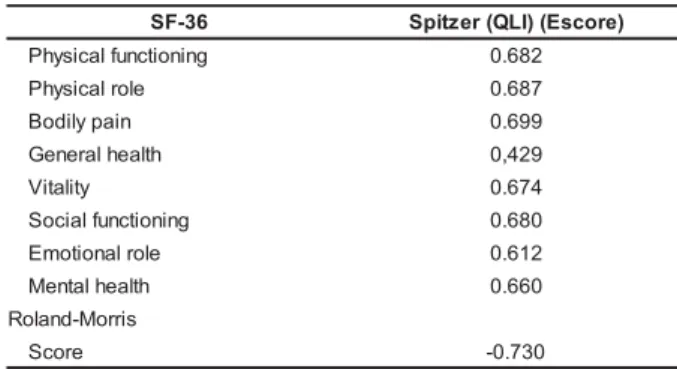
The correlations between the Spitzer (QLI)
score and the different dimensions of the SF-36 were
significant, particularly with respect to the correlations
between the domains of pain (r=0.699), physical
aspects (r=0.687), functional capacity (r=0.682) and
social aspects (r=0.680). A significant negative
correlation was also found between the scores
obtained in the Spitzer (QLI) and the Roland-Morris
Table 3 - Spearman’s correlation coefficient (r) for
the 8 domains of the SF-36 and Brazil-Roland-Morris
questionnaire with the Brazilian-Portuguese version of the Spitzer (QLI)
6 3 -F
S Spitzer(QLI)(Escore)
g n i n o i t c n u f l a c i s y h
P 0.682
e l o r l a c i s y h
P 0.687
n i a p y l i d o
B 0.699
h t l a e h l a r e n e
G 0,429
y t il a t i
V 0.674
g n i n o i t c n u f l a i c o
S 0.680
e l o r l a n o i t o m
E 0.612
h t l a e h l a t n e
M 0.660
s i r r o M -d n a l o R e r o c
S -0.730
All correlations significant at p= 0.0001
DISCUSSION
The process of cultural adaptation followed
all the steps suggested in international methodology. The principal modification implemented to make the
instrument more appropriate for use within the
Brazilian cultural environment was to make the
version a self-report questionnaire. This alteration occurred because of the conceptual perspective of
quality of life, which considers the measured concept
as subjective and, therefore, its evaluation must be based on the report of the subject themselves. We
should point out that in studies carried out in other
countries, as Australia, the instrument in its self-responded form was also used(5,21).
The majority of subjects in this study were
female, and the predominant age-groups confirm that
the back pain is one that affects an economically productive population, leading to a large number of
claims of disability compensation. The most frequent
duration of low back pain was between 25 and 60 months (31.7%), characterizing a population with
chronic symptoms, as previously reported(16). The
version of the instrument was easily understood by the patients. The average schooling was of 10,7 (±4,6)
years of study, and because of this, new studies with
individuals who have little schooling are required.
With respect to quality of life, the analysis of the scores of the Spitzer (QLI) test and retest showed
a moderate quality of life, and this was confirmed by
the results of the Roland-Morris. The dimensions of the SF-36 instrument that resulted in the lowest scores
recorded were: pain, emotional aspects, physical
aspects and vitality. Similar results have been
reported in recent studies on musculoskeletal
disorders, specifically those on low back pain(16). New
dimensions of health are being incorporated into the
traditional evaluation of clinical, laboratory and radiographic parameters for patients with chronic
diseases. Studies have confirmed the negative effect
of musculoskeletal symptoms on various dimensions of quality of life, particularly pain and physical
aspects(22). Therefore, it is increasingly important to
measure the impact of the back pain on the quality of life of patients.
The international literature has reported that
health-related quality of life instruments are being widely recommended to measure the outcome in
patients with back disorders. Following up these results
constitutes a systematic method of monitoring the efficacy of treatment of low back pain.
The evaluation of the reliability showed
satisfactory internal consistency as indicated by a Cronbach’s alpha coefficient of 0.76 for the test and
0.77 for the retest. These results are similar to those
found in the original study(5) carried out in 91 patients with cancer and other chronic diseases, in which a
Cronbach’ s alpha value of 0.77 was reported.
Cronbach’s alpha coefficient was also calculated for a sample of 261 patients with chronic diseases in a
study on the validation of the Quality of Life Index carried out in Canada, in which a value of 0.78 was
found. A sub-group of these patients with cancer had
an alpha of 0.85(23). We must point out that these studies used the original form of application. These
results of the present study suggest that the Spitzer
(QLI) instrument has reliable internal consistency in the self- reported form.
The test-retest stability of the Portuguese
version of the Spitzer (QLI) was evaluated using an interval of 48 hours between the first and the second
interview, resulting in a Spearman’s correlation of
0.937 (p<0.001) and an intraclass correlation coefficient (ICC) of 0.960 (p<0.001; 95%CI:
0.943-0.972). It should be remembered that during the first
step in the data collection process, four different instruments were applied. The literature states the
importance of considering the time interval, in such a
way that the answers of the second interview may not be influenced by the memory of the first, and
also that the interval isn’t long enough to produce
changes in the natural evolution of the pain chart(24). In the original study(5), the reliability of the
questionnaire was evaluated using internal
Canadian patients, physicians applied the instrument
independently to a group of subjects with an interval
of 7 days between the test and the retest. For a sample of 64 patients, Spearman’s correlation coefficient was
0.81(25).
The correlations between the Spitzer (QLI) score and the dimensions of the SF-36 were
significant, particularly the correlations of the domains
of pain (r=0.699), physical aspects (r=0.687), functional capacity (r=0.682) and social aspects
(r=0.680). Satisfactory negative correlation was also
found between the scores obtained in the Spitzer (QLI) and those of the RolandMorris questionnaire (r=
-0.730).
In a study carried out in patients with congestive heart failure, Spitzer’s questionnaire was
found to be effective in differentiating between a study
group and a control group when compared with the Sickness Impact Profile (SIP) and the Quality of
Well-Being (QWB)(26). The data showed that the adapted
version of this instrument may be useful since it is easily applied, particularly in clinical and interventional
evaluations. Further use and psychometric evaluation
should be tested in other chronic conditions within the Brazilian cultural environment.
CONCLUSIONS
The Brazilian version of the Spitzer (QLI) achieved good results with respect to the evaluation
of its psychometric properties, and was considered
reliable for use in subjects with low back pain. Internal consistency was satisfactory with a Cronbach’s alpha
coefficient of 0.76 for the test and 0.77 for the retest.
Stability (test-retest) was confirmed by the Intraclass Correlation Coefficient (ICC) of 0.960 (p<0.001;
95%CI: 0.943-0.972) and Spearman’s correlation
coefficient (r=0.937). Validity was confirmed by the significant correlation between the Spitzer (QLI) and
the Roland-Morris questionnaire (r= - 0.730) and the
different dimensions of the SF-36, stronger correlations being found for the dimensions of pain
(r=0.699), physical aspects (r=0.687), functional
capacity (r=0.682) and social aspects (r=0.680).
ACKNOWLEDGMENTS
The study received the financial support of
the CNPq of Brazil (National Council of Technological and Scientific Development).
REFERENCES
1. Barros ENC, Alexandre NMC. Cross-cultural adaptation of the Nordic Musculoskeletal Questionnaire. Int Nurs Rev 2003; 50:101- 8.
2. Manek NJ, Macgregor AJ. Epidemiology of back disorders: prevalence, risk factors, and prognosis. Curr Opin Rheumatol 2005; 17:134-40.
3. Wood-Dauphinee SL. Assessment of back-related quality of life: the continuing challenge. Spine 2001; 26 (8):857-61. 4. Nordin M, Alexandre NMC, Campello M. Measures for low back pain: a proposal for clinical use. Rev Latino-am Enfermagem 2003; 11(2):152-5.
5. Spitzer WO, Dobson AJ, Hall J, Chesterman E, Levi J, Shepherd R, et al. Measuring the quality of life of cancer patients: a concise QL-Index for use by physicians. J Chron Dis 1981; 34:585-97.
6. Wood-Dauphinee SL, Williams JI. The Spitzer Quality of Life Index: its performance as a measure. In: Osaba D. The effect of cancer on quality of life. Boca Raton, Florida, United States: CRC Press Inc; 1991. p. 169-84.
7. Albers M, Fratesi AC, Luccia, N. Assessment of quality of life of patients with severe ischemia as a result of infrainguinal arterial occlusive disease. J Vasc Surg 1992; 16(1):54-9. 8. Förster R, Storck M, Schäfer JR, Hönig H, Lang G, Liewald F. Thoracoscopy versus thoracotomy: a prospective comparison of trauma and quality of life. Langenbeck’s Arch Surg 2002; 387:32-6.
9. Alexandre NMC, Nordin M, Hiebert R, Campello M. Predictors of compliance with short-term treatment among patients with back pain. Rev Panam Salud Publica 2002; 12(2):86-94. 10. Hutchinson A, Bentzen N, Konig-Zanhn C. Cross cultural health outcomeassessment: a user’s guide. T Netherlands: ERGHO; 1996.
11. Beaton DE, Bombardier C, Guillemin F, Ferraz MB. Guidelines for the process of cross-cultural adaptation of self-report measures. Spine 2000; 25(24):3186-91. 12. Alexandre NMC, Guirardello EB. Adaptación cultural de instrumentos utilizados em salud ocupacional. Rev Panam Salud Publica 2002; 11(2):109-11.
13. Ciconelli RM, Ferraz MB, Santos W, Meinão I, Quaresma MR. Tradução para a língua portuguesa e validação do questionário genérico de avaliação de qualidade de vida SF-36 (Brasil SF-SF-36). Rev Bras Reumatol 1999; 39(3):143-50. 14. Nordin M, Weiser SR, Doorn JW, Hiebert R. Nonespecific l o w b a c k p a i n . I n : R o m W N . E n v i r o n m e n t a l a n d occupational medicine. 3ª ed. Philadelphia: Linppicott; 1998. p. 947-57.
15. Ciconelli RM. Tradução para o português e validação do questionário genérico de avaliação de qualidade de vida “Medical Outcomes Study 36-Item Short-Form Health Survey (SF-36)”[Tese de Doutorado]. São Paulo (SP): Escola Paulista de Medicina/UNIFESP; 1997.
17. Nusbaum L, Natour J, Ferraz MB, Goldenberg J. Translation, adaptation and validation of the Roland-Morris questionnaire - Brazil Roland-Morris. Braz J Med Biol Res 2001; 34(2):203-10.
18. Roland M, Morris R. A study of the natural history of back pain. Spine 1983; 8(2):141-4.
19. Nunnally JC. Psychometric theory. New York: McGraw-Hill; 1978.
20. Fayers PM, Machin D. Quality of life: assessment, analysis and interpretation. Chichester: John Wiley; 2000.
21. Gough IR, Furnival CM, Schilder L, Grove W. Assessment of the quality of life of patients with advanced cancer. Eur J Cancer Clin Oncol 1983; 19(8):1161-5.
22. Kovacs FM, Abraira V, Zamora J, Real MTG, Llobera J, Fernández C, et al. Correlation between pain, disability, and quality of life in patients with common low back pain. Spine 2004; 29(2):206-10.
23. Suissa S, Shenker SC, Spitzer WO. Measuring the quality of life of cancer and chronically ill patients: cross-validation studies of the Quality of Life Index. Montreal, Quebec: Department of Clinical Epidemiology, McGill University; 1984.
24. Menezes PR, Nascimento AF. Validade e confiabilidade das escalas de avaliação em psiquiatria. In: Gorenstein C, Andrade LHSG, Zuardi AW. Escalas de avaliação clínica em psiquiatria e psicofarmacologia. São Paulo (SP): Lemos Editorial; 1999. p. 23-8.
25. Williams JBW, Rabkin JG. The concurrent validity of items in the Quality-of-Life Index in a cohort of HIV-positive and HIV-negative gay men. Controlled Clin Trials 1991; 12:129S-41S.
26. Tandon PK, Stander H, Schwarz RP Jr. Analysis of quality of life data from a randomized, placebo-controlled heart-failure trial. J Clin Epidemiol 1989; 42(10):955-62.