THE POWER OF LOVING HUMANE CARE IN NURSING
1Digna Escobar Rivero1
Alacoque Lorenzini Erdmann2
Escobar Rivero D, Erdmann AL. The power of loving humane care in nursing. Rev Latino-am Enfermagem 2007 julho-agosto; 15(4):618-25.
This study aimed to develop an approach about the power of humane care within the concept of
nursing through the building of a theoretical structure. Spiegelberg’s methodology was used to seek the meaning
of the power of humane care for new nurses and for patients. The resulting theoretical structure is based on
Parker’s theory of power, Patterson and Zderad’s humane care, Watson’s theories and Larrañaga’s concept of
love. The elements of this structure are: the nurse, the ill or healthy person, the environment and nursing, all
bound by an affectionate humane care. The final reflection was that all of them are included within the
technical-scientific paradigm of modernity and that the patients hope to be care for by humane nurses.
DESCRIPTORS: power (psychology); love; nursing
EL PODER DEL CUIDADO HUMANO AMOROSO EN LA ENFERMERÍA
Este estudio tuvo como propósito desarrollar una aproximación sobre el poder del cuidado humano en
la concepción de Enfermería a través de la construcción de una estructura teórica. Se utilizó la propuesta
metodológica de Spiegelberg, buscando el significado que tiene el poder y el cuidado humano para nueve
enfermeras y dos enfermos. La estructura teórica resultante se orienta a como la enfermería puede lograr
poder a través del ejercicio del cuidado humano basado en el amor, apoyada en las teorías del poder de
Parker, de cuidado humano de Paterson y Zderad, Watson y la concepción del amor de Larrañaga. Los elementos
de la estructura son la enfermera, la persona sana o enferma, el ambiente y la enfermería, unidos en el
cuidado humano amoroso. La reflexión final indica que las enfermeras están ubicadas dentro del paradigma
tecno-científico de la modernidad, mientras que los enfermos esperan ser cuidados por enfermeras humanas.
DESCRIPTORES: poder (psicología); amor; enfermería
O PODER DO CUIDADO HUMANO AMOROSO NA ENFERMAGEM
Este estudo teve como propósito desenvolver uma aproximação sobre o poder do cuidado humano na
concepção da Enfermagem através da construção de uma estrutura teórica. Foi utilizada a proposta metodológica
de Spiegelberg buscando o significado que tem o poder e o cuidado humano para enfermeiras novas e para os
enfermos. A estrutura teórica resultante se orienta em como a enfermeira pode conseguir poder através do
exercício do cuidado humano baseado no amor, apoiada nas teorias do poder de Parker, de cuidado humano
de Paterson y Zderad, Watson e a concepção de amor de Larrañaga. Os elementos da estrutura são: a
enfermeira, a pessoa sadia ou doente, o ambiente e a enfermeira, unidos pelo cuidado humano amoroso. A
reflexão final indica que as enfermeiras estão inseridas dentro do paradigma técnico-científico da modernidade
e que os pacientes esperam ser cuidados por enfermeiras humanas.
DESCRITORES: poder (psicologia); amor; enfermagem
1 Paper extracted from Doctoral Dissertation; 2 PhD in Nursing, Full Professor, University of Carabobo School of Nursing, Venezuela; 3 PhD in Nursing
Philosophy, CNPq Researcher, Full Professor, Santa Catarina Federal University Nursing Department, Brazil, e-mail: [email protected]
INTRODUCTION
I
n Venezuela, nursing is facing a moment of transition regarding its consolidation as a profession.This is evidenced when studying central aspects like
power, which emanates from the essence of its
practice: offering humane care to individuals, families
and healthy or ill groups. Power is the strength that
triggers the changes demanded by society. Humane
care, due to the debilitation of man’s transcendental
values, is present in the current century, marked by
dehumanization among human groups.
The researcher’s large experience as a nurse
at public health centers, in outpatient and hospital
care, in addition to performing health care, association,
administrative and faculty tasks has provided her with
a view of the reality regarding Venezuelan nursing
profession. Despite its irreplaceable social role in
preserving human life, nursing does not receive
appropriate treatment from society. This fact aroused
the idea to review a few factors associated with this
reality.
In this quest, very important empirical
evidence was found, such as the lack of a Professional
Practice Law and the fact that there are many
academic levels, but without occupational profiles
describing the tasks for each level. This causes
confusion, since there is no role definition. Another
evidence of the studied phenomenon is the
encapsulated nursing work, with a monodisciplinary
approach to health care. The historically prevalent
leadership of very small groups was also observed,
which are responsible for the profession’s
advancement, although this goes by unnoticed by the
patient community. One of the most significant
evidences guiding the study was the lack of the
nursing profession in the political structure of the
Venezuelan Health Ministry, with a consequent
absence of participation in high-level decision making.
Through qualitative research and using the
method proposed by Spiegelberg(1), the phenomenon
“power of humane care” could be outlined, delivered by
nurses, in the search for the multiple perspectives of the
studied nurses, patients, and the researcher’s points of
view. This method consists of six phases: outlining the
phenomenon, searching for the multiple perspectives,
searching for the essence and structure, building the
meaning, suspension of judgments, and interpreting the
phenomenon. This permitted searching the meaning that
nurses assign to power and humane care.
FOUNDATIONS OF THE STUDY
PHENOMENON
Power has been extensively studied in
sociology and administration. Classic reports like those
by Parsons, Max Weber, Giner and others are guided
by the conception that power is a key element in social
relationships, in which one person’s desire is imposed
over others’, and over their resistance, regardless of
that imposition being fair or not. This has been referred
to as “power over”, as the capacity of exerting
influence, adopting an expected behavior.
Power is an ability of individuals or groups
make their own interests or motivations prevail,
despite the resistance they may face (2-3). Power is
also a social fact in which some give orders and others
obey. Human groups cannot exist without power. When
questioning about power in nursing, it is observed
that this issue has been studied in the United States
since the 1960’s. Power development in nursing has
been delayed by characteristics specific to the
profession, to the place where nurses work and by
their not knowing that it is a positive strength that
can be used as an instrument to make the expected
social changes. After reviewing some traditional
conceptions of power, it was observed that they had
the common denominator putting yourself above
others, dominating, being or arriving first, in which
there is no simultaneous place for two, regardless of
whether the prevalence of one over the other is useful.
This conception of power over is not the power that
nurses could use in their professional relationships
with healthy or ill individuals. Those relationships
should be horizontal and intersubjective, in which they
share the goal of improving the health situation:
nurses with their care delivery goal, and healthy or ill
individuals as care receivers.
Previewing this encounter in an environment
consisting of understanding, respect and transparency
idea of power with, which is immersed in people’s
lives and should be sought with, for and from people.
Moreover, it should be constructed by integrating
desires, efforts, and interests, so as to facilitate power
with and impede domination or power over. It
emphasizes that power with means the simple ability
to make things happen, developed in an active and
participative way; collectively, not coercively. The
author of this study directs power in an integrative
social action, which results from natural collaborative
work with other people, and not as an imposition of
desires.
This type of power is in harmony with present
times, since people currently reject being directed
with domination. Rather, they expect to be taken into
consideration and be treated as human beings.
Moreover, the tendency now is for horizontal
relationships, which do not exist with coercive
domination, power over. This is demanded by
sociopolitical, cultural and economic determinants.
Nursing, through the quest to provide society with
better support, also follows the power with paradigm
in establishing actions to sustain humane care.
The conception of love has been considerably
approached, and this study discusses forms of using
it in nursing. By practicing loving humane care, nursing
can acquire the necessary power to irradiate that love
in health institutions and obtain social legitimacy in
Venezuela.
Therefore, love is understood as “the ability
to feel concern, responsibility, respect, and
understanding toward others” (5) and, complementarily,
love is finding and recognizing others considering their
subjectivity, it is wanting others as subjects (6), it is to
affirm others and respond to their call. In addition,
authentic love is unconditional, uninterested, and
implies being loyal to others. Hence, it is assumed
that every man needs to love and be loved in a natural
way. Thus, love-based humane care in nursing would
mean the authentic expression of its essence and the
pathway to transcendence (7).
Regarding humane care support, the
propositions presented in Paterson and Zderad’s
humanistic nursing theory are considered, which states
that nursing means “a special human encounter as
the answer to a noticed need, associated with health
quality – illness, of the human condition. Nursing seeks
to care for wellbeing and improvement, through an
intentional encounter, in which there is a call and an
intentional answer, as a sort of dialogue(8). Thus, care
factors from Watson’s theory are also incorporated,
which highlights that love, lovability and equanimity
should be practiced within the context of conscientious
care. Transpersonal care is understood as thorough
human-human connection. It means that nurses enter
others’ space and are able to detect their condition;
they understand others’ to the extent that when giving
them an answer, nurses feel relief from those feelings,
thoughts, and tensions. The ideas regarding the
aforementioned theories are presented in the final
section of the present research about the power of
loving humane care.
THE PATHWAY
A qualitative research(9) was performed, using
the phenomenological-hermeneutic approach. Data
collection was performed through the focus interview
technique. Husserl’s(10) ideas were used, which
consider phenomenology as the method that attempts
to understand man’s world through an intellectual view,
based on intuition over the fact. Knowledge is acquired
by trying to see things from other peoples’
perspectives, describing, understanding, interpreting.
In this case, the meaning of power for each
key-informant was studied, considering his/her own
experiences.
Spiegelberg’s(1) method proposal permitted
describing the phenomenon “power of humane care”
provided by nurses, with a view to obtaining the
multiple perspectives built by patients’ and nurses’
statements and considering the researcher’s
perspective as well. The information was organized
according to internal relationships, in order to find
the essence and the structure. Meaning was
determined by a thorough analysis of the structures,
until the total phenomenon could be visualized. In
the judgment suspension phase, the investigator had
a clear idea of the informants’ point of view, and,
finally, interpreted the phenomenon and assigned
consideration.
The information was organized by means of
the focus interview technique according to Merton,
who states that it is a form of non-directed interview
addressing a certain focus. It is an experience, a
situation, an action toward a concrete individual,
previously characterized for having had that
experience(11).
The present study was performed in Valencia,
Carabobo state, an industrial region in Venezuela and
a model city concerning Health Sector
Decentralization.
The key-informants were nine high-level
nurses: two managers of the most important private
health centers, one outpatient clinic head nurse, two
supervisors from the public and private sector, two
direct-care qualified nurses from outpatient clinics and
hospitals, one experienced faculty member, and one
experienced association member,
administrator-faculty member. Interviews were guided by two central
aspects: the meanings of power and of humane care
power. Guiding questions were the following: what does
s e i r o g e t a
C Participants Externalagents Investigator Intersections
f o g n i n a e M
r e w o
p -Makingdecisions -Nursesprovidetreatments,cures n
o i t a c i d e m d n a
h s il b a t s e o t y t il i b A
-h t i w s p i h s n o i t a l e r e v i t c e j b u s r e t n i
s p u o r g r o e l p o e p
e c n e u l f n i s i r e w o P
-s m e l b o r p g n i v l o S
- -Theyarebotheredbypatients -Seeksconsensus -Powerisinterpersonal p
i h s n o i t a l e r
s b o j n g i s s A
- -Batheillpeoplewhoareincapable s
e v l e s m e h t t i g n i o d f
o -Unifiesideas -tIiscommunication
p i h s n o i t a l e r y t i r o h t u A
- -Donotilketoseerelativesinthe m
o o r
, t c e p s e r f o t n e m n o r i v n e n a s t e S
-n r e c n o c , y t il i b i s n o p s e r , y t e f a s
s r e h t o d r a w o t
e c n e d n e p e d d n a n o i t a n i m o D
- -Rushindoingthings -Mutualinfluence
e c n a m r o f r e p b o J
- -Areusuallyinabad-mood -Opentowardothers
l a c i n h c e t d n a c i m e d a c a s d n a m e D
-e c n e i r e p x e r o n o i t a r a p e r
p -Donothavetimeforeveryone -Unionstrengthindiversity
, p i h s n o i t a l e r d n a e c n e u l f n I
-s ll i k s n o i t a c i n u m m o c
n i l a u t c n u p t o n e r a s e m i t e m o S
-s t n e m t a e r t
f o r e w o P
e n a m u h
e r a c
n o i t i s o p b o j e h t n o s d n e p e d r e w o P
- -Theyshouldbeloveable,thoughtful g
n i r a c d n
a -Humanecaregeneratespower
t i f e n e b e h t r o f g n i k r o W
-s r e h t o f o
r o f y t il i b i s n o p s e r g n i k a t s n a e m tI
-n o i t i s o p e h t
e h t t a s t n e m t a e r t w o ll o f d l u o h s y e h T
-e m i t d e n i m r e t e d
r o f e v o l n o d e s a b e c n e u l f n i s i tI
-s r e h t
o -tImeansservingothers
s r e h t o f o t i f e n e b e h t r o f g n i k r o w s i tI
- -Theyshouldbesympathetic, . g n i d n a t s r e d n u d n a , e t a r e d i s n o c
p i h s n o i t a l e r l a n o s r e p r e t n i a s i tI
-s r e h t o s r e d i s n o c d n a s e u l a v t a h t
e l p o e p s a
h t i w k r o w d n a s a e d i g n i r a h s s i tI
-s e u g a e ll o
c -Mutualbenefit
e g d e l w o n k e h t g n i v a h s i tI
-b o j e h t g n i n r e c n o c
r o g n i p l e h , s r e h t o g n i v r e s s i tI
-g n i t s i s s a
power mean to nurses? What are the characteristics
of nursing practice? What type of power have nurses
used in their daily work? Are nurses aware of the
power in human care? Do nurses believe that humane
care gives power?
Nurses were asked to describe what they are
like and what was expected of them.
Interviews concerning the meanings of power
and humane care were performed by the researcher.
A photo camera and a tape recorder were used to
record the information, with previous authorization
from the informants, and guaranteeing the confidential
character of the information they provided. Gemstone
names were used as fictitious names. The eleven
interviews were recorded, compiled, and integrally
and faithfully transcribed. Next, they were analyzed
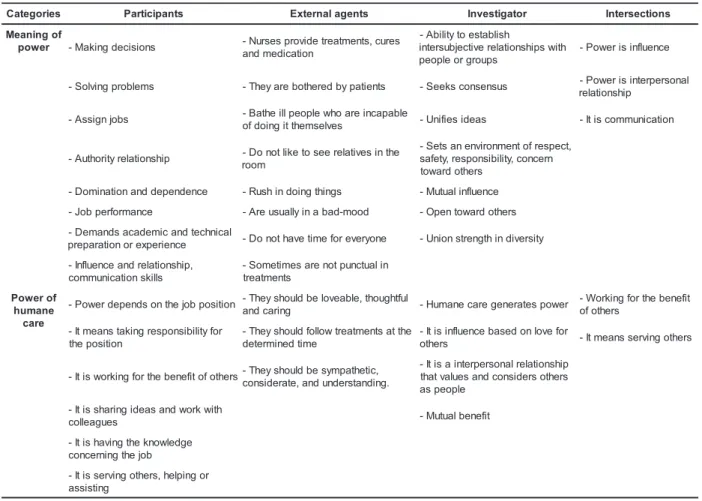
according to Spielberg’s method. Intersection
matrices were determined, first by excerpts, and then
by the intersections of the three excerpts (Table 1),
which composed the study results to be interpreted,
recommended and used to elaborate the theoretical
structure.
In the search for essence and structure,
Table 2 presents the meaning units obtained in
the analysis of the information regarding nurses’
perspectives.
Table 2 – Meanings stated by nurse informants, identified with fictitious names
s t n a m r o f n
I Meaningsofpower Meaningsofhumanecarepower
Results show the phenomena revealed in this
study by the two categories, power and power of
humane care, which include the components of love.
- The nurses’ perspectives regarding power imply
making decisions and solving problems, and are
associated with authority, communication abilities,
influence, dominium and dependence, which demands
capacity. Interaction with the informants permitted
observing the nurses’ rejection to speak about power,
and the confusion between the term and activities
that require power. Other informants clearly identified
that only power makes it possible for high
administrative positions to exist; and in a very subtle
way, others associate power with influence. This is
understood as a reflex that Venezuelan nursing
remains attached to the old paradigm of values, which
is characterized by protection behaviors to ensure
safety, in line with the organization’s norms and
requirements. This is related to the fact that
Venezuelan nursing appeared in 1930, in sheer
modern times, with mechanistic organizational models,
in schools as well as in hospitals. Nurses show
behaviors specific to this model, which continue after
70 years.
- Regarding the perspectives of humane care power,
nurse informants associate power with the job
position, but not with the care they provide. Only three
of the nine nurses timidly associated power with the
service provided to others. It is believed that,
innocently, nurse practitioners identify the technical
dimension involved in health care and, at a lower level,
the affective, ethical and esthetical dimension, but
dissociated from the knowledge they have regarding
the immense power that emanates from practicing
humane care.
- Patients describe nurses as being rushed and in a
bad mood. This is interpreted as nursing continuing
to be based on the technical-scientific paradigm, since
that is how it appeared in Venezuela.
- Patients expect nurses to be loveable, thoughtful,
caring, to follow treatments at the established time,
and to be sympathetic, considerate and understanding
toward them. They hope to see a humane nurse, but
they find that person very technical. This is interpreted
as a product of three relevant factors. One factor is
that health institutions privilege technical skills.
Another fact could be that the health system remains
anchored in the bureaucratic model, in which procedure
abilities prevail and favor impersonality, thus moving
affective, emotional or spiritual actions to the
background. Hence, it disagrees with the new view of
the world, which is focused on humans and requires
nurses to provide eminently humanistic care. The third
fact is that management at health facilities likely
remains directed toward an administration that seeks
quantitative production, performing tasks and
controlling people.
- The researcher’s perspectives regarding power
and the power of humane care are products of the
systematic study of those issues, in which love is
the intersubjective expression that surpasses all
others.
THE THEORETICAL STRUCTURE OF LOVING
HUMANE CARE POWER
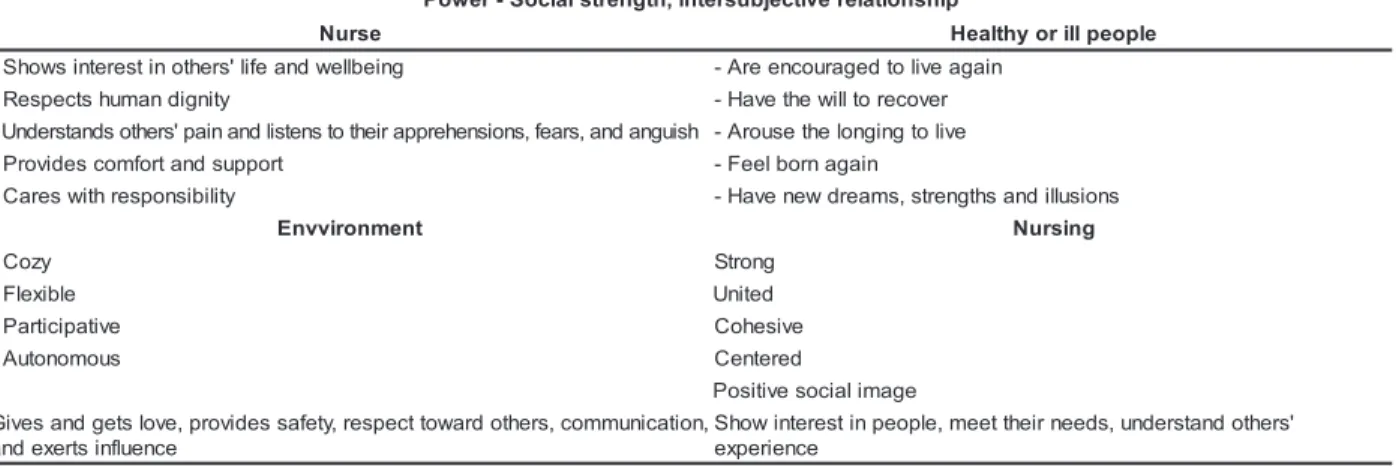
S t r u c t u r a l e l e m e n t s c o n s i s t o f l o v i n g
h u m a n e c a r e a n d p o w e r, a n d t h e f u n c t i o n a l
elements are the nurse, the healthy or ill person,
the environment and nursing. These items are
described in tables 3 and 4.
- loving humane care is understood as an
intersubjective relationship between nurses and
healthy or ill people, in which love is given and taken:
concern and interest, respect, understanding and
responsibility, in a reciprocal way.
- Nurse practitioners are those interested in the health,
well being and lives of healthy or ill people. They
respect, understand and take responsibility for their
patients’ health care.
- Healthy or ill people are those who receive health
care from nurses and are encouraged to live again,
become interested in their recovery, and have new
dreams, strength and illusions.
- The environment is the physical setting where health
care is offered, characterized by coziness, flexibility,
participation and sensitivity.
- Nursing consists of a strong, united, cohesive team,
centered on humane care and with a clear positive
social image.
- Power is the social strength, product of the
intersubjective relationship between nurses – health
Table 3 – Loving humane care, with an intersubjective relationship between nurses and healthy or ill people
e r a C e n a m u H g n i v o L
, s r e h t o d r a w o t t c e p s e r , y t e f a s s e d i v o r p , e v o l s t e g d n a s e v i G
e c n e u l f n i s t r e x e d n a , n o i t a c i n u m m o c
' s r e h t o s d n a t s r e d n u , s d e e n r i e h t s t e e m , e l p o e p n i t s e r e t n i s w o h S
e c n e i r e p x e
e s r u
N HealthyOrIllPeople
. g n i e b ll e w d n a e f il ' s r e h t o n i t s e r e t n i s w o h S
- -Isencouragedtoilveagain
. y t i n g i d n a m u h s t c e p s e R
- -Hasawilltorecover
. h s i u g n a d n a , s r a e f , s n o i s n e h e r p p a r i e h t o t s n e t s il d n a n i a p ' s r e h t o s d n a t s r e d n U
- -Arousesthelongingtoilve
. t r o p p u s d n a t r o f m o c s e d i v o r P
- -Feelsbornagain
. y t il i b i s n o p s e r h t i w s e r a C
- -Hasnewdreams,strengthsandillusions
t n e m n o r i v v n
E Power Nursing
y z o C
- -Socialstrength -Strong
e l b i x e l F
- -Intersubjectiverelationship -United e
v i t a p i c i t r a P
- -Cohesive
s u o m o n o t u A
- -Centered
e g a m i l a i c o s e v i t i s o P
-Table 4 – Power as social strength, a product of the intersubjective relationship between nurses and healthy or ill people
Hence, this study presented the conception of loving humane care as an intersubjective relationship between nurses and healthy or ill people. The love exchanged in these relationships is understood as the ability to demonstrate concern and interests, respect dignity, take responsibility for health care and understand the implied health situation.
Therefore, the theoretical structure of loving humane care consists of: concern and interest, understanding, responsibility and respect for dignity. This permits for redirecting nurses’ work as a possible work technology, as shown below:
- concern and interest are addressed through permanent face-to-face authentic conversation with patients;
- respect for dignity in professional autonomous work, patients’ freedom to make or participate in decisions affecting them, as well as having their rights respected, provides them with individualized health care; - comprehension through empathy, as a feeling that is expressed by putting yourself in the place of
patients, not guessing but exploring what they feel regarding their health situation;
- the other element is the responsibility understood from the perspective of the moral commitment to respond for the consequences of the interventions offered as caregivers and the obligation to complete the activities and tasks determined by the job position. The theoretical structure elements of loving humane care include Caring Nursing, which presumes health care with concern, respect, comprehension and responsibility, until it is passed to patients. These healthy or ill people should have become interested in and concerned about recovering or improving their health, to the point that they feel the desire to live and create new illusions. The environment should be cozy, welcoming, ventilated, illuminated, comfortable and harmonically decorated (art, music, nature).
This gives new directions to the attitude of loving caring nurses, which involves the stages of receiving patients (which cannot be delegated); the recommendations and trust required for loving
p i h s n o i t a l e r e v i t c e j b u s r e t n i , h t g n e r t s l a i c o S -r e w o P
e s r u
N Healthyorillpeople
g n i e b ll e w d n a e f il ' s r e h t o n i t s e r e t n i s w o h S
- -Areencouragedtoilveagain y
t i n g i d n a m u h s t c e p s e R
- -Havethewilltorecover
h s i u g n a d n a , s r a e f , s n o i s n e h e r p p a r i e h t o t s n e t s il d n a n i a p ' s r e h t o s d n a t s r e d n U
- -Arousethelongingto ilve t
r o p p u s d n a t r o f m o c s e d i v o r P
- -Feelbornagain
y t il i b i s n o p s e r h t i w s e r a C
- -Havenewdreams,strengthsandillusions
t n e m n o r i v v n
E Nursing
y z o C
- Strong
e l b i x e l F
- United
e v i t a p i c i t r a P
- Cohesive
s u o m o n o t u A
- Centered
e g a m i l a i c o s e v i t i s o P , n o i t a c i n u m m o c , s r e h t o d r a w o t t c e p s e r , y t e f a s s e d i v o r p , e v o l s t e g d n a s e v i G
e c n e u l f n i s t r e x e d n a
' s r e h t o d n a t s r e d n u , s d e e n r i e h t t e e m , e l p o e p n i t s e r e t n i w o h S
humane care; following the health care process according to patients’ needs and conditions; and, giving final instructions when the care period is over and make them comfortable until the next time you meet.
It is concluded that the theoretical structure of loving humane care is directed to emphasizing the beauty, deepness and complexity of the nursing profession and lead it to transcendence through love.
SOME FINAL CONSIDERATIONS
- the theoretical structure of loving humane care could lead to a powerful nursing in this historical moment;
- practicing power and humane care in nursing is
founded on the technical-scientific paradigm of
modern times.;
- there is disagreement between the nurses’, patients’
and researcher’s perceptions regarding power and
humane care;
- the nature and sources of power and its advantages
to nursing remain unknown;
- spaces for discussion should be created to address
the meaning of power, the power of humane care and
the power of loving humane care;
- practicing humane care power could be a
determinant for the social legitimacy of nursing in
Venezuela.
REFERENCES
1.Gómez RG. Metodología de la investigación cualitativa. Málaga: Ediciones Alibe; 1996.
2. Giddens A. Sociología. Madrid: Alianza Editorial; 2000. 3. Neira E. El saber del poder. Introducción de ciencias políticas. Mérida: ULA; 1991.
4. Parker FM. Prophet of Management. Boston: Harvard Business School Press; 1994.
5. Larrañaga I. Sube conmigo. Perú: Ediciones Paulinas; 1 9 9 8 .
6. Gevaert J El problema del hombre. Introducción a la antropología filosófica. Salamanca: Ediciones Sígueme; 1993. 7. Buscaglia L. El Amor: la experiencia más importante en la vida. Colombia: Editorial Diana; 1985.
8. Paterson J, Zderad L. Humanistis Nursing. United States of America: National League for Nursing; 1988.
9. Ruiz J. La descodificación de la vida cotidiana: métodos de investigación cualitativa. Bilbao: Universidad de Deusto; 1 9 8 9 .
10. Husserl E. Ideas: relativas o una fenomenológica para y una filosofía fenomenológica. España: Editorial Fondo de Cultura Económica; 1993.
11. Merton R. Teoría y estructuras sociales. México: Editorial Fondo de Cultura Económica; 1992.