Received on 02/23/2010. Approved on 01/19/2011. Ethics Committee: FR189426. Financial support: Alice Abath received a Scientific Initiation scholarship from IMIP/CNPq. The authors declare no conflict of interest.
Instituto de Medicina Integral Professor Fernando Figueira – IMIP, Recife, PE, Brazil.
1. Scientific Initiation scholarship from IMIP/CNPq – Medical student of the Faculdade Pernambucana de Medicina – FPS
2. MSc candidate in Internal Medicine of the Universidade Federal de Pernambuco (UFPE); Cardiologist, Tutor at the Ambulatório de Ensino de Clínica Médica of the FPS
3. Statistician; MSc in Public Health at the Centro de Pesquisas Aggeu Magalhães – Fiocruz
4. PhD at the Centro de Pesquisas Aggeu Magalhães – Fiocruz; MCs in Internal Medicine at the UFPE; Tutor at the FPS
Correspondence to: Claudia Diniz Lopes Marques. Rua dos Coelhos, 300, Boa Vista. Recife, PE, Brazil. Zip Code: 50070-550. E-mail: [email protected].
Comorbidities in patients with
osteoarthritis: frequency and impact
on pain and physical function
Alice Abath Leite1, Aline Jurema Gesteira Costa1, Beatriz de Arruda Matheos de Lima1,Adriana Valentina Lopes Padilha2, Emidio Cavalcanti de Albuquerque3, Claudia Diniz Lopes Marques4
ABSTRACT
Introduction: As the prevalence of osteoarthritis (OA) increases with age, the coexistence of other chronic diseases is common. Objectives: To evaluate the frequency of comorbidities in OA patients and to measure their impact on pain and physical function of those patients. Methods: Cross-sectional study in OA patients of a public rheumatology clinic. Pain was measured by use of the Visual Analogue Scale (VAS) and physical function by use of the Lequesne’s and SACRAH indices. A screening for depression was performed, as were the following measurements: anthropometric data; blood pressure; fasting glycemia; and lipid proile. Results: The study assessed 91 patients (mean age 59.3 years; 91.4% female). The metabolic syndrome frequency was 54.9%. Hypertension occurred in 75.8% of the patients, dyslipidemia in 52.6%, and obesity in 57.1%. The screening for depression was positive in 61.3% of patients. When comparing the metabolic syndrome components individually, patients with hypertension had higher SACRAH scores, with statistically signiicant differences (P = 0.035). For the other variables, no differences among the Lequesne’s, SACRAH and VAS scores were observed. Conclusion: This group of OA patients showed a high frequency of depression, metabolic syn-drome and its components in isolation, which can impact the pain and physical function of those patients. Such results showed the need for investigating and treating those comorbidities in OA patients.
Keywords: osteoarthritis, metabolic syndrome X, depression, chronic disease.
[Rev Bras Reumatol 2011;51(2):113-123] ©Elsevier Editora Ltda.
INTRODUCTION
Osteoarthritis (OA) is considered the most common disorder of the musculoskeletal system and the greatest cause of disability in both developed and the so-called emerging countries.1 Since
the the population is aging, the prevalence of OA has increased, and its consequences have a great socioeconomic impact. Approximately 40% of the adults over the age of 70 years have knee OA, and 80% of those with OA have any type of limitation of movement.1 Data obtained from the Framingham study
place OA at the same level of both cardiovascular diseases and chronic obstructive pulmonary disease as the major cause of chronic physical disability.2
Because the prevalence of OA increases with aging, coexistence with other chronic diseases is common, further increasing the impact on the quality of life of those patients. The major comorbidities of OA patients are systemic arterial hypertension (SAH), cardiovascular disease, diabetes, and dyslipidemia.3,4 Metabolic syndrome, defined as the
hypertriglyceridemia or low HDL levels (at least three of the
ive criteria) in the same individual,5 also occurs at a high
frequency in OA patients.6 Despite the clear relation between
OA development and the trauma resulting from excessive weight, the occurrence of OA in joints that do not bear load
suggest that the chronic inlammation status existing in patients
with metabolic syndrome can alter the metabolism of cartilage, regardless of excessive weight.7 In addition, glucose intolerance
can also collaborate to maintain that persistent inlammation
status in obese individuals with metabolic syndrome.8
As OA is the major cause of pain in elderly patients, a population with a very high prevalence of depression, the coexistence of both diseases is frequent. The impact of
depression on OA is signiicant, since it inluences the two
major joint symptoms: pain and physical disability. Depressed individuals are more likely to report chronic or more severe pain, and more than half of the patients with chronic pain are depressed.9
The presence of diabetes, heart disease or even visual alterations are not only more frequent in OA patients, but also lead to a greater impairment of physical functions and quality of life, in addition to worsening the prognosis of arthroplasties.10,11
Although OA is the disease that most commonly causes physical disability, the real extension of the impact of its combination with other chronic diseases on physical function has not yet been assessed among us. A study in England has concluded that the presence of comorbidities increases the frequency of physical disability in OA patients, and the
inluence of the combination is higher than that expected for
OA alone or for each disease in isolation. The treatment of such comorbidities in OA patients would, thus, be crucial to reduce the impact on physical disability, and, consequently, enhance the quality of life of those individuals.11
This study aimed at assessing the frequency of the association of chronic degenerative diseases in patients diagnosed with OA, as well as the impact of such associations on the physical function of those patients, measured by use of the Lequesne’s algofunctional and SACRAH indices, both validated for the Portuguese language.12,13
METHODS
This was a cross-sectional study including patients with OA of the hands, knees, and hips, being followed up at the outpatient clinic of rheumatology of the Fundação Professor Martiniano Fernandes, Instituto de Medicina Integral Professor Fernando Figueira (IMIP), from August 2008 to May 2009.
Patients underwent their regular consultation in the outpatient clinic of rheumatology, and, those diagnosed with OA according to the criteria of the American College of Rheumatology14-16 were invited to participate in the study. Once
accepted the invitation, the written informed consent was read and signed, and an interview followed.
The interview comprised the application of a questionnaire
speciically developed for the study, with information about
the disease duration, life habits (smoking), previous history of SAH, diabetes mellitus, obesity, dyslipidemia, and depression, in addition to site of OA and pain severity, by use of a 100-mm visual analogue scale (VAS). If the patient was being treated for SAH, diabetes mellitus, and dyslipidemia, those data were
computed as positive in the inal analysis, even if during the
interview blood pressure was normal or the laboratory tests showed no alterations.
The following were also applied: the Lequesne’s algofunctional index for knees and hip validated for the Portuguese language;12 SACRAH validated for the Portuguese
language;13 and the Goldberg depression questionnaire.17 When
patients had at least three depressive symptoms of the Goldberg scale, the ICD-1018 diagnostic criteria for major depression
were applied. For analysis, the cutoff points of the Lequesne’s index used were as follows: score from 8 to 10 means severe OA; from 11 to 13, very severe; and equal to or greater than 14, extremely severe. For patients with OA affecting more than one joint, the questionnaire was directed to the most painful or disabling joint. Then, physical examination was performed, and included the following measurements: blood pressure (BP) on two occasions at a 5-minute interval; abdominal circumference (AC); weight; and height. At the end of the consultation, the following complementary tests were carried out at the IMIP:
fasting glycemia; and lipid proile, comprising LDL, HDL,
triglycerides and total cholesterol.
Patients returned 21 days after the irst interview, and BP
was once again measured following the same technique of
the irst contact; if BP remained altered, the patients were then classiied as hypertensive. After assessing the results of
the laboratory tests, at the same consultation, patients were
classiied as either having or not having the following: diabetes
mellitus,19 SAH,20 obesity,21 dyslipidemia,22 and metabolic
syndrome.5 Classiication was based on the speciic criteria
used in clinical practice, even in the absence of positive previous history for each condition.
normal distribution. For categorical variables, the chi-square and Fisher’s exact tests were used to identify the statistically
signiicant associations.
The study was approved by the Committee on Ethics and Research of the IMIP, and all participants provided written informed consent.
RESULTS
The study included 93 patients as follows: 67 with knee OA; 24 with hand OA; and two with hip OA. To make the sample more homogeneous, we chose to exclude the two patients
with hip OA. Thus, the inal sample comprised 91 patients
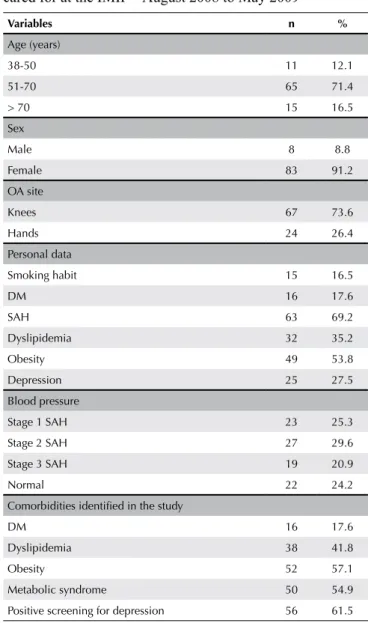
[83 (91.2%) of the female sex; mean age, 59.3 years (38-85 years)]. Table 1 shows the demographic data, frequency of anterior diseases, most frequent OA sites, and frequencies of SAH, diabetes mellitus, dyslipidemia, obesity, metabolic
syndrome, and depression identiied in this study.
We observed a higher frequency of SAH, dyslipidemia, and depressive symptoms than that initially reported by the patients. For example, only 25% of the patients reported a previous history of depression, and, when applying the Goldberg questionnaire, 56% screened positive for depression
(P = 0.003). Regarding SAH, 63% of the patients reported a
previous history, but during physical examination, SAH was
identiied in 75.8% of the patients (P = 0.000). Of the 52.6%
patients diagnosed with dyslipidemia, only 33.9% reported the
disease previously (P = 0.065). The same was not observed with
diabetes mellitus, because all patients identiied as diabetic in the study reported previous history of that disease.
The frequency of metabolic syndrome was 54.9% in that group of patients and distributed as follows: 82% in knee OA
and 18% in hand OA. No statistically signiicant difference was observed between groups (P = 0.078). Individually, 61.2% of
the patients with knee OA had metabolic syndrome.
When comparing individually the components of metabolic syndrome (SAH, dyslipidemia, obesity, increased abdominal circumference, diabetes mellitus), patients with SAH showed higher SACRAH scores, with a statistically significant
difference (P = 0.035). Regarding the other variables, no statistically signiicant difference was observed among the
VAS, Lequesne’s, and SACRAH scores.
Statistically signiicant differences were observed for the
pain scale (VAS) and SACRAH questionnaire in patients who screened positive for depression as compared with patients who
screened negative (P = 0.006 and 0.000, respectively). The
same has not occurred with the Lequesne’s index, although its mean was greater in the group with depressive symptoms.
Table 2 shows the means and standard deviations of the VAS, Lequesne’s and SACRAH scores in OA patients with and without each of the comorbidities studied.
DISCUSSION
Our results showed a high frequency of comorbidities, such as metabolic syndrome, SAH, dyslipidemia, obesity, diabetes, and depression, in the OA patients cared for at the outpatient clinic of rheumatology of the IMIP. With the increase in the life expectancy of the population, the coexistence of chronic and Table 1
Frequency of the variables studied in OA patients cared for at the IMIP – August 2008 to May 2009
Variables n %
Age (years)
38-50 11 12.1
51-70 65 71.4
> 70 15 16.5
Sex
Male 8 8.8
Female 83 91.2
OA site
Knees 67 73.6
Hands 24 26.4
Personal data
Smoking habit 15 16.5
DM 16 17.6
SAH 63 69.2
Dyslipidemia 32 35.2
Obesity 49 53.8
Depression 25 27.5
Blood pressure
Stage 1 SAH 23 25.3
Stage 2 SAH 27 29.6
Stage 3 SAH 19 20.9
Normal 22 24.2
Comorbidities identified in the study
DM 16 17.6
Dyslipidemia 38 41.8
Obesity 52 57.1
Metabolic syndrome 50 54.9
Positive screening for depression 56 61.5
degenerative diseases is becoming more and more frequent, increasing the impact on the health and quality of life of the population.
Possible explications for the relation between OA and those comorbidities include shared etiology and physiopathology or the result of the aging biological process, in which different events occur more frequently (cartilage degeneration, increased insulin resistance, weight gain, dyslipidemia), and, thus, can appear simultaneously, even if not interrelated.23 Perhaps, more
important than identifying the cause leading to the simultaneity
of those diseases is deining to what extent they can inluence
the health status of OA patients. Previous studies have shown that comorbidities, such as visual disorders, diabetes, and cardiovascular disease not only occur more frequently than expected in OA patients,23 but also result in greater physical
function impairment10 and adverse results for patients
undergoing arthroplasty.24
To the extent of our knowledge, in Brazil, there are no previous studies on the frequency of the comorbidities in OA patients. For the sake of comparison, we looked for studies assessing the presence of those comorbidities in individuals without OA and observed that the frequency in our sample was higher than that found in patients without the disease.25-7
The estimated prevalence of SAH in the Brazilian population is approximately 30%.25 Sighn et al.,4 in the United
States, in a study interviewing 115.9 million people, reported a 21% frequency of OA patients, of whom 40% had SAH, whose frequency in the general North-American population is 25%. In our sample, the frequency of SAH was much higher, reaching 75.8%, for all hypertension classes. That discrepancy can be explained by the cultural differences of our population that resists adhering to treatment, in addition
to the dificulties in having access to appropriate follow-up
and medication, which is often not made available for free in the public health system. In addition, of the OA therapeutic
options, undoubtedly non-steroidal anti-inlammatory drugs
(NSAIDs) are the most commonly used. They are known to be able to cause elevations in blood pressure levels, mainly in patients treated with angiotensin-converting enzyme (ACE) inhibitors and beta-blockers.28
Clinical and epidemiological studies have shown the coexistence of obesity and hand and knee OA. Several clinical conditions associated with obesity and sedentary lifestyle, such as SAH and type II diabetes mellitus, are also frequently found
in OA patients. The presence of OA is signiicantly increased in
overweight individuals and can be associated with the trauma caused by the body mass excess on joints that bear load, such as the hips and knees.29 However, the increased OA frequency in
joints that do not bear load has suggested that a component of the overweight syndrome can alter the metabolism of cartilage and subchondral bone, regardless of the load.7 Rojas-Rodriguez et al.8 have studied the role of the pathogenesis of obesity
in inducing OA. The metabolic alterations in the striated muscle induced by the interaction of insulin resistance and
systemic inlammation in obese individuals with metabolic syndrome would lead to OA as a inal consequence. In England,
Kadam et al.11 have concluded that the non-musculoskeletal Table 2
Mean and standard deviation of the physical function and pain scales in OA patients cared for at the IMIP – August 2008 to May 2009, according to the presence or absence of comorbidities
SAH
Yes (Mean) No (Mean) P value
VAS (cm) 7.7 7.55 0.825**
Lequesne 12.44 10.92 0.374*
SACRAH 6.24 3.95 0.035*
Diabetes mellitus
Yes (Mean) No (Mean) P value
VAS (cm) 8.19 7.55 0.325**
Lequesne 12.73 12.00 0.670*
SACRAH 6.17 5.31 0.607*
Dyslipidemia
Yes (Mean) No (Mean) P value
VAS (cm) 8.00 7.42 0.475**
Lequesne 12.74 11.76 0.520*
SACRAH 5.34 5.45 0.923*
Metabolic syndrome
Yes (Mean) No (Mean) P value
VAS (cm) 7.9 ± 2.603 7.4 ± 2.607 0.307**
Lequesne 12.0 ± 5.828 12.4 ± 4.980 0.758*
SACRAH 5.8 ± 2.340 5.2 ± 2.884 0.599*
BMI
Normal (Mean)
Overweight (Mean)
Obesity (Mean)
P value
VAS (cm) 6.46 7.15 8.21 0.239#
Lequesne 8.30 11.20 12.98 0.130*
SACRAH 4.89 4.86 6.75 0.224*
Positive screening for depression
Yes (Mean) No (Mean) P value
VAS (cm) 8.3 ± 1.929 6.6 ± 3.146 0.006**
Lequesne 13.1 ± 5.652 10.8 ± 4.993 0.092*
SACRAH 6.7 ± 1.752 2.6 ± 1.963 < 0.001*
comorbidity most commonly associated with OA is obesity. In our sample, the minority of patients had adequate weight, and the association of OA and diabetes mellitus was also high. In our study, the percentage of patients with dyslipidemia was 40.9%, also higher than those reported in studies performed in other countries, emphasizing the importance of assessing the components of the metabolic syndrome in patients with OA. Singh et al.4 have reported a 32% prevalence of dyslipidemia
in OA patients when assessing only total cholesterol. Another study in Germany has concluded that high serum levels of cholesterol are independent systemic risk factors for OA.30
Individuals with persistent pain have a greater tendency
to have disorders such as anxiety and depression (classiied
according to the CID-10 criteria) than individuals without pain.30 Kadam et al.11 have reported an association between
depression and OA, confirmed in our study, showing a high frequency of patients reporting being diagnosed with depression, and an even greater number of patients meeting the criteria for depressive symptoms.
Regarding the impact of the coexistence of those diseases on OA patients, we observed that SAH and the depressive symptoms lead to greater pain perception in patients with hand OA. In addition, patients screeningpositive for depression had
a more impaired hand function, with a statistically signiicant
difference.
Despite the lack of statistically significant difference between the other variables studied regarding the functional
tests (Lequesne’s and SACRAH) and VAS, a tendency towards a worse score is observed in the group with each of the diseases, as shown in Table 2.
Kadam and Croft,11 in a study with OA patients over the
age of 50 years in England, have shown that the presence of comorbidities increases the possibility of physical function
impairment, and that the inluence of their combination is
higher than that expected for OA or comorbidities isolated.
CONCLUSION
The frequency of comorbidities in OA patients is very high, mainly SAH, diabetes mellitus, obesity, dyslipidemia, metabolic syndrome, and depression. The recognition of such associations by the internist and rheumatologist is extremely important. Those associations can jeopardize the result of the OA treatment due to the interaction of such comorbidities with the chronic pain symptomatology. In addition, OA therapy can cause complications and aggravation of those diseases. The routine follow-up of OA patients should include periodic measurements of BP, lipid profile, and fasting glycemia, in addition to instructions about weight control
and identiication of depressive symptoms, which can be