Journal of Computer Science 3 (11): 860-862, 2007 ISSN 1549-3636
© 2007 Science Publications
860
Handover Outage Time Optimization in Heterogeneous Networks
S. Louvros
Department of Telecommunications Systems and Networks,
Technological Educational Institution of Messologi, Hellas
Abstract: Handover is a very critical parameter in Cellular Networks. The outage handover time is a drawback for Quality of Service in wireless voice applications and heterogeneous cellular wireless networks. Apart from existing handover technique, a novel approach has been developed known as Network Assisted Handover improving the outage handover time and the fluctuations of data throughput.
Key words: Network assisted handover, mobile terminal, handover outage time, heterogeneous networks
INTRODUCTION
Intersystem hard handover in heterogeneous networks, especially towards the next generation all IP cellular solutions where transparent to the end user mobility is seriously considered. There exist two kind of intersystem handovers, horizontal handover and vertical handover. Horizontal handover occurs when the mobile terminal (MT) is handed-over from the old base station (BS) to the new BS within the same network, while vertical handover occurs when the MT is handed-over from the old BS to the new BS in a different network. WLAN-GPRS integration has been specified by the ETSI[1-3] in two general approaches, the so called loose coupling and the tight coupling. In loose coupling approach the deployment of WLAN is designed as a complementary access network to GPRS, using the subscriber GPRS databases without using the core network[3]. In this paper the loose coupling interconnection architecture is considered.
In wireless voice applications, handover is performed by the switch via the old base station and it has usually been horizontal handover. Investigation of vertical handovers for wireless data network applications has been the focus of recent studies in[4-6]. The main difference however is that in wireless data networks handover (or to be more precise cell recollection) is performed by the MT and initiated either because the received signal strength of the new BS is greater than that of the old BS, or because the Quality of Service (QoS) is degraded or for traffic reasons (load balancing in the serving and neighbouring cells). In, the authors show that the time spent the mobile terminal to detect the lost connection with the old base station comprises the majority of the time to
perform upward vertical handover. Several enhancement techniques that allowed reduction of time detection of lost connection were also investigated, like double casting of the packets from the old and new BS or bi-casting using FEC. However, the improvement on the handover latency causes waste of resources since bi-casting uses twice the resources to send the same information to the MT over the handover region. In this paper a novel approach, called Network Assisted Handover, has been proposed to be applied in handover in heterogeneous wireless networks by eliminating the handover outage time without any waste of resources. In this approach, while the MT decides about the handover, the main switch helps also the handover execution resulting in the increase of handover and decrease of outage time.
J. Computer Sci., 3 (11): 860-862, 2007
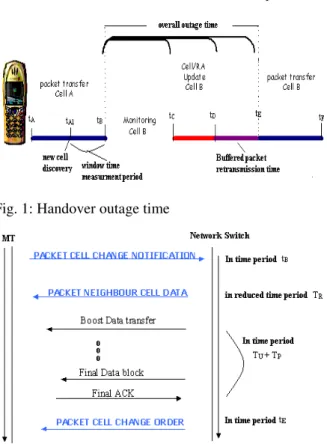
861 Fig. 1: Handover outage time
Fig. 2: Heterogeneous handover approach signalling implementation
Fig. 3: NAH reduced handover outage time
to the old core network A, containing the addresses to the old and the new cell as well as the MT identity, requesting retransmission of all buffered acknowledged packets not sent during outage time. From tE-tF period the downlink/uplink packet transfer is continued through the new path and the heterogeneous vertical handover has been executed.
Hence the overall outage handover time is Tout = TR+TU+TP Among these time delays the TR is mostly responsible for the increased outage time. TP in most of the cases is the least and TU depends on the core network architecture, a parameter to be optimised
Fig. 4: NAH approach signalling implementation
by the core engineers. In Fig. 2 the new cell heterogeneous handover signalling implementation is presented:
Novel Approach: The time handover outage can be reduced if network is involved in the handover procedure. Network Assisted Handover (NAH) is a feature that allows the network switch, controlling the cell, to assist the heterogeneous handover while in packet data transfer mode. This significantly reduces the service handover outage time for a MT supporting NAH down to 0.3 seconds in packet transfer mode while performing a loose architecture intra-switch heterogeneous handover. The improvement is possible as the MT immediately performs access in the new cell after a cell reselection and enter packet transfer mode without waiting to acquire the complete set of system information in TR time period. The network will assist the MT before, during and after the cell change. When the MT indicates it has decided to make a cell reselection while in packet transfer mode (time period tA1-tB), the new core switch sends the minimum required system information for the new cell (before the cell change) so that packet transfer can be established in the new cell immediately, thus reducing time period TR. While in the new cell, after new packet transfer establishment, during time TU+TP the network B sends the remaining set of system information to the MT. In Fig. 3 the new approach is explained.
It is important to understand that the NAH approach does not control the MS's choice of new cell but only assists the MT once it has chosen what cell to go to. In Fig. 4 the new signalling implementation of the NAH approach is presented
CONCLUSIONS
J. Computer Sci., 3 (11): 860-862, 2007
862
Table 1: The result of the overall WLAN>GPRS and GPRS>WLAN handover
handover GPRS->WLAN Handover WLAN->GPRS Handover
times --- ---
in msec 1st 2nd 3rd 4rth mean 1st 2nd 3rd 4rth mean
tu 310 789 429 553 520.25 838 659 749 696 735.5
tc 1998 2567 2210 2373 2287 3210 3452 3927 3734 3580.75
th 2308 3356 2639 2926 2807.25 4048 4111 4676 4430 4316.25
was supposed to start a session with the WLAN network, downloading a compressed file of 100 Mbytes from a local laboratory web server connected to the emulated GPRS router, hence all traffic was forced to pass though the emulator. After a few seconds the mobile terminal was forced to execute a vertical handover to GPRS sub-network by manually attenuating the AP’s power with a Faraday shield (a metal box covering the AP’s antenna). After a few more seconds, that the GPRS session was active downloading data TBF’s, the mobile terminal executed again hard handover to the WLAN network by manually removing the Faraday shield. This procedure simulated actually the mobility of subscribers from Hot Spots areas to GPRS areas and vice versa and it was repeated several times in order to have statistical means of the time lags and the total hard handover time. During these transitions WLAN->GPRS->WLAN the TCP traffic was monitored by the GPRS emulator through the GPRS router in Fig. 1. The transmitted TCP Kbytes were decreased during hard handovers and increased gradually up to the next handover. These gradually increments were caused due to retransmitted lost packets and queued packets during the connection time lag, as explained in next paragraph. In Table 1 the results of four such handovers are presented. From this Table it is obvious that the overall WLAN->GPRS handovers were slower than the opposite cases. However looking in more details the problem were caused mainly by the connection time. The routing update time tu was almost similar for both handover cases, indicating a similar performance of both networks with no optimization need. This result was expected since in loose coupling architecture the routing update time is dependent on the router advertisements which were sent from the core router. However the connection time tc was responsible for the worst WLAN->GPRS performance since it lasted more in the GPRS new establishments. All data packets coming from the WLAN network before the completion of connection time were stored in a GPRS deep queue buffer to be delivered later on, a case not appeared in the GPRS->WLAN handover since WLAN network has a very small queue service. Moreover all flying packets, during the stop and re-establishment of the hard handover, were not delivered properly causing
packet losses which were retransmitted after the establishment of the new link resulting into an increased connection time lag. In this preliminary study of the project these two packet retransmissions, the retransmitted lost packets and the queued packets, were indicated as the main causes for delay that had to be optimised. During the optimization procedure it was proposed that the soft handover technique could improve the connection time lag in the WLAN->GPRS handovers since the queued and retransmitted packets would be minimised by the alternative co-existing route of the soft case. This is however something to be examined in the next stages of the project, using again the same loose coupling architecture and executing the same test bed experiments.
REFERENCES
1. ETSI, requirements and Architectures for Interworking between HIPERLAN/3 and 3rd Generation cellular Systems Technical Report ETSI TR 101 957.
2. 3GPP, General Packet Radio Service (GPRS), Service description”. Technical Specification 3GPP TS 23.060 v3.12.0.
3. 3GPP, Feasibility Study on 3GPP System to WLAN Interworking, Technical Report eGPP TR 22.934 v1.2.0.
4. Sienje Technologies at: http://www.sienje.com
5. Osternamm, S., tcptrace at:
<http://jarok.cs.ohiou.edu/software/tcptrace/tcptrac e.html>
6. OPNET Technologies, OPNET Modeler.
Commercial, Information at: