Halotolerant bacteria in the São Paulo Zoo composting process and their hydrolases
and bioproducts
Lilian C.G. Oliveira
1, Patricia Locosque Ramos
1,3, Alyne Marem
1, Marcia Y. Kondo
1,
Rafael C.S. Rocha
1,4, Thiago Bertolini
1, Marghuel A.V. Silveira
2, João Batista da Cruz
3,
Suzan Pantaroto de Vasconcellos
2,3, Luiz Juliano
1,3, Debora N. Okamoto
1 1Departamento de Biofísica, Escola Paulista de Medicina, Universidade Federal de São Paulo, São Paulo, SP, Brazil.
2
Departamento de Ciências Biológicas, Universidade Federal de São Paulo, Diadema, SP, Brazil.
3
Laboratório de Microbiologia Aplicada, Fundação Parque Zoológico de São Paulo, São Paulo, SP, Brazil.
4
Koppert Biological Systems, Itapetininga, SP, Brazil.
Submitted: March 20, 2013; Approved: August 15, 2014.
Abstract
Halophilic microorganisms are able to grow in the presence of salt and are also excellent source of enzymes and biotechnological products, such as exopolysaccharides (EPSs) and polyhydroxyal-kanoates (PHAs). Salt-tolerant bacteria were screened in the Organic Composting Production Unit (OCPU) of São Paulo Zoological Park Foundation, which processes 4 ton/day of organic residues in-cluding plant matter from the Atlantic Rain Forest, animal manure and carcasses and mud from water treatment. Among the screened microorganisms, eight halotolerant bacteria grew at NaCl concentra-tions up to 4 M. These cultures were classified based on phylogenetic characteristics and comparative partial 16S rRNA gene sequence analysis as belonging to the generaStaphylococcus,Bacillusand Brevibacterium. The results of this study describe the ability of these halotolerant bacteria to produce some classes of hydrolases, namely, lipases, proteases, amylases and cellulases, and biopolymers. The strain characterized as ofBrevibacterium aviumpresented cellulase and amylase activities up to 4 M NaCl and also produced EPSs and PHAs. These results indicate the biotechnological potential of certain microorganisms recovered from the composting process, including halotolerant species, which have the ability to produce enzymes and biopolymers, offering new perspectives for environ-mental and industrial applications.
Key words:halophilic, protease, lipase, amylase, cellulase.
Introduction
The biocatalysts required in several industrial pro-cesses exhibit optimal activities at high ranges of salt con-centration, pH and temperature. Halophiles are excellent sources of such enzymes and are found in nearly all major microbial clades, including prokaryotic (Bacteria and Archaea) and eukaryotic forms; two categories have been defined: halotolerant microorganisms that are adapted in live at high salinity, and halophiles that require salinity for growth. Halotolerant species tend to live in areas of
salin-ity, such as hypersaline lakes, coastal dunes, saline deserts and salt seas (Ventosa and Nieto, 1995).
Halophilic enzymes perform the same enzyme func-tion as their non-halophilic counterparts but require 1-4 M salt concentrations for their full activity and stability. In ad-dition, these enzymes typically demonstrate a large excess of acidic amino acids compared to basic residues (Enache and Kamekura, 2010).
Proteases constitute approximately 66% of the total enzymes employed in biotechnological and commercial DOI: http://dx.doi.org/10.1590/S1517-838246220130316
Send correspondence to L. Juliano. Departamento de Biofísica, Escola Paulista de Medicina, Universidade Federal de São Paulo, Rua Três de Maio 100, 04044-020 São Paulo, SP, Brazil. E-mail: [email protected].
processes (Guptaet al., 2002), and the moderately halo-philic aerobic bacteria of generaBacillus,Pseudomonas, HalomonasandSerratiaare important sources of proteases (Ventosaet al., 1998). Amylases are extensively studied due to their potential application in the food, detergent, pa-per and pharmaceutical industries, representing approxi-mately 25% of the total enzymes in the industrial market. The extracellular production ofb-amylase by halophilic Halobacillus sp. LY9 and of two a-amylases from Chromohalobactersp. has been reported (Li and Yu, 2011; Prakashet al., 2009). Cellulases also have industrial appli-cation, including the generation of bioethanol and in the textile industry, and a halotolerant cellulase was character-ized in a soil metagenome analysis (Vogetet al., 2006). Lipolytic enzymes are of particular industrial interest, and their identification in halophilic bacteria has been reported and recently reviewed (Gomez et al., 2012). Exopoly-saccharides (EPSs) and polyhydroxyalkanoates (PHAs) are biotechnological products that were identified and pro-duced from halophilic/halotolerant microorganisms (Legat et al., 2010; Litchfield, 2012).
In this sense, the Organic Composting Production Unit (OCPU) of SPZPF is a potential source of microorgan-isms, as demonstrated by an OCPU metagenomic analysis, which revealed a diversity of biomass degradation func-tions and organisms (Martinset al., 2013). The composting process is predominantly aerobic, with organic residues be-ing degraded by microorganisms, generatbe-ing a humus-like material. In recent years, composting has attracted attention as a viable and environmentally adequate alternative for the treatment of organic waste. The initial phase of composting is thought to be the most dynamic part of the process and is characterized by a rapid increase in temperature, a large change in pH, and the degradation of simple organic com-pounds (Schlosset al., 2003). A detailed comparison of the
bacterial diversity from different composting plants revealed a large difference at both the species and strain levels (Partanenet al., 2010).
This paper reports the screening of the composting process of OCPU at SPZPF for bacteria in the presence of a range of NaCl concentrations and also the evaluation of their potential for the production hydrolases and bio-polymers. To date, the microbial diversity of this ecosys-tem has not been explored, particularly with regard to the screening of halotolerant microorganisms.
Material and Methods
Bacterial strains and isolation of DNA
Composting process
The composting process was conducted in the SPZPF OCPU in 2.5 x 2.0 x 1.6 m (lengthxwidthxheight) cells, as shown in Figure 1. The piles were formed by organic resi-dues including food, droppings and excreta, the beds of na-tive and exotic wild animals, carcasses and wood chips from gardening. The pile has decomposition phases that were considered active degradation (before aeration) and mature compost (after aeration). Pile aeration was achieved by the mechanical turning of the material after 50 to 60 days of composting. The temperature of the pile was monitored at five different points (four sides and one center). The av-erage temperature of the pile at the time of collection was 50 °C.
Microbial isolation
Compost samples (10 g) were collected from the piles and diluted in 90 mL of sterile water. Serial dilutions (-2, -4 and -6) were performed and spread on agar plates of two se-lective halophilic media: JCM nº 377 medium (10% [w/v] NaCl, 0.5% [w/v] casamino acids, 0.5% [w/v] yeast extract,
Figure 1- Partial view of the Organic Composting Production Unit (OCPU) of São Paulo Zoological Park Foundation. (A) Aerobic composting process
0.2% [w/v] KCl, 0.3% [w/v] sodium citrate, 2% [w/v] MgSO4•7H2O, 0.036% [w/v] FeCl24H2O, 0.00036% [w/v]
MnCl24H2O and 2% [w/v] agar, pH 7.2) and YPC medium
(0.5% [w/v] yeast extract, 0.1% [w/v] peptone and 0.1% [w/v] casamino acids with 60% [v/v] of salt water solution 24% [w/v] NaCl, 3% [w/v] MgCl2 6H2O, 3.5% [w/v]
MgSO4•7H2O, 0.1% [w/v] KCl, 20 mM Tris HCl pH 7.5
and 3 mM CaCl2) and incubated at 30, 37 and 42 °C. After
24 or 48 h, the colonies were selected and transferred sepa-rately to obtain purified colonies.
Screening of secreted extracellular hydrolytic activities
Enzymatic agar plate assays were performed to detect the presence of extracellular hydrolases. All media were adjusted to pH 7.3, and NaCl was added to obtain a salt con-centration in the range of 0-4 M. The composition of the media used is described below.
Determination of extracellular amylase activity
Amylolytic activity on plates was determined qualita-tively using a previously described method (Pasconet al., 2011), which was modified for halophilic microorganisms by adding NaCl in the medium. After incubation at 37 °C for 5 days, the plates were exposed to iodine crystals for 5 min to reveal the starch degradation zone that indicates amylolytic activity.
Determination of extracellular protease activity
The cultures were screened in JCM nº 377 medium and YPC medium supplemented with 1% skim milk for the determination of protein hydrolytic activity. Clear zones around the colonies after 7 days were taken as evidence of proteolytic activity.
Determination of extracellular lipase activity
Lipase production by the isolated microorganisms was evaluated in nutrient agar tributyrin medium (NAT), which consisted of 1.3% nutrient broth, 1% tributyrin and 2% agar (Ben-Gigireyet al., 2000). After incubation at 37 °C for 7 days, the hydrolytic zones around the bacterial col-onies were considered an indication of lipase production.
Determination of extracellular cellulase activity
Cellulase activity was screened on a solid medium containing carboxymethyl cellulose (CMC) (Rohbanet al., 2009). After incubation at 37 °C for 7 days, the plates were flooded with 0.1% Congo red solution. The clear zone around colonies indicated cellulolytic activity.
Screening of polyhydroxyalkanoates and exopolysaccharides
Detection of polyhydroxyalkanoate (PHA)-producing microorganisms
The isolates were evaluated in mineral medium (Schlegelet al., 1970) with 2.5 M NaCl and containing glu-cose, xylose or octanoic acid as the carbon source. Glucose is known to be a carbon source for the production of short-chain-length PHAs, whereas octanoic acid produces medium-chain-length PHAs. Sugarcane bagasse contains xylose, and its excess is a promising substrate for producing by-products, such as second-generation bioethanol and PHAs (Lopeset al., 2009). After 24 h of incubation (30 °C), the isolated strains were evaluated for their ability to grow on these carbon sources; the isolates were stained with Su-dan Black B after 72 h to verify their potential to produce PHAs.
Detection of exopolysaccharide (EPS) producers
The isolates were cultivated in Bushnell Haas Salt Medium (50 mL) containing 2.5 M NaCl with glycerol as sole the carbon source for the microbial growth. After incu-bation for 5 days at 30 °C in a rotary shaker (150 rpm), the cultures were centrifuged at 8,200 xgfor 15 min (4 °C). The emulsification index (E24) of the supernatant was evaluated according to the method described by Flecket al. (2000) using hexadecane as a hydrophobic model com-pound. The chemical composition of EPSs precipitated from the supernatant with ethanol up to 70% was dialyzed against pure water, and carbohydrates, proteins and uronic acids were quantified in the retained high molecular weight fraction, as reported (Tanasupawatet al., 2010).
Bacterial identification
Mass spectrometry
Amplification and sequencing of 16S rRNA gene fragment
DNA (30-50 ng) from each strain was incubated in a 50-mL reaction mixture containing 2 mM MgCl2, 200mM
dNTPs, 0.3 mM universal primer 27f
(5-AGAGTTGATCCTGGCTCAG-3), 0.3 mM 1525r (5-AAGGAGGTGWTCCARCC-3) and 2 U Taq DNA polymerase (Invitrogen) in the recommended buffer. Am-plification was performed in a Veriti 96 well Thermal Cycler (Applied Biosystems) with an initial temperature at 94 °C for 2 min, 30 cycles at 94 °C for 1 min, 55 °C for 1 min and 72 °C for 3 min. A final extension at 72 °C was included for 10 min. The PCR products were purified with a GFX PCR DNA and gel band purification kit (GE Healthcare), and the sequence analysis was performed us-ing a 3500 Genetic Analyzer Sequencer (Applied Bio-systems). Subsequently, 5.0mL purified PCR product was mixed with 4.0mL of BigDye v. 3.1 (Applied Biosystems) and 1.0mL sequencing primer (0.5mmol). The primers used in the sequencing reactions were 27f (Dojkaet al., 1998), 782r (5ACCAGGGTATCTAATCCTGT3) (Chun and
Goodfellow, 1995) and 1401r
(5CGGTGTGTACAAGACC C3) (Nübelet al., 1996). The sequencing program consisted of 25 cycles at 95 °C for 20 s, 50 °C for 15 s and 60 °C for 60 s. The 16S rRNA gene sequence of all the analyzed strains was compared to bacte-rial sequences deposited in GenBank. Sequences with simi-larity were retrieved, and the consensus sequences were aligned using CLUSTALW with MEGA 5.05. EzTaxon tools (http://147.47.212.35:8080/) were further employed to confirm the similarities, and phylogenetic trees were constructed based on neighbor-joining, maximum-likelihood and maximum-parsimony methods. The result-ing tree topologies were evaluated by a bootstrap analysis based on 1000 replicates.
Nucleotide sequence accession numbers
The sequenced strains SR5-6, SR5-7, SR5-12, YPC-6, YPC-8, YPC-11, YPC-13 and YPC-15 were de-posited in GenBank under accession numbers JX154082, JX154083, JX154084, JX154085, JX154086, JX154087, JX154088 and JX154089, respectively.
Results and Discussion
Identification of halophilic strains
The isolated bacteria were obtained from the com-posting process during the turning stage (60thday). Eight out of eleven halophilic isolates in 2.5 M NaCl from the composting process were subjected to a MALDI-TOF mass spectrometry analysis, which indicated that the genera of all isolates were Gram positive, which was confirmed by Gram staining. These procedures ensured and confirmed the purity of the isolates. The 16S rRNA gene sequences of eight strains (> than 1300 bp) were compared with those
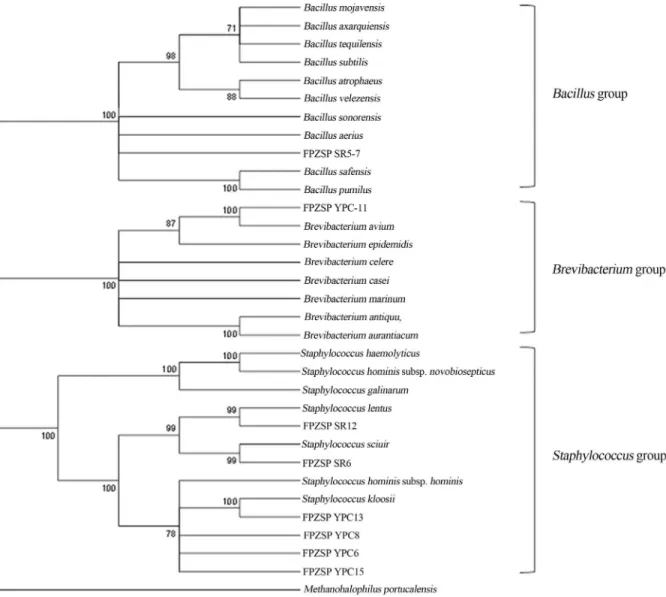
previously deposited in GenBank. The neighbor-joining and maximum-likelihood trees showed the taxonomic posi-tion of these strains, which were affiliated withBacillus, StaphylococcusandBrevibacteriumgenera (Figure 2).
Strain SR5-7 showed high 16S rRNA gene sequence similarity toBacilluswhen compared with the 184 different species of this genus. However, based on the similarity ma-trix of the 16S rRNA gene, this isolate did not show 100% similarity with any of the species already reported. The spe-cies ofBacillusdescribed as halophilic to date are as fol-lows:B. hemicentroti(Chenet al., 2011);B. humanensis (Chen et al., 2011); B. xianensis (Sanchez-Porro et al., 2003; Schlegelet al., 1970); B. alkaliphilic(Zhanget al., 2012); B. halochares (Pappa et al., 2010); B. chungangensis(Choet al., 2010) andB. subtilis(Takenaka et al., 2011). Thus, the possibility that a new species of halophilicBacilluswas isolated from a compost process is noteworthy.
The YPC-11 strain was identified asBrevibacterium avium(100% similarity). An EzTaxon analysis confirmed that this strain shared 100% 16S rRNA gene sequence simi-larity with B. avium and 99.97% with Brevibacterium epidermidis, the only halotolerant bacterium (Nagata and Wang, 2005) described in the genusBrevibacterium.
Strains SR5-12, SR5-6, YPC-6, YPC-8, YPC-13 and YPC-15 were classified as members of theStaphylococcus genus. The isolates SR5-12 and SR5-6 showed 100% 16S rRNA gene sequence similarity withS. lentusandS. sciuri, respectively, a result that was confirmed by EzTaxon. However, to date, these species have not been described as high salt concentration-tolerant bacteria, with the only spe-cies ofStaphylococcusknown as halophilic being Staphy-lococcus equorum(Essghaieret al., 2009).
All the selected isolates were deposited at the São Paulo Zoo Park Culture Collection (SPZSP-CCol).
Salt tolerance and growth of halophilic isolates
ex-tremely halotolerant if growth extends above 2.5 M. Based on this classification, seven out of the eight isolated micro-organisms isolated from composting process were halo-tolerant or extremely halohalo-tolerant. It should be noted that the salt requirement and tolerance of many species vary ac-cording to the growth conditions, such as temperature and medium composition.
Several bacteria ofBacillus,Halobacillusand Staph-ylococcushave been found in saline environments, such as Salt Plains National Wildlife Refuge, Great Salt Plains of Oklahoma, a Bolivian hypersaline lake, deep-sea sediments and tropical marine sediments (Ventosaet al., 1998). Some species ofBacillussp. are salt tolerant and are important de-graders of organic pollutants. Examples includeBacillus cereus, which degrades 1,3-dichlorobenzene derivatives from town-gas industrial influent (Wanget al., 2003), and
Bacillus subtilis, which degrades p-aminobenzene from textile industry wastewater (Zissiet al., 1997).
Hydrolytic activities of halotolerant isolates
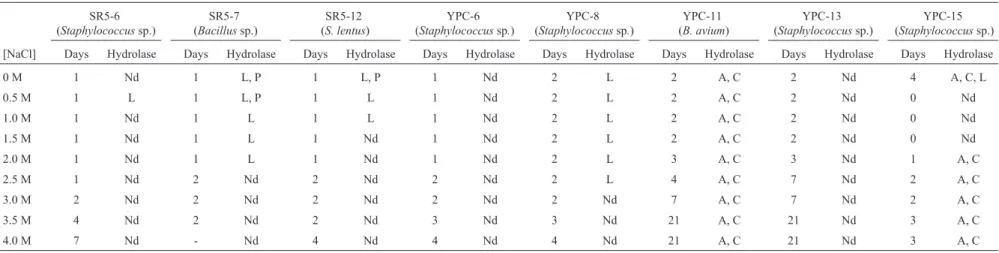
The SR5-6, SR5-7, SR5-12, YPC-8, YPC-11 and YPC-15 strains were found to be moderate halophilic mi-croorganisms and showed combined cellulolytic, amylolyt-ic, lipolytic and proteolytic activities (Table 1). These strains have potential biotechnological applications with respect to their ability to produce different hydrolases (Rohbanet al., 2009). In contrast, no hydrolytic activity was observed for YPC-6 and YPC-13.
Only YPC-11 (affiliated with B. avium) presented amylase and cellulase hydrolytic activities from 0 to 4 M NaCl. Members of the genusBacillusare well known en-zyme producers, and many industrial processes utilize spe-cies belonging to this genus for the commercial production
Figure 2- Phylogenetic tree showing the position of the halotolerant isolates, as based on a partial 16S rRNA gene sequence comparison obtained by
Oliveira
et
al.
SR5-6 (Staphylococcussp.)
SR5-7 (Bacillussp.)
SR5-12 (S. lentus)
YPC-6 (Staphylococcussp.)
YPC-8 (Staphylococcussp.)
YPC-11 (B. avium)
YPC-13 (Staphylococcussp.)
YPC-15 (Staphylococcussp.)
[NaCl] Days Hydrolase Days Hydrolase Days Hydrolase Days Hydrolase Days Hydrolase Days Hydrolase Days Hydrolase Days Hydrolase
0 M 1 Nd 1 L, P 1 L, P 1 Nd 2 L 2 A, C 2 Nd 4 A, C, L
0.5 M 1 L 1 L, P 1 L 1 Nd 2 L 2 A, C 2 Nd 0 Nd
1.0 M 1 Nd 1 L 1 L 1 Nd 2 L 2 A, C 2 Nd 0 Nd
1.5 M 1 Nd 1 L 1 Nd 1 Nd 2 L 2 A, C 2 Nd 0 Nd
2.0 M 1 Nd 1 L 1 Nd 1 Nd 2 L 3 A, C 3 Nd 1 A, C
2.5 M 1 Nd 2 Nd 2 Nd 2 Nd 2 L 4 A, C 7 Nd 2 A, C
3.0 M 2 Nd 2 Nd 2 Nd 2 Nd 2 Nd 7 A, C 7 Nd 2 A, C
3.5 M 4 Nd 2 Nd 2 Nd 3 Nd 3 Nd 21 A, C 21 Nd 3 A, C
4.0 M 7 Nd - Nd 4 Nd 4 Nd 4 Nd 21 A, C 21 Nd 3 A, C
The assays were performed as described in Material and Methods. Days: Time in days that visible growth was observed, considering zero to be the day of inoculation. (Nd): Hydrolytic activity not detected.
Table 2- Analysis of isolates for the ability to produce EPSs in mineral medium and PHAs using different carbon sources in the presence of 2.5 M NaCl.
SR-6 (Staphylococcussp.)
SR-7 (Bacillussp.)
SR-12 (S. lentus)
YPC-6 (Staphylococcussp.)
YPC-8 (Staphylococcussp.)
YPC-11 (B. avium)
YPC-13 (Staphylococcussp.)
YPC-15 (Staphylococcussp.)
EPS (E24) 58% 50% 51% 53% 50% 55% 55% 55%
PHA Nd Xylose (+) Nd Nd Nd Xylose (+) Octanoic
acid (+)
Octanoic acid (+) Glucose (+)
(E24): Emulsification indexes of the isolates in a mineral medium containing 2.5 M NaCl, as described in Materials and Methods. (+): indicates that PHAs were detected when using the indicated carbon source.
of enzymes (Vasconcelloset al., 2011). The strain SR5-7 (affiliated withBacillus) produced lipase and protease in 2.0 M and 0.5 M NaCl, respectively. It is interesting to note that the lipase producers reported thus far are limited to rep-resentatives of the generaSalinivibrio,Halomonasand Ba-cillus-Salibacillus(Sanchez-Porroet al., 2003).
Polyhydroxyalkanoate (PHA) producers
All the isolates were evaluated using a medium with nitrogen limitation and different carbon sources (Table 2). The isolates grew better with glucose as the sole carbon source compared to xylose and octanoic acid. The isolates YPC-13 (affiliated with Bacillus sp.), SR5-7 (affiliated withBacillussp.) and YPC-15 (affiliated with Staphylo-coccus sp.) accumulated PHAs in presence of octanoic acid, xylose and glucose, respectively. The genusBacillus is known as a producer of PHAs (Lopeset al., 2009), and Staphylococcus epidermidis, which was isolated from ses-ame oil, presented the ability to produce poly-3-hydroxy-butyrate (Wonget al., 2000). The strain YPC-11 (affiliated with B. avium) was detected as a potential producer of biopolymers using octanoic acid and xylose. This result is in accordance with the previous observation that Brevibacterium casei(SRKP2 strain) could produce PHAs in a medium containing dairy industrial waste, yeast extract and sea water (Pandianet al., 2009). Halotolerant microbes are important for the biotechnology industry due to their advantages for use in sterilization processes and the control of contaminants; the PHA-producing halophilic microor-ganisms have recently been reviewed (Poliet al., 2011). The production of PHAs using xylose is an alternative strat-egy to produce economically competitive PHAs using agro-industrial products such as sugarcane molasses and bagasse (Gomezet al., 2012).
EPS production and emulsification potential
Microbial exopolymers (EPSs) correspond to com-pounds produced by microorganisms to solubilize essential nutrients for their survival or to promote their adherence onto surfaces (Ron and Rosenber, 2002). The use of glyc-erol as a sole carbon source and 2.5 M NaCl resulted in EPS values up to 60% of the emulsification index (E24) of hexadecane (Table 2). A colorimetric analysis showed that the biosurfactant produced by the evaluated halotolerant strains were mainly composed of carbohydrates (95%) but also contained proteins (0.5%) and uronic acids (4.5%) in their composition. A similar EPS composition was also re-ported in halophilic Archaea strains (Poliet al., 2011).
Conclusion
Screens for halotolerant or halophilic microorgan-isms in non-saline environments are scarce as is the detec-tion of extracellular enzymes. This study found eight isolates from an organic residue composting process that showed the ability to tolerate a wide range of salinity. Some
of these strains presented combined hydrolytic ability in the presence of NaCl. The possibility of these microorganisms, particularly YPC-11 (affiliated withB. avium), to produce EPSs and PHAs in the presence of 2.5 M NaCl can offer new biotechnological and bioremediation perspectives for the treatment of oilfield wastes as well as in MEOR (micro-bial-enhanced oil recovery) processes. The performance of the halotolerant isolates in the present work were not com-pared to other already known and classic halophilic micro-organisms, and this should be performed in future work.
Acknowledgments
This study was supported by the Brazilian research agencies Fundação de Amparo a Pesquisa do Estado de São Paulo (FAPESP - 2009/52030-5) and Conselho Nacional de Desenvolvimento Científico e Tecnológico (CNPq -471340/2011-1). The authors would like to express their gratitude to Fundação Parque Zoológico de São Paulo for providing the material from its composting facility and to recognize the relevant participation and support of Mr. Robson Carlos Santos and Mr. Carlos Augusto Magalhães Batista, at Fundação Parque Zoológico de São Paulo, in the composting unit processes.
References
Ben-Gigirey B, de Sousa JMVB, Villa TGet al.(2000) Character-ization of biogenic amine-producing Stenotrophomonas maltophiliastrains isolated from white muscle of fresh and frozen albacore tuna. Int J Food Microbiol 57:19-31. Chen YG, Hao DF, Chen QHet al.(2011) Bacillus hunanensis sp
nov., a slightly halophilic bacterium isolated from non-saline forest soil. Antonie Van Leeuwenhoek Int J Genet Mol Microbiol 99:481-488.
Chen YG, Zhang YQ, He JWet al.(2011)Bacillus hemicentroti sp. nov., a moderate halophile isolated from a sea urchin. Int J Syst Evol Microbiol 61:2950-2955.
Cho SL, Jung MY, Park MHet al.(2010)Bacillus chungangensis sp. nov., a halophilic species isolated from sea sand. Int J Syst Evol Microbiol 60:1349-1352.
Chun J, Goodfellow M (1995) A phylogenetic analysis of the ge-nusNorcadiawith 16S rDNA gene sequences. Int J Syst Bacteriol 45:240-245.
Dojka MA, Hugenholtz P, Haack SKet al.(1998) Microbial di-versity in a hydrocarbon-and chlorinated-solvent-conta-minated aquifer undergoing intrinsic bioremediation. Appl Environ Microbiol 64:3869-3877.
Enache M, Kamekura M (2010) Hydrolytic enzymes of halophilic microorganisms and their economic values. Rom J Biochem 47:47-59.
Essghaier B, Fardeau ML, Cayol JLet al.(2009) Biological con-trol of grey mould in strawberry fruits by halophilic bacteria. J Appl Microbiol 106:833-846.
Fuciños P, Gonzalez R, Atanes Eet al.(2012) Lipases and esteras-es from extremophilesteras-es: overview and case example of the production and purification of an esterase from Thermus thermophilusHB27. Methods Mol Biol 861:239-266. Gomez J, Mendez B, Nikel Pet al.(2012) Making Green
mers even greener: Towards sustainable production of poly-hydroxyalkanoates from agroindustrial by-products. In: Petre, M (ed) Adv Appl Biotechnol InTech Publisher, p. 41-62.
Gupta R, Beg QK, Lorenz P (2002) Bacterial alkaline proteases: molecular approaches and industrial applications. Appl Microbiol Biotechnol 59:15-32.
Kushner DJ (1978) Life in High Salt and Solute Concentrations: Halophilic Bacteria. Academic Press, London.
Legat A, Gruber C, Zangger K et al. (2010) Identification of polyhydroxyalkanoates in Halococcus and other halo-archaeal species. Appl Microbiol Biotechnol 87:1119-1127. Li X, Yu HY (2011) Extracellular production of beta-amylase by
a halophilic isolate,Halobacillussp. LY9. J Ind Microbiol Biotechnol 38:1837-1843.
Litchfield CD (2012) Potential for industrial products from the halophilic Archaea. J Ind Microbiol Biotechnol 38:1635-1647.
Lopes MSG, Rocha RCS, Zanotto SPet al.(2009) Screening of bacteria to produce polyhydroxyalkanoates from xylose. World J Microbiol Biotechnol 25:1751-1756.
Martins LF, Antunes LP, Pascon RCet al.(2013) Metagenomic analysis of a tropical composting operation at the São Paulo zoo park reveals diversity of biomass degradation functions and organisms. PLoS One 8:e61928.
Nagata S, Wang CX (2005) Efficient utilization of ectoine by halophilic Brevibacterium species and Escherichia coli sub-jected to osmotic down shock. J Biosci Bioeng 99:61-67. Nübel U, Engelen B, Felske Aet al. (1996) Sequence
hetero-geneities of genes encoding 16S rRNAs in Paenibacillus polymyxadetected by temperature gradient gel electropho-resis. J Bacteriol 178:5636-5643.
Pandian SRK, Deepak V, Kalishwaralal Ket al.(2009) Synthesis of PHB nanoparticles from optimized medium utilizing dairy industrial waste usingBrevibacterium caseiSRKP2: A green chemistry approach. Colloids Surf. B-Biointerfaces 74:266-273.
Pappa A, Sanchez-Porro C, Lazoura P et al. (2010) Bacillus halocharessp. nov., a halophilic bacterium isolated from a solar saltern. Int J Syst Evol Microbiol 60:1432-1436. Partanen P, Hultman J, Paulin Let al.(2010) Bacterial diversity at
different stages of the composting process. BMC Microbiol 10:1-11.
Pascon RC, Bergamo RF, Spinelli RXet al.(2011) Amylolytic Microorganism from São Paulo Zoo Composting: Isolation, Identification, and Amylase Production. Enzym Res 2011:679624.
Poli A, Di Donato P, Abbamondi GRet al.(2011) Synthesis, Pro-duction, and Biotechnological Applications of Exopoly-saccharides and Polyhydroxyalkanoates by Archaea. Archaea 2011:693253.
Prakash B, Vidyasagar M, Madhukumar MSet al.(2009) Produc-tion, purificaProduc-tion, and characterization of two extremely halotolerant, thermostable, and alkali-stable alpha-amylases from Chromohalobacter sp TVSP 101. Process Biochem 44:210-215.
Rohban R, Amoozegar MA, Ventosa A (2009) Screening and iso-lation of halophilic bacteria producing extracellular hydro-lases from Howz Soltan Lake, Iran. J Ind Microbiol Bio-technol 36:333-340.
Ron EZ, Rosenberg E (2002) Biosurfactants and oil bioremedia-tion. Curr Opin Biotechnol 13:249-252.
Sanchez-Porro C, Martin S, Mellado E, Ventosa A (2003) Diver-sity of moderately halophilic bacteria producing extra-cellular hydrolytic enzymes. J Appl Microbiol 94:295-300. Schlegel HG, Lafferty R, Krauss I (1970) Isolation of mutants not
accumulating poly-beta-hydroxybutyric acid. Arch Für Mikrobiol 71:283-294.
Schloss PD, Hay AG, Wilson DBet al.(2003) Tracking temporal changes of bacterial community fingerprints during the ini-tial stages of composting. FEMS Microbiol Ecol 46:1-9. Takenaka S, Yoshida N, Yoshida Ket al.(2011) Molecular
clon-ing and sequence analysis of two distinct halotolerant extra-cellular proteases fromBacillus subtilisFP-133. Biosci Bio-technol Biochem 75:148-151.
Tanasupawat S, Chamroensaksri N, Kudo Tet al.(2010) Identifi-cation of moderately halophilic bacteria from Thai fer-mented fish (pla-ra) and proposal ofVirgibacillus siamensis sp. nov. J Gen Appl Microbiol 56:369-379.
Vasconcellos SP, Dellagnezze BM, Wieland Aet al.(2011). The potential for hydrocarbon biodegradation and production of extracellular polymeric substances by aerobic bacteria iso-lated from a Brazilian petroleum reservoir.World J Micro-biol Biotechnol 27:1513-1518.
Ventosa A, Nieto JJ (1995) Biotecnological applications and po-tentialities of halophilic microrganisms. World J Microbiol Biotechnol 11:85-94.
Ventosa A, Nieto JJ, Oren A (1998) Biology of moderately halo-philic aerobic bacteria. Microbiol Mol Biol Rev 62:504-544. Voget S, Steele HL, Streit WR (2006) Characterization of a metagenome-derived halotolerant cellulase. J Biotechnol 126:26-36.
Wang L, Zhou Q, Zhang BSet al.(2003) The biodegradation of 1,3-dichlorobenzene by an adapted strainBacillus cereus PF-11 derived from town-gas industrial effluent. J Environ Sci Health Part A 38:1837-1848.
Wong AL, Chua H, Yu pH (2000) Microbial production of poly-hydroxyalkanoates by bacteria isolated from oil wastes. Appl Biochem Biotechnol 84-86:843-857.
Zhang GM, Li SY, Xue YFet al.(2012) Effects of salts on activity of halophilic cellulase with glucomannanase activity iso-lated from alkaliphilic and halophilicBacillussp. BG-CS10. Extremophiles 16:35-43.
Zissi U, Lyberatos G, Pavlou S (1997) Biodegradation of p-aminoazobenzene byBacillus subtilisunder aerobic con-ditions. J Ind Microbiol Biotechnol 19:49-55.
Associate Editor: Cynthia Canêdo da Silva