805 805 805 805 805 Mem Inst Oswaldo Cruz, Rio de Janeiro, Vol. 92(6): 805-809, Nov./Dec. 1997
TcruziDB, an Integrated Database, and the WWW
Information Server for the
Trypanosoma cruzi
Genome Project
Wim Degrave/
+, Antonio B de Miranda, Alex Amorim, Adeílton Brandão,
Martin Aslett*, Mark Vandeyar**
Departamento de Bioquímica e Biologia Molecular, Instituto Oswaldo Cruz, Av. Brasil 4365, 21045-900 Rio de Janeiro, RJ, Brasil *European Bioinformatics Institute (EBI), Hinxston, UK **Av. Couronnement 27, 1200
Brucels, Belgium
Data analysis, presentation and distribution is of utmost importance to a genome project. A public domain software, ACeDB, has been chosen as the common basis for parasite genome databases, and a first release of TcruziDB, the Trypanosoma cruzi genome database, is available by ftp from ftp:// iris.dbbm.fiocruz.br/pub/genomedb/TcruziDB as well as versions of the software for different operating systems (ftp://iris.dbbm.fiocruz.br/pub/unixsoft/). Moreover, data originated from the project are avail-able from the WWW server at http://www.dbbm.fiocruz.br. It contains biological and parasitological data on CL Brener, its karyotype, all available T. cruzi sequences from Genbank, data on the EST-sequencing project and on available libraries, a T. cruzi codon table and a listing of activities and participating groups in the genome project, as well as meeting reports. T. cruzi discussion lists ([email protected] and [email protected]) are being maintained for communication and to promote collaboration in the genome project.
Key words: TcruziDB - genome database - Trypanosoma cruzi clone CL Brener Parasite Genome Projects -anonymous ftp - listserver
Parasite genome projects, some of which started in 1994 after the WHO/TDR sponsored Parasite Genome Network Planning Meeting at Fiocruz (Rio de Janeiro, Brazil, 14-15 April 1994), can be considered as highly successful. Scientists from developing and developed countries have planned and initiated the projects and several “consortiums” for the mapping and sequencing of these medium-sized genomes were established, often based on already ongoing North-South and South-South collaborations. Thus, the genomes of Plasmodium falciparum, Schistosoma mansoni, Trypanosoma cruzi, Leishmania major, Trypanosoma brucei, Brugia malayi, amongst others, are now under study (see http://www.ebi.ac.uk/parasites/parasite-genome.html). The main objectives for these projects are to increase drastically the knowledge
Financial support: UNDP/World Bank/WHO Special Programme for Research and Training in Tropical Dis-eases; CYTED-Subprogram of Biotechnology (Spain), CNPq, Centro Brasileiro Argentino de Biotecnologia (CBAB/CABBIO).
+Corresponding author. Fax: +55-21-590.3495. E-mail:
[email protected] Received 20 August 1997 Accepted 10 September 1997
on the (molecular) biology of these parasites, to identify new genes with key cellular functions, which could be eligible as target for new drugs or new antigens for use in diagnostics or vaccine de-velopment, and to promote technology transfer and cooperation between the different participating laboratories.
The T. cruzi genome initiative has been work-ing along these lines, and recent reviews on scien-tific progress have been published (Degrave et al. 1997, Zingales et al. 1997). More than 20 collabo-rating centers are contributing to the initiative, of which the majority are located in Latin-America, where Chagas disease is endemic. During the first two years of the project, emphasis has been laid on the structuring of the network, acquisition of adequate basic infrastructure for genome research and expertise in new techniques, construction of genomic and cDNA libraries and further charac-terization of the parasite, including its karyotype. The project has now entered into a large scale se-quencing phase, both on ESTs and selected chro-mosomes, and we can expect the generation of large quantities of new data during the next few years.
806 806 806 806
806 TcruziDB, a Database for the T. cruzi Genome Project • W Degrave et al.
next decade. Indeed, information, such as nucle-otide sequences and maps, are quite useless if it is not analyzed, processed and presented to the greater scientific community.
RESULTS AND DISCUSSION
TcruziDB, an integrated database for the T. cruzi genome project - At the WHO/NCBI Para-site Genome Computing Workshop, held at Woods Hole Marine Biological Laboratory (Sept. 14-16, 1995), it was decided that the ACeDB software, an object oriented database manager specifically developed for large-scale molecular biology, such as genome projects, would be adopted for the para-site genome projects. The ACeDB software was written initially for the Caenorhabditis elegans
project (Durbin & Thierry-Mieg 1991), but has since then been adapted for a great number of other projects (for an overview, see the ACeDB-faq at http://probe.nalusda.gov/acedbfaq.html), including several plant and parts of the human genome project. ACeDB is an object-oriented database with
tools for displaying and analyzing most of the types of objects used in molecular biology and genome projects, such as genes, antigens, genetic maps, sequences, clones, contigs, filter grids, literature data and authors, collaborating colleagues etc. The database can be adapted for the specific needs and information from a certain genome project, and data can be cross referenced where needed accord-ing to the “model”. User guides can be obtained from http://probe.nalusda.gov:8000/acedocs/. A major drawback of the ACeDB software is that it runs on either UNIX or Linux systems or on Macintosh computers, under X windows, hamper-ing its widespread use in develophamper-ing countries. The recent release of Winace, a version running on personal computers with the Win95 or WinNT operating system, should be considered as a major breakthrough.
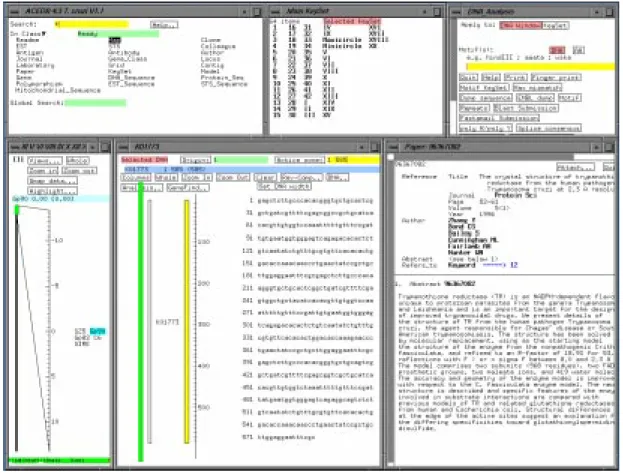
The first version of the TcruziDB v 1.1 genome database in ACeDB format (version 4.3i) was cre-ated and currently contains the following data (Fig. 1):
807 807807 807807 Mem Inst Oswaldo Cruz, Rio de Janeiro, Vol. 92(6), Nov./Dec. 1997
- T. cruzi CL Brener chromosomes (numbered I-XX and 1-42, to reflect the karyotype analyses), as well as minicircle/maxicircle molecules - Mapped loci (50 entries)
- T. cruzi sequences from GB and EMBL (279 en-tries)
- T. cruzi medline references since 1966 (3573 en-tries)
- Addresses and data on the collaborators in the T. cruzi genome initiative
- T. cruzi protein data from Swissprot.
Ace files for data entry were created through awk and modification of existing perl scripts. The “model” used for this release is similar to the one used for LeishDB, with some modifications. TcruziDB, as well as the databases from the other parasite genome projects, is available via ftp at ftp:/ /iris.dbbm.fiocruz.br/pub/genomedb/TcruziDB. ACeDB software for a variety of operating sys-tems (UNIX, Linux and also Winace) are avail-able at the same site in the directory /pub/unixsoft/. A second version of TcruziDB v2.1 will be avail-able by the time of this publication and will include updates on the sequences (650 entries), EST se-quences (1100 entries or more), medline references, protein data from Swissprot and TREMBL and on collaborators, and will also include new data on fil-ter grids for cosmid and BAC libraries, and fasta alignments. Version 2.1 has modifications in the “model”, in order to include pictures and particular
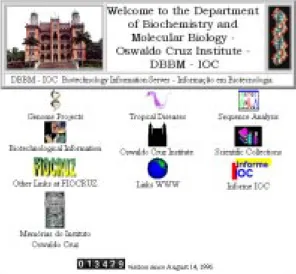
data from the T. cruzi project. Fig. 2: main page of the DBBM/IOC WWW server. The DBBM/IOC biotechnology and genome in-formation server - The WWW server of the De-partment for Biochemistry and Molecular Biology/Oswaldo Cruz Institute (http:// www.dbbm.fiocruz.br; Fig. 2) offers information and links on genome projects, on some tropical dis-eases and on general biotechnology, as well as on nucleotide and protein sequence analysis, and pro-vides some general services.
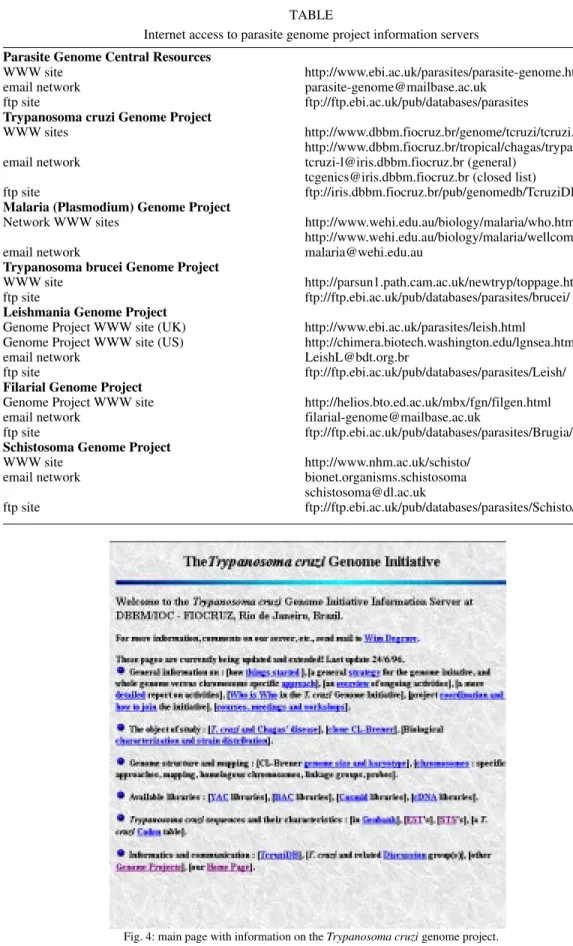
Besides offering links to all major (parasite) ge-nome projects (Fig. 3, Table), the server is the cen-tral site for the T. cruzi genome project (Fig. 4),
808 808 808 808
808 TcruziDB, a Database for the T. cruzi Genome Project • W Degrave et al.
TABLE
Internet access to parasite genome project information servers
Parasite Genome Central Resources
WWW site http://www.ebi.ac.uk/parasites/parasite-genome.html
email network [email protected]
ftp site ftp://ftp.ebi.ac.uk/pub/databases/parasites
Trypanosoma cruzi Genome Project
WWW sites http://www.dbbm.fiocruz.br/genome/tcruzi/tcruzi.html
http://www.dbbm.fiocruz.br/tropical/chagas/trypan.html
email network [email protected] (general)
[email protected] (closed list)
ftp site ftp://iris.dbbm.fiocruz.br/pub/genomedb/TcruziDB
Malaria (Plasmodium) Genome Project
Network WWW sites http://www.wehi.edu.au/biology/malaria/who.html http://www.wehi.edu.au/biology/malaria/wellcome.html
email network [email protected]
Trypanosoma brucei Genome Project
WWW site http://parsun1.path.cam.ac.uk/newtryp/toppage.htm
ftp site ftp://ftp.ebi.ac.uk/pub/databases/parasites/brucei/
Leishmania Genome Project
Genome Project WWW site (UK) http://www.ebi.ac.uk/parasites/leish.html Genome Project WWW site (US) http://chimera.biotech.washington.edu/lgnsea.htm
email network [email protected]
ftp site ftp://ftp.ebi.ac.uk/pub/databases/parasites/Leish/
Filarial Genome Project
Genome Project WWW site http://helios.bto.ed.ac.uk/mbx/fgn/filgen.html
email network [email protected]
ftp site ftp://ftp.ebi.ac.uk/pub/databases/parasites/Brugia/
Schistosoma Genome Project
WWW site http://www.nhm.ac.uk/schisto/
email network bionet.organisms.schistosoma
ftp site ftp://ftp.ebi.ac.uk/pub/databases/parasites/Schisto/
809 809809 809809 Mem Inst Oswaldo Cruz, Rio de Janeiro, Vol. 92(6), Nov./Dec. 1997
sides mirroring the sites for the project on Leish-mania and for the parasite-genome pages. The pages on the T. cruzi genome project present gen-eral information, as well as details on available li-braries, sequences, and EST data from our labora-tory, before deposit to dbEST. Data for the web pages have been gathered through personal con-tact with the participants of the genome project.
Discussion lists, related to T. cruzi - A T. cruzi
discussion list, automated through the majordomo software (subscription by sending a message “sub-scribe tcruzi-l”to majordomo@iris. dbbm.fiocruz.br; messages to [email protected]. fiocruz.br) is unmoderated and a monthly archive is made. Up to now, about 150 researchers from more than 20 countries are subscribed. The (closed) list [email protected]. fiocruz.br has been set up in
order to improve the cooperation between the par-ticipating groups in the T. cruzi genome initia-tive, and deals specifically with technical commu-nication on the genome project.
REFERENCES
Degrave W, Levin MJ, da Silveira JF 1997. Parasite ge-nome projects and the Trypanosoma cruzi genome initiative. Mem Inst Oswaldo Cruz (this volume). Durbin R, Thierry-Mieg J 1991. A C. elegans database.
Documentation, code and data available from anony-mous ftp servers at lirmm.lirmm.fr, cele.mrc-lmb.cam.ac.uk and ncbi.nlm.nih.gov.
Zingales B, Rondinelli E, Degrave W, da Silveira JF, Levin M, Le Paslier D, Modabber F, Dobrokhotov B, Swindle J, Kelly JM, Aslund L, Hoheisel JD, Ruiz AM, Cazzulo JJ, Pettersson U, Frasch AC 1997. The
810 810 810 810