exploited by the Manaus fishing fleet, Amazonas, Brazil
Batista, VS.
a* and Petrere Jr, M.
b*
aInstituto de Ciências Biológicas e da Saúde, Praça Afrânio Jorge s/n, Universidade Federal de Alagoas,
CEP 57010-020, Maceio, AL, Brazil
bDepartamento de Ecologia, Campus Rio Claro, Universidade Estadual Paulista – UNESP,
CP 199, CEP 13506-900, Rio Claro, São Paulo, Brazil *e-mail: [email protected], [email protected]
Received November 24, 2005 – Accepted April 10, 2006 – Distributed November 30, 2007 (With 2 figures)
Abstract
Fishing resources are important generators of income and food for the rural and urban people in the Amazon. The present paper investigates fishing and environmental variables determining fishing production landed in Manaus and evaluates the relative abundance of commercial fishes in the different sub-systems of the Central Amazon basin. Information collected was used to test the new catch index derived from multiple regressions with the following signif-icant variables: number of fisherman days fishing; distance of the fishing ground from Manaus; amount of ice carried during the trip; and river level. There were no significant differences between mean catch values of the Purus, Madeira and Juruá sub-systems. These results suggest that the tributaries of the right margin were very similar and were the most productive in commercial terms. The actual production varies according to the recent magnitude of fishing effort, environmental variations and operational aspects of fishing, particularly ice consumption.
Keywords: distribution, fishes, Amazon, fishing fleet, large rivers.
Distribuição espacial e temporal de recursos pesqueiros
explorados pela frota pesqueira de Manaus, Amazonas, Brasil
Resumo
Recursos pesqueiros são importantes fontes de renda e alimento para as populações rurais e urbanas na Amazônia. O presente trabalho avalia a pesca e as variáveis ambientais que determinam a produção de pescarias que desembarcam em Manaus, e avalia também a abundância relativa de recursos pesqueiros em diferentes subsistemas na Amazônia Central. A informação coletada no porto de desembarque de pescado de Manaus foi utilizada para testar um novo índice de captura obtido a partir de um modelo de covariância que apresentou as seguintes variáveis significativas: número de pescadores/dia (dias de pesca vezes número de pescadores por viagem); distância do pesqueiro até Manaus; quantidade de gelo que usou durante a viagem; e nível de rio. Não houve nenhuma diferença significativa entre valores médios de captura entre os subsistemas do Purus, Madeira e de Juruá. Estes resultados sugerem que os tributários da margem direita são similares e mais produtivos em termos comerciais. Concluiu-se que a produção corrente varia de acordo com a magnitude de esforço pesqueiro, por variações ambientais, assim como por aspectos operacionais da pesca, particularmente o consumo de gelo.
Palavras-chave: distribuição, peixes, Amazônia Central, frota pesqueira, grandes rios.
1. Introduction
The use of fishing resources in the Amazon has only been made from the experiences acquired daily from fishing and in riverine life, with the contribution of sci-entific knowledge being negligible for its sustainable development. The work carried out by Petrere in 1982, and its attendant publications (Petrere 1983a,b, 1985) are the only consistent source of information, on a macro scale, that are useful to subsidize fishing management in the area, while other studies are locally or temporally restricted. The discontinuity in the collection of
statisti-cal data since 1986 and the lack of analyses about the distribution of fishing resources in this period on a macro scale jeopardized this initial effort of evaluation, which is reassumed in the present work.
days of fishing (Petrere, 1978; Batista, 1998), is the cap-ture divisor, and the results analyzed in terms of relative abundance. The second method was through application of a linear general model, standardizing the effort with use of dummy variables for the discrete variables origi-nally presented in the model (Kleinbaum et al. 1988). In this method, continuous variables were transformed in neperian logarithms. The following statistical model was tested:
IC X X X X
X X X X X X
t
= + + - + - +
- + - + - +
m a b b
b b b
1 1 1 2 2 3 3 3 3 4 4 4 5 5 5
( ) ( )
( ) ( ) ( ) eetk (1)
where:
IC - index of capture, given by Ct;
µ- overall mean of the transformed capture index; αt - the relative abundance in year t in relation to the general average;
β1, β2, β3, β4, and β5 - regression coefficients; X1 - covariate (number of fishermen days of fishing); X2 - covariate (diesel consumption in liters); X3 - covariate (distance from the fishing ground from Manaus, in km);
X4 - covariate (amount of ice consumed, in ton); X5 - covariate (mean level of the river);
εtk - random error of the deviations, with a normal
distribution.
Two dummy variables were generated in order to designate the levels of αt, being the type (1,0) for the year 1994, (0,0) for the year 1995 and (0,1) for the year 1996.
The residuals of the final model represent the por-tion of the variance not explained by the variables of effort and environment that remained significant, and were interpreted as indicative of relative abundance. After having verified the homocedasticity of the data, these residuals were used in a simple analysis of vari-ance, with the regions as factors. Whenever significant differences were found, mean values were analyzed by the test of least significant difference (LSD), and differences were considered significant at the level of 10%.
To compare the capture indices among years, we used as a basis an index estimated for an arbitrary com-mon situation, where a value of zero was assigned to all continuous variables, and the respective values for each year were assigned to the dummy variables.
Statistical programs, with theoretical frameworks of Sokal and Rohlf (1981), Kleinbaum et al. (1988) and Tabachnick and Fidell (1996) carried out the regression and the variance/covariance analysis, as well as the pre-supposition tests of such analyses.
3. Results
Initially the above models were tested, which were developed by Petrere (1983) to predict the landings made in Manaus:
• System Solimões-Amazonas (extensive floodplain): log C = –6.0114 + 2.3409 log f like Central Amazon. Until now, such analysis was only
carried out by Petrere (1983), which produced an analy-sis that will be used here as a reference and whose model will also be tested with data from 1994 to 1996.
Thus, the objective of this work is to test a hypoth-esis about fishing and environmental variables which determine fishing production landed in Manaus and to evaluate the relative abundance of commercial fish in the different sub-systems in Central Amazon.
2. Material and Methods
Trained collectors accompanied the fishing landings in the central landing port of Manaus, located at the Feira do Panair. Based on the information gathered, the fol-lowing variables were used in this work: date of arrival; name of the boat; fishing ground; number of fishermen; days of fishing; catch per fish species; amount of fuel and lubricants used and amount of ice acquired.
The calculation of the catch effectively landed (on a weight basis) followed the procedures of Merona and Bittencourt (1988), considering that it is 10% superior to the amount declared.
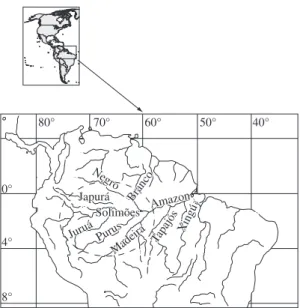
The daily level of the rivers in stations selected by region (Figure 1), were supplied by the National Agency for Water and Electric Energy (ANEEL – www.aneel. gov.br) for the whole period. However, as the lack of samples for some days could seriously bias the month-ly average, we opted for calculating mean values from the levels registered on the days 14, 15 and 16 of each month, considering lost dates from months without some of these days.
The catch per unit of effort (CPUE) was obtained by two methods: the first was by the traditional approach, where the validated unit of effort, number of fishermen
80°
0°
4°
8°
70° 60° 50° 40°
Solimões Juruá Purus
Madeira Tapajós Xingú Japurá Branco
Negro
Amazon Solimões
Juruá Purus
Madeira Tapajós Xingú Japurá Branco
Negro
Amazon
The first question appraised was the variation of the index among years, which showed a positive variation during the studied period. This variation was equal to 8.7% between 1994 and 1995, and equal to 81% between 1995 and 1996. Following that, we carried out an analy-sis of variance with the residuals, with the sub-systems as factors, whose results showed a significant difference among levels (P < 0.01).
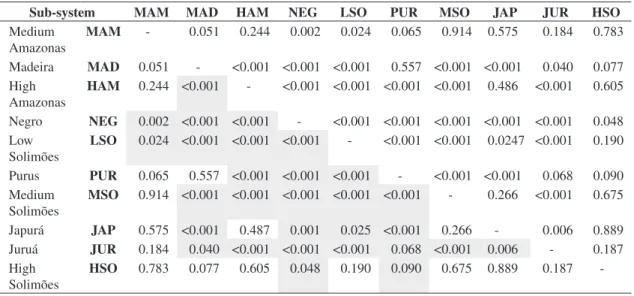
The analysis a posteriori (Table 2) showed that the Purus, Juruá and Madeira Rivers are sub-systems with higher, but quite similar, capture indexes. Middle Solimões, Japurá and Middle Amazonas form a group of sub-systems with intermediary magnitude, followed by the Low-Solimões sub-system, as well as the Negro River, which presented the smallest indices of capture.
4. Discussion
Fishing is an activity that provides an important bio-logical sampling for the whole Amazon basin. It is as-sumed that all the fishermen are trying to obtain the largest revenue and profit in all the rivers reached by the fleet, gen-erating samples comparable with each other. This feature is important to validate the analysis, allowing us to obtain a general approach of the production in the basin. Such an approach is economically unviable by means of experi-mental fishing, besides being extremely difficult to operate in such a large and diverse environment.
Fishermen in the Amazon go fishing in preferred targets and select sub-systems and fishing grounds in agreement with their beliefs about the abundance of the resource there. However, if the fishing was unsuccessful they fish on a similar target (Batista, 1998). The fishing ships generally possess several types of fishing gear, al-though production can be carried out using a single type of gear. The fishermen are enabled technically to explore a diverse and dynamic environment, using several types of gear that in turn, are used with varied techniques. Different from the fishing ships, whose movements are quite limited by the hydrodynamic and bathymetric fea-tures of the rivers, the several environments of a fish-ing area are equally accessible to the fishermen, since their operational base is the canoe. In any case, fishing occurs in accordance with the available resource in the •Maintributaries(normalfloodplain):
log C = –1.0553 + 0.2574 Z1 – 0.2536 Z2 + 1.28301 log f
being C the corrected annual capture of the river j in the year i; Z1 and Z2 are dummy variables, that indicate the group of rivers analyzed: for the Juruá and Jutaí Rivers it was (1.0), for the Negro, Branco and Purus Rivers it was (0.1) and for the Madeira River it was (0.0); f is the sum of the number of fishermen that fished every year in each river.
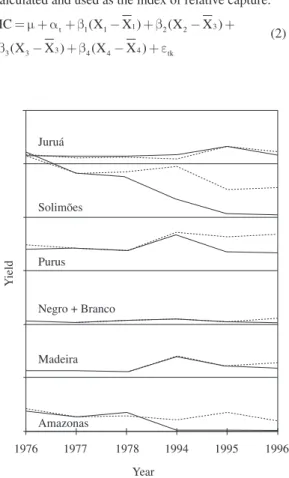
The adjustment of the model for the main tributaries showed a good fit, except for Purus in 1995 and 1996 (Figure 2), which showed several changes in the charac-teristics of the fishing in the period. Also, the model for the Solimões-Amazonas system presented predictions consistently below observed patterns.
A new capture index had its parameters selected and estimated, resulting in the following final model, which was significant (P < 0.01), with all variables displaying significant contribution at the minimum level of 0,01% (Table 1):
This model presented R = 0.377 (F 6.4664 = 469.75; p < 0.01), and the residuals showed an adequate distribu-tion. Thus, the model explained about 38% of the vari-ance between trips and the residuals for each trip were calculated and used as the index of relative capture.
IC X X X X
X X X X
t
tk
= + + - + - +
- + - +
m a b b
b b e
1 1 1 2 2 3 3 3 3 4 4 4
( ) ( )
( ) ( ) (2)
Table 1. Estimated coefficients for each variable, standard error (se) and the associated level of significance in the mod-el of the capture index.
Item Coefficient se Significance
I intercept –2.0297 0.1599 <0.0001
α2 –0.0831 0.0301 0.0058
α3 0.5094 0.0319 <0.0001
ln(dist) 0.0974 0.0170 <0.0001 ln(gelo) 0.6401 0.0258 <0.0001 ln(nvrio) 0.0556 0.0161 0.0006 ln(np*dp) 0.3518 0.0237 <0.0001
Y
ield
Juruá
Solimões
Purus
Negro + Branco
Madeira
Amazonas
1976 1977 1978 1994 1995 1996
Year
unit of effort for regional fishing (Petrere, 1978; Batista, 1998). We also used other variables that presented good adjustments (amount of ice) or not (amount of diesel) seeking to evaluate the contributions to the model. The result was coherent with the previous information, for the contribution of all the variables, except for the amount of diesel consumed, were significant for the model indicat-ing robustness in the method for these type of data.
The portion not explained by the model is within the residuals, which contains about 63% of the total observed variance in this case. The inter-annual variation in the yield per trip and the seasonal variations associated with the variation in the level of the river were successfully contemplated in the model. This last variable is an en-vironmental reference of the complex variations that are associated with the river pulse (Junk et al., 1989). This variable certainly is important due to its co-linearity with variables that directly affect fish production and fishing, but although the environmental contribution could surely be improved, it already contributed significantly to the model.
The residuals from the model could represent the rel-ative variation in the abundance of the fishing resources as a whole. More complex processes associated with ef-fort (e.g. the master’s ability in conducting the fishing process) or to the river pulse (e.g. forest area flooded each month), might be the determining part of the vari-ance contained in the residuals. However, this varivari-ance can also be regarded as being randomically distributed in space and time, so that the relative variation that is the target of our analysis was considered pertinent and viable.
In this context, the existence of a significant dif-ference among sub-systems, associated to the similar-ity of the mean values among the Purus, Madeira and Juruá sub-systems, suggests that the tributaries of the right-hand-side margin are similar and exhibit greater sub-system chosen, be it the main objective of the
fish-ing or not, and it finishes when the resources invested in the operation (e.g. ice or space in the box) are fully used or exhausted.
The contribution of the variables related to the ef-fort and to the environment should also be considered or pondered, as well as the inter-annual variation in the availability of the fishing resources. The weighing of the capture for a unit of effort is traditionally used as a form of obtaining an index of relative capture. However, the lack of linearity, the variation of catchability with abundance or the wide fraction of the variance that is not explained in the relationship between CPUE and abundance (Paloheimo and Dickie, 1964; Cooke, 1985; Shardlow, 1993), can lead to potentially misleading evaluations (Peterman and Steer, 1981; Shardlow, 1993). Since the work of Gavaris (1980), linear models have been increasingly used in order to contemplate these pre-requirements, with more information being requested, generating a demand for identifying the variables that explain most of the variance (Vignaux, 1996). This can be done through variables that are relatively easy to fol-low, such as size of the ships and information about the effort (Palsson and Durrenberger, 1982), even though such variables do not explain an acceptable or signifi-cant minimum in some fisheries (Hilborn and Ledbetter, 1985, Merona and Gascuel, 1993). Nevertheless, in all cases, the elaboration of a specific model represents a development process that is sensitive to the dynamics of the fishing activity and in the availability of informa-tion. This fact allows the obtention of an index of rela-tive capture that indicates non-biased variations in the abundance of fishing resources, which is important for its management.
In the present work, we used variables associated with effort (number of fishermen times days fishing) that were the best ones in papers that aimed to determine the
Table 2. Significance test of contrast of the capture index through the least significant difference (LSD) among the levels that form the factor sub-system. Below the diagonal, grey lines indicate cells with significant contrast (P < 0,05).
Sub-system MAM MAD HAM NEG LSO PUR MSO JAP JUR HSO
Medium Amazonas
MAM - 0.051 0.244 0.002 0.024 0.065 0.914 0.575 0.184 0.783
Madeira MAD 0.051 - <0.001 <0.001 <0.001 0.557 <0.001 <0.001 0.040 0.077 High
Amazonas
HAM 0.244 <0.001 - <0.001 <0.001 <0.001 <0.001 0.486 <0.001 0.605
Negro NEG 0.002 <0.001 <0.001 - <0.001 <0.001 <0.001 <0.001 <0.001 0.048
Low Solimões
LSO 0.024 <0.001 <0.001 <0.001 - <0.001 <0.001 0.0247 <0.001 0.190
Purus PUR 0.065 0.557 <0.001 <0.001 <0.001 - <0.001 <0.001 0.068 0.090
Medium Solimões
MSO 0.914 <0.001 <0.001 <0.001 <0.001 <0.001 - 0.266 <0.001 0.675
Japurá JAP 0.575 <0.001 0.487 0.001 0.025 <0.001 0.266 - 0.006 0.889 Juruá JUR 0.184 0.040 <0.001 <0.001 <0.001 0.068 <0.001 0.006 - 0.187
High Solimões
-the right margin as well as -the Tupinambarana island and Canumã river), is defined by the similarity of the flood-plains that occur in these sub-systems. Nevertheless, the impact of non-managed fishing can reduce capture productivity as low as the intermediary level of Medium Solimões or at the depressed level of Low Solimões, even though both sub-systems also possess extensive flood-plain areas. However, these two sub-systems showed low fishing productivity due to anthropomorphic impact, be it associated with an inadequate fishing pressure gener-ated by the disorder in the system of current fishing ex-ploration, or by degradation of the floodplain areas for extraction and agricultural activities.
This spatial variation of fishing productivity sup-ports the thesis of the importance of the floodplain in the aquatic organic production in Central Amazonia and, thus corroborates the pulse theory. On the other hand, Petrere (1983) tested a model that considered the magni-tude of the flooded area per year and the significance of the factor “lake” in the prediction of fishing production. He was not able to detect an affect neither for flooded ar-eas nor for the correlation between effort and size of the flooded area where the fishing took place; however, he found a significant effect for the variable “lake”. These results already indicated that the fishermen fished in dif-ferent lakes, independently of the size of its flooded area (Petrere, 1983); it also showed that these lakes differed in a factor different from the “flooded” area, resulting in varied fishing productivity.
Merona and Gascuel (1993) found an effect of the level of the river in previous years on the mean fishing production, in a fishing place in which the fishing effort did not affect the production significantly (The Careiro island, located about 20 km from Manaus). This result indicates that the variance of the effort does not con-tribute to prediction of the production in fishing places close to the consuming center; it also shows that rainy variation might be a powerful factor, although its effects are poorly understood. Pluviometric variations can de-termine the productivity of the system in a way associ-ated to the autochthonous contribution of organic mat-ter of the flooded forest, due to the positive relationship between the area of the forest and the amount of water it receives during the annual flooding period.
Notwithstanding this complexity, the observed spa-tial affinities seem to indicate that the sub-system is a small unit to embrace the most exploited resources in the area which, in turn, determine the magnitude of the professional fishing production. The hydrographic basin is the recommended unit of study for water resources, a choice recently recognized in the approved national politics of water resources (law 9433 of 8/01/1997) and a promising perspective for the rational use of water and its renewed resources. However, it is not advisable to turn these extremes into a dogma, because mega-basins such as the Amazonian are very diverse and complex to be subject to the same human and natural activities through time. On the other hand, the minimum size of abundance, being different from the main course of the
Solimões-Amazonas and Negro Rivers, which showed the smallest values. However, at least the first case is not linked to environmental characteristics, but with the larger exploitation by linear kilometer of the river. The riverine population also heavily uses this area for agricultural activities in the floodplain and it exhibits the highest level of inhabitation.
In the analysis of the productivity of the system, it is important to underscore two concepts. First, Vannote et al. (1980) proposed the concept of river continuum whereby morphologic and biotic characteristics of the system are related to a gradation in the availability of organic matter as the order of the rivers is increased. As far as fish populations are concerned, the concept fore-sees a transition of insectivorous predators in the rivers of smaller order for herbivore and detritivorous in the rivers of larger order. This last group usually transforms the alochthonous organic matter for incorporation to the biotic aquatic system. The second concept was proposed by Junk et al. (1989), who synthesized the interaction of the flooded forest with the main course of the riv-ers in terms of its productivity through the concept of “flood “ pulse. Accordingly to this concept, the variation in the level of the rivers and the consequent flooding of the marginal areas would be the main factor controlling the existent adaptations and the year-to-year productiv-ity observed in a system. For the fish fauna, the charac-teristics of the aquatic/terrestrial transition zone (ATTZ) are fundamental, as it defines the availability of food and habitats for youths and adults of numerous species.
Although in the specific formulation there are di-vergent aspects in the two concepts (Welcomme, 1990; Junk, 1997), basic aspects of both can be put together for evaluating the productive system, treating them as be-ing complementary in two defined contexts. The concept of fluvial continuity accepts that disturbances along the continuum determine new characteristics down river of the disturbed course. On the other hand, the impact of the flood pulse as an adaptive event would depend on the characteristics and of the dimension of the flooded area, being also determined by the duration and stabil-ity of the fluvial cycle to each pulse. This integration of the concepts is important in the present context, because the species that form most of the fish marketed in the area use the flooded areas as well as the main channel of the basin and its sub-basins along different moments of its life history (Batista, 1998). However, the differ-ent sub-systems could presdiffer-ent limnological particulari-ties that can individualize them in terms of productivity (Sioli,1984; Junk, 1997).
MERONA, B. and BITTENCOURT, MM., 1988. A pesca na Amazônia através dos desembarques no mercado de Manaus: Resultados preliminares. Mem. Soc. Cienc. Nat. La Salle, vol. 48, supl. 2, 433-453.
MERONA, B. and GASCUEL, D., 1993. Effects of flood regime and fishing effort on the overall abundance of an exploited fish community in the Amazon floodplain. Aquatic Living Resources, vol. 6, no. 1, p. 97-108.
PALOHEIMO, JE. and DICKIE, LM., 1964. Abundance and fishing success. Rapp. P.-C. Reun. Cons. Perm. Int. Explor. Mer vol. 155, no. 28, p. 152-163.
PALSSON, G. and DURRENBERGER, P., 1982. To dream of fish: the causes of Icelandic skippers fishing success. J. Anthropol. Res., vol. 38, no. 2, p. 227-242.
PETERMAN, RM. and STEER, GJ., 1981. Relation between sport-fishing catchability coefficients and salmon abundance. Trans. Am. Fish. Soc., vol. 110, no. 5, p. 585-593.
PETRERE, Jr., M., 1978. Pesca e esforço de pesca no estado do Amazonas. I - Esforço e captura por unidade de esforço. Acta Amazonica, vol. 8, no. 3, p. 439-454.
-, 1982. Ecology of the fisheries in the river Amazon and its tributaries in the Amazonas state (Brazil). (Ph. D. thesis) – University of East Anglia. 96p.
-, 1983a. Relations among catches, fishing effort and river morphology for eight rivers in Amazonas State (Brazil), during 1976-1978. Amazoniana, vol. 8, no. 2, p. 281-296.
-, 1983b. Yield per recruit of the tambaqui, Colossoma macropomum Cuvier, in the Amazonas State, Brazil. J Fish Biol., vol. 22, no. 2, p. 133-144.
-, 1985. A pesca comercial no rio Solimões-Amazonas e seus afluentes: análise dos informes do pescado desembarcado no Mercado Municipal de Manaus (1976-1978). Ciênc. Cult. vol. 37, no. 12, p. 1987-1999.
SHARDLOW, TF., 1993. Components analysis of a density-dependent catchability coefficient in a salmon hook and line fishery. Can. J. Fish. Aquat. Sci., vol. 50, p. 513-520.
SIOLI, H., 1984. The Amazon and its main affluents: Hydrography, morphology of the river courses, and river types. In SIOLI, H. (ed.) The Amazon: limnology and landscape ecology of a mighty tropical river and its basin. The Hague, W. Junk Publications, Netherlands, p. 127-166.
SOKAL, RR. and ROHLF, FJ., 1981. Biometry. The principles and practice of statistics in biological research. W.H. Freeman and Company, New York, 859p.
TABACHNICK, BG. and FIDELL, LS., 1996. Using multivariate statistics. HarperCollins College Publishers Inc., New York, 880p.
VANNOTE, RL., MINSHALL, GW., CUMMINS, KW., SEDELL, JR. and CUSHING, CE., 1980. The river continuum concept. Can. J. Fish. Aquat. Sci. vol. 37, p. 130-137. VIGNAUX, M., 1996. Analysis of vessel movements and strategies using commercial catch and effort data from the New Zealand hoki fishery. Can. J. Fish. Aquat. Sci. vol. 53 no. 9, p. 2126-2136.
WELCOMME, RL., 1990. Status of fisheries in South American rivers. Interciencia, vol. 15, no. 6, p. 337-345. the aquatic bodies for management purposes would not
correspond to a great tributary or section of a large river, since the biological interactions in a dynamic system seem to determine density gradients, but on a much larg-er scale. The dimension of the managed area clarg-ertainly will have to be defined by means of a global evaluation of the unit of use and of resource cycling. To do so, it is necessary to carry out management in an adaptive form, case-by-case, trying to learn with the results of the im-plemented actions or simply from the natural variations that arise.
Obviously there is little information to determine definitive patterns, being rare the opportunity to find in-formation about spatial-temporal variations on aquatic resources in the Amazonian waters with a minimum of methodological standardization, which allows us to have a general overview of the system. It is recommended that the evaluation be maintained in the area under the form of environmental and fishing monitoring, which should lead to more consistent strategies for the maintenance of sustainable development of fishing in the area.
Acknowledgments — This research was carried out at the Federal University of Amazonas and supported by the Conselho Nacional de Desenvolvimento Científico e Tecnológico, Superintendência para o Desenvolvimento da Amazônia, Fundação Banco do Brasil e Fundo Nacional do Meio Ambiente. The research described in this article formed part of V.S.B.´s doctoral thesis at the INPA/FUA (www.inpa.gov.br).
References
ARAUJO-LIMA, CARM, AGOSTINHO, AA. and FABRÉ, NN., 1995. Trophic aspects of fish communities in Brazilian rivers and reservoirs.. In TUNDISI, JG., BICUDO, CEM., TUNDISI, TM. (eds.) Limnology in Brazil. ABC/SBL, São Paulo p. 105-136
BATISTA, VS., 1998. Distribuição, dinâmica da pesca e dos recursos pesqueiros na Amazônia Central. Unpublished doctoral thesis, INPA/FUA, 291p.
COOKE, JG., 1985. On the relationship between catch per unit effort and whale abundance. Report of the International Whaling Commission, vol. 35, p. 511-519.
GAVARIS, S., 1980. Use of a multiplicative model to estimate catch rate and effort from commercial data. Can. J. Fish. Aquat. Sci. vol. 37, p. 2272-2275.
HILBORN, R. and LEDBETTER, M., 1985. Determinants of catching power in the British Columbia salmon purse-seine fleet. Can. J. Fish. Aquat. Sci. vol. 42, p. 51-56.
JUNK, WJ., 1997. The Central Amazon Floodplain: Ecology of a pulsing system. Ecological Studies, Springer-Verlag. Berlin, p. 126, 525p.
JUNK, WJ, BAYLEY, PB. and SPARKS, RE., 1989. The flood pulse concept in river-floodplain systems. Can. J. Fish. Aquat. Sci. Special Publication, vol. 106, p. 110-127.