491 Braz. J. Biol., 69(2, Suppl.): 491-500, 2009
An intuitive premise for ecological modeling is that interacting abiotic variables create environmental gradi-ents that shape the spatial patterns of natural populations. In general, phytoplankton is the major source of pelagic carbon, and its abundance can be estimated through chlorophyll-a concentration. The relationship between nutrients and chlorophyll-a concentration in aquatic sys-tems has yielded insights on nutrient limitation and is a valuable management tool (Peters, 1986).
Regression and correlation analysis are widely used in water quality management as supplementary tools for
Modeling chlorophyll-
a
and dissolved oxygen concentration in
tropical floodplain lakes (Paraná River, Brazil)
Rocha, RRA., Thomaz, SM.*, Carvalho, P. and Gomes, LC.
Núcleo de Pesquisas em Limnologia Ictiologia e Aqüicultura, Universidade Estadual de Maringá – UEM, Av. Colombo, 5790, CEP 87020-900, Maringá, PR, Brasil
*e-mail: [email protected]
Received November 10, 2008 – Accepted March 7, 2009 – Distributed June 30, 2009 (With 3 figures)
Abstract
The need for prediction is widely recognized in limnology. In this study, data from 25 lakes of the Upper Paraná River floodplain were used to build models to predict chlorophyll-a and dissolved oxygen concentrations. Akaike’s information criterion (AIC) was used as a criterion for model selection. Models were validated with independent data obtained in the same lakes in 2001. Predictor variables that significantly explained chlorophyll-a concentration were pH, electrical conductivity, total seston (positive correlation) and nitrate (negative correlation). This model explained 52% of chlorophyll variability. Variables that significantly explained dissolved oxygen concentration were pH, lake area and nitrate (all positive correlations); water temperature and electrical conductivity were negatively correlated with oxygen. This model explained 54% of oxygen variability. Validation with independent data showed that both models had the potential to predict algal biomass and dissolved oxygen concentration in these lakes. These findings suggest that multiple regression models are valuable and practical tools for understanding the dynamics of ecosystems and that predictive limnology may still be considered a powerful approach in aquatic ecology.
Keywords: model, chlorophyll-a, oxygen, floodplain lakes.
Predição das concentrações de clorofila-
a
e oxigênio dissolvido
em lagoas da planície de inundação do Alto Rio Paraná
Resumo
O objetivo desse estudo foi o de construir modelos para predizer as concentrações de clorofila-a e oxigênio dissolvido em lagoas da planície de inundação do Alto Rio Paraná. Para tanto, foram selecionadas 25 lagoas na planície de inun-dação. O critério de Akaike (AIC) foi utilizado para a seleção dos modelos. Posteriormente, os modelos foram vali-dados utilizando vali-dados independentes obtidos nas mesmas lagoas. As variáveis que explicaram significativamente as concentrações de clorofila-a (52%) foram pH, condutividade elétrica, material em suspensão (relação positiva) e nitra-to (relação negativa). As variáveis que melhor explicaram as concentrações de oxigênio dissolvido (54%) foram pH, área das lagoas, nitrato (relação positiva), temperatura da água e condutividade elétrica (relação negativa). A elevada capacidade preditiva desses modelos foi demonstrada através da utilização de dados independentes. Esses resultados demonstraram que a limnologia preditiva continua sendo uma importante área de pesquisa na ecologia aquática.
Palavras-chave: modelo, clorofila-a, oxigênio, lagoas.
1. Introduction
main tributaries. In the upper portion, the Paraná River presents a floodplain (5-20 km wide), which represents the last undammed stretch within Brazil. Three conser-vation units were recently created in this region, which is vital for biodiversity conservation of biological diversity and ecological functioning of this large river. The Paraná and its floodplain remnant are also one of the Brazilian sites belonging to the Long Term Ecological Research Program (LTER).
The data set used includes 25 lakes located in the Upper Paraná River floodplain. These lakes belong to three different ecoregions, determined by the river that affects each most intensively: the Paraná, Baía or Ivinheima rivers (Figure 1). Some lakes are permanently connected with a river whereas others are connected only during high water periods (usually from December to March), due to overflow; however, communication through ground water is constant. Morphometric and limnological characteristics varied intensely among lakes (Thomaz et al., 2004a; Table 1).
2. Methods
Water samples were taken in different seasons (February, May, August and November 2000), about 10 cm below the surface. Sampled lakes were shallow (depth < 2 m), except during high water periods when depths reached ~4-5 m. However, vertical mixing is common in these shallow lakes and stratification in physicochemistry is rarely found (Thomaz et al., 1992; Rodrigues et al., 2002; Rocha and Thomaz, 2004). Thus, surface samples are adequate to characterize water quality.
For all 25 lakes, we obtained data for 19 morpho-metric and limnological variables: lake area (meters), water depth (meters), Secchi disc depth (meters), pH and electrical conductivity (μS.cm–1; digital portable
poten-tiometers), dissolved oxygen (mg.L–1) and temperature
(°C; digital portable YSI), turbidity (NTU; portable tur-bidimeter LaMotte) and total alkalinity (μEq.L–1; Gran
titration; Carmouze, 1994). All these variables were measured during samplings.
Sub-samples were filtered (Whatman GF/C mem-branes) and used to quantify chlorophyll-a (spectropho-tometer, after acetone extraction; Golterman et al., 1978) and total seston (mg.L–1; gravimetry) concentrations.
Total nitrogen concentrations (μg.L–1) were obtained
after oxidation of the organic and inorganic nitrogen to N-nitrate, which was reduced to N-nitrite and examined in a spectrophotometer with a Flow Injection Analysis system (Zagatto et al., 1981). Nitrate and nitrite levels (μg.L–1) were determined spectrophotometrically with a
Flow Injection Analysis System (Zagatto et al., 1981). N-ammonium concentrations (μg.L–1) were measured
spectrophotometrically according to Mackereth et al. (1978). Total phosphorus (μg.L–1), reactive phosphate
(μg.L–1) and dissolved phosphate (μg.L–1) were
deter-mined in a spectrophotometer after ascorbic acid-mo-dynamic models. These types of relationships can be
used to improve estimations of chlorophyll-a and oxy-gen concentration in tropical aquatic ecosystems (e.g., Huszar et al., 2006). For instance, the Upper Paraná River floodplain (Paraná River, Brazil) is characterized by its high heterogeneity of aquatic habitats and diversity of organisms (Agostinho and Zalewski, 1995; Agostinho et al., 2004; Aoyagui and Bonecker, 2004). However, few predictive models have been described for this sys-tem (e.g., Thomaz et al., 2001) or for other Neotropical floodplains.
Chlorophyll and oxygen are relevant parameters in tropical and sub-tropical river-floodplain systems. Phytoplankton (indexed by chlorophyll concentration) constitute an important carbon source for fish (e.g., Araújo-Lima et al., 1986; Lopes et al., 2007; Hoeinghaus et al., 2008), despite the apparent predominance of mac-rophytes in river-floodplain systems (Hoeinghaus et al., 2007). In addition, phytoplankton can develop conspicu-ously in floodplain lakes, leading to eutrophic conditions, especially during low-water periods (Carvalho et al., 2001; Rodrigues et al., 2002). Similarly, oxygen is im-portant for aquatic fauna in floodplains, where extreme seasonal fluctuations in oxygen concentration are ob-served (Thomaz et al., 1992). This gas is also considered one of the most important abiotic factors affecting fish (Crampton, 1998; Agostinho et al., 2004; 2007; Soares et al., 2006) and invertebrate distribution (Bonecker and Lansac-Tôha, 1996; De Melo et al., 2004). Decreased oxygen concentration during rising and high waters can lead to fish kills in floodplain habitats (Hamilton et al., 1997).
In this study, we used an extensive spatial (25 lakes) and temporal (4 samples per year) data set obtained in lakes of the Upper Paraná River floodplain to identify predictors or environmental forcing functions that could explain chlorophyll-a and dissolved oxygen concentra-tions. This stretch of the Paraná River and its remnant floodplain (the last stretch within Brazil) are key for maintaining the unique biological diversity of this river in the Brazilian territory, already threatened by numer-ous human impacts (e.g., flow regulation; Agostinho and Zalewski, 1995; Agostinho et al., 2004). We also tested the predictions of the models with independent data sets (validation), to evaluate the potential of these models. Finding models that represent causal relationships is fundamental to determine the most important variables linked to primary production and eutrophication (indexed by chlorophyll) and the integrity of bodies of water for wildlife (indicated by dissolved oxygen). These models represent important tools to predict the future state of the upper Paraná River floodplain, providing insight into possible management actions aimed at conservation.
1.1. Study area
The Paraná basin covers a large area of the Brazilian territory (~802,150 km2). Several dams were built
Modeling limnological variables in tropical lakes
493 Braz. J. Biol., 69(2, Suppl.): 491-500, 2009
The best models were selected using the model selec-tion approach (Burhnham and Anderson, 1998). Akaike’s Information Criterion (AIC) is a recent tool that has been widely used as a criterion for model selection in ecology, but it is rarely applied to limnological data. Basically, AIC is defined as:
AIC = - 2Ln[L(x|Mi)] + 2K (1)
where Ln[L(x|Mi)] is the log-likelihood of data x given the model Mi; K is the number of parameters in the mod-el. This measure combines the goodness of fit of a model to data and the number of estimated model parameters (complexity).
In particular, we examined ∆i, the difference between
AIC for any particular model and the minimum AIC for the best, most parsimonious model (best fit and complex-ity). As a rule of thumb, ∆i> 4-7 suggests that a model
does not have strong empirical support (Burnham and Anderson, 1998).
We validated the resulting models using independ-ent data obtained in 2001 in the same lakes. Computer software for analyses included the open-sourceR and Statistica. Due to the high number of possible models (a total of ten variables considered), only the best one (lower AIC) is presented.
lybdate reaction (Golterman et al., 1978). A Shimadzu TOC 5000 apparatus measured dissolved organic carbon (DOC; mg.L–1).
2.1. Data analysis
Before analyses, all data, except pH, were log-trans-formed to meet the assumptions of regression analysis. Multiple regression analysis was performed to obtain models that predicted chlorophyll-a and dissolved oxy-gen concentrations, taking into account the other limno-logical variables as predictor variables (see Table 1 for the list of variables).
To circumvent multicollinearity problems, strongly correlated predictors (e.g., total seston and turbidity, electrical conductivity and total alkalinity) were not in-cluded in the same model. Thus, considering the differ-ent pairs of correlated variables, only the ones with the highest predictive power were retained in the multiple regression models. After this first step, a total of ten variables were retained to model chlorophyll-a and dis-solved oxygen concentrations by different combinations of these variables as predictors: lake area (Area), tem-perature (Temp), pH, electrical conductivity (EC), total seston (TS), total phosphorus (TP), Nitrate (N-NO3), nitrite (N-NO2), N-ammonium (NH4) and dissolved or-ganic carbon (DOC).
Rocha, RRA. et al.
Br
az. J
. Biol., 69(2, Suppl.): 491-500, 2009
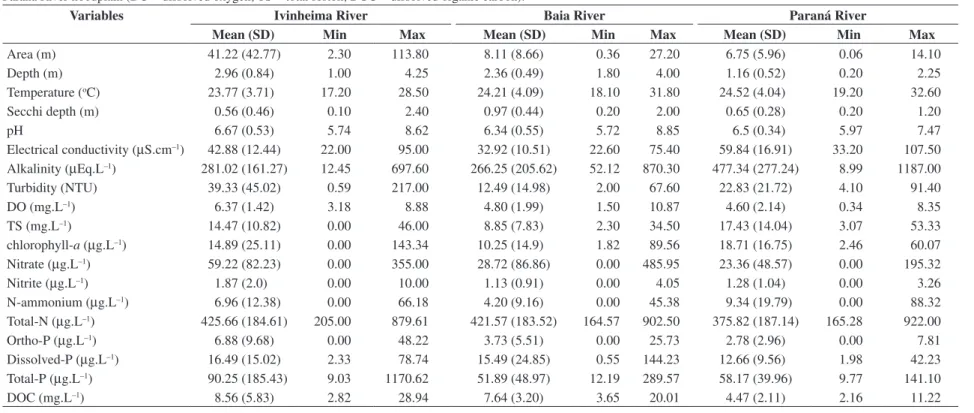
Table 1. Mean, standard deviation (SD), minimum (min) and maximum (max) values of each variable obtained in lakes connected to the rivers (Ivinhema, Baia and Paraná) in the Upper Paraná River floodplain (DO = dissolved oxygen; TS = total seston; DOC = dissolved organic carbon).
Variables Ivinheima River Baia River Paraná River
Mean (SD) Min Max Mean (SD) Min Max Mean (SD) Min Max
Area (m) 41.22 (42.77) 2.30 113.80 8.11 (8.66) 0.36 27.20 6.75 (5.96) 0.06 14.10
Depth (m) 2.96 (0.84) 1.00 4.25 2.36 (0.49) 1.80 4.00 1.16 (0.52) 0.20 2.25
Temperature (oC) 23.77 (3.71) 17.20 28.50 24.21 (4.09) 18.10 31.80 24.52 (4.04) 19.20 32.60 Secchi depth (m) 0.56 (0.46) 0.10 2.40 0.97 (0.44) 0.20 2.00 0.65 (0.28) 0.20 1.20
pH 6.67 (0.53) 5.74 8.62 6.34 (0.55) 5.72 8.85 6.5 (0.34) 5.97 7.47
Modeling limnological variables in tropical lakes
495 Braz. J. Biol., 69(2, Suppl.): 491-500, 2009
concentration in these lakes. Similarly to chlorophyll, there was no trend in residuals along the oxygen concen-tration gradient (Figure 2b). Thus, the proposed model is adequate to predict dissolved oxygen concentration in the Paraná River floodplain lakes.
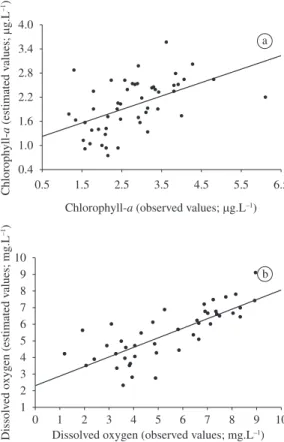
To test the predictive power of both models, we used an independent data set obtained in the same lakes in 2001. We observed a significant relationship between chloro-phyll-a concentrations estimated through the model and the chlorophyll-a concentrations measured independ-ently in 2001 (r = 0.50; p < 0.001; n = 50) (Figure 3a). A significant relationship was also observed between dissolved oxygen concentrations estimated through the model and concentrations measured independently in 2001 (r = 0.75; p < 0.001; n = 43; Figure 3b). Therefore,
3. Results
Overall, sampled lakes presented a wide range of morphometrical and limnological conditions (Table 1). Mean values of dissolved oxygen, nitrate, nitrite, total nitrogen, reactive phosphate, total phosphate and turbid-ity were higher in lakes of the Ivinheima River. Lakes of the Paraná River showed higher values of electrical conductivity, alkalinity and ammonium, whereas those of the Baía river had the highest mean Secchi depth and intermediate values for most of the remaining variables (Table 1).
Following the AIC criterion, the best, most parsi-monious model (fit and complexity), to predict chloro-phyll-a concentration was:
log (Chlor) = –3.747 + 0.422 (pH) + 0.528 log (EC) + 0.682 log (TS) – 0.191 log (N-NO3) (2)
with AIC = 198.2; ∆I = 34.1; n = 97; R² = 0.52; F = 36.89;
p < 0.001.
Predictor variables that significantly explained chlo-rophyll-a concentration were pH, electrical conductivity (EC), total seston (TS) (positive correlations) and nitrate (N-N03) (negative correlation) (Table 2).
This model explained 52% of the total variation in levels of chlorophyll-a in these lakes. Residual analysis indicated that this model was adequate for describing chlorophyll-a (Figure 2a). Therefore, this is an indica-tion that the resulting model is adequate to predict chlo-rophyll-a concentrations in the Paraná River floodplain lakes.
The best, most parsimonious model to predict dis-solved oxygen concentration was:
log (DO) = 2.92265 + 0.30255 (pH) + 0.06172 log(Area) – 0.60086 log (Temp) + 0.03999 log (N-NO3)
– 0.36633 log (EC) (3)
with AIC = 12.132; ∆I = 7.673; n = 89; R2 = 0.54;
F = 21.76; p < 0.001.
Predictor variables that significantly explained dis-solved oxygen concentration were pH, lake area (Area) and nitrate (N-NO3) (positive correlations), and water temperature (Temp) and electrical conductivity (EC) (negative correlations) (Table 3). Overall, this model ex-plained 54% of the total variation in dissolved oxygen
Table 2. Results of a multiple regression analysis of chlo-rophyll-a concentration against pH, electrical conductivity (EC), total seston (TS) and nitrate (N-NO3).
Predictor variables B t (92) p
Intercept –3.747 –3.575 0.00056
pH 0.421 3.231 0.0017
log EC 0.527 2.646 0.0095
log TS 0.682 7.584 <0.0001
log N-NO3 –0.191 –5.805 <0.0001
a
b
Figure 2. a) Relationship between residuals and estimated values of chlorophyll-a; and b) oxygen concentrations.
Table 3. Results of a multiple regression analysis of dis-solved oxygen concentration against pH, lakes area (Area), water temperature (Temp), nitrate (N-NO3) and electrical conductivity (EC).
Predictor variables B t (84) p
Intercept 2.92265 4.174 <0.001
pH 0.30255 5.672 <0.001
log Area 0.06172 2.942 0.004
log Temp –0.60086 –3.549 <0.001
log N-NO3 0.03999 3.017 0.003
temperate lakes (Peters, 1986; Kalff, 2002), although a few investigations using this approach studied tropi-cal and sub-tropitropi-cal freshwater ecosystems (Attayde and Bozelli, 1998; Huszar et al., 2006; Chellappa et al., 2008). It is well known that phytoplankton biomass, ex-pressed as chlorophyll-a concentration, is affected by nutrients, mainly phosphorus, both in temperate (e.g., Dillon and Rigler, 1974; Rigler and Peters, 1995; Van Nieuwenhuyse and Jones, 1996; Bryhn et al., 2007) and tropical and subtropical (Attayde and Bozelli, 1998; Huszar et al., 2006) freshwater ecosystems. In the Upper Paraná floodplain, phosphorus also limits microbial activity (Thomaz et al., 2001) and free-floating macro-phytes (Kobayashi et al., 2008). However, our findings suggest that only 11% of the variation in chlorophyll-a concentration was explained by phosphorus concentra-tion. The weak chlorophyll-phosphorus relationship may be explained by at least two non-mutually exclusive causes. First, previous studies of microbial organisms and macrophytes examined the short temporal period in only a few lakes, connected to the Paraná River, which presented low phosphorus concentrations (Thomaz et al., 2004a). This suggests that phosphorus may be important in some lakes, but its importance disappears when the entire floodplain is considered. Thus, by incorporating a large-spatial scale data set, including several lakes, as we did in this investigation, it is possible to add another perspective to those previous studies. Second, phospho-rus was highly correlated with turbidity (log TP-log tur-bidity: r = 0.49; p < 0.001; n = 97). Thus, phosphorus concentrations in the floodplain lakes have a temporal synchrony with water turbidity, and underwater radiation may hide the relationship between phosphorus and phy-toplankton biomass. A similar pattern has been described to explain the weak relationship between total phospho-rus and chlorophyll-a in Paraná River basin reservoirs (Pagioro et al., 2005).
In our analysis, the best predictors of chlorophyll-a concentration in Paraná floodplain lakes were pH, elec-trical conductivity, total seston and nitrate. In fact, this model had higher R2 (R2 = 0.52) than the model
gen-erated based only on total phosphorus (R2 = 0.11). In
agreement with our results, a principal component anal-ysis (PCA) demonstrated that pH, electrical conductiv-ity, total seston and nitrate are responsible for the spatial ordination of lakes (Rocha and Thomaz, 2004). This re-sult has been supported by Van Nieuwenhuyse and Jones (1996), Attayde and Bozelli (1998), and Gomes and Miranda (2001), who explain chlorophyll-a concentra-tion by physical, chemical and biological variables, such as grazing pressure induced by zooplankton.
Although the model explained substantial variabil-ity in the data set, we wondered if its application would be valuable and if the multiple regression approach is a practical tool for understanding the dynamics of chlo-rophyll-a in lakes. One of our objectives was to test the model using an independent data set (obtained in 2001). In fact, the correlation (r = 0.52) between predicted val-independent validation also indicated that both models
have potential to predict algal biomass and dissolved oxygen concentration in these lakes.
4. Discussion
The hydrological regime, together with temperature, wind and photosynthetically active radiation (PAR) are considered the main driving forces in river-floodplain systems (Junk et al., 1989; Thomaz et al., 2007). The Paraná River floodplain lakes were characterized by high variability in most of the limnological variables. At a large spatial scale, differences in the limnology of these lakes are mainly determined by the river to which they are connected, i.e., the Paraná, Baía or Ivinheima rivers (Carvalho et al., 2003; Thomaz et al., 2004a). On the other hand, lakes are also affected by local functioning forces, such as inputs from small tributaries, depth, colo-nization by aquatic macrophytes and source of organic substrate and nutrients traveling from the floodplain into the lakes (Thomaz et al., 2007). Both coarse and finer scale factors contribute to the great variety of limnologi-cal features found in this study.
In general, the great majority of empirical studies re-lating phytoplankton to nutrients use data obtained from
a
b
Modeling limnological variables in tropical lakes
497 Braz. J. Biol., 69(2, Suppl.): 491-500, 2009
oxygen within the water column. In fact, this variable explained approximately 16% of oxygen concentration variability. Empirical studies demonstrate that large lakes exposed to wind have a more uniform oxygen distribu-tion in the water column (Panosso and Kubrusly, 2000). Indeed, smaller lakes are more influenced by margins and, consequently, are subject to higher allochthonous organic matter input (edge effects). The continuous input and decomposition of allochthonous detritus, produced in the aquatic terrestrial transitional zone (ATTZ), tends to decrease the oxygen concentrations even in periods of autotrophy (Carvalho et al., 2001).
Electrical conductivity was negatively associated with oxygen concentration, but this relationship is prob-ably indirect, since this variable reflects decomposition processes. Increases in decomposition rates and decreases in oxygen usually occur during high water periods, when decomposing organic matter input to the lakes increases (Taniguchi et al., 2004; Thomaz et al., 2004a; Townsend, 2006). This process rapidly leads to a change in water quality, an increase of ions due to the leaching of detri-tus and a decrease of dissolved oxygen due to microbial respiration (Godshalk and Wetzel, 1978; Carvalho et al., 2005; Bianchini et al. 2008; Cunha-Santino et al., 2008). In addition, oxygen depletion promotes the release of ions from sediment (e.g., reactive phosphorus), increas-ing electrical conductivity. As discussed previously, pho-tosynthetic rates may increase water pH and dissolved oxygen concentration. Thus, the relationship between oxygen and pH is also an indirect effect of phytoplank-ton photosynthesis. In the Paraná River floodplain lakes, higher pH values are frequently obtained during the low water phase when chlorophyll-a and dissolved oxygen concentrations are higher (Thomaz et al., 2004a; Rocha and Thomaz, 2004). The positive relationship between nitrate and dissolved oxygen can be explained by the de-pendence of the nitrification process on oxygen supply (Wetzel, 2001).
There is a direct effect of temperature on the solu-bility of gases, in particular dissolved oxygen (Wetzel, 2001). In addition, there is a direct temperature effect on decomposition rates due to microbial activity. According to the Van T’ Hoff rule, an increase in temperature can cause a two-to three-fold increase in bacterial activity, and consequently decrease dissolved oxygen concentra-tions. The negative effect of temperature on oxygen con-centration reflected by the predictive model corroborates other studies that showed that high temperatures found in tropical and subtropical aquatic ecosystems are respon-sible for rapid detritus breakdown (Esteves and Barbieri, 1983; Carvalho et al., 2005), further enhancing oxygen depletion.
Models built to predict chlorophyll-a and dissolved oxygen concentrations in the Paraná River floodplains lakes, explained most of the variability of the data, as proven by multiple regression analysis and posteriori validation with an independent data set. Despite sig-nificant correlations between predicted and measured ues (model) and independent data demonstrated the
sub-stantial predictive power of the model.
Although it is difficult to determine cause and effect through an exploratory approach such as that used in this paper, we believe that some inferences are possible. The positive relationship between chlorophyll-a and pH, for example, can be readily explained by photosynthe-sis, since CO2 assimilation increases pH values (Wetzel, 2001). The positive relationship between electrical con-ductivity and chlorophyll-a concentration could also be a causal mechanism, since bicarbonate, which is significantly related to conductivity in the Paraná basin (Thomaz et al., 1992), can influence photosynthesis and phytoplankton biomass. Sediment resuspension can also transfer nutrients and ions from sediment to the water, increasing the electrical conductivity (Thomaz et al., 2004a). In addition, nutrients are transported from other floodplain features to lakes during high water and rainy seasons. In general, electrical conductivity can be consid-ered a surrogate for the concentration of nutrients in the water, which directly influences phytoplankton biomass. The positive relationship between chlorophyll-a con-centration and total seston suggests that phytoplankton per se is an important component of seston in these lakes. The absorption of nitrate (NO3–) by the phytoplankton
community has been widely discussed, mainly with re-gard to daylight conditions (Thomaz et al., 2004a). The negative relationship between nitrate and chlorophyll corroborates this idea, and suggests that, in fact, phy-toplankton significantly affects nitrate. This variable is considered an important determinant of phytoplankton biomass in some lakes of the Upper Paraná floodplain (Train and Rodrigues, 2004).
Predicting dissolved oxygen concentration in flood-plain lakes is necessary, since this gas is one of the main determinants of fish and invertebrate distributions in floodplain ecosystems (e.g., Bonecker and Lansac-Tôha, 1996; De Melo et al., 2004; Crampton, 1998; Soares et al., 2006). Indeed, during high water levels, when al-lochthonous influence increases, low oxygen concentra-tion in the water column can affect aquatic biota, espe-cially fish (Hamilton et al., 1997; Crampton et al., 1998; Carvalho et al., 2001). The main sources of oxygen for the Paraná floodplain lakes are the atmosphere and algal photosynthesis, since these lakes are poorly colonized by submerged macrophytes (Thomaz et al., 2004b). The loss of this gas occurs through decomposition of organic matter (substantial in the Paraná floodplain; Pagioro and Thomaz, 1999), transfer from the water to the atmos-phere, respiration and oxidation of metal ions (e.g., iron and manganese; Wetzel, 2001). Thus, several variables may influence water oxygen in lakes.
in the Upper Paraná River: effects on assemblage attributes, reproduction and recruitment. Reviews in Fish Biology and Fisheries, vol. 14, no. 1, p. 11-19.
AGOSTINHO, AA., PELICICE, FM. and GOMES, LC., 2008. Dams and the fish fauna of the Neotropical region: impacts and management related to diversity and fisheries. Revista Brasileira de Biologia = Brazilian Journal of Biology, vol. 68, no. 4, p. 1119-1132.
AGOSTINHO, AA., PELICICE, FM., PETRY, AC., GOMES, LC. and JÚLIO Jr., HF., 2007. Fish diversity in the upper Paraná River basin: habitats, fisheries, management and conservation. Aquatic Ecosystem Health & Management, vol. 10, no. 2, p. 174-186.
AOYAGUI, ASM. and BONECKER, CC., 2004. Rotifers in different environments of the upper Paraná River floodplain (Brazil): richness, abundance and the relationship with connectivity. Hydrobiologia, vol. 522, p. 281-290.
ARAÚJO-LIMA, CARM., FORSBERG, BR., VICTORIA, R. and MARTINELLI, L., 1986. Energy-sources for detritivorous fishes in the Amazon. Science, vol. 234, no. 4781, p. 1256-1258.
ATTAYDE, JL. and BOZELLI, RL., 1998. Environmental heterogeneity patterns and predictive models of chlorophyll a in a Brazilian coastal lagoon. Hydrobiologia, vol.390, no. 1-3, p. 129-139.
BIANCHINI JR., I., CUNHA-SANTINO, MB. and PERET, AM., 2008. Oxygen demand during mineralization of aquatic macrophytes from an oxbow lake. Revista Brasileira de Biologia = Brazilian Journal of Biology, vol. 68, no. 1, p. 61-67.
BONECKER, CC. and LANSAC-TÔHA, FA., 1996. Community structure of rotifers in two environments of the upper River Paraná floodplain (MS) – Brazil. Hydrobiologia, vol. 325, no. 2, p. 137-150.
BRYHN, AC., HESSEN, DO. and BLENCKNER, T., 2007. Predicting particulate pools of nitrogen, phosphorus and organic carbon in lakes. Aquatic Sciences, vol. 69, no. 4, p. 484-494. BURNHAM, KP. and ANDERSON, DR., 1998. Model selection and inference: a practical information-theoretic approach. New York: Springer-Verlag. 353p.
CARMOUZE, JP., 1994. O metabolismo dos ecossistemas aquáticos: fundamentos teóricos, métodos de estudo e análises químicas. São Paulo: Edgard Blücher; Fapesp. 254p.
CARVALHO, P., BINI, LM., THOMAZ, SM., OLIVEIRA, LG., ROBERTSON, B., TAVECHIO, WLG. and DARWISCH, AJ., 2001. Comparative limnology of South American floodplain lakes and lagoons. Acta Scientiarum, vol. 23, no. 2, p. 265-273. CARVALHO, P., THOMAZ, SM. and BINI, LM., 2003. Effects of water level, abiotic and biotic factors on bacterioplankton abundance in lagoons of a tropical floodplain (Paraná River, Brazil). Hydrobiologia, vol.510, no. 1-3, p. 67-74.
______, 2005. Effects of temperature on decomposition of a potential nuisance species: the submerged aquatic macrophyte Egeria najas Planchon (Hydrocharitaceae). Revista Brasileira de Biologia = Brazilian Journal of Biology, vol. 65, no. 1, p. 767-770.
CHELLAPPA, NT., BORBA, JM. and ROCHA, O., 2008. Phytoplankton community and physical-chemical characteristics concentrations of chlorophyll-a and dissolved oxygen,
48% of the total variability of the former and 46% of variability in the latter remained unexplained by the pro-posed models. Therefore, this type of model may be use-ful for estimating both variables, but application of these models should be conducted with great caution. Other possible factors not considered in our models but that could contribute to explain chlorophyll-a concentrations in these lakes are herbivory, difference in chlorophyll-a concentration between algal populations (Attayde and Bozelli, 1998), water turbulence and sedimentation of algal cells adsorbed with clay. Similarly, other potential variables explaining oxygen are water column mixing, concentration of metals and bacterial densities.
In conclusion, these findings suggest that predictive limnology may be considered a powerful approach in aquatic ecology, even considering the unexplained vari-ability found in these models. Multiple regression mod-els can be valuable and practical tools for understanding the dynamics of ecosystems if these models meet cer-tain requirements such as simplicity, general applicabil-ity and validapplicabil-ity. We believe that our models meet these requirements and could be used to study other tropical floodplain lakes. The models proposed here are also a valuable tool to predict future trends with regard to chlorophyll-a and oxygen concentrations in the Paraná River floodplain lakes, which are rapidly changing due to human interference (Agostinho et al., 2008). It would be difficult to propose measures related to all important variables included in our models, but at least two of them deserve attention due to indicated roles in future broad-scale floodplain management. First, it seems that nitro-gen is driving phytoplankton productivity in lakes and consequently, attempts to control eutrophication should focus first on this nutrient. Second, lake area was an im-portant predictor of oxygen concentration and thus, ef-forts to reduce fish mortality derived from anoxia (e.g., by increasing the connection between lakes and the main river channel) should focus on smaller lakes. Thus, these predictions are useful to identify patterns and also to manage ecosystem function following disturbances.
Acknowledgements –– Sidinei M. Thomaz and Luiz C. Gomes are supported by the Conselho Nacional de Desenvolvimento Científico e Tecnológico (CNPq) and by the Coordenação para Aperfeiçoamento do Ensino Superior (CAPES). Renata Ribeiro A. Rocha received a scholarship from CAPES. Priscilla Carvalho is supported by the PDTA program (Fundação Parque Tecnológico Itaipu – FPTI-BR). This paper was conducted as a part of the Long Term Ecological Research supported by CNPq (CNPq-PELD).
References
AGOSTINHO, AA. and ZALEWSKI, M., 1995. The dependence of fish community structure and dynamics on floodplain and riparian ecotone zone in the Paraná River. Hydrobiologia, vol. 303, no. 1-3, p. 141-148.
Modeling limnological variables in tropical lakes
499 Braz. J. Biol., 69(2, Suppl.): 491-500, 2009
KOBAYASHI, JT., THOMAZ, SM. and PELICICE, FM., 2008. Phosphorus as limiting factor for Eichhornia crassipes Mart (Solms.) growth in the Upper Paraná River floodplain. Wetlands, vol. 28, no. 4, p. 905-913.
LOPES, CA., BENEDITO-CECÍLIO, E. and MARTINELLE, LA., 2007. Variability in the carbon isotope signature of Prochilodus lineatus (Prochilodontidae, Characiformes) a bottom-feeding fish of the Neotropical region. Journal of Fish Biology, vol. 70, no. 6, p. 1649-1659.
MACKERETH, FYH., HERON, JG. and TALLING, JJ., 1978. Water analysis some revised methods for limnologist. Ambleside: Freshwater Biological Association, Scientific Publication. 120p.
PACE, ML., 2001. Prediction and the aquatic sciences. Canadian Journal of Fisheries and Aquatic Sciences, vol. 58, no. 1, p. 63-72.
PAGIORO, TA. and THOMAZ, SM., 1999. Influence of the decomposition of Eichhornia azurea on selected limnological variables of different environments of the floodplain of the High Paraná River. Acta Limnologica Brasiliensia, vol. 11, no. 2, p. 157-171.
PAGIORO, TA., THOMAZ, SM. and ROBERTO, MC., 2005. Caracterização limnológica abiótica dos reservatórios. In RODRIGUES, L., THOMAZ, SM., AGOSTINHO, AA. and GOMES, LC. (Eds.). Biocenoses em reservatórios: padrões espaciais e temporais. São Carlos: RiMa. p. 17-37.
PANOSSO, RF. and KUBRUSLY, L., 2000. Avaliação espacial e temporal das variáveis limnológicas básicas e nutrientes. In BOZELLI, R., ESTEVES, FA. and ROLAN, F. (Eds.). Lago Batata: impacto e recuperação de um ecossistema amazônico. Rio de Janeiro: IB-UFRJ; Sociedade Brasileira de Limnologia. p. 55-72.
PETERS, RH., 1986. The role of prediction in limnology. Limnology and Oceanography, vol. 31, no. 5, p. 1143-1159. RIGLER, FH., 1982. Recognition of the possible: an advantage of empiricism in ecology. Canadian Journal of Fisheries and Aquatic Sciences, vol. 39, no. 9, p. 1323-1331.
RIGLER, FH. and PETERS, RH., 1995. Science and Limnology. Oldendorf; Luhe: Ecological Institute. 239p.
ROCHA, RRA. and THOMAZ, SM., 2004. Variação temporal de fatores limnológicos em ambientes da planície de inundação do alto rio Paraná (PR/MS – Brasil). Acta Scientiarum, vol. 26, no. 3, p. 261-271.
RODRIGUES, LC., TRAIN, S., ROBERTO, MC. and PAGIORO, TA., 2002. Seasonal fluctuation of some limnological variables on a floodplain lake (Patos lagoon) of the Upper Parana River, Mato Grosso do Sul State, Brazil. Brazilian Archives of Biology and Technology, vol. 45, no. 4, p. 499-513.
SOARES, MGM., MENEZES, NA. and JUNK, WJ., 2006. Adaptations of fish species to oxygen depletion in a central Amazonian floodplain lake. Hydrobiologia, vol. 568, no. 1, p. 353-367.
TANIGUCHI, GA., BICUDO, DD. and SENNA, PAC., 2004. Abiotic variables in littoral-limnetic gradient of an Oxbow lake of Mogi-Guacu River floodplain, southeastern, Brazil. Brazilian Archives of Biology and Technology, vol. 47, no. 5, p. 961-971. of water in the public reservoir of Cruzeta, RN, Brazil. Revista
Brasileira de Biologia = Brazilian Journal of Biology, vol. 68, no. 3, p. 477-494.
CRAMPTON, WGR., 1998. Effects of anoxia on the distribution, respiratory strategies and electric signal diversity of gymnotiform fishes. Journal of Fish Biology, vol. 53, suppl. A, p. 307-330.
CUNHA-SANTINO, MB., GOUVÊA, SP., BIANCHINI Jr., I. and VIEIRA, AAH., 2008. Oxygen uptake during mineralization of photosynthesized carbon from phytoplankton of the Barra Bonita Reservoir: a mesocosm study. Revista Brasileira de Biologia = Brazilian Journal of Biology, vol. 68, no. 1, p. 115-122.
De MELO, SM., TAKEDA, AM., GRZYBKOWSKA, M. and MONKOLSKI, A., 2004. Distribution of ephemeropteran nymphs associated with different stolon sections of Eichhornia azurea (Schwartz) in two floodplain lakes of the upper Paraná River (Brazil). Polish Journal of Ecology, vol. 52, no. 3, p. 369-376.
DILLON, PJ. and RIGLER, FH., 1974. A test of a simple nutrient budget model predicting the phosphorus concentration in lake water. Journal of Fisheries Research Board of Canada, vol. 31, no. 11, p. 1771-1778.
ESTEVES, FA. and BARBIERI, R., 1983. Dry weight and chemical changes during decomposition of tropical macrophytes in Lobo Reservoir – São Paulo, Brazil. Aquatic Botany, vol. 16, no. 3, p. 285-295.
GODSHALK, GL. and WETZEL, RG., 1978. Decomposition of aquatic angiosperms. I. Dissolved components. Aquatic Botany, vol. 5, no. 4, p. 281-300.
GOLTERMAN, HL., CLYMO, RS. and OHMSTAD, MAM., 1978. Methods for physical and chemical analysis of freshwaters. Oxford: Blackwell Scientific Publication. 214p.
GOMES, LC. and MIRANDA, LE., 2001. Hydrologic and climatic regimes limit phytoplankton biomass in reservoirs of the upper Paraná river basin, Brazil. Hydrobiologia, vol. 457, no. 1-3, p. 205-214.
HAMILTON, SK., SIPPEL, SJ., CALHEIROS, DF. and MELACK, JM., 1997. An anoxic event and other biogeochemical effects of the Pantanal wetland on the Paraguay River. Limnology and Oceanography, vol. 42, no. 2, p. 257-272.
HOEINGHAUS, D., WINEMILLER, KO. and AGOSTINHO, AA., 2007. Landscape-scale hydrologic characteristics differentiate patterns of carbon flow in large-river food webs. Ecosystems, vol. 10, no. 6, p. 1019-1033.
HOEINGHAUS, D., WINEMILLER, KO. and AGOSTINHO, AA., 2008. Hydrogeomorphology and river impoundment affect food-chain length of diverse Neotropical food webs. Oikos, vol. 117, no. 7, p. 984-995.
HUSZAR, VLM., CARACO, NF., ROLAND, F. and COLE, J., 2006. Nutrient-chlorophyll relationships in tropical-subtropical lakes: do temperate models fit? Biogeochemistry, vol. 79, no. 1-2, p. 239-250.
JUNK, WJ., BAYLEY, PB. and SPARKS, SE., 1989. The flood pulse concept in river-floodplain systems. Canadian Special Publication of Fisheries and Aquatic Sciences, vol. 106, p. 110-127.
sediment fractions in waterbodies of the Upper Paraná River floodplain, Brazil. Revista Brasileira de Biologia = Brazilian Journal of Biology, vol. 61, no. 2, p. 277-286.
TOWNSEND, AS., 2006. Hydraulic phases, persistent stratification, and phytoplankton in a tropical floodplain lake (Mary River, northern Australia). Hydrobiologia, vol. 556, no. 1, p. 163-179.
TRAIN, S. and RODRIGUES, LC., 2004. Phytoplankton assemblages. In THOMAZ, SM., AGOSTINHO, AA. and HAHN, NS. (Eds.). The Upper Paraná River and its floodplain: physical aspects, ecology and conservation. Leiden: Backhuys Publishers. p. 103-124.
VAN NIEUWENHUYSE, EE. and JONES, JR., 1996. Phosphorus chlorophyll relationship in temperate streams and its variation with stream catchment area. Canadian Journal of Fisheries and Aquatic Sciences, vol. 53, no. 1, p. 99-105. WETZEL, RG., 2001. Limnology: lake and river ecosystems. San Diego: Academic Press. 1006p.
ZAGATTO, EAG., JACINTHO, AO., REIS, BF., KRUG, FJ., BERGAMIN, H., PESSENDA, LCR., MORTATTI, J. and GINÉ, MF., 1981. Manual de análises de plantas empregando sistemas de injeção em fluxo. Piracicaba: Universidade de São Paulo. 45 p.
THOMAZ, SM., BINI, LM. and BOZELLI, RL., 2007. Floods increase similarity among aquatic habitats in river-floodplain systems. Hydrobiologia, vol. 579, no. 1, p. 1-13.
THOMAZ, SM., BINI, LM., PAGIORO, TA., MURPHY, KJ., SANTOS, AM. and SOUZA, DC., 2004b. Aquatic macrophytes: diversity, biomass and decomposition. In THOMAZ, SM., AGOSTINHO, AA. and HAHN, NS. (Eds.). The Upper Paraná River and its floodplain: physical aspects, ecology and conservation. Leiden: Backhuys Publishers. p. 331-352. THOMAZ, SM., LANSAC-TÔHA, FA., ROBERTO, MC., ESTEVES, FA. and LIMA, AF., 1992. Seasonal variation of some limnological features of lagoa do Guaraná, a várzea lake of the High Rio Paraná, State of Mato Grosso do Sul, Brazil. Revue d´Hydrobiolgie Tropicale, vol. 25, no. 4, p. 269-276. THOMAZ, SM., PAGIORO, TA., BINI, LM., ROBERTO, MC. and ROCHA, RRA., 2004a. Limnology of the Upper Paraná Floodplain habitats: patterns of spatio-temporal variations and influence of the water levels. In THOMAZ, SM., AGOSTINHO, AA. and HAHN, NS. (Eds.). The Upper Paraná River and its floodplain: physical aspects, ecology and conservation. Leiden: Backhuys Publishers. p. 76-102.