Acta Limnologica Brasiliensia, 2016, vol. 28, e22 http://dx.doi.org/10.1590/S2179-975X1216 ISSN 0102-6712
Fish-based Index of Biotic Integrity for wadeable streams
from Atlantic Forest of south São Paulo State, Brazil
Índice de Integridade Biótica utilizando a comunidade de peixes para riachos de
cabeceira que cruzam a Mata Atlântica do sul do estado de São Paulo, Brasil
Mauricio Cetra1* and Fabio Cop Ferreira2
1 Departamento de Ciências Ambientais, Universidade Federal de São Carlos – UFSCar, Rodovia João Leme dos Santos, Km 110, CEP 18052-780, Sorocaba, SP, Brazil 2 Departamento de Ciências do Mar, Universidade Federal de São Paulo – UNIFESP,
Avenida Almirante Saldanha da Gama, 89, Ponta da Praia, CEP 11030-400, Santos, SP, Brazil *e-mail: [email protected]
Cite as: Cetra, M. and Ferreira F.C. Fish-based Index of Biotic Integrity for wadeable streams from Atlantic Forest of south São Paulo State, Brazil. Acta Limnologica Brasiliensia, 2016, vol. 28, e-22.
Abstract: Understanding the relationship between environmental quality of streams and biological integrity of fish assemblages is critical to successful ecosystem management. Aim: We adapted the Index of Biotic Integrity (IBI) using ecological data of the fish assemblages that occur in headwater streams from the Atlantic Forest in southern São Paulo State. Methods: We sampled the ichthyofauna and collected environmental data in 27 streams stretches during the dry season of 2010. The fish species were categorized into trophic group, position in the water column and preference for rapid meso-habitats. Candidate metrics were screened for range, responsiveness and redundancy. Results: Of the 17 metrics tested, four metrics were included in the IBI. They belonged to attributes species diversity: percentage of individuals as Loricariidae family; habitat use: percentage of individuals as benthic riffles; and trophic function: percentage of individuals as omnivores and percentage of individuals as herbivores/detritivores. Eight streams (30%) were classified as excellent or good and fourteen (50%) as poor or very poor. Conclusions: On a regional scale, many aspects of biological integrity were altered but there are streams that can be used as biological reference.
Keywords: ichthyofauna; biomonitoring; multimetric index; neotropical.
Resumo: Compreender a relação entre qualidade ambiental de riachos e a integridade biótica de comunidades de peixes é crucial para um bom gerenciamento ecossistêmico. Objetivo: Nós adaptamos um Índice de Integridade Biótico (IIB) utilizando dados das comunidades de peixes que ocorrem em riachos de cabeceira da Mata Atlântica no sul do Estado de São Paulo. Métodos: Nós amostramos a ictiofauna e coletamos dados ambientais de 27 trechos de riachos durante a estação seca de 2010. Os peixes foram organizados em grupos tróficos, posição na coluna d’água e preferência por meso-habitat corredeira. As métricas candidatas foram examinadas quanto à amplitude, capacidade de resposta e redundância. Resultados: Das 17 métricas testadas, quatro foram selecionadas para compor o IIB. Elas pertencem aos atributos diversidade de espécies: porcentagem de indivíduos da família Loricariidae; uso de hábitat: porcentagem de indivíduos bentônicos de corredeiras; e função trófica: porcentagem de indivíduos onívoros e herbívoros/detritívoros. Oito riachos (30%) foram classificados como excelente ou bom e 14 (50%) foram classificados como pobres ou muito pobres. Conclusões: Em escala regional, muitos aspectos da integridade biótica foram alterados mas ainda existem riachos que podem ser utilizados como referência biológica.
Palavras-chave: ictiofauna; biomonitoramento; índice multimétrico; neotropical.
Ferreira & Casatti, 2006; Casatti et al., 2009, 2012; Esteves & Alexandre, 2011). Streams at headwater regions are generally less degraded than downstream stretches of the river basins, also presenting smaller natural variations in physical, chemical and biological conditions. Due to these characteristics, these regions can be used as references sites in environmental assessment (Drake, 2004).
Although the natural variability in these systems can be considered low, when the results of anthropogenic modifications are considered, headwaters can be quite heterogeneous spatially, and characterized by diverse interacting patches ranging from human-dominated environments to conservation units. In the present study we developed an IBI based on stream fish communities that can provide potential implications for the management in headwater streams that flow through the Atlantic Forest in the south of the São Paulo state.
2. Material and Methods
2.1. Study area
The Maciço de Piedade has a highly heterogeneous relief, contributing to the formation of numerous small-sized watercourses. In this region, the drainage basin is topographically separated by the Serra de Paranapiacaba, which represents a geographical barrier of the adjacent basins of the Sorocaba, Paranapanema and Ribeira de Iguape rivers (Figure 1). The hydrographic basin of the Sorocaba river is characterised by a well-developed industry and a population density of about
1. Introduction
In urban areas, studies point to dramatic changes in the quality of streams, primarily due to sewage emission (Pinto et al., 2006). In rural areas, these changes are generally related to a decline in riparian vegetation to provide area for cultivation and forestry and to the presence of plumbing and drain-laying work for construction of secondary roads (Ferreira & Casatti, 2006; Roth et al., 1996).
Several studies demonstrated a relationship between environmental quality of streams and biological integrity of fish assemblages. Since the Index of Biotic Integrity – IBI was proposed (Karr, 1981), environmental assessment systems based on biological community attributes have supplemented those based only on water quality. The IBI focus at the biological responses to physical or chemical characteristics of water bodies of the different organisms that make up the assemblages (Karr, 1981), by grouping multiple indicators of abundance, composition and functional organization patterns of these assemblages into a single index (Karr & Dudley, 1981). Thus, it can be used as an indicator for assessing and monitoring the quality of water bodies.
The integrity of the assemblages provides a direct measure of the ecological conditions of water resources (Angermeier & Davideanu, 2004) and, when compared to an intact reference system, these environments can be positioned along a continuum of environmental degradation. In São Paulo state several studies generated streams IBIs based in fish community (Marciano et al., 2004;
140 inhabitants.km-2. The Alto Paranapanema river basin presents agricultural characteristics, a population density of about 30 inhabitants.km-2 with about 15% of native vegetation and headwaters covered by reforestation areas, mainly Eucaliptus and natural forests. In the hydrographic basins of the Ribeira de Iguape river about 60% of its territory has native vegetation and it has a population density of about 15 inhabitants.km-2.
2.2. Streams classification
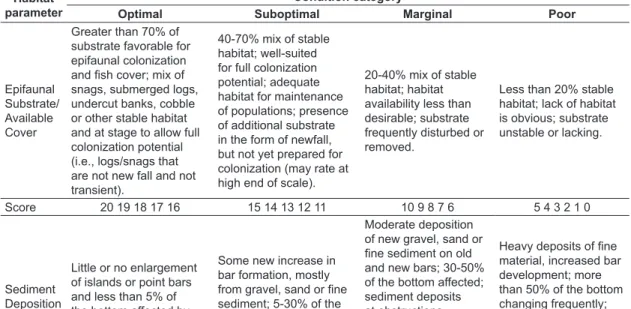
During the dry period in 2010 (July – November), we sampled the ichthyofauna and structural environmental data to represent the full range of habitat types and stream quality within each sub-drainage system. Twenty-seven sample sites distributed in the Sorocaba river basin (n=10), Alto Paranapanema river basin (n=8) and in the Ribeira de Iguape river basin (n=9) were sampled (Figure 1). The streams in this study measured 3.9 m ± 2.14 m in width and 28.7 cm ± 11.02 cm in depth (mean +/- sd) (Cetra et al., 2012). To characterize the reaches we used a physical habitat index (PHI) adapted from Barbour et al. (1999). We evaluated the stretches with four habitat parameters: epifaunal substrate/available cover, sediment deposition, frequency of riffles and bank stability (Table 1). The PHI range classification was: 0 to 20 (Poor), 21 to 40 (Marginal), 41 to 60 (Suboptimal) and 61 to 80 (Optimal).
2.3. Fish collections
Considering that seasonal fluctuation of the water level is one of the most important factors to influence the structure of fish assemblages (Rodríguez & Lewis, 1997), the sampling period for the ichthyofauna was the dry season. During this period, connections between the structure of the fish assemblage and the habitat structure are more robust, and the effect of temporal variation can be controlled (Willis et al., 2005). Sampling is also more efficient due to the smaller volume of water and consequent increase in the density of fish (Pease et al., 2012).
Sampling was performed with an electrofishing apparatus, between 8:00hs and 17:00hs without contention nets, at the upper and lower limits. The ichthyofauna was collected in 70-meter stretches, a distance that is sufficient for representing the range of available mesohabitats, i.e., a repeating sequence of riffle, pool and run. The apparatus consists of a transformer supplied by a generator
(Toyama 2000W) connected to two dip nets, that in the water release a continuous current (2A). Two individuals handled the nets in a single downstream-upstream movement to capture the fish.
2.4. Data analysis
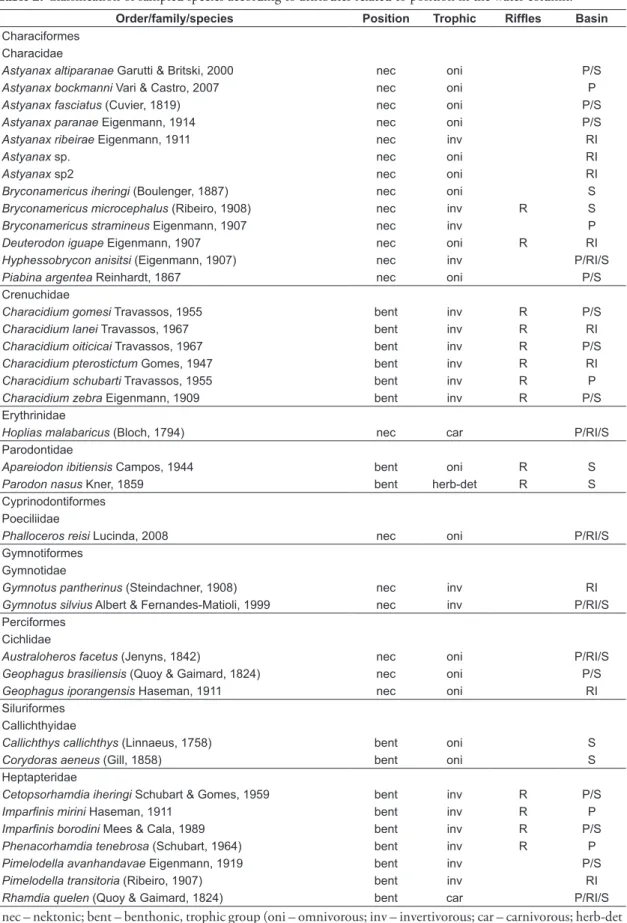
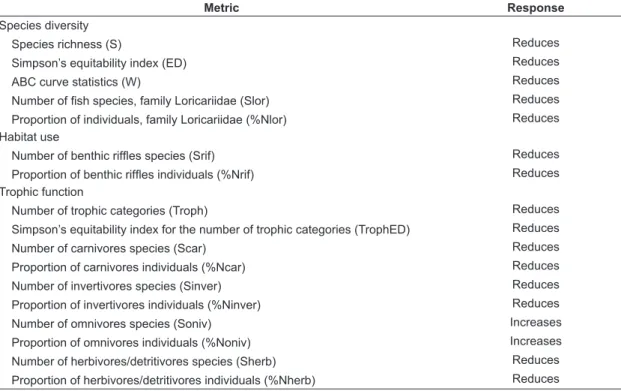
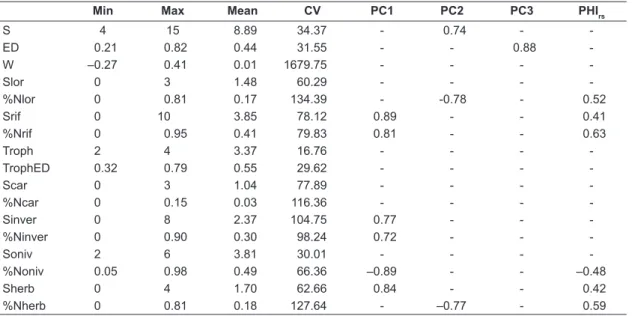
Based on the literature (Oyakawa et al., 2006; Casatti et al., 2012) species were categorized into trophic group, position in the water column and preference for rapid meso-habitats (Table 2). Seventeen metrics were considered to define the list of candidate metrics of the IBI (Table 3). Candidate metrics were screened for range, responsiveness, and redundancy. First, a principal component analysis (PCA) was used to detect the metrics with a low variance. We used a broken-stick model to decided which axes are important and representative. Metrics with a factor loading > 0.7 were rejected. Second, a Spearman’s rank correlation coefficient (rs) significance (α < 0.05) was used to examine the responsiveness of the remaining candidate metrics discriminating the minimally and the most disturbed sites based in the PHI index. Third, Pearson’s correlation coefficient was used to test redundancy. Pairs of the metrics with strong positive correlations (r > 0.75) were considered redundant. The redundant metrics were then selected basing on their responsiveness and the applicability to the study area (Casatti et al. 2009; Jia et al., 2013).
The metrics were trissected in the 75th and 25th percentiles. Values above the 75th were given score 5 and those below the 25th were given score 1; and intermediate values were given score 3. For the metrics negatively related to the PHI 5 and 1 were reversed. The IBI was composed from the sum of scores for each metric by stretch stream.
3. Results
Frequency of riffles and epifaunal substrate parameters varied from poor to optimal. About 50% of the streams has a sediment deposition classified as optimal. The streams bank stability was classified as poor, marginal and suboptimal. The PHI streams ranged from 12 (poor) to 66 (optimal). About 67% of the streams was classified as suboptimal and marginal (Table 4).
accounted for 70.16% of the total variation (35.18, 22.85, 12.14%, respectively), were higher than broken-stick model and most metrics had the highest values on them. From the remaining 10 metrics, 4 failed the responsiveness test due to P value > 0.05 (Table 5). We exclude two redundant metrics: (i) number of herbivores/detritivores species (Sherb) was considered redundant with proportion of herbivores/detritivores individuals (%Nherb) and; (ii) proportion of benthic riffles individuals (%Nrif ) was considered redundant
with number of benthic riffles species (Srif ). Four metrics were finally included in the IBI. They belonged to attributes species diversity (%Nlor), habitat use (%Nrif) and trophic function (%Noniv and %Nherb) (Table 6). Eight streams (30%) was classified as excellent or good and fourteen (50%) as poor or very poor (Table 7), indicating that, on a regional scale, many aspects of biological integrity are altered but there are streams that can be used as biological reference. Table 1. Habitat parameters, condition categories and scores of the sampled streams from Atlantic Forest of south São Paulo State (adapted from Barbour et al., 1999).
Habitat parameter
Condition category
Optimal Suboptimal Marginal Poor
Epifaunal Substrate/ Available Cover
Greater than 70% of substrate favorable for epifaunal colonization and fish cover; mix of snags, submerged logs, undercut banks, cobble or other stable habitat and at stage to allow full colonization potential (i.e., logs/snags that are not new fall and not transient).
40-70% mix of stable habitat; well-suited for full colonization potential; adequate habitat for maintenance of populations; presence of additional substrate in the form of newfall, but not yet prepared for colonization (may rate at high end of scale).
20-40% mix of stable habitat; habitat availability less than desirable; substrate frequently disturbed or removed.
Less than 20% stable habitat; lack of habitat is obvious; substrate unstable or lacking.
Score 20 19 18 17 16 15 14 13 12 11 10 9 8 7 6 5 4 3 2 1 0
Sediment Deposition
Little or no enlargement of islands or point bars and less than 5% of the bottom affected by sediment deposition
Some new increase in bar formation, mostly from gravel, sand or fine sediment; 5-30% of the bottom affected; slight deposition in pools.
Moderate deposition of new gravel, sand or fine sediment on old and new bars; 30-50% of the bottom affected; sediment deposits at obstructions, constrictions, and bends; moderate deposition of pools prevalent.
Heavy deposits of fine material, increased bar development; more than 50% of the bottom changing frequently; pools almost absent due to substantial sediment deposition.
Score 20 19 18 17 16 15 14 13 12 11 10 9 8 7 6 5 4 3 2 1 0
Frequency of Riffles (or bends)
Occurrence of riffles relatively frequent; ratio of distance between riffles divided by width of the stream <7:1 (generally 5 to 7); variety of habitat is key. In streams where riffles are continuous, placement of boulders or other large, natural obstruction is important.
Occurrence of riffles infrequent; distance between riffles divided by the width of the stream is between 7 to 15.
Occasional riffle or bend; bottom contours provide some habitat; distance between riffles divided by the width of the stream is between 15 to 25.
Generally all flat water or shallow riffles; poor habitat; distance between riffles divided by the width of the stream is a ratio of >25.
Score 20 19 18 17 16 15 14 13 12 11 10 9 8 7 6 5 4 3 2 1 0
Bank Stability
Banks stable; evidence of erosion or bank failure absent or minimal; little potential for future problems. <5% of bank affected.
Moderately stable; infrequent, small areas of erosion mostly healed over. 5-30% of bank in reach has areas of erosion.
Moderately unstable; 30-60% of bank in reach has areas of erosion; high erosion potential during floods.
Unstable; many eroded areas; “raw” areas frequent along straight sections and bends; obvious bank sloughing; 60-100% of bank has erosional scars.
Score Left bank 10 9
Right bank 10 9
8 7 6 8 7 6
5 4 3 5 4 3
Table 2. Classification of sampled species according to attributes related to position in the water column.
Order/family/species Position Trophic Riffles Basin
Characiformes Characidae
Astyanax altiparanae Garutti & Britski, 2000 nec oni P/S
Astyanax bockmanni Vari & Castro, 2007 nec oni P
Astyanax fasciatus (Cuvier, 1819) nec oni P/S
Astyanax paranae Eigenmann, 1914 nec oni P/S
Astyanax ribeirae Eigenmann, 1911 nec inv RI
Astyanax sp. nec oni RI
Astyanax sp2 nec oni RI
Bryconamericus iheringi (Boulenger, 1887) nec oni S
Bryconamericus microcephalus (Ribeiro, 1908) nec inv R S
Bryconamericus stramineus Eigenmann, 1907 nec inv P
Deuterodon iguape Eigenmann, 1907 nec oni R RI
Hyphessobrycon anisitsi (Eigenmann, 1907) nec inv P/RI/S
Piabina argentea Reinhardt, 1867 nec oni P/S
Crenuchidae
Characidium gomesi Travassos, 1955 bent inv R P/S
Characidium lanei Travassos, 1967 bent inv R RI
Characidium oiticicai Travassos, 1967 bent inv R P/S
Characidium pterostictum Gomes, 1947 bent inv R RI
Characidium schubarti Travassos, 1955 bent inv R P
Characidium zebra Eigenmann, 1909 bent inv R P/S
Erythrinidae
Hoplias malabaricus (Bloch, 1794) nec car P/RI/S
Parodontidae
Apareiodon ibitiensis Campos, 1944 bent oni R S
Parodon nasus Kner, 1859 bent herb-det R S
Cyprinodontiformes Poeciliidae
Phalloceros reisi Lucinda, 2008 nec oni P/RI/S
Gymnotiformes Gymnotidae
Gymnotus pantherinus (Steindachner, 1908) nec inv RI
Gymnotus silvius Albert & Fernandes-Matioli, 1999 nec inv P/RI/S
Perciformes Cichlidae
Australoheros facetus (Jenyns, 1842) nec oni P/RI/S
Geophagus brasiliensis (Quoy & Gaimard, 1824) nec oni P/S
Geophagus iporangensis Haseman, 1911 nec oni RI
Siluriformes Callichthyidae
Callichthys callichthys (Linnaeus, 1758) bent oni S
Corydoras aeneus (Gill, 1858) bent oni S
Heptapteridae
Cetopsorhamdia iheringi Schubart & Gomes, 1959 bent inv R P/S
Imparfinis mirini Haseman, 1911 bent inv R P
Imparfinis borodini Mees & Cala, 1989 bent inv R P/S
Phenacorhamdia tenebrosa (Schubart, 1964) bent inv R P
Pimelodella avanhandavae Eigenmann, 1919 bent inv P/S
Pimelodella transitoria (Ribeiro, 1907) bent inv RI
Rhamdia quelen (Quoy & Gaimard, 1824) bent car P/RI/S
Table 2. Continued...
Order/family/species Position Trophic Riffles Basin
Loricariidae
Harttia kronei Miranda-Ribeiro, 1908 bent herb-det R RI
Hisonotus sp1 bent herb-det R P
Hypostomus ancistroides (Ihering, 1911) bent herb-det R P/RI/S
Hypostomus variipictus (Ihering, 1911) bent herb-det R S
Isbrueckerichthys duseni (Miranda-Ribeiro, 1907) bent herb-det R RI
Isbrueckerichthys epakmos Pereira & Oyakawa, 2003 bent herb-det R RI
Neoplecostomus ribeirensis Langeani, 1990 bent herb-det R P/RI
Neoplecostomus cf. yapo Zawadzki, Pavanelli & Langeani, 2008 bent herb-det R RI
Neoplecostomus sp. bent herb-det R S
Rineloricaria pentamaculata Langeani & Araújo, 1994 bent herb-det R P
Trichomycteridae
Ituglanis proops (Miranda-Ribeiro, 1908) bent inv RI
Trichomycterus iheringi (Eigenmann, 1917) bent inv R S
Trichomycterus cf. zonatus (Eigenmann, 1918) bent inv R RI
Trichomycterus sp. bent inv R P
Synbranchiformes Synbranchidae
Synbranchus marmoratus Bloch, 1795 nec car P/S
nec – nektonic; bent – benthonic, trophic group (oni – omnivorous; inv – invertivorous; car – carnivorous; herb-det – herbivorous/detritivorous); riffles (R) and river basin (P – Paranapanema; S – Sorocaba; RI – Ribeira de Iguape.
Table 3. Candidate metrics for the Index of Biotic Integrity and the expected response to an increase in environ-mental degradation.
Metric Response
Species diversity
Species richness (S) Reduces
Simpson’s equitability index (ED) Reduces
ABC curve statistics (W) Reduces
Number of fish species, family Loricariidae (Slor) Reduces
Proportion of individuals, family Loricariidae (%Nlor) Reduces
Habitat use
Number of benthic riffles species (Srif) Reduces
Proportion of benthic riffles individuals (%Nrif) Reduces
Trophic function
Number of trophic categories (Troph) Reduces
Simpson’s equitability index for the number of trophic categories (TrophED) Reduces
Number of carnivores species (Scar) Reduces
Proportion of carnivores individuals (%Ncar) Reduces
Number of invertivores species (Sinver) Reduces
Proportion of invertivores individuals (%Ninver) Reduces
Number of omnivores species (Soniv) Increases
Proportion of omnivores individuals (%Noniv) Increases
Number of herbivores/detritivores species (Sherb) Reduces
Proportion of herbivores/detritivores individuals (%Nherb) Reduces
Table 4. Number of streams by PHI parameter classification.
Parameter Classification
Optimal Suboptimal Marginal Poor
Epifaunal substrate 2 9 7 9
Sediment deposition 14 8 4 1
Frequency of riffles 6 7 7 7
Bank stability - 4 11 12
4. Discussion
The current Index of Biotic Integrity (IBI) used the stream fish community and consisted of four metrics that reflected, in a satisfactory manner, the environmental gradient found in wadeable headwater streams, which generally show little environmental change.
The four selected metrics for the IBI reflected the structure of the assemblages mainly in terms of proportional species abundance of the attributes
species diversity, habitat use and trophic function. In the present study, surprisingly, we did not have the expected response of species richness that has been extensively used to infer the quality of ecological systems (Roth et al., 2000). Perhaps the species richness variation is best explained by stream position in the longitudinal gradient than in the present disturbance gradient.
The predominance of individuals as Loricariidae family and herbivores/detritivores in preserved Table 6. IBI metrics and scoring criteria for Atlantic Forest of south São Paulo State streams.
Metric Scoring criteria
1 3 5
Species diversity
1. Percentage of individuals as Loricariidae family ≤ 2 2-21 ≥ 21
Habitat use
2. Percentage of individuals as benthic riffles ≤ 5 5-60 ≥ 60
Trophic function
3. Percentage of individuals as omnivores ≥ 87 17-87 ≤ 17
4. Percentage of individuals as herbivores/detritivores ≤ 2 2-21 ≥ 21
Table 7. Detailed descriptions of stream biotic integrity, IBI values and number of streams by category (n).
Categories Values Description n
Excellent 19-20 Comparable to the best situation without human disturbance; the relative contribution of individuals as benthic riffles is high without omnivores. 3 Good 16-18 Fish community represented by individuals as Loricariidae family, benthic riffles
and herbivores/detritivores and trophic structure shows some signs of stress. 5 Fair 13-15 Signs of additional deterioration include loss of individuals as benthic riffles and
moderate skewed trophic structure with increasing frequency of omnivores. 5 Poor 9-12 Fish community dominated by omnivores with less abundance of individuals
as benthic riffles. 4
Very poor 4-8 Dominated by omnivores. 10
Table 5. Minimum (Min), Maximum (Max), Mean and coefficient of variation (CV) of the candidate metrics (see Table 3 legend) for the IBI. Range and responsiveness significance: PCA metric loadings (PC1, PC2, PC3) and Spearman’s rank correlation coefficient with PHI (PHIrs).
Min Max Mean CV PC1 PC2 PC3 PHIrs
S 4 15 8.89 34.37 - 0.74 -
-ED 0.21 0.82 0.44 31.55 - - 0.88
-W –0.27 0.41 0.01 1679.75 - - -
-Slor 0 3 1.48 60.29 - - -
-%Nlor 0 0.81 0.17 134.39 - -0.78 - 0.52
Srif 0 10 3.85 78.12 0.89 - - 0.41
%Nrif 0 0.95 0.41 79.83 0.81 - - 0.63
Troph 2 4 3.37 16.76 - - -
-TrophED 0.32 0.79 0.55 29.62 - - -
-Scar 0 3 1.04 77.89 - - -
-%Ncar 0 0.15 0.03 116.36 - - -
-Sinver 0 8 2.37 104.75 0.77 - -
-%Ninver 0 0.90 0.30 98.24 0.72 - -
-Soniv 2 6 3.81 30.01 - - -
-%Noniv 0.05 0.98 0.49 66.36 –0.89 - - –0.48
Sherb 0 4 1.70 62.66 0.84 - - 0.42
streams is expected in streams with shading because the presence of riparian vegetation increasing primary productivity, especially Periphyton that can be used as a food resource by these organisms. In degraded conditions, the intense sediment supply increase the unstable substrate, preventing the accumulation or attachment of periphyton and thus the individuals with such food habits become rare in the impacted environment (Ferreira & Casatti, 2006). Our explanation would be linked to the bank stability rather than shading, because the streams with poor classification have low scores on the parameter bank stability.
The relative contribution of individuals as benthic riffles is high in streams with low sediment deposition with little or no enlargement of islands or point bars and less than 5% of the bottom affected by sediment deposition. With this metric we were able to discriminate excellent from poor or very poor biotic integrity in the streams. Benthic rifles species lived on or near the bottom and usually did not feed on the surface (Noble et al., 2007), and were sensitive to the stream siltation (Oberdoff & Hughes, 1992)
Alterations in habitat quality, including bank stability, commonly result in changing availabilities of food resources (Karr, 1981). The omnivores dominated streams with biotic integrity very poor. In tropical and sub-tropical rivers and streams, the omnivore food category is predominant (Esteves & Aranha, 1999; Castro et al., 2003; Pinto et al., 2006), although the same behavior is expected where the increase in the degree of omnivory reflects the destructuring of aquatic habitats.
5. Conclusion
The current adaptation of the IBI is a first step in the establishment of an assessment protocol and the monitoring of Atlantic Forest streams in the headstreams of the Alto Paranapanema, Ribeira de Iguape and Sorocaba river basins. The survey of the four metrics that integrate the IBI and their scores should be sufficient to accompany the environmental changes in these systems. Thus, given the great utility of these results in the biomonitoring of headwater streams in the region, we have confidence in transmitting this information to the decision makers so that sophisticated statistical techniques will no longer be necessary for the adequate accompaniment of anthropogenic changes to these systems.
Acknowledgements
We acknowledge FAPESP (Proc 2009/53056-8) for the financial support to carry out this research,
IBAMA (License n˚ 13352-1 SISBIO/IBAMA/MMA) and Instituto Florestal (License n° 260108-004.423/2010
SMA).
References
ANGERMEIER, P. and DAVIDEANU, G. Using fish communities to assess streams in Romania: initial development of an index of biotic integrity.
Hydrobiologia, 2004, 511(1), 65-78. http://dx.doi. org/10.1023/B:HYDR.0000014030.18386.65. BARBOUR, M.T., GERRITSEN J., SNYDER,
B.D. and STRIBLING, J.B. Rapid bioassessment protocols for use in streams and wadeable rivers: periphyton, benthic macroinvertebrates and fish. 2nd ed. Washington, D.C.: Environmental Protection Agency, 1999. EPA 841-B-99-002.
CASATTI, L., FERREIRA, C.P. and LANGEANI, F. A fish-based biotic integrity index for assessment of lowland streams in southeastern Brazil. Hydrobiologia, 2009, 623(1), 173-189. http://dx.doi.org/10.1007/ s10750-008-9656-x.
CASATTI, L., TERESA, F.B., GONÇALVES-SOUZA, T., BESSA, E., MANZOTTI, A.R., GONÇALVES, C.S. and ZENI, J.O. From forests to cattail: how does the riparian zone influence stream fish? Neotropical Ichthyology, 2012, 10(1), 205-214. http://dx.doi. org/10.1590/S1679-62252012000100020. CASTRO, R.M.C., CASATTI, L., SANTOS, H.F.,
FERREIRA, K.M., RIBEIRO, A.C., BENINE, R.C., DARDIS, G.Z.P., MELO, A.L.A., STOPIGLIA, R., ABREU, T.X., BOCKMANN, F.A., CARVALHO, M., GIBRAN, F.G. and LIMA, F.C.T. Estrutura e composição da ictiofauna de riachos do rio Paranapanema, sudeste e sul do Brasil.
Biota Neotropica, 2003, 3(1), 1-31. http://dx.doi. org/10.1590/S1676-06032003000100007. CETRA, M., BARRELLA, W., LANGEANI, F.,
MARTINS, A.G., MELLO, B.J. and ALMEIDA, R.S. Fish fauna of headwater streams that cross the Atlantic Forest of South São Paulo state. Check List, 2012, 8(3), 421-425.
DRAKE, D. Selecting reference condition sites: an approach for biological criteria and watershed assessment. Portland: Laboratory Division Oregon, 2004 [viewed 23 Feb. 2016]. Technical Report WAS04-002. Available from: http://www.deq.state.or.us/lab/ techrpts/docs/WSA04002.pdf.
ESTEVES, K.E. and ARANHA, J.M.R. Ecologia trófica de peixes de riachos. In E.P. CARAMASCHI, R. MAZZONI, P.R. PERES-NETO, eds. Ecologia de peixes de riachos. Rio de Janeiro: PPGE/UFRJ, 1999, pp. 157-182.
FERREIRA, C.P. and CASATTI, L. Integridade biótica de um córrego na bacia do Alto Rio Paraná avaliada por meio da comunidade de peixes. Biota Neotropica, 2006, 6(3), 1-25.
JIA, Y.T., SUI, X.Y. and CHEN, Y.F. Development of a fish-based index of biotic integrity for wadeable streams in Southern China. Environmental Management, 2013, 52, 995-1008.
KARR, J.R. and DUDLEY, D.R. Ecological perspective on water quality goals. Environmental Management, 1981, 11, 249-256. http://dx.doi.org/10.1007/ BF01867203.
KARR, J.R. Assessment of biotic integrity using fish communities. Fisheries (Bethesda), 1981, 6(6), 21-27. http://dx.doi.org/10.1577/1548-8446(1981)006<0021:AOBIUF>2.0.CO;2. MARCIANO, F.T., CHAUDHRY, F.H. and RIBEIRO,
M.C.L.B. Evaluation of the index of biotic integrity in the Sorocaba River Basin (Brazil, SP) based on fish communities. Acta Limnologica Brasiliensia, 2004, 16(3), 225-237.
NOBLE, R.A.A., COWX, I.G., GOFFAUX, D. and KESTEMONT, P. Assessing the health of European rivers using functional ecological guilds of fish communities: standardising species classification and approaches to metric selection. Fisheries Management and Ecology, 2007, 14, 381-392.
OBERDOFF, T. and HUGHES, M. Modification of an index of biotic integrity based on fish assemblages to characterize rivers of the Seine Basin, France.
Hydrobiologia, 1992, 228, 117-130.
OYAKAWA, O.T., AKAMA, A., MAUTARI, K.C. and NOLASCO, J.C. Peixes de riachos da Mata Atlântica. São Paulo: Editora Neotrópica, 2006, 201 p. PEASE, A.A., GONZÁLEZ-DÍAS, A.A.,
RODILES-HERNÁNDEZ, R. and WINEMILLER, K.O. Functional diversity and trait-environment relationships of stream fish assemblages in a large tropical catchment. Freshwater Biology, 2012, 57, 1060-1075.
PINTO, B.C.T., ARAÚJO, F.G. and HUGHES, R.M. Effects of landscape and riparian condition on a fish index of biotic integrity in a large southeastern Brazil river. Hydrobiologia, 2006, 556(1), 69-83. http:// dx.doi.org/10.1007/s10750-005-9009-y.
RODRÍGUEZ, M.A. and LEWIS, W.M. Structure of fish assemblages along environmental gradients in floodplain lakes of the Orinoco River. Ecological Monographs, 1997, 67, 109-128.
ROTH, N.E., ALLAN, J.D. and ERICKSON, D.L. Landscape influences on stream biotic integrity assessed at multiple spatial scales. Landscape Ecology, 1996, 11(3), 141-156. http://dx.doi.org/10.1007/ BF02447513.
ROTH, N.E., SOUTHERLAND, M.T., CHAILLOU, J.C., KAZYAK, P.F. and STRANKO, S.A. Refinement and validation of a fish index of biotic integrity for Maryland streams. Annapolis: Maryland Department of Natural Resources, 2000. CBWP-MANTA-EA-00-2.
WILLIS, S.C., WINEMILLER, K.O. and LOPEZ-FERNANDEZ, H. Habitat structural complexity and morphological diversity of fish assemblages in a Neotropical floodplain river. Oecologia, 2005, 142, 284-295.