ABSTRACT: This study aimed to characterize the proile of morbidity among users of family health teams in the northeastern macroregion of Minas Gerais, Brazil. This is a cross-sectional population-based study, developed with the teams of the Family Health Strategy (FHS). It was conducted by data collection, using semi-structured questionnaires with speciic instruments adjusted for three categories of professional teams of the FHS: physicians, nurses and community health agents (CHA). We used the International Classiication of Primary Care, second edition (ICPC-2) to encode morbidity. Information was collected from 17,988 people, and 10,855 (60.3%) were females; 1,662 (9.2%) questionnaires were related to care by the physician; 2,530 (14.1%) were related to care by nurses and 13,796 (76.7%) corresponded to visits by and meetings with the CHA. The main health problems were: circulatory diseases (especially hypertension), musculoskeletal problems (especially back pain) and diseases of the digestive tract (especially intestinal parasites), which accounted for more than 40% of the medical consultations. Nonspeciic complaints and visits related to women’s health were the most prevalent in the care by nurses. In meetings with CHA, complaints about respiratory, musculoskeletal and cardiovascular diseases were the most pointed. The morbidity proile observed does not difer substantially from the results of other studies. Small diferences can be attributed to regional particularities.
Keywords: Morbidity. Primary Health Care. Health Surveys. Epidemiology. International Classiication of Diseases. Uniied Health System.
Morbidity in users of Family Health teams in
the northeast of Minas Gerais based on the
International Classiication of Primary Care
Morbidade em usuários de equipes de Saúde da Família no nordeste de
Minas Gerais com base na Classiicação Internacional da Atenção Primária
Valquiria M. SilvaI, Ivelisa V. S. PereiraI, Maria de Jesus L. RochaI, Antônio P. CaldeiraII
ORIGINAL ARTICLE / ARTIGO ORIGINAL
IState Department of Health of Minas Gerais – Belo Horizonte (MG), Brazil.
IIUniversidade Estadual de Montes Claros – Montes Claros (MG), Brazil.
Corresponding author: Antônio P. Caldeira. Universidade Estadual de Montes Claros. Rua Monte Pascoal, 225, Ibituruna, CEP: 39401-347, Montes Claros, MG, Brasil. E-mail: [email protected]
INTRODUCTION
The Uniied Health System (SUS), in Brazil, has allowed a rapid expansion of primary care, with signiicantly positive results in the provision of services and indicators of access to health care by the population1.Despite the progress made, there are still challenges to overcome2. Since 1994, when the irst Family Health Strategy (FHS) teams were deployed, the strengthening of health actions has been discussed, with emphasis on promotion activities and strategies to change the care model, previously hospital-centered and focused on medical consultations.
It is natural to assume that the changes in the care model involve having a better knowledge of the characteristics of assisted demand, among other things. Self-perception of health conditions has been employed as a measure that is able to relect an integrated concern of the individual in the biological, psychological and social dimensions3. The use of associated epidemiological data can be very useful for the design of appropriate care strategies for users, including the morbidity statistics4.
There are few studies in the country on the proile of morbidities that afect people assisted by primary care. The Primary Health Care Information System (SIAB), which is
RESUMO: Este estudo objetivou caracterizar o peril de morbidade referida por usuários das equipes de saúde da família na macrorregião nordeste de Minas Gerais. Trata-se de um estudo transversal de base populacional, desenvolvido junto às equipes da Estratégia Saúde da Família (ESF), com uso de questionários semiestruturados adaptados para três categorias proissionais das equipes de saúde da família: médicos, enfermeiros e agentes comunitários de saúde (ACS). Utilizou-se a Classiicação Internacional da Atenção Primária, segunda edição (CIAP 2), para codiicação da morbidade referida. Foram coletadas informações de 17.988 pessoas, em 204 equipes da ESF, sendo 10.855 (60,3%) do sexo feminino; 1.662 (9,2%) questionários foram referentes ao atendimento do médico, 2.530 (14,1%) do enfermeiro e 13.796 (76,7%) corresponderam aos encontros com ACS. Os principais problemas de saúde foram: doenças do aparelho circulatório (especialmente hipertensão), queixas musculoesqueléticas (especialmente as lombalgias) e doenças do aparelho digestório (especialmente as parasitoses intestinais), que juntas responderam por mais de 40% das consultas médicas. As queixas inespecíicas e atendimentos relacionados à saúde da mulher foram prevalentes nos atendimentos de enfermeiros. Os ACS registraram mais as queixas referentes a problemas respiratórios, musculoesqueléticos e cardiovasculares. O peril de morbidade observado não difere substancialmente de outros estudos, com pequenas diferenças que podem ser atribuídas às particularidades regionais.
the oicial record of the major morbidities assisted by the FHS also has weaknesses and does not provide necessary and reliable information for the identiication of morbidities5.
In principle, the reality on the morbidity of primary care users demands, in addition to the development of standardized electronic medical records, training for FHS workers. Classification and coding of diagnoses, complaints and health needs of patients is a fundamental step in this process. In this context, the International Classiication of Primary Care, in its second edition (ICPC-2), constitutes an important contribution in the knowledge of morbidity at this level of care6. The coding system is relatively simple and easy, and has been used in many countries4,7,8.
Given the lack of electronic medical records, surveys based on interviews or printed medical records can provide important information. The information obtained from the surveys help to identify the epidemiological proile of the population, assist health policy and allow inferences on diferent health dimensions9. Also, the various aspects of accessibility to health services can be identiied by the survey10. This study aimed to characterize the proile of morbidity reported by users of the FHS teams in the Northeast macroregion of Minas Gerais, based on ICPC-2.
METHODOLOGY
This is a cross-sectional, population-based study that was developed in the Northeast macroregion of Minas Gerais with the FHS teams. The region consists of 63 municipalities and is one of the poorest areas of the country, incorporating Vale do Jequitinhonha and Vale do Mucuri, with a Human Development Index below 0.65 as the general average. During data collection, there was a record of 268 FHS teams, including teams of Community Health Agents (CHA) for a population of approximately 917,000 inhabitants. Adolescents and adults who use the service and are registered by the Family Health teams in the region studied were eligible for this study.
Before conducting the research, a pilot study was conducted on a randomly selected area with the aim of testing the instruments for data collection and the proposed methodology. No adjustments to the data collection instruments were required.
For data analysis, instruments that were incorrectly or illegibly filled, as well as those by users coming from municipalities outside the predetermined region, were excluded. Data were analyzed using the SPSS software, version 16.0. All complaints and health problems recorded were classified according to the International Classification of Primary Care, second version (ICPC-2), a procedure performed by a single person previously qualified in order to avoid distortions of classification. The proportions of diagnoses, complaints and health problems in diferent systems (chapters if ICPC-2) were compared between genders using the χ2 test, assuming a significance level of 5% (p < 0.05).
All ethical aspects were observed, and the project was previously approved by the Research Ethics Committee of Universidade Estadual de Montes Claros (Protocol no. 2314/2010). Interviews were conducted with the permission of the municipal managers and workers in family health teams and all respondents, in the context of teams from the Northeast macroregion of Minas Gerais, upon signature of an informed consent. There was no conflict of interest for conducting the study.
RESULTS
Of the 268 teams registered in the region, 64 were excluded because the managers and/or coordinators did not efectively support or refused to conduct the data collection in their municipalities. Thus, data from 204 family health teams were collected. In total, 17,988 people participated in the study, 10,855 (60.3%) were females and 7,133 (39.7%) were males. Of these, 1,662 (9.2%) corresponded to care by physicians, 2,530 (14.1%), care by nurses and 13,796 (76.7%) corresponded to visits and meetings with CHA. The reported morbidity was divided into ‘diagnoses’, when the treatment was given by doctors, in ‘complaints or reasons for visits’, when the treatment was carried out by nurses and ‘health problems’ when the data resulted from meetings with community health agents during home visits. The main characteristics and patterns of morbidity are presented in Tables 1 to 3, according to the type of professional from the FHS and chapters of ICPC-2. Twenty-ive forms were excluded due to illegibility.
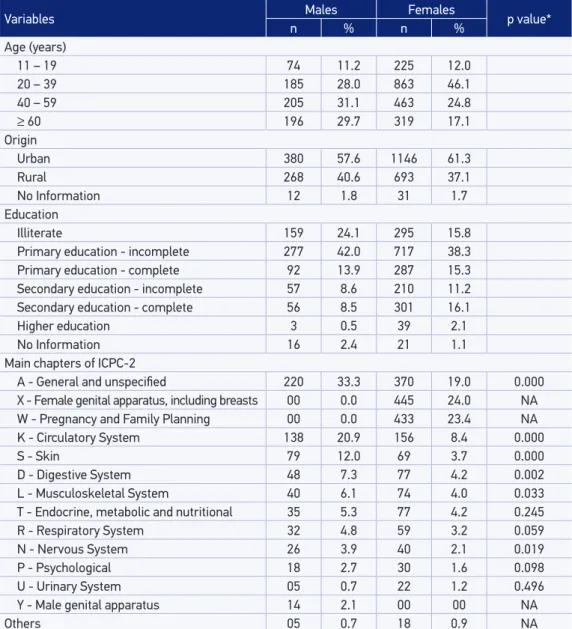
Table 2 presents the main characteristics and complaints/reasons for visits of adult patients assisted by FHS nurses. A greater proportion of visits to the younger population was observed, with a prevalence of the 20-39 years old age range (n = 1,048; 41.4%). In this group, women accounted for the highest number of visits (n = 1,870; 73.9%). Schooling was also assessed for this population, which identified that the majority of the care was given to people who had not completed primary school.
The main complaints were related to the chapter of “general and non-specific causes,” totaling 590 visits (23.3%), followed by complaints in the chapter of female genital tract, with 445 visits (17.6%), and 433 visits due to pregnancy or family planning (17.1%).
Table 1. Main characteristics and diagnoses of patients assisted by physicians of the Family Health Strategy in the northeastern macroregion of Minas Gerais, Brazil, 2011.
Variables Males Females p-value*
n % n %
Age (years)
11 – 19 66 12.2 137 12.2
20 – 39 144 26.7 338 30.1
40 – 59 163 30.2 368 32.8
≥ 60 166 30.8 280 24.9
Origin
Urban 328 60.9 684 60.9
Rural 200 37.1 432 38.5
No Information 11 2.0 7 0.6
Main chapters of ICPC-2
K - Circulatory System 74 13.7 179 15.9 0.270 L - Musculoskeletal System 74 13.7 151 13.4 0.935
D - Digestive System 78 14.5 124 11.0 0.055
R - Respiratory System 43 8.0 80 7.1 0.601
T - Endocrine, metabolic and nutritional 32 5.9 85 7.6 0.265
S - Skin 45 8.3 54 4.8 0.006
A - General and unspeciied 41 7.6 52 4.6 0.018 X - Female genital apparatus, including breasts 0 0.0 87 7.7 NA
P - Psychological 30 5.6 51 4.5 0.430
W - Pregnancy and Family Planning 0 0.0 78 6.9 NA
N - Nervous System 25 4.6 45 4.0 0.639
U - Urinary System 18 3.3 48 4.3 0.436
H - Ears 8 1.5 16 1.4 0.901
B - Blood, blood-forming organs and lymph 5 0.9 15 1.3 0.636
Y - Male genital apparatus 17 3.2 0 0.0 NA
F - Eyes 6 1.1 8 0.7 0.401
No diagnosis 43 8.0 50 4.5 0.005
NA: not applicable.
Table 3 presents the main characteristics and health problems referred to CHA by FHS users. There was a predominance of people with low education, including 2,542 (18.4%) illiterate individuals. Health problems reported refer to those presented in the 15 days previous to the data collection. Among the people interviewed by the CHA, 3,338 (24.2%) reported some complaint or health problem in the previous 15 days. Most respondents comprised a younger population, aged between 20 and 39 years (33.7%),
Table 2. Main characteristics and complaints of patients assisted by nurses of the Family Health Strategy in the northeastern macroregion of Minas Gerais, Brazil, 2011.
Variables Males Females p value*
n % n %
Age (years)
11 – 19 74 11.2 225 12.0
20 – 39 185 28.0 863 46.1
40 – 59 205 31.1 463 24.8
≥ 60 196 29.7 319 17.1
Origin
Urban 380 57.6 1146 61.3
Rural 268 40.6 693 37.1
No Information 12 1.8 31 1.7
Education
Illiterate 159 24.1 295 15.8
Primary education - incomplete 277 42.0 717 38.3 Primary education - complete 92 13.9 287 15.3 Secondary education - incomplete 57 8.6 210 11.2 Secondary education - complete 56 8.5 301 16.1
Higher education 3 0.5 39 2.1
No Information 16 2.4 21 1.1
Main chapters of ICPC-2
A - General and unspeciied 220 33.3 370 19.0 0.000 X - Female genital apparatus, including breasts 00 0.0 445 24.0 NA W - Pregnancy and Family Planning 00 0.0 433 23.4 NA K - Circulatory System 138 20.9 156 8.4 0.000
S - Skin 79 12.0 69 3.7 0.000
D - Digestive System 48 7.3 77 4.2 0.002
L - Musculoskeletal System 40 6.1 74 4.0 0.033 T - Endocrine, metabolic and nutritional 35 5.3 77 4.2 0.245
R - Respiratory System 32 4.8 59 3.2 0.059
N - Nervous System 26 3.9 40 2.1 0.019
P - Psychological 18 2.7 30 1.6 0.098
U - Urinary System 05 0.7 22 1.2 0.496
Y - Male genital apparatus 14 2.1 00 00 NA
Others 05 0.7 18 0.9 NA
NA: not applicable.
being mostly women (57.0%). Regarding complaints/health problems recorded by the CHA, the main ones refer to the chapter of the respiratory tract (n = 518; 15.5%), musculoskeletal system (n = 493; 14.8%) and cardiovascular system (n = 449; 13.5%).
Table 4 presents the main diagnoses, health complaints and problems assigned to users in the study in each system or chapter of ICPC-2.
Table 3. Main characteristics and health problems referred to community health agent by patients assisted by the Family Health Strategy teams in the northeastern macroregion of Minas Gerais, Brazil, 2011.
Variables Males Females p-value
n % n %
Age (years)
11 – 19 1198 20.2 1391 17.7
20 – 39 1973 33.2 2682 34.1
40 – 59 1554 26.2 2024 25.7
≥ 60 1209 20.4 1765 22.4
Education
Illiterate 999 16.8 1543 19.6
Primary education - incomplete 3317 55.9 3724 47.4 Primary education - complete 322 5.4 395 5.0 Secondary education - incomplete 282 4.8 440 5.6 Secondary education - complete 748 12.6 1295 16.5
Higher education 90 1.5 232 3.0
No Information 176 3.0 233 3.0
Main chapters of ICPC-2*
R - Respiratory System 191 16.3 327 15.1 0.388 L - Musculoskeletal System 174 14.8 319 14.7 0.967 K - Circulatory System 166 14.2 283 13.1 0.404
D - Digestive System 132 11.3 267 12.3 0.396
A - General and unspeciied 141 12.0 243 11.2 0.519
N - Nervous System 115 9.8 248 11.4 0.164
P - Psychological 53 4.5 80 3.7 0.282
U - Urinary System 40 3.4 90 4.2 0.335
S - Skin 48 4.1 57 2.6 0.027
T - Endocrine, metabolic and nutritional 38 3.2 62 2.9 0.611 X - Female genital apparatus, including breasts 0 0.0 71 3.3 NA
H - Ears 27 2.3 34 1.6 0.169
F - Eyes 26 2.2 31 1.4 0.125
W - Pregnancy and Family Planning 0 0.0 38 1.8 NA B - Blood, blood-forming organs and lymph 5 0.4 15 0.7 0.474
Y - Male genital apparatus 15 1.3 0 0.0 NA
Z - Social problems 1 0.1 1 0.0 1.000
Table 4. Main diagnoses, health problems and complaints assigned to patients assisted by the Family Health Strategy teams in northeastern macroregion of Minas Gerais, Brazil, 2011.
Chapters of ICPC-2 n %
Records by doctors
Circulatory system (n = 253)
K85/K86: Hypertension 230 90.9
K95: Varicose veins in the lower limbs 6 2.4
K91: Sequel of stroke 4 1.6
Others 13 5.1
Musculoskeletal system (n = 225)
L03: Low back pain 98 43.6
L18/L19/L20: Unspeciied muscular signs and symptoms 46 20.4 L14 a L17 e L29: Signs and symptoms in the lower limbs and other nonspeciic 35 15.6
Others 46 20.4
Digestive System (n = 202)
D96: Unspeciied parasitosis 86 42.6
D87: Gastritis 43 21.3
D01/D02: Abdominal pain 40 19.8
Others 33 16.3
Records by nurses
General and unspeciied (n = 590)
A30: Exams/checkups 259 43.9
A62: Administrative procedures 66 11.2
A03: Fever 62 10.5
A11: Chest pain 62 10.5
A04: Malaise and fatigue 60 10.2
Others 81 13.8
Pregnancy and Family Planning (n = 445)
W 78: Prenatal 320 71.9
W 14: Family Planning 111 24.9
W 18: Puerperium 14 3.1
Female genital apparatus/Breasts (n = 433)
X46: Pap test with APS professional 361 83.4 X05 a X09: Menstruation disorders 29 6.7
X14: Leukorrhea 19 4.4
Others 24 5.5
Records by CHA
Respiratory tract (n=518)
R80: Flu 291 56.2
R78: Bronchitis 68 13.1
R74: Problems related to the throat 67 12.9
R75: Sinusitis 60 11.6
Others 32 6.2
Musculoskeletal system (n=493)
L01/L02/L03: Problems of the spine 200 40.6 L18/L19/L20: Muscle and members pain 187 37.9 L29: Musculoskeletal trauma and other non-speciic manifestations 40 8.1
Others 66 13.4
Circulatory system (n=449)
K85/K86: Hypertension 375 83.5
K29: Unspeciied heart problems 38 8.5
DISCUSSION
This study characterized the profile of reported morbidity by FHS users in the Northeast macroregion of Minas Gerais and, although the demand for medications and immunizations was not considered, it helped identify the main health problems that reach primary care teams in the region studied. The recorded results revealed the main diagnoses of people assisted by the medical teams evaluated, stressing the importance of cardiovascular (especially hypertension), musculoskeletal (especially back pain) and digestive tract (especially intestinal parasites) diseases, which together account for over 40% of consultations. Respiratory and endocrine disorders also represent important causes of morbidity. These results are different from those observed in the study by Gusso11, who pointed out, in the distribution of morbidity by chapters of ICPC-2, cardiovascular diseases, general and nonspecific complaints and respiratory diseases as the three main groups of most frequent causes. However, a broader analysis of the most frequent problems identified in this study allows greater similarity, since most referred chapters coincide with this study. The work by Gusso is the most recent and comprehensive national study of the demand in primary care, although it was restricted to just one city11. Other national studies are restricted to the characterization of the demand for a single unit14, of specific groups15, or are older studies16.
Even though the morbidity patterns are highly sensitive to social, environmental and economic contexts17, it is noteworthy that international studies also point to circulatory diseases4,18,respiratory diseases4,7,18, musculoskeletal problems4,7 and disorders of the digestive system7,18 as their biggest demands, which is consonant with the results of this study. It is natural to assume, therefore, that these are common demands for doctors of primary care services.
Complaints or reasons for visits registered by nurses highlighted mainly general and non-specific signs and symptoms consultations relating to women’s health. Probably, the highlight observed for general and non-specific signs and symptoms are reflecting the welcoming and managerial role of the nursing professional19. Generally, this professional takes the coordination of care in primary health units and ultimately serves as a reference for users in many of their visits to health facilities. It is also important to highlight that a high proportion of patients without a definite diagnosis, or even without a target system defined, is common in primary care11. The visits related to women’s health are also compatible with the role of the FHS nurse, who, traditionally, in the organization of care activities, shares the activities of cervical cancer preventive examinations, monitoring of risk pregnancies and guidance for family planning with the doctors20.
reported by doctors and nurses. The top ive health problems recorded by CHA account for over 60% of all reported problems. This trend, of a few diagnoses representing an important contingent of demand in primary care, has been reported in other studies4,18.This inding underscores the importance of using ICPC-2 in categorizing problems assisted in primary care. Codes can facilitate the communication of data within the same team and the exchange of information between FHS teams.
ICPC-2 works with a simple coding system on two levels: the first defines the organic system (represented by 17 chapters) and the second defines seven components (represented by numbers), that discriminate: (1) complaints and symptoms, (2) diagnostic and preventive screening, (3) medications, treatments and therapeutic procedures, (4) results of examinations, (5) administrative component, (6) follow-up and other reasons for consultation and (7) diagnoses and diseases6,7. There is also the possibility of inclusion of gravity in the code, which broadens slightly the complexity of the classification. Naturally, the same health problem can be classified in different ways, according to the perception of the health care professional who performs the encoding, their degree of certainty about the ‘diagnosis’ and their familiarity with the coding process. Different encodings for the same episode of care in primary care does not imply inadequacy of the coding system and does not affect the recognition of the morbidity profile of a population group8. A recent national study reported good interobserver reliability using the ICPC-2, which indicates a good performance of the classification code for reasons of care in primary care, even from logs in medical records21. Other aspects of the classification tend to be better studied from computerized analyses, which is still not a reality in the country. It is worth noting that although ICPC-2 is used in several countries4,7,18, its simplification process still suffers criticism, and some authors suggest it is inadequate to meet all the complexity of clinical problems7,22.
In the present study, although there was zeal in putting a single person to classify responses recorded, the coding was done from data of the survey form and not directly from the contact with patients, a fact that undermines the diagnostic accuracy. However, the authors believe that the definition of the main chapters and major health problems within each chapter is less susceptible to coarse errors and sufficient to characterize the demand, as it is recorded in other international studies4,7. The finding that up to 60% of the main health problems reported by users of the FHS teams are restricted to only a few chapters of ICPC-2 can assist the process of organizing the demand for these teams and alert health managers about the importance of training of health professionals, more oriented towards those needs of the assisted population.
critic of their analysis process, often serving just as a bureaucratic instrument for the operation of teams5,23.
The lack of broader or more recent national data on morbidity recorded by the FHS teams affects more detailed analysis of the observed data. Surely the lack of a computer system is a limiting factor for such studies, unlike what happens in other countries8.
In general, the structure of the population assisted by teams evaluated is similar to what was observed in other studies that, highlighting higher prevalence of women and younger individuals in the demand of primary care18. Although it was not the specific objective of this study to conduct a deeper analysis from the point of view of genders, it is important to note that, in the records of all professional categories, women showed more complaints or health problems.
In relation to medical consultations, there was homogeneity for different diagnoses among men and women, except for skin diseases and general and non-specific complaints, which were more common for men. In nursing records, in addition to the two chapters indicated, men also had higher proportions of complaints about the problems of the circulatory, digestive, nervous and musculoskeletal systems. However, considering the high demand for nursing regarding the health status of women (gynecological problems related to pregnancy and family planning), it is unreasonable to establish any inference about these differences. In the records of CHA, only the skin diseases were more prevalent among men, with no records of other gender differences in the remaining chapters of ICPC-2. Thus, in general, small differences are observed in the registration of morbidity among men and women, which is consistent with the observation by Laurenti et al24. These authors observed that, in the evaluation of morbidity between genders, measured by hospital admissions and excluding causes related to pregnancy and childbirth, there is a balance between the number of male and female hospitalizations, with a similar distribution of reasons for hospitalization, except for external causes, mental and behavioral disorders.
problems such as anxiety, depression, abuse of alcohol and other drugs may denote the invisibility of these issues for the health team or the difficulty of recognition or management of these issues. Often, patients with mental health problems present nonspecific complaints or other physical problems, which are more easily identified by health teams. These represent just some of the differences that reinforce the need for regular surveys, with the potential to reveal, in deeper approaches, the role of socioeconomic inequalities on the health-disease process17. In fact, all of the observed results indicate the relevance of population-based studies on morbidity. For Barros, this would be essential for the generation of information necessary for defining new intervention policies and the evaluation of their impact on health10. Population-based health surveys are important for understanding the reality of conditions occurring in the population, ranging from the well defined to uncharacteristic symptoms or signs, which often may disappear without any interference16.
It is important to note that the region covered in this study is one of the poorest in the country, with low socioeconomic indicators. An indirect measure of this scenario is reflected in the high percentage of people observed who are illiterate or with low education. This aspect strongly influences the disease burden and should not be overlooked. In a health survey in greater São Paulo, Barros and colleagues found that there was a significant impact of social inequality on the presence of chronic conditions reported, and the less educated segment of the population had 62% higher prevalence of chronic diseases, when compared to the most educated segment10.
The results of this study should be interpreted in light of some limitations. The fact that the research was carried out in a single day is one of the limiting factors, because some comorbidities may undergo seasonal effects (respiratory diseases are, for example, most common during the winter). The schedule of demand of health facilities (with groups of hypertensive patients, pregnant women, etc.) can also interfere with the results collected in a single day. However, the logistical difficulty of multiple collections and the fact that the methodology was already backed by the international literature were factors that enabled the selection of the strategy employed12,13.
Another limitation identified was the low participation of the doctor, with a small quantity compared to the amount of municipalities participating in the study. This influenced the study negatively, because it complicated more comprehensive diagnostics results, as only doctors can provide the patient’s diagnosis.
CONCLUSIONS
The characteristics of primary care and the relevance it has taken in Brazil in recent years highlight the need for further research in this area. For greater effectiveness of the model assumed in the country, it is desirable that primary care determine the work of other levels of the health system, addressing the most common problems in the community and integrating the attention when there are several health problems. In this context, the morbidity and evaluative studies in the FHS services may provide the basis for strengthening primary care.
The results allowed the knowledge of the health needs of people assisted by the FHS teams, setting up a pattern of morbidity in primary care for the area evaluated. The use of ICPC-2 proved to be useful and applicable to the context of family health teams and may represent an important tool for health managers. Indirectly, these data allowed a broader knowledge of the daily workload for teams evaluated in relation to major health problems. Results of similar studies should be used in the planning of activities and continuing education programs for workers in primary care.
1. Paim J, Travassos C, Almeida C, Bahia L, Macinko J. The Brazilian health system: history, advances, and challenges. Lancet 2011; 377(9779): 1778-97.
2. Victora CG, Barreto ML, Carmo LM, Monteiro CA, Schmidt MI, Paim J, et al. Lancet Brazil Series Working Group. Health conditions and health-policy innovations in Brazil: the way forward. Lancet 2011; 377(9782): 2042-53.
3. Nunes APN, Barreto SM, Gonçalves LG. Relações sociais e autopercepção da saúde: Projeto Envelhecimento e Saúde Rev Bras Epidemiol 2012; 15(2): 415-28.
4. Minas M, Koukosias N, Zintzaras E, Kostikas K, Gourgoulianis K. Prevalence of chronic diseases and morbidity in primary health care in central Greece: an epidemiological study. BMC Health serv Research 2010: 252. Available at: http://www.biomedcentral. com/1472-6963/10/252
5. Silva AS, Laprega MR. Avaliação crítica do Sistema de Informação da Atenção Básica (SIAB) e de sua implantação na região de Ribeirão Preto, São Paulo, Brasil. Cad Saúde Pública 2005; 21(6): 1821-8.
6. WONCA (Organização Mundial dos Médicos da Família): Classificação internacional de atenção primária, CIAP-2, Sociedade Brasileira de Medicina da Família, Florianópolis, 2009.
7. Brueton V, Yogeswaran P, Chandia J, Mfenyana K, Modell B, Modell M, et al . Primary care morbidity in Eastern Cape Province. S Afr med J 2010; 100(5): 309-12.
8. Soler JK, Okkesb I, Woodc M, Lambertsb H. The coming of age of ICPC: celebrating the 21st birthday
of the International Classification of Primary Care. Family Practice Advance. 2008; Available from: http:// fampra.oxfordjournals.org/
9. Theme Filha MM, Szwarcwald CL, Souza Júnior PRB. Medidas de morbidade referida e inter-relações com dimensões de saúde. Rev Saúde Pública 2008; 42(1): 73-81.
10. Barros MBA. Inquéritos domiciliares de saúde: potencialidades e desaios. Rev Bras Epidemiol 2008; 11(Suppl 1): 6-19.
11. Gusso GDF. Diagnóstico de demanda em Florianópolis utilizando a Classiicação Internacional de Atenção Primária: 2ª edição (CIAP-2). [Tese] USP: São Paulo; 2009.
12. Silva N, Mendis K. One-day general practice morbidity survey in Sri Lanka. Family Practice 1998; 15(4): 323-31.
13. Emmanuel SC, Tan BY, Chan KW. A one-day morbidity survey of outpatients. Singapore Fam Physician 1989; 15: 171-97.
14. Pimentel IRS, Coelho BC, Lima JC, Ribeiro FG, Sampaio FPC, Pinheiro RP, et al.Caracterização da demanda em uma Unidade de Saúde da Família. Florianópolis. Rev Bras Med Fam Comunidade 2011; 6(20): 175-81.
15. Silva DMPP, Tomanik EA. Morbidade referida por moradores ribeirinhos de Porto Rico, PR, Brasil. Rev Bras Enferm 2010; 63(3): 452-8.
16. Cesar CLG, Laurenti R, Buchala CM, Figueredo G M, Carvalho WO,Carantin CVS. Uso da Classiicação Internacional de Doenças em inquéritos de saúde. Rev Bras Epidemiol 2001; 4(2): 120-9.
17. Szwarcwald CL, Leal MC, Gouveia GC, Souza WV. Desigualdades socioeconômicas em saúde no Brasil: resultados da Pesquisa Mundial de Saúde, 2003. Rev Bras Saúde Matern Infant 2005; 5(Suppl 1): S11-S22.
18. Gataa R, Ajmi TN, Bougmiza I, Mtiraoui A. Morbidity patterns in general practice settings of the province of Sousse, Tunísia. Pan African Med Journal 2009; 3:11. Available at: http://www.panafrican-med-journal. com/content/article/3/11/full
19. Ximenes Neto, FRG. Sampaio JJC. Gerentes do território na Estratégia Saúde da Família: análise e peril de necessidades de qualiicação. Rev Bras Enferm 2007; 60(6): 687-95.
20. Rodrigues EM, Nascimento RG, Araújo A. Protocolo na assistência pré-natal: ações, facilidades e diiculdades
dos enfermeiros da Estratégia de Saúde da Família. Rev Esc Enferm USP 2011; 45(5): 1041-7.
21. Sampaio MMA, Coeli CAM, Alves MGM, Soares MF, Camargo Jr KR, Moreno AB. Confiabilidade interobservador da Classificação Internacional de Atenção Primária em uma unidade de atenção básica à saúde. Rev Bras Epidemiol. 2012; 15(2): 355-62.
22. Botsis T, Bassoe CF, Hartvigsen G. BMC Medical Informatics and Decision Making. 2010; 10:11. Available from: http://www.biomedcentral. com/1472-6947/10/11
23. Marcolino JS, Scochi MJ. Informações em saúde: o uso do SIAB pelos proissionais das Equipes de Saúde da Família. Rev Gaúch Enferm 2010; 31(2): 314-20.
24. Laurenti R, Jorge MHPM, Gotlieb SLD. Perfil epidemiológico da morbi-mortalidade masculina. Rev C S Col 2005; 10(1): 35-46.
25. Goldbaum M, Gianini RJ, Novaes HMD, César CLG. Utilização de serviços de saúde em áreas cobertas pelo programa saúde da família (Qualis) no Município de São Paulo. Rev Saúde Pública 2005; 39(1): 90-9.
Received on: 10/03/2012