Artigo
Brazilian Journal of Pharmacognosy16(4): 485-489, Out./Dez. 2006 Received 11/23/05. Accepted 07/18/06
1-Octen-3-
O
-D-L-arabinopyranosyl-(1o6)-E-glucopyranoside,
a minor substance from the leaves of
Kalanchoe pinnata
(Crassulaceae)
Ana P. Almeida
1,2, Michelle F. Muzitano
1, Sônia S. Costa
11Núcleo de Pesquisas de Produtos Naturais, Universidade Federal do Rio de Janeiro,
21941-590, Rio de Janeiro, RJ, Brazil,
2Curso de Farmácia, Centro de Ciências da Saúde, Universidade Severino Sombra,
27700-000, Vassouras, RJ, Brazil
RESUMO: “1-Octeno-3-O-D-L-arabinopiranosil-(1o6)-E-glicopiranosídeo, u m a s u b s t â n c i a m i n o r i t á r i a d a s f o l h a s d e K a l a n c h o e p i n n a t a ( C r a s s u l a c e a e ) ”. A partir das folhas de Kalanchoe pinnata (Crassulaceae), uma planta medicinal amplamente utilizada contra processos infl amatórios e que apresenta importante atividade imunossupressora e anti-leishmania, foi isolado um álcool vinílico diglicosilado minoritário, caracterizado como 1-octeno-3-O-D-L-arabinopiranosil-(1o6)-E-glicopiranosídeo baseado em RMN mono e bi-dimensional e em CG-EM, após sucessivos processos cromatográfi cos em coluna. Esta molécula é um derivado hidrossolúvel da aglicona 1-octen-3-ol, molécula que atua como atrativo para polinizadores e sinalizador de defesa contra herbivoria.
Unitermos: Kalanchoe pinnata, Crassulaceae, extrato etanólico, 1-octeno-3-O-D -L-arabinopiranosil-(1o6)-E-glicopiranosídeo, defesa da planta, atrativo para polinizadores.
ABSTRACT: From the leaves of Kalanchoe pinnata (Crassulaceae), a medicinal plant widely used against infl ammatory processes which exhibit a important immunosuppressive and anti-leishmanial activities, was isolated a minor vinylic aliphatic alcohol diglycoside which structure was proposed as the known 1-octen-3-O-D-L-arabinopyranosyl-(1o6)-E-glucopyranoside based on1H and 13C mono and bi-dimensional NMR experiments and GC-MS analysis, after successive chromatographic column procedures. This molecule is a water-soluble derivative of the volatile aglicone 1-octen-3-ol that appears to be attractant of pollinators and signalling of defence against herbivores.
Keywords: Kalanchoe pinnata, Crassulaceae, ethanolic extract, 1-octen-3-O-D -L-arabinopyranosyl-(1o6)-E-glucopyranoside, plant-defence, pollinator attractant.
INTRODUCTION
Plants synthesise and emit a large variety of volatile organic compounds where terpenoids and fatty acid derivatives constitute the dominant classes. Floral volatiles serve as attractants for species-specifi c pollinators; whereas, the volatiles emitted from vegetative parts appear to protect plants by deterring herbivores and by attracting the enemies of herbivores. Plant volatiles are herbivores-induced and these volatiles activate the defense of the neighbouring plants (Pichersky; Gershenzon, 2002).
In general, plants provide shelter for insects, permitting them to mature, digest and gestate under equitable conditions, also provide places protected from direct sunlight for larval deposition. The ability of some insects to respond to olfactory stimuli can explain their propensity to fi nd suitable cover under a specifi c group of
plant (Syed; Guerin, 2004).
It is interesting to note that aliphatic secondary alcohols are components of several aggregation pheromones of important beetle and weevil pests. Some of these pheromones are used frequently for the monitoring and mass trapping of the relevant insects (Walton et al., 2004), and especially the aglycone 1-octen-3-ol plays an important role as insect attractant (Zada et al., 2002).
The genus Kalanchoe (Crassulaceae) comprises about one hundred species, most of them native from Madagascar. Succulent plants belonging to this genus can reproduce sexually during the blooming season or by leaf-plantlet development (Allorge-Boiteau, 1996).
Rossi-Bergmann et al., 1994). Several biological activities have been reported for K. pinnata such as immunosuppressive effects (Rossi-Bergmann et al., 1994), hepatoprotective activity (Yadav; Dixit, 2003), acetylcholinesterase inhibition (Barbosa-Filho et al., 2006), besides an important protection against progressive infection with
Leishmania amazonensis (Da-Silva et al., 1995 and 1999; Muzitano et al., 2006). Kalanchoe brasiliensis
- another medicinal species popularly known by the same name (saião) and widely used against rheumatism and infl ammatory processes - showed protection against the local effects (edema, hemorrhage and necrosis) of
Bothrops alternatus venom in mice (Fonseca et al., 2004) and anti-infl ammatory activity (Mourão et al., 1999; Ibrahim et al., 2002; Falcão et al., 2005; Costa et al., 2006).” Our results showed that an enriched saturated fatty acid fraction from K. pinnata (KP) could play an important role on its immunosuppressive in vivo effect (Almeida et al., 2000).
Previous studies on the chemical composition of
K. pinnata showed that bufadienolides (Yamagishi et al., 1989), terpenoids and fl avonoids (Costa et al., 1995) are the main constituents of this species. Here we describe the identifi cation of a rare vinylic O-glycosylated chain from Kalanchoe pinnata, until now only reported for a Fabaceae species.
MATERIAL AND METHODS
General experimental procedures
Reverse phase column chromatographies were carried out on silanized silica gel RP-2 (70-230 mesh, Merck) and RP-8 using a gradient of water/methanol. Sephadex LH-20 gel (25-100 mm, Sigma) column was also used. TLC plates [Silica 60 F254 Merck; n-butanol/ acetic acid/water 8:1:1 (v/v)] were revealed with a spray of ceric sulfate solution. 1H (200MHz; DMSO-d
6;G 2.49
as internal reference) and 13C NMR (50MHz) spectra
were recorded in a Varian Gemini 200. Optical rotation was measured on a Perkin-Elmer 243 B Polarimeter using a sodium lamp (589 nm).
A Finnigan model GCQ (MS) and a model 9001 (gas chromatography) were used in the analysis of the per-acetylated derivatives. The capillary column was a J & W DB-5MS (30 m; 0.25 mm ID; 0.25 Pmfi lm). Injection of 2 PL was used for all the samples (helium carrier gas velocity was 40 cm/min). The temperature was programmed at a rate of 65 ºC/min; 40 ºC/min until 100 ºC; 12 ºC/min from 100 ºC until 290 ºC; 290 ºC during 15 min. The eluent used was ethyl acetate and the voltage was 70 eV. These analyses were carried out by Dr. Arthur de Lemos Scofi eld (Departamento de Química, Pontifícia Universidade Católica, PUC, Rio de Janeiro, Brazil).
Plant material
Kalanchoe pinnata was collected during the autumn season, out of fl owering time; at the garden of Universidade Federal do Rio de Janeiro campus (Brazil), where the plant was cultivated under direct sunlight and water stress. A voucher specimen number 292.697 is deposited at the herbarium of Rio de Janeiro’s Botanical Garden.
Extraction and isolation
Fresh leaves (3.1 kg) were dried on a ventilated oven (30 ºC). Previously powdered dried leaves (278 g) were macerated in ethanol at room temperature. The ethanolic extract (EE) was concentrated until dryness under vacuum at 65-70 ºC yielding a dark-green syrupy material (9 g).
The crude EE (9 g) was exhaustively washed with water, at room t e m p e r a t u r e . T h e w a t e r-s o l u b l e f r a c t i o n ( E E - 1 ; 4 . 3 g , 47.8% of EE) w a r-s c h r o m a t o g r a p h e d o n a R P - 2 column (29.5 x 4.0 cm) yielding twelve fractions (KP1 to KP12). Fraction KP7 (474 mg), eluted with water/ methanol 1:1 (v/v), was further purifi ed.
A sample (449 mg) of KP7 was washed with ethanol (12 mL), yielding a main soluble fraction (KP7A; 410 mg). K P 7 A ( 410 mg) w a s chromatographed on Sephadex LH-20 ( 1 6 . 0 x 2.5 cm) with ethanol giving four fractions. A sample (355 mg) of the major fraction KP7A2-3 (362 mg) w a s chromatographed on a reverse phase column RP-8 (1.2 x 19.5 cm; water/methanol gradient). Seven sub-fractions were obtained considering TLC analyses: A (20 mL, MeOH 50%, 35 mg); B (10 mL, MeOH 50%, 1.3 mg); C (2 mL, MeOH 50%, 20 mg); D (5 mL, MeOH 50%-70%, 267 mg); E (2 mL, MeOH 70%, 20 mg) and F (15 mL, MeOH 100%, 0.3 mg). The KP7A2-3E fraction (20 mg) showed a light-purple spot after ceric sulfate (Rf = 0.38) and w a s successively chromatographed on Sephadex LH-20 using ethanol as eluent. Compound 1 (5 mg), not visible under UV light, was obtained as a light-yellowish oily material (Rf = 0.38).
Hydrolysis of compound 1
1-Octen-3-O-Į-L-arabinopyranosyl (1ĺ6)-ȕ-glucopyranoside, a minor substance from the leaves of Kalanchoe pinnata (Crassulaceae)
Acetylation of compound 1 hydrolysate and sugar commercial samples
For each 0.9 mg (hydrolyzed material from 1, L-arabinose and D-glucose) it was utilized 2 mL of pyridine and 2 ml of anhydride acetic. The resulting solution was heated under agitation for 30 minutes. The acetylated material was dried under vacuum. These acetylated fractions were analyzed separately by gas chromatography coupled to mass spectrometry (GC/MS).
RESULTS
In this study we used an ethanolic extract (EE) obtained from K. pinnata leaves collected during the autumn season, in a region at sea level, where the plant grew under direct sunlight and without watering.
Successive chromatographic procedures of the water-soluble fraction (EE-1) obtained from the K. pinnata crude extract afforded compound 1 (0.0019% from dried leaf) as an oily material. The optical rotation value>D@D = -38.3 (MeOH, c 0.15) measured for 1is here reported for the fi rst time.
The 1H NMR of 1 (DMSO-d
6, 200 MHz)
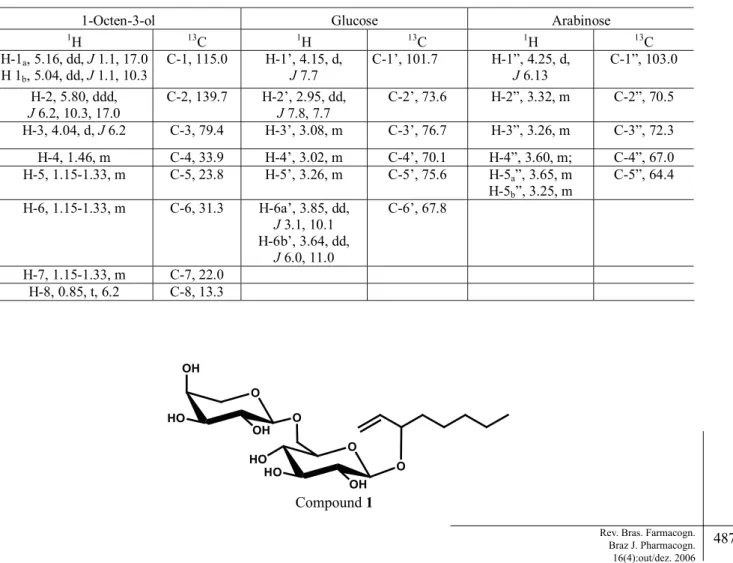
exhibited signal pattern for an aliphatic chain bearing a terminal vinyl group and a disaccharide moiety (Table 1 –Jdata were listed with basis on the apodized spectra). The olefi nic protons H-1a (J17.0 Hz) and H-1b (J10.3 Hz) were assigned to be trans and cisin relation to H-2, respectively.
The 13C NMR data (DMSO-d
6, 50 MHz) for
compound1confi rmed the aliphatic chain and defi ned its length. The chain was composed by eight carbons (C-1, 115.0 ppm; C-2, 139.7 ppm; C-3, 79.4 ppm; C-4, 33.9 ppm; C-5, 23.8 ppm; C-6, 31.3 ppm; C-7, 22.0 ppm and C-8, 13.3 ppm). The signals attributed to the aliphatic chain are in agreement with the literature data (Yoshikawa et al., 1998; Wang et al., 1998 and Kanchanapoom et al., 2001). Our assignment was confi rmed unambiguously by 2D-NMR APT, HETCOR and COSY 1H,1H data. In the
reported study by Yamamura et al. (1998), C-1 and C-2 signals of the aliphatic chain were wrongly interchanged, because of the absence of 2D-NMR experiments.
The presence of a down-fi eld signal at 79.4 ppm indicated the attachment point of the disaccharide unit (64.4-103.0 ppm) to the aliphatic chain. From the
13C NMR data (APT, HETCOR and COSY 1H,1H), this
disaccharide unit is composed by a ȕ-glucopyranosyl inner moiety linked to an Į-arabinopyranosyl unit, by a
1-Octen-3-ol Glucose Arabinose 1
H 13C 1H 13C 1H 13C
H-1a, 5.16, dd, J1.1, 17.0 H 1b, 5.04, dd, J1.1, 10.3
C-1, 115.0 H-1’, 4.15, d,
J 7.7
C-1’, 101.7 H-1”, 4.25, d,
J6.13
C-1”, 103.0
H-2, 5.80, ddd,
J6.2, 10.3, 17.0
C-2, 139.7 H-2’, 2.95, dd,
J 7.8, 7.7
C-2’, 73.6 H-2”, 3.32, m C-2”, 70.5
H-3, 4.04, d, J6.2 C-3, 79.4 H-3’, 3.08, m C-3’, 76.7 H-3”, 3.26, m C-3”, 72.3
H-4, 1.46, m C-4, 33.9 H-4’, 3.02, m C-4’, 70.1 H-4”, 3.60, m; C-4”, 67.0
H-5, 1.15-1.33, m C-5, 23.8 H-5’, 3.26, m C-5’, 75.6 H-5a”, 3.65, m
H-5b”, 3.25, m
C-5”, 64.4
H-6, 1.15-1.33, m C-6, 31.3 H-6a’, 3.85, dd,
J 3.1, 10.1 H-6b’, 3.64, dd,
J 6.0, 11.0
C-6’, 67.8
H-7, 1.15-1.33, m C-7, 22.0
H-8, 0.85, t, 6.2 C-8, 13.3
Table 1.1H (200 MHz) and 13C NMR (50 MHz) data obtained for compound 1 in DMSO-d
6and expressed in G ppm
(JHz).
Compound1
O HO
HO
OH O O
OH
HO
1o6 interglycosidic bound. Table 1 shows all the 1H and 13C NMR data for compound 1.
A sample of 1 was submitted to a hydrolysis reaction, with trifl uoroacetic acid solution (4 M). The hydrolyzed material as well as standard samples of L-arabinose and D-glucose was separately submitted to the acetylation reaction for posterior analysis in GC-MS.
The GC-MS analysis of the acid hydrolysate of compound1, after acetylation, confi rmed the presence of glucose and arabinose in its structure. Two peaks were detected for the carbohydrate residues present in the per-acetylated hydrolysate. The peak observed at tR111.28 min that showed M+· ion peak at m/z 259 (diagnostic ions at m/z 199, 170, 157, 128, 115, 100, 86, 73) was identifi ed as the corresponding per-acetylated arabinose by comparison with the per-acetylated L-arabinose authentic sample. A second peak at tR2 13.34 min, and M+· ion at m/z 331 (diagnostic ions at m/z 273, 242, 228, 211, 199,182, 168, 157, 140, 126, 115, 98, 85, 73, 57) exhibited the same values found for the per-acetylated D-glucose authentic sample.
Therefore, compound 1 was identifi ed as 1-octen-3-0-arabinopyranosyl-(1o6)-E-glucopyranoside.
DISCUSSION
The glycoconjugate 1-octen-3-0
-arabinopyranosyl-(1o6)-E-glucopyranoside was
fi rst isolated from leaves of Trifolium subterraneum
(Fabaceae) (Wang et al., 1998). The chemical structure was based on NMR data using CD3OD as solvent and no biological activity was atributed to this compound. Our NMR data obtained using DMSO-d6are very close to that observed previously.
As far we know, only four other glycosides of 1-octen-3-ol were reported: the 1-octen-3-0 -glucopyranosyl-(1o6)-E-glucopyranoside (Yoshikawa et al., 1998); the (3R)-1-octen-3-O-E-D-xylopyranosyl-(1o6)-O-E -D-glucopyranoside (Yamamura et al., 1998; Kanchanapoom et al., 2001) and two triglycoside: (3R)-1-octen-3-O-E -D-xylopyranosyl-(1”’o6’)-O->E-D-glucopyranosyl-(1”o 2’)@-O-E-D-glucopyranoside (Kanchanapoom et al., 2001) and 1-octen-3-yl-O-E-apiofuranosyl-(1o6)-O
->E-D-glucopyranosyl-(1o2)@-E-glucopyranoside (Çaliú; Kirmizibekmez, 2004).
The 1-octen-3-ol glycosides reported until now have been isolated from plants belonging to few families such as Acanthaceae (Kanchanapoom et al., 2001), Fabaceae (Wang et al., 1998), Lamiaceae (Yamamura et al., 1998; Çaliú and Kirmizibekmez, 2004) and Orchidaceae (Yoshikawa et al., 1998). At our knowledge, there is no biological activity correlated with any of these compounds.
The aliphatic alcohol 1-octen-3-ol is a component of fl avour mixtures of some mushrooms (Wood et al., 2001) and plants, especially Lamiaceae
species (Mastelic; Jerkovic, 2003). It was demonstrated
that this volatile alcohol has antifeedant properties (Wood et al., 2001). In Basidiomycetes, 1-octen-3-ol is produced by the action of a specifi c hydroperoxide lyase on 10-hydroperoxy-8 (E), 12 (Z)-octadienoic acid (Delcarte et al., 2000).
The alcohol 1-octen-3-ol was also identifi ed as the major volatile component from the millipede Niponia glandulosa secretion (Ômura et al., 2002).
In plants, the alcohol volatile compounds have been identifi ed as free compounds or their glycoconjugated compounds (Jerkovic; Mastelic, 2001).
It is interesting to note that D-L- octil-arabinopyranosyl-(1o6)-E-D-glucopyranoside, a rare glycoside, was isolated from the traditional Chinese medicine Rhodiola quadrifi da which is also a Crassulaceae member (Yoshikawa et al., 1995). Despite the lack of the vinyl group, this glycoside could be originated as compound 1 from a similar pathway.
This is the second report on the isolation of 1-octen-3-0-arabinopyranosyl-(1o6)-E-glucopyranoside that is here described for the fi rst time in Crassulaceae. This rare glycoconjugated from 1-octen-3-ol may play an important role of storage of the volatile aglycone in the plant.
ACKNOWLEDGEMENTS
We are indebted with Dr. A. L. Scofi eld (PUC, RJ, Brazil) and E. Miguez (NPPN, UFRJ, Brazil) for the NMR spectra. A.P. de Almeida and M. F. Muzitano thank CNPq and CAPES (Brazil) for fellowship, respectively.
REFERENCES
Allorge-Boiteau L 1996. Madagascar Centre de Spéciation et d’Origine du Genre Kalanchoe (Crassulaceae). In: Lourenço, W.R. (org.) Biogéographie de Madagascar.
Paris: Editions de l’ORSTOM, p.137-145.
Almeida AP, Da Silva SAG, Souza MLM, Lima LMTR, Rossi-Bergmann B, Gonçalves De Moraes VL, Costa SS 2000. Isolation and chemical analysis of a fatty acid fraction of Kalanchoe pinnata with a potent lymphocyte suppressive activity.Planta Med 66: 134-137.
Barbosa-Filho JM, Medeiros KCP, Diniz MFFM, Batista LM, Athayde-Filho PF, Silva MS, Cunha EVL, Almeida JRGS, Quintans-Júnior LJ 2006. Natural products inhibitors of the enzyme acetylcholinesterase. Rev Bras Farmacogn 16: 258-285.
Çaliþ Ý, Kirmizibekmez H 2004. Glycosides from Phlomis lunariifolia.Phytochemistry 65: 2619-2625.
Costa SS, Jossang A, Bodo B 1995. Propriétés biologiques et phytochimie des Kalanchoe. In: Boiteau, P.; Allorge-Boiteau, L. (org.) Kalanchoe (Crassulacées)
de Madagascar, Systématique, écophysiologie et phytochimie. Paris: Edition Karthala, p.219-235. Costa SS, Souza MLM, Ibrahim T, Melo GO, Almeida AP,
1-Octen-3-O-Į-L-arabinopyranosyl (1ĺ6)-ȕ-glucopyranoside, a minor substance from the leaves of Kalanchoe pinnata (Crassulaceae)
brasiliensis. J Nat Prod 69: 815-818.
Da-Silva SAG, Costa SS, Mendonça SCF, Silva EM, Moraes VLG, Rossi-Bergmann B 1995. Therapeutic effect of oral Kalanchoe pinnata leaf extract in murine Leishmaniasis.Acta Trop 60: 201-210.
Da-Silva SAG, Costa SS, Rossi-Bergmann B 1999. The antileishmanial effect of Kalanchoe is mediated by nitric oxide intermediates. Parasitology 118: 575-582.
Delcarte J, Fauconnier M, Hoyaux P, Jacques P, Thonart P, Marlier M 2000. Revue Bibliographique: L’hydroperoxyde Lyase. Biotechnology, Agronomy, Society and Environment 4: 157-167.
Falcão HS, Lima IO, Santos VL, Dantas HF, Diniz MFFM, Barbosa-Filho JM, Batista LM 2005. Review of the plants with anti-infl ammatory activity studied in Brazil.Rev Bras Farmacogn 15: 381-391.
Fonseca FV, Melo MM, Silva J, Pereira GP, Dantas-Barros AM 2004. Extratos de Curcuma longa L. e
Kalanchoe brasiliensis Camb. no tratamento local do envenenamento por Bothrops alternatus. Rev Bras Farmacogn 14(Supl. 1): 26-29.
Hema D, Tidjani M, Bassene E, Pousset JL, Giono-Barber H 1986. Plantes médicinales Africaines XXXIV Étude de l’action anti-infl ammatoire de Bryophyllum pinnatum
(Crassulacées).Plantes Médicinales et Phytothérapie 20: 231-235.
Ibrahim T, Cunha JM, Madi K, da Fonseca LM, Costa SS, Gonçalves Koatz VL 2002. Immunomodulatory and anti-infl ammatory effects of Kalanchoe brasiliensis. Int Immunopharmacol 2: 875-883.
Jerkovic I, Mastelic J 2001. Composition of free and glycosidically bound volatiles of Mentha aquatica L.
Croat Chem Acta 74: 431-439.
Kanchanapoom T, Kasai R, Picheansoonthon C, Yamasaki K 2001. Megastigmane, aliphatic alcohol and benzoxazinoid glycosides from Acanthus ebracteatus.
Phytochemistry 58: 811-817.
Mastelic J, Jerkovic I 2003. Gas Chromatography-Mass Spectrometry analysis of free and glycoconjugated aroma compounds of seasonally collected Satureja montana L. Food Chem 80: 135-140.
Mourão RH, Santos FO, Franzotti EM, Moreno MP, Antoniolli AR 1999. Antiinfl ammatory activity and acute toxicity (LD50) of the juice of Kalanchoe brasiliensis (Camb.) leaves picked before and during blooming. Phytother Res 13: 352-354.
Muzitano MF, Cruz EA, de Almeida AP, da Silva SA, Guette C, Kaiser CR, Rossi-Bergmann B, Costa SS 2006. Quercitrin: an antileishmanial fl avonoid glycoside fromKalanchoe pinnata. Planta Med 72: 81-83. Ômura H, Kuwahara Y, Tanabe T 2002. 1-Octen-3-ol together
with geosmin: New secretion compounds from a polydesmid millipede, Niponia nodulosa. J Chem Ecol 28: 2601-2612.
Pichersky E, Gershenzon J 2002. The formation and function of plant volatiles: perfumes for pollinator attraction and defense.Curr Opin Plant Biol 5: 237-243.
Rossi-Bergmann B, Costa SS, Borges MBS, Da Silva SAG, Noleto GR, Souza MLM, Moraes VLG 1994. Immunosuppressive effect of the aqueous extract of
Kalanchoe pinnata in mice. Phytother Res 8: 399-402.
Syed Z, Guerin PM 2004. Tsetse fl ies are attracted to the invasive plantLantana camara. J Insect Physiol 50: 43-50. Walton VM, Daane KM, Pringle KL 2004. Monitoring
Planococcusfi ccus in South African vineyards with sex pheromone-baited traps. Crop Prot 23: 1089-1096.
Wang S, Ghisalberti EL, Ridsdill-Smith J 1998. Bioactive isofl avonols and other components from Trifolium subterraneum.J Nat Prod 61: 508-510.
Wood WF, Archer CL, Largent DL 2001. 1-Octen-3-ol, a banana slug antifeedant from mushrooms. Biochem Syst Ecol 29: 531-533.
Yadav NP, Dixit VK 2003. Hepatoprotective activity of leaves of Kalanchoe pinnata Pers. J Ethnopharmacol 86: 197-202.
Yamagishi T, Haruna M, Yan XZ, Chang JJ, Lee KH 1989. Bryophyllin B, a novel potent cytotoxic bufadienolide from Bryophyllum pinnatum. J Nat Prod 52: 1071-1079.
Yamamura S, Ozawa K, Ohtani K, Kasai R, Yamasaki K 1998. Antihistaminicfl avones and aliphatic glycosides from
Mentha spicata.Phytochemistry 48: 131-136. Yoshikawa M, Murakami T, Kishi A, Sakurama T, Matsuda
H, Nomura M, Matsuda H, Kubo M 1998. Novel indole S,O-bisdesmoside, Calanthoside, the precursor glycoside of tryptanthrin, indirubin, and isatin, with increasing skin blood fl ow promoting effects, from two Calanthe species (Orchidaceae). Chem Pharm Bull 46: 886-888.
Yoshikawa M, Shimada H, Shimoda H, Matsuda H, Yamahara J, Murakami N 1995. Rhodiocyanosides A and B, new antiallergic cyanoglycosides from Chinese natural medicine “Si Lie Hong Jing Tian”, the underground part of Rhodiola quadrifi da (Pall.) Fisch. et Mey.
Chem Pharm Bull 43: 1245-1247.