Responses of water mite assemblages (Acari) to environmental parameters
at irrigated rice cultivation fields and native lakes
Guilherme L. da Silva
1, Maicon H. Metzelthin
2, Tairis Da-Costa
2, Matheus S. Rocha
3,
Darliane E. Silva
2, Noeli J. Ferla
2, Onilda S. da Silva
11Departamento de Microbiologia, Imunologia e Parasitologia, Universidade Federal do Rio Grande do Sul. Rua Sarmento Leite 500, 90050-170 Porto Alegre, RS, Brazil.
2Laboratório de Acarologia, Tecnovates, UNIVATES – Universidade do Vale do Taquari. Rua Avelino Talini 171, 95914-014 Lajeado, RS, Brazil.
3Laboratório de Diversidade e Sistemática de Arachnida, Universidade do Vale do Rio dos Sinos. Avenida Unisinos 950, 93022-000 São Leopoldo, RS, Brazil.
Corresponding author: Guilherme Liberato da Silva ([email protected])
http://zoobank.org/962071A9-11FA-4DE9-90DF-D80AD3493C69
ABSTRACT. Many studies have revealed that water mite communities can be affected by the physical and chemical parameters of the water. The similarity between the water ‘mite assemblages in local water bodies and in irrigated rice areas can be a way to measure the water conditions, enabling an assessment of the anthropic impact in the environment. The aim of this study was to evaluate the distribution of water mites in lakes and irrigated rice fields in south Brazil. To accomplish that we characterized the distinctive environments using physical and chemical variables such as pH, turbidity (NTU), water tempera-ture (°C) and dissolved oxygen (mg/L), in order to verify the influence of these abiotic factors on the species composition of water mite communities; and to compare water mite abundance, richness and composition among different habitats. We assessed three native lakes and four sites with irrigated rice cultivation. Our results showed, for the first time in Brazil, strong correlations between the water mite fauna and turbidity. In addition, native lakes were richer and had greater mite abundance when compared with the irrigated rice areas.
KEY WORDS. Coastal plain, habitat, physical and chemical variables, rice field, water mite.
INTRODUCTION
Most freshwater mites belong to Hydrachnidiae (Acari: Prostigmata), which are represented by ca. 6,000 species. These mites can live in wetlands, temporary pools, springs, marine habitats, torrential waterfalls, ponds, streams and lakes (Smith and Cook 1991, Goldschmidt 2016). Another important acarine group that inhabits aquatic zones includes members of the sub-order Oribatida. These mites can be abundant, but their species richness is very low (Fernandez and Athias-Binche 1986). Water mites have been used as environmental quality bioindicators in several ecosystems (Biesiadka and Kowalik 1991, Rousch et al. 1997, Di Sabatino et al. 2002, Dohet et al. 2008, Goldschmidt 2016). Many studies have revealed that water mite communities can be affected by several abiotic factors, such as pollution agents
and variations in temperature, dissolved oxygen, conductivity and carbonate concentrations (Schwoerbel 1961, Wi cek et al. 2013). Many efforts are being made to effectively employ mites as ecological indicators, including faunal monitoring programs (Goldschmidt 2016).
Brazil is the ninth leading rice grower in the world, and the state of Rio Grande do Sul accounts for approximately 69% of country’s rice production (IBGE 2015). With the addition and growth of areas of irrigated crop production such as rice, monitoring water quality has acquired growing importance. In Brazil, the Restinga in the South is one of the regions where there is massive irrigated rice cultivation. This region includes a portion of the Atlantic forest biome and it is under extreme anthropogenic pressure, which has modified the natural land-scapes (Ab’Saber 2003). The decline in water quality resulting
RESEARCH ARTICLE
from intense contamination has resulted in decreasing numbers of water mites, lower water mite diversity and in some cases, a collapse of the water mite fauna (Kowalik and Biesiadka 1981).
In general, the water used to irrigate crops comes from several freshwater lakes and ponds located in the vicinities of crop fields. Therefore, comparisons between the water mite as-semblages from native lakes and irrigated rice areas can be used to measure water quality, enabling an assessment of the impact of agriculture on the environment.
The composition of water mite species in irrigated rice areas is generally poorly understood. This work is the first trying to ascertain the water mite community in such an environment. This study has two goals: (1) to compare the abundance, richness and composition of the water mite fauna from different habitats; (2) to verify the influence of the following abiotic factors on spe-cies composition: pH, turbidity (NTU), water temperature (°C), and dissolved oxygen (mg/L). Our hypotheses are: (1) Different habitats should influence the abundance, richness and species composition of the water mite community; (2) water mites should respond to the physical and chemical parameters mea-sured, reflecting the different conditions of their sample sites.
MATERIAL AND METHODS
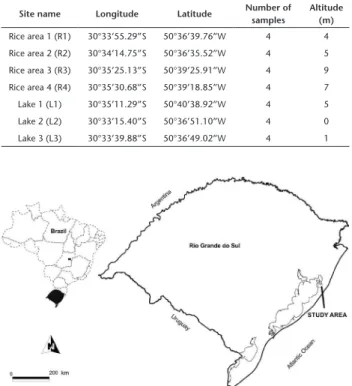
Our study was conducted in the municipality of Mostar-das, Rio Grande do Sul, Brazil. The study area is situated in the coastal plains (Table 1) (Assis et al. 2011, Magnago et al. 2010). The original vegetation cover is open. It is dominated by herba-ceous plants and shrubs that have xerophytic adaptations (Assis et al. 2011, Lima et al. 2011), together with other associated Atlantic forest elements (Magnago et al. 2010).
All rice areas from which samples were taken for this sur-vey had been cultivated for three months, and were in the mid to late vegetative phase (tillering to stem elongation) to mid to late reproductive phase (heading to flowering), when the rice fields were flooded. We chose seven sampling areas: four at an irrigated rice cultivation area (R1, R2, R3, R4), in which sampling was carried out during the rice growing season (January-March/15); and three in native lakes (L1, L2, L3) (Figs 1–9). Both L2 and L3 are connected by a narrow water channel. The rice areas R1 and R2 are supplied by L2 and L3 (distance among rice areas to native lakes: 1 km) placed in Farm 1, whereas R3 and R4 are supplied by the northern portion of a lagoon known as Lagoa dos Patos. This lagoon is separated from the Atlantic Ocean by a barrier beach system. According to Madeira-Falceta (1974), the salinity levels in the northern part of this lagoon are very low (freshwater). The L1 area is a permanent native lake, isolated from human disturbances and away from rice areas. The distance from R3, R4 to L1 is 2 km, the former two located in Farm 2. The distance between these two farms (Farm 1 and 2) is 5 km.
The native lake areas had the following characteristics: permanent lakes, and surrounding vegetation consisting basi-cally of grasses. Cattle rearing and fishing are a very common
practice near L2 and L3. Additionally, there are aquatic macro-phytes (Salvinia spp., Pistia spp., Eleocharis spp., Lemma spp.) often covering the surface of the water.
Samplings were carried out from January to March 2015, two per month. In March, only one sampling was performed, on the first week of the month. A total of five samplings were carried out at each area. For the assessment of species’ composi-tion, only adult mites were evaluated. For this reason, L1, L2, L3, R1 were used in all data analyses, whereas only three samplings from rice areas R2 and R3, and four from R4, were analyzed.
Samples were collected five meters from the margin of the lake and rice field at maximum of 40 cm depth. Each sample consisted of 10 liters of water collected using a plastic tray (50 x 30 cm), and filtered through a net (mesh size 250 µm). The water mites caught in the net were transported to the laborato-ry in water gallons, and were later preserved in Koenike’s fluid (Mitchell and Cook 1952, Barr 1973).
Specimens were identified to species using a phase-con-trast light microscope (Leica DM750) with the help of identifi-cation keys (Rosso de Ferradás and Fernández 2009, Smith et al. 2009). Specimens collected were deposited in the mite reference collection of the Museum of Natural Sciences of the University Center UNIVATES (ZAUMCN), Lajeado, Rio Grande do Sul, Brazil.
Table 1. Seven sampled areas with geographical coordinates and numbers of samples collected between January to March 2015.
Site name Longitude Latitude Number of samples
Altitude (m) Rice area 1 (R1) 30°33’55.29”S 50°36’39.76”W 4 4
Rice area 2 (R2) 30°34’14.75”S 50°36’35.52”W 4 5
Rice area 3 (R3) 30°35’25.13”S 50°39’25.91”W 4 9
Rice area 4 (R4) 30°35’30.68”S 50°39’18.85”W 4 7
Lake 1 (L1) 30°35’11.29”S 50°40’38.92”W 4 5
Lake 2 (L2) 30°33’15.40”S 50°36’51.10”W 4 0
Lake 3 (L3) 30°33’39.88”S 50°36’49.02”W 4 1
We measured the values of water temperature, turbidity, pH and dissolved oxygen using portable instruments (DM-2P; DM-4P; DM-TU: Digimed) and all variables were measured when and where samples were collected. There were no records of phytosanitary treatments with pesticides during the study, in the sampling areas.
At each sampling point, species composition was analyzed considering the abundance of each species per location (quan-titative data). In order to investigate whether abundance and richness of mite species varied according to the different areas, factor analyses of variance (Factorial ANOVA) were performed. These areas were characterized in three clusters of environments (R1-R4, L2-L3, L1). Based on these quantitative data, we obtained an association matrix between sampling points using Bray-Curtis similarity indices.
Using distance matrices calculated based on mite species composition, we performed an ordination using a Non-Metric Multidimensional Scaling (NMDS) with Bray-Curtis (quanti-tative) and Jaccard (quali(quanti-tative) distance and two dimensions to visualize how species composition varied between envi-ronments (Rice Areas R1-R4 vs. Native lakes L2-L3 vs. L1). Species abundance and values of abiotic and biotic factors were Log transformed (x+1) and subsequently normalized and centralized through vectored transformations. Additionally, in order to reveal the effects of the environment on community dissimilarity, we tested whether abiotic and biotic factors adjusted to the ordination model (NMDS) by using the En-vfit function. The One-factor Similarity Analyses (ANOSIM) (Clarke and Warwick 2001) tested for statistical differences in the composition of communities from different environments. SIMPER analysis (Similarity Percentage) was applied to assess which species contributed to the similarity/dissimilarity among environments (Clarke and Warwick 2001). The contribution amounts of each species were expressed as a percentage. Transformations of abundances and values of environmental factors were calculated using MULTIV software (Pillar 2004). Factorial ANOVA’s and linear regressions were verified using the statistical program SYSTAT 13 (Systat Inc.). ANOSIM and SIMPER multivariate analyses were carried out using the PASt program (Paleontological Statistics, version 1.97) (Hammer et al. 2009). Mantel’s, NMDS and Envfit analyses were performed using the R program, “vegan” package. The significance level was p < 0.05 for all statistical tests.
RESULTS
We found a total of 514 water mites, 477 were adults, distributed in 9 families, 10 genera and 19 species/morphos-pecies (Table 2).
The most abundant water mite morphospecies were Koeni-kea sp. 1 (Unionicolidae) (179 specimens), followed by Limnesia
sp. 1 (84) (Limnesiidae) and Koenikea sp. 3 (38). Among the areas evaluated, L1 was the richest (15 species), followed by L2 (10)
and L3 (9); and the order of abundance was L1 (197 specimens) followed by R2 (88) and L2 (61).
The abundance (N) of adult mites differed among the envi-ronments surveyed (F2,27 = 6.871, p = 0.004). The Tukey post-hoc test revealed differences between L1 and the rice areas (R1-R4) (p = 0.003), but not between L1 and L2, L1 and L3 (p = 0.117); thus, R1-R4 and L2-L3 (p = 0.178) (Fig. 10). Regarding richness, there was a significant difference among environments (F2,27 = 11.663, p < 0.001). The Tukey post-hoc test revealed a difference in richness between L1 and the rice areas (R1-R4) (p < 0.001), L1 with L2-L3 (p = 0.005) and R1-R4 with L2-L3 (p = 0.003) (Fig. 11). The mite fauna composition among environments was significantly different (Bray-Curtis: R2 = 0.2657, p = 0.01; Jaccard: R2 = 0.1551, p < 0.001) (Figs 12, 13). The post-hoc test showed differences in mite composition among L1 and the rice areas (R1-R4) (Bray-Curtis, p = 0.002; Jaccard, p = 0.003) and among L1 and L2, L3 (Bray-Curtis, p = 0.004; Jaccard, p = 0.002), but not among R1-R4 and L2-L3 (Bray-Curtis, p = 0.2946; Jaccard, p = 0.3934). Through SIMPER analysis, the Limnesia sp. 4 (Lim-nesiidae) (Contrib.% 20.1), Oribatulidae (Contrib.% 16.44) and
Arrenurus sp. 1 (Arrenuridae) (Contrib.% 14.35) with higher
Table 2. List of water mite species and number of individuals collected (January to March/2015) in three lakes (L1, L2, L3) and four irrigated rice area cultivation (R1, R2, R3, R4) in Southern Brazil.
Order Family Species Rice area 1 (R1)
Rice area 2 (R2)
Rice area 3 (R3)
Rice area 4
(R4) Lake 1 (L1) Lake 2 (L2) Lake 3 (L3) Total
Trombidiformes
Arrenuridae
Arrenurus sp. 1 7 3 6 – 5 4 7 32
Arrenurus sp. 2 – – – 1 5 2 – 8
Arrenurus sp. 3 – – – – 1 1 – 2
Eylaidae Eylais sp. – – – – 1 – – 1
Hydrodromidae Hydrodroma sp. 1 – – – – 36 – – 36
Hydrodroma sp. 2 – – – – 1 – – 1
Hydryphantidae Hydryphantes sp. – – – – 5 – – 5
Limnesiidae
Limnesia sp. 1 6 2 18 11 2 21 24 84
Limnesia sp. 2 – – – – 1 2 4 7
Limnesia sp. 3 – 1 1 – – 1 4 7
Limnesia sp. 4 – – – – – – 4 4
Limnesia sp. 5 – – – – – – 2 2
Pionidae Piona sp. 5 – 3 8 – 11 3 30
Unionicolidae
Koenikea sp. 1 3 47 1 2 121 3 2 179
Koenikea sp. 2 – 4 – – 8 – – 12
Koenikea sp. 3 1 31 1 3 1 1 – 38
Neumania sp. – – – – 1 - – 1
Sarcoptiformes Oribatulidae sp. – – – – 6 15 4 25
Ctenacaridae sp. – – – – 3 – – 3
Total 22 88 30 25 197 61 54 477
Figures 12–13. Ordination diagram (first two axes) of Non-Metric Multidimensional Scaling (NMDS) using (12) Bray-Curtis and (13) Jaccard indexes with Envfit function for the evaluated environments. (▲ Lake 1, ■ Lake 2 and 3, ● Rice Area). Stress: 0.15.
ues of abundance R1-R4 and at L2-L3, Ctenacaridae (Contrib.% 16.07) and Hydryphantes sp. (Hydryphantidae) (Contrib.% 10.31) contributed the most to the dissimilarity among environments. Thus, Arrenurus sp. 2 (Contrib.% 4.721) and Limnesia sp. 2 (Con-trib.% 2.085) had higher values of abundance in L1.
Among the evaluated environmental parameters (Ta-ble 3), the Envfit analysis demonstrated that turbidity (r2 =
DISCUSSION
We found differences in the composition of the water mite communities between rice areas and the isolated native lake in which the parameter turbidity influenced the composition of the population of water mites. In addition, it was possible to observe that the native lakes carry a greater richness of water mite species when compared with irrigated rice areas. The greatest number of species was found in native ponds, not in rice areas. Eylais
sp., Hydrodroma species, Neumania sp. and Ctenacaridae were exclusively collected in L1, Limnesia sp. 3 and Limnesia sp. 4 in L3. Only two species were present in all samples sites, Koenikea
sp. 1 and Limnesia sp. 1, while all species that were present in rice areas were also found simultaneously in one of the native lakes. No species occurred exclusively in rice areas.
The greater abundance and richness of water mites in L1 may be due to the low levels of turbidity, and the fact that this lake is isolated and does not suffer the impact of human action. The turbidity of the water is caused by the suspended sediment. These can originate from the organic input from microorgan-isms, including bacteria and algae, and external input from leaf litter and debris, and decaying carcasses of invertebrates (Laessle 1961, Maguire Jr 1971). In addition, high turbidity levels can decrease the penetration of light and reduce the water quality, significantly reducing the water resources utilized by these mites (Copatti et al. 2013). Some of the water mite species are strongly positively phototropic; however, each family responds different-ly to various wavelengths (Roberts et al. 1978). No relationships were found between the composition of water mite species and the other physical and chemical variables such as pH, dissolved O2 and water temperature. Więcek et al. (2013) found a strong correlation between the water mite fauna, and the environment variables such as conductivity and pH gradient; however, those authors did not measure turbidity. Both pH and conductivity can be used to assess the mineral richness of the water.
An explanation for a higher richness of water mites at certain sites than at others is the differing dispersion ability of these arthropods. The dispersion process is very important, since it allows the expansion of mite populations, the colonization of different areas, and escaping from natural enemies (Binns 1982,
Zawal et al. 2013, Knee et al. 2013). Most larval water mites are parasites of insect, which facilitates their dispersal (Smith et al. 2009, Williams and Proctor 2002). The phoretic behavior observed in several families of water mites allows for a passive transport of dispersion (Zawal et al. 2013). There are several records of Arrenurus, Hydrachna and Limnochares involving para-sitized insects (Munchberg 1954, Mullen 1975, Stechmann 1980, Smith and Cook 1991, Snell and Heath 2006, Milne et al. 2009, Kirkhoff et al. 2013). It is possible that the absence of mite host taxa could be responsible for the low number of mites. Another, simpler explanation, is that richness has decreased in response to environmental changes.
Furthermore, we suggest that the dispersion pathways used by water mites to colonize adjacent environments are related to the route of the flow paths, as it can be observed in many species collected in this study (Arrenurus sp. 1, Limnesia
sp. 1, Limnesia sp. 3, Piona sp., Koenikea sp. 1, Koenikea sp. 3) and which were found simultaneously in the native lake areas (L2-L3) that supply the rice areas (R1-R2).
Several species of water mites exploit aquatic plants, since these plants create the substrate required for the life cycles of water mites and their hosts. Several water mites lay eggs and transform from deutonymphs to tritonymphs among aquatic mosses and macrophytes (Smith et al. 2009). Macrophyte plants offer suitable conditions for various host taxa, playing a large role in the dispersion and colonization of new patches by water mites (Martin 2008). Therefore, the presence of macrophytes in general in lakes probably is probably a factor influencing water mite diversity. Wi cek et al. (2013) reported that some species of
Arrenurus are associated with abundant growth of macrophytes. The conservation of native lakes is very important to pre-serve biodiversity. Thus, aquatic mites might be used as diversity bioindicators when comparing natural and anthropized envi-ronments. Young (1969) described that water mite communities (diversity, abundance and community structure) are sensitive to contamination. Several sensitive species are restricted to very clean water and immediately respond to the early contamination of their environment. Thus, water mites are excellent indicators of pure water conditions and provide a powerful early warning system (Zawal 1996, Miccoli et al. 2013). Species of the genus Lim-nesia are very sensitive to altered sites (Van der Hammen and Smit 1996) and, according to our study, Limnesia sp. 4 showed greater dissimilarity in R1-R4 and L2-L3 environments while Ctenaca-ridae, Hydryphantes sp., Arrenurus sp. 2 and Limnesia sp. 2 to L1.
The abundance and diversity of water mites was significant-ly higher in unpolluted sites (Growns 2001). Water mites can be powerful biomonitoring tools, fulfilling all adequate requirements for a bioindicator (Goldschmidt 2016). Our results confirm that anthropized areas have lower richness of water mites than native areas, as suggested by Katayama et al. (2015). They observed a decline in richness and abundance at a consolidated rice field. In the future, it is possible that water mites will be implemented in faunal surveys as an important group for biomonitoring,
be-Table 3. Physiochemical variables (mean ± SE) evaluated from different habitats in this study (Jan-Mar/15).
Site name pH Water temperature (°C)
O2 dissolved
(mg/l) Turbidity (NTU) Rice area 1 (R1) 7.73 ± 0.5 26.13 ± 1.49 5.08 ± 0.86 41.43 ± 20.33
Rice area 2 (R2) 7.56 ± 0.5 26.5 ± 1.58 4.8 ± 0.88 46.89 ± 46.05
Rice area 3 (R3) 7.51 ± 0.9 28.38 ± 2.14 5.55 ± 1.64 31.42 ± 33.48
Rice area 4 (R4) 7.67 ± 0.7 29.88 ± 3.28 6.25 ± 1.37 7.05 ± 2.46
Lake 1 (L1) 8.31 ± 0.2 28.5 ± 1.58 5.2 ± 0.84 5.80 ± 6.51
Lake 2 (L2) 8.09 ± 0.6 25.5 ± 1.68 3.48 ± 0.71 29.14 ± 10.67
coming an important tool in areas of environmental protection where there are watercourses. The water mite community is not sufficiently known yet. Considering Brazil’s vast territory with large affluent and unexplored areas, it would be important to carry out more studies in the country. This study compared, for the first time, the water mite species from native lakes associated with irrigated rice areas in southern Brazil.
ACKNOWLEDGMENTS
The authors thank CAPES-Brazil for the doctoral scholar-ship for the first author. UNIVATES for the opportunity to carry out the practical part of this study. We would like to extend our gratitude to the agronomist Miguel Guedes and Geraldo “Fion” for providing study areas and Vanessa Fischer for pro-viding language help. We thank to the members of Laboratório de Biorreatores – UNIVATES University Center for providing the equipment to measure the environmental variables. NJ Ferla is supported by CNPq productivity research scholarship (311307/2014-0).
LITERATURE CITED
Ab’Saber AN (2003) Os domínios de natureza no Brasil: potencia-lidades paisagísticas. Ateliê Editorial, São Paulo.
Assis MA, Prata EMB, Pedroni F, Sanchez M, Eisenlohr PV, Mar-tins FR, Santos FAM, Tamashiro JY, Alves LF, Vieira SA, Piccolo MC, Martins SC, Camargo PB, Carmo JB, Simões E, Martinelli LA, Joly CA (2011) Florestas de restinga e de terras baixas na planície costeira do sudeste do Brasil: vegetação e heteroge-neidade ambiental. Biota Neotropica 11: 103–121. https://doi. org/10.1590/S1676-06032011000200012
Barr D (1973) Methods for the Collection, Preservation and study of Water Mites (Acari: Parasitengona). Royal Ontario Museum, Life Sciences Division, Toronto.
Biesiadka E, Kowalik W (1991) Water mites (Hydracarina) as indi-cators of trophy and pollution in lakes. In: Dusbabek F, Bukva V (Eds) Modern Acarology 1. SPB Academic Publishing BV, The Hague, 475–481.
Binns ES (1982) Phoresy as migration some functional aspects of phoresy in mites. Biological Reviews 57: 571–620. https://doi. org/10.1111/j.1469-185X.1982.tb00374.x
Clarke KR, Warwick RM (2001) Change in marine communities: an approach to statistical analysis and interpretation. PRIMER-E, Plymouth, UK.
Copatti CE, Fagundes LS, Quaini JB, Copatti BR (2013) Diversity of aquatic arthropods on Eichhornia crassipes (Mart.) Solms roots before and after removal of substrate in a reservoir in southern Brazil. Pan-American Journal of Aquatic Sciences 8: 265–275. Di Sabatino A, Martin P, Gerecke R, Cicolani B (2002) Hydrachnidia
(water mites). In: Rundle SD, Robertson AL, Schmid-Araya JM (Eds) Freshwater meiofauna: biology and ecology. Backhuys Publishers, Leiden, 105–133.
Dohet A, Ector L, Cauchie H, Hoffmann L (2008) Identification of benthic invertebrate and diatom indicator taxa that distinguish different stream types as well as degraded from reference con-ditions in Luxembourg. Animal Biology 58: 419–472. https:// doi.org/10.1163/157075608X383719
Fernandez NA, Athias-Binche F (1986) Analyse demographique d’une population d’Hydrozetes lemnae Coggi, Acarien Oribate infeode a la lentille d’eau Lemna gibba L. en Argentine. I. Methodes et techniques, demographie d’ H. lemnae comparaisons avec d’autre Oribates. Zoologisches Jahrbuch Systematik 113: 213–228. Goldschmidt T (2016) Water mites (Acari, Hydrachnidia):
power-ful but widely neglected bioindicators – a review. Neotropical Biodiversity 2: 12–25. https://doi.org/10.1080/23766808.201 6.1144359
Growns JE (2001) Aquatic mites as bioindicators, with an Austra-lian example. In: Halliday RB, Walter DE, Proctor H et al. (Eds) Acarology: proceedings of the 10th International Congress. CSIRO Publishing, Melbourne, 136–142.
Hammer O, Harper DAT, Ryan PD (2009) Past: Palaeontological Statistics software package for education and data analysis. Pa-laeontologia Electronica 4: 1–9.
IBGE (2015) Produção agrícola. Available online at: http://www. ibge.gov.br [Accessed 12/11/2015]
Katayama N, Baba YG, Kusumoto Y, Tanaka K (2015) A review of post-war changes in rice farming and biodiversity in Japan. Agricultural Systems 132: 73–84. https://doi.org/10.1016/j. agsy.2014.09.001
Kirkhoff CJ, Simmons TW, Hutchinson M (2013) Adult mosquitoes parasitized by larval water mites in Pennsylvania. Journal of Par-asitology 99: 31–39. https://doi.org/10.1645/GE-3105.1 Knee W, Fober MR, Beaulieu F (2013) Diversity and host use of
mites (Acari: Mesostigmata, Oribatida) phoretic on bark bee-tles (Coleoptera: Scolytinae): global generalists. Annals of the Entomological Society of America 106: 339–350. https://doi. org/10.1603/AN12092
Kowalik W, Biesiadka E (1981) Occurence of water mites (Hyd-racarina) in the river Wieprz polluted with domestic industry sewage. Acta Hydrobiologica 23: 331–348.
Laessle AM (1961) A micro-limnological study of Jamaican brome-liads. Ecology 42: 499–517. https://doi.org/10.2307/1932236 Lima RAF, Oliveira AA, Martini AMZ, Sampaio D, Souza VC, Ro-drigues RR (2011) Structure, diversity, and spatial patterns in a permanent plot of a high Restinga forest in Southeastern Brazil. Acta Botanica Brasilica 25: 633–645. https://doi.org/10.1590/ S0102-33062011000300017
Madeira-Falceta M (1974) Ecological distribution of thecamoebal and foraminiferal associations in the mixohaline environments of the Southern Brazilian Littoral. Anais da Academia Brasileira de Ciências 46: 667–687.
Maguire Jr B (1971) Phytotelmata: Biota and community structure determination in plant-held waters. Annual Review of Ecology and Systematics 2: 439–464. https://doi.org/10.1146/annurev. es.02.110171.002255
Martin P (2008) Water mites (Hydrachnidia, Acari) and insects: a survey of a seldom considered relationship. Entomologie heute 20: 45–75.
Miccoli FP, Lombardo P, Cicolani B (2013) Indicator value of lotic water mites (Acari: Hydrachnidia) and their use in macroin-vertebrate-based indices for water quality assessment purpos-es. Knowledge and management of aquatic ecosystems 411: 1–28. https://doi.org/10.1051/kmae/2013075
Milne MA, Townsend VJ, Smelser P, Felgenhauer BE, Moore MK, Smyth FJ (2009) Larval Aquatic and Terrestrial Mites Infesting a Temperate Assemblage of Mosquitoes. Experimental and Ap-plied Acarology 47: 19–33. https://doi.org/10.1007/s10493-008-9194-2
Mitchell RD, Cook DR (1952) The preservation and mounting of water-mites. Turtox News 30: 1–4.
Mullen GR (1975) Acarine Parasites of Mosquitoes I. A Critical Re-view of All Know Records of Mosquitoes Parasitized by Mites (Acarina: Hydrachnellae). Journal of Medical Entomology 12: 27–36. https://doi.org/10.1093/jmedent/12.1.27
Munchberg P (1954) Zur Kenntnis der an culiciden (Diptera) sch-marotzenden Arrenurus-Larven (Hydracarina), so-wie ueber die Bedeutung dieser Parasitenfuer Wirt und Mensch. Zeitschrift für Parasitenkunde 16: 298–312. https://doi.org/10.1007/ BF00260194
Pillar VDP (2004) MULTIV: Aplicativo para análise multivariada e testes de hipóteses. Porto Alegre, Departamento de Ecologia, UFRGS. Available online at: http//:ecologia.ecoqua.ufrgs.br [Accessed 15/07/2016]
Roberts EA, Dimock Jr RV, Forward Jr RB (1978) Positive and Host-Induced Negative Phototaxis of the Symbiotic Water Mite
Unionicola formosa. Biological Bulletin of the Marine Laboratory 155: 599–607. https://doi.org/10.2307/1540793
Rosso de Ferradás B, Fernández HR (2009) Acari, Parasitengona, Hydrachnidia. In: Domínguez E, Fernández HR (Eds) Macroin-vertebrados bentônicos sudamericanos. Fundación Miguel Lil-lo, Tucumán, 497–549.
Rousch JM, Simmons TW, Kerans BL, Smith BP (1997) Relative acute effects of low pH and high iron on the hatching and survival of the water mite, Arrenurus manubriator and aquatic insect, Chi-ronomus riparius. Environmental Toxicology and Chemistry 16: 2144–2150. https://doi.org/10.1002/etc.5620161022
Schwoerbel J (1961) Die Bedeutung der Wassermilbenfür die biozönotische Gliederung. Verhandlungen der Internationalen Vereinigung für Theoretische und Angewandte Limnologie 14: 355–361.
Smith IM, Cook DR (1991) Water Mites. In: Covich T (Ed.) Fresh-water Invertebrates from North American. Academic Press, To-ronto, 523–592.
Smith IM, Cook DR, Smith BP (2009) Water mites (Hydrachnida) and other arachnids. In: Thorp JH, Covich AP (Eds) Ecology and classification of North American freshwater invertebrates (3. ed). Academic Press, San Diego, 485–586.
Snell AE, Heath ACG (2006) Parasitism of Mosquitoes (Diptera: Culicidae) by Larvae of Arrenuridae and Microtrombidiidae (Acari: Parasitengona) in the Wellington Region, New Zealand. New Zealand Journal of Zoology 33: 9–15. https://doi.org/10. 1080/03014223.2006.9518426
Stechmann DH (1980) Zum Wirtskreis syntopischer Arrenurus -Ar-ten (Hydrachnellae, Acari) mit parasitischer Entwicklung an Ne-matocera (Diptera). Zeitschrift für Parasitenkunde 62: 267–283. https://doi.org/10.1007/BF00926567
Van der Hammen H, Smit H (1996) The water mites (Acari: Hydrachnidia) of streams in The Netherlands: distribution and ecological aspects on a regional scale. Netherland Jour-nal of Aquatic Ecology 30: 175–185. https://doi.org/10.1007/ BF02272237
Young WC (1969) Ecological distribution of Hydracarina in North Central Colorado. The American Midland Naturalist Journal 82: 367–401. https://doi.org/10.2307/2423785
Więcek M, Martin P, Gąbka M (2013) Distribution patterns and environmental correlates of water mites (Hydrachnidia, Acari) in peatland habitats. Experimental and Applied Acarology 61: 147–160. https://doi.org/10.1007/s10493-013-9692-8 Williams CR, Proctor HC (2002) Parasitism of Mosquitoes (Diptera:
Culicidae) by Larval Mites (Acari: Parasitengona) in Adelaide, South Australia. Australian Journal of Entomology 41: 161–163. https://doi.org/10.1046/j.1440-6055.2002.00274.x
Zawal A (1996) Wodopójki (Hydracarina) jakobioindykatory. Water mites as bioindicators. Uniwersytet Szczeciński Materiały Kon-ferencje 19: 229–235.
Zawal A, Çamur-Elipek B, Fent M, Kirgiz T, Dzierzgowska K (2013) First Observations in Turkish Thrace on Water Mite Larvae Par-asitism of Ranatra linearis by Hydrachna gallica (Acari: Hydrach-nidia). Acta Parasitologica 58: 57–63. https://doi.org/10.2478/ s11686-013-0106-1
Submitted: 20 October 2016
Received in revised form: 3 March 2017 Accepted: 10 March 2017
Editorial responsibility: Michel P. Valim
Author Contributions: GLS MSR and NJF designed the experiments;
GLS MHM TD and DES conducted the experiments; GLS TD MSR OSS and NJF analyzed the data; GLS MSR NJF and OSS wrote the paper.
Competing Interests: The authors have declared that no competing