J Educ Eval Health Prof 2015, 12: 8 • http://dx.doi.org/10.3352/jeehp.2015.12.8
RESEARCH ARTICLE
Open Access
How to encourage intrinsic motivation in the clinical teaching
environment?: a systematic review from the self-determination
theory
Cesar Orsini
1,3*, Phillip Evans
2, Oscar Jerez
31College of Medical, Veterinary and Life Sciences, University of Glasgow, Glasgow, United Kingdom; 2Medical Education Development Centre,
Medical School, Gifu University, Gifu, Japan; 3Teaching and Learning Centre, School of Economics and Business, University of Chile, Santiago, Chile
Abstract
Purpose: Internalization of students’ motivation towards an intrinsic form is associated with increased interest, commit-ment, learning, and satisfaction with education. Self-Determination theory postulates that intrinsic motivation and au-tonomous forms of self-regulation are the desired type of motivation; as they have been associated with deep learning, better performance and well-being. It claims three basic psychological needs have to be satisied in order to achieve in-trinsic motivation. These are the needs for autonomy, competence and relatedness. This study aims to provide a review on how these basic psychological needs are encouraged in undergraduate students so they can be transferred to the clinical teaching environment. Methods: Electronic searches were performed across four databases (Medline, Embase, PsycINFO, and ERIC), relevant journals, and retrieved bibliography of selected articles. In total, searches produced 4,869 references, from which 16 studies met the inclusion criteria. Results: Main themes were coded in three categories: The support of autonomy, competence and relatedness. The research-based evidence appears to be of reasonable quality, and indicates that teachers should work to satisfy students’ basic psychological needs to foster internalization of self-reg-ulation. Our indings suggest that teachers should interact with students in a more ‘human centred’ teaching style, as these actions predict motivational internalization. Several themes emerged from diferent contexts and further investi-gation should expand them. Conclusion: This review identiied actions that clinical teachers could implement in their daily work to support students’ self-determination. Autonomy supportive teaching in health professions educations would beneit students and may actually result in more efective health care delivery.
Key Words: Achievement; Learning; Motivation; Personal autonomy; Personal satisfaction
INTRODUCTION
Over the last decade there has been increased research on motivation in health professions education [1,2]. Clinical tea ching has been suggested as an important factor inluencing students intrinsic motivation and performance [3,4]. A num ber of studies have found that internalization of students mo
tivation towards an intrinsic form is associated with increased interest, commitment, effort, learning, and satisfaction with education [57]. In contrast, a poor quality of learning occurs when students are not willing to learn [6]. It is suggested that students in higher education, especially in health professions education, have natural tendencies to learn and to know the environment that surrounds them, they have a selfconcept of being responsible for their own decisions, and learn things they need to know for real life situations [1,8,9]. However, these behaviours can be supported or diminished by internal or ex ternal factors [9]. Selfdetermination theory [6] supports the idea of students’ innate curiosity and desire to learn. his is
*Corresponding email: [email protected]
Received: September 20, 2014; Accepted: April 7, 2015;
Published: April 8, 2015
his article is available from: http://jeehp.org/
achieved by internalizing and integrating psychic components to build an integrated and uniied sense of the self [8]. It posits three quality types of motivation: amotivation (i.e. lack of mo tivation), extrinsic motivation (i.e. driven by external control or demands) and intrinsic motivation (i.e. free engagement in an activity for inherent satisfaction). An internalization pro cess, from external to internal regulation, inluences the type of motivation adopted. his relates to how selfdetermined an individuals’ behaviour is and can lead to internalization of hab its and motives in order to generate feelings of autonomous selfregulation and value.
Selfdetermination theory claims three basic psychological needs that have to be satisied in order to achieve intrinsic mo tivation and internalization of autonomous selfregulation. hese are the needs for autonomy, competence and related ness [2,8]. he needs for autonomy refers to making decisions by your own will, based on one’s own needs and values [9]. he need for competence refers to the desire of feeling capable of performing a determined task and it is related to seek chal lenges that are optimal to one’s abilities [6]. Relatedness is de scribed as the need for belongingness or connectedness with signiicant others, as well as with a signiicant community [10]. It means being accepted and valued by people surrounding us. The clinical learning environment can promote these needs and foster intrinsic motivation through an autonomysupport ive teaching style, making students feel autonomous, compe tent and supported by their teachers and peers. his opposes to the traditional controlling style in which behaviour is usu ally regulated by punishments and rewards [6], leading to ex trinsic motivation. Evidence suggests that if teachers support students’ autonomy, competence and relatedness, they will thrive in educational settings [9], they will take responsibility for their learning [1] and also act in a more autonomy sup portive way in their interactions with patients [11]. herefore the aim of this systemic review is to describe and analyse how the teaching environment supports students’ needs for auton omy, competence, and relatedness and consequently supports undergraduate students to achieving intrinsic motivation and
engagement in academic activities.
METHODS
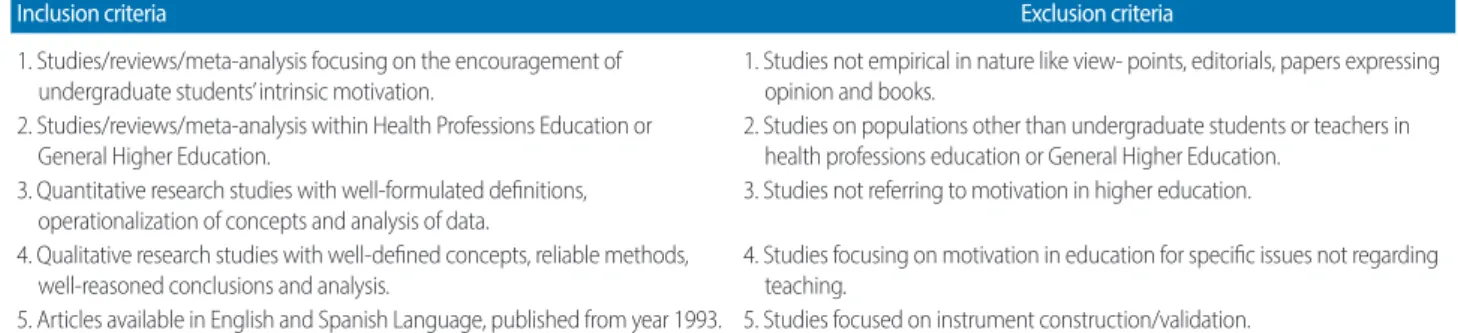
The search for relevant literature was performed during November and December 2013. he inclusion and exclusion criteria are outlined in Table 1. Electronic searches were per formed across four databases (Medline, Embase, PsycINFO, and ERIC), relevant journals, and retrieved bibliography of selected articles via the Science Citation Index (SCI). All se lected articles were exported to a reference manager for fur ther and detailed review.
We designed a three main theme search strategy based on the concepts of ‘Clinical Teaching AND Intrinsic Motivation AND Undergraduate Students’. hese concepts were expanded and adapted speciically for each database thesaurus. he core strategy for Medline, which was accessed via Ovid, is present ed in Table 2. he results from the database search provided key journals for hand searching. Journals were searched through their electronic websites using their advanced search option. Search criteria included articles available in English and Span ish because of the bilingual characteristics of the authors, and considered a 20year time frame search in order to assess cur rent tendencies. Two reviewers independently assessed wheth er the abstracts were eligible for full article review. Any difer ences of opinion were debated and consensus was reached on which papers to include/exclude. Aterwards the selected ab stracts were exported to the reference manager and duplicates were removed. Subsequently, related articles were searched throughout the reference manager’s library, and inally, of the selected articles, an ancestry search of their references through the Web of Science®
was performed. A summary of the litera ture search and review process is presented in Fig. 1.
he selected articles that met the inclusion criteria were an alysed and read as full text. A word processing ile was crated for each article in order to extract information about their me thods and outcomes. he ‘Critical Appraisal Skills Programme’ was used as a guide to critically analyse the articles’ methods
Table 1. Setting the scope of the search: inclusion and exclusion criteria
Inclusion criteria Exclusion criteria
1. Studies/reviews/meta-analysis focusing on the encouragement of undergraduate students’ intrinsic motivation.
1. Studies not empirical in nature like view- points, editorials, papers expressing opinion and books.
2. Studies/reviews/meta-analysis within Health Professions Education or General Higher Education.
2. Studies on populations other than undergraduate students or teachers in health professions education or General Higher Education.
3. Quantitative research studies with well-formulated deinitions, operationalization of concepts and analysis of data.
3. Studies not referring to motivation in higher education.
4. Qualitative research studies with well-deined concepts, reliable methods, well-reasoned conclusions and analysis.
4. Studies focusing on motivation in education for speciic issues not regarding teaching.
[12]. Afterwards, three main themes were used to describe how teachers encourage intrinsic motivation. These themes referred to the three psychological needs mentioned earlier: the needs for autonomy, competence and relatedness. Each relevant idea regarding one of these ‘needs’ was registered as a topic with a brief description. Subsequently, all the data col lected was used to create a table that summarised the infor
mation extracted, including the study reference, research top ics, type of study, sample, data collection method, data analy sis and selected indings and comments. Finally, and attempt ing to make sense and integrate the extracted data, a thematic analysis was performed. he most relevant themes from each article, referring to the ‘three psychological needs’ were identi ied and grouped in a new table. Two reviewers independently Table 2. Identifying and expanding essential concepts (Medline Search Strategy)
•Search 1 (words with OR): Clinical Teaching
- Mesh Terms: exp Teaching/ - Mentors/ - exp faculty/ - clinical clerkship/
- Keyword Search (free text): tutor$ - clinical adj2 (tutor$ OR teach$) - teach$ – facilitator$ –lecturer$ – Teach$ adj1 development– (chairside or bedside or efective) adj1 teach$ – Instructor$
•Search 2 (words with OR): Intrinsic Motivation
- Mesh Terms: exp motivation/ - personal autonomy/ - internal-external control/ - professional autonomy/
- Keyword Search (free text): (intrinsic$ OR extrinsic$ OR controlled OR autonomous) adj2 motivation$ - self adj1 determination - self adj1 regulated adj1 learning – SRL - autonomy – competence – relatedness – (Autonomy or competence or relatedness) adj1 Support – learner adj1 autonomy – motivat$ – Incentive$ – motive$
•Search 3 (words with OR): Undergraduate Students
- Mesh Terms: students, dental/ - students, medical/ - exp education, dental/ - education, medical, undergraduate/ - Education - Keywords Search (free text): (Dental or medical) adj1 student$ - dentist$ - dental - Undergraduate adj1 Student$
•Search 1 AND Search 2 AND Search 3
Fig. 1. Summary of literature search and review process.
24 DatabaseSearch
Medline
651 Embase492 ERIC323 PsycINFO469
RelevantHealth Professions Educationand HigherEducation
Journals
2060
HandSearching
Titles excluded not referring to encourage of motivation in Higher
Education 4638
ArticlesExported toReferences Manager ‐ DuplicatesRemoved
97
Abstracts Review ‐ Inclusion and Exclusion Criteria
86 Excluded
RetrievedArticles
11
Retrieved Articles for Final Report
16
Related Articles in Reference Manager Library (10) 1 selected
analysed the selected articles following the described steps and posteriorly met, compared their results, and agreed in the inal report. he review was organised following the reporting guidelines of the PRISMA statement [13].
RESULTS
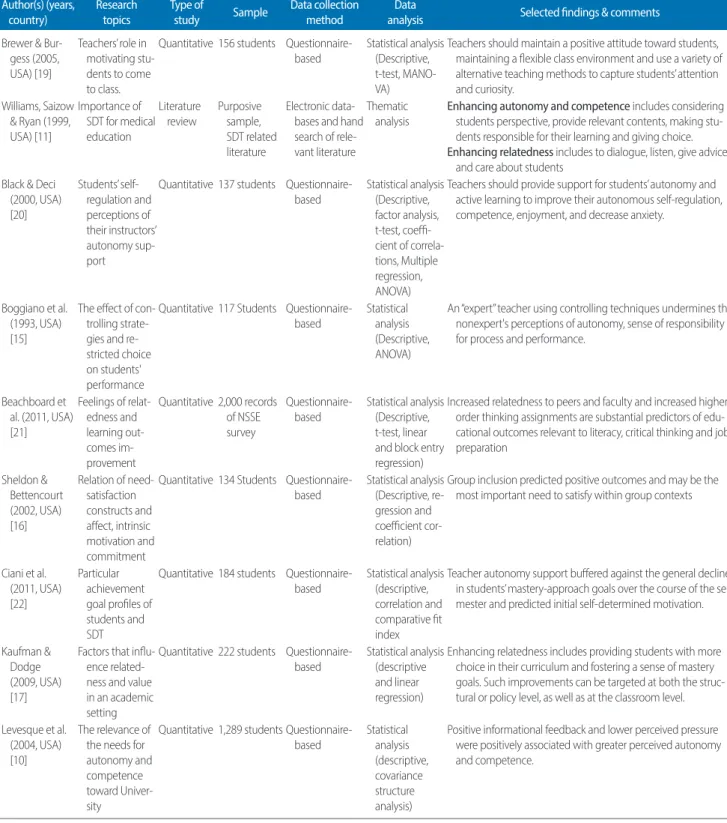
The database, manual, and retrieved bibliography search produced 4,869 references to the encouragement of intrinsic motivation in undergraduate students. Of those, 16 met the eligibility criteria and were included in the inal review (Fig. 1). Articles were excluded mainly because they were not em pirical in nature (i.e. view points, editorials, papers expressing opinion and books), they involved other populations, were not referring to motivation in higher education, they focused on motivation for speciic issues not regarding the encourage ment of the three basic psychological needs to foster Intrinsic motivation in higher education, or were focused on instrument construction/validation. Table 3 provides a summary of the key indings from the 16 articles reviewed.
he majority of the studies stated clear objectives or research questions, consistent with the study’s development and were found to be relevant for the encouragement of motivation in higher education and particularly to the health professions field. Four studies were centred in overviewing motivation and its applications through the selfdetermination theory concept [2,8,9,11], meanwhile the rest focused either on sup porting autonomy, competence, or relatedness. Although one study was oriented to dental education [3], most studies ex amined the encouragement of intrinsic motivation in medical education [2,9,11], psychology education [1417] and general higher education contexts [8,10,1822]. One study combined medical and nursing education [1]. Most studies were design as quantitative [10,1522], only two studies reported mixed methods [3,14] and one a qualitative design [1]. Crosssec tional studies were predominant. Two studies employed lon gitudinal designs [20,22] with two and three data collection points during a one semester period. No control groups were included. One study made a cultural comparison between Ger man and United States students [10]. Participants were all un dergraduate students. Modest sample sizes were selected rang ing from 117 to 222 participants, with two exceptions. One study collected 1,289 reports from students [10], and a quali tative study recruited 31 students [1]. Student recruitment was through advertisement, email and paperbased invitation. Not surprisingly, selfadministered questionnaires were the most popular data collection method, although in several papers more than one was used, these measured diferent variables. One study used three data collection sources for the same vari ables (i.e. open and close questions, semistructured interviews
and focus group), increasing data triangulation [3]. One study used only focus groups [1].
Data analysis was consistent with the studies objectives or research questions. Statistical analysis (i.e. descriptive an infer ential), thematic and content analysis were performed. Studies with qualitative components showed rigorous and credible analysis [1,14]. More than one author examined the collected information separately, and then crosschecked listed catego ries and made adjustments. hese studies were also character ised by transparency about methods, one Swedish study asked students to check the inal list of categories created and com pleted a forward and backward translation of results to Eng lish, in order to increase dependability and make indings trans ferable [1]. Most studies did not establish causal relations, in stead providing correlations between variables. hree studies reported selfcriticism in this aspect [16,18,20] arguing that manipulating these ‘needs of satisfaction’ variables in real group contexts would be diicult and perhaps unethical to conduct.
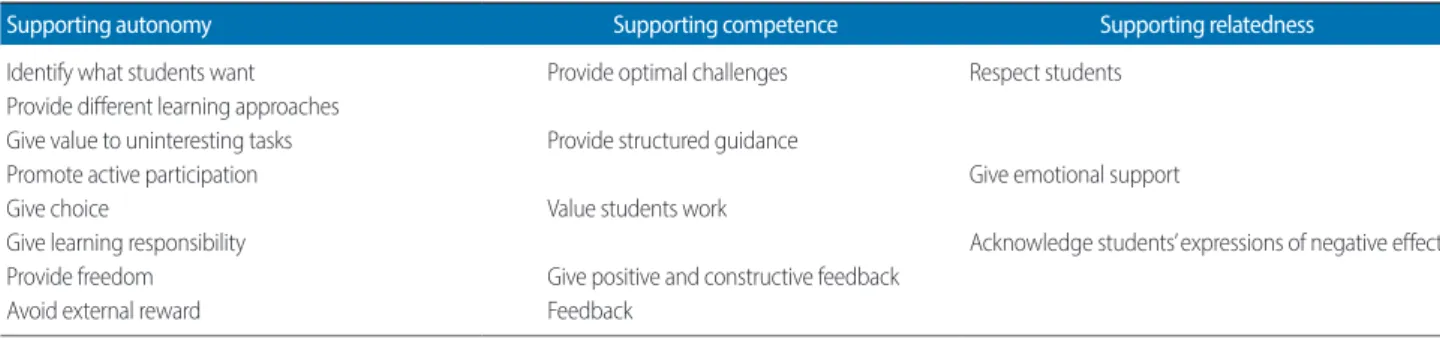
How to encourage the three basic psychological needs? he majority of the studies stressed the importance of au tonomy supportive teaching to encourage students’ intrinsic motivation. hrough the variety of contexts revised, the main approach to promote intrinsic motivation was adopting the principles from the selfdetermination theory that stress the importance of creating feelings of competence, autonomy and relatedness in students [2,811,1518,2022]. Table 4 summaris es the main themes according to each psychological need. Stu dents’ perceived that an autonomy supportive teaching style increased their autonomous selfregulation, competence, in terest, wellbeing [2,9,10,20] and predicted positive outcomes [10,11,14,15,17,18,21].
Strategies for enhancing autonomy
Table 3. Summary of studies on the encouragement of intrinsic motivation in undergraduate students
A uthor(s) (years, country) Research topics Type of study Sample Data collection method Data
analysis Selected indings & comments
Ryan & Niemiec, (2009, USA ) [8]
Overview SDT and applica-tions to educa-tional practice. Literature review Purposive sample of articles Electronic data-bases and hand search of relevant literature
Thematic analysis
- Enhancing autonomy includes providing choice, meaningful rationales for learning activities, acknowledging students’ feel-ings, and minimizing pressure and control.
- Enhancing competence includes providing efectance-rele-vant feedback and optimally challenging tasks.
- Enhancing relatedness includes conveying warmth, caring, and respect to students.
Kusurkar et al. (2011, The Netherlands) [2]
Autonomy-sup-portive teach-ing and practi-cal tips for medical teach-ers. Literature review Purposive sample, SDT related Liter-ature Electronic data-bases and hand search of rele-vant literature
Thematic analysis
- Enhancing autonomy includes nurturing what students need and want, encouraging active participation having students’ internal states guide their behaviour, encouraging students to accept more responsibility for their learning, communicating value in uninteresting activities, giving choices, directing with ‘can, may, could’ instead of ‘must, need, should.
- Enhancing competence includes providing structured guid-ance, optimal challenges and positive and constructive feed-back.
- Enhancing relatedness includes giving emotional support and to acknowledge students’ expressions of negative efect Benson, Cohen, & Buskist (2005, USA) [14] Rapport: student attitudes and proacademic behaviours, and Instructor behaviours contributing to it. Mixed methods
166 students Questionnaire-based (close/ open ques-tions) Statistical analy-sis, (Frequen-cies, t-test, ANOVA) and content analy-sis
Rapport-inducing teachers are likely to have students who at-tend class, pay attention, enjoy subject matter and engage in proacademic behaviours.
Ten Cate et al. (2011, The Netherlands) [9]
Practical applica-tions of SDT in medical educa-tion Literature review Purposive sample SDT related liter-ature Electronic data-bases and hand search of rele-vant literature
Thematic analysis
- Enhancing autonomy includes giving time and opportunity for autonomous work, enquiring what students want, allowing students to choose how to learn and plan moments of assess-ment.
- Enhancing competence includes praising quality of perfor-mance, providing constructive feedback and trust students with more clinical responsibilities, taking their role seriously. - Enhancing relatedness includes empathising, listening to and
acknowledging students’ perspectives. Davies et al.
(2012, UK) [3]
Student’s views and percep-tions of clinical teaching
Mixed methods
Three cohorts of 152 inal-year stu-dents Questionnaire-based (online/ paper-open/ closed ques-tions) - Semi-structured interviews - Focus groups
Descriptive statistics and thematic analy-sis
- A friendly, non-threatening teaching environment is perceived by students to be a good learning environment.
- Students appreciate the time and space to take ownership of their learning.
- Learning experience is enhanced through relective practice and feedback.
Bengtsson et al. (2010, Swe-den) [1] What students consider im-portant for their motiva-tion to attain knowledge
Qualitative 31 students Focus group with semi-struc-tured questions
Content analysis
Dedicated teachers giving performance feedback, discussions in diferent forms and choices of learning and assessment meth-ods enhance enthusiasm and learning.
Hodgins et al. (1996, Cana-da) [18]
Relective auton-omy and inter-personal expe-riences with parents and with peers
Quantitative 153 students Questionnaire-based
Statistical analysis (coeicient of correlation)
Relective autonomy was signiicantly related to more positive and honest naturally occurring interaction and positive relat-edness.
A uthor(s) (years, country) Research topics Type of study Sample Data collection method Data
analysis Selected indings & comments
Brewer & Bur-gess (2005, USA) [19]
Teachers’ role in motivating stu-dents to come to class.
Quantitative 156 students Questionnaire-based
Statistical analysis (Descriptive, t-test, MANO-VA)
Teachers should maintain a positive attitude toward students, maintaining a lexible class environment and use a variety of alternative teaching methods to capture students’ attention and curiosity.
Williams, Saizow & Ryan (1999, USA) [11]
Importance of SDT for medical education Literature review Purposive sample, SDT related literature Electronic data-bases and hand search of rele-vant literature
Thematic analysis
Enhancing autonomy and competence includes considering students perspective, provide relevant contents, making stu-dents responsible for their learning and giving choice.
Enhancing relatedness includes to dialogue, listen, give advice, and care about students
Black & Deci (2000, USA) [20] Students’ self-regulation and perceptions of their instructors’ autonomy sup-port
Quantitative 137 students Questionnaire-based
Statistical analysis (Descriptive, factor analysis, t-test, coei-cient of correla-tions, Multiple regression, ANOVA)
Teachers should provide support for students’ autonomy and active learning to improve their autonomous self-regulation, competence, enjoyment, and decrease anxiety.
Boggiano et al. (1993, USA) [15]
The efect of con-trolling strate-gies and re-stricted choice on students' performance
Quantitative 117 Students Questionnaire-based
Statistical analysis (Descriptive, ANOVA)
An “expert” teacher using controlling techniques undermines the nonexpert's perceptions of autonomy, sense of responsibility for process and performance.
Beachboard et al. (2011, USA) [21]
Feelings of relat-edness and learning out-comes im-provement
Quantitative 2,000 records of NSSE survey Questionnaire-based Statistical analysis (Descriptive, t-test, linear and block entry regression)
Increased relatedness to peers and faculty and increased higher order thinking assignments are substantial predictors of edu-cational outcomes relevant to literacy, critical thinking and job preparation
Sheldon & Bettencourt (2002, USA) [16]
Relation of need- satisfaction constructs and afect, intrinsic motivation and commitment
Quantitative 134 Students Questionnaire-based Statistical analysis (Descriptive, re-gression and coeicient cor-relation)
Group inclusion predicted positive outcomes and may be the most important need to satisfy within group contexts
Ciani et al. (2011, USA) [22]
Particular achievement goal proiles of students and SDT
Quantitative 184 students Questionnaire-based Statistical analysis (descriptive, correlation and comparative it index
Teacher autonomy support bufered against the general decline in students’ mastery-approach goals over the course of the se-mester and predicted initial self-determined motivation.
Kaufman & Dodge (2009, USA) [17]
Factors that inlu-ence related-ness and value in an academic setting
Quantitative 222 students Questionnaire-based
Statistical analysis (descriptive and linear regression)
Enhancing relatedness includes providing students with more choice in their curriculum and fostering a sense of mastery goals. Such improvements can be targeted at both the struc-tural or policy level, as well as at the classroom level.
Levesque et al. (2004, USA) [10]
The relevance of the needs for autonomy and competence toward Univer-sity
Quantitative 1,289 students Questionnaire-based Statistical analysis (descriptive, covariance structure analysis)
Positive informational feedback and lower perceived pressure were positively associated with greater perceived autonomy and competence.
Table 3. Continued
motivation was mostly driven by curiosity, being in charge of their studies and contents, and if these contents were connect ed to their own personal situation [1]. On the other hand, not
subjects are important for their professional future, consequent ly internalizing an originally externally regulated behaviour [8,9].
Brewer concludes that college teachers should use a variety of alternative teaching methods to capture students’ attention and curiosity [19]. In his indings, lectures were ranked by stu dents as the number one “amotivational reason to skip class”; therefore, teachers should avoid relying only on them. When using lectures as a teaching strategy in the clinical setting, teach ers should demonstrate vast knowledge of the subject, as stu dents perceived “knowledge of the subject matter” as the num ber one reason to attend class. Using case studies, role plays, experiments, and group activities made learning easier for me dical and nursing students [1]. he use of alternative teaching methods was supported by two studies which argue that turn ing a passive student into an active learner may hold promise for enhancing students’ achievement and psychological devel opment [8,20]. Being an active learner involves having time and space to take ownership of the learning process. In two studies, nursing, medical and dental students expressed the value of clinical freedom [1,3] and complained about too much work and too little time to deepen in their areas of interest.
Traditionally, many teachers and schools have relied on con trolling strategies for teaching and curriculum development. Contrary to this, six studies supported giving choice to students, so they could identify and integrate contents [1,2,8,9,15,22]. Boggian et al. found that students under controlling directives conditions performed signiicantly worse than students in no controlling directives conditions [15]. Students felt comfort able when being in charge of their own behaviour. Teachers can enhance this by giving choices of learning methods, exer cises and task, leading to intrinsic motivation [1,2]. An envi ronment that provides choices and freedom for students also needs them to take more responsibilities in their learning pro cess, this has been shown to stimulate students’ motivation [2,11]. Davies et al. stressed the importance of facilitating the empowerment of dental students in clinical teaching [3]. Stu dents should determine their learning path and plan their own
Table 4. Main themes for supporting intrinsic motivation and satisfying the three basic needs
Supporting autonomy Supporting competence Supporting relatedness
Identify what students want Provide optimal challenges Respect students Provide diferent learning approaches
Give value to uninteresting tasks Provide structured guidance
Promote active participation Give emotional support
Give choice Value students work
Give learning responsibility Acknowledge students’ expressions of negative efect
Provide freedom Give positive and constructive feedback
Avoid external reward Feedback
moments of assessment when they feel ready [9]. In order to do this, students must know what is expected from them since the beginning of the semester.
Strategies for enhancing competence
he need for competence refers to the desire of feeling ef fective in whatever actions one pursues and performs. Com petence is not meant as an attained skill or ability per se, but rather a perception of conidence and efectance [9]. Two stud ies argued the importance of providing optimal challenges for students feeling competent and enhancing intrinsic motiva tion [2,8]. Activities shouldn’t be too hard, but neither too easy for students to test and expand their capabilities. Medical stu dents considered that too easy tasks made them feel insecure and that the level of demands should be appropriate for their learning stage [1]. The idea of an autonomy and competent student does not imply an independent and ‘free from the gov ernment of others’ learner. Teachers should provide a struc tured guidance, delivering the necessary tools for students’ success [2,8], but also seriously valuing their work and mak ing them feel an important part of the clinical environment [3,9]. Five studies revealed the importance that positive and constructive feedback has when promoting intrinsic motiva tion [2,3,810]. his feedback should be oriented on the task, not on the person so that it doesn’t feel like a threat but as a suggestion on how to improve what went wrong. Dental stu dents and medical students from different cultures, valued positive feedback at the end of sessions, relating it with greater autonomy and competence [3,10].
Strategies for enhancing relatedness
were more important in motivating students than were the teaching methods and classroom management practices [19]. he most frequently rapportinducing teachers qualities stated by students were: encouraging, openmindedness, creative, interesting, accessible, happy, having a “good” personality, pro moting class discussion, approachability, concern for students, and fairness [14]. Four studies stressed the importance of re specting and having a positive attitude towards students, pro viding a non threatening environment, and feeling cared [1, 3,9,19].
Dental students stated that working together and for the teacher to know them, made them feel ‘part of the team’ [3]. On the other hand, nursing students felt that sometimes lec turers treated them like teenagers instead of adults, afecting their motivation [1]. Teachers should support an environment were students feel emotionally supported, comfortable and free to express opinions, leading them to be more interested in subjects and to the internalization of tasks [2,8]. Not ac knowledging students’ expressions of negative effect under mines motivation. Students claimed that when saying some thing critical, teachers sometimes acted defending themselves instead of listening and discussing [1]. Autonomy supportive teaching also includes being empathic when reasonable stu dents’ opinions criticise teachers work [2,9].
DISCUSSION
he researchbased evidence for the encouragement of in trinsic motivation in undergraduate students appears to be of reasonable quality, and indicates that clinical teachers should work to satisfy students’ basic psychological needs to foster internalization of selfregulation. Several themes emerged from diferent contexts referring to satisfying those needs and fur ther investigation should expand them. Autonomy supportive teaching in health professions education would benefit stu dents and may actually result in more efective health care de livery [11]. his review identiied actions that teachers could implement in their daily clinical teaching work to improve students selfdetermination. Independent of the context, these actions could be transferred to a broad of educational settings. Our results suggest that clinical teachers should interact with their students in a more ‘human centred’ teaching style, as these actions predict motivational internalization. Findings illustrate that research on academic motivation has been fo cused in general higher education, psychology education and to a lesser extent in medical, dental, and nursing education. Selfdetermination theory represents one of the most referred theories in psychology, however, its application in health pro fessions education is not so common [9]. Further research ap plying selfdetermination theory principles should be under
taken in health professions education, and especially in clini cal teaching settings that represents a very important venue for students’ development. As motivation represents a univer sal truth, cultural diferences may also inluence the implemen tation of an autonomy supportive teaching style. Although one study established cultural comparison between students from Germany and United States [10], future research in aca demic motivation should take into account this differences between students in order to generalize indings in other cul tures.
Most of the studies were based on quantitative methods, and relying only on students’ point of view. Only few studies used mixed or qualitative methods and none of them focused on teachers’ perceptions. here is no denying of the valuable data emerged from quantitative studies, but the richness and depth of qualitative and mixed methods constituted the core of the extracted data. For further understanding of teachers’ practices, qualitative and mixed methods should be consid ered, and students’ perceptions should be combined with tu tors’ opinions. Teachers are in charge of supporting students’ motivation; therefore, knowing their opinions and apprehen sions would add rich information to the data provided by the students. he majority of the studies relied on one method for data collection, primarily questionnairebased instruments. Future research should consider combining multiple sources of data, therefore increasing data triangulation and credibility of results. On the other hand, two studies were based on six and seven questionnairebased instruments to collect infor mation and, as it would be expected, response rates were low er than studies that used fewer instruments. Students fatigue to respond and time value should be taken into account.
Intrinsic motivation and autonomous forms of selfregula tion are the desired type of motivation in students, as they have been associated with deep learning, better performance and wellbeing, in comparison with extrinsic motivation and con trolled forms of selfregulation (i.e. under external control) [5,6,9]. Teacher behaviours and teaching styles can inluence students motivation [8,19], either in classroom or in clinical environments. Students’ own curiosity and interests are potent tools by which teachers can promote their desire to learn. In contrast, teachers that rely on external factors (e.g. rewards), risk students internal learning aspirations, compromising the quality of the process [8]. An autonomysupportive teaching style is characterised by providing options and opportunities for selfdirected decisions minimising external pressures [6,23].
addition, intrinsic or extrinsic motivation are not permanent characteristics, thus, stressing the point about paying attention to the inluences of learning environments [6].
Finally, a number of important limitations need to be con sidered. First, several sources of bibliographic data were used to identify eligible articles. Though important material was found, it was limited to the sources included and important papers could have been ignored. Second, journals searched were predominantly from the United Kingdom and USA, and in English. Even though Spanish articles were included in da tabase search, language and demographic criteria was also counted as limitations. Lastly, most of the reviewed articles were design as crosssectional studies. Prospective research is needed to examine if the satisfaction of the three psychologi cal needs in fact predicts changes in the internalization of be haviour and the fostering of intrinsic motivation towards aca demic activities.
It is not diicult to engage in an autonomysupportive teach ing style, it can be learned through practice and selfrelection. By providing an educational environment based on the self determination theory principles, clinical tutors may be suc cessful in their teaching. herefore it is important that future research considers what educators and clinical tutors are actu ally doing to enhance student’s motivation and how they can incorporate new teaching and learning strategies.
ORCID:
Cesar Orsini: http://orcid.org/0000000252263625; Phillip Evans: http://orcid.org/0000000308588788; Oscar Jerez: http://orcid.org/0000000308695938CONFLICT OF INTEREST
No potential conlict of interest relevant to this article was reported.
SUPPLEMENTARY MATERIAL
Audio recording of abstract.
REFERENCES
1. Bengtsson M, Ohlsson B. he nursing and medical students mo-tivation to attain knowledge. Nurse Educ Today. 2010;30:150-156. http://dx.doi.org/10.1016/j.nedt.2009.07.005
2. Kusurkar R, Croiset G, Ten Cate T. Twelve tips to stimulate in-trinsic motivation in students through autonomy-supportive classroom teaching derived from self-determination theory. Med Teach. 2011;33:978-982. http://dx.doi.org/10.3109/0142159X. 2011.599896
3. Davies B, Leung A, Dunne S. So how do you see our teaching?
Some observations received from past and present students at the Maurice Wohl Dental Centre. Eur J Dent Educ. 2012;16:138-143. http://dx.doi.org/10.1111/j.1600-0579.2012.00733.x 4. Jahangiri L, McAndrew M, Muzafar A, Mucciolo TW.
Charac-teristics of efective clinical teachers identiied by dental students: a qualitative study. Eur J Dent Educ. 2013;17:10-18. http://dx.doi. org/10.1111/eje.12012
5. Ryan RM, Deci EL. Self-determination theory and the facilita-tion of intrinsic motivafacilita-tion, social development, and well-being. Am Psychol. 2000;55:68-78.
6. Ryan RM, Deci EL. Intrinsic and extrinsic motivations: classic definitions and new directions. Contemp Educ Psychol. 2000; 25:54-67.
7. Vansteenkiste M, Lens W, Deci EL. Intrinsic versus extrinsic goal contents in self-determination theory: another look at the quali-ty of academic motivation. Educ Psychol. 2006;41:19-31. 8. Niemiec CP, Ryan RM. Autonomy, competence, and relatedness
in the classroom: Applying self-determination theory to educa-tional practice. heory Res Educ. 2009;7:133-144. http://dx.doi. org/10.1177/1477878509104318
9. Ten Cate TJ, Kusurkar RA, Williams GC. How self-determination theory can assist our understanding of the teaching and learn-ing processes in medical education. AMEE guide No. 59. Med Teach. 2011;33:961-973. http://dx.doi.org/10.3109/0142159X. 2011.595435.
10. Levesque C, Zuehlke AN, Stanek LR, Ryan RM. Autonomy and competence in German and American university students: a comparative study based on self-determination theory. J Educ Psychol. 2004;96:68-84.
11. Williams GC, Saizow RB, Ryan RM. he importance of self-de-termination theory for medical education. Acad Med. 1999;74: 992-995.
12. Singh J. Critical appraisal skills programme. J Pharmacol Phar-macother. 2013;4:76-77. http://dx.doi.org/10.4103/0976-500X. 107697
13. Liberati A, Altman DG, Tetzlaf J, Mulrow C, Gøtzsche PC, Ioan-nidis JP, Clarke M, Devereaux PJ, Kleijnen J, Moher D. he PRIS-MA statement for reporting systematic reviews and meta-analy-ses of studies that evaluate health care interventions: explanation and elaboration. PLoS Medicine. 2009. http://dx.doi.org/10.1371/ journal.pmed.1000100
14. Benson TA, Cohen AL, Buskist W. Rapport: its relation to stu-dent attitudes and behaviors toward teachers and classes. Teach Psychol. 2005;32:237-239.
15. Boggiano AK, Flink C, Shields A, Seelbach A, Barrett M. Use of techniques promoting students’ self-determination: effects on students’ analytic problem-solving skills. Motiv Emot. 1993;17:319-336. http://dx.doi.org/10.1007/BF00992323
2002;41:25-38.
17. Kaufman A, Dodge T. Student perceptions and motivation in the classroom: Exploring relatedness and value. Soc Psychol Educ An Int J. 2009;12:101-112. http://dx.doi.org/10.1007/s11218-008-9070-2
18. Hodgins HS, Koestner R, Duncan N. On the compatibility of au-tonomy and relatedness. Personal Soc Psychol Bull. 1996;22:227-237. http://dx.doi.org/10.1177/0146167296223001
19. Brewer EW, Burgess DN. Professor’s role in motivating students to attend class. J Ind Teach Educ. 2005;42:23-47.
20. Black AE, Deci EL. he efects of instructors’ autonomy support and students’ autonomous motivation on learning organic chem-istry: A self-determination theory perspective. Sci Educ. 2000; 84:740-756. http://dx.doi.org/10.1002/1098-237X(200011)84:
6<740::AID-SCE4>3.0.CO;2-3
21. Beachboard MR, Beachboard JC, Li W, Adkison SR. Cohorts and relatedness: Self-determination theory as an explanation of how learning communities affect educational outcomes. Res High Educ. 2011;52:853-874. http://dx.doi.org/10.1007/s11162-011-9221-8
22. Ciani KD, Sheldon KM, Hilpert JC, Easter MA. Antecedents and trajectories of achievement goals: a self-determination theory perspective. Br J Educ Psychol. 2011;81:223-243. http://dx.doi. org/10.1348/000709910X517399