AIDS incidence and mortality in injecting
drug users: the AjUDE-Brasil II Project
Incidência de AIDS e mortalidade em usuários
de drogas injetáveis: Projeto AjUDE-Brasil II
1 Faculdade de Medicina, Universidade Federal de Minas Gerais, Belo Horizonte, Brasil. 2 Instituto de Ciências Exatas, Universidade Federal de Minas Gerais, Belo Horizonte, Brasil. 3 Other members listed at the end of the paper.
Correspondence W. T. Caiaffa Faculdade de Medicina, Universidade Federal de Minas Gerais. Av. Alfredo Balena 190, Belo Horizonte, MG 30130-100, Brasil. [email protected]
Mauro Nogueira Cardoso 1 Waleska Teixeira Caiaffa 1 Sueli Aparecida Mingoti 2 Projeto AjUDE-Brasil II 3
Abstract
This paper presents AIDS incidence and mortal-ity among injecting drug users (IDUs) reached by the AjUDE-Brasil II Project. From a cross-sec-tional survey, 478 IDUs were interviewed in three Brazilian cities: Porto Alegre, São José do Rio Preto, and Itajaí. The cohort was followed up in the Brazilian surveillance database for AIDS and mortality during 2000 and 2001. AIDS incidence was 1.1 cases per 100 person-years, and the mortality rate was 2.8 deaths per 100 person-years. AIDS cases only occurred in IDUs who reported ever having shared injecting equip-ment. Female gender (RR = 5.30), homelessness (RR = 6.16), and report of previous sexual rela-tions with same-sex partners (RR = 6.21) were as-sociated with AIDS. Deaths occurred only among males. Homelessness (RR = 3.00), lack of income (RR = 2.65), HIV seropositive status (RR = 4.52), and no history of incarceration (RR = 3.71) were also associated with death. These findings sup-port evidence that gender and socioeconomic conditions are both determinants of morbidity and mortality in Brazilian IDUs.
Acquired Immunodeficiency Syndrome; Mortal-ity; Intravenous Substance Abuse
Introduction
In Brazil, of the 362,363 AIDS cases reported to the Ministry of Health through the National Re-portable Diseases System (SINAN) from 1980 to June 30, 2004, 16.4% were attributed to in-jecting drug use 1.
Despite the downward trend in the propor-tion of new AIDS cases associated with inject-ing drug use, this decrease has not been homo-geneous in the country. In some cities or regions, especially in the South, injecting drug users (IDUs) constitute an important component of the epidemic. In the southernmost State capi-tal city, Porto Alegre, HIV prevalence among IDUs has reached 65% 2,3.
For the year 2003, overall AIDS incidence in the Brazilian population was 18.4 cases per 100 thousand inhabitants. The epidemic is increas-ing more quickly in population groups with less schooling and lower socioeconomic status 4,5,6,
and IDUs have been the group with the worst socioeconomic situation since the beginning of the epidemic 7.
The incidence of HIV infection among IDUs, estimated at 1 to 3 per 100 person-years in the United States in the early 1990s, also appears to have dropped to some 1.84 per 100 person-years in 1995-1998 8,9. The known risk factors
and sexual behaviors such as same-sex rela-tions and sex with other IDUs 8.
In addition to representing an important risk group for HIV infection, IDUs are included in the portion of the population most exposed to increased mortality risk. Not only in Brazil, but elsewhere in the world, high mortality rates have been shown in this group, estimated at 3.3 deaths per 100 person-years in the United States in 1999-2000 10and 2.3 deaths per 100 person-years in Edinburgh, Scotland, in 1980-2001 11.
The most relevant risk factors associated with death in IDUs are infectious diseases, es-pecially AIDS and its markers such as high HIV viral load and decreased CD4 lymphocyte counts. Although the causes related to HIV dis-ease currently constitute the principal cause of death in this population, there are other major causes of death, especially those related to overdose, pneumonia, and bacterial endo-carditis, in addition to external causes such as suicide and homicide 10,11,12,13.
The current study aimed to estimate AIDS incidence and mortality among IDUs in the con-text of syringe-exchange programs (SEP) partic-ipating in the AjUDE-Brasil II Project, as well as to explore the principal determinants of these events.
Method
The AjUDE-Brasil II Project, a cross-sectional study conducted from May 2000 to February 2001, interviewed clients of SEP supported by the Drugs and AIDS Unit of the Programa Na-cional de DST e AIDS, Ministry of Health (PN-DST/AIDS). This study aimed to characterize the socio-demographic, behavioral, and sero-logical profiles of the accessed IDUs. Struc-tured interviews were conducted by properly trained staff and/or outreach workers. Collect-ed information includCollect-ed social, sexual, and drug-use behavior, characteristics of the health-care utilization and drug-related treatment, and any criminal record. Blood samples were col-lected by finger stick on filter paper to deter-mine the HIV seroprevalence, using the ELISA test performed by two independent methods. The use of ELISA as a serological test was justi-fied by the high HIV seroprevalence in the IDUs population and consequently by the tests’ high positive predictive value 14.
This prospective component study includ-ed three of the six Brazilian cities from the over-all project: Porto Alegre in the State of Rio Gran-de do Sul, São José do Rio Preto in São Paulo, and Itajaí in Santa Catarina. These three cities
were chosen because they presented structured SEP at the time the research was done, and be-cause their respective city health departments allowed access to the local surveillance sys-tems.
The 478 individuals interviewed in these cities constituted a cohort, followed up during the years 2000 and 2001, aimed at estimating AIDS incidence and mortality. The information gathered in the survey’s baseline was used for the exposure variables. Identification of AIDS cases and deaths was based on a list of IDUs in-terviewed at baseline in the AjUDE-Brasil II Project, containing full name, date of birth, and mother’s initials, allowing an active search of these individuals in the databases of the Na-tional Reportable Diseases System for AIDS (SINAN-AIDS) and the Mortality Information System (SIM) at the regional level. Information on incarceration was collected from local prison records.
Based on identification of the interviewee in the data systems, data on AIDS diagnosis and/or death were recorded, along with the re-spective underlying cause. Incident AIDS cases (n = 6) were defined as all IDUs found in the SINAN-AIDS database from May 10, 2000, to December 31, 2001, and who had not been recorded with a date prior to the interview dur-ing the field study in the AjUDE-Brasil II Pro-ject. Six additional individuals recorded in the SINAN-AIDS database during this same peri-od, but who had the same date of death record-ing in the SIM (recorded in SINAN-AIDS fol-lowing death) were not tabulated as incident cases because they were considered cases of delayed reporting. Fifty-six AIDS cases showed date of diagnosis prior to the beginning of the study and were considered prevalent AIDS cas-es and were excluded, such that 422 individu-als remained. Individuindividu-als not found in the SINAN-AIDS database were considered AIDS-free.
Deaths (n = 17) were defined as all IDUs found in the SIM from May 10, 2000, to Decem-ber 31, 2001, out of the total of 478 individuals interviewed.
direct responses by IDUs to the AjUDE-Brasil II Project questionnaire.
A descriptive analysis of the 478 study par-ticipants was performed initially using univari-ate analysis, by comparison of the incidence density rates between the exposed and unex-posed groups, using the Poisson regression technique 15. Estimation of the relative risk used the risk ratio (RR) and respective 95% confi-dence interval (95%CI). Associations were also investigated for the exposure variables using chi-square (χ2) or Fisher’s exact test, as appro-priate 16. Graphs using the Kaplan-Meier tech-nique were produced to visualize the survival trend of IDUs between the field testing and the AIDS diagnosis 17. Epidemiologically relevant exposure factors or those with a p-value of ≤0.20
were selected for multivariate analysis using the Cox proportional model, aimed at producing a model adjusted for confounding variables 18. Due to the model’s limitations, variables with null incidence in one of the exposure categories were not included in this stage of the analysis.
The research complied with the guidelines and technical standards as defined by Ruling 196/96, and was approved by the Institutional Review Board of the Universidade Federal de Minas Gerais, case review ETIC 168/99.
Results
Of the 478 participating IDUs, 52.9% were from Porto Alegre, 26.8% from São José do Rio Preto, and the remaining 20.3% from Itajaí. Mean age was 30.0 ± 8.7 years. Median schooling was five years (5thgrade of primary school).
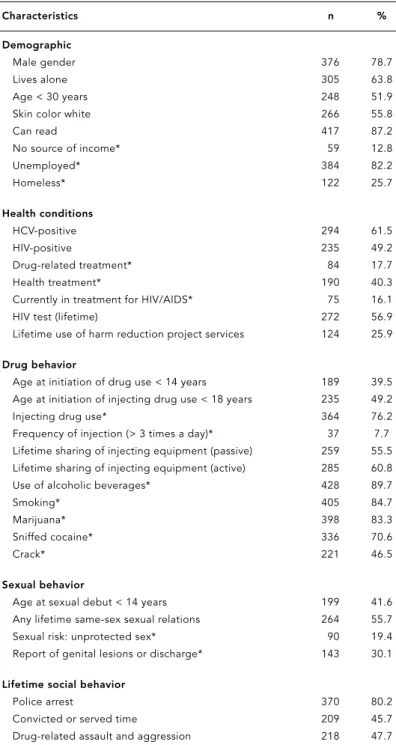
Table 1 shows the descriptive analysis of the IDUs. Most of the sample consisted of male IDUs, living alone. The majority of the IDUs re-ported having some source of income, al-though many were unemployed.
More than half of the IDUs reported not having sought drug-related or health treatment in the previous six months, and only one-fourth had used SEP services. Half were HIV-positive according to the field testing. Most had started using drugs after the age of 14, and by 18 years approximately half were already using injecting drugs. More than half of the IDUs were already sharing needles and syringes in some way.
Sexual initiation had occurred around 14 years of age, and some one-third reported any lifetime same-sex relations (35.2% of the males and 14.7% of the females). The vast majority had a history of police arrest, and nearly half had served prison time, with a median of a month and a half.
Table 1
Selected characteristics of 478 injecting drug users participating in a prospective component study of the AjUDE-Brasil II Project, 2000-2001.
Characteristics n %
Demographic
Male gender 376 78.7
Lives alone 305 63.8
Age < 30 years 248 51.9
Skin color white 266 55.8
Can read 417 87.2
No source of income* 59 12.8
Unemployed* 384 82.2
Homeless* 122 25.7
Health conditions
HCV-positive 294 61.5
HIV-positive 235 49.2
Drug-related treatment* 84 17.7
Health treatment* 190 40.3
Currently in treatment for HIV/AIDS* 75 16.1
HIV test (lifetime) 272 56.9
Lifetime use of harm reduction project services 124 25.9
Drug behavior
Age at initiation of drug use < 14 years 189 39.5 Age at initiation of injecting drug use < 18 years 235 49.2
Injecting drug use* 364 76.2
Frequency of injection (> 3 times a day)* 37 7.7 Lifetime sharing of injecting equipment (passive) 259 55.5 Lifetime sharing of injecting equipment (active) 285 60.8 Use of alcoholic beverages* 428 89.7
Smoking* 405 84.7
Marijuana* 398 83.3
Sniffed cocaine* 336 70.6
Crack* 221 46.5
Sexual behavior
Age at sexual debut < 14 years 199 41.6 Any lifetime same-sex sexual relations 264 55.7 Sexual risk: unprotected sex* 90 19.4 Report of genital lesions or discharge* 143 30.1
Lifetime social behavior
Police arrest 370 80.2
Convicted or served time 209 45.7 Drug-related assault and aggression 218 47.7
Mean follow-up time for analysis of AIDS incidence was 1.29 years (15.5 months). The AIDS incidence density for the entire group of IDUs was 1.10 cases per 100 person-years (n = 6), with 1.07 in Porto Alegre (n = 3), 1.42 in São José do Rio Preto (n = 2), and 0.81 in Itajaí (n = 1). There was no statistical difference between these rates in the three cities (p = 0.680). Con-sidering only HIV-positive individuals accord-ing to the ELISA test, the incidence was 2.54 per 100 person-years.
For mortality, the follow-up time was 1.28 years (15.4 months). The mortality rate was 2.77 deaths per 100 person-years. The rates by city were 1.16 per 100 person-years in São José do Rio Preto (n = 2) and 1.56 (n = 2) in Itajaí, while Porto Alegre showed the highest mortality at 4.16 (n = 13), with a different statistical behav-ior from the other two cities (p = 0.047). The most common underlying cause of death was HIV disease (66.7%, n = 10), followed by aggres-sion (20%, n = 3), septicemia (6.7%, n = 1), and pneumonia (6.7%, n = 1). Death from pneumo-nia occurred in one individual with an AIDS di-agnosis according to the SINAN-AIDS data-base. Two deaths in São José do Rio Preto were classified as due to undefined conditions, but one of these was located with an AIDS diagno-sis in the SINAN-AIDS database.
One individual had an AIDS diagnosis and died after the interview, while the death oc-curred three and a half months after the AIDS diagnosis recorded in the SINAN-AIDS. Anoth-er 12 IDUs who died wAnoth-ere also found in the SINAN records: six had the same date for diag-nosis and death, while six presented a date of diagnosis prior to the survey, with the death occurring some two years after recording of the AIDS diagnosis (mean 1.98 years, median 2.11 years).
Univariate analysis
a) AIDS incidence
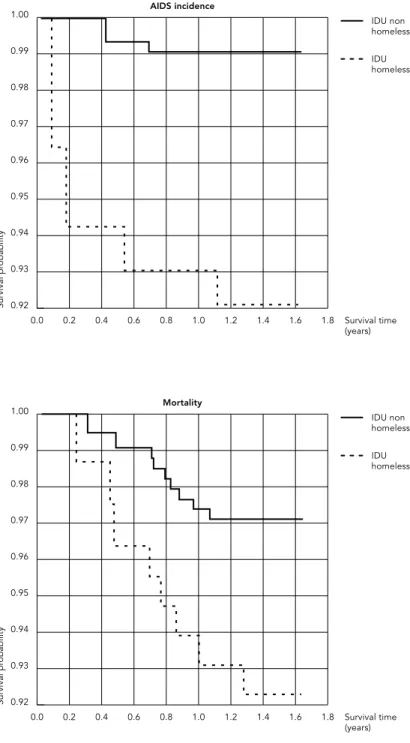
Table 2 shows the main results. Of the six new AIDS cases, two were women, and although this was not statistically significant, they showed twice the risk of developing AIDS as compared to men. Homeless individuals had six times the risk of developing the syndrome. The influence of one’s living place on survival of IDUs with AIDS can be seen in Figure 1, showing a statis-tically lower survival function for homeless-ness (log-rank = 5.75; p = 0.016).
All of the six new AIDS cases had previous HIV-positive serology and reported ever having shared needles and/or syringes. Individuals who
sought health treatment were associated with a higher risk of developing AIDS as compared to those who did not seek health treatment. There was no significant difference in the risk of de-veloping AIDS, when comparing those who sought or failed to seek drug-related treatment. All of the AIDS cases reported previous use of SEP services, although this was not statistically significant.
As for sexual exposure, individuals report-ing any lifetime same-sex relations, all of whom were male, showed a fivefold risk of developing AIDS as compared to those denying such expo-sure. Paradoxically, those who reported ade-quate condom use showed a six-fold risk of having an AIDS diagnosis. Likewise, individu-als who reported not having used cocaine in the previous six months showed a greater risk of AIDS diagnosis as compared to those report-ing use of this drug durreport-ing the same period. Al-though the association was not significant (p = 0.561), the RR point estimate indicated a more than fivefold risk in the group of individuals who self-identified as non-cocaine users (RR = 5.26; 95%CI = 0.96-33.33).
In order to elucidate these findings, a paral-lel analysis of some exposure variables was performed in the prevalent cases found in the SINAN-AIDS database. Of the 56 prevalent cas-es, 16.2% of those reporting condom use in all their sexual relations already had an AIDS di-agnosis in the SINAN-AIDS, as compared to 8.3% in the group reporting irregular condom use (p = 0.008). Likewise, in the group that had not used cocaine in the six months prior to the interview, 16.4% already had an AIDS diagnosis in SINAN-AIDS, as compared to 9.8% in the group who reported cocaine use (p = 0.04). In addition, the group that attended SEP services had 15% of its IDUs with an AIDS diagnosis in the SINAN-AIDS, while only 2.4% of those not attending SEP services were found in the SINAN-AIDS (p < 0.001).
b) Mortality
Table 2
AIDS incidence according to selected characteristics of 422 injecting drug users participating in prospective component study of the AjUDE-Brasil II Project, 2000-2001.
n Rate* p RR 95%CI
Gender
Male 4 0.92 1.00
Female 2 1.87 0.410 2.04 0.37-7.82
Age (years)
< 30 3 1.00 1.00
≥30 3 1.22 0.808 1.22 0.25-6.04
Skin color
White 3 0.98 1.00
Non-white 3 1.27 0.753 1.30 0.26-6.25
Marital status
Married 1 0.51 1.00
Single 5 1.44 0.346 2.80 0.32-24.02
Source of income
Yes 5 1.10 1.00
No 1 1.56 0.754 1.41 0.16-12.06
Living place
Yes 2 0.49 1.00
No 4 2.96 0.039 5.99 1.09-32.70
HIV
Negative 0 0.00 –
Positive 6 2.54 0.006 – –
Health treatment
Yes 5 2.54 0.049 8.33 1.01-71.43
No 1 0.30 1.00
Drug-related treatment
Yes 1 1.09 1.00
No 5 1.12 0.981 1.03 0.12-8.79
Ever used syringe-exchange program services
Yes 6 1.52 0.189 – –
No 0 0.00 –
Sexual risk
Absent 5 2.21 0.078 6.71 0.78-57.47
Present 1 0.32 1.00
Same-sex sexual relations
No 2 0.56 1.00
Yes 4 2.47 0.075 4.68 0.86-25.54
Ever served time in prison
No 2 0.68 1.00
Yes 4 1.77 0.267 2.61 0.48-14.26
HIV-positive individuals showed increased risk of death. Prior AIDS diagnosis in the SINAN-AIDS database was an important predictor of death. Individuals with the syndrome showed a 20-fold risk of dying.
As for criminal records, in the univariate analysis the absence of previous incarceration or conviction did not significantly increase the risk of dying. However, analyzing only males, the RR increased to 2.04 (p = 0.158). In order to better understand this characteristic, we inves-tigated the association between AIDS recorded in the SINAN-AIDS and reported history of conviction. The proportion of AIDS cases dou-bled when comparing IDUs without criminal records (8.1%) to those with criminal records (16.7%) (p = 0.004). As for frequency of arrests, among males reporting only one arrest, 14.8% were recorded with AIDS in the SINAN-AIDS. Among male IDUs with more than one arrest, the proportion was significantly higher (28.6%; p = 0.089).
Multivariate analysis
Table 4 shows the results of this analysis for the two target events.
New AIDS cases occurred independently with increased probability among IDUs who re-ported homelessness in the six months prior to the interview, in female IDUs, and in those with any lifetime report of same-sex sexual relations. A model was investigated that included the six AIDS cases with a simultaneous report of death, classified here as delayed reporting. The results generated a model that was very similar to the multivariate model for mortality and is described below.
In relation to mortality analysis, consider-ing that all the deaths occurred in males, we opted to use the 376 male IDUs to comprise this stage of the analysis. The types of exposure that were markers for socioeconomic status and that remained in the model after adjusting and were statistically significant were home-lessness and lack of income, increasing the risk of death by some threefold. Positive HIV serol-ogy increased the risk of death fivefold, while time served in some penal institution decreased the risk of death. IDUs who reported never having been incarcerated showed a fourfold greater risk of dying as compared to those with a history of conviction.
Analysis of the Martingale and Deviance residues 18were performed for all the
multi-variate models, showing good adequacy and adjustment in the final models.
0.92
Survival pr
obability
0.93 0.94 0.95 0.96 0.97 0.98 0.99 1.00
1.6 1.8 Survival time (years) 1.4
1.2 1.0 0.8 0.6 0.4 0.2 0.0
IDU non homeless IDU homeless AIDS incidence
0.92
Survival pr
obability
0.93 0.94 0.95 0.96 0.97 0.98 0.99 1.00
1.6 1.8 Survival time (years) 1.4
1.2 1.0 0.8 0.6 0.4 0.2 0.0
IDU non homeless IDU homeless Mortality
Figure 1
Table 3
Mortality rates according to selected characteristics of 478 injecting drug users participating in the prospective component project of the AjUDE-Brasil II Project, 2000-2001.
N Rate* p RR 95%IC
Gender
Male 17 3.52 0.030 –
Female 0 0.00 – –
Age (years)
< 30 8 2.56 1.00
≥30 9 3.00 0.746 1.17 0.45-3.03
Skin color
White 10 2.85 0.903 1.06 0.40-2.79
Non-white 7 2.68 1.00
Marital status
Married 2 0.92 1.00
Single 15 3.83 0.058 4.16 0.95-18.21
Source of income
Yes 11 2.15 1.00
No 5 6.56 0.039 3.05 1.06-8.77
Living place
Yes 9 1.99 1.00
No 8 5.08 0.054 2.55 0.98-6.60
HIV
Negative 3 0.98 1.00
Positive 14 4.57 0.016 4.65 1.34-16.19
In AIDS database (SINAN)
No 5 0.92 1.00
Yes 12 17.74 <0.001 19.35 6.82-54.92
Drug-related treatment
Yes 0 0.00 –
No 17 3.41 0.052 – –
Ever used syringe-exchange program services
Yes 15 3.25 0.230 2.47 0.56-10.79
No 2 1.32 1.00
Sexual risk
Absent 10 3.70 0.238 1.79 0.68-4.70
Present 7 2.07 1.00
Same-sex sexual relations
No 13 4.24 0.316 1.79 0.58-5.48
Yes 4 2.37 1.00
Ever served time in prison
No 11 3.51 0.352 1.60 0.59-4.34
Yes 6 2.19 1.00
Discussion
In this study, Brazilian IDUs showed AIDS inci-dence and death rates greater than 1% and 2% per year, respectively. AIDS risk was associated with sharing of needles and/or syringes, female gender, same-sex sexual relations, and precari-ous living conditions, as marked here by home-lessness in the previous six months. Death, which occurred only among males and with higher risk among those with an HIV/AIDS di-agnosis, was also associated with precarious living conditions and possible lost opportuni-ties for diagnosis and treatment, as marked here by the absence of time served in a penal institution.
The few Brazilian and international studies on this issue show rate estimates similar to those found here. There is a similarity between the AIDS incidence estimate and the HIV infec-tion rates of 1 to 3 cases per 100 person-years found currently in the United States 9. In
addi-tion, comparing the mortality estimates with contemporary international studies, one notes some similarity in the rates, varying from 2.8 to 3.3 per 100 person-years, despite the method-ological differences between the studies 10,11.
The finding that women showed increased AIDS risk appears consistent with the epidem-ic’s overall profile in Brazil, currently with 18.8 AIDS cases per 100 thousand inhabitants. Con-trary to the situation described for men, in whom the epidemic shows signs of stabiliza-tion, among women, with 14 new cases per 100 thousand, the figures show an upward annual trend. These data appear to confirm the hypoth-esis that women are becoming more
vulnera-ble to AIDS in Brazil 1,19. For female IDUs, this appears to be a typically Brazilian phenomenon, since international studies point to lower risk of progression to AIDS among women IDUs 20. Absence of deaths in female IDUs in the cur-rent study could reflect the peculiar dynamic of the HIV/AIDS epidemic, which is more ma-ture among males (the predominant gender in the early days of the epidemic among IDUs) and who would thus tend to show an increased risk of death.
The importance of socioeconomic indica-tors can be observed in IDUs morbidity and mortality. Major risk factors were homeless-ness and lack of income, associated with both AIDS and death. This agrees with international studies showing a fivefold mortality risk in IDUs with no source of income 21. These data appear
to confirm the pauperization of the HIV/AIDS epidemic and its negative outcomes in Brazil 4
and also prove this population group’s vulnera-bility and the importance of maintaining IDUs as targets in the main prevention programs.
Corroborating the above is the confirmation that sharing of needles and/or syringes is one of the principal risk factors for AIDS, reinforc-ing the importance of preventive measures, es-pecially in the less privileged segments of this population group, in order to inhibit injecting practices with contaminated equipment.
Probable evidence of the above is the asso-ciation between use of SEP services and in-creased AIDS incidence. In the current study, as well as in international research such as that of Bruneau et al. 22, this association suggests that SEP in the respective cities are accessing a segment of IDUs in precarious living and health Table 4
AIDS incidence density ratio and adjusted mortality ratio using Cox regression method for injecting drug users participating in the AjUDE-Brasil II Project, 2000-2001.
Estimate Risk Ratio 95%CI p
AIDS incidence*
Female gender 1.67 5.30 0.78-36.08 0.088
Homelessness 1.82 6.16 1.07-35.31 0.041
Same-sex sexual relations 1.82 6.21 0.95-40.62 0.057
Mortality
Lack of income 0.97 2.65 0.98-7.17 0.055
Homelessness 1.09 3.00 1.01-8.73 0.047
Positive HIV serology 1.51 4.52 1.26-16.21 0.021 Lack of incarceration (lifetime) 1.31 3.71 1.26-10.94 0.018
conditions, the majority of whom are HIV-pos-itive and who come to treatment services late, when they already present the initial symp-toms of the disease 23. While some might ques-tion whether SEP are meeting the role of prima-ry prevention and health promotion, that is, before HIV infection, these data do suggest that SEP are satisfactorily meeting their role in sec-ondary and tertiary prevention.
Still, the underlying cause in the majority of deaths was HIV infection and AIDS. That is, HIV/ AIDS is confirmed as cause of death in a young segment of the Brazilian population, although external causes cannot be overlooked 10,24.
Two findings in this study are intriguing: 100% of the deaths occurred in individuals who reported not having sought drug-related treat-ment, and there was a lower risk of death among those who reported having served time in a penal institution. One hypothesis is that these data point to direct or indirect participa-tion by health care services for vulnerable groups, whether at the primary or specialized level, for example in prisons, suggesting that IDUs who are more exposed to such services have a higher probability of both diagnosis (as evidenced in this study by the higher propor-tion of AIDS cases recorded in the SINAN-AIDS database among IDUs who reported having served time in prison) and treatment, conse-quently showing decreased odds of death, prin-cipally related to HIV/AIDS.
This hypothesis is consisted with the work by Havens et al. 25, whose IDUs cohort study showed an association between the search for psychiatric treatment and decreased mortality. Mental health services or those provided by prisons and which focus on overcoming the di-chotomy between treatment and prevention 26
could function as possible markers for the re-duction in mortality, due to increased access to HIV/AIDS diagnosis and treatment.
The current study has limitations. One of them is the small number of events collected in the short follow-up period, possibly jeopardiz-ing the relative risk estimates, which failed to reach significance due to lack of statistical pow-er. We thus classified some statistical associa-tions as significant when the p values were ei-ther borderline or slightly above 0.05. The IDUs would have to be followed up for a longer peri-od of time in order to accumulate more cases and better elucidate the risk factors for mor-bidity and mortality in this group.
The incidence and mortality rates found here may be lower than expected, due to un-derreporting in the surveillance systems (for example, 42.7% in the SINAN-AIDS database in
the city of Rio de Janeiro) 27. Corroborating this possibility, in the current study six AIDS cases among IDUs were entered into the SINAN-AIDS database at the time of death, thus sug-gesting a reporting delay of some 50%. The AIDS incidence rates may therefore be twice what were actually shown here.
It is also conceivable that there was an un-derestimation of deaths (in the SIM) due to de-layed reporting, given that classification prob-lems are common, as described in studies in Rio de Janeiro and Belo Horizonte 27,28. In ad-dition, underestimation could occur due to high co-morbidity and mortality from compet-ing causes in this IDUs group 29,30.
Another important limitation of this study is the presence of a prevalence bias. To analyze AIDS incidence, some exposure variables that represent classic risk factors for AIDS behave as protective factors. We hypothesize that inviduals with symptoms prior to their AIDS di-agnosis could reverse their risk behavior. This could explain the threefold risk of AIDS among those reporting some type of medical treat-ment in the previous six months, as compared to those without treatment. The lower use of sniffed cocaine in the incident AIDS group could also indicate that individuals with the syndrome decrease their drug use as the dis-ease progresses.
The same bias would also appear to explain the increased AIDS risk among individuals re-porting adequate condom use. Since they are aware of their serological status or display symptoms of the disease, they probably report more frequent condom use.
Further research is necessary to confirm the determinants of morbidity and mortality that were shown by the current study in IDUs. Despite this study’s limitations, we highlight the importance of AIDS in the life and death of injecting drug users and can expect that the IDUs studied here are living in precarious liv-ing and health conditions, with considerable vulnerability to HIV/AIDS.
References
1. Ministério da Saúde. Boletim Epidemiológico AIDS e DST 2004; ano I, n. 1. http://www.aids. gov.br/final/dados/BOLETIM2.pdf (accessed on 02/Dec/2004).
2. Caiaffa WT, Proietti FA, Carneiro-Proietti AB, Mingoti SA, Doneda D, Gandolfi D, et al. Projeto AjUDE-Brasil II: avaliação epidemiológica dos usuários de drogas injetáveis dos projetos de re-dução de danos apoiados pelo PN-DST/AIDS. Brasília: Ministério da Saúde; 2003.
3. Caiaffa WT, Proietti FA, Carneiro-Proietti AB, Mingoti SA, Doneda D, Gandolfi D, et al. The dy-namics of the Human Immunodeficiency Virus epidemics in the South of Brazil: increasing role of injection drug users. Clin Infect Dis 2003; 37 Suppl 5:S376-81.
4. Bastos FI, Szwarcwald CL. AIDS e pauperização: principais conceitos e evidências empíricas. Cad Saúde Pública 2000; 16 Suppl 1:65-76.
5. Fonseca MG, Bastos FI, Derrico M, Andrade CL, Travassos C, Szwarcwald CL. AIDS e grau de esco-laridade no Brasil: evolução temporal de 1986 a 1996. Cad Saúde Pública 2000; 16 Suppl 1:77-87. 6. Fonseca MGP, Szwarcwald CI, Bastos FI. Análise
sociodemográfica da epidemia de Aids no Brasil, 1989-1997. Rev Saúde Pública 2002; 36:678-85. 7. Fonseca MGP, Travassos C, Bastos FI, Silva NV,
Szwarcwald CL. Distribuição social da AIDS no Brasil, segundo participação no mercado de tra-balho, ocupação e statussócio-econômico dos casos de 1987 a 1998. Cad Saúde Pública 2003; 19:1351-63.
8. Nelson KE, Galai N, Safaeian M, Strathdee SA, Ce-lentano DD, Vlahov D. Temporal trends in the in-cidence of human immunodeficiency virus infec-tion and risk behavior among injecinfec-tion drug users in Baltimore, Maryland, 1988-1998. Am J Epi-demiol 2002; 156:641-53.
9. Vu MQ, Steketee RW, Valleroy L, Weinstock H, Karon J, Janssen R. HIV incidence in the United States, 1978-1999. J Acquir Immune Defic Syndr 2002; 31:188-201.
10. Vlahov D, Wang CL, Galai N, Bareta J, Mehta SH, Strathdee SA, et al. Mortality risk among new on-set injection drug users. Addiction 2004; 99:946-54.
11. Copeland L, Budd J, Robertson JR, Elton RA. Chang-ing patterns in causes of death in a cohort of in-jecting drug users, 1980-2001. Arch Intern Med 2004; 164:1214-20.
12. Zaccarelli M, Gattari P, Rezza G, Conti S, Spizzi-chino L, Vlahov D, et al. Impact of HIV infection Acknowledgments
This study was conducted by the Universidade Fede-ral de Minas Gerais, with technical and financial sup-port from the Cooperative Project between the Pro-grama Nacional de DST e AIDS and the United Na-tions Office on Drugs and Crime (UNODC), no. AD/ BRA/99/EO2.
Contributors
M. N. Cardoso was responsible for the literature, structuring of the database for data analysis, and drafting of the article. W. T. Caiaffa conducted litera-ture searches, data analysis, and participated in draft-ing the article, especially in relation to discussion of the findings. S. A. Mingoti conducted literature search-es (principally on scientific methodology), data analy-sis (supervision of the statistical techniques used in the article), and drafting of the sections on presenta-tion and interpretapresenta-tion of the results.
Resumo
Este estudo apresenta a incidência de AIDS e a morta-lidade em usuários de drogas injetáveis (UDIs) partic-ipantes do Projeto AjUDE-Brasil II. Uma coorte de 478 indivíduos entrevistados nas cidades de Porto Alegre – Rio Grande do Sul –, São José do Rio Preto – São Paulo – e Itajaí – Santa Catarina – foi acompanhada nos sis-temas de vigilância brasileiros entre 2000 e 2001. En-controu-se incidência de AIDS de 1,1 caso por 100 pes-soas/ano e taxa de mortalidade de 2,8 óbitos por 100 pessoas/ano. Casos de AIDS ocorreram somente em UDI que relataram compartilhar seringas. Sexo femi-nino (RR = 5,30), relato de ausência de local para morar (RR = 6,16) e de relações sexuais com pessoas do mesmo sexo (RR = 6,21) estiveram associados à ocor-rência de AIDS. Relato de ausência de local para mo-rar (RR = 3,00) e de fonte de renda (RR = 2,65), ser HIV soropositivo (RR = 4,52) e nunca ter sido encarcerado (RR = 3,71) se associaram aos óbitos, que ocorreram somente em homens. Esses achados parecem confir-mar que diferenças de gênero e condições econômicas são determinantes para a morbi-mortalidade de UDIs brasileiros.
Síndrome de Imunodeficiência Adquirida; Mortali-dade; Uso Indevido de Drogas Parenterais
Other members of the AjUDE-Brasil II Project
on non-AIDS mortality among Italian injecting drug users. AIDS 1994; 8:345-50.
13. van Ameijden EJ, Krol A, Vlahov D, Flynn C, van Haastrecht HJ, Coutinho RA. Pre-AIDS mortality and morbidity among injection drug users in Am-sterdam and Baltimore: an ecological compari-son. Subst Use Misuse 1999; 34:845-65.
14. Caiaffa WT, Proietti FA, Carneiro-Proietti AB, Mingoti SA, Doneda D, Gandolfi D, et al. Projeto AjUDE-Brasil. Avaliação epidemiológica dos usu-ários de drogas injetáveis dos projetos de redução de danos apoiados pelo PN-DST e AIDS. Brasília: Ministério da Saúde; 2001.
15. Frome EL. The analysis of rates using Poisson re-gression models. Biometrics 1983; 39:665-74. 16. Soares JF, Siqueira AL. Introdução à estatística
mé-dica. Belo Horizonte: Departamento de Estatísti-ca, Universidade Federal de Minas Gerais; 1999. 17. Bustamante-Teixeira MT, Faerstein E, Latorre
MR. Técnicas de análise de sobrevida. Cad Saúde Pública 2002; 18:579-94.
18. Hosmer Jr. DW, Lemeshow S. Applied survival analysis: regression modeling of time to event da-ta. New York: John Wiley & Sons; 1998.
19. Vermelho LL, Barbosa RH, Nogueira SA. Mulheres com AIDS: desvendando histórias de risco. Cad Saúde Publica 1999; 15:369-79.
20. Garcia-de la Hera M, Ferreros I, del Amo J, Gar-cia-de Olalla P, Perez-Hoyos S, Muga R, et al. Gen-der differences in progression to AIDS and death from HIV seroconversion in a cohort of injecting drug users from 1986 to 2001. J Epidemiol Com-munity Health 2004; 58:944-50.
21. Piketty C, Castiel P, Giral P, Lhomme JP, Boubilley D, Olievenstein C, et al. Lack of legal income is strongly associated with an increased risk of AIDS and death in HIV-infected injecting drug users. AIDS Care 1999; 11:429-36.
22. Bruneau J, Lamothe F, Franco E, Lachance N, Desy M, Soto J, et al. High rates of HIV infection among injection drug users participating in nee-dle exchange programs in Montreal: results of a cohort study. Am J Epidemiol 1997; 146:994-1002.
23. Amill A, Gomez ML, Fernandez DM, Bangdiwala SI, Rios E, Hunter RF. Changing profiles of inject-ing drug users with AIDS in a Hispanic popula-tion. Addiction 2004; 99:1147-56.
24. Mezzelani P, Quaglio GL, Venturini L, Lugoboni F, Friedman SR, Des Jarlais DC. A multicentre study on the causes of death among Italian injecting drug users. AIDS has overtaken overdose as the principal cause of death. AIDS Care 1998; 10:61-7. 25. Havens JR, Strathdee SA, Fuller CM, Ikeda R, Friedman SR, Des Jarlais DC, et al. Correlates of attempted suicide among young injection drug users in a multi-site cohort. Drug Alcohol De-pend 2004; 75:261-9.
26. Blower SM, Gershengorn HB, Grant RM. A tale of two futures: HIV and antiretroviral therapy in San Francisco. Science 2000; 287:650-4
27. Ferreira VMB, Portela MC. Avaliação da subnotifi-cação de casos de Aids no Município do Rio de Janeiro com base em dados do sistema de infor-mações hospitalares do Sistema Único de Saúde. Cad Saúde Pública 1999; 15:317-24.
28. Oliveira MTC, Caiaffa, WT, Mingoti AS, Silva R, Fernandez H, Macedo LM, et al. Underreporting of AIDS cases in Brazil: applications of capture-recapture methods. In: XIII International Aids Conference. Durban: International AIDS Confer-ence; 2000. p. 378.
29. Caiaffa WT, Vlahov D, Graham NM, Astemborski J, Solomon L, Nelson KE, et al. Drug smoking, Pneumocystis carinii pneumonia, and immuno-suppression increase risk of bacterial pneumonia in human immunodeficiency virus-seropositive injection drug users. Am J Respir Crit Care Med 1994; 150:1493-8.
30. Vlahov D, Fuller CM, Ompad DC, Galea S, Des Jarlais DC. Updating the infection risk reduction hierarchy: preventing transition into injection. J Urban Health 2004; 81:14-9.
Submitted on 26/Sep/2005