Health seeking behavior of the families of children with cataract attending an
eye clinic in Rio de Janeiro, Brazil
Perfil de procura dos serviços de saúde pelas famílias de crianças com catarata assistidas
em uma clínica oftalmológica no Rio de Janeiro, Brasil
CLAUDIA LEITE1, ANDREA ZIN2
Submitted for publication: July 4, 2010 Accepted for publication: August 4, 2011
Study was carried out at the Pediatric Ophthalmology Sector, Instituto Brasileiro de Oftalmolologia -IBOL - Rio de Janeiro (RJ), Brazil.
1Physician, Pediatric Ophthalmology Sector, Instituto Brasileiro de Oftalmolologia - IBOL - Rio de
Janeiro (RJ), Brazil.
2Physician, Neonatology Department, Unidade de Pesquisa Clínica, Instituto Fernandes Figueira
-Rio de Janeiro (RJ), Brazil.
Funding: No specific financial support was available for this study.
Disclosure of potential conflicts of interest: C.Leite, None; A.Zin, None.
Correspondence address: Claudia Leite. Instituto Brasileiro de Oftalmologia - Praia de Botafogo, 206 - Rio de Janeiro - RJ - 22250-040 - Brazil - E-mail: [email protected]
Editorial Note: After completing the confidential analysis of the manuscript, ABO discloses, with their agreement, the names of Dr. Mônica Fialho Cronemberger and José Augusto Alves Ottaiano as revieweres. We thank your effort and expertise in participating in this process.
INTRODUCTION
The control of blindness in children is a priority of the Interna-tional Agency for the Prevention of Blindness/World Health Organi-zations’ (WHO) global initiative, VISION 2020 - the Right to Sight(1). However, control strategies need to vary, as the magnitude and causes of visual loss in children vary significantly from country to country with a far higher proportion of causes being potentially avoidable in poor countries compared with affluent countries. Indeed, under-five mortality rates and infant mortality rates, which reflect levels of socioeconomic development and access to health care, can be used as proxy indicators for the prevalence and causes of blindness in children(1,2).It is estimated that bilateral cataract is responsible for 15% of all childhood blindness in the world, with an incidence of at least 10 new cases per million people per year(3). In Latin American countries, retinal diseases are the major causes of visual impairment and blindness in children(4-8).Nevertheless, cata-ract still accounts for 6.4% to 12.7% of visual loss among children attending low vision services in Brazil and Chile(4,6-8).
ABSTRACT
Purpose: To determine the health-seeking behavior of the families of children presenting with congenital and developmental cataract attending “Instituto Brasilei-ro de Oftalmologia” (IBOL), Rio de JaneiBrasilei-ro, Brazil.
Methods: Caregivers of consecutive eligible children were interviewed using a pre-tested questionnaire and medical records were reviewed to collect information about their health-seeking behavior and socioeconomic status in June and July of 2008.
Results: Data from 70 children were gathered, from which 42 (60.0%) had bilateral disease. Fifty-eight (82.9%) cases were considered congenital and 12 (17.1%) deve-lopmental. Presentation delay was observed in 33 (47.1%) children. Having insurance (adjusted OR 0.17; 95% CI 0.04 - 0.82) and being the only child (adjusted OR 0.16; 95% CI 0.04 - 0.69) decreased likelihood of late presentation.
Conclusions: Delayed detection and presentation for treatment of non-traumatic pediatric cataract are still significant problems in the state of Rio de Janeiro. Early recognition as well as prompt referral and appropriate treatment have to be impro-ved, especially at the public sector.
Keywords: Cataract/congenital; Cataract/therapy; Child; Health services
RESUMO
Objetivo: Determinar o padrão da procura dos serviços de saúde pelas famílias de crianças com catarata congênita e de desenvolvimento, assistidas no Instituto Brasileiro de Oftalmologia (IBOL), Rio de Janeiro, Brasil.
Métodos: Os responsáveis das crianças foram entrevistados utilizando um questionário pré-testado e seus prontuários foram revisados para obter informações sobre a procura dos serviços de saúde pelas famílias, assim como suas condições socioeconômicas, nos meses de junho e julho de 2008.
Resultados: Dados de 70 crianças foram obtidos, das quais 42 (60%) tinham doença bilateral. Cinquenta e oito (82,9%) casos foram considerados congênitos e 12 (17,1%) de desenvolvimento. Atraso na apresentação foi observado em 33 (47,1%) crianças. O fato de a criança possuir seguro-saúde (OR ajustado 0,17; 95% IC 0,04 - 0,82) e ser filho único ( OR ajustado 0,16; 95% IC 0,04 - 0,69) reduziu a probabilidade de apresentação tardia. Conclusões: A detecção e apresentação tardia para tratamento da catarata pediátrica não-traumática são problemas ainda significantes no estado do Rio de Janeiro. O reconhecimento precoce assim como o encaminhamento imediato e tratamento apro-priado tem que ser melhorados, principalmente no serviço público de saúde.
Descritores: Catarata/congênito; Catarata/terapia; Criança; Serviços de saúde
Surgical intervention is indicated in the majority of total cata-ract in children. Prompt surgery is even more important in dense congenital cataracts and early developmental cataracts(9,10). For total unilateral congenital cataract, surgery is indicated by 6 to 8 weeks of life to minimize amblyopia(11-13).Regarding bilateral cases, opti-mal timing of surgery has to be established since early surgery is associated with higher incidence of aphakic glaucoma but surgery before three months of life is desirable(9,11,14).
Early identification of cataract and prompt referral for speciali-zed treatment are needed for good visual results. Despite existen-ce of the simple and non-invasive red reflex test for cataract detec-tion(11,15-18),screening is not a common practice in the majority of countries and most of the time delay detection is made by parents when they notice leukocoria, nystagmus or/and strabismus(9,10,19,20).
“Instituto Brasileiro de Oftalmologia “(IBOL) is a private clinic in Rio de Janeiro and a referral center for eye diseases in Rio de Janeiro state. A local non-governmental organization (NGO), named “Institu-to Catarata Infantil” (ICI) was established in 2004 “Institu-to support children from low income families who do not have insurance but need cataract surgery. The NGO supports cataract surgery at IBOL at a reduced cost and all examinations and surgery are done by the same professionals, using the same infrastructure and equipment, as private patients.
It was sought to describe the health-seeking behavior of fami-lies of children presenting with congenital or developmental cata-ract attending IBOL in Rio de Janeiro, by direct appointment or by ICI, and investigate factors associated with delay in diagnosis and/ or presentation for treatment.
METHODS
This cross-sectional study was conducted in June and July 2008, in the pediatric ophthalmic sector of “Instituto Brasileiro de Oftal-mologia” (IBOL) with its private patients and those assisted by “Instituto Catarata Infantil” (ICI).
The study population consisted of children aged less than 16 years with unilateral or bilateral cataract who had attended the ICI and IBOL since 1999. New cases and follow-up cases of congenital and developmental cataract were enrolled on the study. Traumatic cases were excluded. The study was explained and an information sheet was read and informed consent obtained from caregivers.
An interview with children’s guardians was conducted, using a pre-tested questionnaire. Interviews were conducted either face-to-face or by telephone. Parents were contacted by telephone if their children did not have an appointment scheduled and/or lived far from the hospital. The following data were collected: demographic details, health-seeking behavior, and socio-econo-mic status. The health-seeking behavior sector of the questionnaire included a series of questions related to the steps from the time a problem was first noticed to the first visit to hospital where treat-ment was started. Additionally, participants’ medical records were reviewed to assess information about etiological, perinatal and prenatal factors as well as details of the disease and other associated anomalies.
Economic status of children’s families was classified in five major categories (A, B, C, D and E) using the new Brazilian Economic Classi-fication of the Brazilian Association of Research Companies(22). Addi-tionally, household income grouped according to the national minimal salary (MS) and parent’s educational level was assessed. The value of Brazilian MS was 415 reais or 259.4 dollars during the study. Concerning their level of education, parents were grouped in 3 categories: 1. Low education, when they did not have any formal education or studied up to the last year of primary education; 2. Medium, if they had completed part or total of secondary school; 3. High, if they had studied further than secondary school.
Those children whose cataracts were noticed when the child was below one year of age were classified as having congenital cataract and those who developed cataract after one year of age were classified as having developmental cataract.
Detection of the cataract was the moment a problem on the child was first noticed by someone. Presentation time to a health worker was defined as the period of time between cataract detection and the first visit to a health worker, and presentation time to treatment as the period between the latter and being seen by specialized ophthalmologist who started treatment. Delayed presentation time to a health worker was considered if caregivers took more than one month to seek for first help. Moreover, delay in presenting to treat-ment was considered if this period was more than two months. Finally, total presentation time, the time taken from detection to presentation for treatment, was considered delayed when the treatment started four or more months after detection.
All questionnaires were checked at the end of each interview. Epidata was used for data entry. Excel, SPSS and Stata software were used for analysis. Non-parametric tests (Mann- Whitney) were used to analyze skewed data. Chi-squared test measured the association between categorical variables. In addition, risks factors for delay in presentation were analyzed using univariate and multivariable analysis.
Ethical approval from the LSHTM Ethics Committee was obtai-ned. Permission from IBOL and ICI to review medical records and interview children’s guardians was also taken in advance.
RESULTS
Data from 70 children were gathered, 38 (54.3%) of whom were boys. The median child’s age at the time of interview was 46.5 months (range 1 124 months; lower quartile (LQ) 28; upper quartile (UQ) -81). Thirty-three (47.1%) interviews were conducted by telephone and the other 37 (52.9%) were conducted face-to-face.
The mean age of mothers at the birth of their affected child was 27.8 years (range 14 to 40 years; SD 6.7). Sixty-four (91.4%) children were follow-up cases and only six (8.6%) were new cases; 28 (40%) children had unilateral cataract and 42 (60%) had bilateral cataract. Fifty-eight (82.9%) cases were considered congenital and 12 (17.1%) developmental (Table 1). Surgery was indicated for 65 pa-tients (92.9%).
Mothers (44, 62.9%) or another relative (9, 12.9%) were usually the first person to recognize that the child had an eye condition. In 44 children (62.9%), a “white pupil” (i.e. leukocoria) was the first abnormality detected followed by difficulty in seeing in 11 (15.7%), strabismus in 5 (7.1%), nystagmus in 4 (5.7%), and 6 (8.6%) children had other signs. Health workers detected the abnormality in 17 children (24.3%): 10 (14.2%) pediatricians, 6 (8.6%) ophthalmologists and one nurse (1.4%). The median age at detection was 2 months (range 1-73, LQ - 1; UQ - 8) (Table 1). There was no significant difference between unilateral and bilateral cases.
In those 58 congenital cases, 42 (72.4%) had the problem noticed by the age of 3 months, mostly by parents or relatives (Table 2).
In fifty percent of cases an ophthalmologist was the first health professional parents visited for help. Additionally, the other half (35) of parents relied on pediatricians to make the diagnosis. Pre-sentation time to a health worker varied from less than one week to 69 weeks, median time 2 weeks (LQ - 1; UQ - 4). In only 13 (18.6%) cases caregivers took more than month, the main causes reported were: 6 (8.6%) parents did not know who to look for/where to go, in 3 (4.3%) they thought that was normal of age or not serious, in 2 (2. 9%) cases child had more important problems to treat first and 2 (2. 9%) people related other causes.
Presentation time to treatment varied from zero to 169 weeks, median time 8 weeks (LQ - 2; UQ - 35). In thirty-one (44.3%) children presentation time to treatment was longer than 2 months. There was a significant difference between the first professional sought for help and delay in presentation to treatment (Table 3). The main causes were: 10 (14.3%) parents did not know who to look for/where to go, 7 (10%) waited for treatment in a public hospital, 6 (8.6%) had difficulties in making an appointment, in 5 (7.1%) pediatricians neither diagnosed the cataract nor referred them and 3 (4.3%) people reported other causes.
The median child’s age when treatment was started was 8 (range 1 - 74) months, (LQ - 3; UQ - 24). In the group of children with congenital cataract, the median child’s age was 6.5 (range 1 48) months, (LQ -2; UQ - 30). In the other group with developmental cataract it varied from 26 to 74 months, median age 47.5 (LQ - 32; UQ - 57).
Questionnarie. Cataract in children: health seeking behaviour and cost of treatment
Institution: ________________________________________________________ Study number
Who interviewed 1 Mother
2 Father 3 Other relative
Demographic details: 4 Other, not a relative
Mother’s initials: Mother’s age when had this child: years
Child’s initials: Hospital record number __________________________
Sex: 1 Male Ethnic group 1 White
2 Female 2 Black
3 Mixed black-white Gestational age Weeks (99 if not known) Weight at birth: kgs (9999 if not known)
Total number of siblings No of other children with cataract:
Case: 1 New Type of cataract 1 Unilateral
2 Follow up 2 Bilateral
Child’s age when first noticed : months
Age of surgery: months Right eye (999 if not been operated) Date:___/___/_____
months Left eye (999 if not been operated) Date:___/___/____
Aetiology of cataract 1 Known If known: 1 Familial
2 Unknown 2 Toxoplasmosis
Other disabilities 1 Yes 3 Congenital rubella
2 No 4 Metabolic disease
5 Syndrome 6 Other
Health seeking behaviour
Who first noticed the problem: 01 Mother What was first noticed: 1 White pupil
(tick one only) 02 Father (tick one only) 2 Squint
03 Grandmother 3 Difference in size of eyes
04 Other relative 4 Visual difficulty
05 Paediatrician 5 Delayed development
06 Nurse 6 Nystagmus
07 Family doctor 7 Other
08 General clinician
09 Ophthalmologist Who did you first go to for help? 1 Paediatrician
10 Friend (tick one only) 2 Nurse
11 Neighbour 3 Family doctor
12 Carer 4 General clinician
13 Other 5 Ophthalmologist
6 Others How long did you take to look for help? weeks
If more than 1 month, what was the main reason of delay?
1 Difficult to make an appointment 2 Fear of diagnosis
3 Doctor not available in my town 4 Fear of treatment
5 The child had others problems more serious to be treated 6 I did not know who to seek/where to go
7 Others _______________________ How many ophthalmologists/services did you visit before coming to this service?
After been referred, how long did it take to be seen by the specialized ophthalmologist in this service? weeks If more than 2 months, what was the main reason of delay?
1 Difficult to make an appointment 2 Fear of diagnosis
3 Ophthalmologist not available in my towns 4 Fear of treatment
5 The child had others problems more serious to be treated 6 I did not know who to seek/where to go
How old was the child when treatment recommended by ophthalmologist started? months
Socioeconomic Status
Marital status of mother 1 Married and living with husband 2 Married but not living with husband 3 Divorced
4 Single 5 Widow
Education Mother Father
0 No formal education 0 No formal education
1 Primary only 1 Primary only
2 Incomplete secondary 2 Incomplete secondary
3 Secondary 3 Secondary
4 Incomplete tertiary 4 Incomplete tertiary
5 Complete tertiary 5 Complete tertiary
6 Post graduate 6 Post graduate
Occupation Mother ________________________________________________________________ Father _________________________________________________________________
To be used by researcher Mother Number ____________
Father Number ____________
Mother Father
Transport owned by household 0 None 0 None
1 Pedal bike 1 Pedal bike
2 Motorbike 2 Motorbike
3 Car 3 Car
4 Lorry 4 Lorry
Housing
1 Up to 415 reais 1 Rented house/flat
Household income per month 2 415 - 1,245 reais 2 Own house/flat
3 1,246 - 2,490 reais 3 Public dormitory
4 2,491 - 4,150 reais 4 Other
5 4,151 - 8,300 reais 6 more than 8,300 reais
No of bedrooms : No of bathrooms
People living in the household: Adults Children
No of color TV No of radios
Do you have VCR or DVD? Yes Washing Machine Yes
No No
Do you have refrigerator? Yes No No of employees (salaries)
Actual out of pocket costs of treatment for the family Travel costs:
No of adults usually accompanying child Number of visits (outpatient + surgery):
Usual method of transport to eye clinic: 1 Walked 2 Ambulance 3 Bus 4 Train 5 Motorbike 6 Taxi 7 Own car
8 Friend/relative’s car 9 Plane
Travel costs for one visit: Child Adult 1 Adult 2 Total
Bus Rs Rs Rs Train Rs Rs Rs
Taxi Rs
Plane Rs Rs Rs
Friend/relative’s car Rs
Motorbike Rs
Own car Rs
Grand total for all visits:
Rs
Costs with food (each visit) Rs
Total cost Rs
Accommodation costs for visits:
Number of nights had overnight stay
Cost of overnight stay Rs Total cost of overnight stays: Rs
Consultation and surgery:
Insurance for consultation: 1 Yes Insurance for surgery: 1 Yes
2 No 2 No
Consultation fee paid by family: Per visit Number of consultations Rs
Total consultation fee(s) paid: Rs
Examination under sedation
Hospital charges paid by family: Rs Physicians’ payment: Rs
Total per examination Rs No of examinations
Surgical fee paid by family: First operation 2nd operation 3rd operation
Ophthalmologists’ payment Rs Rs Rs Total paid for ophthalmologists: Rs Rs Rs
Hospital charges paid by family: Rs Rs Rs Total hospital charges paid: Rs Rs Rs
Anesthesiologist’s payment: Rs Rs Rs Total paid for anesthesiologists: Rs Rs Rs Intraocular lenses Rs
Opportunity costs
Lost of income for adults: Rs
Other costs: Rs Specify ______________________________
Other costs
Glasses: Rs Total spent on glasses (000 = none) Contact Lenses Rs Total spent on contact lenses (000 = none) Eye patches Rs Total spent on eye patches (000 = none) Low vision devices Rs Total spent on low vision devices (000 = none) Medication Rs Total spent on medication (000 = none) Other costs Rs Specify: ________________________
(Continuation questionnaire) Cataract in children: health seeking behaviour and cost of treatment
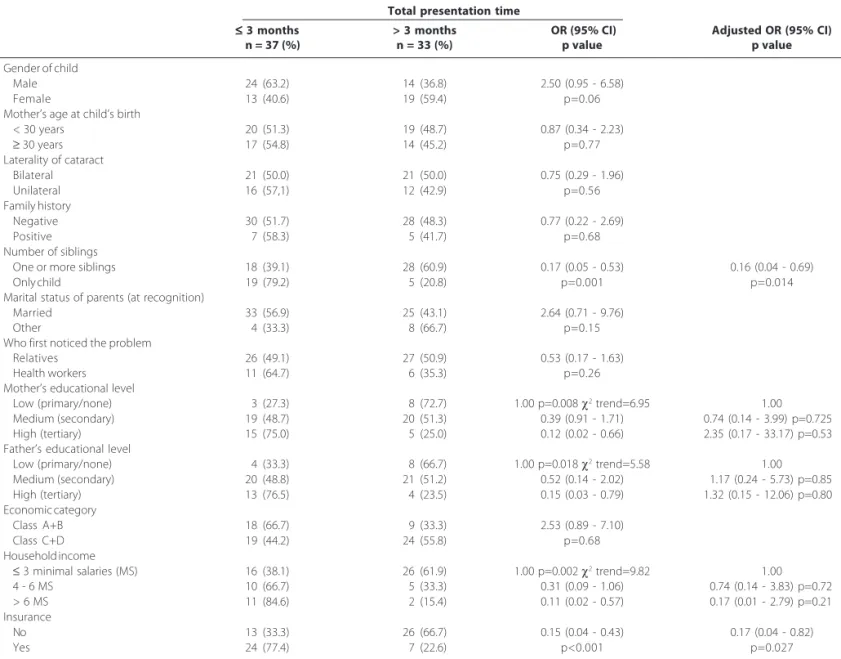
(8.6%) in both periods. Initially, total delay of treatment was asso-ciated with mother’s educational level (p=0.008), father’s educa-tional level (p=0.018), household income (p=0.002), being the only child (p=0.001) and having insurance (p<0.001). Using a multiple logistic regression modeling, only the last two factors showed a protective effect after controlling for the other variables. Children without siblings were 84% less likely to have a delay in their treat-ment compared to those with siblings. Moreover, children whose families had insurance were 83% less likely to have their treatment delayed compared to those without insurance (Table 4).
There is no statistically significant difference in total presentation time between children with congenital or developmental cataract (Mann-Whitney U=253.50; p=0.14).
DISCUSSION
Cataract remains an important cause of blindness in children as many studies around the world have shown(4-8).Prevention is limited
since many aspects of its etiopathogenesis are still unknown. Con-sequently, early diagnosis and prompt referral for proper treat-ment are even more important in increasing the probability of these children developing sight.
In Brazil, although primary health care is well established and easily accessible, primary eye care is not normally incorporated to it.
Total delay in presentation in our study occurred mostly in seeking the specialized ophthalmologist who started treatment after the child had been seen by another health worker. Considering that half of caregivers sought directly an ophthalmologist as first health worker, a much lower proportion of delay on the second phase should be expected. Instead 11 (31.4%) out of these 35 children had delay at treatment presentation, mostly due to problems in referral or treat-ment in the public health system. Additionally, other 20 children firstly seen by pediatricians had delay at treatment presentation, half of them (10) by referral problems due to lack of knowledge of specialized centers or difficulty in making appointment mainly in the public health system and also, although much less frequently, in the private sector. Moreover, in other 5 of these 20 cases lack of pediatricians’ skills in diagnosing the problem was responsible for the delay.
Applying the same criteria used in this study for educational level to the population of the state of Rio de Janeiro about 17.0% were classified as having low education, 50.0% medium education and 33% high education(21).In the present study, similar figures were found for the parents’ educational level, respectively: 16.4%, 57.1% and 26.4%. This may suggest our sample is representative of the population of the state of Rio de Janeiro. However, the mother’s educational level in this setting was not a determinant in late pre-sentation in this study. This finding contrasts with that of a similar study in Tanzania(23). Furthermore, the gender of the child was not
deter-minant in seeking for treatment as it is in some African and Asian settings(23-25).
In fact, the only two factors which showed significant negative relation to total late presentation were: having insurance and being the only child. The former was expected by some of the reasons mentioned above as a great number of children whose treatment was supported by NGO had already been seen or even treated in the public system before seeking or been referred to ICI. Compa-rison of this result is not possible due to lack of similar studies. Furthermore, being the only child as a protective factor against delay in presentation could suggest higher level of parents’ atten-tion on their only child. In contrast, Mwende et al.(23) found that children with congenital cataract who had siblings were 4.40 (95% CI 1.38 to 14. 39) less likely to have a late presentation to hospital (after 12 months in their study) compared to only children in Tanzania.
The fact that the study was performed in a specialized hospital could introduce some bias since parents who attend these hos-pitals tend to be more health concerned or conscious, more likely to have higher socioeconomic status. Moreover, even with the NGO covering most of the costs, expenditure with transportation could deter some families from looking for help. Also, some level of inaccura-cy in recalling details of their health-seeking behavior could occur particularly in cases of longer follow-up.
We considered the number of siblings at the day of interview which could not be same of that at the birth of the child. Therefore, association between this variable and total delay in presentation could be underestimated or overestimated.
Table 2. Age of child at detection by who detected her congenital cataract
Age of the child at detection (months)
Who detected ≤≤≤≤≤ 3 months (%) > 3 months (%) Total
Parents/relatives 31 ( 73.8) 13 ( 81.3) 44 ( 75.9)
Pediatrician 07 ( 16.7) 02 ( 12.5) 09 ( 15.5)
Other health worker 4 ( 9.5) 1 ( 6.2) 05 ( 8.6)
Total 42 (100.0) 16 (100.0) 58 (100.0)
Pearson χ2=0.3582; p=0.836
Table 3. Delay in presentation to treatment by first professional sought for help
Professional
Delay Ophthalmologist (%) Pediatrician (%) Total (%)
Yes 11 ( 31.4) 20 ( 57.1) 31 ( 44.3)
No 24 ( 68.6) 15 ( 42.9) 39 ( 55.7)
Total 35 (100.0) 35 (100.0) 70 (100.0)
Pearson χ2= 4.6898; p=0.03
Table 1. Median age of child at detection by type of cataract and laterality
Age of the child at detection (months)
Median Range Lower quartile Upper quartile Frequency
Type of cataract *
Congenital 01 1 - 36 01.0 04.0 58
Developmental 30 18 - 73 21.5 51.0 12
Laterality**
Bilateral 02 1 - 55 01.0 09.0 42
Unilateral 01 1 - 73 01.0 04.5 12
Total 02 1 - 73 01.0 08.0 70
ACKNOWLEDGMENTS
The authors thank colleagues and staff of the eye clinic (IBOL) and “Instituto Catarata Infantil”.
REFERENCES
1. Gilbert C, Foster A. Childhood blindness in the context of VISION 2020 - the right to sight. Bull World Health Organ. 2001;79(3):227-32.
2. World Health Organization. Global initiative for the elimination of avoidable blindness. Geneva: World Health Organization; 1998.
3. Gilbert C. Childhood blindness. Foster A. In: A Manual for VISION 2020 Workshops. London: London School of Hygiene and Tropical Medicine; 2002. p. 29-44.
4. Gilbert C, Cánovas Emhart R, Kocksch Werner R, Foster A. Ceguera infantil en Chile: estudio de escuelas de ciegos. Arch Chil Oftalmol. 1993;50(2):49 -53.
5. Zuluaga C, Sierra MV, Asprilla E. Causas de ceguera infantil en Cali, Colombia. Colomb Med. 2005;36(4):235-8.
6. Haddad MA, Sei M, Sampaio MW, Kara-José N. Causes of visual impairment in children: a study of 3,210 cases. J Pediatr Ophthalmol Strabismus. 2007;44(4):232-40.
7. Haddad MA, Lobato FJ, Sampaio MW, Kara-José N. Pediatric and adolescent population with visual impairment: study of 385 cases. Clinics (Sao Paulo). 2006;61(3):239-46. 8. Brito PR, Veitzman S. Causas de cegueira e baixa visäo em crianças. Arq Bras Oftalmol.
2000;63(1):49-54.
9. Roche O, Beby F, Orssaud C, Dupont Monod S, Dufier JL. [Congenital cataract: general review]. J Fr Ophthalmol. 2006;29(4):443-55. French.
10. Basti S, Greenwald MJ. Principles and paradigms of pediatric cataract management. Indian J Ophthalmol. 1995;43(4):159-76.
11. Rahi JS. Congenital and infantile cataract. In: Wormald R, Smeeth L, Henshaw K, editors. Evidence-based ophthalmology. London: Blackwell BMJ Books; 2003. p. 47-51. 12. Wilson ME Jr, Trivedi RH, Hoxie JP, Bartholomeu LR. Treatment outcomes of congenital
monocular cataracts: the effects of surgical timing and patching compliance. J Pediatr Ophthalmol Strabismus. 2003;40(6):323-9; quiz 353-4. Comment in J Pediatr Ophthalmol Strabismus. 2003;40(6):322.
13. Birch EE, Stager D, Leffler J, Weakley D. Early treatment of congenital unilateral cataract minimizes unequal competition. Invest Ophthalmol Vis Sci. 1998;39(9):1560-6. 14. Arieta CEL, Kara José N. Catarata congênita: dificuldades no tratamento. Arq Bras
Oftal-mol. 1987;50(3):116-9.
15. Haargaard B, Wohlfahrt J, Fledelius HC, Rosenberg T, Melbye M. Incidence and cumulative risk of childhood cataract in a cohort of 2.6 million Danish children. Invest Ophthalmol Vis Sci. 2004;45(5):1316-20.
16. Rahi JS, Dezateux C. Congenital and infantile cataract in the United Kingdom: underlying or associated factors. British Congenital Cataract Interest Group. Invest Ophthalmol Vis Sci. 2000;41(8):2108-14.
17. Magnusson G, Persson U. Screening for congenital cataracts: a cost- consequence analysis of eye examination at maternity wards in comparison to well- baby clinics. Acta Paediatr. 2005;94(8):1089-95.
18. Rahi JS, Dezateux C. National cross sectional study of detection of congenital and infantile cataract in the United Kingdom: role of childhood screening and surveillance. The British Congenital Cataract Interest Group. BMJ. 1999;318(7180):362-5.
19. Mérula RV, Fernandes LC. Catarata infantil: importância do diagnóstico e tratamento pre-coces. Arq Bras Oftalmol. 2005;68(3):299-305.
Table 4. Characteristics associated with total delay
Total presentation time
≤ ≤≤
≤≤ 3 months > 3 months OR (95% CI) Adjusted OR (95% CI)
n = 37 (%) n = 33 (%) p value p value
Gender of child
Male 24 (63.2) 14 (36.8) 2.50 (0.95 - 6.58)
Female 13 (40.6) 19 (59.4) p=0.06
Mother’s age at child’s birth
< 30 years 20 (51.3) 19 (48.7) 0.87 (0.34 - 2.23)
≥ 30 years 17 (54.8) 14 (45.2) p=0.77
Laterality of cataract
Bilateral 21 (50.0) 21 (50.0) 0.75 (0.29 - 1.96)
Unilateral 16 (57,1) 12 (42.9) p=0.56
Family history
Negative 30 (51.7) 28 (48.3) 0.77 (0.22 - 2.69)
Positive 07 (58.3) 05 (41.7) p=0.68
Number of siblings
One or more siblings 18 (39.1) 28 (60.9) 0.17 (0.05 - 0.53) 0.16 (0.04 - 0.69)
Only child 19 (79.2) 05 (20.8) p=0.001 p=0.014
Marital status of parents (at recognition)
Married 33 (56.9) 25 (43.1) 2.64 (0.71 - 9.76)
Other 04 (33.3) 08 (66.7) p=0.15
Who first noticed the problem
Relatives 26 (49.1) 27 (50.9) 0.53 (0.17 - 1.63)
Health workers 11 (64.7) 06 (35.3) p=0.26
Mother’s educational level
Low (primary/none) 03 (27.3) 08 (72.7) 1.00 p=0.008 χ2 trend=6.95 1.00
Medium (secondary) 19 (48.7) 20 (51.3) 0.39 (0.91 - 1.71) 0.74 (0.14 - 3.99) p=0.725
High (tertiary) 15 (75.0) 05 (25.0) 0.12 (0.02 - 0.66) 2.35 (0.17 - 33.17) p=0.53
Father’s educational level
Low (primary/none) 04 (33.3) 08 (66.7) 1.00 p=0.018 χ2 trend=5.58 1.00
Medium (secondary) 20 (48.8) 21 (51.2) 0.52 (0.14 - 2.02) 1.17 (0.24 - 5.73) p=0.85
High (tertiary) 13 (76.5) 04 (23.5) 0.15 (0.03 - 0.79) 1.32 (0.15 - 12.06) p=0.80
Economic category
Class A+B 18 (66.7) 09 (33.3) 2.53 (0.89 - 7.10)
Class C+D 19 (44.2) 24 (55.8) p=0.68
Household income
≤ 3 minimal salaries (MS) 16 (38.1) 26 (61.9) 1.00 p=0.002 χ2 trend=9.82 1.00
4 - 6 MS 10 (66.7) 05 (33.3) 0.31 (0.09 - 1.06) 0.74 (0.14 - 3.83) p=0.72
> 6 MS 11 (84.6) 02 (15.4) 0.11 (0.02 - 0.57) 0.17 (0.01 - 2.79) p=0.21
Insurance
No 13 (33.3) 26 (66.7) 0.15 (0.04 - 0.43) 0.17 (0.04 - 0.82)
XII Congresso Internacional de
Catarata e Cirurgia Refrativa
30 de maio a 2 de junho de 2012
Parque Anhembi - SP
Informações:
CENACON - Centro Nacional de Congressos
Tel: (17) 3214-5900 - Fax: (17) 3214-5905
Site: http://www.cataratarefrativa2012.com.br
20. Oliveira MLS, Di Giovanni ME, Porfírio Neto Júnior F, Tartarella MB. Catarata congênita: aspectos diagnósticos, clínicos e cirúrgicos em pacientes submetidos a lensectomia. Arq Bras Oftalmol. 2004;67(6):921-6.
21. Instituto Brasileiro de Geografia e Estatística - IBGE. Censo brasileiro.[citado 2011 Set 9]. Disponível em: http://www.ibge.gov.br/home/
22. ABEP. Critério Padrão de Classificação Econômica Brasil/ 2008. [citado 2007, jun]. Dispo-nível em: http://www.viverbem.fmb.unesp.br/docs/classificacaobrasil.pdf
23. Mwende J, Bronsard A, Mosha M, Bowman R, Geneau R, Courtright P. Delay in presenta-tion to hospital for surgery for congenital and developmental cataract in Tanzania. Br J Ophthalmol. 2005;89(11):1478- 82.