Guillain-Barré syndrome (GBS) covers a set of clinical syndromes in which idiopathic peripheral neuropathy affecting motor, sensitive and auto-nomic nerves and spinal roots causes acute, or subacute, progressive motor weakness in more than one limb1,2. The degree ranges from mini-mal weakness in the legs to total paralysis of the muscles of all four extremities and of the trunk. External ophthalmoplegia, bulbar and facial pa-ralysis may occur with varied frequency. GBS has near complete, or complete, clinical recovery in
most cases3. It is mediated by humoral and cellu-lar immune responses that result in the direct des-truction of either the myelin sheath surrounding the peripheral nerves or the axon itself4. Immune reactions against target epitopes contained in Schwann cell surface membrane or myelin result in acute inflammatory demyelinating neuropathy, and reactions against epitopes in the axonal mem-brane cause the acute axonal form of the syndro-me5. It may follow triggering events, most fre-quently nonspecific or “flu-like” upper respiratory
EPIDEMIOLOGIC FEA
TURES OF GUILLAIN-BARRÉ
SYNDROME IN SÃO PAULO, BRAZIL
Maria Sheila Guimarães Rocha
1, Sônia Maria Dozzi Brucki
2,
Alzira Alves de Siqueira Carvalho
2, Úrsula Waleska Poti Lima
3ABSTRACT - Introduction: There are few epidemiologic studies concerning Guillain-Barré syndrome (GBS). Due to difficulties with definition and lack of a standard diagnostic test of reference, GBS is not easy to study epidemiologically. We evaluate some epidemiological features of GBS in a sample of cases treated at a tertiary hospital in São Paulo, Brazil. Method: We retrospectively reviewed all cases of GBS with hos-pitalization in Santa Marcelina hospital, over the period of January 1995 through December 2002. Results:
Ninety-five cases were included in this study. Fifty-five were men and forty women, with a proportion of 1.4 men to 1 woman. The age ranged from 1 to 83 years with a mean age at onset of 34 years. GBS was less frequently observed below 15 years (18.9%) and above 60 years (16.9%). The highest frequency was observed in patients aged 15 to 60 years old (66.2%). The annual incidence rate was 0.6 cases/100,000 people. There was a highest frequency of cases during the months of September through March (62.1%).
Conclusion: Our data differs from that of other epidemiological studies in that we did not observe a bimodal distribution in age and found a seasonal pattern in hotter months.
KEY WORDS: Guillain Barré syndrome, epidemiology.
Aspectos epidemiológicos da síndrome de Guillain-Barré em São Paulo, Brasil
RESUMO - Introdução: Os estudos epidemiológicos da síndrome de Guillain-Barré são escassos, devido às dificuldades com a definição da doença e à ausência de marcador biológico diagnóstico. Avaliamos aspec-tos epidemiológicos de uma amostra de pacientes com a SGB internados em hospital terciário da zona leste de São Paulo. Método: Avaliamos retrospectivamente prontuários de internação de todos os pa-cientes com o diagnóstico de SGB internados no Hospital Santa Marcelina no período de janeiro de 1995 a dezembro de 2002. Resultados e conclusão: A amostra consta de 55 pacientes do gênero masculino e 40 pacientes do feminino, na proporção de 1.4 homens para 1 mulher. A idade variou de 1 a 83 anos (média: 34 anos). Observamos menor incidência da doença em pacientes com idade abaixo de 15 anos (18,9%) e acima de 60 anos (16,9%). A freqüência maior foi observada no subgrupo com idade entre 15 e 60 anos (66,2%). A incidência anual foi de 0,6 casos/100,000 habitantes, sendo 62,1% dos casos observados nos meses de setembro a março e 37,9% nos meses de abril a agosto. A mortalidade observada foi de 3,1%.
Conclusão: Nossos resultados diferem daqueles publicados na literatura médica pela ausência de dis-tribuição bimodal na idade e pelo caráter sazonal apresentado.
PALAVRAS-CHAVE: síndrome de Guillain-Barré, epidemiologia.
Serviço de Neurologia Clínica do Hospital Santa Marcelina (HSM), São Paulo SP, Brasil; 1Doutora em Medicina, Chefe do Serviço de
Neurologia Clínica HSM; 2Doutora em Medicina, Assistente do Serviço de Neurologia Clínica HSM; 3Residente de Neurologia do HSM.
Received 27 May 2003, received in final form 15 August 2003. Accepted 13 September 2003.
infections, gastrointestinal illnesses and vaccina-tions6,7. Nowadays Guillain-Barré syndrome has be-come the principal cause of acute flaccid paraly-sis in Western countries, after the control of po-liomyelitis8,9.
Epidemiological studies can provide a more complete picture of the natural history and clini-cal spectrum of a disease, mainly when the studies are based on all cases of the disease in a well fined population. Peripheral neuropathies are de-finitively not easy to study epidemiologically, due to the heterogeneity of the disorder and because many different clinical disorders have neuropa-thy as a component. Guillain-Barré syndrome is a subgroup of neuropathy and its diagnosis remains descriptive. We still have difficulties with its defi-nition and there is not a standard diagnostic test of reference. Epidemiological studies of GBS are rare, with only ten series that include more than one hundred patients to date10-16. This occurs par-tially because the clinical, laboratory and electro-diagnostic criteria, although well defined, are dif-ficult to apply retrospectively. Despite these ca-veats, GBS has been the subject of many epide-miological studies given that it is a striking neu-rologic condition and usually serious enough to require medical attention at a very early stage.
To our knowledge, there have been just a few epidemiological studies of this syndrome in Latin American8,9,17,18. The aim of this study is to demons-trate clinical and epidemiological aspects of GBS in a series of ninety-five Brazilian patients whose illness occurred over the years from 1995 to 2002.
METHOD
We included all patients with clinical diagnosis of GBS who had been hospitalized in Santa Marcelina Hos-pital, São Paulo, Brazil, from January 1995 to Decem-ber 2002. Clinical data was collected from medical re-cords of the patients whose hospitalization occurred during the period of 1995 to 1999, and from clinical re-gistrations for cases occurring during the years of 2000 to 2002. We used a standard protocol that included demographic data and a questionnaire in order to dis-close possible risk factors for GBS. We also applied clin-ical, electrophysiological and cerebrospinal fluid (CSF) criteria for GBS defined by Asbury and Cornblath3 . Pa-tients were included only if they fulfilled all criteria de-fined by Asbury and Cornblath: presence of roughly symmetrical motor weakness over a period ranging from days to four weeks and decrease or disappearan-ce of deep tendon reflexes. All the patients were exa-mined by the same neurological staff during all these years. They all underwent CSF biochemical analysis and
electrodiagnostic studies. Patients were excluded if they had Diabetes mellitus or acquired immunodeficiency syndrome, since these illnesses are related to acute in-flammatory demyelinating polyneuropathy, and there-after present a high possibility of bias in an epidemio-logical study.
RESULTS
Ninety-five patients met diagnostic criteria of
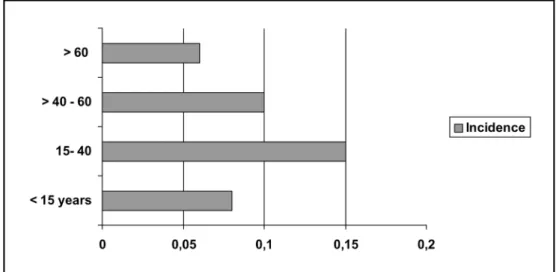
Asbury and Cornblath for GBS and were included in statistical analysis. (Figs 1 and 2) Fifty-seven percent of the patients were male and 43% were female, with a male/female ratio of 1.4/1.0. The mean age of the 95 patients at admission was 35 years (range 1 to 83). The female group was sig-nificantly younger than the male group. The fe-male group had a mean age of 30 years (range 1 to 79) and the male group had a mean age of 39 years (p< 0.05). The analysis of subgroups of ages showed a higher proportion of patients aged 15 to 60 years (66.2% of all cases), and a small pro-portion of patients with age below fifteen (18.9%) and above sixty (16.9%). The analysis of the chil-dren subgroup showed an increased frequency among children aging 0-4 years (55.5%).
The annual mean coefficient of incidence of GBS was 0.4 per 100.000 persons considering both sexes and all ages of the population located at Santa Marcelina Hospital area (three million peo-ple). The mean annual frequency was 11.9 cases. Considering seasonal fluctuations, the highest in-cidence was observed from September to March with 62.1% of cases and 37.9% during the months of April to August (p< 0.05). Table 1 shows a high-er incidence of GBS during the months of Spring and Summer in six out of eight years. Antecedent infections within one month before the onset of neurological symptoms were found in fifty-eight percent of the cases. Among them, respiratory in-fections were related in 46 percent of cases, and gastrointestinal infections in 12% of cases.
DISCUSSION
Incidence - Forty large series of GBS patients
from well-defined geographic areas were identi-fied over the last 45 years19. Annual incidence has varied widely, from 0.4 to 4 cases/100,000 popu-lation with a median of 1.3 cases/100,000. Our series of GBS patients disclosed a mean annual incidence of 0.4 case /100.000. Although definite-ly not representative of the Brazilian population, as this was a hospital-based study, it showed an annual incidence similar to a recently published study, which analyzed the GBS in the whole Bra-zilian population under 15 years of age9. They found a mean coefficient of incidence of 0.46 for the whole country and 0.40 for the southeast re-gion, where lies the city of São Paulo. These data, however, cannot be compared with that from the present study, since our survey included all age subgroups. In spite of that, our data showed an annual incidence that is not different from the overall incidence rates recorded in many other studies, ranging from 0.2 to 0.9 case/100.00010,19-22. We did not consider the population of São Pau-lo´s metropolitan area because all the patients in this series lived in the hospital referred area. The annual incidence of the cases (given in Table 1) showed no increasing incidence during these eight years, although we have observed a peak inci-dence in 1996 (Fig 1).
Sex distribution - In almost all series studies,
males are more commonly affected by Guillain-Barré syndrome than are females, with a median rate of 1.25 men to one woman22. Considering the supposed autoimmune etiology of GBS, the male preponderance is somewhat unexplained. We also observed the same preponderance in our study with a male/female ratio of 1.4/1.0. Dias-Tosta and Huckelhaus found a slight preponder-ance of boys throughout the years of their study in the Brazilian population below fifteen9. Our study also showed that men were older than wo-men at the onset of the disease. We do not have a reasonable explanation for that. Perhaps this represented only a statistical bias in consequence of the difference between the numbers of cases in both sexes.
Age distribution- The age distribution of GBS
is usually bimodal, with peaks both in the young and the elderly22. The incidence is lower in chil-dren under fifteen, whereas the highest inciden-ce is observed in the elderly. This increased inci-dence in the elderly is commonly attributed to an abnormal immune suppressor mechanism, lead-ing to higher susceptibility to autoimmune disor-ders. Our study failed to demonstrate this bimo-dal age distribution. We saw an isolated peak in young adult, mainly in those between 15 to 40 years old, and lower incidences in children and in patients above 60 years old (Fig 2). Among chil-dren the greater prevalence was observed in
se under four years old. We had a lower inciden-ce in the age subgroup below fifteen than that found in Dias-Tosta and Huckelhaus series of pa-tients9, although we had observed the same high prevalence in children below four as they had. Probably this reflected the influence of the lack of pediatric emergency reference to our hospital, known as a general one.
Seasonal distribution- Most studies have not
identified a relationship between the incidence of GBS and season preponderance, despite the clear association with preceding upper respirato-ry infections, which are more frequent in the col-der months of winter. Some epidemiological dies show a seasonality pattern, such as those stu-dies that identify a higher frequency of the dise-ase in autumn23, or in the summer and autumn13,24 along with the study in Sardinia, Italy, which re-ported the most critical seasons to be Winter and Spring10. A study in northern China has found a markedly increased incidence of the acute motor axonal form of GBS in the Summer months. This form of the disease is clearly associated with en-teric infections and Campilobacter jejuni, with
higher incidence in hotter months25. The lack of seasonal association observed in most studies may be due to the fact that the respiratory and enteric infections have opposite seasonality. We found a higher incidence of the illness in the months during Spring and Summer in Brazil, when sixty-two percent of the cases occurred (Table 1). This cannot be attributed to enteric infections li-ke in China, since the most frequent trigger event in our series was respiratory tract infections. Dias-Tosta and Kuckelhaus’ study, also in Brazil, shows
no clear peak distribution against months, altho-ugh they had found a slight variation in January and May, which was not significant9.
Trigger events - GBS is the prototypic “postin-fectious” disease, with about two-thirds of pati-ents with an antecedent infection, but in many instances, the pathogen that caused the prodro-mal illness remains unidentified. Respiratory in-fections are the most frequently reported, follo-wed by gastrointestinal infection, of which Cam -pilobacter jejuni is the main identified agent26. Many other identified pathogens have been re-ported, including human immunodeficiency virus, as being triggers for GBS, but these have been reported in small series and anecdotal reports, for which there is a lack of statistically valid eviden-ce27. The association with vaccinations has been reported in many studies as antecedent events14, but the only case with a satisfactorily explained mechanism is that of the rabies vaccines. Two se-parated case control studies failed to show a sig-nificant association between the occurrence of GBS and immunization, although they have found an increased risk likely to be four to five-fold28. Other possible life event associations, such as preg-nancy, surgery and trauma, have been reported as remote etiologic possibilities22. We found the respiratory infection to be the most frequently antecedent trigger event, being reported by 46% percent of our patients, followed by gastrointes-tinal infection, reported by 12% of patients. No-ne of our niNo-nety-five patients reported previous vaccination, trauma, surgery or pregnancy.
cal care quality and remains a significant cause of mortality and morbidity among persons aged over 40 years. Mortality rate increases among older age groups. The overall case-fatality ratio is about 4.4% in the United States, ranging from 0.7% among persons younger than fifteen years old to as high as 8.6% among persons older than 65 years old29. In southeast England the mortality ratio was also about 8%, as it was demonstrated in a recent survey by Rees et al.30. Dias-Tosta & Ku-ckelhaus found a death rate of 5.4% in a Brazi-lian series of pediatric GBS, with a regional varia-tion from 2.7% in the southeastern part of Brazil to 7.6% in the northeast region9. We found a mortality ratio of 3.1%. The three patients who died were over 60. The mortality rate observed in our study was slightly lower than those discussed above, probably reflecting a constant concern over early critical care measures, and early use of plasmapheresis or high dose intravenous immu-noglobulin, the standard treatment defined for all patients with certain diagnosis of GBS in our centre since 1995.
In conclusion, our study demonstrated inci-dence, sex distribution and trigger events of Gui-llain-Barré Syndrome similar to many other previ-ous studies. However, our data differs from that of other epidemiological studies in that we did not observe the typical bimodal distribution in age, there was a slightly lower mortality than worldwide described and we have found a sea-sonal preponderance in hotter months.
REFERENCES
1. Griffin JW, Li CY, Ho TW, et al. Guillain-Barré syndrome in northern China. The spectrum of neuropathological changes in clinically defined cases. Brain 1995;118:577-595.
2. Hartung HP, Pollard JD, Harvey GK, Toyka KV. Immunopathogenesis and treatment of the Guillain-Barré syndrome. I. Muscle Nerve 1995;18:137-153.
3. Asbury AK, Cornblath DR. Assessment of current diagnostic criteria for Guillain-Barré syndrome. Ann Neurol 1990;27(Suppl):S21-S24. 4. Koski CL. Humoral mechanisms in immune neuropathies. Neurol
Clin 1992;10:629-649.
5. Hafer-Macko CE, Sheikh KA, Li CY, et al. Immune attack on the Schwann cell surface in acute inflammatory demyelinating polyneu-ropathy. Ann Neurol 1996;39:625-635.
6. Alter M. The epidemiology of Guillain-Barré syndrome. Ann Neurol 1990;27(Suppl):S7-S12.
7. Lasky T, Terracciano GJ, Magder L, et al. The Guillain-Barré syndro-me and the 1992-1993 and 1993-1994 influenza vaccines. N Engl J Med 1998;339:1797-1802.
8. Olive JM, Castillo C, Garcia CR, Quadros CA. Epidemiologic study of Guillain-Barré syndrome in children < 15 years of age in Latin America. J Infect Dis 1997;175(Suppl 1):S160-S164.
9. Dias-Tosta E, Kuckelhaus CS. Guillain Barré syndrome in a population less than 15 years old in Brazil. Arq Neuropsiquiatr 2002;60:367-373. 10. Congia S, Melis M, Carboni MA. Epidemiological and clinical
featu-res of Guillain-Barré syndrome in Sardinia in the 1961-1980 period. Acta Neurol 1989;11:15-20.
11. Jiang GX, Cheng Q, Link H, Pedro-Cuesta J. Epidemiological features of Guillain-Barré syndrome in Sweden, 1978-1993. J Neurol Neuro-surg Psychiatry 1997;62:447-453.
12. Hankey GJ. Guillain-Barré syndrome in Western Australia, 1980-1985. Med J Aust 1987;146:130-133.
13. Larsen JP, Kvale G, Nyland H. Epidemiology of the Guillain-Barré syndrome in the county of Hordaland, Western Norway. Acta Neurol Scand 1985;71:43-47.
14. Langmuir AD, Bergman DJ, Kurland LT, Nathanson N, Victor M. An epidemiological and clinical evaluation of Guillain-Barré syndrome reported in association with the administration of swine influenza vaccines. Am J Epidemiol 1984;119:841-879.
15. McLean M, Duclos P, Jacob P, Humphreys P. Incidence of Guillain-Barré syndrome in Ontario and Quebec, 1983-1989, using hospital service databases. Epidemiology 1994;5:443-448.
16. Nyland H. Epidemiology of Guillain-Barré syndrome in mid-western Norway. Acta Neurol Scand 1978;57:223-231.
17. Hart DE, Rojas LA, Rosario JA, Recalde H, Roman GC. Childhood Guillain-Barré syndrome in Paraguay, 1990 to 1991. Ann Neurol 1994; 36:859-863.
18. Lamenha JA, Lyro AS. Acute multiradiculopathy: report of 56 cases. Arq Neuropsiquiatr 1993;51:112-117.
19. Cheng Q, Wang D, Jiang G, et al. Distinct pattern of age-specific inci-dence of Guillain-Barré syndrome in Harbin, China. J Neurol 2002; 249:25-32.
20. Brewis M, Poskanzer DC, Rolland C, Miller H. Neurological disease in an English city. Acta Neurol Scand 1966;42(suppl 24):1-89. 21. D’Ambrosio G, De Angelis G, Vizioli R. Epidemiology of
Guillain-Barré syndrome in Campania (South Italy): preliminary results. Acta Neurol 1983;23:245-252.
22. Hughes RAC, Rees JH. Clinical and epidemiological features of Guillain-Barré syndrome. J Inf Dis 1997;176(Suppl 2):S92-S98. 23. Ravn H. The Landry-Guillain-Barré syndrome. Acta Neurol Scand
1967;43(Suppl 30):1-18.
24. Lesser RP, Hauser WA, Kurland LT, Mulder WM. Epidemiologic fea-tures of the Guillain-Barré syndrome. Neurology 1973;23:1269-1275. 25. McKhann GM, Cornblath DR, Griffin JW, et al. Acute motor axonal
neuropathy: a frequent cause of acute flaccid paralysis in China. Ann Neurol 1993;33:333-342.
26. Winer JB, Hughes RAC, Anderson MJ, Jones DM, Kangro H, Watkins RFP. A prospective study of acute idiopathic neuropathy: antecedent events. J Neurol Neurosurg Psychiatry 1988;51:613-618.
27. Arnason B, Soliven B. Acute inflammatory demyelinating polyradicu-loneuropathy. In Dyck PJ, Thomas PK, Griffin JW, Low PA, Poduslo JF (eds). Peripheral neuropathy, 3rdEd. Philadelphia: Saunders, 1993:
1437-1497.
28. Hughes RAC, Rees J, Smeeton N, Winer J. Vaccines and Guillain-Barré syndrome. Br Med J 1996;312:1475-1476.
29. Prevots DR, Sutter RW. Assessment of Guillain-Barré syndrome mor-tality and morbidity in the United States: implications for acute flac-cid paralysis surveillance. J Inf Dis 1997;175(Suppl1):S151-155. 30. Rees JH, Thompson RD, Smeeton NC, Hughes RAC. Epidemiological