HEPATIC ENZYMES' LEVEL DURING CHRONIC USE OF ANTICONVULSANT DRUGS
S U M M A R Y - We studied retrospectively 894 adult epileptic patients treated during the period from 1983 to 1992. Hepatic enzymes abnormal values were seen in 49%(n=438). In 22.3%(n=200), at least 2 enzyme levels in different moments were altered. They were divided in three groups: GI with alterations at transaminases ( 3 % , n=6), GII with alterations at G G T and A P enzymes (72%,n=144) and GIII with alterations in both groups (25%, n=50). No patient developed clinical symptoms of liver disease. The increase of gamma-glutamil-transferase (GGT) and alkaline phosphatase (AP) levels is frequent and not necessarily pathological. Slight increase of transaminases can occur with no clinical correlation. The routine screening of hepatic enzymes level during the chronic use of anticonvulsivant drugs in adults has a questionable value.
KEY W O R D S : hepatic enzymes, epilepsy, anticonvulsant drugs.
Dosagens de enzimas hepáticas em pacientes em uso crônico de drogas antiepiléticas
R E S U M O - Oitocentos e noventa e quatro pacientes epiléticos adultos tratados no período de 1983 a 1992 foram estudados retrospectivamente. Valores anormais de enzimas hepáticas foram detectados e m 4 9 % (n=438) dos casos. E m 200 pacientes (22,3%), ao menos duas dosagens obtidas em momentos diferentes estavam alteradas. Estes últimos foram divididos em 3 g r u p o s : GI, com alterações de transaminases ( 3 % , n=6); GII com alterações de gama-glutamil-transferase (GGT) e fosfatase alcalina (AP) (72%, n=144) e GIII com alterações nos dois grupos d e enzimas (25%, n=50). Nenhum paciente desenvolveu sinais ou sintomas de doença hepática. O aumento d e G G T e A P e m pacientes e m uso de drogas antiepiléticas é frequente e pode não ter significado patológico. Pequenos aumentos de transaminases também podem ocorrer sem correlação clínica.
PALAVRAS-CHAVE : enzimas hepáticas, epilepsia, drogas antiepiléticas.
The use of anticonvulsant drugs includes a risk of hepatotoxicity with associated mortality and morbidity rates. Such reactions are frequently idiosyncratic, due to hypersensitivity or abnormal metabolism. De Vries5
suggested, in 1965, that such reactions could be preceded by an asymptomatic phase, detectable by routine screening, allowing a precocious stop in the use of the drug. However, the routine laboratory monitoring had not proved to be beneficial and is of doubtful value.
This study discusses the results of repetitive hepatic enzymes blood tests during the follow-up of epileptic patients.
METHODS
We studied retrospectively 894 epileptic patients older than 12 years old with partial epilepsy followed at our out-patient service from January 1983 to November 1992. Repetitive routine screening of hepatic enzymes was carried out. Values of aspartate aminotransferase (AST/TGO) >20 U/l, alanine aminotransferase (ALT/ TGP) >20 U/l, gamma-glutamyl transferase (GGT) >30 U/l and alkaline phosphatase (AP) >200 U/l were considered abnormal. The patients whose results were abnormal at least twice were selected and divided in 3 groups: Group I (GI) with altered transaminases; Group II (Gil) with altered G G T and AP and Group III (GUI) for those patients with both transaminases and GGT/AP elevated.
RESULTS
The average follow-up time was 34.5 months. All patients studied had partial epilepsy and
the most common drugs prescribed were carbamazepine (CBZ) and phenytoin (DPH). Few patients
received valproate (VPA).
Hepatic enzymes' abnormal values were seen in 49% of the patients (n=438).
In 22.4% (n=200), at least 2 enzyme levels in different moments were altered; from them,
5 2% (n= 104) were in monotherapy and 48% (n=96) were in polytherapy. These patients were further investigated.
The patients with 2 altered enzyme levels were distributed as follows: Group I (GI) only with
alterations at transaminases (AST/ALT) (3%, n=6); Group II (G II) only with alterations at GGT
and/or AP (72%, n=144) and Group III (G III) when both were altered (25%, n=50) (Fig 1).
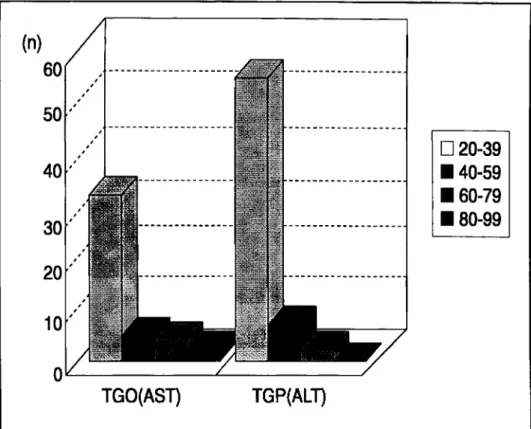
Fig 2. Distribution of the patients with increased transaminases according to the enzyme's level. Normal values: AST/ALT < 20 U/l; AP < 200 U/l; GGT < 30 U/l.
In the polytherapy group (n=96), 3 (3.1 %) belonged to GI, 74 (77%) to GH and 19 (20%) to GUI.
No patient developed symptoms or signs of liver disease.
COMMENTS
In our study we found a high proportion of altered hepatic enzymes (48.9%), mainly GGT and
AP. Transaminases were increased less then twice the normal value in approximately 80% of the cases.
Although the actual incidence of hepatic lesions due to DPH has not yet been determined,
some authors found it to be infrequent
1 7 , 2 8predominating in black adults with an interval from 1 to 6
weeks from drug initiation to the onset of symptoms. Immuneallergic mechanisms are probably
involved at pathogenesis, leading to symptoms like fever, cutaneous alterations, lymphadenopathy
2 7and eosinophilia. Mortality rates are between 10 and 38%
5.
The most susceptible patients receiving CBZ are adults
2 0. The initial symptoms of hepatic
failure resemble those of biliary tract infection with pruritus, fever, jaundice, chills and upper right
quadrant tenderness
8, from 3 to 4 weeks after beginning of the drug. The mortality rate is around
25%
1 3. Hypersensitivity reactions or toxic metabolites can be involved.
Dreifuss et al.
7 , 9verified that the risk factors for VPA induced hepatic failure are children
younger than 2 years old and receiving polytherapy. The onset symptoms include nausea, vomiting,
anorexia, lethargy, edema and loss of seizure control, occurring during the first 6 months of treatment.
It is followed by jaundice with or without ascites, coma, renal failure and death. The histologic
features are microvesicular steatosis and necrosis
2 9. Idiosyncratic drug reactions by metabolic
abnormalities are the most probable mechanisms of toxicity
4 1 9(4-pentenoic acid
2 2,4-en metabolite
1 5,
fatty acid beta-oxidation
2 3, hypocarnitinemia, deficiencies in free radical scavenging enzymes,
alfal-antitripsin deficiency
1 1and elevated ammonia levels
2 3). VPA users have been reported to have elevated
hepatic enzyme levels in 7 to 4 4 %
2 6 , 2 9, but only 0,01% develop fatal hepatotoxicity
7. The small
number of patients in monotherapy with VPA (n=2) in this series compromises the evaluation of our
results in relation to this drug.
Almost half of our patients had abnormal enzyme levels, but there were no clinical correlations
and no prognostic value.
The transaminases' elevations were independent from the studied drug; this is in contrast to
other findings showing a differential elevation of transaminases linked to some anticonvulsants
2 4.
GGT was the most frequently altered enzyme. GGT values increment has been described in
90% of anticonvulsants users, mainly DPH, due to liver enzyme i n d u c t i o n
1 1 0 1 2 1 4-
1 6'
1 8-
2 1 , 2 5. However,
Detusch et al considered an elevated GGT level an early indicator of hepatic disease
6.
Due to the ubiquity and inespecifity of the GGT and AP enzymes alterations, the value of
routine laboratory monitoring is questionable. Asymptomatic increases in hepatic enzyme
concentrations are often seen with no clinical significance. There are difficulties in interpretation,
frequent need for repetition of the test (6% of all tests), no use in predicting acute idiosyncratic
reactions and occasionally inappropriate drug interruption due to unspecific findings
2-
3. Clinical
monitoring, on the other hand, is also limited due to late detection of hepatic failure
2-
3-
25.
Hepatic enzymes (GGT and AP) elevations are frequent and do not have necessarily a pathological
meaning. Mild alterations of transaminases can also occur with no clinical significance. These findings
suggest that repetitive laboratory tests for ambulatorial epileptic patients have a questionable value.
REFERENCES
2. Camfield P, Camfield C, Dooley J, Farrell K, Humphreys P, Langevin P. Routine screening of blood and urine for severe reactions to anticonvulsant drugs in asymptomatic patients is of doubtful value. Can Med Assoc J 1989; 140:1303-1305.
3. Camfield P, Camfield C, Smith E, Tibbies JAR. Asymptomatic children with epilepsy: little benefit from screening for anticonvulsant-induced liver, blood, or renal damage. Neurology 1986; 36:838-841. 4. Cotariu D, Zaidman JL. Valproic acid and the liver. Clin C h e m 1988; 18: 575-581.
5. De Vries SI. Haematological aspects during treatment with anticonvulsant drugs. Epilepsia 1965; 6:1-15. 6. Detusch J, Fritsch G, Golles J, Semmelrock HJ. Effects of anticonvulsive drugs on the activity of gamma
glutamyl transferase and aminotransferases in serum. J Pediatr Gastroenterol Nutr 1986; 5:542-548. 7. Dreifuss FE. Fatal liver failure in children on Valproate. Lancet 987; 1:47-48.
8. Dreifuss FE, Langer DH. Hepatic considerations in the use of antiepileptic drugs. Epilepsia 1987; 28(Suppl 2):S23-S29.
9. Dreifuss FE, Santilli N, Langer DH, Sweeney KP, Moline KA, Menander K B . Valproic acid hepatic fatalities: a retrospective review. Neurology 1987; 37:379-385.
10. Giroud M, D'Athis P, Guard O, Soichot P, Dumas R. Elevation of gamma-glutamyl transferase levels in treated epileptic patients. Presse Med 1986; 15: 791-794.
11. Green SH. Sodium valproate and routine liver function tests. Arch Dis Child 1984; 59:813-814. 12. Hirayanagi N, Fujii E, Teshirogi T. The significance of serum gamma-glutamyl transpeptidase
(gamma-GTP) elevation caused by antiepileptic drug(s): using the antipyrine metabolic capacity as a parameter of microsomal enzyme activity. Nippon Ika Daigaku Zasshi 1991; 58:547-560.
13. Horowitz S, Patwarden R, Marcus E. Carbamazepine hepatotoxicity. (abstract) Epilepsia 1986; 27: 592 . 14. Keeffe E B , Sunderland MC, Gabourel JD. Serum gamma- glutamyl transpeptidase activity in patients
receiving chronic phenytoin therapy. Dig Dis Sci 1986; 31:1056-1061.
15. Kondo T, Kaneko S, Otani K, Ishida M, Hirano T, Fukushima Y, Muranaka H, Koide N, Yokoyama M. Associations between risk factors for valproate hepatotoxicity and altered valproate metabolism. Epilepsia 1992; 33:172-177.
16. Mendis GP, Gibberd F B , Hunt HA. Plasma activities of hepatic enzymes in patients on anticonvulsant therapy. Seizure 1993; 2:319-323.
17. Mullick FG, Ishak KG. Hepatic injury associated with diphenylhidantoin therapy: a clinicopathologic study of 20 cases. Am J Clin Pathol 1980; 74:442-452.
18. Nijhawan R, Wierbicki AS, Tozer R, Lascelles PT, Patsalos PN. Antiepilepitc drugs, hepatic enzyme induction and raised serum alkaline phosphatase isoenzymes. Int J Clin Pharmacol Res 1990; 10:319-323. 19. Olsson R, Zettergren L. Anticonvulsant-induced liver damage. A m J Gastroenterol 1988 ; 979; 29:175-178.
2 1 . Rao ML, Stefan H, Scheid C, Kuttler AD, Froscher W. Serum amino acids, liver status and antiepileptic drug therapy in epilepsy. Epilepsia 1993; 34:347-354.
22. Rettie AE, Rettenmeier AW, Howald W N , Baillie TA. Cytochrome P450-catalyzed formation of VPA, a toxic metabolite of valproic acid. Science 1987; 235:890-893.
2 3 . Siemens H, Nau H, Schultze K, Wittfoht W, Drews E, Penzien J, Seidel U. Valproate (VPA) metabolites in various clinical conditions of probable VPA-associated hepatotoxicity. Epilepsia 1993; 34:332-346. 24. Verma NP, Haidukewych D. Differential but infrequent alterations of hepatic enzyme levels and thyroid
hormone levels by anticonvulsant drugs. Arch Neurol 1994; 51:381-384.
2 5 . Wall M, Baird-Lambert J, Buchan N, Farrell G. Liver function tests in persons receiving anticonvulsant medications. Seizure 1992; 1:187-190.
26. Willmore LJ, Wilder BJ, Bruni J, Villareal HJ. Effect of valproic acid on hepatic function. Neurology 1978; 28:961-964.
2 7 . Wyllie E, Wyllie R. Routine laboratory monitoring for serious adverse effects of antiepileptic medications: the controversy. Epilepsia 1991; 32(SuppI 5):S74-S79.
2 8 . Zimmerman HJ. Hepatotoxicity. New York: Apleton-Century-Crofts, 1978.