U
NIVERSIDADE
T
ÉCNICA DE
L
ISBOA
F
ACULDADE DE
M
OTRICIDADE
H
UM ANA
Capturing Interpersonal Coordination Processes in
Association Football: from Dyads to Collectives
Dissert at ion submit t ed in order t o obt ain the degree of Ph.D. in t he branch of Human
Kinet ics, specialt y in Sport Sciences
Advisor: Professor Doutor Duarte Fernando Rosa Belo Patronilho Araújo
Jury Chair: ReItor da Universidade Técnica de Lisboa
Jury M embers: Professor Doutor João M anuel Pardal Barreiros Professor Doutor Carlos Lago Peñas
Professor Doutor António Jaime da Eira Sampaio
Professor Doutor Duarte Fernando Rosa Belo Patronilho Araújo
Professor Doutor António Paulo Pereira Ferreira
RICARDO FILIPE LIM A DUARTE
The work presented in t his dissertat ion was supported by t he Foundat ion
for Science and Technology (Port ugal), grant SFRH/ BD/ 43994/ 2008
Interpersonal Coordination in Association Football III
Agradecimentos
Ao longo do desenvolvimento deste trabalho, inúmeras relações interpessoais se
formaram e constrangeram de modo decisivo o seu curso de ação. A natureza fractal
da relação humana com o tempo e o espaço cria em mim, neste momento, a
necessidade de recuar, nesse tempo e nesse espaço, e começar por agradecer o
suporte familiar que sempre recebi e sem o qual nada teria sido possível. Ao meu Pai, à
minha M ãe, às minhas incansáveis irmãs e à M adrinha que sempre esteve disponível,
estarei eternamente grato. M as estas coisas não se agradecem, partilham-se e
retribuem-se. Obrigado Gé por teres alimentado a minha curiosidade cient ífica e me
teres oferecido o livro do Lovelock sobre Gaia. Percebo agora que o capítulo 2 desta
tese começou a ser construído há muit os anos atrás.
Uma especial palavra de gratidão para o Professor Duarte Araújo por tão
generosamente me ter criado a possibilidade de aprofundar a minha curiosidade
científica, a minha carreira académica e a oportunidade de pertencer a tão nobre
grupo de investigação. Nobre por muitas coisas, mas acima de tudo pelos valores que
nele se cultivam! A sua paixão pela investigação e a perícia com que desenvolve o
potencial humano e criador de cada um dos seus alunos são, sem dúvida, um
extraordinário exemplo a seguir.
Ao Bruno, Pedro, Vanda e Cris por terem sido os mais importantes co-atores deste
trabalho, fica não um agradecimento, mas uma ligação que se estende muito para
além destas páginas. A part ilha e a interação constante, em diferentes escalas
temporais e espaciais, foram sem dúvida o maior motor da superação das nossas
limitações individuais e de uma humilde mas orgulhosa afirmação coletiva. Ao Luís
Vilar, João Carvalho e Zé Lopes fica o profundo agradecimento pela forma tão peculiar
como cada um, com as suas palavras e exemplos de vida, contribuíram decisivamente
para este trabalho e para o meu crescimento pessoal.
Ao Hugo Folgado, velho companheiro doutras andanças, um obrigado por, como
sempre, não negares uma boa discussão científica, uma sempre brilhante colaboração,
amiga.
Um especial agradecimento ao Pedro M arques pela sua valiosa ajuda ao longo deste
percurso, pela sua disponibilidade constante para discutirmos os nossos projetos e por
ser um excelente exemplo de gratidão à sua casa mãe, a FM H.
Ao Vitor Gazimba e Luís Freire, meus brilhant es e dedicados alunos, um eterno
agradecimento pela sua entrega e motivação. Os seus contributos foram
extremamente importantes e decisivos para algumas partes deste trabalho.
À Ana M aria, Luis Laranjo e Zé M armeleira um obrigado especial pela revisão final do
texto, mas acima de tudo pelo incent ivo e pela amizade de sempre. Ao Nuno Batalha
por ter sido um importante catalisador ao apresentar-me ao Professor Duarte Araújo.
A ele, à Ana e a todo o restante Proto-departamento de Desporto da Universidade de
Évora, o meu sincero e profundo agradecimento pelos excelentes anos lá passados.
Aos colegas de faculdade, nomeadamente ao grupo dos Jogos Desportivos Colectivos,
António Paulo, Anna, Fernando e Jorge, mas também aos restantes elementos
residentes, M iguel e Professor César, e visitantes assíduos do Spert lab, Pedro Passos e
Rita Cordovil. Agradeço ainda as boas conversas e amizade do Paulo M artins que
resolveu arriscar e acreditar antes de conhecer. Ao Luís Cunha pelas imensas horas
partilhadas, pelo incentivo constante e pelas profundas conversas que só com ele é
possível ter. Aos Professores Francisco Alves e João Barreiros pelo exemplo inspirador
Interpersonal Coordination in Association Football V
curiosidade técnica e científica, mas acima de tudo foram e continuarão para mim a
ser excecionais referências de competência profissional.
Obrigado ainda ao Hélder e à Ana Lúcia que tão perto acompanharam a parte final
desta tese, e que sempre tiveram o t iming certo para uma palavra e um gesto amigo.
E porque apenas de um trabalho académico se trata, obrigado M adalena por dares
razão e verdadeiro sentido à minha existência.
E porque as minhas palavras são notoriamente pobres pra tamanha gratidão, dedico as
palavras do grande Pessoa a todos aqueles que, intencional ou espontaneamente, me
ajudaram neste percurso.
Não sei quantas almas tenho.
Cada momento mudei.
Continuamente me estranho.
Nunca me vi nem acabei.
De tanto ser, só tenho alma.
Quem tem alma não tem calma.
Quem vê é só o que vê,
Quem sente não é quem é,
Atento ao que sou e vejo,
Torno-me eles e não eu.
Cada meu sonho ou desejo
É do que nasce e não meu.
Sou minha própria paisagem;
Assisto à minha passagem,
Diverso, móbil e só,
Não sei sentir-me onde estou.
Por isso, alheio, vou lendo
Como páginas, meu ser.
O que segue não prevendo,
O que passou a esquecer.
Noto à margem do que li
O que julguei que senti.
Releio e digo: "Fui eu?"
Deus sabe, porque o escreveu.
Interpersonal Coordination in Association Football VI
Acknow ledgements
To my non-official co-advisor, Keith Davids, all the thanks I could express would
certainly fall short of my intentions. Your scientific guidance was undoubtedly of
central importance for the work presented in this thesis. But even more important was
your human sense and your personal and academic example. Thanks for everything,
Keith.
I would also like to thank M ike Richardson, who gave me the opportunity to w ork with
him. It was a great pleasure to build up a project together, which I hope was the first
one of many to come.
Thanks also to M ike Riley for the fantastic days you have granted me in Cincinnati. It
was a very important time for my academic pathways that pushed me forward. Your
encouragement and w ise advises were really important for me. Thanks for everything,
M ike.
To Nikita Kuznetsov, the good friend I made in Cincinnati, thanks for having shared
very nice talks (and sometimes a little bit weird). I was so impressed on how a
high-level researcher, as you will be in a near future, can be so humble and unpretentious.
Our mutual understanding was really spontaneous.
To Tsuyoshi Taki, who readily has seen how we might shape a fantastic synergy, a
special thanks for having opened the possibility of starting a very promising
collaborat ion that this thesis also foresees.
Finally, I would like to thank formally the M anchester City and ProZone. The research
partnership that we started during this work was of much importance and significance
Interpersonal Coordination in Association Football VII
Abstract
The purpose of this thesis was to investigate how football performers coordinate their
behaviours in different levels of social organisation. We began with a position paper
proposing the re-conceptualisation of sport teams as functional integrated
superorganisms to frame a deeper understanding of the interpersonal coordination
processes emerging between team players. Time-motion analysis procedures and
innovative tools were developed and presented in order to capture the
superorganismic properties of sports teams and the interpersonal coordination
tendencies developed by players. These tendencies were captured and analysed in
representative 1vs1 and 3vs3 sub-phases, as well as in the 11-a-side game format. Data
showed higher levels of variability at the individual level compared to the team level.
This finding suggested that micro-variability may contribute to stabilise the
behavioural dynamics at the collect ive level. M oreover, the specificities of the
interpersonal coordination tendencies displayed within attacking-defending dyads
demonstrated to have influenced the performance outcome. Attacking players tend to
succeed when they were more synchronised in space and time with the defenders, and
their interaction were more unpredictable/ irregular. Besides, the time-evolving
dynamics of the collective behaviours (i.e., at 11-a-side level) during competitive
football performance indicated a tendency for an increase in the predictability (i.e.,
more regularity). These data were interpreted as evidencing co-adaptation processes
between opponent players, which suggest that team players may shift from prevalent
explorative and irregular behaviours to more predictable behaviours emerging due
changes in their functional movement possibilities. However, some game events such
as goals scored, halftime and stoppages in play seemed to break this cont inuum and
acted as relevant performance constraints.
Keyw ords: Interpersonal interactions; spat ial-temporal coordinat ion; social
neurobiological system; system complexity; degrees of freedom; degeneracy;
performance constraints; variability; time-evolving behavioural dynamics; synchrony;
Interpersonal Coordination in Association Football VIII
Resumo
O objetivo desta dissertação foi investigar a coordenação interpessoal dos jogadores
de futebol em diferentes níveis de análise. Começamos por propor a
reconceptualização das equipas como superorganismos como forma de aprofundar o
entendimento dos processos de coordenação interpessoal que emergem entre os
jogadores e que são funcionalmente integrados no seio da equipa. Foram
desenvolvidos procedimentos de análise do movimento e ferramentas que permitem
captar as propriedades super-organísmicas e as tendências de coordenação
interpessoal dos jogadores. Estas tendências foram captadas e analisadas em situações
de 1x1 a 3x3 representativas do jogo, tal como na própria situação de jogo formal. Os
resultados demonstraram maiores valores de variabilidade ao nível individual do que
ao nível da equipa. Estes resultados sugeriram que a variabilidade ao nível micro
parece contribuir para a estabilização da dinâmica comportamental ao nível coletivo.
As tendências particulares de coordenação interpessoal exibidas pelos jogadores em
díades atacante-defensor demonstraram influenciar o sucesso nesta subfase do jogo.
Os atacantes tenderam a alcançar o sucesso quando se sincronizaram mais com o
movimento dos defensores, e demonstraram maior imprevisibilidade nessa relação. Ao
nível coletivo, a evolução temporal dos comportamentos analisados na situação de
jogo formal indicou uma tendência para um aumento da previsibilidade (i.e., mais
regularidade no modo de variação desses comportamentos). Estes resultados parecem
evidenciar processos de co-adaptação entre as equipas, sugerindo que os jogadores
iniciam o jogo com comportamentos predominantemente exploratórios e irregulares
que progressivamente mudam para comportamentos mais estáveis e previsíveis.
Contudo, alguns eventos críticos do jogo como os golos, a interrupção para o intervalo
e paragens momentâneas no jogo pareceram influenciar esta tendência e atuar como
importantes constrangimentos ao desempenho.
Palavras-chave: Relações interpessoais; coordenação espácio-temporal; sistema
neurobiológico social; complexidade do sistema; graus de liberdade; degenerescência;
constrangimentos; variabilidade; dinâmica comportamental; sincronia;
List of Publicat ions and Communications
Interpersonal Coordination in Association Football IX
List of Publications and Communications
During the developmental stages of this thesis, some work has been published, accepted or submitted for publication in peer-reviewed journals, as well as presented at scientific meetings originating some publications in proceedings and abstract books. Next we present a selection of the publications and communications specifically related with the work developed in this thesis.
Peer-review ed papers in international journals (ISI)
Duarte, R., Araújo, D., Folgado, H., Esteves, P., M arques, P., & Davids, K. (submitted). Capturing
complex, non-linear team behaviours during competitive football performance. (Journal of System Science and Complexity)
Duarte, R., Araújo, D., Correia, V., Davids, K., M arques, P., & Richardson, M . (submitted).
Competing together: Assessing the dynamics of team-t eam and player-team synchrony in professional football. (Human M ovement Science)
Duarte, R., Araújo, D., Freire, L., Folgado, H., Fernandes, O., & Davids, K. (under review). Intra-
and inter-group coordination pat terns reveal collective behaviours of football players near the scoring zone. (Human M ovement Science)
Duarte, R., Araújo, D., Correia, V., & Davids, K. (under review). Sport teams as superorganisms:
Implications of biological models for research and practice in team sports performance analysis. (Sports M edicine)
Duarte, R., Araújo, D., Travassos, B., Davids, K., Gazimba, V., & Sampaio, J. (in press).
Interpersonal coordination tendencies shape 1vs1 sub-phase performance outcomes in youth soccer. Journal of Sports Sciences.
Duarte, R., Araújo, D., Fernandes, O., Fonseca, C., Correia, V., Gazimba, V., Travassos, B.,
Peer-review ed papers in international journals (not indexed in ISI)
Duarte, R., Araújo, D., Gazimba, V., Fernandes, O., Folgado, H., M armeleira, J. & Davids, K.
(2010). The ecological dynamics of 1v1 sub-phases in association football. The Open Sports Sciences Journal, 3, 16-18.
Book chapters
Duarte, R., Araújo, D., Davids, K., & Travassos, B. (submitted). How group motion dynamics
create instabilities and goal-scoring opport unities in association football. In H. Nunome & B. Dawson (Eds.). Science and Football VII – The Proceedings of the Seventh World Congress on Science and Football. Routledge.
Duarte, R., Fernandes, O., Folgado, H., & Araújo, D. (submitted). Single camera analyses in
studying pattern forming dynamics of player interactions in team sports. In K. Davids, R. Hristovski, D. Araújo, N. Balague, C. Button, & P. Passos (Eds.). Complex Systems in Sport. Routledge.
Papers in proceedings of scientific meetings
Duarte, R., Araújo, D., Gazimba, V., & Fernandes, O. (2010). A time-motion analysis method to
study people interaction in human movement science. Conference Proceedings of the 3rd M athematical M ethods in Engineering International Symposium (pp. 408-415), Polytechnic Institute of Coimbra, Coimbra, Portugal.
List of Publicat ions and Communications
Interpersonal Coordination in Association Football XI
Communications at scientific meetings
Oral Communicat ions
Duarte, R., Araújo, D., Richardson, M .J., Correia, V., M arques, P. (2011). Assessing player-team
synchrony in top level professional football. II Simpósio Internacional da Performance Desportiva [2nd International Symposium of Sports Performance], CIDESD, 8-9 October, Covilhã, Portugal.
Duarte, R., Araújo, D., Folgado, H., M arques, P., & Davids, K. (2011). Do professional football
teams behave like Superorganisms? 13t h European Congress of Sport Psychology. 12-17
Julho 2011, Funchal, M adeira, Portugal.
Duarte, R., Araújo, D., Davids, K., Folgado, H., M arques, P., & Ferreira, A. (2011). In search for
dynamical patterns of teams’ tactical behaviours during the match. VIIt h World Congress on Science & Football, 26-30 M ay, Nagoya, Japan.
Duarte, R., Araújo, D., Gazimba, V., & Fernandes, O. (2010). A time-motion analysis method to
study people interaction in human movement science. 3rd M athematical M ethods in Engineering International Symposium, Coimbra, Portugal.
Duarte, R., Araújo, D., Gazimba, V., Travassos, B., Fonseca, S., & Davids, K. (2010).
Predictability of spatiotemporal coordination and performance outcomes in 1 v 1 dyads in association football. 3rd International Congress of Complex Systems in
M edicine and Sport, 15-18 September, Kaunas, Lithuania.
Duarte, R., Freire, L., Gazimba, V., Araújo, D. (2010). A Emergência da Tomada de Decisão no
Futebol: da Decisão Individual para a Colectiva [The emergence of decision making in football: from individual to the team]. VII Simpósio Nacional de Investigação em Psicologia [VII National Symposium on Research in Psychology], 2-4 February, Braga, Portugal.
Post er Present at ions
Duarte, R., Travassos, B., Taki, T., M arques, P., & Araújo, D. (2011). Using dominant region
Internacional da Performance Desportiva [2nd International Symposium of Sports
Performance], CIDESD, 8-9 October, Covilhã, Portugal.
Duarte, R., Araújo, D., Correia, V., Travassos, B., Vilar, L., Davids, K. (2011). Footballers’
decision making behaviours in creating goal-scoring opportunities. 13t h European
Congress of Sport Psychology. 12-17 Julho 2011, Funchal, M adeira, Portugal.
Duarte, R., Araújo, D., Travassos, B., Davids, K., Vilar, L., & Sampaio, J. (2011). Interpersonal
coordination tendencies explain 1v1 out comes in foot ball. VIIt h World Congress on Science & Football, 26-30 M ay, Nagoya, Japan.
Duarte, R., Araújo, D., Davids, K., Vilar, L., & Travassos, B. (2011). How group motion dynamics
create instabilities and goal-scoring opportunities in association football. VIIt h World Congress on Science & Football, 26-30 M ay, Nagoya, Japan.
Duarte, R., Araújo, D., Travassos, B., Vilar, L., Fonseca, S., & Davids, K. (2010). Team sports
performance assessment using autocorrelation function and approximate entropy. 3rd International Congress of Complex Systems in M edicine and Sport , 15-18 September, Kaunas, Lithuania.
Duarte, R., Araújo, D., Rosado, D., Fernandes, O., & Davids, K. (2010). Collective
decision-making as an emergent property in association football. 11t h European Workshop on Ecological Psychology (EWEP), 9-12 June, Fréjus, France.
Duarte, R., Araújo, D., Gazimba, V., Fernandes, O., Folgado, H., M armeleira, J. & Davids, K.
Visiting research
Interpersonal Coordination in Association Football XIII
Visiting research
During the course of this thesis, an important research visit was made to the
Perceptual-M otor Dynamics Laboratory in the Department of Psychology at the
University of Cincinnati (United States): from the 15th to the 25t h June 2011.
The work presented in Chapter 7 was partially developed during this stage. We are
grateful to Professors M ichael Riley and M ichael Richardson for have received and
Table of Contents
Interpersonal Coordination in Association Football XIV
Table of Contents
1. General Introduction ... 1
1.1 Introduct ory note ... 2 1.2 Defining Coordination ... 2 1.2.1 Degrees of freedom and degeneracy ... 3 1.2.2 Absolute and relative coordination ... 5 1.3. Extending the picture ... 6 1.3.1. From intra- to inter-person coordination ... 7 1.3.2. Sports teams as synergistic collectives ... 9 1.3.3. Understanding emergent coordination in social neurobiological systems... 11 1.4. Towards an understanding of interpersonal coordination in football ... 13 1.5. References ... 14
2. Sport teams as superorganisms: Implications of biological models for research and
practice in team sports performance analysis ... 19
2.1. Abstract... 20 2.2. Introduction ... 21 2.3. A brief incursion into sociobiology ... 22 2.3.1 Viewing teams as ‘superorganisms’ ... 23 2.4. Capturing the superorganismic properties of sports teams ... 25 2.4.1. Tools to assess ‘division of labour’ and ‘communication systems’ ... 25 2.4.2. Compound positional variables ... 28 2.5. Emerging alternative approaches and future direct ions ... 30 2.5.1. Cluster phase ... 30 2.5.2. Dominant region ... 30 2.5.3. M odelling ... 31 2.6. Concluding remarks ... 32 2.7. Supplementary materials... 33 2.8. Acknowledgments ... 36 2.9. References ... 36
3. Capturing complex human behaviours in representative sports contexts w ith a single
camera ... 43
3.2. Introduction ... 45 3.3. M aterial and M ethods ... 46 3.3.1. Representative task design ... 46 3.3.2. Data collection ... 47 3.3.3. Image treatment... 47 3.3.4. Camera calibration and 2D-reconstruction ... 48 3.3.5. Filtering ... 51 3.3.6. Reliability analysis ... 52 3.3.7. Data computation ... 52 3.4. Results and Discussion ... 53 3.6. Acknowledgments ... 56 3.7. References ... 56
4. Interpersonal coordination tendencies shape 1-vs-1 sub-phase performance outcomes
in youth football ... 59
Table of Contents
Interpersonal Coordination in Association Football XVI
5.3.4 Data Analysis ... 84 5.4. Results ... 85 5.4.1 Coordination Tendencies in 3vs3 Sub-Phases ... 85 5.4.2 Sub-group Relations at Key M oments of the Plays ... 89 5.5. Discussion ... 91 5.6.Appendix ... 95 5.7. Acknowledgments ... 97 5.8. References ... 97
6. Capturing complex, non-linear team behaviours during competitive football
performance... 103
6.1. Abstract... 104 6.2. Introduction ... 105 6.3. M ethods... 106 6.3.1. Sample and Data Acquisition ... 106 6.3.2. Procedures ... 107 6.3.3. Data Analysis ... 108 6.4. Results ... 110 6.4.1. Variations in the patterns of collective behaviour ... 110 6.4.2. Changes in complexity throughout the match ... 111 6.5. Discussion ... 114 6.6. Conclusion ... 117 6.7. Acknowledgements ... 118 6.8. References ... 118
7. Competing together: Assessing the dynamics of team-team and player-team synchrony
in professional football ... 121
7.5.1. Teams as synergistic collectives ... 134 7.5.2. How player synchronizes itself with the team ... 135 7.5.3 How micro-variability contributes to stabilization of team(macro) performance ... 136 7.6. Conclusion ... 137 7.7. Acknowledgements ... 138 7.8. References ... 138
8. General Discussion and Conclusion ... 143
Tables and Figures
Interpersonal Coordination in Association Football XVIII
Tables
Tables were subsequently numbered following chapter number.
Table 2.1. Exemplar data on compound positional variables from two competing teams during the first 15-mins of an association football match[39] calculated with a specifically conceived
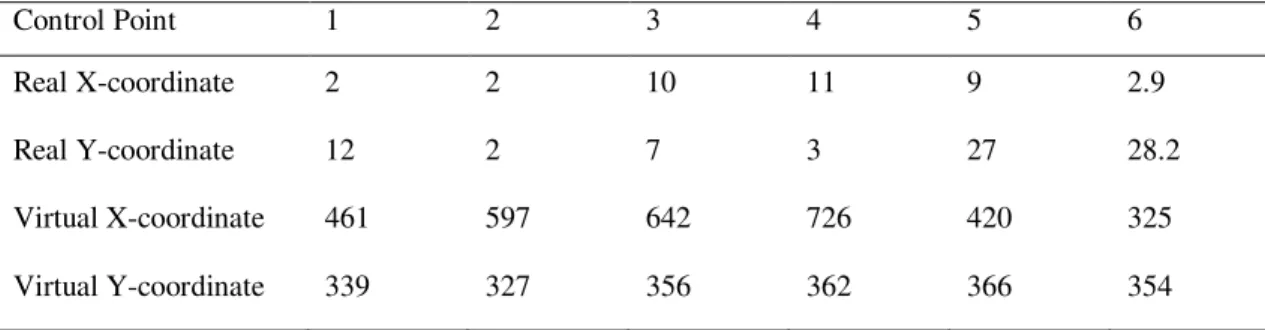
software application – TeamSense.[38] Tutorial examples of computations: left panel shows a photogram of each variable for a single time frame extracted from the 2D video animations; right panel displays time plots of each variable. ... 33 Table 3.1. Real (m) and virtual (pixels) coordinates of t he control points measured. ... 51 Table 6.1. M easures of magnitude (%CV and %RM SD) and structure (ApEn) of variability utilised to assess the ‘quantity of variation’ and complexity of the teams’ collective behaviours, classified by team and by time periods of 15 mins. ... 112 Table 7.1. M ean, SD and SampEn values of the within-group synchrony time-series. ... 132 Table 7.2. M ean, SD and SampEn values of player-team synchrony as a function of the game half, team and field direction. ... 133
Figures
Figures were subsequently numbered follow ing chapter number.
is seen when two persons who watch and follow each other's leg’s motions try to coordinate together (adapted from Kelso et al., 1986 and Schmidt et al., 1990)... 8 Figure 1.5. Relational properties are defined over an animal–environment system in different levels of systems organisation. M utuality between tw o or more individuals yields perceptions and actions that obey time-evolving dynamical principles (based on an image from M arsh et al., 2006). ... 10 Figure 2.1. M ajor ranges for two sub-groups of foot ball players in defending and attacking phases. Left panel shows the four back players; right panel shows the three forward players of the same team. Reproduced with permission from the authors.[8] ... 26
Figure 2.2. M ajor ranges of 10 outfield players from a football team. Left panel shows values from the first 5 mins of the game; right panel displays values from t he next 5-min segment. A blue colour was used to distinguish the midfielders from the backs and forwards (data from
[38]
Tables and Figures
Interpersonal Coordination in Association Football XX
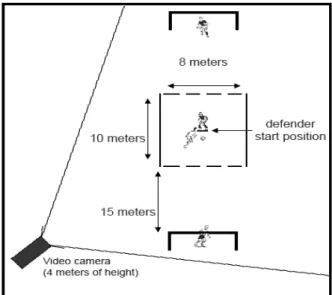
Figure 4.1. Experimental task: Left panel shows the entire experimental setting, including the camera positioning (reprinted with permission from M edicina journal); Right panel highlights the aims and variables used to capture the interaction between players... 64 Figure 4.2. Interpersonal coordination tendencies of 1vs1 sub-phases. Upper panels show the overall relative phase histograms for successful trials of attackers (left panel, n=55) and defenders (right panel, n=27). Bottom panels display exemplar trials of relative phase time-series for each of the corresponding performance out comes. ... 67 Figure 4.3. Relative phase of the special case of plays with only one crossover between players, ending in successful outcomes for t he defenders (n=11 of 27). ... 67 Figure 4.4. M ean data of ApEn and SD of the relative phase. ... 68 Figure 5.1. Experimental task schematic representation... 82 Figure 5.2. Exemplar data of coordination tendencies between both teams for centroids during 7 s of motion in an exemplar play. Top: Variation in the distance of each centroid to the defensive line. Bottom: Respective running correlation function and frequency histogram. The tendency of the correlation function to be predominantly positive is captured by the asymmetrical distribution of frequency histogram (bottom right panel). ... 86 Figure 5.3. Correlation landscape for the distance of each centroid to defensive line in all trials (n=20). ... 87 Figure 5.4. Exemplar data of coordination tendencies between both teams for surface area during 7 s of motion. Top: Variation in surface area for both teams. Bottom: Corresponding correlation function and frequency histogram. The fluctuations of the correlation function between positive and negative correlation values resulted in a more equally distributed frequency histogram (bottom right panel). ... 88 Figure 5.5. Correlation landscape for surface area of each team in all trials (n=20). ... 89 Figure 5.6. Distance of the centroid t o defensive line for both teams in the three key moments of play. * * - showed statistical differences between ball control and assistance pass moments (p < .001) for both teams; * - showed statistical differences between assistance pass and crossing line moments (p < .01) for both teams. Error bars shows standard deviation. ... 90 Figure 5.7. Surface area for both teams at the three key moments of performance. * - showed statistical differences between attacking and defending teams at the passing moment (p = .018); * * - showed statistical differences between attacking and defending teams at the moment that the ball crossed the defensive line (p = .001). Error bars shows standard deviation... 91 Figure 5.8. Flow chart representation of the time-motion analysis procedures employed. ... 96 Figure 6.1. M ean and standard deviation data for surface area (top left panel), stretch index
(top right panel), team length (middle left panel), team width (middle right panel) and
Figure 6.3. Distribution of ApEn values from the five collective behaviours of each team across the 6 time periods of the match. ... 113 Figure 7.1. Time-series of group synchrony of the two teams using cluster amplitude measures, ρgroup (ti), as a function of each game half and field direction. Cluster amplitude ranges from 0
“ The aim of science is not things themselves, as the dogmatists in
their simplicity assume, but the relations among things; outside
these relations there is no reality knowable”
(Henri Poincaré, 1905, p. 24)
1.1 Introductory note
This chapter provides an overview on the current understanding of
Interpersonal Coordination. The literature discussed bellow supported the research
studies of the present dissertation, which together cont ribute to answer the question:
how football performers mut ually int eract in different levels of social neurobiological
organisat ion? From the first insights on individual human body-level coordination,
understanding is extended to the analysis of other levels of organisation where people
(i.e., footballers) interact t o coordinate their act ions during goal-directed behaviour
(Davids, Araújo, & Button, 2011). The main differences concerning the referred levels
of analysis are the type of connectivity or linkages between the system components.
Whilst individual body-level coordination is sustained essentially by mechanical
linkages (e.g., muscles, joints and tendons), int erpersonal coordination is based on
informational couplings between individuals (Turvey, 1990). Scientific support for a
multi-level approach on interpersonal coordinat ion in association football is provided
in the next sections.
1.2 Defining Coordination
Chapter 1
Interpersonal Coordination in Association Football 3
participate in many different coordinative structures on different occasions (see also
Kay, 1988). At the individual level, coordinat ive structures are functional synergies that
emerge between parts of the body used to achieve specific movement goals such as
running, kicking, or passing a ball. However, groups of performers functioning in a
team game need to coordinate their actions with respect to each other as well as key
task constraints such as rules, performance area dimensions, and shared goals. This
process involves social coordination between agents considered as degrees of freedom
of a social neurobiological system such an association football team (Davids et al.,
2011). Independently of the level of analysis, the concepts of coordinative structures
or functional synergies explain how any change in one system component is
automatically adjusted for, in other system components, wit hout jeopardizing the
achievement of the task goal (Turvey, 1990; Davids et al., 2011).
1.2.1 Degrees of freedom and degeneracy
The initial formulation of Bernstein’s degrees of freedom problem questioned
how complex neurobiological systems organize, maintain, and disaggregate the
large-scale (or macroscopic) patterned connect ions which occur between their components
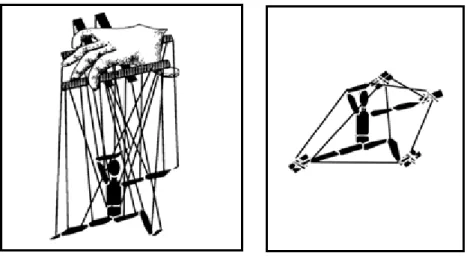
(Davids et al., 2011). As Figure 1.1 shows, two possible explanat ions can be introduced.
On one side (left panel of Figure 1.1), coordination can be considered as a
problem in organisation, with each part behaving in a well-defined way according t o
instructions from an outside source. This independence between component parts
would imply that the regulation of coordinat ive structures is achieved through
centralised and sequential computation, which especially sharpens the problem of
coordination. Alternatively, Bernstein (1967) proposed that coordination could be
considered as a problem of self-organisation (right panel of Figure 1.1). There are
neither external instructions nor a single centralised cont roller. As M ichael Turvey
(1990) pointed out , the parts spontaneously cooperate through ‘some kind of mutual
understanding’ in order to achieve a common goal. Thus, task goals are the meaning
by which components parts self-assemble into stable and ordered movement patterns
or coordinative structures. This proposal entails a ubiquitous property of biological
systems – degeneracy.
Degeneracy can be defined as the ability of elements that are structurally
different to perform the same function or yield the same output (Edelman, & Gally,
2001). Therefore, degeneracy can form the basis for the emergence of equivalent
coordinative structures under varying contexts, which ensures an adaptive and robust
system. This explanation has been gaining ground in the last years, over the initial
proposal of Bernstein (1967). He suggested that human movement systems were
governed by redundant motor degrees of freedom. However, strong criticisms led
some scientists to favour ‘mot or abundance’ in place of motor redundancy. That is, it
was argued that motor redundancy is only a property of mechanical or electronic
Chapter 1
Interpersonal Coordination in Association Football 5
maintaining the same playing pattern or a stable output. Therefore, this property is of
relevant interest for the study of interpersonal coordination in team sports.
1.2.2 Absolute and relative coordination
Nature is rich in providing degenerative solutions for the coordinative problems
of living things. Different modes of coordination can be encountered in biological
systems. The seminal works of Eric von Holst (1973) introduced the notion of absolut e
and relat ive coordinat ion as the explanation for the different coordination patterns
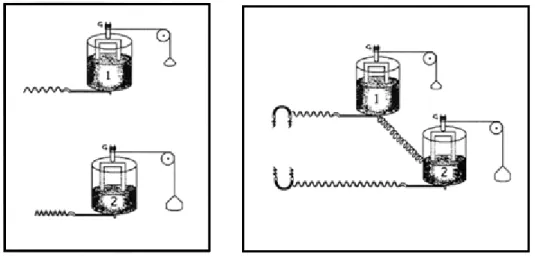
observed in nature. Figure 1.2 exemplifies von Holst’s mechanical model of
independent and coupled biological rhythm generators.
Figure 1.2.Von Holst’s mechanical model of biological rhythms generators (adapted from Turvey, 1990).
The von Holst’s mechanical model used an oscillator given by a paddle rotating
in a liquid under the force produced by a descending weight. This model served to
illustrate certain facts of rhythmic movement units. Differences in amounts of liquid
and weight mean that the two oscillators have different characteristic frequencies (see
left panel). In this case, each oscillator moved independently at its own tempo, thereby
satisfying its intrinsic dynamics. Von Holst called this preference, the maint enance
t endency. However, if the two oscillators were t o be coupled by a spring (see right
panel), then they would progressively share oscillatory vibrat ions and would eventually
be coupled on the same frequency. Von Holst (1973) called the tendency of a rhythmic
oscillat ors are attracted to the extrinsic dynamics of the other, and that the resultant
single tempo is likely to occur between the preferred tempos of t he two oscillators.
However, Kugler and Turvey (1987) showed that this single tempo does not necessarily
collapse into an intermediate frequency. Using swinging pendulums experiments,
these authors concluded that this tempo is constrained by the preferred frequencies of
oscillat ion of t he system in a high-dimensional space.
Generalising these ideas for coordination of rhyt hmical biological movements,
von Holst (1973) saw the maint enance t endency (i.e., to move at one's own pace) and
the magnet effect (i.e., to move at the pace of the other) as working in direct
opposit ion. If the maintenance tendency dominates, then the coordinat ion isrelat ive
(i.e., multiple rhythms and wandering phase relations). On the other hand, if the
magnet effect dominates, then the coordinat ion isabsolut e, show ing a single rhythm
and a single phase relation. As Kelso and Engstrøm (2006) pointed out, the
complementary relat ion between absolute and relative coordination encompasses all
the possible forms of coordination that are feasible and found in nature. However, as
Kugler and Turvey (1987) showed, the modes of relation between the component
parts of a system can be constrained by the features of the system itself in a high level
of organisation. This point can be particularly important in studying social systems such
as the playing interactions developed within sports teams. Therefore, the relation
between different levels of organisation could be thus hypothesised as a key point to
deep understanding on the interpersonal coordination processes developed by
Chapter 1
Interpersonal Coordination in Association Football 7
should be equally observable at this level of biological organisation, as a property
allowing the stability of performance outcome and the functional behaviour of the
team.
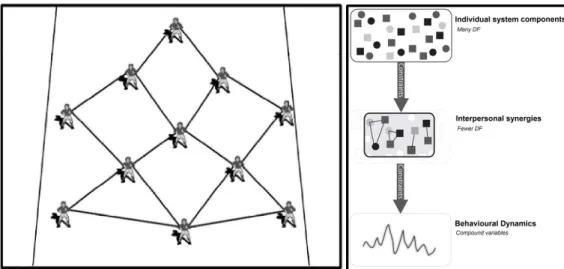
Figure 1.3. Social connectedness and interpersonal synergies within a football team. Imaginary strings link players and constrain the degrees of freedom of the whole team (left panel) allowing the emergence of functional interpersonal synergies which reveal their low-dimensional behavioural dynamics (right panel, adapted from Riley et al., 2011).
The strings showed in Figure 1.3 were used for illustrative purposes only and t o
highlight the potential connectedness between team-mates during performance. As
proposed by Riley, Richardson, Shockley and Ramenzoni (2011) interpersonal synergies
are likely to emerge from individuals sharing common task goals. Individuals
intentionally coordinating their movements shape high-dimensional synergies which
reduce the degrees of freedom of the whole system (e.g., a team). Its behavioural
dynamics may be captured by selecting functional relevant compound variables that
describe the synergy’s organisational state (see right panel of Figure 1.4).
However, the question is what type of connection might link players allowing
them to produce coordinated patterns at group or team level and act as an
interpersonal synergy?
1.3.1. From intra- to inter-person coordination
Are the individuals actually connected during social activities such as playing
by Richard Schmidt and colleagues (Schmidt , Carello, & Turvey, 1990). They
demonstrated that patterns of interpersonal coordination between individuals
optically connected displayed exactly the same dynamical features that previous
studies have shown for intra-person index finger experiments described below (Kelso,
Scholz, & Schöner, 1986, illustrated in upper panel of Figure 1.4).
Figure 1.4. As frequency (f) is increased, a person coordinating his/ her two index fingers in anti-phase absolute coordination (left side) will jump spontaneously to in-phase absolute coordination (right side). The same sudden transition accompanied by critical fluctuations (SD) is seen when two persons who watch and follow each other's leg’s motions try to coordinate together (adapted from Kelso et al., 1986 and Schmidt et al., 1990).
In these experiments, two seated persons oscillat ed a leg with the goal of coordinating
the two legs in anti-phase (i.e., syncopation) or in-phase (i.e., synchronisation) as the
frequency of the movement oscillations was increased. To satisfy the goal, the two
persons watched each other closely. As with the within-person case, the
in-Chapter 1
Interpersonal Coordination in Association Football 9
natural frequency) was synchronising movement coordination to in-phase modes,
since system components were connected (whatever physically or informationally).
Summarising, anatomical and optical connectivity between system components
appear to be governed by ident ical underlying principles. However, other means than
optical information seems to be equally important for interpersonal coordination
processes. For example, Néda and colleagues (2000) showed how people can
synchronise their clapping based on auditory information. Therefore, percept ual
information (e.g., optical, auditory) can be a crucial mean by which individuals are
coupled during social activities, sustaining patterns of interpersonal coordination in
goal-directed behaviours.
1.3.2. Sports teams as synergistic collectives
The importance of the perceptual information (particularly optical information)
for the coordination and cont rol of the behaviour of individuals was firstly suggested
by James Gibson (1966, 1979). In its ecological approach to percept ion and action,
Gibson emphasised the mutuality of individual and environment as a central tenet. He
argued that the interaction with the surrounding environment occurs by direct physical
contact and perception of the physical propert ies of the ambient energy array. Thus,
the optical flow resulting from patterns of light reflection on surfaces and objects of
the environment presents individuals w ith the necessary visual information to guide
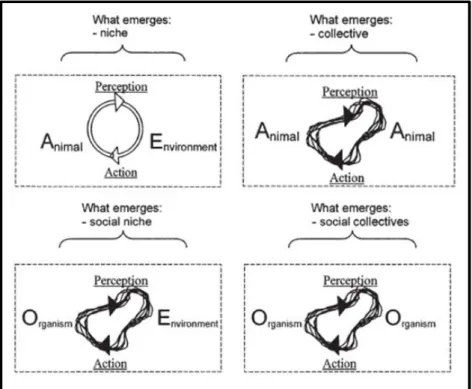
behaviour. As the top left panel of Figure 1.5 shows, the information-movement
couplings are the mode by which individuals explore and interact with environmental
properties such as surfaces, objects, events and even other individuals (Gibson, 1979).
M arsh and colleagues (2006) proposed an extension from the
individual-environment to group-individual-environment relations based on gibsonian ecological psychology
Figure 1.5. Relational properties are defined over an animal–environment system in different levels of systems organisation. M utuality between two or more individuals yields perceptions and actions that obey time-evolving dynamical principles (based on an image from M arsh et al., 2006).
Top left panel illustrates the percept ion–action processes viewed as involving
mutuality of animal and environment rather than being solely focused on the animal or
on the environment itself. When another person becomes a significant aspect of one’s
environment , mutuality implies the intertwined of one person’s perceptions and
actions with the other person’s perceptions and actions (see top right panel). An
implication of this mutuality is the emergence of a ‘collective’. This collective is not
merely the sum of the individuals, but it is a coordinat ive structure or synergy, which
can be defined as funct ional groupings of struct ural elements (e.g., players) that are
Chapter 1
Interpersonal Coordination in Association Football 11
system with the laws of the game and field dimensions acting as boundary constraints
(bottom right panel – Figure 1.5).
This social synergistic perspective provides a sound theoretical framework to
study interpersonal coordination processes in different levels of social organisation of
football teams. For example, dyadic systems such as 1vs1 sub-phases, or multi-agent
systems such as the whole 11vs11 game can be investigated using the principles
underlying the presented framework.
1.3.3. Understanding emergent coordination in social neurobiological systems
Nature supports the view that groups of cooperating individuals gain some
advantages when working and living t ogether. There are plenty of examples of animal
societies that typically display emergent collective behaviours such as schools of fish,
flocks of birds, swarms of honeybees, flashing firefly or ant colonies. Examples of
emergent social coordination in human systems with large number of interact ing
individuals reported in scientific literature include panic escape (Helbing, Farkas, &
Vicsek, 2000), walking in a busy street (Helbing, & M olnar, 1995), the formation of
M exican waves in football stadiums (Farkas, Helbing, & Vicsek, 2002), the emergence
of traffic jams (Helbing, & Huberman, 1998), and audience applause (Néda et al.,
2000). These emergent social behaviours have the particular feature of displaying
novel properties and new patterns at the group (macro) level, which cannot be
observed at the individual (micro) level (Reeve, & Hölldobler, 2007). In recent years,
the concept of self-organisation has been used to explain how certain behavioural
patterns emerge in complex social neurobiological systems (Sumpter, 2006).
Self-organisation can be defined as a process by which complex systems evolve based on
spontaneous (no centralised external control) interactions among system components.
A central tenet of self-organisation in biological systems (and not necessarily
similar to physical and chemical systems) is that simple repeated interactions between
individuals can produce complex adaptive patterns at group level. Inspiration came
from Nicolis and Prigogine (1977) general observation that, individuals following
simple behavioral rules can produce complex behavioural patterns. Despite the variety
different collective patterns are generated by small variations in the local rules
followed by their members (Sumpter, 2006). Indeed, Couzin and colleagues (2002)
showed how adjusting simple local rules using computerised simulations grouping
animals would lead to emergent patterns such as swarm, torus (i.e., moving in a circle)
or dynamic parallel group motion.
Therefore, it seems that individuals base their movement decisions on locally
acquired information sources such as the relative positioning, motion direction, or
changing motion direction, of their near-neighbours conspecifics (Couzin, 2009). Thus,
emergent patterns of movement coordination in social neurobiological systems can
arise spontaneously without any centralised homunculus-like control. These social
neurobiological models are inspirational in the way individuals manage their local
interactions to achieve advantageous forms of emergent coordination. Like in the
mentioned examples, team sports players need to develop coordinated relations
within its team. In this sense, sports teams can be regarded as functional integrated
‘superorganisms’ displaying emergent patterns of interpersonal coordination at
different levels of analysis. Furthermore, sport contexts embrace also the need t o
develop competitive relations with the opposing performers. Some recent studies
developed in sports contexts have dedicated particular attention t o this point. For
example, interpersonal coordination between two compet ing performers was
previously investigated in squash (M cGarry, 2006), tennis (Palut, & Zanone, 2005),
basketball (Bourbousson, Sève, & M cGarry, 2010a), rugby union (Passos et al., 2008),
and futsal (Travassos, Araújo, Vilar, & M cGarry, 2011). All these investigations have
shown high levels of task-dependence, highlighting how specific task constraints
Chapter 1
Interpersonal Coordination in Association Football 13
1.4. Tow ards an understanding of interpersonal coordination in football
The purpose of the present thesis was to understand the processes underlying
interpersonal coordination on Association Football performance. Distinct studies
concerning different levels of organisation were described, ranging from dyads to
collect ives.
A collect ion of 6 original research articles, submitted or published on
peer-review journals with ISI Impact Factor, constituted the main body of this thesis. Each
article was presented as an individual chapter follow ing the format requested by the
journal for where it was submitted.
The current chapter (Chapter 1) introduced the general conceptual and
scientific fundamentals supporting the research programme on interpersonal
coordination.
Chapter 2 presents a position statement (Sport teams as superorganisms: Implications of biological models for research and practice in team sports performance analysis) in which current knowledge from socio-biological systems such
as animal societies frame a way sports teams can be theoretically re-conceptualised.
The concept of ‘superorganism’ was discussed bringing insights on how sport teams
could be seen as functionally integrated social complex systems. M ethodological tools
to capture the superorganismic properties of sports teams were also presented and
discussed.
In Chapter 3, a methodological article entitled: Capturing complex human behaviors in representative sports contexts w ith a single camera, waspresented. This
work described the conceptual framework and the mot ion analysis procedures
followed in this programme of work. Particularly, concepts related to complex systems
research such as order and cont rol parameters, as well as methodological procedures
such as the use of TACTO software and the DLT method were discussed and introduced
in a step-by-step tutorial fashion.
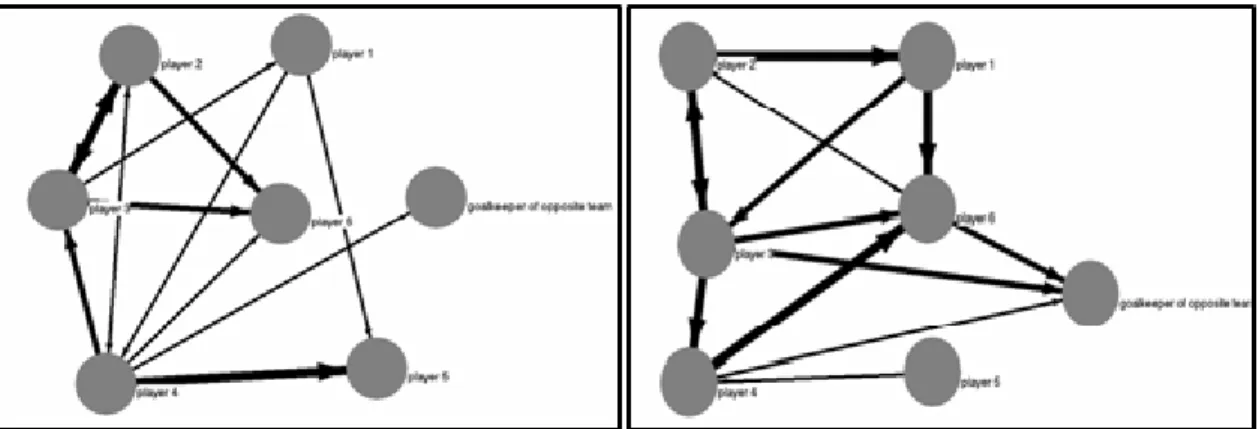
Chapter 4 presents an experimental research article entitled: Interpersonal coordination tendencies shape 1-vs-1 sub-phase performance outcomes in youth football. This w ork investigated interpersonal coordinat ion at the dyadic level between
(success of the attacker vs. success of the defender) as well as the structure of their
variability were presented and discussed.
Chapter 5 introduces another experimental research article entit led: Intra- and inter-group coordination patterns reveal collective behaviours of football players near the scoring zone. The coordination patterns of two competing sub-groups of
players were investigated in a 3vs3 sub-phase task. Intra- and inter-group coordinat ion
tendencies were described in this study, namely the particular environmental and
relational conditions that afford the creation of goal scoring opportunities.
Chapter 6 conveys an experimental research ent itled: Capturing complex, non-linear team behaviours during competitive football performance. Assigned to a macro
level of analysis, the team level, this work presented the use of compound positional
variables to capture the idiosyncratic behaviours of football teams. Trends in the
magnitude and structure of variability of the emergent team behaviours were also
discussed.
Chapter 7 addresses the study: Competing together: Assessing the dynamics of team-team and player-team synchrony in top level professional football. This study
followed a different research strategy by integrating two different levels of
organisation in an effort to capture synchronisation processes occurring within each
competing team. This was achieved by means of the use of the innovative cluster
phase method. Furthermore, non-linear measures assessing the dynamical structure of
the whole team and player-team synchronies were also presented.
Finally, Chapter 8 provides a General Discussion where findings of the different
investigations were integrated into a single framework in line with the ontological
Chapter 1
Interpersonal Coordination in Association Football 15
Bernstein, N. (1967). The coordinat ion and regulat ion of movement s. London:
Pergamon
Bourbousson, G., Sève, C., M cGarry, T. (2010). Space-time coordination dynamics in
basketball: Part 1. Intra- and inter-couplings among player dyads. Journal of Sport s
Sciences, 28, 339 - 347.
Bourbousson, G., Sève, C., M cGarry, T. (2010). Space-time coordination dynamics in
basketball: Part 2. The interaction between the two teams. Journal of Sport s Sciences,
28, 349-358.
Correia, V., Araújo, D., Davids, K., Fernandes, O., & Fonseca, S. (2011). Territorial gain
dynamics regulates success in attacking sub-phases of team sports. Psychology of Sport
and Exercise, 12, 662-669.
Couzin, I. D., Krause, J., James, R., Ruxton, G. D., & Franks, N. R. (2002). Collective
memory and spatial sort ing in animal groups. Journal of Theoret ical Biology, 218, 1-11.
Couzin, I. D. (2009). Collective cognition in animal groups. Trends in Cognit ive Science,
13, 36-43.
Davids, K., Araújo, D., & Button, C., (2011/ in press). Coordination, Training. In F. C.
M ooren, and J. S. Skinner (Eds.), Encyclopedia of Exercise M edicine in Healt h and
Disease, Berlin: Springer.
Davids, K., Araújo, D., Button, C., & Renshaw, I. (2007). Degenerate Brains,
Indeterminate Behavior, and Representative Tasks: Implications for Experimental
Design in Sport Psychology Research. In G. Tenenbaum, and R. C. Eklund (Eds.).
Handbook of Sport Psychology (pp. 224-244). New Jersey: Wiley.
Edelman, G. M ., & Gally, J.A. (2001). Degeneracy and complexity in biological systems.
Proceedings of t he Nat ional Academy of Science USA, 98, 13763–13768.
Farkas, I., Helbing, D., & Vicsek, T. (2002). Social behaviour: M exican waves in an
excitable medium – The stimulation of this concerted motion among expectant
Frencken, W., Lemmink, K., Delleman, N., Visscher, C. (2011). Oscillations of centroid
position and surface area of soccer teams in small-sided games. European Journal of
Sport Science, 4, 215-223.
Gibson, J. J. (1966). The senses considered as percept ual syst ems. Boston: Houghton
M ifflin.
Gibson, J. J. (1979). The ecological approach to visual percept ion. Boston: Houghton
M ifflin
Helbing, D., & Huberman, B. A. (1998). Coherent moving states in highway traffic.
Nat ure, 396, 738–740.
Helbing, D., & M olnar, P. (1995). Social force model for pedestrian dynamics. Physical
Review E, 51, 4282–4286.
Helbing, D., Farkas, I. & Vicsek, T. 2000 Simulating dynamical features of escape panic.
Nat ure, 407, 487–490.
Kay, B. (1988). The dimensionality of movement trajectories and the degrees of
freedom problem: A tutorial. Human M ovement Science, 7, 343-364.
Kelso, J. A. S., & Engstrom, D. A. (2008). The Complement ary Nature. Cambridge, M A:
M IT Press.
Kelso, J. A. S. (2009). Coordination dynamics. In R. A. M eyers (Ed.), Encyclopedia of
Complexit y and Syst em Science (pp. 1537-1564). Berlin: Springer.
Chapter 1
Interpersonal Coordination in Association Football 17
Latash, M . L. (2000). There is no motor redundancy in human movements: There is
motor abundance. M ot or Cont rol, 4, 259–261.
M arsh, K. L., Richardson, M . J., Baron, R. M ., Schmidt, R. C. (2006). Contrasting
approaches to perceiving and acting with others. Ecological Psychology, 18, 1-38.
M cGarry, T. (2006). Identifying patterns in squash contests using dynamical analysis
and human perception. Int ernat ional Journal of Performance Analysis in Sport, 6,
134-147.
Neda, Z., Ravasz, E., Brechet, Y., Vicsek, T., & Barabasi, A. L. (2000). The sound of many
hands clapping. Nat ure, 403, 849.
Nicolis, G., & Prigogine, I. (1977). Self-organizat ion in nonequilibrium syst ems. New
York: Wiley.
Palut, Y., & Zanone, P. G. (2005 ). A dynamical analysis of tennis: Concepts and data.
Journal of Sport s Sciences, 23, 1021-1032.
Passos, P., Araújo, D., Davids, K., Gouveia, L., M ilho, J., & Serpa, S. (2008).
Information-governing dynamics of attacker-defender interact ions in youth rugby union. Journal of
Sport s Sciences, 26(13): 1421–1429.
Passos, P., M ilho, J., Fonseca, S., Borges, J., Araújo, D., Davids, K. (2011). Interpersonal
Distance Regulates Functional Grouping Tendencies of Agents in Team Sports. Journal
of M ot or Behavior, 43, 155-163.
Poincaré (1905). Science and Hypot hesis. New York: Dover
Reeve, H. K., Hölldobler, B. (2007). The emergence of a superorganism through
intergroup competition. Proceedings of t he Nat ional Academy of Science USA, 104,
9736–9740.
Richardson, M . J., M arsh, K. L., & Schmidt, R. C. (2010). Challenging the egocentric
notions of perceiving, act ing and knowing. In L. F. Barrett, B. M esquita, and E. Smit h
Riley, M . A., Richardson, M . J., Shockley, K., & Ramenzoni, V. C. (2011). Interpersonal
synergies. Front iers in Psychology, 2, 1-7.
Schmidt, R. C., Carello, C., & Turvey, M . T. (1990). Phase transitions and critical
fluctuations in the visual coordination of rhythmic movements between people.
Journal of Experiment al Psychology: Human Percept ion and Performance, 16, 227-247.
Sumpter, D. J. T. (2006). The principles of collective animal behaviour. Philosophical
Transact ions of t he Royal Societ y B, 361, 5-22.
Tononi, G., Sporns, O., & Edelman, G. M . (1999). M easures of degeneracy and
redundancy in biological networks. Proceedings of t he Nat ional Academy of Science
USA, 96, 3257–3262.
Travassos, B., Araújo, D., Vilar, L., & M cGarry, T. (2011/ in press). Interpersonal
coordination and ball dynamics in futsal (indoor football). Human M ovement Science.
Turvey, M . T. (1977). Cont rasting orientations to the theory of visual information
processing. Psychological Review, 84, 67-88.
Turvey, M . T. (1990). Coordination. American Psychologist, 45(8), 938-953.
von Holst, E. (1973). The behavioral physiology of animal and man. Coral Gables, FL:
University of M iami Press.
Yue, Z., Broich, H., Seifriz, F., M ester, J. (2008). M athematical Analysis of a Soccer
Game. Part I: Individual and Collective Behaviors. St udies in Applied M at hemat ics, 121,
2.
Sport teams as superorganisms:
Implications of biological models
for research and practice in team
2.1. Abstract
Significant criticisms have emerged on the way that collective behaviours in team
sports have been tradit ionally evaluated. A major recommendation has been for future
research and practice to focus on the interpersonal relationships developed between
team players during performance. M ost research has typically investigated team game
performance in game sub-phases, rather than considering the interact ions of
performers within the whole team. In this paper, we propose that team performance
analysis could benefit from the adoption of biological models used to explain how
repeated interactions between grouping individuals scale to emergent social collective
behaviours. We highlight the advantages of conceptualising sports teams as functional
integrated ‘superorganisms’ and discuss innovative measurement tools which might be
used to capture the superorgamismic properties of sports teams. These tools are
suitable for revealing the idiosyncrat ic collective behaviours of sports teams,
particularly their coordination of labour and the most frequent channels of
communication and patterns of interaction between team players. The principles and
tools presented here can serve as the basis for novel approaches and applications of
performance analysis, devoted to understanding sports teams as functioning,
high-order organisms exhibiting their own peculiar behavioural patterns.
Keyw ords: Social neurobiological systems, collect ive behaviours, team sports,
Chapter 2
Interpersonal Coordination in Association Football 21
2.2. Introduction
Nature provides evidence that groups of cooperating individuals can gain many
functional advantages when working and living together. Research has demonstrated
the superior performance of groups over single organisms in a wide range of human
social phenomena.[1] Sports teams are equally composed of different interacting
individuals who develop cooperative relations to achieve successful performance
outcomes. The collective performance of sports t eams has been extensively analysed
by a range of analytical performance indicat ors.[2,3] For example, it has been
demonstrated that the percentage of ball possession of association football teams
changes as a function of the evolving match status, game location, and level of
opposit ion,[4] and that the percentage of ball possession in the opposition penalty box
remained high when teams used a counterattacking style[5]. However, the view that
some game events are more important than others, and that the method of notating
discrete actions or events fails to provide information about the performance context,
is challenging sports scient ists to re-think their research strategies.[6]
With reference to t racked positional data, recent studies have begun t o reveal
how players and teams cont inuously interact during competition. For example, teams
tend to be tightly synchronised in their lateral and longitudinal movements[7], with a
counterphase relat ion regarding their expansion and contraction movement patterns[8]
commonly caused by changes in ball possession[9]. This type of investigatory approach
shares some conceptual similarit ies with models of behaviour in biological systems,
which have revealed the emergent social collective behaviours of human groups and
animal societies.[10] Here, we argue that sports teams also exhibit emergent collective
behaviours that differ from the sum of individual aggregated performances. Analysis of
patterns of behaviour at the collective system level in team sports requires a
reformation of notational analysis methods used t o study performance.
As in other collect ive systems, sports team performers often need to make
decisions about where to move and which actions to perform, in uncertain and shifting
environmental condit ions. It has been suggested both in biology[11] and in team sports
information sources such as the relat ive positioning, mot ion direct ion, or changing
motion direction, of significant others operating in a system, making a collect ive
response all the more remarkable. This finding implies that the actions of individuals
functioning in a complex biological system need t o be intimately coordinated. Next we
discuss the potential advantages of integrating biological models to study emergent
collect ive behaviours of performers in team sport s.
2.3. A brief incursion into sociobiology
Studies in biology have shown how the repeated interactions among grouping
animals (including humans) scale to global collective system behaviours.[10] These
social interact ive behaviours within a group lead to the emergence of a ‘collective’,
which can be understood as a ‘new organism’ within the animal–environment
system.[13,14] In this sense, the act ions of individual organisms (e.g., team players)
constrain and are constrained by the actions of neighbouring organisms toward the
implicit and mutually exclusive goals of the ‘collect ive’. The coordination and
re-organization of these ongoing interactions occur via externally controlled feedback
processes sustained by the continuous exchange of information between the grouping
individuals.[15] For example, when an ant finds a food source it deposits a pheromone
so that other members of the colony can locate it, or when a fish swims in a specific
direction, its nearest neighbours in a school soon follow. As such recruitment
behaviour continues, the number of individuals engaged in a goal-directed activity
increases.[10] Evidence is beginning to reveal that similar processes seem to emerge