FLEXIBLE BLENDED LEARNING APPROACH
Margarida Fonseca Cardoso
*ICBAS – Instituto de Ciências Biomédicas Abel Salazar, Universidade do Porto, Porto, Portugal CIIMAR – Centro Interdisciplinar de Investigação Marinha e Ambiental, Porto, Portugal
Cipes – Centro de Investigação de Políticas do Ensino Superior, Matosinhos, Portugal [email protected]
Teresa Correia
GATIUP - Gabinete de Apoio para as Novas Tecnologias na Educação da Universidade do Porto, Porto, Portugal [email protected]
ABSTRACT
There is a growing demand in Basic Biostatistics courses in new or reformulated curricula degrees according to the Bologna Process. Basic Biostatistics is a fundamental scientific component of biomedical, public health sciences and biological research areas. Both graduate students from biomedical/biological areas or mathematical/bioengineering areas should be trained to have not only the theoretical knowledge in biostatistics but also the verbal and written skills to be effective in a team research environment. The university should be prepared to offer a course in Basic Biostatistics with some flexibility in order to be easily adapted to the different profile of the students. Following the so-called Bologna Process students should be motivated to take part of the learning process and the role of the teacher is more of facilitator and tutor of that learning process. Is based on this new principle that innovation in the training programs in biostatistics is necessary. A Virtual Learning Environment was used and activities such as forums, databases and assignments were implemented. This blended learning experience revealed to have flexibility in its adaptation to the needs of different scientific areas (Aquatic Sciences, Public Health and Mathematics) and degrees (undergraduate, master and doctoral). The success achieved by a student who could only access the on-line environment indicates that an e-learning approach could be possible. The use of assignments with the format of a scientific paper developed the writing skills; forums worked as an excellent tool for sharing information and stimulating communication between students and teacher; and databases stimulated students to research topics of the program and thereby participate in their own learning process. This training program was an opportunity to innovate the teaching and learning methodology of Basic Biostatistics. Students were trained to be able to convert data into information with a balance between knowledge of statistical methodology and training in communication. Students also developed skills and competencies necessary to the knowledge society and professional career. This training program could also be considered in more advanced biostatistics programs, distance learning programs or even other courses, according to the student market in higher education.
KEYWORDS
Biostatistics, Bologna Process, training program, blended learning, e-learning, virtual learning environment.
1.
INTRODUCTION
There is a growing demand in biostatistics following the restructuring of some degree curricula under the
Bologna Process and the creation of new degrees. This new degrees, mostly master and doctoral programmes, were created to attract the emerging student market in higher education. Biostatistics is a
* Correspondence to: Margarida Fonseca Cardoso
fundamental scientific component of biomedical, public health sciences (DeMets et al., 2006, Zelen, 2006) and biological research areas. A basic biostatistics course is part of any degree in areas ranging from medicine to biology. Even degrees in mathematical areas have this course in their curricula. The increasing demand of introductory courses in biostatistics should lead to flexible modules, corresponding to the needs of the different degrees with this course in their curricula. These introductory courses in biostatistics should prepare students to gain skills and training in the theory and practice of statistics. Students should be prepared to be part of cross and multidisciplinary research teams, including collaboration between statisticians and non-statisticians, biomedical/biological researchers. Both graduate students from biomedical/biological or mathematical/bioengineering areas should be trained to have the verbal and written skills to be effective in a team research environment (DeMets et al., 2006).
New methods of training biostatistics are necessary in a way to meet the new challenges that the Bologna
Process brought and also answer to the new demands of the future professional career. The exposition of students to applications of biostatistics should lead to a first experience, insight and motivation for the research process in the biological/biomedical area. All graduate students should have knowledge in the fundamental theory and methods in basic biostatistics (DeMets et al., 2006, Zelen, 2006), even if only some of them will pursue to more advanced biostatistics programs (DeMets et al., 2006). Innovation in the training programs and evaluation methodologies can be easily achieved with the help of the implementation of educational technology (Hingel, 2009) available in the universities, such as the Moodle platform. Moodle is the Learning Management System provided by the University of Porto, a web application that can be easily used by educators as a tool to create on-line learning sites.
The Institute of Biomedical Sciences Abel Salazar (ICBAS) is a medical and biosciences higher education institution integrating the University of Porto and has undergraduate degrees in Medicine, Veterinary, Aquatic Sciences, Biochemistry (in cooperation with Faculty of Sciences) and Bioengineering (with Faculty of Engineering). ICBAS is also responsible, alone or in cooperation with other higher education institutions, for master and doctoral programs in those areas and areas such as Public Health, Epidemiology, Mental Health, Forensic Sciences, Mathematics, etc.
The main objective of the present training program in biostatistics was to explore a new way of teaching biostatistics, using a blended learning approach, emphasizing the role of the students in the learning process
and improving the acquisition of competences and skills, according to the so-called Bologna Process (EME,
1999, EC, 2001).
2.
METHODS
A combination of traditional learning methods with methods offered by new technology was used. The Virtual Learning Environment (VLE) used for the Basic Biostatistics course was Moodle (Modular Object-Oriented Dynamic Learning Environment), the platform that the University of Porto is using as a tool to promote the blended learning experience among the academic community.
As expected from any e-learning platform, in this VLE there are multiple features/tools available that allows the teacher to delivery static and dynamic content to the students and also promote the on-line participation and evaluation. In the case of Basic Biostatistics the features that were considered were the resources modules (web pages, files and website links, directories and labels) and the activity modules (forums, databases and assignments).
2.1 RESOURCES
Material such as the program of the course, evaluation criteria, documentation of the theoretical sessions and worksheets were delivered to the students using the platform.
2.2 ACTIVITIES
2.2.1 Forums
The main motivation to use forums was to encourage the on-line communication between the students and the teacher. Both students and teacher could post and answer questions and all participants received a copy via e-mail. All postings had the authors photo attached, facilitating the communication. Because the forum is an activity that allows the asynchronous communication it provides flexibility in terms of time and place for its use.
2.2.2 Database
The use of the database was a way to motivate students to participate actively in the collection and register of materials relevant to the aim of the course. The suggested contributions for the database were scientific papers, websites, news, etc.
2.2.3 Assignments
Three types of evaluations used the assignment tool of Moodle: weekly assignments, final assignment and a final exam.
• Weekly Assignments
These assignments consisted in a small biological/biomedical problem with a corresponding data file. All the assignments were in accordance with the course program, which means that each module had a different type of assignment/problem. The modules covered in the program were: Descriptive Statistics, Statistical Inference with Quantitative Data, Statistical Inference with Categorical Data, Linear Regression and Analysis of Variance.
The assignments were delivered to the students through the on-line page of the course in Moodle and the submission of the final report was also made through the platform. The grades and the teacher feedback – something that has always been provided to the students - were also delivered on-line.
The assignments should be written as a short written scientific report with Introduction, Methods, Results, Discussion and Appendix. The Appendix should include detailed information about the statistical analysis considered in the work, such as detailed information of all statistical tests performed and outputs of the statistical program considered. The Statistical Package for Social Sciences (SPSS) was the statistical program chosen, since it is easy to use and has the main statistical procedures needed. SPSS is available in the computers of the campus and the license of the University of Porto allows the students to install this program on personal computers. However, students could choose another statistical program for the resolution of the proposed assignments. Assignments were graded as Excellent, Fair or Poor. Poor was considered for those assignments with severe mistakes in the statistical analysis and results interpretation. Fair was considered for those assignments with some mistakes in the statistical analysis and/or in the interpretation and presentation of the results. Excellent was the grade considered for those assignments with an adequate statistical analysis and correct report of the results with the format of a short scientific paper.
• Final Assignment
The final assignment consisted in the analysis of a biological/biomedical problem defined by the students with a corresponding data file obtained by them. Students should write a final report as a scientific paper and present it as an oral communication. The aim of the study should be in the scientific area of the degree the student was enrolled in. Students were motivated to contact other teachers and researchers as a way to improve their scientific knowledge. The final report should also include an Appendix, with a format similar to the weekly assignments.
• Final Exam
the student had the written skills to communicate effectively the results obtained in the statistical analysis of a simple biological/biomedical problem. Statistical analysis was performed using statistical software.
3.
RESULTS
The use of a Virtual Learning Environment in Basic Biostatistics was considered in different courses belonging to three different scientific areas and three different degrees available in the University of Porto: Aquatic Sciences (first cycle), Public Health (second cycle) and Mathematics (second and third cycles). These degrees were approved according to the Bologna Process. The undergraduate degree in Aquatic Sciences was reformulated in the academic year of 2007/2008, the master program in Public Health (in collaboration with the Faculty of Medicine) was reformulated in the academic year of 2008/2009 and the master and doctoral programmes in Mathematics were created in 2008 in collaboration with other three institutions of the University of Porto (Faculty of Sciences, Faculty of Engineering and the Faculty of Economy) and both were already according to the Bologna principles.
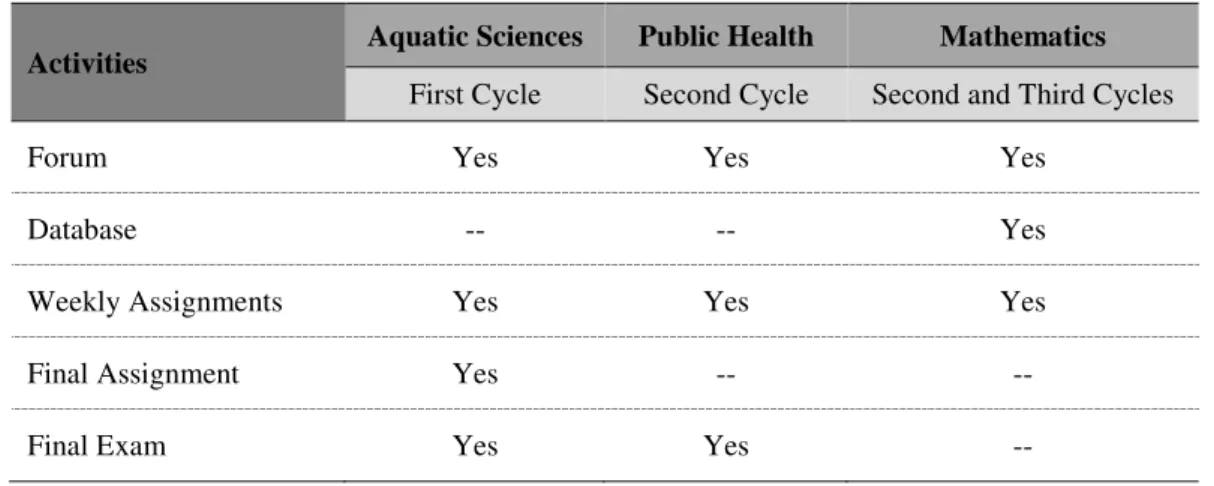
In all the on-line courses of Basic Biostatistics the structure of the page, resources and activities were very similar [Image 1]. All the units also had a forum and assignments, but the database was only used in the master degree course in Mathematics and in the doctoral program in Applied Mathematics [Table 1].
Table 1. The activities that were used in the on-line courses according to the scientific area and degrees.
Activities
Aquatic Sciences Public Health Mathematics
First Cycle Second Cycle Second and Third Cycles
Forum Yes Yes Yes
Database -- -- Yes
Weekly Assignments Yes Yes Yes
Final Assignment Yes -- --
Final Exam Yes Yes --
Looking back to this experience of using an e-learning platform as a complement to traditional face-to-face classes it is clear that the tool most used and most important was the assignments. All the degrees had to do the weekly assignments with problems, when possible adapted to their scientific area. The final assignment was provided only to the undergraduate degree in Aquatic Sciences, since in the other areas students could choose courses with more advanced statistics and will have to write a thesis where they could apply the concepts learned. In the undergraduate degree in Aquatic Sciences and in the master degree course in Public Health, the final exam was used as a way to evaluate individually the students since the weekly assignments were evaluated at the group level.
After a detailed analysis of the interactive tools/activities used in the on-line courses the main conclusions were:
• Forums
The students from the undergraduate degree in Aquatic Sciences were the ones using more the forum, starting its use just after the course started. The students from the master degree course in Public Health did not use very much this tool. In what concerns to the students from the master and doctoral degree in Mathematics its participation in the forum increased gradually, the exception was a student who could not attend classes and that since the beginning of the course had an active participation in the forum and made all his learning process through the platform.
The forum was used by the students mainly as a way of communicating with the teacher to ask questions about the assignments or the final exam. It is important to say that some of the students also communicated with the teacher using the e-mail in a way to avoid delays or to have a private conversation about the evaluation of the previously submitted assignments. In the page of all the on-line courses it was also available a module called ‘Messages’ that allow the teacher and the students to establish a private communication in an asynchronous or synchronous way.
The teacher considered when possible each question post individually by the students as being important for all the class. So the answers were carefully written because it was an opportunity to explain in detail some subjects with no pressure of time imposed by the face-to-face classes.
Some of the strong points of this forum experience were the fact that the barrier of time and space have been broken and the students look as if they were more comfortable asking questions in this virtual environment than in the face-to-face classes.
• Databases
A database was considered in the course given in conjunction to the master and doctoral degree in Mathematics. The two starting contributions were provided by the teacher and correspond to two
scientific papers from the Statistics in Medicine journal discussing the role of the biostatistician in a
the database were provided by the students and included papers discussing the use of statistics, papers with examples of the use of biostatistics methods in the area of biomedical/biological sciences and websites with statistic contents.
• Assignments (weekly assignments, final assignment and final exam)
Weekly assignments were considered in all the degrees and were the core of the courses. All the assignment propositions in all the courses were similar, a small biological/biomedical problem with a corresponding data file was delivered to the students and they had to submit a written analysis of that problem based in a statistical analysis. Even though the assignments were different within each course the given biological/biomedical problem was vague in order that the students could build a hypothetical investigation.
Due to the number of students the weekly assignments were done in groups in the undergraduate degree in Aquatic Sciences and in the master degree course in Public Health, and individually in the master and doctoral degree in Mathematics. Feedback and the grades were always provided by the teacher through the platform. This feedback included commentaries about both the statistical analysis and the written text.
The first assignments submitted revealed heterogeneity between students within all courses. But with the feedback provided by the teacher - that gave them the necessary guidelines to correct and improve the reports - in general the final assignments submitted were much less heterogeneous and much closer to a satisfactory short scientific paper with a correct statistical analysis.
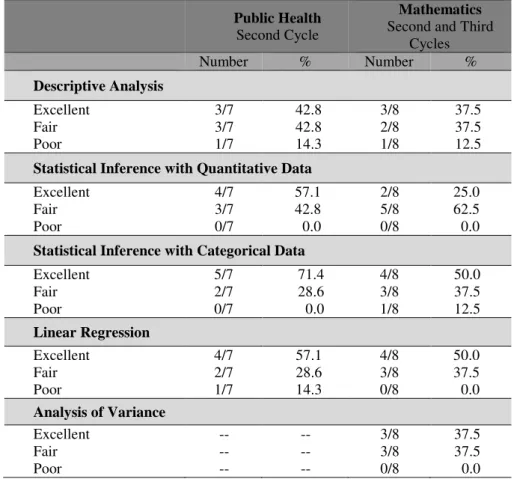
The Table 2 shows the grades of the weekly assignments obtained in the master degree course in Public Health and in the master and doctoral degree in Mathematics. Results of these two scientific areas should be compared with some caution since in the master degree in Public Health the weekly assignments were done in groups and individually in the master and doctoral degree in Mathematics. The time between submissions was also different, two weeks for the master degree in Public Health and one week for the master and doctoral degree in Mathematics.
In the master degree course in Public Health one of the groups started with a Poor evaluation and three out of seven with an Excellent evaluation. In the last two weekly assignments, none of them had a Poor evaluation and the majority achieved an ‘Excellent’ evaluation. All the groups always submitted the assignments on time.
In the master and doctoral degree in Mathematics, some of the students did not submit all the weekly assignments. In the first assignment, there was a student with a Poor evaluation revealing inability to do a descriptive analysis involving a file with quantitative and qualitative data. Although in the last two weekly assignments none of the students had a ‘Poor’ classification, there were two of them that did not submit the assignments. In the last weekly assignment only half of the six submitted analysis had an ‘Excellent’ evaluation, in the other three graded as ‘Fair’ even though the statistical analysis was adequate the students revealed difficulties in the correct interpretation and presentation of the results.
In general students gradually revealed to be able to define a background and a main objective and report the results obtained through a statistical analysis according to it. When doing the assignments the students had at the same time to understand and apply the necessary statistical methods and develop the writing skills necessary to write the report within the deadline defined. The majority of the assignments were submitted before the deadline. Some of the assignments submitted revealed the inability of the students to deal with a simple statistical problem that involve a statistical program (SPSS) and the lack of necessary writing skills.
Table 2.Evaluation of the weekly assignments at group level in the master degree course in Public Health and individually in the master and doctoral degree in Mathematics.
Public Health Second Cycle
Mathematics Second and Third
Cycles
Number % Number %
Descriptive Analysis
Excellent 3/7 42.8 3/8 37.5
Fair 3/7 42.8 2/8 37.5
Poor 1/7 14.3 1/8 12.5
Statistical Inference with Quantitative Data
Excellent 4/7 57.1 2/8 25.0
Fair 3/7 42.8 5/8 62.5
Poor 0/7 0.0 0/8 0.0
Statistical Inference with Categorical Data
Excellent 5/7 71.4 4/8 50.0
Fair 2/7 28.6 3/8 37.5
Poor 0/7 0.0 1/8 12.5
Linear Regression
Excellent 4/7 57.1 4/8 50.0
Fair 2/7 28.6 3/8 37.5
Poor 1/7 14.3 0/8 0.0
Analysis of Variance
Excellent -- -- 3/8 37.5
Fair -- -- 3/8 37.5
Poor -- -- 0/8 0.0
The final exam was considered in the undergraduate degree in Aquatic Sciences and in the master degree in Public Health where assignments were evaluated at the group level. The final exam revealed that individual evaluation was needed since students from the same group had quite different marks. After the evaluation of the exam it was clear that some of them seem to be more capable than the others from the same workgroup. However in the second exam for those students, who failed the first attempt, all of the students (fifteen) of the master degree in Public Health succeeded and only three out of twenty-two from the undergraduate degree in Aquatic Sciences failed. These three students from Aquatic Sciences belonged to groups in which all the assignments were not submitted or that had a negative evaluation.
4.
DISCUSSION
After this experience it is obvious that there is a growing demand in Basic Biostatistics courses in different scientific areas and degrees. The University should be prepared to offer a course of Basic Biostatistics with some flexibility in order to be easily adapted to the different profile of the students. Innovation is needed in the teaching and learning process in Biostatistics in order that both biostatisticians (DeMets et al., 2006, Zelen, 2006) and their colleagues from biological/biomedical areas contribute effectively in the research process within cross disciplinary research teams.
and successful because both sides (teacher and students) had an active participation in activities such as forums, databases and assignments.
An interactive activity such as a database where students can add relevant material to the course revealed to be an excellent way of stimulating students to participate in the learning and teaching process. Students added materials that contributed to their (and the teachers) theoretical knowledge as well as material that could develop their skills in biostatistics. Since the beginning students were encouraged to use scientific sources and at the end most of the material added was from scientific journals accessed on-line.
Team work and problem solving was provided through assignments. The resolution of the assignments was a way of developing skills in both theoretical and practical aspects of biostatistics through the exposition of students to simple biological/biomedical problems. Students had to convert data into information, gaining skills in quantitative reasoning and writing, a challenge for biostatistics in this century (DeMets et al., 2006, Zelen, 2006). Although similar weekly assignments were done by post graduate students belonging to different scientific areas, such as Public Health and Mathematics, the evaluation of the assignments revealed weaknesses in the practice of biostatistics in both groups.
The final assignment provided to the students a first insight into the professional world (EC, 2001). The contact made by the undergraduate students of Aquatic Sciences with researchers from the Centre of Marine and Environmental Research (CIIMAR) gave them a perspective of skills needed for their future. Those researchers co-operated with the students allowing the connection of traditional biostatistics with the scientific area of the course. Researchers helped the students group with the fundamental knowledge of the biological specialty area, so that they could be able to build a biological problem with an aim, objectives and interpretation of the results obtained after an adequate statistical analysis (DeMets et al., 2006). The role of the teacher was to guide the learners through the process of analysis of the biological/biomedical problem until the final report is complete and in accordance to a scientific paper format. This guidance was made during the discussion of the adequate statistical analysis of the data and also in the correct definition of the objectives, interpretation and correct transmission of the information.
A final exam requiring the same skills necessary for the resolution of the weekly assignment was considered. The final exam was provided and resolved through the platform and required a statistical analysis of a simple biological/biomedical problem using a statistical program (SPSS) and the written interpretation of the results.
The main objective of this training program was that students acquire theorethical and practical knowledge in biostatistics, through a process where they have to solve problems and the teacher functioned as guider in their individual pathway (EC, 2001).
This blended learning experience in the teaching of Basic Biostatistics was a combination of face-to-face theoretical and practical sessions with the technology-based teaching such as a Learning Management System like Moodle. The use of Moodle allowed a more interactive work between teachers and students.
This training program used in Basic Biostatistics revealed to have flexibility in its adaptation to the needs of different scientific areas and degrees (undergraduate, master and doctoral). The success achieved by a student that could only access the virtual environment indicates that an e-learning approach could be possible for the Basic Biostatistics course. The activities included (forums, databases and assignments) were the way considered to promote the development of the necessary skills in biostatistics: students should have not only the theoretical knowledge in statistical theory and methods but also competences in communication, converting data into information, in order to have an effective role in a multidisciplinary team (DeMets et al., 2006, Zelen, 2006). This training program with the use of ICT in the learning process was also an opportunity for students developing their skills and competencies that everyone needs in knowledge society (EC, 2001, CEC, 2007). This blended learning approach, with a flexible structure, easily adapted to the different profiles of degrees with Basic Biostatistics course in their curricula, could also be considered in more advanced biostatistics programs, distance learning programs or even other courses, according to the student market in higher education.
REFERENCES
DEMETS, D. L., STORMO, G., BOEHNKE, M., LOUIS, T. A., TAYLOR, J. & DIXON, D. (2006) Training of the next generation of biostatisticians: a call to action in the U.S. Stat Med, 25, 3415-29.
EC (2001) The concrete objectives of education and training systems. Education Council (EC), Council of the European Union.
EME (1999) The Bologna Declaration of 19 June 1999. European Ministers of Education (EME).
HINGEL, A. (2009) The Transition to Computer-Based Assessment - New Approaches to Skills Assessment and Implications for Large-scale Testing. IN BJÖRNSSON, F. S. J. (Ed.) Luxembourg, Luxembourg: Office for Official Publications of the European Communities.