SOCIUS Working Papers
Alexandre Abreu
João Peixoto
Demography, labour force and
migration: trends, prospects and
policy implications in Portugal
Nº 9/2008
SOCIUS - Centro de Investigação em Sociologia Económica e das Organizações Instituto Superior de Economia e Gestão
Universidade Técnica de Lisboa Rua Miguel Lupi, 20
1249-078 Lisboa
Tel. 21 3951787 Fax:21 3951783 E-mail: [email protected]
Demography, labour force and migration: trends, prospects
and policy implications in Portugal
Alexandre Abreu 1 and João Peixoto 2
Introduction34
Across most European societies, demographic ageing began to make itself manifest a
few decades ago and is only now beginning to show its true dimension. It is the
necessary consequence of two inter-related processes, whose origins can themselves
be traced back far into the past. One is unquestionably positive: successive victories in
the battle against death that have made it possible to increase average life expectancy
ever further. The other is far more controversial, though also a “natural” consequence
of socioeconomic development: a sharp, sudden decrease in fertility, or the average
number of children that people eventually bear. Together, these two processes shift the
age structure of the societies experiencing them and bring about a series of potentially
serious social and economic consequences – from potential labour shortages to
changes in the structure of demands with which public budgets are faced, to difficulties
in ensuring the sustainability of public welfare systems.
1
Centro de Estudos Geográficos, Universidade de Lisboa.
2 SOCIUS, Instituto Superior de Economia e Gestão, Universidade Técnica de Lisboa.
3
This paper was originally written for the International Organization for Migration (IOM) in the framework of the EC/ARGO 2005 Project European Cooperation in Labour Migration - Search for Best Practices. It was first published in the project report - Elmar Honekopp and Heikki Mattila (eds.), Permanent or Circular
Migration? Policy Choices to Address Demographic Decline and Labour Shortages in Europe, Budapest,
IOM, 2008, pp. 183-214. The paper is published with the consent of IOM.
4
In this context, the relevance of migration, labour immigration in particular, is
being increasingly acknowledged. Immigrants (at least, labour immigrants) add to the
labour force directly and typically help fill the fertility gap in the societies hosting them –
hence the idea that immigrants might “replace” the declining autochthonous population
and provide a decisive contribution to addressing the problems associated with present
and future labour shortages. However, poorly-managed migration flows can also bring
about undesired outcomes: poor integration (at times resulting in deviant behaviour and
antagonistic subcultures), xenophobia and racism and labour-market outcomes that
may involve many winners, but also leave some of the losers unprotected.
Searching for the “best practices in labour migration” in this context has thus
become an essential strategic concern for present-day European societies – and is the
overriding concern of the eponymous project undertaken by the International
Organization of Migration, which involves a number of in-depth analyses of these
issues in several European countries of immigration, emigration, or both. Portugal, the
country covered in this report, is one of these countries. It is not a particularly unusual
case study as far as its demographic dynamics are concerned, but its recent migration
history is certainly more original: from a country of mass emigration throughout most of
the 20th century, peaking in the 1960s, Portugal underwent some significant changes in its migration regime to eventually find itself in a mixed situation in which inward flows
relatively recently overcame, in quantitative terms, outward flows that nevertheless
refuse to wane completely.
This report seeks to provide an overview of the past, present and (as far as
possible) future of these processes and dynamics insofar as they affect Portugal’s
society and economy. This exercise is carried out in several successive steps. First,
Section 1 briefly outlines Portuguese demographic dynamics and their likely future
developments. As a complement to this section, the reader is also referred to the
general chapter on demography included in this volume. Then, because the social and,
especially, economic consequences of ageing may differ depending on a number of
intervening variables, which might themselves be regarded as policy instruments,
Section 2 discusses some of the past and likely future developments in the labour
market, which provides the mediating link between demography and material
production. This involves such crucial aspects as the level and characteristics of
and undeclared work. Section 3 focuses in on migration issues and provides a
characterization of the past, present and likely future of migration flows and of the
migrant labour force in Portugal. Due to the specific characteristics of the Portuguese
case, this involves addressing both emigration and immigration and, in particular, the
main labour market and broader economic consequences of these two types of flows.
Section 4 then analyses the various available policy options from the point of view of
their costs and advantages and the extent to which they have been drawn upon in the
Portuguese context. Finally, because immigration must be regarded as a possible
partial solution to the problems posed by ageing, and because effective (and, most will
agree, also humane) migration policies are a goal in themselves, Section 5 focuses
specifically on immigration and integration policies in the Portuguese case. This is done
by way of an analysis of the main policy developments in the recent past and a
presentation of the main conclusions of a workshop involving multiple stakeholders that
was held specifically for the purpose of writing this report. The conclusion sums up the
main findings and puts forth a number of recommendations.
When it comes to such politically sensitive issues as those addressed in this
report – demographic and family policies, employment and unemployment,
redistribution, migration and integration, to name a few – the decisions over the desired
outcomes should be the result of broad democratic discussions engaged in by
well-informed societies. Like it or not, the Portuguese society will have to keep making
those decisions in the decades to come – failures to decide and act upon those
decisions will in themselves constitute decisions by omission. By bringing together
data, analyses and interpretations that touch upon all of these issues, this report seeks
to contribute to helping a better-informed Portuguese society make these decisions.
1 Demography: Recent Trajectory and Projected Developments
1.1 Recent trends
As highlighted by Ferrão (1996), among other authors, the years between 1960 and
1990 saw the belated modernization and convergence of Portuguese demography. By
modernization we mean the gradual adoption of social, cultural, economic and
epidemiological patterns and behaviours that characterize modern (as opposed to
insofar as it paralleled, in many ways but with a considerable lag, similar processes
experienced in most of the more advanced European societies in the previous decades
with which Portuguese society has been gradually converging.
Probably the single most expressive development in this period was the change
in fertility behaviour: from 3.15 in 1960 (well above replacement level), the Portuguese Total Fertility Rate6 (TFR) had dropped to 1.6 by 1990 – a trajectory that provides a clear illustration of the social, cultural, economic and even territorial changes
experienced by Portugal. These changes in fertility were sudden, significant and came
to stay: the total fertility rate dropped below the replacement level of 2.1 in 1983 and
has not recovered since. In turn, changes in mortality have not been as radically
concentrated in time as those in fertility. The epidemiological transition can to a certain
extent advance through gradual technological progress, without necessarily requiring
socioeconomic rearrangements of the magnitude of those involved in the fertility
transition – and, indeed, life expectancy at birth7 (LEB) rose consistently in Portugal throughout the entire 20th century. After a period of intense expansion between 1920 and 1960, from 35.8 and 40.0 for men and women, respectively, to 60.7 and 66.4, the
LEB kept on the increase and had reached 70.2 and 77.3 by 1990.
If the years between 1960 and 1990 were those of the most historically
profound changes in Portuguese demography, those between the early 1990s and the
present have seen the consolidation of these “modern” patterns. So it was in particular
with respect to the TFR, which continued to drop, albeit at a significantly lower rate (to
1.4 in 2005). It can in fact be argued that, in a certain sense, Portuguese society
continues to lag behind the most advanced European societies in this respect – in this
case, in carrying out the social and institutional rearrangements (e.g. a greater level of
child-care provision or greater work-schedule flexibility) that are needed in order to
bring the TFR back up again in the context of a modern society (although under no
circumstances do these return to the levels experienced in the “traditional” past). Still, it
is worth joining Nicola (2006) in noting that, while lagging behind in this sense as
5
All the data in this section are taken from the website of the Portuguese Statistics Office, or Instituto Nacional de Estatística (INE): www.ine.pt.
6
I.e., the average number of children that women in a given population would give birth to over the course of their lifetime if they were to be subject to the age-specific fertility rates prevalent in that population in a given year. It is computed by adding up the age-specific fertility rates.
7
compared to more advanced European societies, the current levels of the TFR in
Portugal are nevertheless above those currently experienced in other Southern
European countries (e.g. Italy and Spain), where the TFR has dropped below 1.3 in the
final years of the 20th century – a level characterized by Kohler et al (2002, cit. in Bijak, 2004) as “the lowest-low fertility”. Nevertheless, the current trend with regard to this
fundamental determinant of the natural balance remains one of decelerating decrease.
Looking at mortality, the past two decades have also been characterized by the
persistence and consolidation of previous trends: the LEB for both men and women
has continued to rise (from 70.2 and 77.3 in 1990 to 74.9 and 81.4 in 2005), as the
country continued to modernize. Also, at the beginning of this period, there remained
significant room for convergence with regard to the more advanced European
societies. The pace of this convergence is expected to decelerate in the future as the
absolute gap diminishes further, but the pace of the expansion itself will ultimately also
depend on the trajectories of the countries farther along the epidemiological transition,
as they reflect the state-of-the-art technologies available for postponing death.
While the consequences of these changes in the determinants of natality and
mortality upon the age structure (hence, upon the level of population ageing) typically
take a few decades to fully manifest, they take even longer to have an effect upon the
overall population volume. In this latter case, the expansion in life expectancy can exert
– and indeed has exerted – a (temporary) countervailing effect with regard to the drop
in fertility. Until the generations born in the days of high fertility complete their life-cycle
(a time that is fortunately still being postponed by the reduction in their age-specific
death rates), they will indeed continue to ensure that the drop in the absolute
population volume does not occur neither as soon nor as suddenly as the increase in
the level of population ageing. The evolution of the total resident population of Portugal,
from around 9,867,000 in 1991 to around 10,356,000 in 2001 (Census data) and an
estimated 10,599,000 in 2006 – i.e., not having yet begun to decrease despite more
than two decades of below-replacement fertility – supports this conclusion8.
8
1.2 Projected developments
Sustained rises in life expectancy and falls in fertility to below-replacement levels
necessarily entail a process of population ageing. That process has come to stay in the
Portuguese case. Its lesser or greater magnitude in the decades to come, however,
depends not only on the past and present behaviour of the population fundamentals
referred to in section 1.1, but also on the their expected future behaviour. Therefore, in
order to be able to adequately plan for the future, one has no option but to work with
population projections, which in turn should be based on informed assumptions. In this
section, we draw on the population projections published by the Portuguese Statistics
Office (INE) and by the Central European Forum for Migration Research (CEFMR) in
order to quantify the magnitude of the ageing and population-decline trends under
varying assumptions so as to illustrate the most likely future developments.
Both projection exercises followed the cohort-component method, whereby
assumptions are separately made for each component of population change (mortality,
fertility and net migration), and considered similar time horizons (2000-2050 for INE;
2004-2054 for CEFMR). The reader is referred to INE (2004) and Magalhães and
Peixoto (2006) for a detailed presentation of the assumptions made by INE, as well as
to the dedicated internet website9 set up by CEFMR and to Bijak and Kupiszewski (2007)10 for a detailed explanation of those considered by CEFMR.
The INE projections yielded the following results (Fig. 1): in the Base scenario,
from an initial 10,356,000 in the beginning of the period, the total resident population is
expected to increase to 10,626,000 by 2010, before dropping to 10,206,000 in 2030
and 9,302,000 in 2050. The relatively moderate character of this decline is due to the
joint impact of positive migration flows, a relatively optimistic recuperation of fertility and
the time horizon of the projection (since, under expanding LEB conditions, many
children of the days of high fertility will still be alive by 2050). By contrast, under the
assumptions considered in the Low scenario (zero net migration flows and “lowest-low”
fertility), Portugal’s total resident population would decrease from 10,356,000 (2001) to
10,127,000 (2010), 9,109,597 (2030) and 7,467,000 by the end of the period (a return
to the levels of the 1930s). Finally, in the High scenario, the effect of the past drop in
fertility would be largely offset by its hypothesized future increase to 2.0 and by
9
http://www.cefmr.pan.pl/browser/
10
significant net immigration, leading to a relative stable total population over the period:
10,027,000 in 2050, from 10,356,000 in 2001, 10,694,000 in 2010 and 10,513,000 in
2030. While absolute population decline by the end of the period is a constant in all
three scenarios (most notably, of course, in the Low one), it is partly offset in all three
cases by the increase in LEB..Its full foreseeable magnitude is only partially disclosed:
a time horizon extending further into the future would reveal a further decline.
Fig. 1 - Total Resident Population of Portugal 2010-2050, INE Projections (Base, Low and High
scenarios)
6000000 7000000 8000000 9000000 10000000 11000000
2010 2015 2020 2025 2030 2035 2040 2045 2050
Base
Low
High
Source: Portuguese Statistics Office (INE)
Still, there are not really good grounds for considering population decline per se,
of this order of magnitude and at the national level, as a relevant policy concern: a
much more pressing concern is the issue of population ageing. The INE projections are
telling in this respect, since the indicator most commonly used to analyse population
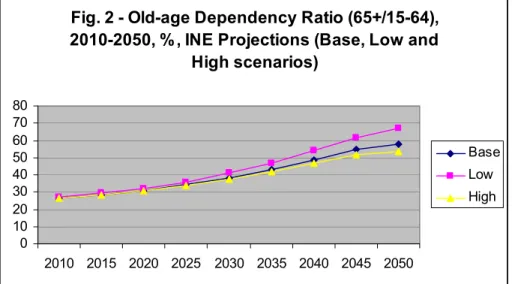
ageing, the Old-age Dependency Ratio11 (ODR), undergoes a massive increase in all three scenarios (Fig. 2): in the Base scenario, from 24.5% in 2001 (i.e., roughly four
people within working age for each person within the traditionally defined retirement
age) to a projected 57.7% in 2050 (i.e., a ratio of 1.7 to one). The end-period level in
the Low scenario is even more impressive (67.1%, or 1.5 potential workers for each
person within retirement age) and only slightly more favourable in the High scenario
(53.7%, or a potential support ratio of 1.9 to 1). This is because even the much greater
number of births optimistically allowed for in the High scenario does not start to have
an impact upon the population of working age until after fifteen or so years into the
future, and even then only a gradual one. In any imaginable scenario, then, population
11
ageing will be an inescapable reality in the next few decades that will call for major
social and economic rearrangements, not least due to a much greater strain upon the
pension and health-care systems.
Fig. 2 - Old-age Dependency Ratio (65+/15-64), 2010-2050, % , INE Projections (Base, Low and
High scenarios)
0 10 20 30 40 50 60 70 80
2010 2015 2020 2025 2030 2035 2040 2045 2050
Base
Low
High
Source: authors’ calculations based on data from the Portuguese Statistics Office (INE)
Comparing the results of the INE projections (as regards the total resident
population) with those produced by the CEFMR (Fig. 3), it becomes clear how sensitive
population projections are to differences in assumptions. In contrast to the former,
CEFMR’s “most populous” scenario results in a projected total population of
11,491,834 by 2054 (compared to 10,027,348 in INE’s High scenario by 2050),
whereas the total population in its “least populous” scenario by the end of the projection
period (9,975,623) is much larger than that in INE’s Low scenario (7,466,983). These
Fig. 3 - Total Resident Population of Portugal, 2004-2054, CEFMR Projections (Development,
High Fertility, Stagnation and Status Quo scenarios) 9000000 9500000 10000000 10500000 11000000 11500000 12000000 2 004 2 009 2 014 2 019 2 024 2 029 2 034 2 039 2 044 2 049 2 054 Development High Fertility Stagnation Status Quo
Source: Central European Forum for Migration Research
Nevertheless, what is most noteworthy is that the differences are much less
significant when we look at the ageing indicators: the projected 2054 levels of the ODR
in CEFMR’s four scenarios (60,6%, 57,5%, 56,1% and 63,4%) are in fact quite similar
to those for 2050 in INE’s three scenarios (57,8%, 67,1% and 53,7%), which is
explained by the fact that the greater expansion in the LEB allowed for in the CEFMR
projections (compared to the INE assumptions) reinforces the effects of the assumed
relatively greater rise in fertility and relatively greater levels of net migration as far as
the total population figures are concerned, but offsets them as regards the ageing
dynamics.
Thus, the main conclusion to be drawn is that while population decline can be
expected to occur in all of INE’s three scenarios, but may be offset to a large extent by
immigration, recuperating fertility levels and an expanding LEB (as shown by the
results of the CEFMR projections), population ageing will inevitably occur very
significantly in any conceivable scenario based on the available information. It
inevitably follows from the massive change in the fertility behaviour of the Portuguese,
2 The Labour Market: Linking Population and Output
As hinted at by the use of the ODR as an indicator of population ageing, the
main problem with ageing concerns the decreasing ability of a shrinking labour force to
provide for an expanding share of dependents. However, the relationship between a
society’s total population – or that within the working age – and the total level of output
(which must provide for the dependents and the economically active alike) is not a
straightforward one. Rather, it is mediated by a series of other variables that ultimately
determine the extent to which a given potential labour force is able to sustain the
burden associated with an evolving age structure. These variables can be divided into
two groups: i) the first one concerns the labour market and is made up of those
variables that express the relationship between the potentially active population and
the actual labour supply (labour force participation rate, unemployment rate, average
number of working hours per employed worker); the second one concerns the average
productivity of labour – productivity increases being one of the ways in which a
shrinking labour force can sustain the same, or an increasing, dependent population.
On the other hand, yet another aspect of relevance to this discussion is the size and
characteristics of the informal or underground economy. Informal activities inherently
entail several disadvantages12 (including the illegal character of some of them, the fact that they give rise to unfair competition and the impossibility of ensuring that labour
standards and regulations are respected), but of greatest importance for our purposes
is the fact that, by definition, taxes and social security contributions cannot be levied on
them. Therefore, a higher incidence of informality will inevitably imply placing an even
greater burden upon those citizens who, through taxes and contributions levied on their
(formal) activities, have to support the dependent share of the population.
The following sections provide an overview of the Portuguese economy as far
as all these variables are concerned.
2.1 Labour force participation
The overall labour force participation rate13 (LFPR) in Portugal is both relatively high and rising: by 2004, it amounted to 73.0% (as compared to 69.7% for the EU-25),
12
Although possibly also some positive ones, including the possibility of greater flexibility benefiting both workers and employers (DGEEP/MTSS, 2006a).
13
upwards from 70.6% in 1998 (OEFP, 2006). The latest Eurostat data (Eurostat, 2007)
confirms the persistence of this trend: by the second quarter of 2006, the Portuguese
LFPR had continued to rise to 73.8%, against 70.4% in the EU-25. This differential is
accounted for by the sex-specific LFPRs of both men and women, but especially so by
the latter: the female LFPR in Portugal in the second quarter of 2006 was as high as
68.4% (EU25: 63.0%), whereas the male one was 79.4% (EU-25: 77.9%). Portuguese
women are more economically active than the EU-25 average from the age of 25
upwards, and especially so in the older economically active age groups.
Future significant increases in most age-specific labour force participation rates
do not seem likely in the Portuguese case, as they are already at relatively high levels
in comparative terms. Indeed, under current institutional conditions, they probably
could take place only at the expense of other outcomes, such as raising the fertility rate
or ensuring the improvement of the future skill level of the working population. The
exception, in line with the epidemiological transition theory, may consist of the group of
the older potentially active, as further decreases in morbidity among the individuals in
this age group may, especially in the long run, still leave substantial room for further
active ageing – even for a radical rethinking of the concepts of “ageing”, “old age” and
“retirement age”. On the other hand, it is true that the population ageing and decline
scenarios presented in the section 1 will, by way of the labour shortages that they will
most likely give rise to, probably turn labour into a more scarce – and consequently
better paid – production factor, which will automatically create an added incentive to
keep on working or actively seek employment across all sex and age groups.
2.2 Employment and unemployment
The recent increase in labour force participation in Portugal has allowed the
employment rate14and the unemployment rate15 to increase simultaneously. Between
1999 and 2005, employment grew slightly from 67.5% to 67.6%, while unemployment
(as computed from the labour force survey) rose from 4.5% to 7.6% (OEFP, 2006a).
Despite this latter – and significant – increase, the unemployment rate in
Portugal has in recent times always stayed below the EU-25 average, even though the
14
I.e., the ratio of the number of employed people to the total population within the working age.
15
gap has been diminishing (4.5% compared to 9.1% in 1999, 7.6% compared to 8.7% in
2005: id, ibid). Before the recent surge in unemployment from 2001 onwards, which
has largely been due to a combination of business cycle factors (insufficient effective
demand) and structural ones (economic restructuring resulting in a mismatch between
skills and jobs), unemployment in Portugal was in fact half that in the EU25 as a whole.
The characteristics of the unemployed are indicative of a labour market undergoing
restructuring, but whose institutional framework values security of employment over
efficiency and job creation. Despite the fact that Portuguese firms certainly still need a
more-skilled labour force to help them move to a higher value-added competitiveness
model, both the relatively skilled (secondary or tertiary education) and young people
are significantly represented among the unemployed (id, ibid). On the other hand,
Portuguese unemployment is also gender-biased, indicating patterns of discrimination
against women in the labour market (Casaca, 2005): unemployment for women in 2005
was 8.7%, i.e. 2 percentage points above that of men, 6.7%16. Finally, there is a very significant overrepresentation of workers previously employed in manufacturing and
construction (OEFP, 2006).
If we turn to the Portuguese employed population (a total of 4,583 million in
2005, for an employment rate of 67.6%), we find a considerable overrepresentation of
males inside the middle interval of the working age interval, i.e. 25-54 years of age
(OEFP, 2006). On the other hand, compared to EU-25 figures, the Portuguese
employed population shows a lower incidence of part-time employment (11.3%,
compared to 17.7%) and a higher percentage of both employees with temporary
contracts (19.8%; EU-25: 13.7%) and self-employed workers (24.1%; EU-25: 15.9%)17. The relatively higher share of the self-employed is again partly a reflection of the
skewed Portuguese labour-regulatory framework, since, as indicated by DGEEP/MTSS
(2006a: 48), many of them are not self-employed professionals in the true sense of the
term, but rather workers performing permanent or semi-permanent functions who are
forced to “disguise” their work as self-employment to enable their employers to
circumvent the much more demanding requirements associated with other types of
contracts.
16
Source: INE website.
17
The vast majority of jobs are accounted for by the service sector (57.3% in
2005, although at some distance from the EU-25 level of 69.7%; OEFP, 2006) – and
will undoubtedly be so even more in the future, as the Portuguese economy continues
to expand its tertiary sector, even without having fully modernized most of its industrial
and agricultural sectors. As manufacturing subsectors such as textiles, clothing and
footwear are finding it harder and harder to compete in the global market – largely due
to competition from emerging economies with much lower labour costs – the service
sector has become by far the main source of new jobs, including for low-skilled
workers.
Ribeiro (2000) argues that the decline of the “mature”-industries model
(metallurgy; chemicals; electrical appliances and devices; cars; textiles, clothing and
footwear; etc) is forcing developed economies to look elsewhere for their sources of
competitive advantage (health; environment; information; software and automation;
leisure; financial, business-to-business and business-to-customer services). In an
exercise aimed at identifying specific potential niches for this latter type of industries in
which Portuguese firms may be able to sustain a competitive advantage in the
production of internationally tradable goods in the future, DGEEP/MTSS (2005)
highlight the following: communications and electronics manufacturing; hi-tech
components for the aeronautical, automotive, oceanic exploration, medical and
pharmaceutical sectors; plastics; specific computer software, web services and
multimedia; and the production of high value-added agricultural goods.
Tourism will remain important in terms both of its weight in the total output and
of employment generation, since it is based upon the exploitation of the country’s
resources as a partial international monopoly. Finally, certain Portuguese firms may
also continue to be globally competitive in carrying out large-scale infrastructural work
in developing countries undergoing rapid urbanization and modernization, as already
visible in the examples of large-scale infrastructural projects in the transport,
telecommunications and construction sectors adjudicated to Portuguese corporations
throughout the developing world. It should be pointed out, however, that the goal of
international competitiveness by Portuguese firms is partly undermined by a
fundamental weakness: the share of the adult population (aged 25 to 64) that had
completed upper secondary education by 2005 amounted to only 26.5 per cent, as
did constitute a significant improvement from a total of less than 20 per cent in the late
1990s. Similarly, Portugal is one of the OECD countries with the fewest adults who
have completed a tertiary education degree (12% in 2005, compared to an OECD
average of 25%18).
Alongside this (hopefully large and dynamic) internationally competitive sector,
another one will co-exist that will mostly provide non-tradable goods and services
protected from global competition by virtue of their proximity requirements: urban,
household, personal care and health services; services to businesses; certain local
retail and business outlets (e.g. restaurants and cafés); and the social economy as
decentralized provider of collective goods. As a consequence of population ageing, the
demand for these activities is likely to experience especially high growth in the field of
personal care and health services. The changes in the structure of employment by
professional categories are consistent with the aforementioned thesis: the largest
professional category (blue-collar, craftsmen and similar workers, accounting for 18.6%
of the employed population in 2005: OEFP, 2006) was also the one which experienced
the greatest drop between 1998 and 2005: a net loss of 146.5 thousand. Conversely,
the occupational categories that have grown the most have been intellectual and
scientific professionals (a net +134.9 thousand) and upper-level managers of the public
and private sectors (+112.9 thousand).
2.3 Average number of hours worked and labour productivity
The data provided by the OECD concerning the average annual number of hours of
work per worker is computed by dividing the total number of hours worked in the
economy by the total number of persons in employment. This data allows for two main
conclusions: the first one is that this indicator has in the Portuguese case been
undergoing a long-term decline, but remained relatively constant over the past few
years (1,685 annual hours of work in 2005 compared to 1,691 in 200019), as indeed has been the case in most OECD countries. The second conclusion is that while
Portugal’s figures are not very distinct from those in, say, Spain, France, Germany or
the United Kingdom, they do seem to be considerably below those in Greece (a
Southern European country commonly used as a benchmark with respect to economic
18
Source: OECD.
19
performance) and, most notably, Korea. Although it is important to look at these figures
with some caution – the OECD itself warns that the differences in the data-collection
methodologies used in the various countries can compromize the adequacy of
international comparisons (as opposed to diachronic analyses for a single country) –,
the magnitude of the differences in the two former comparisons (with Greece and
Korea) seems to suggest that there might remain some room for the Portuguese
economy to accommodate a greater number of average working hours (a possible
“solution” to the additional burden associated with population ageing that, of course,
entails trade-offs in terms of time available for leisure and for “non-productive” labour in
the household and in the community) .
Another possible way in which both the total output and the tax base can
increase (or be kept from decreasing as much) in the presence of a decreasing labour
force is through increases in labour productivity, or the average output produced in the
economy per hour of work. The gap is in this case a huge one – by 2005, labour
productivity (GDP per hour worked) in Portugal (24.1 USD) stood at less than half that
in France (49.0 USD) or in the United States (48.3 USD)20 –, the problem consisting of how to narrow it in the context of rising global competition and a relatively unskilled
labour force. Even though labour productivity in Portugal increased considerably in the
1990s, it has stagnated since the turn of the millennium and failed to significantly
converge with the more advanced industrial economies over the past twenty years.
2.4 The informal economy
The size of the informal or underground economy in Portugal has been estimated by
Schneider and Klinglmair (2004) as amounting to 22.3% of GDP in 2002/2003. It
stabilized,around 22%-23% throughout the late 1990s and early years of the 21st century, after having apparently increased very significantly in the early 1990s. The
figures presented for Portugal by these authors are relatively similar to those found in
Spain or Italy and, though below those in Greece, significantly above those in all the
northern and western European countries.
Few scientific studies, however, have sought to assess or measure the
Portuguese informal economy as a whole. Research has more often focused on one of
20
its aspects, namely undeclared work. Weber (1998), for example, has found
undeclared work in Portugal to be “(…) the preserve of illegal immigrants and women.
Sectors particularly affected are textiles, the retail trade and construction”. Reyneri
(n/d:7) specifies further, although for the group of Southern European countries taken
together (Portugal, Spain, Italy and Greece), that the sectors and occupations in which
undeclared work is most commonly found are “seasonal harvesting in agriculture,
manual labourers and bricklayers in construction, housekeeping and caring for the
elderly, low-skill services in metropolitan areas (waiters, dishwashers, cooks and other
jobs in restaurants; gas-pump operators; guardians, concierges, night watchmen,
painters; blue collar workers in repair workshops, garages and cleaning firms; porters
and transport workers; home delivery workers; cleaners, low level workers in butcher
shops and bakeries, and so on)”.
The construction sector (Baganha, 1998a and 1998b; Baganha, Marques e
Góis, 2002) has traditionally been one in which migrants make up a large share of the
labour force and, at the same time, one in which the prevalence of informality is
especially high: based on information from privileged informants in the sector,
DGEEP/MTSS (2006b) have estimated undeclared work to account for 15% to 37% of
the total work performed in construction in the Lisbon region in 2001. Another specific
area characterized by the coexistence of significant informality and the recruitment of
foreign workers, in this case mostly women, is cleaning and caring. Indeed, given the
exhaustion of the unskilled labour-intensive industrial model, it is likely that undeclared
work will increasingly be a feature of the “secondary” labour market associated with the
service sector – with construction continuing to contribute very significantly in highly
pro-cyclical fashion.
3 Migration Flows to and from Portugal: Economic and Labour Market
Impacts
In a context of rapid and significant change in the demographic profile of the
Portuguese society, with potentially serious impacts upon the labour market and the
economy, it is especially important to scrutinize international migration flows as one of
the main variables with the potential to either attenuate or aggravate the problems in
flows increase the resident population both directly (through the migrants themselves)
and indirectly (through their offspring); migrants are typically characterized by higher
than average labour-force participation rates, which renders them particularly relevant
from a labour-market perspective; and migration (especially labour migration), whether
primarily governed at the state level or within the context of formal or informal migration
networks and chains, constitutes a relatively immediate and automatic “adjustment
valve” for the problems of either labour shortage or excess. Since it is net migration
(i.e., immigration minus emigration) that is relevant, however, and because Portugal is
characterized by a “mixed” migratory regime in which both flows coexist, this section
looks at the background and characteristics of both emigration and immigration.
3.1 Emigration
Portugal has long been a country of emigration, but both the main destinations and the
characteristics of the flows have changed considerably over the long run. Throughout
most of the last century, the vast majority of Portuguese emigrants were permanent
emigrants, who settled by the hundreds of thousands first in the American continent
(the predominant destination area in the early 20th century) and then mostly in the more developed European countries (particularly France, Switzerland and Germany). As a
consequence, the number of Portuguese nationals or individuals of Portuguese origin
scattered throughout the world in the present day adds up to around 4.8 million
(Pimentel, n.d.), compared to a total resident population of just over 10 million.
More recently (from the early 1980s onwards), an important qualitative change
took place, as emigration of a temporary character gradually increased and overtook
permanent emigration (Peixoto, 2004a). The latest available figures indeed show that
temporary emigration accounts for around 75% of total emigration flows (INE, 2004b),
which reflects the increasingly “contemporary” character of the Portuguese emigration
regime – one in which international mobility is regarded as a strategy for upward social,
economic and professional mobility that possibly involves just a short-term phase in the
life-cycle. It is likely that this relative upsurge in temporary emigration corresponds to
the increasing predominance of short-term, often “circular”, migration intentions –
rather than to a subterfuge for permanent migration, disguised as temporary for legal
reasons, as initially thought (Baganha, 1993). The estimated number of annual
is available, after peaking at close to 30,000 in 1997 – which contrasts with annual
permanent emigration figures consistently below 10,000 since 1994 (dropping to a
historical minimum of 4,000 in 1999). Despite the increasingly temporary character of
their migration intentions, the main destinations chosen by the emigrants of the recent
past have not differed very significantly from those of the days of mostly permanent
migration. In particular, France and Switzerland remain the most significant
destinations (INE, 2004b). Arguably the most notable developments in this respect
have been the emergence of Spain and the United Kingdom as relevant receiving
countries and the waning interest in Germany as a destination country for Portuguese
emigrants.
3.2 Immigration
Like Portuguese emigration, so has immigration to Portugal undergone some profound
changes in the recent past. In itself, it is a relatively recent phenomenon, at least on a
significant scale: it was not until the 1970s that immigration to Portugal became truly
considerable, following the democratizing revolution in Portugal and the independence
of the former colonies in Africa, which led to the inflow of both nationals of those
countries and, especially, hundreds of thousands of Portuguese return migrants who
fled the turmoil in the newly independent African countries.
While the formation of a post-colonial migration system dates back to the
moment of democratization and decolonization (or even before that), it was the
political, and especially economic stabilization and development of the Portuguese
society – particularly after joining the EU, then EEC, in 1986 – that lay the foundations
for Portugal to become a more significant country of immigration, drawing in migrants
from a wider variety of origins. Since, as we have seen, emigration from Portugal did
not wane concomitantly – rather, it changed its predominant character from permanent
to temporary – it can certainly be said that Portugal has come to be characterized by a
“mixed” migration regime of an increasingly complex, global and “post-modern”
character. Why this is this case with regard to immigration is easily explained. On top of
the post-colonial migration flows that inaugurated the era of immigration to Portugal,
layer upon layer of subsequent flows with distinct characteristics have been
superposed: a contingent of relatively skilled migrants from Brazil (typically
internal labour markets of transnational corporations) beginning in the 1980s; steady
though relatively minor migration flows from global diaspora-originating areas such as
China and South Asia from the 1990s onwards; and much more impressive migration
flows from Brazil and a variety of Eastern European countries, only this time consisting
mostly of labour migrants targeting low-skilled segments of the labour market, in the
late 1990s and early 21st century.
The stock of foreign citizens regularly staying or residing in Portugal is a
reflection of the accumulated history described in the previous paragraph. There are
three different legal titles in Portugal that confer to foreigners the right to long-term
permanence in the country. These are residence permits, permits to stay21 and long-term visas. Adding up the numbers in the three categories yields a total of 415,934
foreigners in a regular situation as of 2005, the latest year for which data is available
(INE, 2006). At that time, the most numerous national groups were the Capeverdeans
(67,457), followed by the Brazilians (63,654) and the Ukrainians (43,799). These
figures reflect the massive relative increase in the stock of foreign citizens that took
place around the turn of the century, from around 178,000 in 1998 to the
aforementioned 416,000 in 2005. Despite this significant increase, however, the share
of foreign citizens in the total resident population of Portugal (just over 4%) remains
well below those in countries such as Spain, France or Germany – even though their
weight in Portugal’s labour force is higher than that: a calculation based on the fact that
two of the three main legal titles enabling foreigners to remain in the country require
that they be employed (permits to stay and long-term work visas), and on applying the
Census 2001 LFPR for foreigners to the remaining legal title (residence permits),
makes it possible to estimate that foreigners probably account for at least 5.1% of the
labour force (and most likely more than 6% if irregular migrants are taken into account).
Despite their still relatively limited share in the Portuguese population, the
significant increase in the number of foreign citizens has had some relevant effects on
the overall demographics of Portuguese society. For example, Rosa, Seabra e Santos
(2004) pointed out that foreigners accounted for 22% of the increase in the total
resident population of Portugal in the inter-census period 1991-2001 – and the
equivalent figure for the years since the last population census is certainly higher than
21
that, as the natural balance has continued to decrease and immigrant inflows have
persisted at relatively high levels well into this century22. The foreign population’s contribution to fertility in this country is also attested for by the fact that the total fertility
rate among foreign women was much higher (2.4) than that of Portuguese nationals
(1.5) (Rosa, Seabra and Santos, 2004) – despite the well-documented tendency for
migrants’ fertility rates to gradually converge with that of the autochthonous population.
The participation of foreign nationals in the Portuguese labour market may be
characterized as considerably more “polarized” than that of the Portuguese: foreigners
are over-represented both in the highly-skilled categories and in the low-skilled end of
the occupational spectrum. However, the timing and the main nationalities of the
immigrant flows contributing to the two sides of this over-representation exhibit
considerable differences. While migrants associated with post-colonial “lusophone”23 migration have traditionally taken up low-skilled and low-paid jobs (particularly in
construction and cleaning, in the case of males and females respectively), the nationals
of the other EU countries and the first wave of Brazilian immigrants have typically
occupied positions in the “primary” labour market (Baganha, Ferrão and Malheiros,
2002; Baganha, Góis and Pereira, 2005; Peixoto, 2002a).
The most recent and numerous immigration wave, made up for the most part of
Brazilian and Eastern European nationals, was again directed overwhelmingly to the
“secondary” labour market, despite the fact that the latter are known to possess higher
average skills’ and educational levels than the Portuguese population in general, in a
well-documented instance of deskilling and “brain waste”. Within the “secondary”
labour market, however, even the typical labour market insertion trajectories of these
two latter groups have exhibited distinct features. Whereas the Brazilians’ command of
the Portuguese language and their stereotypical cultural characteristics have rendered
them particularly attractive, from the employers’ point of view, for jobs that involve
dealing with customers (e.g., in cafés, restaurants and commerce), the integration
paths of the Eastern European immigrants have been relatively similar to those
traditionally followed by the African nationals – with jobs in the agricultural sector
providing the main exception. This has placed these two latter “macro-regional”
22
It is not possible, however, to rigorously compute a comparable figure, since the methodology used in the census (which aims to survey foreigners with both regular and irregular status) differs from that used in computing the stocks previously referred to (which consist only of foreign citizens with regular status).
23
immigrant groups in direct competition against each other in sectors such as
construction and household cleaning – although that competition is likely of much
lesser significance with regard to the autochthonous population. In fact, as already
stated, the Portuguese population has grown less and less willing to take up the sort of
low-paid and “3-D” (dirty, dangerous and difficult) jobs performed by these immigrants,
even while many emigrants consider doing just that in the context of their host
countries.
Data on “socio-economic groups” (a statistical category that is mostly based on
occupation and professional status) indicate that, among the economically active
foreign population surveyed in the Census (142,442 in 2001), 15.4% were employed in
commerce and service outlets, 54.2% were blue-collar workers (four fifths of which
unskilled) and only 12.9% were independent professionals, upper cadres and
intellectual/scientific professionals (dominated by EU nationals). Another aspect worth
highlighting is overrepresentation (9.1%), compared to the autochthonous population,
of foreign entrepreneurs and owners-managers of small businesses. As confirmed by
recent research on this topic, immigrant entrepreneurship remains most significant in
the case of the EU and Asian nationalities (Oliveira, 2004).
The patterns of professional occupation of the foreign population(s) are
naturally related to their levels of educational attainment. Census data24 show that the foreigners’ educational attainment distribution is significantly associated with their
geographical origin: by 2001, 47.9% of the EU nationals had completed either
secondary or tertiary education, as opposed to only 17.5% of the Africans – Americans
with 39.3% and Asians with 33.2% standing somewhere in between. Unfortunately, no
systematic data has recently been collected on the educational attainment of the
nationals of all the countries with an immigrant presence in Portugal. However, both the
Census figures and some latter research indicate that Eastern European nationals
stand clearly above the average, in educational terms, of both the entire immigrant
population and the Portuguese population. Their level of professional deskilling is
therefore high, as they perform low-skilled jobs despite their relatively high levels of
educational attainment.
24
In closing, it is worth mentioning the attempt by Ferreira, Rato and Mortágua
(2004) to assess the impact of immigration upon the Portuguese economy by
estimating the foreign population’s contribution to Gross Value Added, on the one
hand, and to enhancing labour productivity in two sectors in which foreign workers are
especially represented – (i) construction; and (ii) commerce, hotels and restaurants –
on the other. Although highly compromised by the lack of satisfactory primary data,
these authors concluded that foreign workers accounted for 5% of domestic Gross
Value Added (at a time when their share in the total labour force amounted to 6%) and
that immigration accounted for an increase in average labour productivity in the two
aforementioned sectors in the range of 30%-35% (taking 1992-1997 and 1998-2001 as
the two reference periods in this econometric estimation). In a similar vein, Almeida
(2003) has estimated that the foreign population has had a net positive impact of 324
million Euros upon the public budget in 2001 (the only year for which that exercise has
been carried out), i.e. over 1,000 Euros per foreign citizen with a regular status – a
result that seems plausible given the foreign population’s relatively lower dependency
ratios (hence, relatively lower health and education expenditure requirements) and their
relatively higher labour force participation.
4 Policy Options
Even though immigration may not be the solution to the problems associated with
population ageing (the scale of the migration inflows required to offset them is
inconceivably large), it certainly is a possible partial solution – as are the reliance upon
greater labour force participation, more working time, diverting gains in labour
productivity to addressing this issue, and/or seeking to raise fertility levels. Each of
these possible partial solutions has its own associated costs and benefits, which is why
the determination of the optimal combination of the reliance upon each of them in order
to address the problem at hand is a political, rather than technical or scientific, issue.
Portuguese society, through its democratic decision-making mechanisms, may
well decide that it wishes to forego using its productivity gains to improve its standard
of living and simply divert them to compensating the worsening ODR – in order to avoid
working a greater number of hours, avoid having a larger number of the economically
inactive enter the labour force and avoid letting a larger number of immigrants into the
regime, so as to offset the ageing problem while channelling productivity gains to
improving standards of living and letting zero immigrants into the country. Or, which
would be more typical, it may adopt a more balanced solution to this implicit joint
optimization exercise and draw on each of these solutions to the extent that the gains
from doing so more than exceed the disadvantages implied by them. In sum, it is
clearly a matter of trade-offs.
It should be stressed, however, that there are several reasons – besides the
“deterioration in the dependency ratios” argument – for immigration to be considered a
potentially positive (and probably unavoidable) feature of the future of Portuguese
economy and society. First, labour shortages may occur not only due to the
endogenous demographic dynamics, but also as a result of changes in preferences:
the existence of a dual labour market implies that a part of the native population may
prefer other forms of living, or even emigration, to taking up socially or economically
disregarded jobs. Therefore, even in a demographic “steady-state” situation, there may
well be temporary or structural labour shortages that require immigrant labour in order
to be filled. Second, ageing by itself (i.e. regardless of the countervailing trajectories of
labour force participation, labour productivity, etc.) will most likely bring about specific
skills shortages. In particular, health and caring for the elderly will in the future be
fast-growing sectors, in which it is extremely likely that the demand for labour will increase
too fast to be met by the autochthonous labour supply. Given the fact that these
sectors rely mostly on labour-intensive technologies and that many of the jobs involved
therein are characterised by low social status and low levels of pay, it is very likely that
they will increasingly rely on “secondary” immigrant labour. Third, the increased
liberalization of labour flows benefits a lot of people in some very real ways: the
migrants themselves, of course (otherwise they would hardly choose to migrate), but
also the host-country consumers (who thereby benefit from a higher real standard of
living due to lower labour costs) and the holders of complementary production factors
(e.g. employers and skilled workers). Finally, a country’s migration policy need not –
and arguably should not – be driven by strictly utilitarian criteria; rather, it should reflect
a country’s stance towards international solidarity and human rights and the role it
wishes to play in the international arena. This is all the more obvious in the case of a
country like Portugal, whose diaspora amounts to millions and who wishes to maintain
friendly and mutually beneficial relations with its EU partners and its former colonies (to
Returning to the issue of the joint optimization exercise referred to above, it is
important to note that the “instruments” are not independent from each other and
cannot be treated as such. For example, measures aimed at increasing fertility will, all
other things being equal, bring about a decrease in the employment rate (since some
parents will not be able to work, at least in the few months prior to birth and
immediately after it); measures aimed at increasing the employment rate through an
increase in the labour force participation of young adults may be possible only at the
expense of additional schooling, thereby compromizing productivity gains; and the list
goes on. On the other hand, some of these instruments have an “automatic
stabilization” component to them: for example, a decreasing (in relative terms) labour
force, in the presence of relatively stable total demand, capital stock and investment
rate, is likely to lead to gains in labour productivity (due to greater capital intensity), as
well as to an increase in wages (due to labour becoming more scarce), which will in
turn increase the likelihood of potential immigrants wishing to enter the country and of
the economically inactive (re)entering the labour force. The implication of these
automatically stabilizing effects is that, even in the case of a total inability to
acknowledge the ageing problem or of a total lack of political will to address it, the
consequences will in reality never be as dire as in the scenario of a shift in the age
structure alongside an unchanged trajectory of the remaining influencing variables. In
the following paragraphs, a brief presentation is made of the various policy options
available for addressing the demographic challenge presented in section 1, their main
costs and benefits, some of their interrelationships, some of their “automatic
stabilization” characteristics and the extent to which they have been mobilized in the
Portuguese case in the recent past. It should not be regarded as an exhaustive
treatment of these issues, but as a basis for further research and a contribution to a
better-informed political discussion.
Thus, the first “group” of policy options consists of family and fertility policies
with a view to influencing the fertility behaviour of the population and increasing the
number of births. This may be done, for example, by increasing the availability and/or
subsidizing the cost of child care, or by providing direct financial support to parents as
a function of the number of children that they decide to bear. Its beneficial effects with
regard to the demographic problem are obvious, since the increase in the number of
borne in mind that it also brings about an increase in the total dependency ratio in the
short run: it is not until at least 15 years into the future that those born in response to
these policies start contributing to the production of output; in the meantime, they add
to the pool of dependents. Moreover, fertility policies are often remarkably expensive
and relatively ineffective – the decision to bear (more) children is probably much more
responsive to the conditions in the housing and labour markets, for instance, than to
(necessarily moderate) direct financial incentives. Finally, it is worth highlighting that
fertility policies are among those that entail a series of trade-offs, as suggested before:
on the aggregate, bearing and rearing a larger number of children reduces the labour
force participation rate and the average working time. In the Portuguese case, no
integrated family or fertility policy of this kind has been implemented: the impact of the
modest and isolated measures impinging upon fertility that have been implemented
(maternal leave, subsidized pre-school, financial support) must be regarded as
necessarily limited due to the existence of structural constraints (e.g. the lack of widely
available child care facilities, low income levels and the restrictions to maternal leave
imposed by many firms).
The second group of policies in the portfolio of options to address the
demographic challenge consists of policies which aim to increase the employment rate.
As mentioned before, a decreasing (in relative or absolute terms) potentially active
population can sustain an increasing (also in relative or absolute terms) dependent
population without having to endure a larger burden, provided that the increase in the
employment rate makes up for that shifting balance. Typically (and especially so in the
Portuguese case), it is particularly hard to raise the labour force participation rates of
those in the middle cohorts of the working age. The most effective possible measures
concern younger adults, by way of measures making it easier to reconcile (part-time)
work and education, and older adults, by raising the retirement age, removing
compulsory retirement requirements and fostering active ageing. On the other hand,
the employment rate may be raised not only by raising the labour force participation
rate, but also by reducing unemployment. The latter is obviously a policy goal per se,
but it may be argued that more can yet be done in this field in the Portuguese case,
particularly by enhancing the sectoral and geographical mobility of the workers and by
further liberalizing the labour market (provided that the social safety net is reinforced, in
line with the so-called flexicurity model). The “costs” associated with the measures to
have to do with the smaller number of people available to perform the essential but
largely “invisible” socially reproductive work in the context of the household and
community. Moreover, these policies also involve trade-offs: increasing the activity rate
of young adults can occur at the expense of time dedicated to education and, hence,
future labour productivity; it may also be possible only by drawing on the “marginally
productive” (e.g. some of the older) workers, thereby lowering labour productivity; and it
may jeopardize policies aimed at raising fertility. However, the employment rate has a
built-in automatic stabilizer component: labour shortages directly increase the
attractiveness of being economically active by raising wages; moreover, as labour
becomes more scarce, unemployment tends to fall.
In the Portuguese context, several policy initiatives have been taken in recent
times with the aim of curbing unemployment and fostering job creation. Presently, the
single most important policy framework document in this field is the National Action
Programme for Growth and Employment 2005-2008 (PNACE, 2005), which constitutes
the national-level expression of a European Union initiative within the ambit of the
Lisbon Strategy. It includes a series of strategic plans with an impact at the macro- and
microeconomic levels, addressing issues such as training and human capital formation,
employment and social cohesion. Another important public strategy document is the
National Employment Policy Plan 2005-2008 (MTSS, 2005), whose goals are to
achieve full employment, improve the quality and productivity of labour and reinforce
social and territorial cohesion. Its main priorities consist of attracting more people into
work (and retaining them), improving the social protection mechanisms, enhancing the
adaptability of workers and firms and fostering human capital formation, namely by
seeking to improve the skills and educational levels of the working population through a
variety of measures (MTSS, 2005; PNACE, 2005; Soares, 2006).
In rather loose and piecemeal fashion, many other specific measures have
been taken by the various recent governments with the aim of increasing employment,
improving labour productivity and reducing unemployment, some of which concern the
rules of access to social protection mechanisms. These have included more systematic
checks on the employment status of the registered unemployed and harsher conditions
of access to unemployment benefits – for example, by making it more difficult for
The third option, in line with our “decomposition” of the relationship between the
potential labour force and the actual output produced in the economy, consists of
increasing the average working time. This particular variable is liable to change mostly
through its “automatic stabilizer” properties (when labour becomes scarcer, hence
better paid, there is an incentive for each individual to supply a larger quantity of it).
This is because it can only be implemented directly in the case of civil servants and it
involves the risk of serious negative political reactions if imposed compulsorily.
Moreover, the costs associated with the reduction in leisure time and in the time
available for socially reproductive work must also be borne in mind, as must the fact
that the productivity of the additional working time will typically be lower. The most that
can be done by public policies in this domain (and an option which is yet to be explored
systematically in the Portuguese case) is to provide positive incentives for workers to
work longer hours of their own free will.
The fourth policy option consists in increasing labour productivity, so that the
same (or a decreasing) labour force can sustain an expanding dependent population.
In reality, increasing labour productivity is a policy goal per se, so the real policy option
in this case is to channel the actual or potential productivity gains to addressing the
welfare problems associated with population ageing: diverting any of those gains to this
particular use instead of other alternative (public or private) uses is therefore equivalent
to a tax (one, of course, which the Portuguese may well decide to approve). Still, with
or without population ageing, it is obviously commendable that all efforts be made to
increase labour productivity, namely through lifelong education and training and by way
of facilitating institutional changes. Fortunately, labour productivity has a partial
“automatic stabilizer” component in the context of population ageing: labour shortages
create an incentive to the adoption of more capital-intensive technologies, which
increase labour productivity directly.
The need to raise the levels of schooling and professional training of the
Portuguese population and workforce is a domain where there is widespread
consensus – the various successive governments have consistently introduced
measures and reforms to achieve this. Even though the educational levels of the
Portuguese population are still among the poorest in the EU, the relative number of
rising, as has the number of those in vocational training. In this sense, it can be said
that the stage is set for a steady – albeit slow – future increase in labour productivity.
The domain in which public policy has been most active in recent years when it
comes to addressing the welfare consequences of population ageing is that of social
security mechanisms. Due to the increasing burden associated with public budget
deficits and the rising number of pensioners, a number of actions have been taken in
order to reduce the additional financial burden that is being caused by demographic
ageing and to protect the system from the risk of financial collapse in the long run.
Given the politically sensitive character of the issues at stake, this process has been
neither linear nor fully consensual. Still, some important steps have been taken,
particularly in the past two years. In October 2006, the left-of-centre government and
the main social partners managed to bridge most of their differences and signed an
Agreement on the Reform of Social Security within the ambit of the Social and
Economic Council, which brings together government, public administration,
employers’ associations and trade unions (CES, 2006). The reforms agreed upon
included measures that impinge upon the social-security mechanism and its funding,
such as the convergence of the social security regimes, the elimination of the special
regimes, the postponement of the retirement age, a new pension calculation method,
the introduction of a new “sustainability” factor, taxes on pensions, penalties (in terms
of the calculation of pensions) for anticipated retirements, and bonuses for postponed
retirements. These various measures entered into force by way of a new law (Law no.
4/2007) in January 2007.
The final option in this portfolio is replacement migration, i.e. actively
encouraging migration inflows in order to adjust the present and future age structure of
the population, both directly (as most migrants belong to the potentially active cohorts)
and indirectly (since the migrants’ total fertility rate is typically higher than that of the
autochthonous population). Generally speaking, this can be done both by way of
greater liberalization of migration flows (presumably, labour shortages will automatically
lead to in-migration) and through state-led direct recruitment schemes (more costly and
often less effective).
From an economic perspective, replacement migration is particularly attractive