J. res.: fundam. care. online 2015. abr./jun. 7(2):2475-2485
2475
RESEARCH
Validação de conteúdo de instrumento para avaliar o conhecimento acerca da medida da pressão arterial
Content validation of an instrument to assess the knowledge about the measurement of blood pressure
Validación contenido de un instrumento para evaluar el conocimiento sobre la medición de la presión arterial
Manuela Pinto Tibúrcio 1 , Gabriela de Sousa Martins Melo 2 , Lívia Sêmele Câmara Balduíno 3 ,
Camylla Cavalcante Soares de Freitas 4 , Isabelle Katherinne Fernandes Costa 5 , Gilson de Vasconcelos
Torres 6
Objective: To validate an instrument for assessment of knowledge of nursing students about the blood
pressure measurement. Method: methodological study conducted with 27 judges nurses, teachers of the discipline of semiology and / or semiotics, with at least 1 year of experience in the disciplines, in three stages: literature review for the development of the knowledge questionnaire, submission to the judges; and content validation by the Kappa index, accepting the value> 0,61, and content Validity Index (CVI )> 0,75. Results: The 12 questions obtained Kappa and CVI within the parameters established for content validity, 7 showed perfect concordance index and 5 required modifications. Conclusion: It was not necessary remove questions of the instrument, which expresses that they have representation and extension about the domain of interest, facilitating the assessment of knowledge. Descriptors: Nursing, Blood pressure determination, Validation studies, Knowledge, Questionnaires.
Objetivo: Validar um instrumento para avaliação sobre o conhecimento dos graduandos de enfermagem
acerca da medida da pressão arterial. Método: Estudo metodológico, desenvolvido com 27 enfermeiros juízes, docentes da disciplina de semiologia e/ou semiotécnica, com no mínimo 1 ano de experiência nas disciplinas, em três etapas: levantamento da literatura para a elaboração do questionário do conhecimento; submissão aos juízes; e validação de conteúdo mediante o Índice Kappa, aceitando-se o valor > 0,61, e Índice de Validade de Conteúdo (IVC) > 0,75. Resultados: As 12 questões obtiveram Kappa e IVC dentro dos parâmetros estabelecidos para a validade de conteúdo, 7 apresentaram índice de concordância perfeito e 5 exigiam alterações. Conclusão: Não foi necessária a retirada de questões do instrumento, o que expressa que elas apresentam representatividade e extensão acerca do domínio de interesse, favorecendo a avaliação do conhecimento. Descritores: Enfermagem, Determinação da pressão arterial, Estudos de validação, Conhecimento, Questionários.
Objetivo: Validar instrumento para la evaluación de los conocimientos de los estudiantes de enfermería
acerca de la medición de la presión arterial. Método: Estudio metodológico llevado a cabo con 27 jueces enfermeras, maestros de la disciplina de la semiótica y/o la semiótica, con al menos 1 año de experiencia en las disciplinas, en tres etapas: revisión de la literatura para el desarrollo del cuestionario de conocimientos, la sumisión a los jueces y validación de contenido mediante del índice de Kappa, aceptando el valor>0,61 y contenido Índice de Validez (CIV )>0,75 . Resultados: Las 12 preguntas obtenidas Kappa y CIV dentro de los parámetros establecidos para la validez de contenido, 7 mostraron índice de concordancia perfecta y 5 modificaciones requeridas . Conclusión: No fue necesario retirar las preguntas del instrumento, el cual expresa que tienen representación y extensión sobre el dominio de interés, lo que facilita la evaluación del conocimiento. Descriptores: Enfermería, Determinación de la presión sanguínea, Estudios de validación, Conocimiento, Cuestionarios.
1 Nurse hematology and transfusion medicine core UFRN. PhD student of the Post-Graduate in Nursing. 2 Nurse. Doctorate in Nursing Graduate program in nursing/UFRN. Assistant Professor of nursing Undergraduate/UFRN. 3 Nurse. Master's degree in nursing. PhD student in the doctoral program in nursing (ESE/UL). 4 Studen at the Federal University of Rio Grande do Norte/UFRN. Scientific initiation scholarship PIBIC/CNPq. 5 Nurse. Doctorate in Nursing Graduate program in nursing/UFRN. Assistant Professor and Professor of Graduate program in nursing/UFRN. 6 Nurse. Post-graduate Doctor in nursing. Professor, Department of nursing and graduate programs in nursing and Health Sciences Center/UFRN. Researcher CNPq PQ2.
ABSTRACT
RESUMEN RESUMO
J. res.: fundam. care. online 2015. abr./jun. 7(2):2475-2485
2476
I
n addition to being one of the vital signs, the measure blood pressure (BP) is the recommended diagnostic method to identify the hypotension and hypertension and should be performed in all health assessment.1Consists of a simple and non-invasive
procedure, but at the same time requires that aspects related to the observer, equipment, customer, and technical environment are respected and followed in order to decrease the possibility of failures that can compromise the reliability of the results.2
Several are the methods to determine the BP, being the indirect method with a auscultatória technique more procedures performed in clinical practice by health professionals, especially by nursing. In this sense, learning this technique has been a constant concern in undergraduate education institutions, since this is a procedure performed routinely in the practice of nurses. In a study of 2013, the author relates precisely to the routine care, the reason, the blood pressure measurement is not being carried out correctly by various professionals.3 This being one of its tasks, the correct
execution credits image of excellence and reliability of a health institution and profession.2, 4-5
Most of the errors to be technicians or anátomofisiológicos during the procedure, there are gaps in knowledge on the subject,3 so it is important that the teaching of blood
pressure measurement starts with a review of the concepts of Anatomy and Physiology, equipment used in the procedure and in relation to the observer. Although the procedure be considered relatively simple from a practical point of view, these concepts can often seem complex and hard to be explained, but are indispensable for students to understand the technique itself. Still, mid-level-forming institutions and higher tend to prioritize the systematic approach of the steps of the procedure, disregarding that the meaningful learning of the measure includes both motor skills as the theoretical knowledge.4
A survey in order to analyze the relationship of the measure of the BP and the scientific production of Brazilian nurses, in the period between 1987 and 2007, showed that the knowledge of professionals about the measure is in deficit, the procedure is executed without scientific bases and permanent education programs are still incipient.6
Worth pointing out that teaching is not only in the exhibition of knowledge, practices and situations, but also on learning evaluation. Consequently, for each major intervention performed, use the best way to ascertain and measure the evolution of who is being evaluated to assess its performance and indicate the necessary adjustments.7
To this end, one realizes the need to build assessment tools that can generate good measurements. Thus, the elaboration of a questionnaire, a test or other Scouting technique requires the observance of care without which it cannot be safely with regard to its results, being fundamental to the quality of fact finding an instrument.8
J. res.: fundam. care. online 2015. abr./jun. 7(2):2475-2485
2477
METHOD
Valid measures are representations of what you want to measure, being a significance criterion validity of an instrument, which offers various methods to collect evidence. The validity of content, one of the types of validation is the degree to which each measurement item represents the concept intended to measure of a given object and if it contains elements that can be assigned to other.8
Given the importance of BP measurement, the need to evaluate the theoretical knowledge concerning this procedure, especially during graduation, has the following research questions: what are the items needed for construction of instrument about the knowledge of undergraduates of nursing relating to blood pressure measurement? What is the content validity of the instrument held by judges from research?
The study aimed to perform content validation of an instrument to assess the knowledge of nursing graduates about the measurement of blood pressure.
Quantitative study of methodological type developed in three stages. The first consisted in the construction of the instrument which aims to assess nursing undergraduates' knowledge about the measurement of blood pressure, based on extensive review of the literature. This is a questionnaire composed of 12 multiple choice questions, with 5 alternatives each, which includes the important steps of the technique.
In the second stage, the instrument was submitted to the judges for evaluation. For selection of judges from research, was conducted an initial contact with the Faculty of nursing University of Rio Grande do Norte to identification of professionals who could act as evaluators of the questionnaire. As inclusion criteria for selection: professors adopted the discipline of semiotics or semiology, with at least 1 year of experience in this area, being the Federal University of Rio Grande do Norte (UFRN), nursing school Natal/UFRN, State University of Rio Grande do Norte and of a private University. Later, she was sent an invitation letter to 34 teachers via e-mail, containing the objectives of the study, the justification of the validation process and inquiring about their participation in the research.
Of 34 faculty members, 28 guests agreed to participate. With that, the instrument, the screenplay of the evaluation process and the term of free and informed consent were delivered personally to each one of them. However, a judge completed the trial of the instrument, being deleted, totaling the sample of 27 judges.
The evaluation of the instrument took place from the classification of each question in proper, with changes and inappropriate, in the last two cases should be pointed to the problems and/or suggestions so that the items could be improved. Was also requested the general evaluation of the instrument based on the following requirements:
J. res.: fundam. care. online 2015. abr./jun. 7(2):2475-2485
2478
RESULTS AND DISCUSSION
usefulness/relevance, consistency, clarity, objectivity, simplicity, feasible, update, vocabulary, accuracy and instructional sequence of topics.
After the evaluation, was held the third stage of the study consisted in the content validation with application of the Kappa Index (K) to check the level of concordance and consistency of judges in relation to the presence or not of the items of the instrument. Such index is an indicator of correlation set that ranges from "less 1" the "more 1", the closer to 1 the better the level of agreement between observers.9 As a criterion of acceptance, it was
established an agreement more than 0,61 among the judges, being considered a good level. We also used the Content Validity Index (CVI), which measures the agreement of the judges as to the representativeness of the items on the content under study and is calculated by dividing the number of judges who evaluated the appropriate item for a total of judges (evaluation item), resulting in the proportion of judges who judged the valid item.10 To calculate the overall CVI instrument, was held the sum of all CVI calculated
separately, dividing by the number of items of the instruments.11 Acceptable it was
considered minimum ratio of 0,75 for both evaluation of each item as for general assessment of the instrument.
The data collected were organized into spreadsheet and exported to statistical software. After encodings and tab, data were analyzed through descriptive statistics. After the analysis, the instrument has been redesigned in accordance with the guidelines and suggestions from judges.
The study complied with the ethical principles of research involving human subjects contained in Resolution 196/96 and was appreciated by the Ethics Committee in Research/HUOL, CAAE of number 0002.0.294.000-10.
Of the 27 judges who evaluated the instrument, 77,8% are female, with an average age of 36,6 (± 9,0) years, 63,0% acted at the Federal University of Rio Grande do Norte, 74,1% owned academic masters as greater titration and 63,0% acted exclusively on teaching. The average time of experience in teaching was 7,9 (± 8,0) years and in the disciplines of semiotics or semiology and nursing was 5,5 (± 6,7) years.
In the process of trial of the questionnaire of knowledge about blood pressure measurement, no matter was considered inappropriate, since all obtained level of agreement within the established level (CVI > to 0,75 E K > 0,61). The results are presented in table 1.
J. res.: fundam. care. online 2015. abr./jun. 7(2):2475-2485
2479
Table 1. Trial among the judges on the issues of evaluation of technical knowledge of blood pressure measurement. Natal/RN, 2012.BLOOD PRESSURE MEASUREMENT ISSUES
TRIAL
Suitable c/changes Suitable CVI Kappa
n % n %
Q1. Definition of BP 22 81,5 5 18,5 0,81 0,69
Q2. Statement about the Korotkoff sounds 27 100 - - 1,00 1,00
Q3. Materials required for carrying out the
indirect measure of ideal BP 26 96,3 1 3,7 0,96 0,93
Q4. Arteries used for indirect verification of BP 27 100 - - 1,00 1,00 Q5. Width and length dimensions of the
inflatable cuff pouch 24 88,9 3 11,1 0,89 0,79
Q6. Statement about the indirect measurement
technique of BP 26 96,3 1 3,7 0,96 0,93
Q7. Incorrect alternative on the palpatório
method of indirect measure BP 27 100 - - 1,00 1,00
Q8. Affirmative about the auscultation method
of verification of the BP 27 100 - - 1,00 1,00
Q9. Factors related to the observer that
contribute to errors of reading BP 27 100 - - 1,00 1,00
Q10. Discusses the PA read errors arising from
the sphygmomanometer and stethoscope 26 96,3 1 3,7 0,96 0,93
Q11. Incorrect alternative on the factors that
can overestimate the values of BP 27 100 - - 1,00 1,00
Q12. Incorrect alternative on the nursing record
regarding the measurement of BP 27 100 - - 1,00 1,00
Source: Own research.
Among the twelve questions comprising the questionnaire, seven had perfect concordance index (Q2, Q4, Q7, Q8, Q9, Q11 and Q12). The other was also considered appropriate, but required changes, as shown in Table 1.
Issues Requirements evaluated Suggestions/comments of the judges (n) Acceptance Justification
Q1 Clarity; Vocabulary The verb used in the utterance of issue is incompatible with the right alternative. (5) Yes Will contribute to better understanding of the issue. Q3 Feasible
The measurement of arm
circumference is not feasible in the services, so the tape measure does not need to be included among the materials used for the ideal BP check. (1)
No
Studies show that the use
of cuff according to the circumference of the arm can influence the result of BP (11-12).
Q5 Feasible The services do not have varying sizes of inflatable bags. (3) No
Q6 Instructional sequence of topics
Consider the question as
preparation of the patient to be held before the measurement of blood pressure. (1) Yes Almost all of the alternatives discuss the preparation of the patient
J. res.: fundam. care. online 2015. abr./jun. 7(2):2475-2485
2480
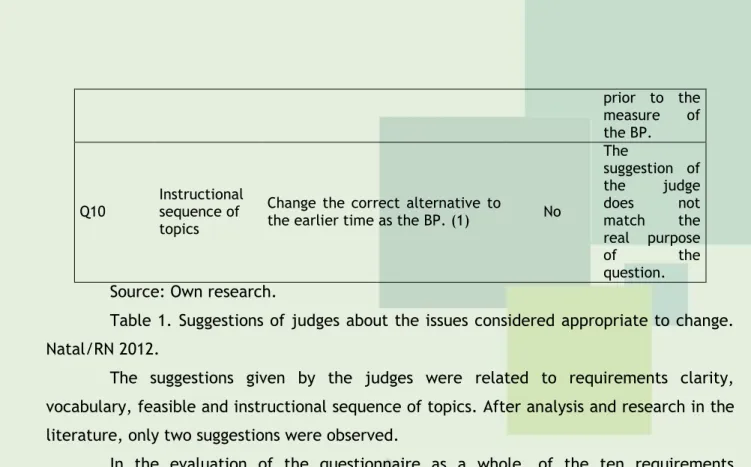
prior to the measure of the BP. Q10 Instructional sequence of topicsChange the correct alternative to
the earlier time as the BP. (1) No
The suggestion of the judge does not match the real purpose of the question.
Source: Own research.
Table 1. Suggestions of judges about the issues considered appropriate to change. Natal/RN 2012.
The suggestions given by the judges were related to requirements clarity, vocabulary, feasible and instructional sequence of topics. After analysis and research in the literature, only two suggestions were observed.
In the evaluation of the questionnaire as a whole, of the ten requirements evaluated by judges, five obtained maximum score of concordances, they are: usefulness/relevance, consistency, objectivity, simplicity and precision. The other requirements also hit scores well above the acceptable, as shown in Table 2.
Table 2. Judgment questionnaire on knowledge of blood pressure measurement from the assessment requirements. Natal/RN 2012.
REQUIREMENTS
GENERAL EVALUATION OF THE QUESTIONNAIRE
Suitable Suitable c/changes CVI K
n % n % Utility/relevance 27 100,0 - - 1,00 1,00 Consistency 27 100,0 - - 1,00 1,00 Clarity 25 92,6 2 7,4 0,93 0,86 Objectivity 27 100,0 - - 1,00 1,00 Simplicity 27 100,0 - - 1,00 1,00 Feasible 26 96,3 1 3,7 0,96 0,93 Update 26 96,3 1 3,7 0,96 0,93 Vocabulary 26 96,3 1 3,7 0,96 0,93 Precision 27 100,0 - - 1,00 1,00 Instructional sequence of topics 26 96,3 1 3,7 0,96 0,93
Source: Own research.
In the overall assessment of the instrument, the questionnaire obtained CVI index of 0,97 and Kappa of 0,94, with an optimum level of concordance between the judges.
Despite the indirect technique of measurement of BP be widely used and taught in technical courses and graduation from nursing, in addition to being the most accomplished in health institutions, a survey has shown that only 7,8% of nurses, by answering a questionnaire dealing with multiple-choice questions about the methods and auscultatory method oscillometric, gave a performance of 60%, while the other searched with a hit percentage less than this.14
The first step for the correct collection and interpretation of blood pressure values is the domain, on the part of health professionals, of the factors that determine, control and influence. Accordingly, the first two issues of the instrument to assess nursing
J. res.: fundam. care. online 2015. abr./jun. 7(2):2475-2485
2481
undergraduates' knowledge about this important physiological parameter bring thedefinition of BP and the meaning of the Korotkoff sounds, respectively.
In a study conducted with the purpose of analyzing the knowledge of health care professionals about the extent of the BP, 72,73% of them answered correctly about the concept of blood pressure. In contrast, 81,82% of respondents were not aware that, beyond the posterior tibial artery, brachial, radial and popliteal can also be used for the measurement of BP. Also highlights the fact that less than half of them meet the components of another tie, demonstrating that the undergraduate courses may be addressing superficially anatomical and physiological aspects and the equipment used in the procedure.15
In the questionnaire elaborated the issue 04 addresses the anatomical and physiological part in blood pressure and issues 03 and 05 involve materials used for your ideal measure. The last two were questioned by judges from research, to claim that the practice of measuring the circumference of the client to set the brachial width and the ideal length of the cuff is not feasible in the services, precisely because there was no availability of varying sizes of inflatable bags.
However, studies have proved that the use of cuff according to the circumference of the arm can influence on the result of blood pressure, and may underestimate her or want to oversell it(12-13). Although there are different cuff sizes on the market, normally only
the pattern is available at health services and, with it, the PA of many customers are still poorly evaluated, which can lead to misdiagnoses and improper treatments.13
Unsatisfactory results were obtained in a survey conducted in order to evaluate the theoretical and practical knowledge of the doctors, nurses and technicians of nursing technique-related blood pressure. In evaluating the theoretical knowledge, all categories of professionals have a percent less than 50% hit when questioned about the dimensions of the cuff. The knowledge deficit ended up reflecting on practice at the time of the survey, since, despite the offer of different cuff sizes and measuring tape at the time of realization of the technique, no professional measured the circumference of the arm of the client and all used cuff with rubber bag standard size of 12 for 23 cm.16
With regard to using cuff proportional to the circumference of the arm of the patient, study showed that of 107 professionals observed regarding the Scouting of the BP in a Center specializing in cardiology, all used the cuff with standardized size, including for obese clients and thin.5
The question addresses the instrument 06 customer preparation before measurement of the BP, which includes checking that it is not with a full bladder, not practiced physical exercises in the past 30-90 min, not ingested alcoholic beverages, coffee, food or smoked until 30 min prior to measurement(1). When evaluated all the necessary
actions to be performed by the professional in relation to the preparation of the patient, no professional had questioned whether the client had emptied his bladder before the procedure.5
The indirect method with the auscultatory technique is the most widely used resource for blood pressure measurement. However, it is essential previously measure the systolic blood pressure by palpation in order to avoid excessive cuff inflation and the
J. res.: fundam. care. online 2015. abr./jun. 7(2):2475-2485
2482
consequent excessive compression of the artery, which can alter blood pressure levels andlead to underestimation of systolic pressure and avoids the discomfort customer.1-2
Question the apparent simplicity of blood pressure measurement, since the guidelines, in most cases, are not followed in its entirety. In a study it was observed that, for different reasons, the technique of BP measurement is not performed correctly.4
As if not enough inconsistencies in measurement of BP, the lack of anatomical and physiological knowledge and neglect and indifference on the part of professionals, another worrying factor is the absence of records in the clients chart. In a study conducted in a hospital outpatient clinic of São Paulo, it was noted that in 67% of queries did not exist the value of blood pressure recorded in the chart, even though in the sample charts of patients seen in the League of hypertension, where necessarily the pressure must be measured and annotated.17
Another potential source of error that deserves highlight is the rounding of BP measurement values and may lead to incorrect diagnosis and improper driving of the treatment of hypertension. The error seems to have digital preference beginning already in professional training. Observational study with nursing students showed clear preference at zero and only 16% for finished values by other digits.17
Given these possibilities that can result in errors, it is essential that responsible for carrying out the procedure are properly advised and trained to reach correct pressure.15 A
study of health professional values shows that 87,56% of them found it necessary more information on the BP measurement, specifically about the material, patient and observer. From the identification of deficits and knowledge needs on the subject, was developed and implemented a continuing education program, which included exhibition-dialogued classes and round tables, in order to motivate the staff and improve the quality of care for hypertensive patients.18
The design for the improvement of practices implies changes in individual behavior/collective/organizational, work processes, in the provision of information and the inclusion of critical reflection. The assignment of values to the intellectual issues and the modification of the way of working with knowledge contribute to the transformation of the best thinking and doing, in both theoretical and practical.19
The questioning, which is regarded as a strategy for teaching elementary, can be used for the development of critical thinking skills, along with others. It is suggested the use and combination of questions of different types and levels, giving preference to the use of intermediate grade, which require the application of student knowledge, analysis, synthesis and evaluation.20
Thus, the assessment of knowledge in relation to measurement of BP configures itself as important strategy for the formative process that develops in the course of undergraduate or continuing education programmes, at the same time that is relevant to the reflection about the importance of knowledge and correct application of the technique, in that it contributes to the formation of conscious professionals and for the transformation of reality andtherefore provides a higher quality assistance.
J. res.: fundam. care. online 2015. abr./jun. 7(2):2475-2485
2483
CONCLUSION
It was found that of the 12 issues that comprised the knowledge assessment questionnaire on the measurement of blood pressure, all achieved levels of validity of content within the established (IVC > 0,75 and Kappa > 0,61). With this, it was not necessary the withdrawal of any of them, which expresses that the instrument issues feature representation and extension about the domain of interest, favoring the knowledge assessment and validity of same.
The judges' suggestions were related to the requirements of clarity, vocabulary, be feasible and instructional sequence of topics. After analysis and research in the literature, 2 suggestions were followed, leaving the questionnaire, after remodeling, more appropriate and clear.
In the overall assessment of the instrument, the questionnaire obtained IVC of 0,97 and Kappa of 0,94, demonstrating great level of concordance and consistency of judges in relation to the permanence of the items and their representativeness as to the content.
As a product of this study, the evaluation survey of knowledge about blood pressure measurement is valid as to its content by 27 judges, by setting a clear and objective tool for the evaluation of undergraduates of nursing as well as other students and health professionals, since the use of valid measures for reducing the risk of distortion of the results.
J. res.: fundam. care. online 2015. abr./jun. 7(2):2475-2485
2484
REFERENCES
1. Sociedade Brasileira de Cardiologia/Sociedade Brasileira de Hipertensão/Sociedade Brasileira de Nefrologia. VI Diretrizes Brasileiras de Hipertensão. Arq Bras Cardiol [periódico na
Internet]. 2010 [acesso em 2013 jul 18];95(suppl.1):1-51. Disponível em:
http://www.scielo.br/pdf/abc/v95n1s1/v95n1s1.pdf
2. Geleilete TJM, Coelho EB, Nobre F. Medida casual da pressão arterial. Rev bras Hipertens [periódico na Internet]. 2009 [acesso em 2012 dez 18];16(2):118-22. Disponível em: http://departamentos.cardiol.br/dha/revista/16-2/13-medida.pdf
3. Tibúrcio MP, Torres GV, Enders BC, Tourinho FSV, Melo GSM, Costa IKF. Análise contextual da mensuração da pressão arterial na prática clínica. J res fundam care Online [periódico na Internet]. 2013 jul/set [acesso em 2013 nov 20]; 5(3): 328-36. Disponível em: http://www.seer.unirio.br/index.php/cuidadofundamental/article/view/2136/pdf_879
4. Alavarce DC, Pierin, AMG. Elaboração de uma hipermídia educacional para o ensino do procedimento de medida da pressão arterial. Rev Esc Enferm USP [periódico na Internet]. 2011
[acesso em 2012 dez 18];45(4):939-44. Disponível em:
http://www.scielo.br/pdf/reeusp/v45n4/v45n4a21.pdf
5. Boll LFC, Irigoyen MC, Goldmeier S. Diretrizes brasileiras de hipertensão arterial: realidade da enfermagem em hospital especializado. Acta paul enferm [periódico na Internet]. 2012 [acesso em 2012 dez 18];25(5):775-80. Disponível em: http://www.scielo.br/pdf/ape/v25n5/20.pdf 6. Arcuri EAM, Araújo TL, Veiga EV, Oliveira SMJV, Lamas JLT, Santos JLF. Medida da pressão arterial e a produção científica de enfermeiros brasileiros. Rev Esc Enferm USP [periódico na
Internet]. 2007 [acesso em 2012 dez 18];41(2):292-8. Disponível em:
http://www.scielo.br/pdf/reeusp/v41n2/16.pdf
7. Moura ECC, Mesquita LFC. Estratégias de ensino-aprendizagem na percepção de graduandos de enfermagem. Rev bras enferm [periódico na Internet]. 2010 [acesso em 2012 dez 18];63(5):793-8. Disponível em: http://www.scielo.br/pdf/reben/v63n5/16.pdf
8. Martins GA. Sobre Confiabilidade e Validade. RBGN [periódico na Internet]. 2006 jan/abr
[acesso em 2012 dez 18];8(20):1-12. Disponível em:
http://200.169.97.104/seer/index.php/RBGN/article/viewFile/51/272
9. Pereira MG. Epidemiologia: teoria e prática. Rio de Janeiro: Guanabara Koogan; 1995.
10. Rubio DM, Berg-Weger M, Tebb SS, Lee ES, Rauch S. Objectifying content validity: conducting a content validity study in social work research. Soc. work res [periódico na
Internet]. 2003 [acesso em 2012 dez 18];27(2):94-111. Disponível em:
http://swr.oxfordjournals.org/content/27/2/94.full.pdf+html
11. Polit DF, Beck CT. The content validity index: are you sure you know what's being reported? Critique and recommendations. Res nurs health [periódico na Internet]. 2006 [acesso em 2012 dez 18];29(5):489-97. Disponível: http://www.ncbi.nlm.nih.gov/pubmed/16977646
J. res.: fundam. care. online 2015. abr./jun. 7(2):2475-2485
2485
12. Alexis O. Providing best practice in manual blood pressure measurement. Br j nurs [periódicona Internet]. 2009 abr [acesso em 2012 dez 18];18(7):410-5. Disponível em: http://www.ncbi.nlm.nih.gov/pubmed/19373184.
13. Veiga EV, Arcuri EAM, Cloutier L, Santos JLF. Medida da pressão arterial: circunferência braquial e disponibilidade de manguitos. Rev Latino-am Enfermagem [periódico na Internet].
2009 [acesso em 2012 dez 22];17(4):455-61. Disponível em:
http://www.scielo.br/pdf/rlae/v17n4/pt_04.pdf
14. Almeida TCF. Enfermeiros de unidade de terapia intensiva adulto: conhecimento sobre medida da pressão arterial [dissertação]. Campinas: Faculdade de Ciências Médicas, Universidade Estadual de Campinas; 2011.
15. Assis MMV, Oliveira JBB. Medida indireta da pressão arterial: conhecimento teórico dos fisioterapeutas. RBPS [periódico na Internet]. 2003 [acesso em 2012 dez 18];16(1):17-20. Disponível em: http://www.redalyc.org/redalyc/pdf/408/40816204.pdf
16. Rabello CCP, Pierin AMG, Mion Jr, D. O conhecimento de profissionais da área da saúde sobre a medida da pressão arterial. Rev Esc Enferm USP [periódico na Internet]. 2004 [acesso em 2012 dez 22]; 38(2):127-34. Disponível em: http://www.scielo.br/pdf/reeusp/v38n2/02.pdf
17. Alavarce DC, Pierin AMG, Mion Jr D. A pressão arterial está sendo medida? Rev Esc Enferm USP [periódico na Internet]. 2000 [acesso em 2012 dez 22];34(1):84-90. Disponível em: http://www.scielo.br/pdf/reeusp/v34n1/v34n1a11.pdf
18. Cordella MP, Palota LC, Claudia B. Medida indireta de pressão arterial: um programa de educação continuada para a equipe de enfermagem em um hospital de ensino. Arq ciênc saúde [periódico na Internet]. 2005 jan/mar [acesso em 2012 dez 22];12(1):21-6. Disponível em: http://www.cienciasdasaude.famerp.br/Vol-12-1/04%20-%20id%2096.pdf
19. Erdmann AL, Andrade SR de, Mello ALSF de, Meirelles BHS. Gestão das práticas de saúde na perspectiva do cuidado complexo. Text & contex enferm [periódico na Internet]. 2006 jul/set
[cited 2012 dez 22];15(3):483-91. Available from:
http://www.scielo.br/pdf/tce/v15n3/v15n3a14.pdf
20. Crossetti MGO, Bittencourt GKGD, Schaurich D, Tanccini T, Antunes M. Estratégias de ensino das habilidades do pensamento crítico na enfermagem. Rev gaúcha enferm [periódico na internet]. 2009 dez [acesso em 2012 dez 22];30(4):732-41. Available from: http://www.scielo.br/pdf/rgenf/v30n4/a21v30n4.pdf
Received on: 19/02/2014 Required for review: No Approved on: 29/10/2014 Published on: 01/04/2015
Contact of the corresponding author: Manuela Pinto Tibúrcio Rua Miraselvas, 90. Bairro Sanvale, Natal/RN, Brasil. CEP: 59066-460 Email: [email protected]