J. res.: fundam. care. online 2016. jan./mar. 8(1):3714-3724
3714
Segurança do paciente na terapia intravenosa em unidade de terapia intensivaPatient safety in intravenous therapy in the intensive care unit
Seguridad del paciente en terapia intravenosa en la unidad de cuidados intensivos
Kisna Yasmin Andrade Alves ¹, Théo Duarte da Costa ², Adriana Gonçalves de Barros ³, Kálya Yasmine Nunes de Lima 4, Viviane Euzébia Pereira Santos 5
Objective: to identify the scientific evidence on Patient Safety (PS) in intravenous therapy in the Intensive Care Unit (ICU). Method: integrative review conducted in the Theses Database Higher Education Personnel Improvement Coordination (CAPES) and the WHO Collaborating Centre for Quality of Care and Patient Safety (PROQUALIS) portal. Results: there were 21 productions, seven studies cited to intravenous therapy. The studies, categorized into levels of evidence 1, 2 and 7, include structural, materials and professional performance of the steps of prescription, dispensing, preparation and administration of medications aspects. The productions have low levels of evidence, and therefore do not exhibit strong degree of recommendation. Conclusion: it is believed that the establishment and maintenance of PS in intravenous therapy in ICU greater investment is needed in research with higher levels of evidence and professional preparation to act as the recommended practices. Descriptors: Patient safety, Intensive care, Administration intravenous.
Objetivo: identificar as evidências científicas sobre Segurança do Paciente (SP) na terapia intravenosa em Unidade de Terapia Intensiva (UTI). Método: revisão integrativa realizada no Banco de Teses da Coordenação de Aperfeiçoamento de Pessoal de Nível Superior (CAPES) e no portal Centro Colaborador para Qualidade do Cuidado e Segurança do Paciente (PROQUALIS). Resultados: De 21 produções, sete estudos mencionaram a terapia intravenosa. Os estudos, categorizados nos níveis de evidências 1, 2 e 7, contemplam os aspectos estruturais, materiais e de atuação profissional das etapas de prescrição, dispensação, preparo e administração dos medicamentos. As produções possuem níveis de evidência baixos e, portanto, não apresentam grau de recomendação forte. Conclusão: acredita-se que para o estabelecimento e manutenção da SP na terapia intravenosa em UTI se faz necessário maior investimento em pesquisas com níveis de evidência mais elevados e preparo profissional para atuação conforme as práticas preconizadas. Descritores: Segurança do paciente, Terapia intensiva, Administração intravenosa.
Objetivo: identificar la evidencia científica sobre la Seguridad del Paciente (SP) en la terapia intravenosa en la Unidad de Cuidados Intensivos (UCI). Método: revisión integradora realizado en Tesis Coordinación Base de Datos de Perfeccionamiento de Personal de Nivel Superior (CAPES) y el Centro Colaborador para la Calidad de la Atención y Seguridad del Paciente (PROQUALIS) portal. Resultados: 21 producciones, siete estudios citados a la terapia intravenosa. Los estudios, clasificados en los niveles de las pruebas 1, 2 y 7, son estructurales, materiales y desempeño profesional de los pasos de la prescripción, dispensación, preparación y administración de medicamentos aspectos. Las producciones tienen bajos niveles de evidencia, y por lo tanto no presentan un fuerte grado de recomendación. Conclusión: es necesaria la creación y el mantenimiento de la SP en terapia intravenosa en UCI mayor inversión en investigación con mayores niveles de pruebas y preparación profesional para actuar como las prácticas recomendadas. Descriptores: Seguridad del paciente, Cuidados intensivos, Administración intravenosa.
1 Nurse. Ph.D. student in Nursing by the Graduate Program of UFRN. Member of the research group called Laboratory and Care Investigation, Security and Health and Nursing Technology at the Federal University of Rio Grande do Norte. E-mail: [email protected] 2 Nurse. Ph.D. student in Nursing by the Graduate Program in Nursing of UFRN. Member of the research group called Laboratory and Care Investigation, Security and Health and Nursing Technology at the Federal University of Rio Grande do Norte. E-mail: [email protected] 3 Nurse. Master in Nursing by the Graduate Program in Nursing of UFRN. E-mail: [email protected] 4 Nurse. Master in Nursing by the Graduate Program in Nursing of UFRN. E-mail: [email protected] 5 Nurse. Ph.D. in Nursing. Associate Professor of the Department of Nursing and Post-graduation in Nursing and leader of the research group called Laboratory and Care investigation, Security and Health and Nursing Technology at the Federal University of Rio Grande do Norte. E-mail: [email protected]
J. res.: fundam. care. online 2016. jan./mar. 8(1):3714-3724
3715
he progressive concern with the level of quality in care has become the main subject of many health systems worldwide in order to ensure satisfactory patient care.However, even with the technological advances that allowed the creation of new care treatments, devices and protocols, patients are still exposed to various risks when subjected to health care, especially in hospitals, creating conditions for the emergence of Adverse Events (AE).1
By definition, AE are unintentional injuries unrelated to the natural course of the disease, which cause measurable lesions in affected patients and/or prolongation of hospitalization or even death.2
Studies show that AE are still present in their everyday care life. One of these studies found the incidence of 9.2% AE in hospitals, and of these, 67% were considered preventable.3
Patient safety (PS) is the reduction to an acceptable minimum risk of unnecessary harm associated with health care. The minimum acceptable is the current scientific knowledge, available findings and the context in which care is given.5
In this sense, considering the relevance of AE in Brazil, the Ministry of Health (MOH) lasted the ordinance 529/2013, which deals with the National Patient Safety Program (PNSP), which seeks the implementation of management risk and patient safety centers in all health facilities, prioritizing the following areas: infections, surgical procedures and anesthesia; prescription, transcription, dispensing and administration of drugs, blood and blood products; patient identification; communication in the service environment; preventing falls; pressure ulcers; transference of patients between care points.5
In Intensive Care Units (ICU), patients have a greater chance of occurrence of AE, since the constant hemodynamic changes and imminent risk of death, requiring the use of advanced pharmacology, monitoring machines, demanding the complex care of professionals, uninterrupted attention and making immediate decisions.2
Thus, patient safety through risk management has been highlighted by the implementation of measures to prevent their exposure, and the patient damages arising from health care.
In this way, it is necessary that the safety culture is operationalized, as this allows the management of AE risk, based on the professional´s responsibility about enforcement actions, maintaining security and organizational learning on incidents.5,6
Based on these, today, safety culture is something essential and therefore is the basis of the issues surrounding patient safety, avoiding exposure to these undue risks.
To this end, appropriate measures to these secure actions should be guided by the best possible scientific evidence, making safe and effective care to those who need it.
J. res.: fundam. care. online 2016. jan./mar. 8(1):3714-3724
3716
Therefore, the following research question emerged: What are the scientific evidences about patient safety in Intensive Care Unit, related to intravenous therapy?Thus, this study aims to identify the scientific evidences about patient safety in intensive care units (ICU) related to intravenous therapy.
The study is characterized as an integrative literature review, which produces a survey of varied references of a particular topic, gathering and synthesizing their results with the aim of deepening and integration of knowledge and possible applicability of the studies in practice.7,8
Search strategies to answer the research question were defined in a protocol containing the steps to guide all the literature process, critical evaluation and synthesis, which are arranged as follows: theme definition and the guiding question; criteria for selection of studies; definition of information and categorization of studies; evaluation of studies and finally the interpretation and presentation of the results of the review.
The studies searching took place in August 2013. The research bases were the Bank of Theses of Higher Education Personnel Improvement Coordination (CAPES) and the Collaborating Centre for Quality of Care and Patient Safety (PROQUALIS) portal.
These sources were selected for the following reasons: 1) the Bank Thesis of CAPES carries immeasurable quality studies consisting of dissertations and theses; and 2) the PROQUALIS has the important task of disseminating information about patient safety through scientific productions of optimal level of evidence.
As a search strategy in the CAPES portal, the following options available in the web page were: the “topic”, with selection of research tools of “all the words” and the combination of keywords “patient safety; intensive care”. In PROQUALIS portal, there was an exploratory approach to identify the consistent production with the selection criteria.
Inclusion criteria for this study were: 1) dissertations and theses that deal with patient safety in intravenous therapy, 2) dissertations, theses, scientific articles, manuals, newsletters, protocols, legal support documents that deal with patient safety in the ICU or hospital; 3) full texts available electronically, in Portuguese, English and Spanish.
By the exclusion criteria there were laboratory research, surveys of commercial products and studies that did not address the relevant topic to achieve the goal.
J. res.: fundam. care. online 2016. jan./mar. 8(1):3714-3724
3717
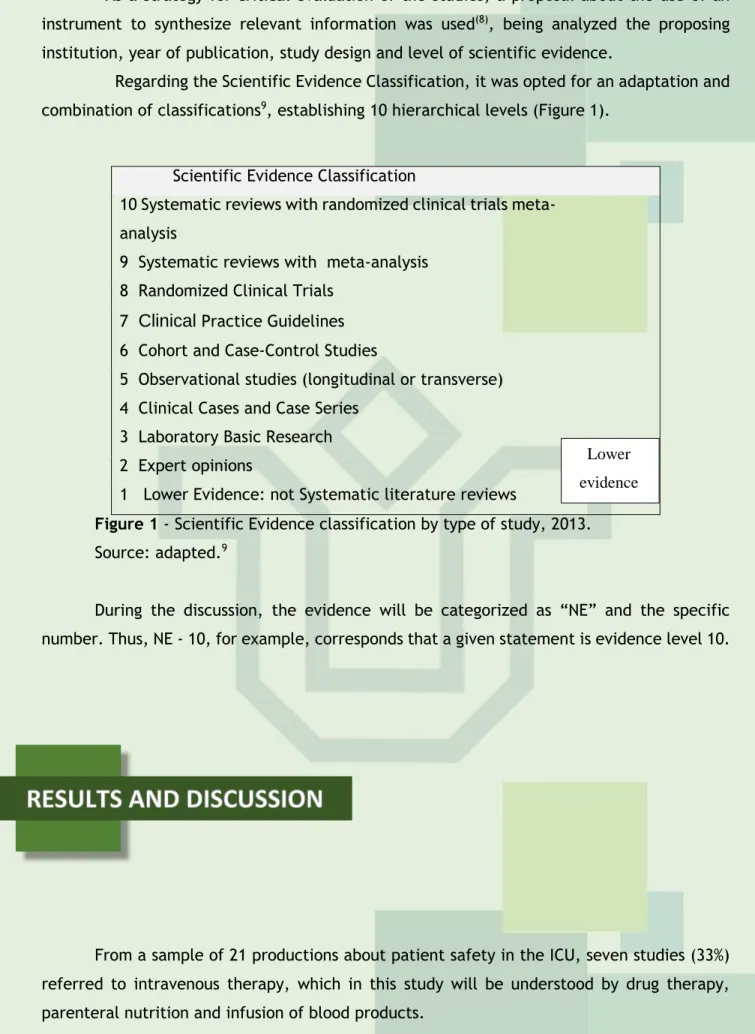
As a strategy for critical evaluation of the studies, a proposal about the use of an instrument to synthesize relevant information was used(8), being analyzed the proposing institution, year of publication, study design and level of scientific evidence.Regarding the Scientific Evidence Classification, it was opted for an adaptation and combination of classifications9, establishing 10 hierarchical levels (Figure 1).
Figure 1 - Scientific Evidence classification by type of study, 2013.
Source: adapted.9
During the discussion, the evidence will be categorized as “NE” and the specific number. Thus, NE - 10, for example, corresponds that a given statement is evidence level 10.
From a sample of 21 productions about patient safety in the ICU, seven studies (33%) referred to intravenous therapy, which in this study will be understood by drug therapy, parenteral nutrition and infusion of blood products.
For the indicator year of collection, there is a greater number of publications in 2010 (48%; n=3), a reality that can be explained by the increase in disclosure, the media, the AE in Brazilian health institutions, especially in the public service.
With regard to studies entities, there is the Ministry of Health with two productions in the covered area of expertise, representing the figure of 29% of the studies. Table 2 summarizes these findings.
Scientific Evidence Classification
10 Systematic reviews with randomized clinical trials meta-analysis
9 Systematic reviews with meta-analysis 8 Randomized Clinical Trials
7
Clinical
Practice Guidelines6 Cohort and Case-Control Studies
5 Observational studies (longitudinal or transverse) 4 Clinical Cases and Case Series
3 Laboratory Basic Research 2 Expert opinions
1 Lower Evidence: not Systematic literature reviews
Lower evidence científica
J. res.: fundam. care. online 2016. jan./mar. 8(1):3714-3724
3718
Nº Author Year of
publicatio n
Type of study Proposing Institution
1 Melo, 200710 2010 Masters
dissertation Janeiro State University of Rio de 2 O’Grady NP et al,
2011 11 2011 Guidelines Control Health care Infection Practices Advisory Committee (HICPAC)
3 Brasil, 20135 2013 Protocols Ministry of Health
4 Brasil, 200812 2008 Guides Ministry of Health
5 Conselho
Regional de Enfermagem de São Paulo, 201013
2010 Booklet São Paulo Regional
Nursing Council 6 Centre for Health
Protection, 201014
2010 Recommend
ations Protection Centre for Health 7 Lobão, 201215 2012 Dissertation Federal University of
Bahia
Table 1 - Summary of the results, according to author research indicators, year of
publication, type of study and proposing institution, in 2013.
To categorize the levels of evidence, the productions as protocols, guidelines and guides as elements of “Practice Guidelines” were considered. Thus, there are (Figure 1):
Figure 2 - Levels of evidence regarding patient safety in intravenous therapy in the
intensive care unit, in 2013.
It is observed that the sample did not include the best evidence levels, with 58% (n=4) in the base of the pyramid. Levels 1 and 2 are respectively 29% (n=2) of productions. This assumption can be explained by the fact that the nursing studies specifically related to patient safety in the ICU, demanding knowledge to the biological, social, philosophical,
J. res.: fundam. care. online 2016. jan./mar. 8(1):3714-3724
3719
political and religious dimensions of human beings, which can be asked by non-experimental research.16Scientific evidence about intravenous therapy in the Intensive Care Unit
Scientific evidence found had structural, materials and professional practice in prescription stages, dispensing, preparation and administration of medicines, which together ensure the PS against the drug therapy in the ICU.
When it comes to structural aspects, the small spaces increase the chance of AE, since it does not allow the practice of rechecking during the preparation, leaving the professional conducive to frequent interruptions. Another aspect that influences the technical execution are noises from ICU area, due to alarms, infusion pumps, phones and team members’ conversations (NE-1).10
The dispensation of drugs should take place through unit dose and individual packages containing the full labels. This aspect restricts the packaging of medicinal products in the sector, but also its manipulation(NE-1).10 Complementing this time, the practice of double checking by the pharmacy and nursing staff is essential, when receiving the prescribed doses, especially, when dealing with potentially dangerous and high surveillance drugs (NS-7).5
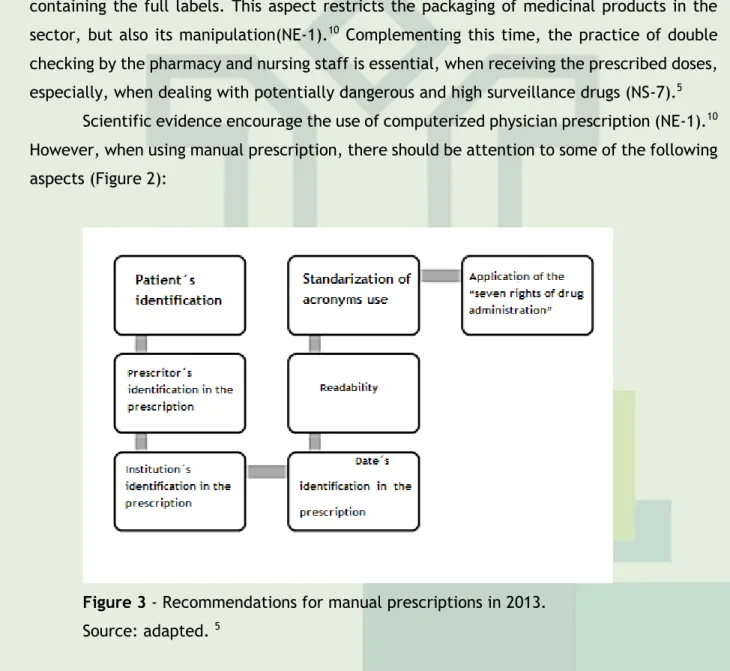
Scientific evidence encourage the use of computerized physician prescription (NE-1).10 However, when using manual prescription, there should be attention to some of the following aspects (Figure 2):
Figure 3 - Recommendations for manual prescriptions in 2013.
Source: adapted. 5
Regarding to the identification of the patient, the presence of the full name, medical record number or record of care, bed, ward/apartment and floor/wing are essential. The prescriber must provide a legible form, his/her full name, professional registration number and signature. This registration can be done in two ways: in manuscript or using stamp. Other relevant aspects are the identification, complete health facility, the presence of date in the
J. res.: fundam. care. online 2016. jan./mar. 8(1):3714-3724
3720
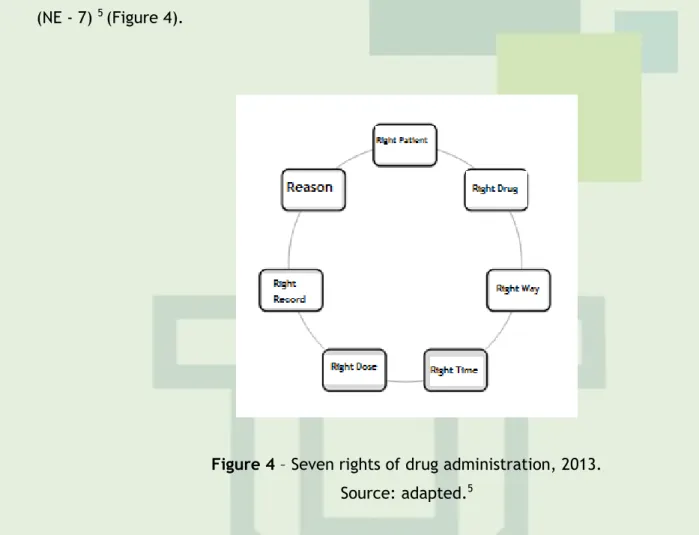
prescription being written in legible letters and without abbreviations. The use of acronyms is encouraged only when the service prepares, formalizes and publishes a list for all professionals (NE-7).5As the stages of preparation and administration of medicines, it is suggested a new definition of “five rights of drug administration” rectifying for the “seven rights of drug administration”, including the right record and the reason, which is the indication of the drug (NE - 7) 5 (Figure 4).
Figure 4 – Seven rights of drug administration, 2013.
Source: adapted.5
For intravenous therapy, the step of “right way”, it is recommended to peripheral venous puncture, in adult upper limbs. The priority is the disinfection with 70% alcohol and the insert with the “non-touch” technic (without touch). It should be highlighted the importance of hand washing before and after the procedure, and the use of gloves as directed by the Ministry of Health, through hand-washing protocol (NE-7.1).10,17,18,14
Added to this, it is necessary to care after the puncture, aiming to check for problems resulting from the procedure. Thus, it should develop inspection and palpation daily on the catheter insertion site. It must be maintained for periods of 72 or 96 hours. In the case of hard reach to some individuals, it can extend this period since monitoring is carried out continuously (NE-7, 1).10,14,17,19
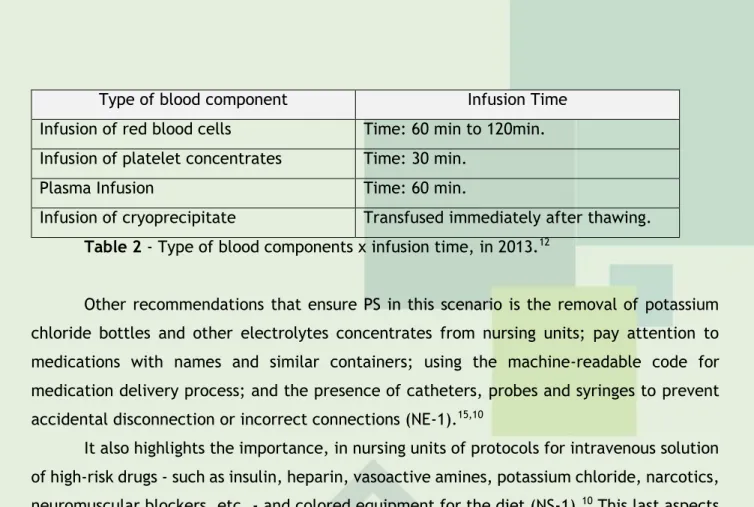
With respect to parenteral nutrition, the evidence points to the infusion of lipid emulsions over up to 24 hours (NE-2).14 In the infusion of blood products, which must be maintained for a maximum of 30 minutes at room temperature before starting the procedure, it must occur at a sole way with predetermined time (Table 3). The catheter patency and absence of complications at insertion site should be noted. In addition, it is recommended that the measurement of vital signs before and after saline cleaning of the catheter procedure is essential (NS-2).13
J. res.: fundam. care. online 2016. jan./mar. 8(1):3714-3724
3721
Type of blood component Infusion Time
Infusion of red blood cells Time: 60 min to 120min. Infusion of platelet concentrates Time: 30 min.
Plasma Infusion Time: 60 min.
Infusion of cryoprecipitate Transfused immediately after thawing.
Table 2 - Type of blood components x infusion time, in 2013.12
Other recommendations that ensure PS in this scenario is the removal of potassium chloride bottles and other electrolytes concentrates from nursing units; pay attention to medications with names and similar containers; using the machine-readable code for medication delivery process; and the presence of catheters, probes and syringes to prevent accidental disconnection or incorrect connections (NE-1).15,10
It also highlights the importance, in nursing units of protocols for intravenous solution of high-risk drugs - such as insulin, heparin, vasoactive amines, potassium chloride, narcotics, neuromuscular blockers, etc. - and colored equipment for the diet (NS-1).10 This last aspects of AE prevent due to diet parenteral routes, particularly in the ICU, where individuals hospitalized use several drugs by infusion pump in order hemodynamically stabilize them, and therefore the existence of various equipment create a favorable situation for such events.
Professional training on prescribing, dispensing, administration and monitoring, besides involving them, educational practices should include the patients, especially for the safe use of medication during hospitalization (NE-1.7).10,11
For AE monitoring related to intravenous therapy and improvement of professional performance, it is essential to notice the incidence of these events (NE-7).11 The implementation of this aspect will only occur after brought a new understanding of patient safety beyond absence of errors and these elements are not inherent in the human condition, appropriate to punishment (NE-1).15 The demystification of that approach enables to see the error as a teaching source and not as individual failure. This is a fundamental step towards PS.19
J. res.: fundam. care. online 2016. jan./mar. 8(1):3714-3724
3722
On this research, it was observed that studies about patient safety in intravenous therapy in ICU have low levels of evidence, and therefore do not present strong level of recommendation.The research indicated adequate physical structure, materials and proper professional performance during the prescription stages, dispensing, preparation and administration of medications as the main aspects of patient safety in ICUs.
It is believed that for establishing and maintaining patient safety in intravenous therapy in ICU, it is necessary greater investment in research with higher levels of evidence, since they provide higher recommendation for practice. On the other hand, it is worth highlighting the importance of professional training for acting as the recommended practices so that they become able to act properly before the recommendations and so favoring the PS.
Finally, it is emphasized the limitation of this study regarding the search strategy, which resulted in a quantitative small studies on this topic. In view of this, it is recommended to carry out further research to corroborate the findings of this study and integrate knowledge about patient safety in intravenous therapy in ICU.
J. res.: fundam. care. online 2016. jan./mar. 8(1):3714-3724
3723
1. Raduenz AC, Hoffmann P, Radunz V, Sasso GTMD, Maliska ICA, Marck PB. Cuidados de enfermagem e segurança do paciente: visualizando a organização, acondicionamento e distribuição de medicamentos com método de pesquisa fotográfica. Rev latinoam enferm. 2010; 18(6):10 telas.2. Gonçalves LA, Andolhe R, Oliveira EM, Barbosa RL, Faro ACM, Gallotti RMD et al. Alocação da equipe de enfermagem e ocorrência de eventos adversos/incidentes em unidade de terapia intensiva. Rev Esc Enferm USP. 2012; 46(spe): 71-7.
3. Mendes W, Martins M, Rozenfeld S, Travassos C. The assessment of adverse events in hospitals in Brazil. Int J Qual Health Care. 2009; 21(4):279-84.
4.De Vries EN, Ramrattan MA, Smorenburg SM, Gouma DJ, Boermeester MA. The incidence and nature of in-hospital adverse events: a systematic review. Qual Saf Health Care. 2008;17(3):216-23.
5. Ministério da Saúde (BR). Portaria GM, n.529, de 01/04/2013. Institui o Programa Nacional de Segurança do Paciente (PNSP) [Internet]. Brasília (DF): 2013 [cited 2013 ago 23]. Available from: http://bvsms.saude.gov.br/bvs/saudelegis/gm/2013/prt0529_01_04_2013.html.
6. Roque KE, Melo ECP. Avaliação dos eventos adversos a medicamentos no contexto hospitalar. Esc Anna Nery Rev Enferm. 2012; 16(1): 121-7.
7. Souza MT, Silva MD, Carvalho R. Revisão integrativa: o que é e como fazer. Einstein. 2010;8(1):102-6.
8. Mendes KDS, Silveira RCCP, Galvão CM. Revisão integrativa: método de pesquisa para a incorporação de evidências na saúde e na enfermagem. Texto & contexto enferm. 2008; 17(4): 758-64.
9. Cavalcanti YW, Freires IA, Carreiro Junior E, Gonçalves DT, Morais FR, Lira-Júnior R et al. Determinação do Nível de Evidência Científica de Artigos sobre Prótese Total Fixa Implanto-Suportada. Revista Brasileira de Ciências e saúde. 2011; 14(4): 45-50.
10. Melo ABR. Enfermagem e segurança na terapia medicamentosa em unidades intensivas [dissertação]. Rio de Janeiro (RJ): Faculdade de Enfermagem, Universidade do estado do Rio de Janeiro; 2007.
11. O’Grady NP, Alexander M, Burns LA, Dellinger EP, Garland J, Heard SO et al. Guideline for the prevention of intravascular catheter related infections [Internet]. 2011 [cited 2013 ago 23]. Available from: http://http://www.cdc.gov/hicpac/pdf/guidelines/bsi-guidelines-2011.pdf 12. Ministério da Saúde (BR). Secretaria de Atenção à Saúde. Departamento de Atenção Especializada. Guia para o uso de hemocomponentes. Brasília (DF); 2008.
13. Conselho Regional de Enfermagem de São Paulo. Rede Brasileira de Enfermagem e Segurança do Paciente. 10 passos para a segurança do paciente. São Paulo: COREN – SP; 2010.
14. Centre for Health Protection. Recommendations on Prevention of Intravascular Catheter Associated Bloodstream Infection [Internet]. Hong Kong: 2010 [cited 2013 ago 23]. Available from :
http://www.chp.gov.hk/files/pdf/recommendations_on_prevention_of_intravascular_catheter_ associated_bloodstream_infection_r.pdf
15. Lobão WM. Construção, validação e normatização da escala de predisposição à ocorrência de eventos adversos (EPEA) [dissertação]. Salvador (BA): Escola de Enfermagem, Universidade Federal da Bahia; 2012.
16. Giacchero KG, Miasso AI. A produção científica na graduação em enfermagem (1997 a 2004): análise crítica. Rev eletrônica enferm. 2006; 8(3): 9 telas.
J. res.: fundam. care. online 2016. jan./mar. 8(1):3714-3724
3724
17. Ministério da Saúde (BR), Agência Nacional de Vigilância Sanitária. Anexo 03: Protocolo de segurança na prescrição, uso e administração de medicamentos [Internet]. Brasília: 2013a [cited2013 ago 23]. Available from:
http://portal.saude.gov.br/portal/arquivos/pdf/seguran_medica.pdf
18. Ministério da Saúde (BR), Agência Nacional de Vigilância Sanitária. Anexo 01: Protocolo para a prática de higiene das mãos em serviços de saúde [Internet]. Brasília: 2013b [acesso em 2013
ago 23]. Disponível em:
http://portalsaude.saude.gov.br/portalsaude/arquivos/pdf/2013/Abr/04/CONSULTA_PUBLICA_ N6_1_DE_ABRIL_2013.pdf
19. Wegner W, Pedro ENR. A segurança do paciente nas circunstâncias de cuidado: prevenção de eventos adversos na hospitalização infantil. Rev latinoam enferm. 2012; 20(3): 8 telas.
Received on: 15/08/2014 Required for review: No Approved on: 17/09/2015 Published on: 07/01/2016
Contact of the corresponding author: Kisna Yasmin Andrade Alves Endereço: Escola de Saúde da Universidade Federal do Rio Grande do Norte. Avenida Senador Salgado Filho, s/n - Lagoa Nova, Natal - RN, Cep: 59078-970.