ABSTRACT: The objective of this research was to evaluate the changes of phenolics and antioxidant capacity of a ready-to-drink
green tea beverage during short storage at commercial
conditions. The total phenols (Folin-Ciocalteu), total catechins
(4-dimethylaminocinnamaldehyde) and total non-catechins
(difference between total phenols and total catechins) were
evaluated as part of phenolic analysis, while antioxidant capacity
was evaluated by using DPPH (2,2-diphenyl-1-picrylhydrazyl) radical.
At the beginning of the experiment, the levels of total phenols, total
catechins and total non-catechins were 1220.69 ± 29.73, 636.94 ± 14.60
and 584.75 ± 15.12 milligrams of catechin per liter of sample,
respectively; these values decreased to 674.38 ± 26.52, 424.54 ± 11.29
and 251.83 ± 37.81 milligrams of catechin per liter of sample,
respectively, after nine days of storage. The losses of phenolics at the
Changes in phenolics and antioxidant capacity during
short storage of ready-to-drink green tea (
Camellia
sinensis
) beverage at commercial conditions
Vania Urías-Orona1, Guillermo Niño-Medina2*
1.Universidad Autónoma de Nuevo León - Facultad de Salud Pública y Nutrición - Monterrey (Nuevo León) - México. 2.Universidad Autónoma de Nuevo León - Facultad de Agronomía - General Escobedo (Nuevo León) - México.
*Corresponding author: [email protected]
Received: Jan. 1, 2018 – Accepted: Mar. 26, 2018
final day of the experiment were 44.67% in total phenols, 33.40% in
total catechins and 56.93% in total non-catechins. The initial values
of the DPPH antioxidant capacity were 3116.43 ± 90.91 micromoles of
trolox equivalents per liter of sample and 66.09 ± 1.82 percentage
of radical scavenging. These values decreased to 1288.86 ± 70.71
micromoles of trolox equivalents per liter of sample and 31.90 ± 2.44
percentage of radical scavenging after nine days of storage,
which means a loss of 58.62% and 53.24%, respectively. The data
obtained in this work give information to the ready-to-drink green
tea consumers, manufacturers and food researchers about loss of
compounds with beneficial health effects during short storage of green
tea at commercial conditions.
Green tea, a product made up from Camellia sinensis, is the most consumed beverage in the world after water. The most important bioactive components of green tea are polyphenols, with the flavonoid compounds as the major group (Cabrera et al. 2006). Catechins are the main flavonoids, representing 80 to 90% of this phenolic group and approximately 40% of the water-soluble solids in green tea (Reygaert 2017). The characteristic catechins of green tea are (-)-epigallocatechin-3-gallate, (-)-epigallocatechin, (-)-epicatechin-3-gallate and (-)-epicatechin. The most widely recognized property of green tea polyphenols is antioxidant activity, arising from their ability toscavenge reactive oxygen species (Yang and Landau 2000).
Catechins epimerization is carried out in bottled green tea during the sterilization step of its manufacture process, producing the catechin epimers (-)-gallocatechin-3-gallate, (-)-gallocatechin, (-)-catechin-3-gallate and (-)-epicatechin, but heat-epimerized catechins show similar or greater antioxidant capacity than native green tea catechins (Sajilata et al. 2008). The consumption of green tea is equally divided between the hot and the ready-to-drink products in most of the Western countries, although this balance shifts drastically to an increased in consumption of ready-to-drink green tea during the spring and summer (Del Rio et al. 2010).
In Mexico, the ready-to-drink green tea products have grown in the last years and most of the large industries commercialize their products at room temperature after sterilization process. This study analyzed the changes of total phenols, total catechins, total non-catechins and DPPH antioxidant capacity of a ready-to-drink green tea beverage during nine days of storage at room temperature.
Bagged green tea product was purchased in a local supermarket. Green tea infusions were prepared by adding 200 mL of distilled water at 85 °C to a 1.4 g bag of green tea and allowed to brew for 15 min in stirring at 200 rpm. After that, samples were placed in 200 mL thread glass bottles, sealed with aluminum bottle caps and heat processed at 121 °C for 1 min. They were then quickly cooled 25 °C with iced bath and storage at room temperature (22 to 25 °C) during nine days with periods of 12 h of lights-on and 12 h of lights-off using 60 W white fluorescents ceiling lamps.
Ten mL of sample were diluted with 40 mL of distilled water. The pH was read in a Corning 440 pH Meter (Woburn, USA). After that, samples were titrated with 0.1 N NaOH to a pH 8.2 (citric acid as predominant) according to Association of Official Analytical Chemist methods (AOAC 1998). For
color determination, a 1.5 mL spectrophotometric cuvette was filled with tea sample and color was measured using a CR-20 Konica Minolta Color Reader (Osaka, Japan). Chromatic parameters were obtained using CIELAB (L*, a*, b*) color system. L* defines Lightness (0 = black, 100 = white), a* indicates red (positive a*) or green value (negative a*) and b* indicates yellow (positive b*) or blue value (negative b*) (CIE 2004). Color view was obtained by online software ColorHexa color converter using L*, a* and b* values (ColorHexa 2017).
Phenolics and antioxidant capacity assays were performed in a Barnstead International Turner SP-830 Plus spectrophotometer (Dubuque, United States). Previously to the evaluation samples were diluted 1:10 (v:v) with water. The total phenols content was evaluated by Folin-Ciocalteu reagent according to Chum and Kim (2004), while the total catechins were quantified by using 4-dimethylaminocinnamaldehyde reagent according to Heil et al. (2002). Results of total phenols and total catechins were expressed as milligrams of catechin per liter of sample (mgCatE·L–1) based on
calibrations curves established with catechin (0 to 200 mg·L–1).
Total non-catechins were obtained by subtraction between total phenols and total catechins. DPPH (2,2-diphenyl-1-picrylhydrazyl) antioxidant capacity was performed based on the reduction of the DPPH absorbance in the presence of sample, according to González-Aguilar et al. (2007). Results were expressed as micromoles of trolox equivalents per liter of sample (µmolTE·L–1) based on a calibration
curve established with trolox (0 to 500 µmolTE·L–1). The
percentage of radical scavenging (%RS) was also obtained using the next formula: %RS = (AC-AS)/AC) × 100, where AC = absorbance of control (initial absorbance of AC = 0.700) and AS = absorbance of sample.
The pH, titratable acidity, color parameters, phenolics and antioxidant capacity were evaluated in intervals of three days. All the results were expressed as mean values of three samples ± standard deviation. Statistical significance between samples was evaluated by analysis of variance followed by Tukey’s test using Minitab 14.0 statistical software (Minitab 2004). A level of probability of p < 0.05 (5%) was set as statistical significance.
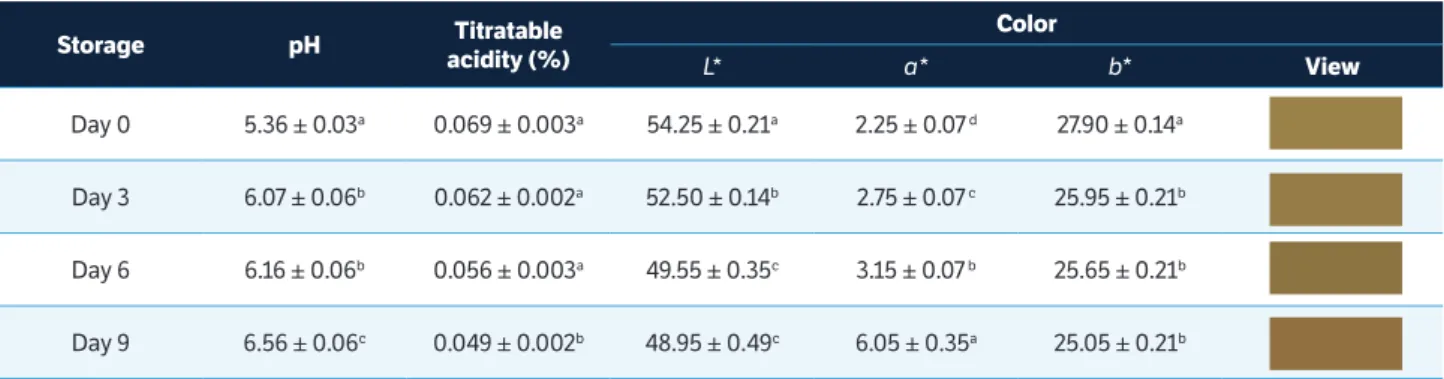
parameters, L* and b* decreased from 54.25 to 48.95 and from 27.90 to 25.05, respectively, while a* increased from 2.25 to 6.05, respectively, from day zero to day nine of storage.
There were significant differences (p < 0.05) in phenolics and antioxidant capacity evaluations during short storage experiment. At the beginning of the experiment, the levels of total phenols, total catechins and total non-catechins were 1220.69 ± 29.73, 636.94 ± 14.60 and 584.75 ± 15.12 mgCatE·L–1, respectively. These values
decreased to 674.38 ± 26.52, 424.54 ± 11.29 and 251.83 ± 37.81 mgCatE·L–1 in total phenols, total catechins
total non-catechins, respectively, after the nine days of storage. The loss of phenolics in terms of percentage at the final day of the experiment was 44.67% in total phenols, 33.40% in total catechins and 56.93% in total non-catechins (Fig. 1a). The total catechins values in terms of percentage in relation to the total phenols during storage were 52% at initial day, 50% at three and six days and 63% at the final day of the experiment. On the other hand, the initial values of the antioxidant capacity were 3116.43 ± 90.91 µmolTE·L–1
and 66.09 ± 1.82 %RS. These values decreased to 1288.86 ± 70.71 µmolTE·L–1 and 31.90 ± 2.44 %RS after
nine days of storage, which meant a loss of 58.62% and 53.24% in terms of µmolTE·L–1 and %RS, respectively (Fig. 1b).
Anaerobic degradation is the main factor in the loss of organic acids during storage of beverages and it is influenced by light, storage temperature and storage time (Randhawa et al. 2014). Succinic, ascorbic, citric and malic are the major organic acids in green tea (Ding et al. 1997), but also green tea contains considerable amounts phenolic acids (mainly gallic acid and its quinic ester theogallin) (Kosińska and Andlauer 2014). On the other hand, green tea catechins stability are pH dependent because of they are relatively stable at pH ≤ 4 and they are unstable at pH ≥ 5 (Chen et al. 2001).
Anaerobic degradation of the organic acids had an effect on the increasing levels pH and this has an effect on the decreasing levels of titratable acidity during storage. The increasing levels of pH during storage of green tea beverage has an effect on the degradation of green tea catechins in aqueous solutions due to they are unstable at pH ≥ 5 and therefore also the antioxidant capacity of green tea beverage is negative affected. In addition, the degradation of catechins leads to a non-enzymatic browning in the green tea beverage during storage and this has an effect on its visual aspect as is shown in Table 1.
Few studies have been carried out about the effect of storage on the phenolics and antioxidant capacity of green tea infusions. In this regard, Wang et al. (2000) conducted an experiment in which green tea beverages were prepared by steamed and roasted treatments of green tea leaves. The reduction values reported by these authors in total catechins after nine days of storage at 50 °C in green tea beverages prepared from steamed and roasted processing were 63.84% and 41.86%, respectively, which were higher losses than our results for the same period of storage.
On the other hand, Kopjar et al. (2009) reported a loss of the 10.38% in the total phenols content and the 4.07% in the DPPH antioxidant capacity after one week of storage at room temperature in water-soluble green tea extract. Although Nekvapil et al. (2012) used another method, they obtained findings similar to ours in the loss of the antioxidant capacity. They observed a decrease of 16% and 24% in the antioxidant capacity at four and seven days of storage at 22 °C, respectively, in a commercial green tea with aloe vera.
Other studies have evaluated the water hot extracts of green tea at different conditions. Komes et al. (2010) analyzed three commercial bagged green teas brewed at 80 °C for Table 1. pH, titratable acidity and color changes during short storage of ready -to-drink green tea beverage at room temperature (22 to 25 °C).
Storage pH Titratable
acidity (%)
Color
L* a* b* View
Day 0 5.36 ± 0.03a 0.069 ± 0.003a 54.25 ± 0.21a 2.25 ± 0.07 d 27.90 ± 0.14a
Day 3 6.07 ± 0.06b 0.062 ± 0.002a 52.50 ± 0.14b 2.75 ± 0.07 c 25.95 ± 0.21b
Day 6 6.16 ± 0.06b 0.056 ± 0.003a 49.55 ± 0.35c 3.15 ± 0.07 b 25.65 ± 0.21b
Day 9 6.56 ± 0.06c 0.049 ± 0.002b 48.95 ± 0.49c 6.05 ± 0.35a 25.05 ± 0.21b
3 min. Th ey found values ranging from 1400 to 2560 mg·L–1 in
total phenols and from 683 to 1073 mg·L–1 in total catechins
and around 5000 to 10500 µmolTE·L–1 in DPPH antioxidant
capacity, which is higher than our results at the initial day of the experiment.
Kodama et al. (2010) brewed six commercial bagged green teas at 97 °C for 5 min. Th ey found an average values of total phenols content ranging from 480 to 1005 mg·L–1
and DPPH antioxidant capacity ranging from 220000 to 650000 μmol·L–1. Th eir results in total phenols are lower
than our data but their antioxidant capacity levels are higher than our results.
Rodrigues et al. (2015) extracted phenolic from green tea brewing it at 80 °C for 7.5 min with stirring, obtaining 2896 mg·L–1 of total phenols and a radical scavenging of
58.57% of DPPH, which is higher to our content in total phenols but lower than our results in the DPPH radical scavenging at initial day of experiment.
In conclusion, the results of the present study showed that total phenols and total catechins content decreased 44.67% and 33.40%, respectively, aft er nine days of storage at commercial conditions. In addition, the antioxidant capacity decreased at levels of 58.62% and 53.24% in terms of micromoles of trolox equivalents and percentage of radical scavenging, respectively. Due to the worldwide high consume of ready-to-drink green tea beverages, the results of the present study are important because they inform consumers, manufacturers and food researches about the changes in their phenolic content during short storage.
ORCID IDs
V. Urías-Orona
https://orcid.org/0000-0003-0430-9438 G. Niño-Medina
https://orcid.org/0000-0003-3316-2316
Figure 1. (a) Total phenols, total catechins and total non-catechins changes during short storage of ready-to-drink green tea beverage at room temperature (22 to 25 °C). (b) DPPH antioxidant capacity and the percentage of radical scavenging (%RS) changes during short storage of ready-to-drink green tea beverage at room temperature (22 to 25 °C).
1400
Total Phenols Total Catechins Total Non-Catechins %RS
%RS
μmol TE·L-¹
μmol TE ·L
-¹
Phenolics (mgC
atE·L
-¹)
Day 0 Day 3 Day 6 Day 9 Day 0 Day 3 Day 6 Day 9
1120
840
560
280
0
3300
2640
1980
1320
660
100
80
a a
a a
b b
b ab b b
c
c
c c
c
d
d d
d
a
60
40
20
0 0
Diff erent lett ers within the same evaluation are signifi cantly diff erent (p < 0.05, n = 3).
[AOAC] Association of Offi cial Analytical Chemist International
(1998). Offi cial Methods of Analysis. 16th Ed., 4th Rev. Maryland:
AOAC International.
Cabrera, C., Artacho, R. and Giménez, R. (2006). Benefi cial eff ects
of green tea - a review. Journal of the American College of Nutrition,
25, 79-99. htt ps://doi.org/10.1080/07315724.2006.10719518
REFERENCES
Chen, Z.-Y., Zhu, Q. Y., Tsang, D. and Huang Y. (2001). Degradation
of green tea catechins in tea drinks. Journal of Agricultural and
Food Chemistry, 49, 477-482. htt ps://doi.org/10.1021/jf000877h
Chum, O. K. and Kim, D. O. (2004). Consideration on equivalent
chemicals in total phenolic assay of chlorogenic acid-rich plums.
Food Research International, 37, 337-342. htt ps://doi.org/10.1016/j.
foodres.2004.02.001
ColorHexa (2017) Color Encyclopedia: Information and Conversion
[Computer Software]. ColorHexa; [accessed 2017 July 31]. http://
www.colorhexa.com
[CIE] Commission Internationale De L’ecleirage (2004). 15 Technical
Report: Colorimetry. 3rd ed. Vienna: Commission Internationale
De L’ecleirage.
Del Rio, D., Calani, L., Scazzina, F., Jechiu, L., Cordero, C. and
Brighenti F. (2010). Bioavailability of catechins from ready-to-drink
tea. Nutrition, 26, 528-533. https://doi.org/10.1016/j.nut.2009.06.013
Ding, M.-Y., Chen, P.-R. and Luo, G.-A. (1997). Simultaneous
determination of organic acids and inorganic anions in tea by
ion chromatography. Journal of Chromatography A, 764, 341-345.
https://doi.org/10.1016/S0021-9673(96)00910-7
González-Aguilar, G. A., Villegas-Ochoa, M. A.,
Martínez-Téllez, M. A., Gardea, A. A. and Ayala-Zavala, J. F. (2007).
Improving antioxidant capacity of fresh-cut mangoes treated
with UV-C. Journal of Food Science, 72, S197-S202. https://doi.
org/10.1111/j.1750-3841.2007.00295.x
Heil, M., Baumann, B., Andary, C., Linsenmair, K. E. and McKey,
D. (2002). Extraction and quantification of “condensed tannins”
as a measure of plant anti-herbivore defence? Revisiting an old
problem. Naturwissenschaften, 89, 519-524. https://doi.org/10.1007/
s00114-002-0366-3
Kodama, D. H., Gonçalves, A. E. S. S., Lajolo, F. M. and Genovese
M. I. (2010). Flavonoids, total phenolics and antioxidant capacity:
comparison between commercial green tea preparations. Food
Science and Technology, 30, 1077-1082. https://doi.org/10.1590/
S0101-20612010000400037
Komes, D., Horžić, D., Belščak, A., Ganić, K. K. and Vulić, I. (2010).
Green tea preparation and its influence on the content of bioactive
compounds. Food Research International, 43, 167-176. https://doi.
org/10.1016/j.foodres.2009.09.022
Kopjar, M., Piližota, V., Hribar, J. and Simčič, M. (2009). Total phenol
content and antioxidant activity of water solutions of plant extracts.
Croatian Journal of Food Science Technology, 1, 1-7.
Kosińska, A. and Andlauer, W. (2014). Chapter 12 – Antioxidant
capacity of tea: effect of processing and storage. In V. Preedy
(Ed.), Processing and Impact on Antioxidants in Beverages
(p. 109-120). Amsterdam: Elsevier. https://doi.org/10.1016/
B978-0-12-404738-9.00012-X
Minitab (2004). Minitab 14.0 statistical software [Computer software].
State College: Minitab Inc.
Nekvapil, T., Kopriva, V., Boudny, V., Hostovsky, M., Dvorak, P. and
Malota, L. (2012). Decrease in the antioxidant capacity in beverages
containing tea extracts during storage. The Scientific World Journal.
Volume 2012, 361698. https://doi.org/10.1100/2012/361698
Randhawa, M. A., Rashid, A., Saeed, M., Javed, M. S., Khan, A.
A. and Sajid, M. W. (2014). Characterization of organic acids in
juices of some Pakistani citrus species and their retention during
refrigerated storage. The Journal of Animal and Plant Sciences,
24, 211-215.
Reygaert, W. C. (2017). An update on the health benefits of green
tea. Beverages, 3, 6. https://doi.org/10.3390/beverages3010006
Rodrigues, C. V., Silva M. V., Santos A. R., Zielinski A. A. F. and
Haminiuk C. W. I. (2015). Evaluation of hot and cold extraction of
bioactive compounds in teas. International Journal of Food Science
and Technology, 50, 2038-2045. https://doi.org/10.1111/ijfs.12858
Sajilata, M. G., Bajaj, P. R. and Singhal, R. S. (2008). Tea polyphenols
as nutraceuticals. Comprehensive Reviews in Food Science and Food
Safety, 7, 229-254. https://doi.org/10.1111/j.1541-4337.2008.00043.x
Wang, L. F., Kim, D. M. and Lee, C. Y. (2000). Effects of heat
processing and storage on flavanols and sensory qualities of
green tea beverage. Journal of Agricultural and Food Chemistry,
48, 4227-4232. https://doi.org/10.1021/jf0003597
Yang, C. S. and Landau, J. M. (2000). Effects of tea consumption on
nutrition and health. Journal of Nutrition, 130, 2409-2412. https://