Licenciada em Ciências de Engenharia do Ambiente
Cátia Joana Costa Magro
Electrodialytic remediation of two types of air pollution control
residues and their applicability in construction materials
Dissertação para obtenção do Grau de Mestre em Engenharia do Ambiente
Perfil de Engenharia de Sistemas Ambientais
Orientador: Professora Doutora Alexandra de Jesus Branco
Ribeiro, CENSE, DCEA, FCT-UNL
Co-orientador: Professora Doutora Lisbeth Ottosen,
Universidade Técnica da Dinamarca
Júri:
Presidente: Professora Doutora Maria Júlia Fonseca de Seixas Arguente: Professora Doutora Célia Maria Dias Ferreira
Vogais: Professora Doutora Alexandra de Jesus Branco Ribeiro Mestre Paula Alexandra Rodrigues e Araújo Guedes
Orientador: Professora Doutora Alexandra de Jesus Branco
Ribeiro, CENSE, DCEA, FCT-UNL
Co-orientador: Professora Doutora Lisbeth Ottosen, Universidade
Técnica da Dinamarca
Júri:
Presidente: Professora Doutora Maria Júlia Fonseca de Seixas
Arguente: Professora Doutora Célia Maria Dias Ferreira
Vogais: Professora Doutora Alexandra de Jesus Branco Ribeiro
Mestre Paula Alexandra Rodrigues e Araújo Guedes
Março 2014
Electrodialytic remediation of two types of air pollution control
residues and their applicability in construction materials
Dissertação para obtenção do Grau de Mestre em Engenharia do Ambiente
Perfil de Engenharia de Sistemas Ambientais
Cátia Joana Costa Magro
Electrodialytic remediation of two types of air pollution control
residues and their applicability in construction materials
Copyright © Cátia Joana Costa Magro, Faculdade de Ciências e Tecnologia, Universidade Nova de Lisboa.
A Faculdade de Ciências e Tecnologia e a Universidade Nova de Lisboa têm o direito, perpétuo e sem limites geográficos, de arquivar e publicar esta dissertação através de exemplares
iii
Acknowledgements
I could not forget to thank the ones that made this work possible. My gratitude is for you all.
My supervisor Professor Alexandra Ribeiro from Faculdade de Ciências e Tecnologia - Universidade Nova de Lisboa (FCT-UNL), that over 5 years, was always an example of character, rigor and hard work. The opportunity that provided me with this project, has changed some aspects of my life. Thank you for the advices, guidance and sincerity in the several steps of this thesis. It was a pleasure working with you. I would like to thank my co-supervisor, Professor Lisbeth Ottosen from Civil Engineering Department - Technical University of Denmark (BYG-DTU) for her infinite patience with my questions and for always believing in my skills, for the constant smile and an open door always for me. A very special thanks goes to Ph.D. Gunvor Kirkelund who gave me the project and my beautiful ashes, for helping me in so many doubts, for teaching me not to give up when adversity comes and for the strength in seminars.
This work would have never been possible without the collaboration of FCT-UNL with BYG-DTU. My four months staying at BYG-DTU was only possible due to an ERASMUS Student Placement Mobility, and already ongoing research projects: ELECTROACROSS - Electrokinetics across disciplines and continents: an integrated approach to finding new strategies for sustainable development (FP7-PEOPLE-2010-IRSES-269289) and PTDC/ECM/111860/2009 - Electrokinetic treatment of sewage sludge and membrane concentrate: phosphorus recovery and dewatering, that Professor Alexandra Ribeiro coordinates and Professor Lisbeth Ottosen participates.
A big thanks goes for these two institutions who have watched me growing up and that made me who I am today. In Departamento de Ciências e Engenharia do Ambiente (DCEA) of FCT-UNL, a huge thank goes for to Dr. Paula Guedes who gave me so many hours of advices, corrections and encouragement. Thanks for the precious help, caring and unquestionable kindness. I would also like to thank Ph.D. Nazaré Couto for statistical explanations, Professor Graça Martinho from DCEA, FCT-UNL and Ph.D. Célia Ferreira of CERNAS - ESAC for the help in legislation. At BYG - DTU a special thank goes to Ph.D. Pernille Jensen, for her explanations and fast answers. At the group of Electrochemistry, thank you for making me always fell at home and for the very helpful discussions on electrodialysis. A thank to Ebba C. Schnell, for guidance in the laboratory and Sabrina Madsen for dealing with my analysis so carefully. A sweet and special thanks to Louise Gammeltoft, dear friend, confidant and lab technician, who helped me during the difficult times in the lab, and taught me so much.
I would also like to thank Helena Gomes, an example to follow. Thanks for the tips, for calming me down, for the walks, friendship and companionship. A special thanks to my forever friend and sister Cláudia Silva, for teaching me so much, for always believing in me and for being my biggest supporter. Hours and hours that we spent on this journey, I think we did accomplish it.
Thanks to migos Rita, Sílvia, Sofia, Vanessa, Joana and Francisco. José, a special thanks, for being the first in the reviews, and for your availability, sweet at all times. Gaspar my dear friend, thanks for caring me, even in my constant absence. Thank you Rosemary, Ioannis, Kos and Saravana, for welcoming me with a big smile during my 4 months in Denmark. My stay was great because of you. You were and are my Danish family, always.
A special thank goes for my family, daddy, mummy, grandparents, uncles and cousin, for putting up with my bad mood, and for always believing in me. And, finally, thank you João, for your constant surprise with my work and for your enthusiasm and pride.
v
Sumário
Os resíduos de controlo de poluição do ar (CPA) provenientes da incineração de resíduos sólidos urbanos são classificados como resíduos perigosos. No entanto, os mesmos podem conter potenciais recursos. Tendo em conta os diferentes sistemas de limpeza de gases de combustão utilizados (húmido ou semi-seco), os resíduos apresentam características químicas e físicas diversas, que por sua vez irão influenciar o sucesso da remediação e a sua possível reutilização. O processo electrodialítico (ED) foi aplicado a dois tipos de resíduos de CPA visando a sua possível remediação. Foram estudadas as características iniciais destas duas cinzas e aplicadas diferentes condições experimentais (célula electrodialítica de 2 e 3 compartimentos, 5 ou 50 mA de corrente elétrica e 3, 7 e 14 dias de tratamento). Os resultados obtidos mostram que a remediação neste tipo de resíduos é bastante difícil, mas que a utilização de uma corrente contínua de baixa intensidade promove a imobilização de metais pesados presentes nos resíduos. A lixiviação do Pb, no resíduo do sistema húmido foi anulada, em algumas das esperiências, enquanto que as restantes apresentaram valores abaixo da legislação dinamarquesa, com algumas exceções. Este resultado foi bastante distinto dos resultados obtidos em estudos anteriores. Apesar da dificuldade em remover os metais pesados estudados, as melhores eficiências de remoção foram obtidas após 14 dias: 84% de Cd, 67% de Pb, 67% de Zn, 30% de Cu e 21% de Cr. Após a remediação das cinzas, foi estudado a sua possível reutilização em materiais de construção, nomeadamente em barras de argamassa. Assim, 5% de Cimento Portland Comum foi substituído por resíduos de CPA com e sem pré-tratamento. A qualidade do material produzido foi avaliado tendo em conta os seguintes parâmetros: porosidade, densidade, resistência mecânica, lixiviação de metais pesados e quantidade de cloretos. Os resultados obtidos permitem concluir que, para o sistema húmido, promover um pré-tratamento antes da reutilização em materiais de construção parece ser a melhor opção, já que os valores de metais ficam menos lixiviáveis e os testes de resistência mecânica são comparáveis ao material sem incorporação de cinzas. Todavia, para o sistema de limpeza semi-seca, um pré-tratamento parece piorar os resultados de remediação, sendo portanto, uma opcção fazer a incorporação do resíduo em bruto. Em conclusão, os resultados deste estudo sugerem possibilidade de reutilização de resíduos CPA, o que apresenta grandes vantagens na gestão de resíduos, bem como na conservação.
vii
Abstract
Air pollution control (APC) residues from municipal solid waste incineration are classified as hazardous waste and disposed of, although it contains potential resources. Due to the different fuel gas cleaning system designs (wet or semi-dry), the APC residues present distinct chemical and physical characteristics that influence the remediation success and their possible reuse. Electrodialytic (ED) process was applied to two types of APC residues aiming their remediation. The characteristics of raw residues and upgraded APC and a broad range of ED experimental conditions were studied (ED cell with – 3 and 2 compartments; 5 or 50 mA of direct current; 3, 7 and 14 days of remediation time). Obtained results showed that remediation was very difficult but the use of low level direct current promoted the immobilization of the heavy metals. The leaching behaviour, for instance, of Pb was avoided in wet system, while the remaining values were kept below the Danish regulation thresholds, with a few exceptions. Still, after 14 days of ED process the best removal rates achieved were: 84% of Cd, 67% of Pb, 67% of Zn, 30% of Cu and 21% of Cr. Thus, 5% of Ordinary Portland Cement was replaced by APC residues in mortars, with or without ED pre-treatment. Porosity, density, compressive strength, heavy metals leaching and chloride were tested. After analysing the parameters, it is possible to say that for the wet gas cleaning systems use a pre-treatment before the reuse in building materials is the best option, since the values for heavy metals leaching tests decrease after, and compressive strength are comparable to material without residue. However, for semi-dry cleaning gas systems, the heavy metals leaching after pre-treatment appears to increase, so for this type of APC it is thus possible to aggregation only of the raw residue. The results of this study suggest new possibilities for this APC waste reuse, presenting great advantages in the waste management system as well as for resource conservation.
ix
Abstrakt
Røggasrensningsaffald (RGA) fra affaldsforbrænding er klassificeret som farligt affald og deponeres,
selv om RGA indeholder potentielt brugbare ressourcer. Forskellige røggasresningssystemer (våd eller semi-tør proces) resulterer i RGA med for meget forskellige kemiske og fysiske karakteristika som har
betydning for eventuel behandlingsmetode og genbrug. Elektrodialytisk rensning (ED) ble brugt til at oprense de to forskellige typer RGA. Karakteristik af rå og elektrodialytisk renset RGA samt flere
elektrodialytiske rensningsforsøg (ED- celle med 3 eller 2 kamre; 5 eller 50 mA strømstyrke; 3,7 eller 14 dags rensningstid) blev udført. Resultaterne fra de elektrodialytiske rensningsforsøg viste at
oprensningsgraden var lav, men at strømmen kunne bruges til at immobilisere tungmetaller i RGA. Udvaskningsforsøg viste at for våd RGA, var Pb udvaskning meget lav og for de fleste andre tungmetaller blev de danske grænseværdier overholdt. Den højeste oprensning blev opnået efter 14
dages rensning hvor 84% af Cd, 67% af Pb, 67% af Zn, 30% af Cu og 21% af Cr blev fjernet. Derefter blev 5 % af Portland cement erstattet af enten rå eller elektrodialytisk renset RGA til brug i mørtelprøver.
Porøsitet, densitet, trykstyrke og tungmetal og klorid udvaskning blev testet på mørtelprøverne. For våd RGA, er det en fordel med elektrodialytisk rensning i forhold til erstatning i mørtel, da
tungmetaludvaskningen minimeres samt at trykstyrken for mørtel er sammenlignelig med referenceprøver uden RGA. Modsat, for semi-tør RGA bliver udvaskningen af tungmetaller højere af
elektrodialytisk rensning, på denne baggrund vil rå semi-tør RGA være mere fordelagtig til mørtel. Resultaterne fra dette projekt åbner for nye muligheder for RGA genbrug, som vil kunne føre til store fordele i affaldshåndteringssystemer og ressourceforvaltning.
xi
Abbreviations and symbols
2C - Two compartments 3C - Three compartments 3D - Three days
7D - Seven days 14D - Fourteen days
AN - Anion-exchange membrane APC - Air pollution control
CAT - Cation-exchange membrane DC - Direct current
DK - Denmark ED - Electrodialytic
EDR - Electrodialytic remediation FA - Fly ash
IC - Ion chromatography
ICP-OES - Inductively coupled plasma – optical emission spectroscopy L/S - Liquid-to-solid
LOI - Loss on ignition MSW - Municipal solid waste
MSWI - Municipal solid waste incineration PAH - Polycyclic aromatic hydrocarbon PCB - Polychlorinated biphenyl
PT - Portugal
REFA – I/S REFA, Waste-to-energy incineration plant S/S - Solidification/stabilization
xiii
Table of contents
Acknowledgements ... iii
Sumário ... v
Abstract ... vii
Abstrakt ... ix
Abbreviations and symbols... xi
List of figures ... xv
List of tables ... xvii
1. Introduction ... 1
2. Literature review ... 3
2.1 Waste management in Europe ... 3
2.1.1 Incineration ... 4
2.1.2 Air pollution control residues ... 6
2.1.2.1 Possible applications ... 8
2.2 Heavy metals ... 9
2.3 Electrodialytic process – A remediation technique ... 15
2.3.1 Transports mechanisms ... 16
2.3.2 Electrodialytic treatment of FA and APC residues from MSWI ... 21
3. Material and methods ... 25
3.1 Air pollution control residues ... 26
3.2 Characterization methods ... 26
3.4 Mortar bars ... 29
4. Results and discussion ... 31
4.1 Air pollution control residues characteristics ... 31
4.2 Electrodialytic experiments ... 33
4.2.1 pH and conductivity ... 33
4.2.2 Removal and mobilization of heavy metals ... 37
4.2.3 Leaching behaviour ... 41
4.1.1 Removal of salts (Cl- and SO42-) ... 44
4.2 Mortar bars ... 45
4.2.1 SEM/EDS ... 45
4.2.2 Porosity and density and compressive tests ... 47
4.2.3 Leaching behaviour ... 49
4.2.4 Chloride ... 50
xv
List of figures
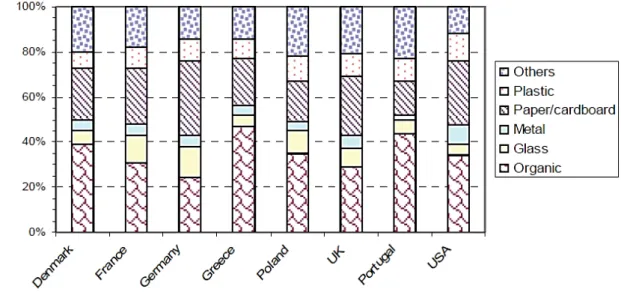
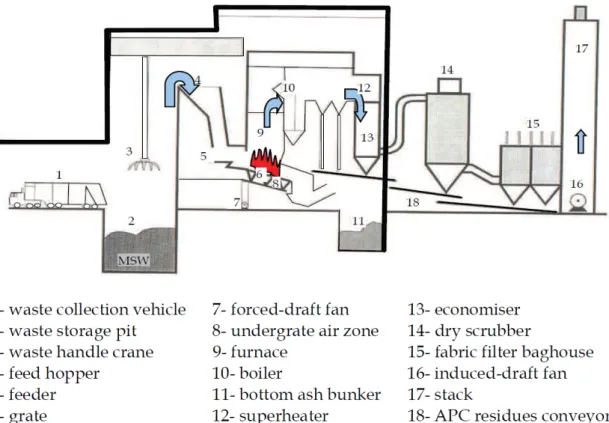
Figure 2.1. Composition of MSW (adapted from Gentil et al., 2009 in Quina et al., 2011) ... 3 Figure 2.2. Simplified scheme of a MSW incinerator (adapted from IAWG, 1997) ... 5
Figure 2.3. Schematic presentation of the EDR principle in an experiment cell (3 compartments). I – anode compartment; II – central compartment; III- cathode compartment (adapted from Nystrøm, 2001) ... 17
Figure 2.4. Sketch of an ion-exchange membrane (Hansen, 1995) ... 19
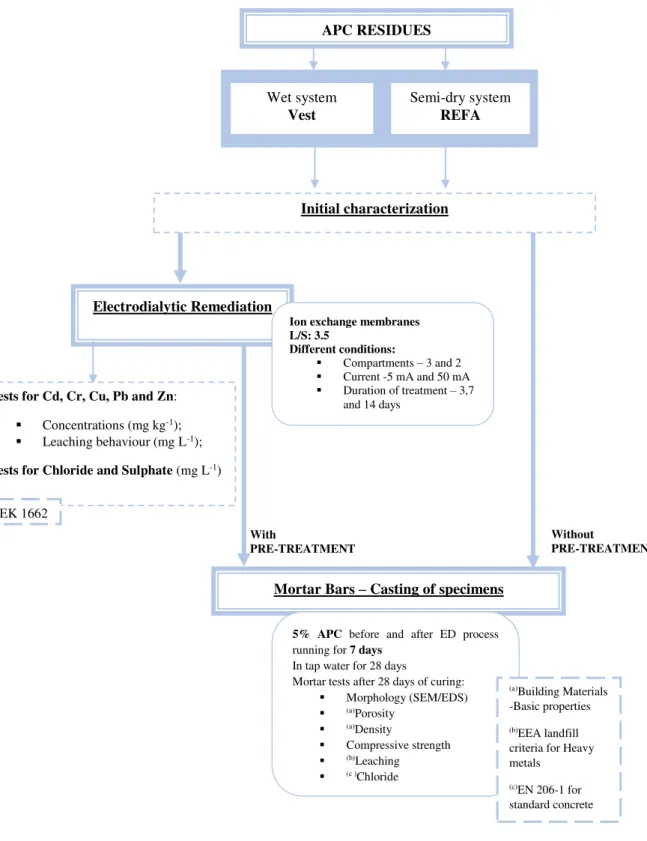
Figure 3.1. Scheme of initial characterization, ED experiments and casting of specimens ... 25
Figure 3.2. Schematic presentation the experimental ED cells. Both models developed at DTU, Denmark: (a) 3 compartment cell, (b) 2 compartment cell. (AN = anion exchange membrane, CAT = cation exchange membrane) ... 27
Figure 4.1. Appearance of the APC residues under study – (a) REFA and (b) Vest ... 31 Figure 4.2. pH of the two- and the three-compartment ED cell experiments for the duration of 3, 7 and 14 days and 5 mA and 50 mA for Vest; (xC –x number of compartments, C compartments; xD – x remediation time, D days; x mA- x intensity of DC) ... 34
Figure 4.3. pH of the two- and the three-compartment ED cell experiments for the duration of 3, 7 and 14 days and 5 mA and 50 mA for REFA; (xC –x number of compartments, C compartments; xD – x remediation time, D days; x mA- x intensity of DC) ... 34
Figure 4.4. Conductivity of the two- and the three-compartment ED cell experiments for the duration of 3, 7 and 14 days and 5 mA and 50 mA for Vest; (xC –x number of compartments, C compartments; xD – x remediation time, D days; x mA- x intensity of DC) ... 35 Figure 4.5. Conductivity of the two- and the three-compartment ED cell experiments for the duration of 3, 7 and 14 days and 5 mA and 50 mA for REFA; (xC –x number of compartments, C compartments; xD – x remediation time, D days; x mA- x intensity of DC) ... 35 Figure 4.6. Best removal rates (%) for Cd, Cr, Cu, Pb and Zn during the ED experiments: (a) Vest and (b) REFA ... 37
Figure 4.7. Cadmium distribution after the 24 ED experiments: (a) Vest and (b) REFA. (Cathode – electrode cathode, electrolyte(-) and cation-exchange-membrane; Anode – electrolyte(+) and anion-exchange membrane; M – middle compartment; (xC –x number of compartments, C compartments; xD – x remediation time, D days; x mA- x intensity of DC) ... 38
Figure 4.8. Chromium distribution after the 24 ED experiments: (a) Vest and (b) REFA. (Cathode – electrode cathode, electrolyte(-) and cation-exchange-membrane; Anode – electrolyte(+) and anion-exchange membrane; M – middle compartment; (xC –x number of compartments, C compartments; xD – x remediation time, D days; x mA- x intensity of DC) ... 38
xvi Figure 4.10. Lead distribution after the 24 ED experiments: (a) Vest and (b) REFA. (Cathode – electrode cathode, electrolyte(-) and cation-exchange-membrane; Anode – electrolyte(+) and anion-exchange membrane; M – middle compartment; (xC –x number of compartments, C compartments; xD – x remediation time, D days; x mA- x intensity of DC) ... 40
Figure 4.11. Zinc distribution after the 24 ED experiments: (a) Vest and (b) REFA. (Cathode – electrode cathode, electrolyte(-) and cation-exchange-membrane; Anode – electrolyte(+) and anion-exchange membrane; M – middle compartment; (xC –x number of compartments, C compartments; xD – x remediation time, D days; x mA- x intensity of DC) ... 40
Figure 4.12. Leaching concentrations (mg L-1) of heavy metals from Vest in the raw APC residues and after ED process: (a) Cd; (b) Cr; (c) Cu; (d) Pb and (e) Zn (The yy axis do not have the same scale); (xC –x number of compartments, C compartments; xD – x remediation time, D days; x mA- x intensity of DC) ... 42
Figure 4.13. Leaching concentrations (mg L-1) of heavy metals from REFA in the raw APC residues and after ED process: (a) Cd; (b) Cr; (c) Cu; (d) Pb and (e) Zn (The yy axis do not have the same scale); (xC –x number of compartments, C compartments; xD – x remediation time, D days; x mA- x intensity of DC) ... 43
Figure 4.14. Chloride concentration (mg L-1) in the raw APC residues and after 24 ED experiments: (a) Vest and (b) REFA; (xC –x number of compartments, C compartments; xD – x remediation time, D days; x mA- x intensity of DC) ... 44
Figure 4.15. Sulphate concentration (mg L-1) in the raw APC residues and after 24 ED experiments: (a) Vest and (b) REFA; (xC –x number of compartments, C compartments; xD – x remediation time, D days; x mA- x intensity of DC) ... 44
Figure 4.16. Images of SEM before ED treatment: (a) raw Vest and (b) raw REFA; After ED treatment (7 days of duration time): Vest - (c) 2C 5 mA, (e) 2C 50 mA, (g) 3C 5 mA, (i) 3C 50 mA and REFA - (d) 2C 5 mA, (f) 2C 50 mA, (h) 3C 5 mA, (j) 3C 50 mA; magnification: 1000x; (X) - glass particles, (Y) - polycrystalline particles; (xC –x number of compartments, C compartments; xD – x remediation time, D days; x mA- x intensity of DC) ... 45
xvii
List of tables
Table 2.1. Advantages and disadvantages of MSWI (Quina et al., 2011) ... 6
Table 2.2. Typical ranges of heavy metals and chloride in different residue components (Chandler et al., 1997) ... 7
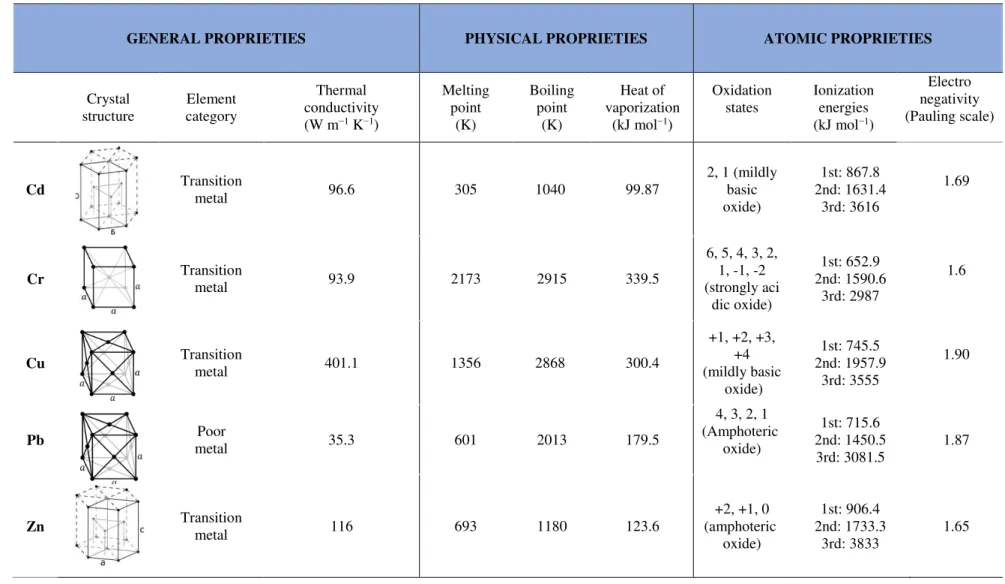
Table 2.3. Some chemical and physical characteristics of Cd, Cr, Cu, Pb and Zn (https://www.ncbi.nlm.nih.gov/pccompound/?term=Iron) ... 12
Table 2.4. Advantages and disadvantages of ED treatments (adapted from Gardner, 2005) ... 16
Table 2.5. Electrodialytic treatment of FA and APC residues from MSWI reported in literature (adapted from Ferreira, 2005) ... 22
Table 3.1. Experimental conditions for the different EDR experiments ... 28
Table 3.2. Experimental conditions of mortar bars-casting of specimens ... 29
Table 4.1. Characteristics of APC residues from Vest and REFA (mean values ± standard error) ... 32
Table 4.2. Recovery rates of Cd, Cr, Cu, Pb and Zn and final pH at the end of the ED experiments for Vest and REFA APC residues; (xC –x number of compartments, C compartments; xD – x remediation time, D days; x mA- x intensity of DC) ... 36
Table 4.3. Porosity and density of specimens: reference; substitution 5% of raw and upgraded APC residues from Vest and REFA as cement; (xC –x number of compartments, C compartments; xD – x remediation time, D days; x mA- x intensity of DC) ... 47
Table 4.4. EEA landfill criteria for heavy metals leachability; Experimental data obtained by prEN 12457-1 on mortar: reference; substitution 5% of raw APC residues and upgraded APC residues from Vest and REFA as cement; (xC –x number of compartments, C compartments; xD – x remediation time, D days; x mA- x intensity of DC) ... 50
1
1.
Introduction
Air Pollution Control (APC) residues are one of the waste products from flue gas cleaning in the incineration facilities. There are different APC residues, depending on the design of the plant. They are considered hazardous due to their contaminants content, namely heavy metals, salts and/or dioxins. Due to their hazardousness and instability, APC residues constitute an environmental problem and, consequently, stabilization prior disposal is required. In Portugal the APC residues are mixed with cement to its inertization, and disposed of in landfills, in Denmark these residues are not allowed to be landfilled due to the risk of groundwater contamination. They are exported to Germany or Norway, where they are either backfilled into mines (Germany) or deposited in an old calcite quarry at an Island in the Oslo Fiord – Langoya - after being mixed with sulphuric acid (Jensen, 2014). The methodology is dependent on the soil characteristics of each country.
Although APC residues are considered hazardous waste, they have features that can be further reused, if the contaminants are successfully removed they can be a valuable resource. For instance in the production of concrete. Nevertheless, the reuse of such a waste should always be in accordance to the precautionary principle and the uncertainty of the contaminants behaviour over time.
Objectives and research
Q1 - Is the Electrodialytic (ED) process an appropriate pre-treatment for APC residues?
Q2 - Can APC residues be incorporated in building materials, after ED process?
Within these main questions, there will be other targets such as, understand how two different gas cleaning systems influence the overall characteristics of the generated APC residues and how they affect heavy metals and salts removal. Electrodiatylic remediation (EDR) was applied to two types (wet and semi-dry system) of APC residues and different conditions were tested. Two EDR cells were used: one with three compartments and a recently patented cell with two compartments (Ottosen et al., 2014). After, the ED process, the ashes were submitted to a stabilization/solidification (S/S) technique. These APC residues were further studied and defined to be suitable and stable (porosity and density, compressive strengths, leaching behaviour and chloride content) for reuse in building materials. Legislation was used to verify if the residue were in conformity, both for leaching of heavy metals and for anions.
Dissertation structure
This work is organized in 8 chapters:
2 2. Literature review - description of the central theme and relevant terms and previous work
developed;
3. Materials and methods - description of materials used, characterization analysis, identification and data treatments methods;
4. Results and discussion- presentation of results, hypothesis formulation and their discussion; 5. Conclusions – main outcomes;
6. Future developments; 7. References;
3
2.
Literature review
2.1
Waste management in Europe
Municipal solid waste (MSW) remains a major problem in modern societies, despite the significant efforts to prevent, reduce, reuse and recycle it. Municipal solid waste normally contains a mixture of organic wastes, fabrics, paper, oil, rubber, plastics, metal, glass, and wood, among others. Figure 2.1 shows the composition of MSW in different countries. In this figure is evident the difference between different proportions of waste composition, showing that even if the technologies for management of waste are equal, the waste will differ from country to country.
Figure 2.1. Composition of MSW (Adapted from Gentil et al., 2009 in Quina et al., 2011)
In Europe-27 Stat Members, MWS production in 2012 was 492 kg year-1 per capita, with an annual decrease since 2003 (Eurostat, 2012). Although Portugal had a per capita production of 453 kg MWS in 2012, the production of MWS in some countries was much higher, as in Denmark or Switzerland: 668 kg year-1per capita and694 kg year -1per capita, respectively(Eurostat, 2012).
4 waste was incinerated, very near to the established value of 22% (Ministério do Ambiente, do Ordenamento do Território e do Desenvolvimento Regional, 2007). The Portuguese Government has decided to review the plan before the next Community Support Framework 2014-2020. As goals, PERSU 2020 provides increased uptake of recyclable waste through selective collection (Ministério do Ambiente, Ordenamento do Território e Energia, 2014). PERSU 2020 will distinct, for the first time, goals for the 23 systems of waste management in the country, by population density and socio-economic parameters of the region in which systems are inserted (Ministério do Ambiente, Ordenamento do Território e Energia, 2014).
Nowadays modern systems embrace different methodologies aiming as much as possible to achieve sustainable global solutions for waste management. Life Cycle Assessment tools have been used to assess the potential environmental burdens of different waste management strategies from the environmental, energetic and economic point of view (Quina et al., 2011). These calculations have shown that landfilling, even if gas is recovered and leachate is collected and treated, should be avoided, due to the fact that resources in the waste are inefficiently utilized (Sundqvist, 2005). Environmental sound alternatives include incineration, material recycling, anaerobic digestion or composting (Lima, 2008).
2.1.1
Incineration
According to Directive 2000/76/EC of the European Parliament and Council, incineration plants
correspond to any stationary or mobile technical unit dedicated to the thermal treatment ofwastes with or without recovery of the combustion heat generated. This includes the incineration by oxidation of waste as well as other thermal treatment processes such as pyrolysis or gasification in so far as the substances resulting from the treatment are subsequently incinerated. This description includes the site and the entire incineration plant counting:
Waste reception and handling (storage, on site pre-treatment facilities);
Combustion chamber (waste-fuel and air-supply systems);
Energy recovery (boiler, economiser, etc.);
Facilities for clean-up gaseous emissions, on-site facilities for treatment or storage of
residues and waste water, stack;
Devices and systems for controlling incineration operations, recording and monitoring;
Incineration conditions.
5
Figure 2.2. Simplified scheme of a MSW incinerator (adapted from IAWG, 1997)
It is important that the gases produced after energy recovery, mostly occur in the boiler (10), superheater (12) and economiser (13). The amount of gases produced during combustion contain air pollutants that are harmful for the environment and, consequently, must comply with the stringent regulatory limits (Quina et al., 2011). Thus, depending on the desired cleaning degree, different APC systems may be used. As an example, in Figure 2.2, a dry scrubber (14) and fabric filters (15) are used. In these units, APC residues are produced and further transported through a conveyor (18) for a silo (not represented). Most of the modern incinerators treat APC residues before disposal in monofills. Finally, by using an induced-draft fan (16), the cleaned flue gas is released by the stack. Concerning air pollution, it is important to note that combustion includes very fast reactions (fractions of seconds) that take place in the gas phase, and self-supporting combustion is possible if heat value of the waste and oxygen concentration are sufficient (Quina et al., 2011).
6 Municipal solid waste incineration (MSWI) in waste-to-energy can be considered an environmentally friendly solution and a common alternative to landfilling, while allowing to recover a large part of the energy contained in MSW (Lima, 2008). Besides several advantages, this process also presents some disadvantages that are reported in Table 2.1.
Table 2.1. Advantages and disadvantages of MSWI (Quina et al., 2011)
Advantages Disadvantages
Handle waste without pre-treatment Originates hazardous waste (APC residues), that require safe disposal
Reduce landfilling demand for MSW Originates slags (bottom ashes)
Reduce waste volume by 90% Originates huge volume of flue gases
Reduce waste weight by 70% High investment and operating costs
Possibility of recovering energy (electricity or heat)
High maintenance costs
If well managed, low air pollution is released Requires suitable composition for auto-combustion
Destroys potential pathogens and toxic organic contaminants
Negative public perception
Can be located close to the centre of gravity of MSW generation
Reduce cost of waste transportation
Require minimum land
Stack emissions are odour-free
Reduce organic materials mainly to CO2 instead CH4 and other volatile organic compound
2.1.2
Air pollution control residues
Municipal solid waste incineration is a highly efficient technique for waste management, as it significantly reduces the volume of waste (Quina et al., 2011). However, MSWI may cause environmental problems, mainly related to the disposal of the produced fly ash (FA) considered hazardous by CEN prEN 14899. There are different types of ash residues that result from cleaning emissions from MSW incinerators, and it is important to differentiate between FA and APC residues. Fly ash is the finer fraction of the particulate (< 200 µm) which is entrained in the flue gas and subsequently trapped in an electrostatic precipitator filter before any further treatment of the gaseous effluents. Fly ash can be recovered separately from the gas stream, or they can be incorporated into the APC residues (Zacco et al., 2014).
7 The composition of MSW varies over time and from country to country, due to the differences in lifestyle and waste recycling process seasons. Also, chemical and physical characteristics of the FA depend on the composition of the raw MSW, the operational conditions, the type of incinerator and APC system design (Zacco et al., 2014). As the APC residues that will be further on studied are respectively from an incinerator with a semi-dry system and another one with a wet system, is given an enlarged description (Astrup, 2008):
Semi-dry residue systems – Slaked lime is injected into the gas, either in dry form or as a slurry. This aims to neutralize acidic components in the flue gas, and is typically done before removing the FA from the flue gas. Fly ash, reaction products, and unreacted lime is typically removed in fabric filters. Activated coal may be injected for dioxin removal and removed together with the FA. Dry and semi-dry systems typically generate a single residue;
Wet residue systems – Fly ash is typically removed before neutralizing acidic components. After this, the flue gas is scrubber in one, two or multistage arrangement of scrubbers. The scrubber solutions are then treated to produce sludge and gypsum. Wet systems typically generate more than one residue.
These different methods will produce very distinct APC residues, and in order to select the most appropriate method of treatment or application for any residue, its main characteristics, and particularly chemical properties should be known. In some cases, some physical characteristics may also be very important. The major elements present in the APC residues are Si, Al, Fe, Ca, Mg, K, Na and Cl-. Regarding heavy metals, Cd, Cr, Cu, Hg, Ni, Pb and Zn are the most frequent, with Zn and Pb being generally found in the largest amounts (Quina et al., 2007). Table 2.2 presents typical rates of heavy metals and chloride in different residue components: FA, dry, semi-dry and wet processes.
Table 2.2. Typical ranges of heavy metals and chloride in different residue components (Chandler et al., 1997)
Content of APC (mg kg-1)
Elements FA Dry Semi-dry and wet
Cd 50 - 450 140 - 300 150 - 1400
Cr 140 - 1100 3 - 570 80 - 560
Cu 600 - 3200 16 - 1700 440 - 2400
8 Trace quantities of very toxic organic compounds are also usually present in these residues, namely polycyclic aromatic hydrocarbons (PAH), chlorobenzenes (CB), polychlorinated biphenyls (PCB) and polychlorinated dibenzo-p-dioxins (PCDD) and furans (PCDF) (Quina et al., 2007). Whenever the treatment, utilization or disposal of APC residues is considered, both Pb and Cl- are of particular concern due to their leaching behaviour. Consequently, the natural pH of these residues is usually very high (12-13 pH), which may constitute a problem for some applications. It should be noted that 12.5 is the pH value of a saturated solution of Ca(OH)2 (Quina et al., 2007).
Due to the high concentration of several heavy metals, the reuse of APC residues as a secondary material is forbidden in many countries, with the ever more stringent legislation. Therefore, taking into account the potential environmental impact of these residues, the main problems that have to be solved concern toxic heavy metals (e.g., Pb, Zn, Cd, Cr, Cu, Ni, Hg), the high concentration of soluble salts (e.g. NaCl, KCl, salts of Ca), and organic micropollutants (e.g., dioxins, furans) (Quina et al., 2007). Consequently, a technical remediation process is required before providing possible reuses to the APC residues. There are two alternative ways of handling APC residues: landfilling after adequate treatment or recycling as a secondary material after suitable inertisation
2.1.2.1 Possible applications
Appropriate treatments for APC residues, specifically regarding heavy metals, can be grouped into three classes (Zacco et al., 2014):
i. Separation processes, for instance, electrochemical process; ii. Solidification/stabilization process, for example cement based;
iii. Thermal methods, like microwave treatment.
A combination between separation processes and S/S processes will be further considered for this study. Electrodialytic method will be explained in section 2.3, the S/S processes are considered in the following paragraphs.
9 practice, the best approach to S/S technology involves initial chemical stabilization and then solidification of the waste. Inorganic materials, such as cements or pozzolanic materials are the most common binders (Quina et al., 2007). Solidification/stabilization methods consist of mixing the binders with the waste and water, and sometimes with chemical additives (e.g. sodium silicate or soluble phosphates). The quantities involved are optimized as a function of the performance required for the final product (leaching behaviour, compressive strength, setting time, etc.), which may be either solid massive (monolithic) or granular (Quina et al., 2007).
Van de Laar et al. (1994) show that with the exception of chlorides, the immobilization of most toxic elements is possible through S/S processes. According to Quina et al. (2007) the most dynamic research area is in the field of solidification with binders, using in particular Portland cement. In practice, at the industrial level in Europe, this is indeed the most important method for treatment of APC residues (Quina et al., 2007). Thus, to better understand the process, when water is added to cement a hydration reaction takes place. The hydration products crystallize and create a three-dimensional structure that binds together all the substances present into a hard mass. The reactions that occur are the basis for the S/S process, applied world-wide for the treatment of hazardous waste. The 3-dimensional structure formed, which comprises hydration products, water, small bubbles of air, and particles of sand or stone, can also include small particles (< 150 µm). Air pollution control residues particles have a small grain size and they could fill these spaces and become encapsulated inside the concrete matrix (Ferreira et al., 2003a).
When Portland cement or similar binders are employed, the product is monolithic and a significant increase in weight (almost double) and volume may occur, which affects shipping and landfill costs (Ferreira et al., 2003a). Environmental costs should also be considered as resources such as soil and raw materials are used. Another disadvantages of treatment with cement are related with low retention of salts, which may leach out in the short term, the possible release of heavy metals in the medium to long term, and finally the problem of the monolith formed at the landfill site that will hardly ever be used again (Ferreira et al., 2003a). The main advantages come from the fact that this technology is well established and low cost. According to Ferreira et al. (2003a) it is advisable to remove the salts before adding the binders, whenever possible.
2.2
Heavy metals
10 (Quina, 2005). In literature, there are many studies about the behaviour of metals in the combustion chamber incineration processes (Fernandez et al., 1992; Wey et al., 2001; Ferreira et al., 2003b). One way to reduce the amount of heavy metals in MSW is the selective separation, mainly of batteries, electronic components and plastics, which has been gaining importance particularly during last decade.
The potential negative effect to the environment of a metal is determined by its oxidation state, its chemical form and its concentration. The possible toxic effects in humans are the occurrence of acute toxicity effects, skin and eyes irritation, allergic reactions, systemic toxicity, organ toxicity, carcinogenic, mutagenic and eventually teratogenic (reproductive toxicity) (Quina, 2005). According to Evans (1989) the toxicity in plants and in animals can vary considerably but it still can be sorted as follows:
Hg, Cd, Ag, Tl> Cu, Pb, Co, Sn, Be>In, Ba> Cr, Mn, Zn, Ni, Fe > Y, La> Sr, Sc> Cs, Li, Al
The main route through which metals can damage humans are inhalation and ingestion of liquids or solids where they exist. Since the APC residues result from a thermal process, it is appropriate to classify the various metals based on their volatility (Fernandez et al., 1992):
Non-volatile - elements with a high boiling point and hardly volatilize in the combustion zone:
Al, Ba, Be, Ca, Co, Fe, K, Mg, Mn, Si, Sr, Ti, Cu, Cr, Ni;
Semi-volatile - elements that volatilize during combustion and can condense on the surface of
the particles as the gas cools Pb, Cd, Se, Sb, Zn, In, As;
Volatile - Elements that can be released into the gas phase: Hg, Cl, Br.
The leaching process is one of the main mechanism by which the residue can damage the environment, and humans in particular. In solution, metals can be found as free ions and/or complexed with organic or inorganic compounds. There is a huge number of ligands that can cause metal complexes, in form of soluble complexes generally connected to Cl-, OH- or organic matter, or many of which are conjugate bases of weak acids (Quina, 2005). The extent of complexation mainly depends on the amount of metal ions, complexing ligands and pH in solution. Thus, the total metal content of a solution is the sum of free metals plus the sum of all the metal species that may form (Quina, 2005). Furthermore, the chemical forms in which one element is in solution (speciation) can be decisive for the mobility in the environment, bioavailability and ability to participate in reactions of precipitation and adsorption/absorption (Kot & Namiesnik, 2000).
11 the relevant metals to consider in waste incineration are: As, Al, B, Ba, Cd, Cr, Cu, Hg, Mn, Mo, Ni, Pb, Sb, Se, Zn, and in terms of anions are the following: Br-, Cl-, CN-, F-, NH4+, NO3-, NO2-, SO42-.
12
Table 2.3. Some chemical and physical characteristics of Cd, Cr, Cu, Pb and Zn (https://www.ncbi.nlm.nih.gov/pccompound/?term=Iron)
GENERAL PROPRIETIES PHYSICAL PROPRIETIES ATOMIC PROPRIETIES
Crystal structure
Element category
Thermal conductivity (W m−1 K−1)
Melting point
(K)
Boiling point
(K)
Heat of vaporization
(kJ mol−1)
Oxidation states
Ionization energies (kJ mol−1)
Electro negativity (Pauling scale)
Cd Transition metal 96.6 305 1040 99.87
2, 1 (mildly basic oxide)
1st: 867.8 2nd: 1631.4
3rd: 3616
1.69
Cr Transition metal 93.9 2173 2915 339.5
6, 5, 4, 3, 2, 1, -1, -2 (strongly aci
dic oxide)
1st: 652.9 2nd: 1590.6
3rd: 2987
1.6
Cu Transition metal 401.1 1356 2868 300.4
+1, +2, +3, +4 (mildly basic
oxide)
1st: 745.5 2nd: 1957.9
3rd: 3555
1.90
Pb metal Poor 35.3 601 2013 179.5
4, 3, 2, 1 (Amphoteric
oxide)
1st: 715.6 2nd: 1450.5
3rd: 3081.5
1.87
Zn Transition metal 116 693 1180 123.6
+2, +1, 0 (amphoteric
oxide)
1st: 906.4 2nd: 1733.3
3rd: 3833
13 Specifying for the incineration process:
Cadmium
The percentage of Cd present in the FA from MSWI mostly comes from the batteries that still arrive at municipal systems (Quina, 2005). Verhulst et al. (1996) reported that Cd is easily volatilized as chlorides (CdCl2(g)), even in oxidizing conditions, like Cd(g) if temperatures are high (> 700 °C). The formation of sulphate (CdSO4(g)) is also possible but it will be a dominant phenomenon for low temperatures (< 700 °C). In the S/S methods, for instance with cement, a strong reduction in the amount of leached Cd can be observed due to the dilution effect element and incorporation of the mineral phase. The Cd can be effectively adsorbed onto the surface of the iron oxide (Zacco et al., 2014).
Chromium
Chromium may come from several materials, and the major sources are glue, matches, scrap metal and building materials (Abbas & Steenari, 2001). The behaviour of this element in the combustion chamber is conditioned by the fact that both in the metallic form and in the form of various Cr compounds they have a relatively low vapour pressure and it is consequently difficult to volatilize. However, Cr(VI) is more likely is the oxidation state since it is solid and oxidized at high pH (Cai et al., 2003). In terms of treatment, the Cr(III) is easier to treat as it is more immobile than Cr(VI). Additionally, the form (III) and (VI) may be soluble in an alkaline medium, with the predominance of one form over the other depending on the redox potential (Quina, 2005).
Copper
In the combustion chamber of the incineration processes it is thermodynamically possible that the total volatilization of Cu occurs in the form of CuCl(g) and Cu3Cl3(g) or in complex oxides (CuO.Fe2O3, CuO.Al2O3 and silicates). In practical terms, volatilization of Cu is normally low, and very dependent on the chamber reduction conditions and amount of existing chlorides (Verhulst et al. 1996). Also the volatilization in the form of sulphates is significant only at low temperatures (< 700 °C).
Lead
14 distribution (Yuan et al, 2005). In terms of treatment of these wastes, Pb can be separated and recovered (Pedersen, 2002b), stabilized through chemical additives and treated by S/S using, for example cement (Zacco et al., 2014).
Zinc
Verhulst et al. (1996) referred that Zn partially volatilizes in the form of chloride (ZnCl2(g)), even in oxidizing conditions, as well as ZnO(g) and Zn(g). To volatilize Zn, reducing conditions and excess chlorides are favourable. The formation of sulphates (ZnSO4.2H2O(g)) is also possible but will be a dominant phenomenon for low temperatures (< 500 °C). In the combustion chamber it can also form stable compounds with Zn (ZnO.Fe2O3, silicates, silicoaluminates), significantly reducing its volatility. The S/S treatments are generally suitable for this metal but it should be taken into account that Zn exhibits amphoteric behaviour that, in some treatments, may unexpectedly lead to increased leached amounts. Since the Zn concentrations are significant in waste incineration, some studies show that this metal can be recovered (Pedersen, 2002b).
Anions (Cl- , SO42-)
Chloride has a considerable relevance in incineration processes, particularly at the level of the chemical compounds formed during the process of APC. In fact, the MSW can contain significant amounts of chloride, being its main source the plastics fraction (Quina, 2005). The presence of the chloride has environmental disadvantages since HCl is its volatilization primarily form. The Cl2(g) formation is thermodynamically unstable at more than 150 ºC (Verhulst et al., 1996). In addition, the presence of a high amount of chloride significantly increases the volatilization of most metals (Marani et al., 2003). This high chloride content in the waste is damaging at many levels, because it is easily leached and it is poorly retained in the S/S treatment which after makes unfeasible to use this residue in material production (Zacco et al., 2014). Giordano et al. (1983) showed that high concentrations of chloride in the ash promote metals mobility in the soil since it works as an anion complexing agent. The CaOHCl develops during the neutralization of HCl by excess lime, according to the reaction 2.1:
Ca(OH)2+ HCl CaOHCl + H2O (2.1)
15 Once the APC residues that will be further studied (section 4), will be also reused in future building materials, it is important to understand how the metal leaching occurs and which are the factors that influence it. The leaching processes are the main exposure ways for ecosystems and living beings. They involve the contact a liquid with a solid material, resulting in a partial dissolution of particular components. Leaching is the result of the occurrence of more or less complex chemical reactions, being the chemical species mobilized by the processes of diffusion and/or convection (Quina, 2005).
According to Quina (2005), there are several physical, chemical and biological factors that may influence the leaching processes. The most relevant factors are the physical size of particles subject to leaching, the mineral phases homogeneity, the process time, the flow of leaching agent, the temperature, the porosity of the solid matrix, the geometric shape and size of the material, the permeability matrix and the hydrogeological conditions (Quina, 2005). The most important chemical factors are the chemical equilibrium kinetics, the material pH, the possibility to occur complexation, redox conditions, adsorption processes, ion exchange, surface complexation and electrostatic attraction (Quina, 2005). The biological action may also impact the leaching processes that is directly related to the living beings’ ability to affect some of the physical and chemical aspects above mentioned (Quina, 2005).
Among all the factors that may affect the leaching processes, the pH is a decisive parameter for all the phenomena involved. Thus, the metals leaching should always be indexed to the pH value present in the solution. There are several processes that can have a strong influence in the leached amount. For example, complexation with organic matter Dissolved Organic Carbon or Cl-, that can increase the amount leached in the alkaline pH range (pH > 7) (Quina, 2005). In terms of pH, it should be distinguished whether if the system is open or closed to the atmosphere, considering that in open systems that variable can be strongly affected by absorption of CO2 from the air (Quina, 2005).
Summarizing up, the amount of metals may vary several orders of magnitude depending on the pH range. In general, at less than pH 4, a plateau is reached that must be relatively close to the potentially leachable amount (Quina, 2005).
2.3
Electrodialytic process
–
A remediation technique
16 However, the introduction of membranes to an electrochemical process was tried before by Carr et al.
(1962 in Lima, 2008).
The ED process has proved its efficiency on the removal of heavy metals from soil (Ottosen, 1995; Ottosen et al., 1997; Hansen et al., 1997; Ribeiro & Mexia, 1997; Ribeiro, 1998; Ribeiro et al., 2005; Ribeiro & Rodríguez-Maroto, 2006; Jensen et al., 2007; Sun, 2013), as well as from quite a few other solid matrices with high removal efficiencies, such as harbour sediments (Nystroem, 2005), impregnated waste wood (Ribeiro et al., 2000; Christensen et al., 2006), mine tailings (Hansen et al., 2005), sludge (Ottosen et al., 2007) or different ash residues (Ferreira, 2005; Lima, 2008; Lima et al., 2012; Kirkelund
et al., 2013). Table 2.4 presents advantages and disadvantages of ED process.
Table 2.4. Advantages and disadvantages of ED treatments (adapted from Gardner, 2005)
Advantages Disadvantages
There are currently no other viable in-situ methods for treating contaminants in porous media simultaneously;
Ionic contaminants are absorbed to sediment particles and are often not available for removal by the simple flushing action of water. The pH shift produced by the electrolysis of the water effectively desorbs contaminating ions;
The process is competitive in cost and remediation effectiveness to other methods currently in use;
The ED process is limited by the solubility of the contaminant and contaminants desorption from the soil matrix. Heavy metals in metallic states are difficult to dissolve and separate from soil samples. The process is also not efficient when the target ion concentration is low and non-target ion concentration is high;
Acidic conditions and corrosion of the anode may create difficulties in in-situ efforts.
2.3.1
Transports mechanisms
The ED process is a remediation technique, applied to contaminated porous matrices being particularly suitable for the remediation of fine-grained soils, due to the presence of diffuse double layer. The main principle used in the EDR is that ions (including heavy metal ions) move under the influence of an electric field. When an electric field is applied to, e.g., a water saturated soil matrix, the current is carried by ions in the soil pore water that move according to their charge (Christensen, 2004). A low level direct current (DC) is applied to the cross section of the soil or other matrix between a pair (or multiple pairs) of electrodes, producing a current density in the range of mA cm-2 (Ribeiro & Rodríguez-Maroto, 2006).
17
Figure 2.3. Schematic presentation of the EDR principle in an experiment cell (3 compartments). I – anode
compartment; II – central compartment; III- cathode compartment (adapted from Nystrøm, 2001)
Electromigration
Electromigration is the physical transport mechanism that is mainly responsible for moving ions through water or moist soil by an applied DC field (Kelsh, 1996). The electrical current tends to go where the electrical resistance is lower. In soil, the resistance is lower in the diffuse double layer, where the ions are accumulated but not specifically adsorbed. Consequently, it is expected that the electrical current passes along the surface of soil colloids and micropores (Ottosen, 1995).
The current efficiency of electromigration of one specific ionic specie is expressed as the proportion of electrical charge carried by the species of interest, relative to the amount of charge carried by all charged species in solution (Acar & Alshawabkeh, 1993; Ribeiro, 1998; Ribeiro & Rodríguez-Maroto, 2006; Lima, 2008). The electromigration transport, Jm, is given by:
𝐽
𝑚= −𝑢 ∗ 𝑐
𝜙𝑒 (2.2)Where:
u* and c– ionic mobility and concentration of species; ϕe - gradient of electric potential.
When applying an electric current to a moist porous material, the ions flow naturally to the opposite charged electrode (electromigration) (Lima, 2008). Electromigration is the most important transport mechanisms for ions in porous media and the electromigration flux is dependent on the ionic mobility, tortuosity factor, porosity of the material, and charge of ions (Acar & Alshawabkeh, 1993).
+
-
Cathode Anode
Me2+
Me2+
H+
H+
OH
-I II III
Electroosmosis
Electrophoresis
Anion-exchange Membrane
18
Electroosmosis
Electroosmosis is the movement of the pore water under the influence of an electric field (Ottosen, 1995). The removal of uncharged species or weakly dissociated organic contaminants, like phenols, is predominant, where the soil has a finite zeta potential (Ribeiro et al., 1999). The flow-direction of electroosmosis is, in the most cases, towards the cathode, but at low pH-values charge reversal of the soil may occur, and cause of electroosmotic flow to change direction (Jensen, 2005). The electroosmotic flux, Jeo, is described by the following equation:
𝐽
𝑒𝑜= −
𝑘𝑒𝑐
𝜙𝑒 (2.3)Where:
ke– electroosmotic permeability of soil
c - concentration of species ϕe - gradient of electric potential.
Electroosmotic flow differs from flow caused by a hydraulic gradient because it is mainly dependent on the porosity and zeta potential of the soil, rather than pore size distribution and macropores (Sun, 2013). The electroosmosis is efficient in fine-grained soils (Acar & Alshawabkeh, 1993). The electroosmotic mobility (ke c) is generally 10 times lower than the ion mobility during electromigration (u* c) (Lageman
et al., 1989).
Electrophoresis
Electrophoresis is the opposite of electromigration and is the movement of larger units, as protein molecules or colloidal particles, under a potential gradient. The charged particles are electrostatically attracted to one of the electrodes and repelled by the other, where negatively charged clay particles move towards the anode (Ribeiro, 1998). Electrophoresis is generally of limited importance in compacted soil system (Probstein & Renaud, 1987 in Sun, 2014), and the process is rarely encountered in EDR (Jensen, 2005), but can be significant if an electric field is applied to a slurry (Acar & Alshawabkeh, 1993), as well as in unconsolidated soils, the electrophoresis may play a role in their cementation (Ribeiro, 1998).
Diffusion
19 the tortuosity effects, which can decrease this transport in more than one order of magnitude (Ribeiro & Rodríguez-Maroto, 2006). The diffusive flux in soil can be obtained by:
𝐽
𝑑= −𝐷
∗𝛻𝑐 (2.4)Where D* is the effective diffusion coefficient and ∇c is the concentration gradient. In general, in the usual conditions for the electrokinetic treatment this is a secondary transport and can be important only in some areas of soil where gradients are especially high, e.g., acid and basic fronts. (Ribeiro & Rodríguez-Maroto, 2006).
Electrodialysis
Ion-exchange membranes are membranes made of polymers with charged surfaces that promote high permselectivity, low electric resistance, good mechanical/form stability and high chemical and thermal stability (Strathmann, 2004). Two types of membranes are the key to EDR: the cation-exchange membrane and the anion-exchange membrane. The surface will attract dissolved ions, with the opposite charge (counter-ions) from the pore water of the membranes. The counter-ions will be transported through the membrane due to the electrical current and the co-ions (with the same charge as the surface of the membrane) will be rejected (Figure 2.4).
Figure 2.4. Sketch of an ion-exchange membrane (Hansen, 1995)
However, ion-exchange membranes are not be 100% effective, which means that some co-ions can pass the membrane together with the counter-ion, Hansen (1995) presents several advantages of the use of membranes:
Allow the passage of ions from polluted media to the electrode compartments; Fixed Groups
Counter-ion
Co-ion
20
Prevent/prohibit the passage of ions from electrode compartments (I and III – Figure 2.3) back to the contaminated media (II - Figure 2.3);
Maintain the ions removed from compartment II in the electrolytes (in compartments I or III);
Prevent the produced acid and base at the anode and the cathode, respectively, to enter into the
soil and be transported through the soil, thus saving energy.
The membranes allow the regulation of the ion fluxes, thus selecting the ions that reach the electrode compartments. A concentration gradient is therefore essential for the flow of ions and water throughout the system (Hansen, 1995).
Electrode reactions
In compartments (I) and (II) of the ED cell (Figure 2.3) the electrolytes are kept re-circulating in order to avoid the build-up of concentration gradients in the vicinity of the electrodes and, at the same time, remove the gasses produced by the electrode reactions (Lima, 2008). The pH in these solutions is varying during the EDR, mainly due to the electrode reactions. Inert electrodes made of carbon, platinum or titanium are used in ED soil remediation because they do not take part in the electrode reactions (Nystrøm, 2001). The applied current leads to electrolysis of water at the electrodes, where the primary reactions are the following:
2 H2O + 2e- H2 + 2 OH- (cathode) (2.5) 2 H2O O2 + 4H+ + 4e- (anode) (2.6)
Thus, acid is produced at the anode and base is produced at the cathode. When the metal concentration in the electrolytes increase, precipitation of the metal at the electrode surface can occur:
H+ + e- 1
2H2 (2.7)
Me n+ - ne- Me (2.8) Me(OH)n + ne- Me + nOH- (2.9)
If chlorides are present in the electrolyte (anolyte), chloride gas is produced:
Anode: 2 Cl- Cl2(g) + 2e- (2.10)
21 the anode directly into matrix compartment. This cell design was recently developed at Technical University of Denmark and patented (Ottosen et al., 2014) by Lisbeth Ottosen, Pernille Jensen, Gunvor Kirkelund and Benjamin Ebbers and, till now, no data has been published using this cell design. This new approach uses the acid produced in the anode to promote the electromobilization of heavy metal complexes from a liquid suspension to the cathode compartment, where they are concentrated. This new approach primarily aims to increase the efficiency in mobilizing and separating heavy metals and other elements in a 2C ED cell setup, opposed to a 3C setup.
2.3.2
Electrodialytic treatment of FA and APC residues from MSWI
The removal of heavy metals from MSWI fly ashes using ED treatment was first applied by Pedersen (2002a), with a conventional ED cell. Difficulties during these initial experiments, like the precipitation in electrolytes, poor control of the pH or long remediation times, revealed the need to agitate the matrix in the cell. Pedersen et al. (2002a) introduced a stirring rod in the central cell compartment. After the introduction of the stirrer, several studies about EDR of FA from MSWI were made, and the assisting agents were introduced to further enhance the process. Beside the assisting agents, water was also used for acidification.
22
Table 2.5. Electrodialytic treatment of FA and APC residues from MSWI reported in literature (adapted from Ferreira, 2005)
Type of ash
Current Density
(mA cm-2)
Number of ED cell compartments Time of treatment (week) Assisting agent Removal rates (%) Refs. Fly ash: Collected electrostatic precipator before exposure to flue gas cleaning additive.
From: Nuuk,
Greenland.
0.8 3 10
0.5 M ammonium
citrate in 2.5% NH3
Cd Cr Cu Pb Zn 44 2-3 18 8 73 (Pedersen, et al., 2001)
0.8 3 10
0.5 M ammonium
citrate in 2.5 NH3
Cd Cr Cu Pb Zn 40 2-3 31 2.5 24 (Pedersen, et al., 2001)
0.8 3 3
0.25 M ammonium
citrate in 1.25 NH3
Cd 70 (Pedersen, et al., 2001)
Fly ash: Collected on
the electrostatic precipitator and not exposed to any flue gas cleaning additive. From:
Vestforbraending, Denmark.
0.8
3
2 2.5% NH3 Cd Cr Cu Pb Zn 100 7 49 3.5 42 (Pedersen, 2002b) 0.8 3
2 Water Pb
Zn
12 25
(Pedersen, 2002b)
0.8 3
2 Na-citrate 0.25 M Cd Cr Cu Pb Zn 15 15 37 12 39 (Pedersen, 2002b) 0.8 3 2 0.25 M ammonium citrate in 1.25 NH3
Cd Cr Cu Pb Zn 62 20 59 6 39 (Pedersen, 2002b)
Air pollution control
residues: Collected
in semi-dry air pollution control equipment. From: Valorsul, Portugal
0.8 3 3 Water
Cd Cu Pb Zn 4 5 5 4 (Ferreira et al., 2004) 0.8 3
3 3%
Na-gluconate Cd Cu Pb Zn 2 3 2 3 (Ferreira et al., 2004) 4.0 3
3 gluconate 22% Na-Cd Cu Pb Zn 5 2 3 3 (Ferreira et al., 2004) 4.0 3
3 gluconate 22% Na-Cd Cu Pb Zn 10 5 6 6 (Ferreira et al., 2004) 0.8 3
2 3%
23 (a) values read from graphics
Air pollution control residues, are a more complex FA, which results from the complete flue gas treatment at the incineration unit. Air pollution control includes, in some cases, activated carbon, added in the scrubber for adsorption of heavy metals. The activated carbon is an adsorption agent, and can “hold” strongly to the metals (Ferreira, 2005). The final ash pH is a significant factor and the pH drop that occurs during the ED process promotes the dissolution of oxides, hydroxides and carbonates, and
Table 2.5. (cont.) Electrodialytic treatment of FA and APC residues from MSWI reported in literature (adapted from Ferreira, 2005)
Type of ash
Current Density
(mA cm-2)
Number of ED cell compartments Time of treatment (week) Assisting agent Removal rates (%) Refs.
Fly ash: Incinerator.
From: Valorsul,
Portugal
0.8
3
2 Water
Cd Cr Cu Pb Zn 86 44 81 20 62 (Pedersen et al., 2005) 0.8 3
2 Water Cu
Pb
90 41
(Ottosen et al., 2006)
Fly ash: Mixture of
residue collected from boiler, APC devices and sorbents (e.g. lime).
From: Valorsul, Portugal.
0.8
3
2 Distilled Water
Cd Pb
7.4 22.6
(Lima et al., 2008a) 0.8 3 2 0.25 M ammonium citrate in 1.25 ammonia Cd Pb 40.1 3.7
(Lima et al., 2008a)
Air pollution control
residues: Results
from the complete flue gas treatment at the incineration unit – injection of ammonia for NOx removal in the boiler; addition of lime in the scrubber; collection of all the formed particulates (both electrically and non-electrically chargeable) in filters. From: Valorsul, Portugal
0.8
3
2 Distilled Water Cd Cu Pb -17 -82 -17
(Lima et al., 2010a) 0.8 3 2 0.25 M ammonium citrate in 1.25 ammonia Cd Cu Pb 57 45 21
(Lima et al., 2010a)
Air pollution control
residues: Collected
after treatment of flue gas in electrostatic filters.
From: Illulissat,
Greenland.
1 3 1 Distilled
Water Cd Cr Cu Pb Zn < 0.01 < 0.1 < 0.01 2 < 0.1(a)
(Kirkelund et al., 2013)
1 3 2 Distilled
Water Cd Cr Cu Pb Zn 1 < 0.1 1 4 1 (a)
25
3.
Material and methods
For a better understanding of the experimental work, Figure 3.1 presents the materials and methods used in the work, initial characterization, ED experimental conditions, mortar bars conditions, performance machines and which legislation was used in section 4 aims to verify if the residues were in conformity.
Figure 3.1. Scheme of initial characterization, ED experiments and casting of specimens
APC RESIDUES
Initial characterization
Electrodialytic Remediation
Ion exchange membranes L/S: 3.5
Different conditions:
Compartments – 3 and 2
Current -5 mA and 50 mA
Duration of treatment – 3,7 and 14 days
Mortar Bars – Casting of specimens
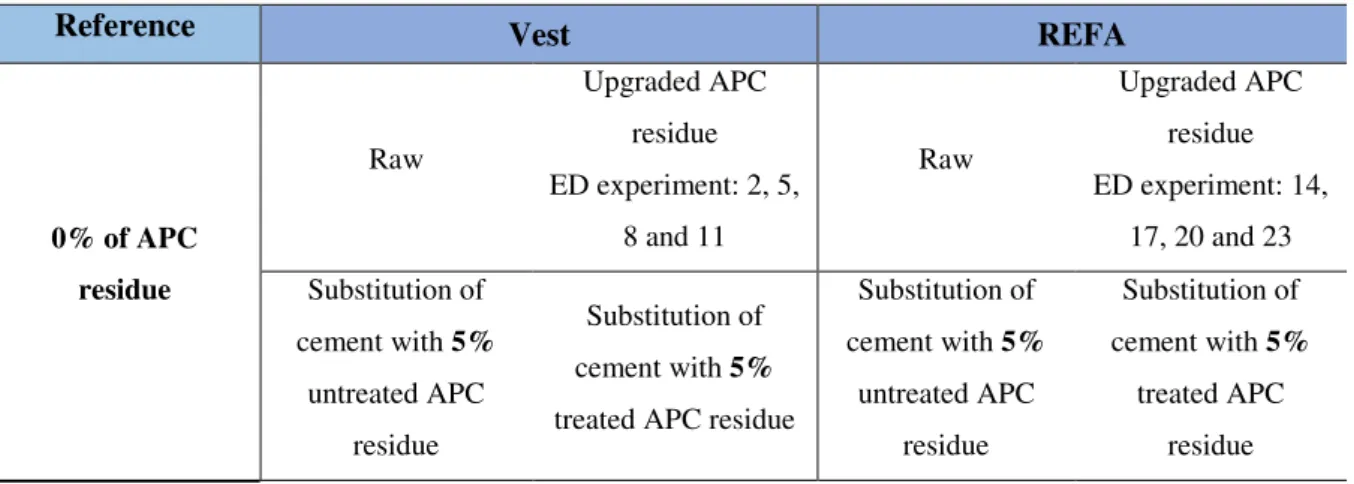
5% APC before and after ED process running for 7 days
In tap water for 28 days
Mortar tests after 28 days of curing:
Morphology (SEM/EDS)
(a)Porosity
(a)Density
Compressive strength
(b)Leaching
(c )Chloride
Wet system Vest
Semi-dry system REFA
Tests for Cd, Cr, Cu, Pb and Zn:
Concentrations (mg kg-1); Leaching behaviour (mg L-1);
Tests for Chloride and Sulphate (mg L-1)
BEK 1662
(a)Building Materials
-Basic properties
(b)EEA landfill
criteria for Heavy metals
(c)EN 206-1 for
standard concrete
With
PRE-TREATMENT
Without