Tannin extracts on quality of fresh cut crisp leaf lettuce. 1357
Tannin extracts on quality of fresh cut crisp leaf lettuce
Extratos de taninos na qualidade de alface crespa minimamente processada
Tâmmila Venzke KlugI* Moises Jardim SegaspiniI Júnia Capua de Lima NovelloII, III
Amanda Bianchini MorescoI Ana Raisa PaivaIV Alessandro de Oliveira RiosIV
Eduardo Cesar TondoIII Renar João BenderI ISSN 1678-4596
ABSTRACT
In the present study, tannin extracts (rinsed or not) were compared to the use of sodium hypochlorite and tap water
on fresh cut crisp leaf lettuce stored under modified atmosphere
packaging. Effects of these sanitizers on total color difference and microbial levels of the product after sanitization and storage for 9 days at 3°C were evaluated. Performance of rinsed SM® tannin
extract was comparable to the results of chlorine solution for all the analyzed parameters and; furthermore, that extract presented a high reduction in the initial bacterial count of minimally processed lettuce. However, storage of tannin extracts, did not impart better outcomes than the use of tap water. Therefore, the tannin extract storage SM® could be used in washing water to reduce the initial
microbiological load, avoiding cross contamination in vegetables minimally processed.
Key words: fresh cut lettuce, tannin extracts, postharvest storage,
Acacia mearnsii De Wild.
RESUMO
Extratos de taninos (com e sem enxague) foram comparados com o uso de hipoclorito de sódio e água em alface
crespa minimamente processada, sob atmosfera modificada.
Foram avaliadas diferença total de cor e análises microbiológicas após a sanitização e durante o armazenamento dos produtos (9 dias à 3°C). O extrato de tanino SM® com enxague apresentou
resultados semelhantes aos da solução de cloro para todos os parâmetros analisados e, além disso, apresentou uma elevada redução da contagem inicial microbiológica de alface minimamente processada. No entanto, durante o armazenamento, SM® não apresentou melhores resultados do que o uso de água.
Portanto, SM® poderia ser utilizado na desinfecção da água de
lavagem das alfaces, reduzindo a microbiota inicial e, assim, impedir a contaminação cruzada durante o processamento mínimo de vegetais.
Palavras-chave: alface minimamente processada, extratos de taninos, conservação pós-colheita, Acacia mearnsii De Wild.
INTRODUCTION
Lettuce (Lactuca sativa L.) is the most consumed leafy vegetable in Brazil. Lettuce accounts for approximately 40% of the total sales volume of fresh produce supply companies (SALA & COSTA, 2012). Nonetheless, concurrent to the consumption of fresh vegetables is the concern regarding microbiological safety of these products, i. e., potential contamination sources as a result of the presence of pathogenic bacteria (ANDERSON et al., 2011).
Sanitation techniques applied to minimally processed products target microbiological safety and prolong shelf life. Sodium hypochlorite is the most common sanitizer due to its low cost. However, sodium hypochlorite use might be questioned because of the likelihood of trihalomethane synthesis
ILaboratório de Pós-colheita, Universidade Federal do Rio Grande do Sul (UFRGS), Av. Bento Gonçalves, 7712, 91540-000, Porto Alegre,
RS, Brasil. E-mail: [email protected]. *Corresponding author.
IICentro de Ciências Exatas, Universidade de Caxias do Sul (UCS), Caxias do Sul, RS, Brasil.
IIILaboratório de Microbiologia e Controle de Alimentos, Instituto de Ciência e Tecnologia de Alimentos (ICTA), Universidade Federal do
Rio Grande do Sul (UFRGS), Porto Alegre, RS, Brasil.
IVLaboratório de Compostos Bioativos, Instituto de Ciência e Tecnologia de Alimentos (ICTA), Universidade Federal do Rio Grande do
Sul (UFRGS), Porto Alegre, RS, Brasil.
resulting from contacts with organic matter (ÖLMEZ & KRETZSCHMAR, 2009). The presence of organic matter might promote the formation of haloacetic acids, chloroform (CHCl3) or other trihalomethanes (THM), all of which are known to be harmful to human health (ARTÉS et al., 2009). In countries such as Germany, Denmark and Belgium, the use of chlorine as sanitizer is already banned (ARTÉS & ALLENDE, 2005).
Great interest has evolved in recent years for sanitization agents/methods to provide low energy demand and competitive costs, being environment friendly, and ensuring the microbiological safety and nutritional and sensorial quality of food. (SÃO JOSÉ et al., 2014). In such context, tannins have drawn attention due to biological and physiological properties (CHUNG et al., 2008). Several studies indicated in vitro bacteriostatic activity of tannin extracts against Escherichia coli, Salmonella typhi
and Staphylococcus aureus (ARIAS et al., 2004; VORAVUTHIKUNCHAI et al., 2004; HERNÁNDEZ et al., 2009). These studies entrust the scientific basis to support tannin extracts treatments as sanitizers for lettuce. Furthermore, tannin extracts are rather inexpensive, easily formulated and ecofriendly.
Evaluation of tannin extracts as disinfectants of minimally processed lettuce constitutes a novel research area, yet it is important to evaluate the effects of such innovative sanitizers on the product end quality. For that reason, the present study intended to evaluate the effects of tannin extracts of Acacia mearnsii De Wild as alternatives to sodium hypochlorite as sanitizer of fresh cut lettuce leaves.
MATERIALS AND METHODS
Preparation of tannins extracts and chlorine solution Two commercial samples containing tannin extracts of Acacia mearnsii De Wild., supplied by Tanac SA (Montenegro, RS) were used in the
present study: Tanfloc SG® and Tanfloc SM®, which
consisted of a mixture of condensed polyphenols,
mainly flavan-3-4-diol. Tanfloc is obtained via
Mannich reaction of the tannin extract with an amine and an aldehyde molecule (MANGRICH et al., 2014).
The main difference between Tanfloc SG and SM lies on pH, wherein the first presents a range of
1.3-2.3 and the latter a range of 0.7-1.2. Tannin extracts (SM and SG) were diluted with distilled water at a concentration of 1% (v/v).
Chlorine solution was prepared immediately before use by diluting 2.5% (v/v) sodium hypochlorite (Anhembi, Brazil) in sterile water to achieve the
concentration of 200mg.L-1 and the pH was adjusted
to pH 6.5 by adding citric acid. The concentration was
verified with tests strips (Ecolab, USA).
Preparation of lettuce samples
Crisp leaf lettuce heads were obtained from a grower located in the rural area of Viamão, RS. Lettuce at horticultural maturity were harvested manually in the early hours of the day and transported in plastic boxes by car to the Laboratorio de Compostos Bioativos of the Universidade Federal do Rio Grande do Sul (UFRGS). Before processing, the raw material was kept under refrigeration at 10±2°C for a maximum of 2h.
Treatment procedure
After reception, a selection was carried out to remove the product with mechanical injury and decay incidence, followed by the toilet operation in which the external and dirty leaves were withdrawn together with the lettuce heart. About 2kg of leaves free from defects were selected for each treatment, and were washed with tap water for 1 minute. Afterwards, they were sanitized with the following treatment solutions: T1) control - tap water washed for 1 minute; T2) immersion for 15 minutes in 200mg L-1 chlorine solution (NaClO) plus 1 minute rinse
in tap water at 7°C; T3) immersion for 10 minutes in 1% (v/v) of SM® tannin extract at pH 2.4 plus 1
minute rinse in tap water at 7°C; T4) immersion for 10 minutes in 1% (v/v) SG® tannin extract at pH 2.6
plus 1 minute rinse in tap water at 7°C; T5) 10 minute immersion in 1% (v/v) SM® tannin extract at pH 2.4,
without rinsing with tap water; and T6) immersion for 10 minutes in 1% (v/v) SG® tannin extract at pH 2.6
also without rinsing with tap water.
Samples were washed in chilled (7°C) treatment solutions, using a 1/10 ratio (weight of product/volume of solution). For tap water rinsing, it was used the same ratio weight/volume. After the last rinsing the samples were centrifuged at 690rpm for 5 minutes to remove excess of treatment solutions. Subsequently, 50g of fresh-cut lettuce leaves were packed and sealed in 25µm polypropylene bags with oxygen (O2)permeability of 7000cm³ m-² d-1,
(CO2) permeability of 20000cm³ m-2 d-1 and water
vapor permeability of 1g m-2 d-1. The atmosphere inside the packages was modified and thermo sealed
experiment set up and after 5, 7 or 9 more days of storage at 3°C and 12-hour light exposure.
Color measurement
A Konica/Minolta chromameter, model CR - 400 was used to determine the color of the lettuce leaves. Considering color variations among lettuce leaves within the same packages, 9 readings per experimental unit were taken to ensure data reliability. The averages of L*, a* and b* were used to determine the Total Color Difference (ΔE) according
the following equation:
(ΔE) =√ (a* f – a
* i)
2 + (b* f – b
* i)
2 + (L* f – L
* i)
2 (1)
where L*
i is the L
* value at the day of the
experimental set up and L*
f the value of L * at
retrieval from storage at either 5, 7 or 9 days. Likewise befalls for a*
I , a *
f , b *
I and b *
f. The total
color differences were ranked as ranging from small differences to very obvious color differences as indicated by GOYENECHE et al. (2014).
Microbiological analysis
Levels of total count of mesophilic microorganisms, total coliforms and Escherichia coli were determined in accordance with U.S. FDA (2001) and PIRES et al. (2011).
Statistical analysis
Three replicates of each treatment and for each analysis period were prepared and the average of each day/treatment/variable were analyzed as completely randomized blocks using the Statistical Analysis System Enterprise Guide 6.1, model Proc-Mixed. Averages were compared by Tukey test to
determine differences at α=0.05.
RESULTS AND DISCUSSION
Total color difference
According to the classification proposed by
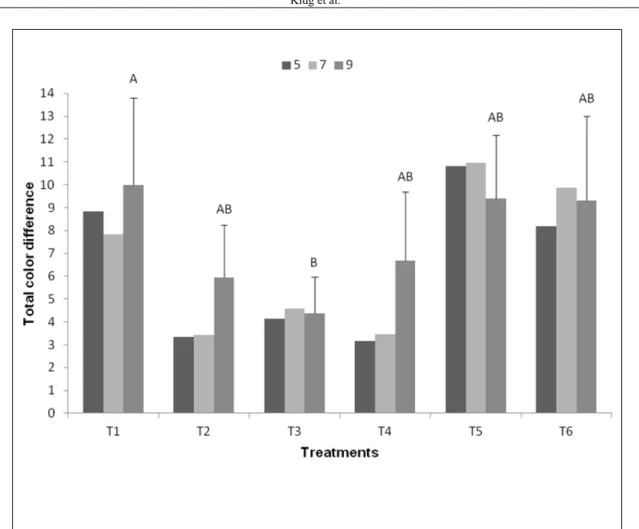
CHEN & MAJUMDAR (2008), the color differences observed in fresh cut crisp lettuce during the nine days of refrigerated storage vary from appreciable color differences (values ranging from 3.1 to 6.0) to large differences color (values ranging from 6.1 up to 12.0). Lettuce leaves treated with the tannin extract SM® (T3) and followed by leaf rinsing were ranked
at the end of the experiment as of appreciable color differences (Figure 1). Lettuce treated either with sodium hypochlorite (T2) or with the tannin extracts SM® (T3) or SG® (T4) presented color changes up
to the last day of storage categorized as presenting appreciable color differences. Lettuce treated either
with only tap water (T1) or with the tannin extracts SM® (T5) or SG® (T6) without subsequent rinsing
were categorized as presenting large differences of color. Treatments in which the tannin extracts were not rinsed off after treatment application, color changes were categorized as large differences. That situation suggested that the tannin extracts do
negatively influence tissue color. Consequently
rinsing is a recommended procedure.
As to what is the main cause of that effect of tannins on tissue color there are some indications. The pH of the tannin solutions is in the range of 2.5, a circumstance that possibly affects tissue metabolism both at cell walls and internally at the level of organelles, such as the chloroplasts. Chlorophyll breakdown that eventually leads to colorless products results from the reduction of chlorophyll molecules to chlorophyllides prompted by chlorophyllases activity. Chlorophyllides are then converted to pheophorbide via magnesium dechelatase (HEATON & MARANGONI, 1996). When low pH coatings such as tannin extracts are applied, the low pH mediates the loss of the magnesium ion from the chlorophyll molecules in the absence of dechelatase activity. Low pH might also inactivate chlorophyll degrading enzymes which have a optimum pH with about 7.0 (SUZUKI et al., 2002; ARKUS et al., 2005) and for that reason changes in lettuce leaf color results in pheophytin accumulation yielding an olive-brown color (HEATON & MARANGONI, 1996).
Microbiological analysis
The presence of E. coli on minimally processed lettuce leaves was always below the detection limits (1log cfu g−1) after 9 days of storage independently of the applied sanitizer. The initial mesophilic load on the unwashed lettuce leaves was in between 6 to 7log cfu g-1. These levels were in the
expected range for fresh-cut produce (NGUYEN-THE & CARLIN, 1994). OLIVEIRA et al. (2010) concluded that mesophilic bacteria are in the range of 103 to 109CFUg-1 in raw vegetables after harvest,
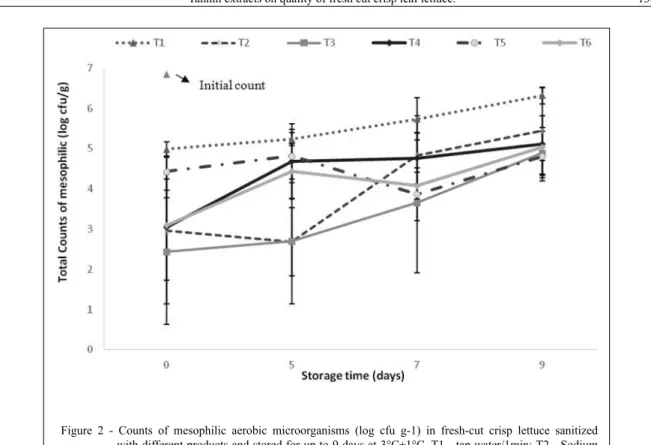
depending on the crop and the growing conditions. In the present research a decrease of about 1.86 to 4.41log cfu g-1 in total counts of mesophilic
cells amongst treated samples and the initial load at day 0 was determined (Figure 2). The highest initial reduction of 4.4log cfu g-1 was observed
when the tannin extract SM® was used to wash the
lettuce leaves. Washing lettuce with only tap water (control treatment) resulted in the lowest reduction of mesophilic counts. The T2 and T3 treatments
5 days of storage, showing significantly different
results from other treatments at day 5 (P<0.05). It was observed an increase in mesophilic counts in
the first 5 days of storage, followed by the decrease
after 7 days of storage for T5 and T6 treatments. This phenomenon can be a residual effect of the tannin extracts, since T5 and T6 treatments are not rinsed with water, but the tendency of all treatments did not
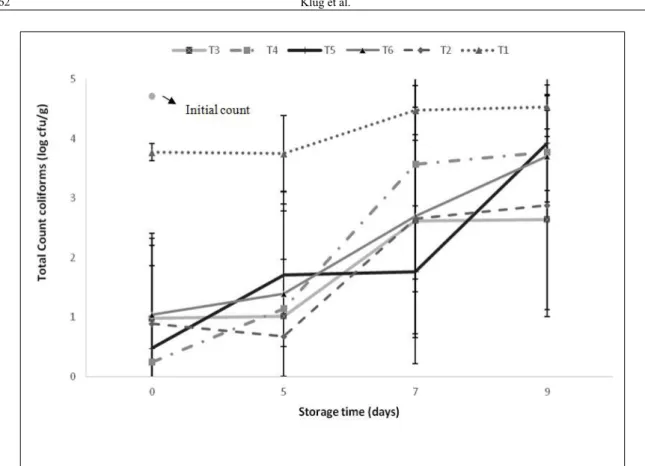
present significant differences after 9 days of storage. The initial count of total coliforms was in the range of 4 and 5log cfu g-1. Immediately after
washing with the sanitizers, total coliforms also presented a reduction in all treatments in colony forming units. The highest reduction of 4.47log was observed when the T4 treatment was applied as sanitizer (Figure 3). Final counts of total coliforms after 9 days of storage were between 2.6 and 4.53log cfu g-1. In relation to total coliform counts, BERBARI
et al. (2001) concluded that a population of total
coliforms of about 105 (5log) as the most probable
number g-1 of coliforms corresponded to high
contamination levels of these microorganisms in the product. Data from the present experiments did not exceed 105 (5 log cycles) (Figure 3).
It is important to consider that regardless of the initial reduction achieved after the treatments, microbial populations of total counts of mesophilic bacteria and total coliforms increased gradually during storage time (Figures 2 and 3). That occurrence has been previously described by several authors, who suggested that microbial populations of ready to eat vegetables could increase faster and even reach an equal or higher number after disinfection (ARTÉS-HERNÁNDEZ et al., 2009; GÓMEZ-LÓPEZ et al., 2013). Also in accordance to the data gathered in the present study, ALLENDE et al. (2008) observed that bacterial count at the end of storage was similar to the count observed when Figure 1 - Total color difference after 5, 7 and 9 days at 3°C±1°C of fresh cut crisp lettuce leaves to which different
sanitizers were applied: T1 - tap water/1 min (control); T2 - Sodium hypochlorite (200mg L-1/15min); T3 - SM®
the product was washed with tap water or with sanitizing solutions.
It is also conceivable that tannin extracts are not appropriate for shelf-life extension of minimally processed crisp leaf lettuce as they yielded after nine days of storage similar results to those of tap water washing. Nonetheless, tannin extracts could be used in washing waters to avoid cross-contamination throughout lettuce processing as already observed by ALLENDE et al. (2008) considering that these tannin extracts presented high initial reductions in the populations of mesophylls and total coliforms and in addition did not affect the quality of the product.
The microbiological hygiene quality achieved using sodium hypochlorite circumscribed to the total count of mesophilic cells, total coliforms and
E. coli was not superior to the sanitation presented by the lettuce samples sanitized by the tannin extract SM®.
That evidence is accreditable to the condition that the tannin extract SM® is concocted by Mannich reaction
rendering this extract bonded to a quaternary ammonium compound. Quaternary ammonium compounds are reported to have antibacterial properties (MCEGAN
& DANYYLU, 2015). Furthermore, the low pH of the SM® extract might be part of that antibacterial action.
CONCLUSION
Microbiological and quality analyses indicate that the application of the tannin extract SM® (T3) results is similar to hypochlorite treatment
results (T2). Nonetheless, SM® (T3) does not
ameliorate shelf life in comparison to the use of tap water (T1) on minimally processed crisp leaf
lettuce stored under modified atmosphere. Tannin
extracts might turn out to be alternatives to chlorine as sanitizing media in view of the fact that they are rather inexpensive, easily formulated and do not give off potential carcinogenic residues. Therefore, the tannin extract SM® (T3) could be used in washing
water to reduce the initial microbiological load as to avoid cross contamination in minimally processing of vegetables. The lack of knowledge on harmfulness of tannins after continuous intake compels further studies to ascertain the appropriateness of this natural extract for fresh-cut produce sanitization.
ACKNOWLEDGMENTS
The authors express gratitude to the Conselho Nacional de Desenvolvimento Científico e Tecnológico (CNPq) for financial support.
REFERENCES
ANDERSON, M. et al. Pathogen–produce pair attribution risk ranking tool to prioritize fresh produce commodity and pathogen combinations for further evaluation (P3ARRT). Food Control, v.22,
p.1865-1872, 2011. Available from: <http://www.sciencedirect. com/science/article/pii/S0956713511001769>. Accessed: nov. 05, 2015. doi: 10.1016/j.foodcont.2011.04.028.
ALLENDE, A. et al. Role of comercial sanitizers and washing systems on epiphytic microorganisms and sensory quality of fresh cut escarole and lettuce. Postharvest Biology and Technology, v.49, p.155-163, 2008. Available from: <http://www.sciencedirect. com/science/article/pii/S0925521408000094>. Accessed: dec. 15, 2015. doi: 10.1016/j.postharvbio.2007.12.010
ARKUS, K.A.J. et al. Mechanistic analysis of wheat chlorophyllase.
Archives of Biochemistry and Biophysics, v.438, p.146-155, 2005. Available from: <http://www.sciencedirect.com/science/ article/pii/S0003986105001700>. Accessed: set. 20, 2015. doi: 10.1016/j.abb.2005.04.019.
ARTÉS-HERNÁNDEZ, F. et al. Effect of UV-C radiation on quality of minimally processed spinach leaves. Journal of the Science of Food and Agriculture, v.89, p.414-421, 2009. Available from: <http://onlinelibrary.wiley.com/doi/10.1002/jsfa.3460/epdf>. Accessed: set. 21, 2015. doi: 10.1002/jsfa.3460.
ARTÉS, F.; ALLENDE, A. Processing lines and alternative preservation techniques to prolong the shelf-life of minimally fresh processed leafy vegetables. European Journal of Horticultural Science, v.70, n.5, p.231-245, 2005. Available from: <http://www.pubhort.org/ejhs/2005/34006.htm>. Accessed: oct. 3, 2014.
ARIAS, M.E. et al. Antibacterial activity of ethanolic and aqueous extracts of Acacia aromaGill. ex Hook et Arn. Life Sciences, v.75, p.191-202, 2004. Available from: <http://www.sciencedirect. com/science/article/pii/S002432050400222X>. Accessed: set. 05, 2014. doi: 10.1016/j.lfs.2003.12.007.
BERBARI, S.A.G. et al. Effect of chlorine in the wash water for disinfecting minimally processed lettuce. Food Science and Technology, v.21, p.197-201, 2001. Available from: <http://www.scielo.br/scielo.php?script=sci_arttext&pid =S0101-20612001000200014>. Accessed: jan. 25, 2014. doi: 10.1590/S0101-20612001000200014.
CHEN, X.D.; MAJUMDAR, A. Drying technologies in food processing. WestSussex: Wiley-Blackwell, 2008. 352p.
CHUNG, K.T. et al. Tannins and human health: a review. Critical Reviews in Food Science and Nutrition, v.38, p.421-464, 2008. Available from: <http://www.ncbi.nlm.nih.gov/pubmed/9759559>. Accessed: fev. 5, 2015. doi: 10.1080/1040869989127427. HEATON, J.W.; MARANGONI, A.G. Chlorophyll degradation in processed foods and senescent plant tissues. Trends Food Science and Technology, v.7, p.8-15, 1996. Available from: <http:// www.sciencedirect.com/science/article/pii/0924224496813525>. Accessed: jan. 19, 2015. doi: 10.1016/0924-2244(96)81352-5. HERNÁNDEZ, N.N.R. et al. Actividad antimicrobiana de Waltheria indoca y Acacia farnesiana. Revista CENIC Ciências Biológicas, v.40, n.2, p.129-134, 2009. Available from: <http:// www.redalyc.org/articulo.oa?id=181221568008>. Accessed: jan. 19, 2015.
GÓMEZ-LÓPEZ, V.M. et al. Generation of trihalomethanes with chlorine-based sanitizers and impact on microbial, nutritional and sensory quality of baby spinach. Postharvest Biology and Technology, v.85, p.210-217, 2013. Available from: <http://www. sciencedirect.com/science/article/pii/S0925521413001543>. Accessed: jan. 19, 2015. doi: 10.1016/j.postharvbio.2013.05.012. MANGRICH, A.S. et al. Green chemistry in water treatment: coagulant derived from use of Acacia mearnsii tannin. Revista Virtual de Quimica, v.6, n.1, p.2-15, 2014. Available from: <http://rvq.sbq.org.br/index.php/rvq/article/view/425>. Accessed: dec. 2, 2014. doi: 10.5935/1984-6835.20140002.
MCEGAN, M.; DANYYLU, M.D. Evaluation of aqueous and alcohol-based quaternary ammonium sanitizers for inactivating Salmonella spp., Escherichia coli O157:H7, and
Listeria monocytogenes on peanut and pistachio shells. Food Microbiololy, v.47, p.93-98, 2015.Available from: <http://www. sciencedirect.com/science/article/pii/S0740002014002858>. Accessed: nov. 24, 2014. doi: 10.1016/j.fm.2014.11.010.
NGUYEN-THE, C.; CARLIN, F. The microbiology of minimally processed fresh fruits and vegetables. Critical Reviews in Food Science and Nutrition, v.34, p.371-401, 1994. Available from: <http://www.tandfonline.com/doi/ pdf/10.1080/10408399409527668>. Accessed: dec. 2, 2014. doi: 10.1080/10408399409527668.
OLIVEIRA, M. et al. Microbiological quality of fresh lettuce from organic and conventional production. Food Microbiology, v.27,
n.5, p.679-684, 2010. Available from: <http://www.sciencedirect. com/science/article/pii/S074000201000050X>. Accessed: oct. 2, 2014. doi: 10.1016/j.fm.2010.03.008.
ÖLMEZ, H.; KRETZSCHMAR, U. Potential alternative methods for organic fresh-cut industry for minimizing water consumption and environmental impact. LWT Food Science and Technology, v.42, p.686-693, 2009. Available from: <http://www.sciencedirect.com/science/article/ pii/S0023643808001862>. Accessed: set. 12, 2014. doi: 10.1016/j.lwt.2008.08.001.
PIRES, D. et al. Use of newly isolated phages for control of
Pseudomonas aeruginosa PAO1 and ATCC 10145 biofilms.
Research in Microbiology, v.162, n.8, p.798-806, 2011. Available from: <http://www.sciencedirect.com/science/article/pii/ S092325081100115X>. Accessed: set. 12, 2014. doi: 10.1016/j. resmic.2011.06.010.
SALA, F.C.; COSTA, C.P.Retrospective and trends of Brazilian lettuce crop. Horticultura Brasileira, v.30, p.187-194, 2012. Available from: <http://www.scielo.br/scielo.php?script=sci_artt ext&pid=S0102-05362012000200002>. Accessed: jan. 12, 2015. doi: 10.1590/S0102-05362012000200002.
SÃO JOSÉ, J.F.B. et al. Decontamination by ultrasound application in fresh fruits and vegetables. Food Control, v.45, p.36-50, 2014. Available from: <http://www.sciencedirect.com/science/article/pii/ S0956713514001984>. Accessed: jan. 24, 2015. doi: 10.1016/j. foodcont.2014.04.015.
SUZUKI, Y. et al. Two enzymatic reaction pathways in the formation of pyropheophorbide a. Photosynthesis Research, v.74, p.225-233, 2002. Available from: <http://link.springer.com/articl e/10.1023%2FA%3A1020919929608>. Accessed: fev. 14, 2015. doi: 10.1023/A:1020919929608.