
Genetics and identification of markers linked to multiflorous
spikelet in hexaploid oat
Kelly Pellizzaro1, Itamar C. Nava1, Shiaoman Chao2, Marcelo T. Pacheco1 and Luiz C. Federizzi1*
Received 27 June 2015 Accepted 21 October 2015
Abstract – The formation of naked grains is directly associated with the formation of multiflorous spikelets in oats. The objectives of this study were to determine the genetics of multiflorous spikelet and to identify molecular markers linked to this character in hexaploid oat. Genetic analysis for multiflorous spikelet was performed in the F5 and F6 generations of two oat populations. DNA extracted from F5:6 plants were assayed with 6,000 genome-wide single nucleotide polymorphism (SNP) markers using a genotyping platform developed for oat. Genetic analysis indicated the presence of a major gene controlling multiflorous spikelet in the UFRGS 01B7114-1-3 x UFRGS 006013-1 population. The SNP marker GMI_ES17_c5923_221 showed strong association with the multiflorous spikelet phenotype. These results suggest that the marker GMI_ES17_c5923_221 should be linked to a gene controlling multiflorous spikelet in the oat lines evaluated in this study.
Key words: Avena sativa, naked oat, molecular marker, quantitative trait loci (QTL), spikelet morphology.
Crop Breeding and Applied Biotechnology 16: 62-70, 2016 Brazilian Society of Plant Breeding. Printed in Brazil
ARTICLE
http://dx.doi.org/10.1590/1984-70332016v16n1a10
1 Universidade Federal do Rio Grande do Sul (UFRGS), Faculdade de Agronomia, Departamento de Plantas de Lavoura, Av. Bento Gonçalves, 7712, 91.501-970, Porto Alegre, RS, Brazil. *E-mail: [email protected]
2 United States Department of Agriculture (USDA), Agricultural Research Service (ARS), Biosciences Research Laboratory, 1605 Albrecht Blvd, Fargo, ND 58105, USA.
INTRODUCTION
Oat is an important cereal crop used for food and feed worldwide. Oat is adapted to a wide variety of environments; however, this crop grows mainly in temperate regions or in the cold seasons of subtropical regions such as southern Brazil (Locatelli et al. 2008). Cultivated oat, Avena sativa L., belongs to the Poaceae family. This species is autogamous, allohexaploid (2n = 6x = 42) and derived from the natural aggregation of the three ancestral diploid genomes AA, CC and DD (Rines et al. 2006).
In addition to cultivated hulled oat, the species Avena sativa subsp. nudisativa is also noteworthy. This species known as ‘naked oat’ differs from hulled oat in that the naked grain threshes free (Ougham et al. 1996). Another striking difference in naked oat is the presence of panicles with
indeterminate multiflorous spikelets. Multiflorous spikelets usually have four to seven fertile florets per spikelet, although naked oat can produce up to 12 fertile florets per spikelet
(Burrows 1986). In hulled oat, spikelets are normal and
determinate with one to three fertile florets per spikelet; four florets are rarely observed in the same spikelet. Multiflorous
spikelets are also found in other species of agricultural interest, including rice (Oryza sativa L.), barley (Hordeum vulgare L.) and maize (Zea mays L.) (Chuck et al. 2007, Lee et al. 2007, Brown and Bregitzer 2011).
From a nutritional standpoint, oat cultivars producing naked grains have higher values of linoleic acid, starch and essential amino acids compared to hulled cultivars (Givens et al. 2003). Naked oat has great potential as a feed for monogastric animals, including pigs, birds and horses; once hulled oat is not suitable for these animals (Peltonen-Sainio et al. 2004). Naked oat may also be used in malting processes, which renders it attractive to the beer industry (Wilhelmson et al. 2001). However, the naked oat shows variable expressivity among different genotypes. This characteristic limits the growth of naked oat at the commercial scale. This variable expressivity results in the presence of hulled and hulless grains in the same panicle.
The formation of naked oat grains is directly associated
with the formation of multiflorous spikelets. However, the
elucidated. Genetic studies conducted by Kibite and Taylor
(1994) suggest that both “naked grain” and “multiflorous
spikelet” characters have monogenic inheritance. Based on this model, the naked grain character is controlled by the Naked1 (N1) gene. This gene acts on lemma and
palea lignification. The multiflorous spikelet character is
controlled by the Multiflorous1 (Mf1) gene. The N1 and Mf1 genes show genetic linkage, with the allelic combination N1_ (naked grains) being dominant over n1n1 (hulled grains) and Mf1_ (multiflorous spikelets) is partly dominant
over mf1mf1 (normal spikelets). Genetic studies involving Brazilian oat genotypes indicated that more than one gene is involved in controlling the formation of naked grain,
besides the action of modifier genes (Cabral et al. 2000,
Valentine et al. 2014).
Recently, various genes with key roles in regulating
the architecture, identity and development of floral organs were identified (Ciaffi et al. 2011). The AGAMOUS gene family stands out among them. These genes participate in the
determinacy of reproductive floral organs, including stamens,
carpels and ovules. AGAMOUS genes also participate in
defining the number of floral organs by controlling the floral
meristem determinacy (Dreni and Kater 2014). These genes
have been identified in a large number of monocot species,
including barley, wheat, rice and maize, and are associated
with the number of florets per spikelet (Reinheimer and
Kellogg 2009). Genes of the AGAMOUS family have not
yet been identified or associated with the expression of multiflorous spikelets in oat. Thus, the identification and
characterization of AGAMOUS genes and other genes
involved in floral meristem determinacy in future studies
will be key to a complete understanding of the genetic
factors controlling the expression of multiflorous spikelet
in oat. The objectives of this study were to determine the
genetics of multiflorous spikelet and to identify molecular
markers linked to this character in hexaploid oat.
MATERIAL AND METHODS
Genetic populations
For the present study, two oat populations were developed
through the following crosses: ‘UFRGS 01B7114-1-3 x UFRGS 006013-1’ and ‘URS Taura x UFRGS 017004-2’. The
genealogy and the type of spikelet (normal or multiflorous)
for each parent is shown in Table 1. The parents UFRGS 01B7114-1-3, UFRGS 006013-1, URS Taura and UFRGS 017004-2 were developed by the Oat-Breeding Program of the Universidade Federal do Rio Grande do Sul (UFRGS). Both populations of oat lines were derived by single-seed descent to the F5 generation.
Phenotypic screening for multiflorous spikelet Oat lines and parents from both populations were
analyzed for multiflorous spikelet. The experiments were
conducted at the Agronomy Experimental Station of the UFRGS, which is located in Eldorado do Sul, RS (Lat 30° 05’ 27’’ S, Long 51° 40’ 18’’ W) at 46 m above sea
level. The soil is classified as Typical Red Dystrophic Argisol (EMBRAPA 1999). The climate is classified as
Cfa (subtropical humic) according to the Köppen-Geiger
classification. Parental lines and recombinant lines from
each population were evaluated in 2012 (F5 generation) and 2013 (F6 generation). A total of 144 and 191 lines
were evaluated for multiflorous spikelet in the populations
UFRGS 01B7114-1-3 x UFRGS 006013-1 and URS Taura x UFRGS 017004-2, respectively. Each parent and line
was sown in double rows (2.0-m long) in the field, with a
spacing of 0.20 m between rows and 0.40 m between plots. At the harvest maturity stage, the lines were visually analyzed in the field and classified according to the following spikelet types: i) normal spikelet, where all plants within the same line expressed panicles with 100% normal spikelets, or ii) multiflorous spikelet, where all plants within the same line expressed panicles
with 100% multiflorous spikelets. Panicles with normal
spikelets showed a determinate growth pattern, with two
to three fertile florets per spikelet and grains adhered to well-lignified lemma and palea. Conversely, multiflorous
spikelets showed an indeterminate growth pattern, with
four or more fertile florets per spikelet and grains coated with soft glumes that consisted of poorly lignified lemma
and palea.
Table 1. Genealogy and characterization of multiflorous spikelet for the parental lines used in the development of the oat genetic populations
Genetic population Parental line† Genealogy Type of spikelet§
1 UFRGS 01B7114-1-3 Pc68/5*Starter / UFRGS 10 Normal
UFRGS 006013-1 Cocker 492/Starter-1 // UFRGS 8 Multiflorous
2 URS Taura UFRGS 970216-2 / UFRGS 970461 Normal
UFRGS 017004-2 Cocker 492/Starter-1 // UFRGS 8 Multiflorous
Genetics of multiflorous spikelet
The number of genes controlling multiflorous spikelet was determined using the F5 and F6 generations of the oat populations UFRGS 01B7114-1-3 x UFRGS 006013-1 and URS Taura x UFRGS 017004-2. A genetic hypothesis was tested for each population based on the observed results. The observed frequencies were compared to the expected frequencies using the Chi-square test (χ2). The hypothesis of a single major gene controlling multiflorous spikelet was tested for the UFRGS 01B7114-1-3 x UFRGS 006013-1 population. The hypothesis of two genes controlling multiflorous spikelet was tested for the URS Taura x UFRGS 017004-2 population. In the evaluated populations, only lines expressing the normal spikelet phenotype or the multiflorous spikelet phenotype were included in the tests of the genetic models for one or two genes. Ratios of one normal spikelet line:one multiflorous spikelet line and three normal spikelet line:one multiflorous spikelet line were expected in the UFRGS 01B7114-1-3 x UFRGS 006013-1 and URS Taura x UFRGS 017004-2 genetic populations, respectively. The calculated χ2 value was compared to the critical χ2 value. One degree of freedom and a 5% significance level were considered.
DNA extraction and analysis of SNP markers The population derived from the cross UFRGS 01B7114-1-3 x UFRGS 006013-1 was genotyped in this study. DNA extracted from F5:6 plants were assayed with 6,000 genome-wide single nucleotide polymorphism (SNP) markers using a genotyping platform developed for oat. A total of 94 lines in the F6 generation and the respective parents UFRGS 01B7114-1-3 and UFRGS 006013-1 were included in this analysis. Plant tissues from seedlings from each line and the parents were collected seven days after planting. Tissues were frozen in liquid nitrogen and
ground. DNA extraction was conducted using the modified
cetyltrimethylammonium bromide (CTAB) method. Sodium chloride (NaCl) and polyvinylpyrrolidone (PVP) were used to remove polysaccharides and polyphenols, respectively, as reported by Lodhi et al. (1994). A 20 µL DNA aliquot at a concentration of 50 ng µL-1 for each line was sent to the Biosciences Research Laboratory, United States Department of Agriculture (USDA) – Agricultural Research Service (ARS) located in Fargo, North Dakota (ND), USA. The GoldenGate genotyping platform from Illumina (www.illumina.com) was used for the analysis
of SNP markers, according to the specifications reported
by Tinker et al. (2014).
Linkage mapping
A genetic linkage map for the UFRGS 01B7114-1-3 x UFRGS 006013-1 population was designed using the program JoinMap 4.0 (Kyazma, the Netherlands). Linkage groups were formed using a logarithm of odds (LOD) score of six and a maximum frequency of recombination of 40%. The maximum likelihood-mapping algorithm was used to generate the linkage groups. The Kosambi mapping function was used to convert recombination frequencies into centimorgans (cM). SNP markers with the expected segregation pattern and polymorphic between parents were used to design the genetic linkage map.
Identification of SNP markers linked to multiflorous spikelet
The single gene mapping method was used to identify
SNP markers linked to multiflorous spikelet in the UFRGS
01B7114-1-3 x UFRGS 006013-1 mapping population. Phenotypic data collected in 2012 (F5 generation) and 2013 (F6 generation) were converted to the JoinMap’s mapping code system and included in the genetic mapping. In 2012, the morphological marker was termed Mf1a(Mf =
Multiflorous); in 2013, this marker was termed Mf1b. Lines
expressing the normal spikelet phenotype were labeled with the mapping code “a” (same as the parent UFRGS
01B7114-1-3). Lines expressing the multiflorous spikelet
phenotype were labeled with the mapping code “b” (same as the parent UFRGS 006013-1). DNA sequences containing
SNP molecular markers associated with multiflorous spikelet
were aligned to sequences available in the open-access sequence database GenBank (http://www.ncbi.nlm.nih.gov/ genbank/), using the Basic Local Alignment Search Tool
(BLAST). The SNP markers associated with multiflorous
spikelet were also compared to the consensus map of oat developed by Oliver et al. (2013) and Tinker et al. (2014) in order to identify the chromosomal location.
RESULTS AND DISCUSSION
The formation of multiflorous spikelet was analyzed in
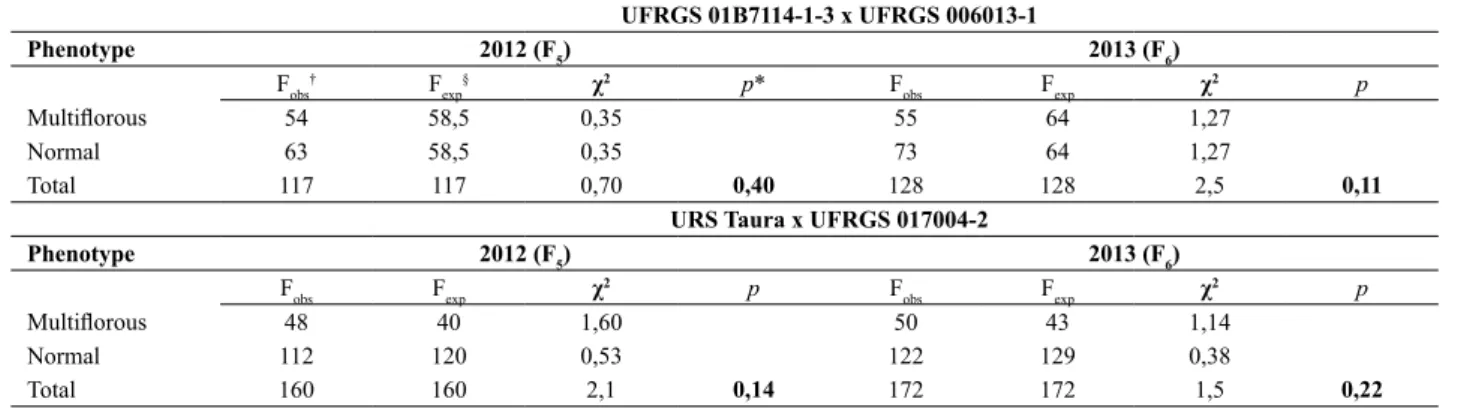
two oat populations, which were derived from the following crosses: UFRGS 01B71114-1-3 x UFRGS 006013-1 and URS Taura x UFRGS 017004-2. For the UFRGS 01B71114-1-3 x UFRGS 006013-1 population evaluated in 2012, 54
lines expressed the multiflorous spikelet phenotype; 63
lines expressed the normal spikelet phenotype. From the observed results, the genetic hypothesis of a single gene
controlling multiflorous spikelet was tested. The calculated
value of the Chi-square test was 0.70 (p = 0.40). Thus, the
hypothesis of a major gene controlling multiflorous spikelet
of lines with multiflorous and normal spikelets was 55 and
73, respectively. The calculated value of the Chi-squared test was 2.5 (p = 0.11). This finding also indicated the
hypothesis of a major gene controlling the character could not be rejected (Table 2).
Genetic studies aiming to determine the number of genes
controlling multiflorous spikelet in oats began over a century
ago. Several studies demonstrated the character controlled by a single gene with a strong effect on the phenotype (Gaines 1917, Caporn 1918, Love and McRosstie 1919, Boland and Lawes 1973, Cabral et al. 2000). Therefore, the results of the genetic analysis for the UFRGS 01B71114-1-3 x UFRGS 006013-1 population corroborate the results reported in previous studies.
For the URS Taura x UFRGS 017004-2 population evaluated in 2012, 48 lines expressed the multiflorous spikelet phenotype; 112 lines expressed the normal spikelet phenotype. This frequency indicates that the single gene model, as previously described for the UFRGS
01B71114-1-3 x UFRGS 006013-1 population, did not fit the results
observed in this population. Thus, the hypothesis of two
genes controlling the multiflorous spikelet character was
tested. The calculated value of the Chi-squared test was 2.1 (p = 0.14), indicating the hypothesis of two genes could not be rejected in this population (Table 2). In 2013, 122 of the 172 lines analyzed expressed the normal spikelet phenotype;
50 lines expressed the multiflorous spikelet phenotype. The
calculated value of the Chi-squared test was 1.5 (p = 0.22),
which fit the genetic hypothesis of two genes.
The genetic analysis of multiflorous spikelet performed
for the UFRGS 01B71114-1-3 x UFRGS 006013-1 and URS Taura x UFRGS 017004-2 populations demonstrated that the
number of genes controlling this character diverged between these populations. The origin of the second gene in the URS Taura x UFRGS 017004-2 population is not known based on the genealogy of the parental lines (Table 1). In previous
studies, several authors suggested the action of modifier genes in addition to a primary gene. These modifier genes
act to form a wide array of phenotypes observed in different genotypes of naked oat (Jenkins and Hanson 1976, Cabral et al. 2000, Valentini et al. 2014). However, we cannot
consider the action of a modifier gene in this study. With the action of “modifier gene”, the expression of the “modified
gene” would be reduced or suppressed, contributing to
a deviation from the 3:1 (normal:multiflorous spikelet)
frequency observed here. Therefore, further studies are needed to validate the presence of both genes and determine
their roles in controlling multiflorous spikelet in the URS
Taura x UFRGS 017004-2 population.
Based on the results of the genetic analysis performed for the UFRGS 01B71114-1-3 x UFRGS 006013-1 population, the lines from this population were subjected to a genotypic analysis using SNP markers. Of the total of 631 SNP
markers identified as polymorphic between the parental
lines, 502 markers were grouped into 42 linkage groups. The remaining markers showed no linkage to any group or were not considered in the analysis due to distortion of Mendelian segregation.
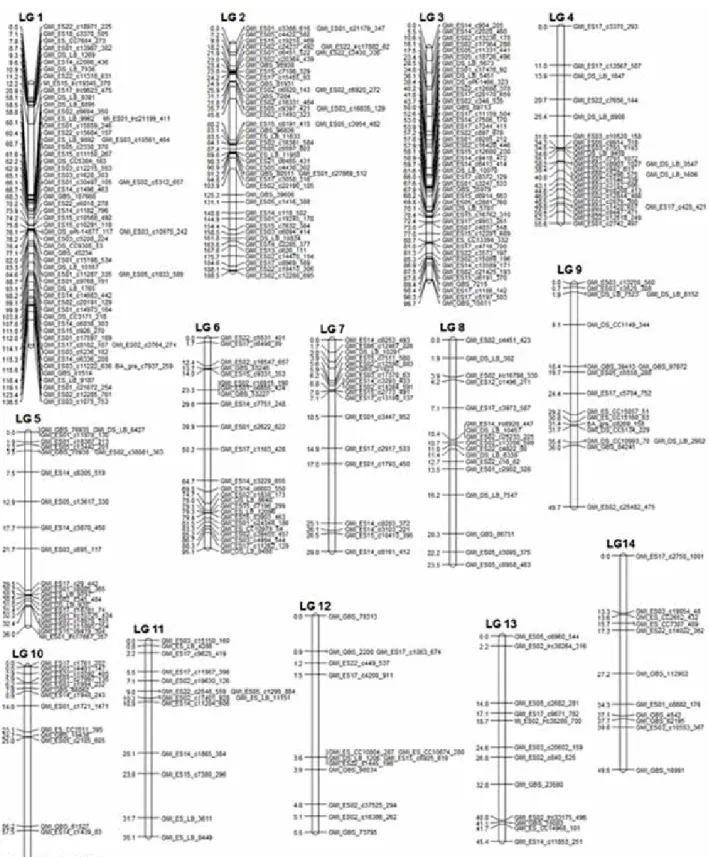
The number of molecular markers in each linkage group ranged from two in linkage groups 35 to 42 to 61 in linkage group 1 (Figure 1).The genetic distance of each linkage group ranged from 0 cM (co-segregating markers; in linkage groups 35, 38 and 39) to 188.5 cM (in linkage group 2; Figure 1).The complete genetic linkage map for the UFRGS 01B71114-1-3 x UFRGS 006013-1 mapping
Table 2. Observed and expected frequencies for the multiflorous spikelet phenotype in two oat populations evaluated in field tests during the growing
seasons of 2012 and 2013
UFRGS 01B7114-1-3 x UFRGS 006013-1
Phenotype 2012 (F5) 2013 (F6)
Fobs† F
exp
§ χ2 p* F
obs Fexp χ
2 p
Multiflorous 54 58,5 0,35 55 64 1,27
Normal 63 58,5 0,35 73 64 1,27
Total 117 117 0,70 0,40 128 128 2,5 0,11
URS Taura x UFRGS 017004-2
Phenotype 2012 (F5) 2013 (F6)
Fobs Fexp χ2 p F
obs Fexp χ
2 p
Multiflorous 48 40 1,60 50 43 1,14
Normal 112 120 0,53 122 129 0,38
Total 160 160 2,1 0,14 172 172 1,5 0,22
† F
obs = observed frequency of oat lines for the multiflorous spikelet phenotype; § F
exp = expected frequency of oat lines for the multiflorous spikelet phenotype, according to the genetic hypothesis of one gene (UFRGS 01B7114-1-3 x UFRGS 006013-1) and two genes (URS Taura x UFRGS 017004-2);
population encompassed a total genetic distance of 1,397.5 cM (Figure 1). These results are in agreement with the results of molecular mapping previously performed in hexaploid oats (O’Donoughue et al. 1995, Wight et al. 2003, Zhu and Kaeppler 2003, Tinker et al. 2009). The expected number
hampered by the genome size and complexity, the scarcity of molecular markers and a lack of aneuploid oat stocks (Oliver
et al. 2013). The first physically anchored chromosomal
map of oat was recently developed using various modern genotyping strategies. This map contains 21 linkage groups,
and most of the identified and mapped molecular markers
are annotated to their corresponding chromosomes in the hexaploid oat genome (Oliver et al. 2013, Tinker et al. 2014). Therefore, the genetic linkage map for the UFRGS 01B71114-1-3 x UFRGS 006013-1 mapping population covered approximately 80% of the oat genome.
The linkage map for the UFRGS 01B71114-1-3 x UFRGS 006013-1 population was used to identify SNP
markers associated with multiflorous spikelet in hexaploid
oats. Based on the single gene mapping strategy used in the present study, only the SNP marker GMI_ES17_c5923_221
showed association with the multiflorous spikelet phenotype.
The SNP marker GMI_ES17_c5923_221 and the markers
for spikelet morphology (normal or multiflorous) ‘Mf1a’
and ‘Mf1b’ were mapped to linkage group 32 of the genetic linkage map designed for the UFRGS 01B71114-1-3 x UFRGS 006013-1 mapping population (Figure 1). In 2012 (F5 generation), the SNP marker GMI_ES17_c5923_221 was mapped at a genetic distance of 1.8 cM from the
morphological marker of the multiflorous spikelet trait
Mf1a. In 2013 (F6 generation), the genetic distance between the markers GMI_ES17_c5923_221 and Mf1b was 3.5 cM (Figure 1). The greater genetic distance between the SNP and morphological marker estimated in 2013 compared to 2012 may be directly associated with a higher frequency of recombination. In 2013 (F6 generation), one additional cycle of meiosis occurred when compared to the year of
2012 (F5 generation). Therefore, the genetic distance of 3.5 cM between the SNP marker GMI_ES17_c5923_221 and the morphological marker (Mf1) must represent a more accurate measurement of the physical distance between these markers on the oat chromosome.
The molecular marker GMI_ES17_c5923_221 showed no genetic linkage to any other SNP markers among the linkage groups formed for the UFRGS 01B71114-1-3 x UFRGS 006013-1 mapping population. In addition, this marker was not associated with any linkage groups in the physically anchored map designed by Oliver et al. (2013) or the consensus map designed by Tinker et al. (2014). The reason for the lack of genetic linkage between the
GMI_ES17_c5923_221 marker and other markers identified
thus far is still unknown.
The nucleotide sequence of the DNA segment in which the
GMI_ES17_c5923_221 marker was identified in the parental
lines UFRGS 01B71114-1-3 and UFRGS 006013-1 is shown in Figure 2. The DNA segment consists of 120 nucleotides, and the genetic polymorphism is characterized by a point mutation involving the substitution of one thymine (T) in the parental line UFRGS 01B71114-1-3 (normal spikelet) with a cytosine (C) in the parental line UFRGS 006013-1
(multiflorous spikelet) (Figure 2a). Sequence alignments
demonstrated that the mutation occurred at position 61 (Figure 2b). This base-pair substitution [T/C], albeit still genetically uncharacterized, may have an evolutionary contribution to the phenotypic divergence of spikelet development in hexaploid oats.
The nucleotide sequence of the SNP marker GMI_ES17_ c5923_221 was also compared with sequences available
Figure 2. Identification of the SNP marker GMI_ES17_c5923_221 in hexaploid oat. a) The nucleotide sequence of the parental lines demonstrates that the SNP marker GMI_ES17_c5923_221 involves the replacement of a pyrimidine with other pyrimidine [T/C]. Such base-pair substitutions
are called transitions. b) The sequence alignment indicates that the base-pair substitution occurred at position 61 between the parental lines UFRGS
in the open-access sequence database GenBank (http:// www.ncbi.nlm.nih.gov). The comparison was carried out using the Basic Local Alignment Search Tool(BLAST). The oat sequence showed similarity to only one wheat (Triticum aestivum L.) sequence with the identification HG670306 (Choulet et al. 2014). Oat sequence showed a molecular identity of 92% with the wheat sequence. In wheat, the sequence is located onto a region of chromosome 3B, with approximately 774 megabases, 5,326 protein-coding genes and 1,938 pseudogenes; transposable elements make up 85% of the chromosome sequence (Choulet et al. 2014).
The molecular marker GMI_ES17_c5923_221 could not be located on the genetic linkage map developed for the UFRGS 01B71114-1-3 x UFRGS 006013-1 mapping population. The high association between this marker and
the multiflorous spikelet phenotype in this population, as
determined in the present study, indicates that this marker may be linked to the major gene involved in controlling the
character. The validation of this marker in other populations and germplasm of hexaploid oats is key to its use as diagnostic marker in the differentiation between genotypes with normal
spikelet or multiflorous spikelet phenotypes. The GMI_ES17_
c5923_221 marker may also be of use in molecular-marker
assisted selection, as the multiflorous spikelet trait is highly
correlated with the naked trait. This would increase the
efficiency of breeding programs in selecting stable naked
oat genotypes, eliminating the environmental effect on the expression of the naked trait in oat.
Thus, the present study reports the first dataset containing SNP markers associated with the multiflorous spikelet in hexaploid oat. The results assessed may help in the efficient
development of naked oat genotypes in genetic breeding programs. These data also form a foundation for future studies seeking to elucidate the genetic and molecular
mechanisms involved in the control of multiflorous/naked
traits in hexaploid oat.
REFERENCES
Boland PP and Lawes DA (1973) The inheritance of the naked grain character in oats studied in a cross between the naked variety Caesar
and the husked variety BO 1/11. Euphytica 22: 582-591.
Brown RH and Bregitzer P (2011) A Ds insertional mutant of a barley
miR172 gene results in indeterminate spikelet development. Crop
Science 51: 1664-1672.
Burrows VD (1986) Breeding oats for food and feed: conventional and
new techniques and materials. In Webster FH (ed) Oats: chemistry
and technology. American Association of Cereal Chemists, Sain Paul, p. 13-46.
Cabral CB, Milach SCK, Federizzi LC, Bothona CA, Taderka I, Tisian LM and Limberger E (2000) Genetics of naked grain oats in crosses with
Brazilian genotypes. Genetics and Molecular Biology 23: 851-854.
Caporn AS (1918) The inheritance of tight and loose palea in Avena nuda
crosses. Journal of Genetics 7: 229-246.
Ciaffi M, Paolacci AR, Tanzarella OA and Porceddu E (2011) Molecular aspects of flower development in grasses. Sexual Plant Reproduction 24: 247-282.
Choulet F, Alberti A, Theil S, Glover N, Barbe V, Daron J, Pingault L, Sourdille P, Couloux A, Paux E, Leroy P, Mangenot S, Guilhot N, Le Gouis J, Balfourier F, Alaux M, Jamilloux V, Poulain J, Durand C, Bellec A, Gaspin C, Safar J, Dolezel J, Rogers J, Vandepoele K, Aury JM, Mayer K, Berges H, Quesneville H, Wincker P and Feuillet C (2014) Structural and functional partitioning of bread wheat
chromosome 3B. Science 345: 288-294.
Chuck G, Meeley R, Irish E, Sakai H and Hake S (2007) The maize tasselseed4 microRNA controls sex determination and meristem
cell fate by targeting Tasselseed6/indeterminate spikelet1. Nature
Genetics 39: 1517-1521.
Dreni L and Kater MM (2014) MADS reloaded: evolution of the
AGAMOUS subfamily genes. New Phytologist 201: 717-732.
EMBRAPA - Centro Nacional de Pesquisa de Solos (1999) Sistema
brasileiro de classificação de solos. Embrapa Produção da Informação/Embrapa Solos, Brasília/Rio de Janeiro, 412p.
Gaines EF (1917) Inheritance in wheat, barley and oat hybrids. Agricultural Experiment Station Annual Reports 135: 47-60.
Givens DI, Davies TW and Laverick RM (2003) Effect of variety, nitrogen fertilizer and various agronomic factors on the nutritive value of
husked and naked oats grain. Animal Feed Science and Technology
113: 169-181.
Jenkins G and Hanson PR (1976) The genetics of naked oas (Avena nuda
L.). Euphytica 25: 167-174.
Kibite S and Taylor JS (1994) Inheritance and linkage relationships of
genes conditioning hullessness, multiflorous spikelet and giantism
in oat (Avena sativa L.) Canadian Journal of Plant Science 74:
497-500.
Lee DY, Lee J, Moon S, Park SY and An G (2007) The rice heterochronic
gene SUPERNUMERARY BRACT regulates the transition from
spikelet meristem to floral meristem. The Plant Journal49: 64-78.
Locatelli AB, Federizzi LC, Milach SCK and MacElroy AR (2008) Flowering time in oat: genotype characterization for photoperiod
and vernalization response. Field Crops Research 106: 242-247.
Lodhi MA, Ye GN, Weeden NF and Reisch BI (1994) A simple and efficient
method for DNA extraction from grapevine cultivars and Vitis species. Plant Molecular Biology Reports 12: 6-13.
oat hybrids. American Naturalist 53: 5-32.
O’Donoughue LS, Sorrells ME, Tanksley SD, Autrique E, Deynze AV, Kianian SF, Phillips RL, Wu B, Rines HW, Rayapati PJ, Lee M, Penner GA, Fedak G, Molnar SJ, Hoffman D and Salas CA (1995)
A molecular linkage map of cultivated oat. Genome 38: 368-380.
Oliver RE, Tinker NA, Lazo GR, Chao S, Jellen EN, Carson ML, Rines HW, Obert DE, Lutz JD, Shackelford I, Koro AB, Wight CP, Gardner KM, Hattori J, Beattie AD, Bjørnstad A, Bonman JM, Jannink JL, Sorrells ME, Brown-Guedira GL, Fetch JWM, Harrison SA, Howarth CJ, Ibrahim A, Kolb FL, McMullen MS, Murphy JP, Ohm HW, Rossnagel BG, Yan W, Miclaus KJ, Hiller J, Maughan PJ, Hulse RRR, Anderson JM, Islamovic E and Jackson EW (2013) SNP
discovery and chromosome anchoring provide the first
physically-anchored hexaploid oat map and reveal synteny with model species. Plos One 8: 1-12.
Ougham HJ, Latipova G and Valentine J (1996) Morphological and biochemical characterization of spikelet development in naked oats
(Avena sativa). New Phytologist 134: 5-12.
Peltonen-Sainio P, Kirkkari AM and Jauhiainen L (2004) Characterizing strengths, weaknesses, opportunities and threats in producing naked
oat as a novel crop for northern growing conditions. Agricultural
and Food Science 13: 212-228.
Rines H, Molnar S, Tinker NA and Phillips R (2006) Oat. Genome mapping
and molecular breeding in plants. Cereals Millets 1: 211-242.
Reinheimer R and Kellogg EA (2009) Evolution of AGL6-like MADS Box genes in grasses (Poaceae): ovule expression is ancient and palea
expression is new. The Plant Cell 21: 2591-2605.
Tinker NA, Kilian A, Wight CP, Heller-Uszynska K, Wenzl P, Rines HW, Bjørnstad A, Jannink J-L, Anderson JM, Rossnagel BG, Stuthman DD, Sorrells ME, Jackson EW, Tuvesson S, Kolb FL, Olsson O, Federizzi LC, Carson ML, Ohm HH, Molnar SJ, Scoles GJ, Eckstein PE, Bonman JM, Ceplitis A and Langdon T (2009) New DArT markers for oat provide enhanced map coverage and global germplasm
characterization. BMC Genomics 10: 39-61.
Tinker NA, Chao S, Lazo GR, Oliver RE, Huang Y, Poland JA , Jellen EM, Maughan PJ, Kilian A and Jackson EW (2014) A SNP genotyping
array for hexaploid Oat. The Plant Genome 3: 1-8.
Valentini APF, Pellizzaro K, Pacheco MTP and Federizzi LC (2014) Genetic analysis of the naked trait in panicles of hexaploid oat. Crop Breeding and Applied Biotechnology 14: 116-123.
Wight CP, Tinker NA, Kianian SF, Sorrells ME, O’Donoughue LS, Hoffman DL, Groh S, Scoles J, Li CD, Webster FH, Phillips RL, Rines HW, Livingston SM, Armstrong KC, Fedak G and Molnar SJ (2003) A molecular marker map in ‘Kanota’ 9 ‘Ogle’ hexaploid oat (Avena spp.) enhanced by additional markers and a robust framework. Genome 46: 28-47.
Wilhelmson A, Oksman-Caldentey KM, Laitila A, Suortii T, Kaukovirta-Norja A and Poutanen K (2001) Development of a germination process for producing high beta-glucan, whole grain food ingredients from
oat. Cereal Chemistry 78: 715-720.
Zhu S and Kaeppler HF (2003) A genetic linkage map for hexaploid, cultivated oat (Avena sativa L.) based on an intraspecific cross Ogle/

![Figure 2. Identification of the SNP marker GMI_ES17_c5923_221 in hexaploid oat. a) The nucleotide sequence of the parental lines demonstrates that the SNP marker GMI_ES17_c5923_221 involves the replacement of a pyrimidine with other pyrimidine [T/C]](https://thumb-eu.123doks.com/thumbv2/123dok_br/15940669.678848/7.833.164.668.699.947/identification-hexaploid-nucleotide-sequence-demonstrates-replacement-pyrimidine-pyrimidine.webp)
