Original Research Article
Comparison of Four Verbal Memory Tests
for the Diagnosis and Predictive Value of
Mild Cognitive Impairment
Dina Silva
a
Manuela Guerreiro
a, b
João Maroco
c
Isabel Santana
d
Ana Rodrigues
d
José Bravo Marques
e
Alexandre de Mendonça
a, f
a Dementia Clinics, Faculty of Medicine, University of Lisbon, b Laboratory of Language Studies, Santa Maria Hospital, and c Superior Institute of Applied Psychology, Lisbon , d Department of Neurology, Coimbra University Hospital, Coimbra , e Department of Neurology, Portuguese Institute for Oncology, and f Institute of Molecular Medicine and Faculty of Medicine, University of Lisbon, Lisbon , Portugal
Key Words
Mild cognitive impairment ⴢ Diagnostic criteria ⴢ Preclinical dementia ⴢ Alzheimer’s disease ⴢ Memory impairment
Abstract
Background: Mild cognitive impairment (MCI) is considered to be an early stage of a neurode-generative disorder, particularly Alzheimer’s disease, and the clinical diagnosis requires the ob-jective demonstration of cognitive deficits. The aim of the present study was to evaluate the predictive value of MCI for the conversion to dementia when using four different verbal mem-ory tests (Logical Memmem-ory, LM; California Verbal Learning Test, CVLT; Verbal Paired-Associate Learning, VPAL; and Digit Span, DS) in the MCI criteria. Methods: Participants were consecutive patients with subjective cognitive complaints who performed a comprehensive neuropsycho-logical evaluation and were not demented, observed in a memory clinic setting. Results: At baseline, 272 non-demented patients reporting subjective cognitive complaints were included. During the follow-up time (3.0 8 1.9 years), 58 patients converted to dementia and 214 did not. Statistically significant differences between the converters and non-converters were present in LM, VPAL, and CVLT. A multivariate Cox regression analysis combining the four memory tests revealed that only the CVLT test remained significant as a predictor of conversion to dementia. Non-demented patients with cognitive complaints diagnosed as having MCI according to ab-normal ( ! 1.5 SD) learning in the CVLT test had a 3.61 higher risk of becoming demented during the follow-up. Conclusion: The verbal memory assessment using the CVLT should be preferred in the diagnostic criteria of MCI for a more accurate prediction of conversion to dementia.
Copyright © 2012 S. Karger AG, Basel
Dina Silva
NonCommercial-NoDerivs 3.0 License (www.karger.com/OA-license), applicable to the online version of the article only. Distribution for non-commercial purposes only.
Instituto de Farmacologia e Neurociências, Edifício Egas Moniz Faculdade de Medicina de Lisboa, Avenida Prof. Egas Moniz PT–1649-028 Lisboa (Portugal)
Introduction
Many elderly people suffer from memory and other cognitive decline that is not severe enough to meet the criteria for dementia. These elderly people may be diagnosed as having mild cognitive impairment (MCI), implying a high risk of progression to dementia, usually Alzheimer’s disease (AD), in the forthcoming years. In the initial formulation by Petersen et al. [1] , MCI was based on (1) memory complaint, preferably corroborated by an informant; (2) memory impairment documented according to appropriate reference values; (3) essen-tially normal performance in non-memory cognitive domains; (4) generally preserved ac-tivities of daily living, and (5) absence of dementia. As repeatedly pointed out, several of these criteria would need operationalization. In particular, the test used to document the memory impairment and the cut-off score should be specified [2] . In spite of further refinements in the concept of MCI [3–10] , there is still no consensus about the specific memory test that should be used for the diagnosis of MCI or prodromal phase of AD [11, 12] . Thus, there is the need to compare systematically and prospectively the inclusion of different verbal memory tests in the MCI criteria, and to examine how this modifies the predictive value of the MCI diagnosis for conversion to dementia.
Deficits in episodic memory are associated with impaired encoding of the contextual information and consolidation of new verbal material [13–15] , and a lower performance on tests of episodic verbal memory is a forerunner of future cognitive decline [16–19] . A deficit in delayed recall assessment of episodic long-term memory, as opposed to the short-term or implicit memory assessment, would be particularly characteristic of initial AD [20] , since it reflects involvement of the hippocampus and related medial temporal lobe structures. Sig-nificant verbal memory impairment, confirmed by neuropsychological testing, is considered the hallmark of both amnestic MCI and AD [4, 21] . So far, distinct tests of memory and learn-ing have been used to establish the presence of memory impairment in order to fulfill the criteria for MCI, namely the Logical Memory (LM) test [19, 22–24] , the Verbal Paired-Asso-ciate Learning (VPAL) test [23, 25] , and the California Verbal Learning Test (CVLT) [17, 19, 26–31] .
The LM test [32] has been used for a long time to discriminate between healthy older adults and individuals with very mild dementia [33] and is still commonly used for the as-sessment of memory impairment in MCI patients nowadays. Recent studies associate the presence of impairment in LM with a higher rate of conversion to AD as compared with other episodic memory tests [24, 34] . Furthermore, the LM test was recently proposed as a screening tool for MCI in the Alzheimer’s Disease Neuroimaging Initiative (ADNI) study [35] .
Previous studies showed that impairment in list learning tests might as well predict ac-curately the conversion to AD [17, 36] . Rabin et al. [19] showed that the impairment in the total learning score from the CVLT [37] had superior overall accuracy in distinguishing MCI from normal aging, even though that accuracy might be enhanced by the inclusion of the delayed recall condition of the LM test. The VPAL test was proposed to reveal the presence of memory deficits in MCI and AD patients, although the facilitation of the encoding process through the cued recall format could lead to a different memory deficit profile than in pa-tients assessed with the CVLT [25] .
Besides verbal memory impairment, some studies have evidenced that other memory domains are also altered in MCI, namely those related to working memory [13] . The Digit Span (DS) test measures auditory attention, immediate span of learning, and working mem-ory. Impairment in the DS test was associated with future cognitive decline [38, 39] . How-ever, it appears that working memory does not decline early in the neurodegenerative process of AD [40] . Therefore, the DS test was used in this study as a negative control to other applied
tests that represent earlier markers of the neurodegenerative process observed in AD patients (e.g., tests assessing episodic memory and verbal learning). Another type of memory that evidenced more resistance to AD progression is semantic memory, since the lexical semantic system might be spared until the initial phase of dementia [41] .
In the present study, non-demented patients with cognitive complaints who had a neu-ropsychological battery assessing different types of memory were followed prospectively. The aim was to determine whether the inclusion of four distinct memory tests, i.e., LM test, CVLT, VPAL test, and DS test, in the diagnostic criteria could modify the predictive value of MCI regarding conversion to dementia.
Methods
Research Participants
Participants were selected from the Cognitive Complaints Cohort [42] , which is a pro-spective study conducted at the Institute of Molecular Medicine, Lisbon, to investigate the cognitive stability or evolution to dementia of subjects with cognitive complaints based on a comprehensive neuropsychological evaluation and other biomarkers. The study was ap-proved by the local ethics committee.
Inclusion Criteria
The inclusion criteria were: (1) presence of cognitive complaints; (2) neuropsychological testing including all four memory tests compared in the present study, and (3) follow-up 1 6 months.
Exclusion Criteria
The exclusion criteria were: (1) presence of neurological or psychiatric disorders that may induce cognitive deficits; patients with major depression according to DSM-IV-TR [43] or serious depressive symptoms (indicated by a score on the Geriatric Depression Scale short version (GDS 15) of 1 10 points) were excluded; (2) systemic illness with cerebral impact; (3) history of alcohol abuse or recurrent substance abuse or dependence, and (4) presence of de-mentia according to DSM-IV-TR [43] , or a Mini-Mental State Examination (MMSE) score below the cutoff for the Portuguese population, or significant impairment on activities of daily life according to the Blessed Dementia Rating Scale (BDRS) [44, 45] .
Procedures
The baseline comprehensive neuropsychological assessment was carried out by the same team of trained neuropsychologists, supervised by M.G., following a standard protocol and comprising several tests and scales:
(1) MMSE [46, 47] : the MMSE is one of the most widely used brief instruments for the clinical evaluation of cognitive state in adults;
(2) Battery of Lisbon for the Assessment of Dementia (BLAD) [48] : the BLAD is a comprehensive neuropsychological battery evaluating multiple cognitive domains and validated for the Portuguese population [48] . Tests of interest for the present study were: LM (immediate and delayed recall; Wechsler Memory Scale, WMS); VPAL (immediate recall; WMS), and DS (forward and backward; WMS) [32] ;
(3) CVLT [27, 37] : the CVLT measures verbal learning assessing constructs as repetition learning, serial position effects, semantic organization, intrusion, and proactive interference. The word lists (list A and list B) are made up of 16 items from 4 different categories of ‘shopping list’ items. The trials of interest (trials with better discriminating
ability for different stages of cognitive decline according to previous studies) [26] considered for the present study were: the total number of words from list A correctly recalled on the five learning trials (Atot) and long-delayed free recall (LDFR; number of words from list A correctly recalled after an interference period of 20 min);
(4) BDRS [44, 45] : the BDRS is a brief behavioral scale based on the interview of a close informant, assessing functional capacity for activities of daily living and changes in personality;
(5) Geriatric Depression Scale (GDS) [49–51] : the GDS is a self-report assessment used specifically to identify depression in the elderly. For this study, a short-form (15 items) of the self-report instrument was used.
Diagnosis of MCI
Diagnosis of MCI was based on criteria given by the MCI Working Group of the Euro-pean Consortium on Alzheimer’s disease [4] :
(1) Cognitive complaints coming from the patients or their families;
(2) The reporting of a decline in cognitive functioning relative to previous abilities during the past year by the patient or informant;
(3) Presence of cognitive impairment: in this study, four distinct memory tests to fulfill this diagnostic criterion were compared: LM, CVLT, VPAL, and DS; 3 cutoffs to define impairment were also analyzed (1, 1.5, and 2 SD below the mean);
(4) Absence of major repercussions on daily life (the patient may report difficulties concerning complex day-to-day activities).
Patients were assessed at follow-up for the presence of dementia and diagnosis of AD, according to the DSM-IV-TR [43] criteria.
Data Analysis
Demographic, clinical, and neuropsychological data were analyzed using the Mann-Whitney U test for numerical data and Pearson 2 test for nominal data. All tests were
two-tailed and a p value of ! 0.05 was assumed as statistically significant.
The neuropsychological assessment was standardized according to the age and educa-tion norms for the Portuguese populaeduca-tion and z scores were calculated. The 1, 1.5, and 2.0 SD cutoffs below the mean were compared for establishing impairment on the memory tests.
Survival methods were chosen for analysis, since MCI conversion to dementia occurred at different times and the observations were censored. To explore the effect of impairment in different memory tests on the conversion to dementia during follow-up, univariate and multivariate Cox proportional hazards regression models were performed. For multivariate models, the Enter selection method was used to build the regression models. The memory tests were introduced as a binary variable (presence or not of impairment, coded as 0 and 1, respectively, and according to the cutoffs established, 1, 1.5, and 2.0 SD). Since converters to dementia were older at the baseline than non-converters, the multivariate model was adjust-ed for age. Survival time was calculatadjust-ed as the interval from the initial baseline evaluation to the diagnosis of dementia. For patients who remained non-demented, survival time was cen-sored at the date of the last clinical assessment. A forest plot with the estimated hazard or risk of conversion to dementia for the different memory tests and cutoffs was displayed. Sta-tistical analyses were performed using IBM SPSS Statistics 19 for Windows (2010 SPSS Inc., an IBM Company) and GraphPad Prism 5 for Windows (GraphPad Software, Inc., San Di-ego, Calif., USA) for graphical displays.
Results
At baseline, 272 patients reporting subjective cognitive complaints and not demented were included. During the follow-up time (3.0 8 1.9 years), 58 patients (21%) converted to dementia, and 214 (79%) did not. Most cases that progressed to dementia were diagnosed as AD (85%). The presence of depressive symptoms and functional capacity did not differ be-tween converters and non-converters ( table 1 ). Likewise, the follow-up time was not signifi-cantly different between the two groups ( table 1 ). The converters were older than the non-converters at the baseline assessment ( table 1 ). Statistically significant differences between the converters and non-converters were present in all measures of verbal memory adminis-trated with the exception of the DS test and a measure of forgetting from the CVLT ( table 2 ). The analysis of other neuropsychological tests from the BLAD also showed significantly lower performances in converters as compared to non-converters, namely in measures of at-tention, initiative, and conceptual thinking; however, all scores were within 1 SD of the mean, showing that the converters had no major impairments in non-memory cognitive do-mains that would qualify them for a diagnosis of dementia (results not shown).
Table 1. B aseline demographic and clinic characterization data Converters (n = 58) Non-converters (n = 214) p value Age, years 69.988.7 66.289.3 0.004#, * Gender (female/male) 38/20 122/92 0.293‡
Formal education, years 9.385.1 10.184.8 0.221#
Follow-up time, years 2.881.7 3.181.9 0.427#
GDS 4.883.7 4.884.1 0.831#
BDRS 3.482.5 2.981.9 0.450#
MMSE 25.482.5 28.381.9 0.001#, *
D ata are number of patients or mean 8 SD. # Mann-Whitney test. ‡ Pearson 2 test. * Statistically
sig-nificant (p < 0.05).
Table 2. V erbal memory tests at baseline
Converters (n = 58) Non-converters (n = 214) p value# LM Immediate recall –1.4681.09 –0.8981.00 <0.001* Delayed recall –1.6181.11 –0.8481.08 <0.001* Forgetting index –0.3880.47 –0.1180.45 0.001* VPAL –1.4881.14 –0.7481.15 <0.001*
CVLT Five learning trials total –3.2281.45 –1.8181.44 <0.001*
Long delayed recall –3.3081.77 –1.6481.61 <0.001*
Forgetting index –0.1180.65 0.0680.44 0.142
DS Forward 0.4081.63 0.4181.27 0.837
Backwards 0.0581.30 0.3081.15 0.084
D ata are mean 8 SD. Means of Z scores, calculated according to the equation [z = (x – mean)/SD].
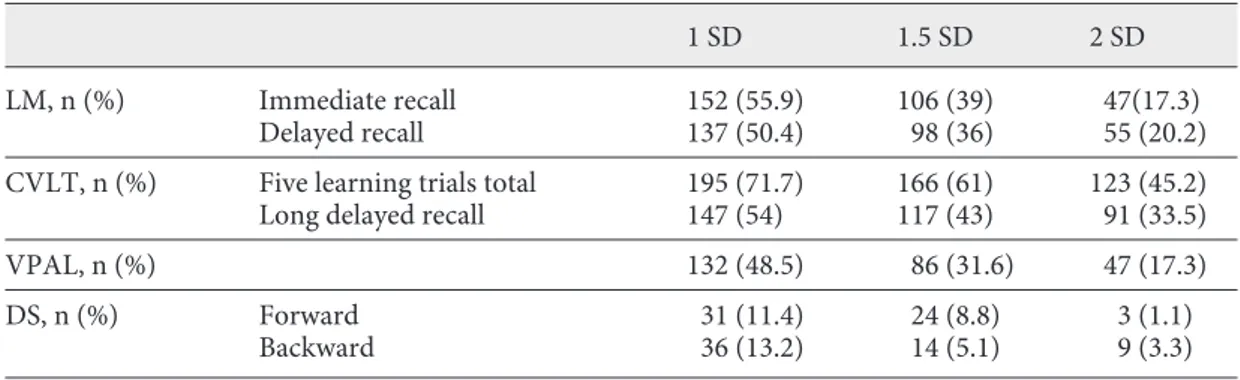
Of the 272 patients reporting subjective cognitive complaints and not demented, 33 (12%) had no alterations at the baseline in the memory tests selected for the present study (considering the cutoff ! 1.5 SD), 72 (26%) had deficits at only 1 of the memory tests, 167 (62%) showed deficits in 6 2 memory tests (from those, 4 (2%) had deficits in at least 1 mea-sure of all memory tests). The number of patients diagnosed as having MCI based on each specific memory test and 3 different cutoff values is shown in table 3 . The CVLT test was the verbal memory test that categorized more individuals as MCI across the 3 cutoffs ( table 3 ).
Since the conversion to dementia occurred during the follow-up time at different mo-ments, a survival analysis was performed. The diagnosis of MCI on the basis of an abnormal value for each of the memory tests, LM, CVLT, and VPAL, according to the cutoffs deter-mined for impairment, carried a significant risk of conversion to dementia during the follow-up (univariate Cox regression model fitted to the results of each memory test; fig. 1 ). The diagnosis of MCI on the basis of an abnormal value for the DS backward condition (all cut-offs) and forward condition (1 and 2 SD cutcut-offs) was not significantly associated with the risk of conversion to dementia during the follow-up ( fig. 1 ). The three significant memory tests showed overlapping hazard risks for conversion to dementia ( fig. 1 ).
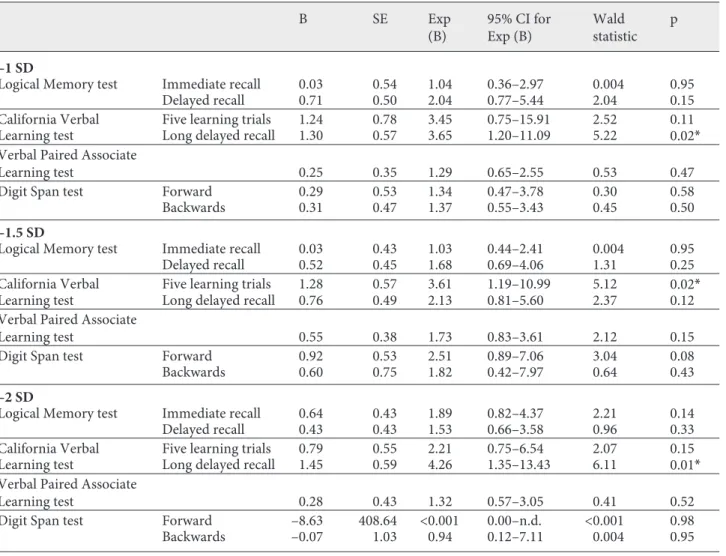
To test whether the verbal memory tests used in the diagnostic criteria of MCI (LM, CVLT, and VPAL) that individually had shown to accurately predict future conversion to dementia, could be combined to improve their predictive value, a multivariate Cox regres-sion analysis was performed. In an attempt to increase the power of multivariate analysis, we reduced the number of measures in the study and selected two at maximum for each mem-ory test. The measures not selected for the present study also showed overlapping hazard risks and did not add any further accuracy for predicting future conversion to dementia. In the multivariate Cox regression analysis only the CVLT (learning measure for the cutoff ! 1.5 SD and long delayed recall for the other cutoffs) remained significant as a predictor of con-version to dementia ( table 4 ). Non-demented patients with cognitive complaints diagnosed with MCI according to abnormal (cutoff commonly used of ! 1.5 SD) learning in the CVLT had a 3.61 higher risk of becoming demented in the follow-up as compared to those who had normal learning in the CVLT ( table 4 ).
Discussion
The present study shows that different verbal memory tests, LM, CVLT, and VPAL, when used in non-demented patients with cognitive complaints to establish memory impair-ment in the diagnosis of MCI, are not significantly different to predict the progression to Table 3. N umber of subjects diagnosed as MCI according to distinct measures and cutoffs of memory tests
1 SD 1.5 SD 2 SD
LM, n (%) Immediate recall 152 (55.9) 106 (39) 47(17.3)
Delayed recall 137 (50.4) 98 (36) 55 (20.2)
CVLT, n (%) Five learning trials total 195 (71.7) 166 (61) 123 (45.2)
Long delayed recall 147 (54) 117 (43) 91 (33.5)
VPAL, n (%) 132 (48.5) 86 (31.6) 47 (17.3)
DS, n (%) Forward 31 (11.4) 24 (8.8) 3 (1.1)
dementia. However, the MCI criteria using the CVLT had the highest predictive value, which was not improved by adding other memory tests.
Although it has been argued that the use of a memory test battery offers a better sensi-tivity to the earlier diagnosis of MCI [52] , we showed that only the CVLT remains significant on the multivariate Cox regression model as a predictor of progression to dementia, and other memory tests did not significantly add to the predictive value. The assessment of verbal memory based on list learning was found to be predictive of future conversion to dementia in earlier phases, possibly due to the reduced use of learning strategies [53] . Previous studies have also suggested that list learning represents a more demanding encoding test than story recall, is more sensitive to executive dysfunction, and offers a better prediction of conversion to dementia [19, 54, 55] . The higher frequency of impaired performance for CVLT at baseline highlights the demanding character of the task, indicating that it might be an early marker for cognitive decline [17] .
Different measures of verbal memory tests used for the diagnosis of MCI may assess dif-ferent stages of the neurodegenerative process by relying on distinct cognitive resources, so the contribution to diagnostic accuracy and predictive value is unique [14] . Both measures of immediate and delayed free recall were analyzed, because there is some evidence that long-term memory is more extensively impaired in MCI patients than short-long-term memory and, more importantly, has evidenced a greater sensitivity for the identification of amnestic MCI which will progress to dementia [20] . Verbal memory impairment can possibly correspond to either a defective consolidation of information relying on an alteration of mesiotemporal areas, or to a difficulty in elaborative encoding and afterwards correct retrieval of informa-tion, which in this case is associated with an alteration of frontal areas. MCI patients at risk of conversion to AD are expected to present deficits in learning (encoding and storage) rath-er than in the retrieval process [56, 57] . Some vrath-erbal memory tests assess primarily the ca-pacity of storage, and for that aim semantic cues are systematically provided during the en-coding phase in order to facilitate the retrieval process. For instance, the Free and Cued Se-lective Reminding Test [58] assesses specifically the storage capacity of MCI patients with
Fig. 1. Verbal memory tests and risk of progression to dementia (hazard ratios and confidence intervals from univariate Cox regression analysis).
focus on the amnestic syndrome of the medial temporal type associated with a future pro-gression to dementia [52, 53] . According to a recent review, the studies that determined the predictive value of this test for future conversion to dementia also evidenced that delayed recall measures were less sensitive and specific than immediate recall measures, supporting the hypothesis of a failure at the initial learning process (although providing semantic cues), instead of forgetting due to inadequate storage of the information [57] . Other studies have shown that MCI patients at risk of conversion to dementia (namely AD) could benefit from semantic cues on the encoding phase in a similar way as normal controls, suggesting that the deficits in encoding correctly the information during the learning process, and not a diffi-culty in the storage process itself, would lead to retrieval impairment [27, 57, 61] .
Bearing in mind the above mentioned, we decided to examine the CVLT performance for the total learning and delayed recall, which are also the measures associated with a better discrimination between normal aging, MCI, and AD [26] . Verbal learning tests were ana-lyzed on associative (VPAL) and non-associative (CVLT) conditions in order to assess dif-ferent stages of impairment progression. Deficits in associative learning tests are present in a more advanced stage of progression in MCI [62] and, therefore, may not be the best predic-Table 4. V erbal memory tests and risk of progression to dementia (multivariate Cox regression analysis)
B SE Exp (B) 95% CI for Exp (B) Wald statistic p –1 SD
Logical Memory test Immediate recall 0.03 0.54 1.04 0.36–2.97 0.004 0.95
Delayed recall 0.71 0.50 2.04 0.77–5.44 2.04 0.15
California Verbal Five learning trials 1.24 0.78 3.45 0.75–15.91 2.52 0.11
Learning test Long delayed recall 1.30 0.57 3.65 1.20–11.09 5.22 0.02*
Verbal Paired Associate
Learning test 0.25 0.35 1.29 0.65–2.55 0.53 0.47
Digit Span test Forward 0.29 0.53 1.34 0.47–3.78 0.30 0.58
Backwards 0.31 0.47 1.37 0.55–3.43 0.45 0.50
–1.5 SD
Logical Memory test Immediate recall 0.03 0.43 1.03 0.44–2.41 0.004 0.95
Delayed recall 0.52 0.45 1.68 0.69–4.06 1.31 0.25
California Verbal Five learning trials 1.28 0.57 3.61 1.19–10.99 5.12 0.02*
Learning test Long delayed recall 0.76 0.49 2.13 0.81–5.60 2.37 0.12
Verbal Paired Associate
Learning test 0.55 0.38 1.73 0.83–3.61 2.12 0.15
Digit Span test Forward 0.92 0.53 2.51 0.89–7.06 3.04 0.08
Backwards 0.60 0.75 1.82 0.42–7.97 0.64 0.43
–2 SD
Logical Memory test Immediate recall 0.64 0.43 1.89 0.82–4.37 2.21 0.14
Delayed recall 0.43 0.43 1.53 0.66–3.58 0.96 0.33
California Verbal Five learning trials 0.79 0.55 2.21 0.75–6.54 2.07 0.15
Learning test Long delayed recall 1.45 0.59 4.26 1.35–13.43 6.11 0.01*
Verbal Paired Associate
Learning test 0.28 0.43 1.32 0.57–3.05 0.41 0.52
Digit Span test Forward –8.63 408.64 <0.001 0.00–n.d. <0.001 0.98
Backwards –0.07 1.03 0.94 0.12–7.11 0.004 0.95
tors for conversion at earlier phases. Interestingly, the use of different cutoffs for CVLT im-pairment did not considerably modify the risk of progression to dementia.
The present results suggest that a measure of working memory, like the DS backward, should not be used to qualify for memory impairment in the MCI diagnostic criteria, and the prediction of future conversion to dementia would be unreliable. Working memory and visuospatial ability have been proposed as functions that decline slowly in MCI patients [63] . A recent study showed that subjects presenting subjective cognitive complaints and impair-ment in DS might have a higher risk of future conversion to MCI but did not compare the DS predictive value to other memory tests [38] .
One limitation of the present study is the focus on a restricted number of verbal memo-ry tests commonly used in clinical practice to evaluate memomemo-ry in non-demented patients with suspected cognitive decline. Clearly, it would be interesting to evaluate other memory modalities, with visual or semantic memory tests. Nevertheless, several studies showed that their diagnostic value in the identification of MCI patients at risk of conversion to dementia do not clearly overtake that of verbal episodic memory tests [18, 64–66] . Another limitation of the present study was that it focused on neuropsychological data, and other biomarkers were not considered. Recently, many studies have been published combining different bio-markers in non-demented subjects with cognitive complaints for predicting future conver-sion to dementia. Consequently, the choice of specific verbal memory tests in the neuropsy-chological assessment, in conjunction with other biomarkers, may be crucial to accurately predict future conversion to dementia.
In conclusion, different memory tests, namely LM, CVLT, and VPAL, can be used to es-tablish the diagnosis of MCI and predict the progression to dementia. Considering our re-sults, the MCI criteria using the CVLT had the highest predictive value, which was not im-proved by adding other memory tests, and taking into account that there are frequent limi-tations in clinical practice to apply an extensive neuropsychological battery to all individuals with suspected cognitive decline [67] , we propose that a list learning task could be the pre-ferred test to establish memory impairment in MCI diagnosis.
Acknowledgements
Supported by grants from Fundação Calouste Gulbenkian and Fundação para a Ciência e Tecnologia. The authors acknowledge the facilities provided by Memoclínica.
Disclosure Statement
The authors of this paper do not have any commercial associations that might pose a conflict of interest in connection with the manuscript.
References
1 Petersen R, Smith G, Waring S, Ivnik RJ, Tangalos EG, Kokmen E: Mild cognitive impairment: clin-ical characterization and outcome. Arch Neurol 1999; 56: 303–308.
2 Petersen RC: Challenges of epidemiological studies of mild cognitive impairment. Alzheimer Dis Assoc Disord 2004; 18: 1–2.
3 Winblad B, Palmer K, Kivipelto M, Jelic V, Fratiglioni L, Wahlund LO, Nordberg A, Bäckman L, Al-bert M, Almkvist O, Arai H, Basun H, Blennow K, de Leon M, DeCarli C, Erkinjuntti T, Giacobini E, Graff C, Hardy J, Jack C, Jorm A, Ritchie K, van Duijn C, Visser P, Petersen RC: Mild cognitive impairment – beyond controversies, towards a consensus: report of the International Working Group on Mild Cognitive Impairment. J Intern Med 2004; 256: 240–246.
4 Portet F, Ousset PJ, Visser PJ, Frisoni GB, Nobili F, Scheltens P, Vellas B, Touchon J, MCI Working Group of the European Consortium on Alzheimer’s Disease (EADC): Mild cognitive impairment (MCI) in medical practice: a critical review of the concept and new diagnostic procedure. Report of the MCI Working Group of the European Consortium on Alzheimer’s Disease. J Neurol Neurosurg Psychiatry 2006; 77: 714–718.
5 Chertkow H, Nasreddine Z, Joanette Y, Drolet V, Kirk J, Massoud F, Belleville S, Bergman H: Mild cognitive impairment and cognitive impairment, no dementia: part A, concept and diagnosis. Alz-heimers Dement 2007; 3: 266–282.
6 Matthews FE, Stephan BC, McKeith IG, Bond J, Brayne C, Medical Research Council Cognitive Function and Ageing Study: Two-year progression from mild cognitive impairment to dementia: to what extent do different definitions agree? J Am Geriatr Soc 2008; 56: 1424–1433.
7 Visser PJ, Verhey FRJ: Mild cognitive impairment as predictor for Alzheimer’s disease in clinical practice: effect of age and diagnostic criteria. Psychol Med 2008; 38: 113–122.
8 Saxton J, Snitz BE, Lopez OL, Ives DG, Dunn LO, Fitzpatrick A, Carlson MC, Dekosky ST, GEM Study Investigators: Functional and cognitive criteria produce different rates of mild cognitive im-pairment and conversion to dementia. J Neurol Neurosurg Psychiatry 2009; 80: 737–743.
9 Jak AJ, Bondi MW, Delano-Wood L, Wierenga C, Corey-Bloom J, Salmon DP, Delis DC: Quantifica-tion of five neuropsychological approaches to defining mild cognitive impairment. Am J Geriatr Psychiatry 2009; 17: 368–375.
10 Petersen RC, Roberts RO, Knopman DS, Boeve BF, Geda YE, Ivnik RJ, Smith GE, Jack CR Jr: Mild cognitive impairment: ten years later. Arch Neurol 2009; 66: 1447–1455.
11 Albert MS, Dekosky ST, Dickson D, Dubois B, Feldman HH, Fox NC, Gamst A, Holtzman DM, Ja-gust WJ, Petersen RC, Snyder PJ, Carrillo MC, Thies B, Phelps CH: The diagnosis of mild cognitive impairment due to Alzheimer’s disease: Recommendations from the National Institute on Aging and Alzheimer’s Association workgroup. Alzheimers Dement 2011; 7: 270–279.
12 Dubois B, Albert ML: Amnestic MCI or prodromal Alzheimer’s disease? Lancet Neurol 2004; 3: 246– 248.
13 Belleville S, Sylvain-Roy S, de Boysson C, Ménard MC: Characterizing the memory changes in per-sons with mild cognitive impairment. Prog Brain Res 2008; 169: 365–375.
14 Moulin CJ, James N, Freeman JE, Jones RW: Deficient acquisition and consolidation: intertrial free recall performance in Alzheimer’s disease and mild cognitive impairment. J Clin Exp Neuropsychol 2004; 26: 1–10.
15 Wang QS, Zhou JN: Retrieval and encoding of episodic memory in normal aging and patients with mild cognitive impairment. Brain Res 2002; 924: 113–115.
16 Almkvist O, Basun H, Bäckman L, Herlitz A, Lannfelt L, Small B, Viitanen M, Wahlund LO, Win-blad B: Mild cognitive impairment-an early stage of Alzheimer’s disease? J Neural Transm Suppl 1998; 54: 21–29.
17 Blacker D, Lee H, Muzikansky A, Martin EC, Tanzi R, McArdle JJ, Moss M, Albert M: Neuropsycho-logical measures in normal individuals that predict subsequent cognitive decline. Arch Neurol 2007; 64: 862–871.
18 Guarch J, Marcos T, Salamero M, Gastó C, Blesa R: Mild cognitive impairment: a risk indicator of later dementia, or a preclinical phase of the disease? Int J Geriatr Psychiatry 2008; 23: 257–265. 19 Rabin LA, Paré N, Saykin AJ, Brown MJ, Wishart HA, Flashman LA, Santulli RB: Differential
mem-ory test sensitivity for diagnosing amnestic mild cognitive impairment and predicting conversion to Alzheimer’s disease. Aging Neuropsychol Cogn 2009; 16: 357–376.
20 Perri R, Serra L, Carlesimo GA, Caltagirone C, Early Diagnosis Group of the Italian Interdisciplin-ary Network on Alzheimer’s Disease: Amnestic mild cognitive impairment: difference of memory profile in subjects who converted or did not convert to Alzheimer’s disease. Neuropsychology 2007; 21: 549–558.
21 Dubois B, Feldman HH, Jacova C, Dekosky ST, Barberger-Gateau P, Cummings J, Delacourte A, Galasko D, Gauthier S, Jicha G, Meguro K, O’brien J, Pasquier F, Robert P, Rossor M, Salloway S, Stern Y, Visser PJ, Scheltens P: Research criteria for the diagnosis of Alzheimer’s disease: revising the NINCDS-ADRDA criteria. Lancet Neurol 2007; 6: 734–746.
22 Cunje A, Molloy DW, Standish TI, Lewis DL: Alternate forms of logical memory and verbal fluency tasks for repeated testing in early cognitive changes. Int Psychogeriatr 2007; 19: 65–75.
23 Brooks BL, Iverson GL, Holdnack JA, Feldman HH: Potential for misclassification of mild cognitive impairment: a study of memory scores on the Wechsler Memory Scale-III in healthy older adults. J Int Neuropsychol Soc 2008; 14: 463–478.
24 Guo Q, Zhao Q, Chen M, Ding D, Hong Z: A comparison study of mild cognitive impairment with 3 memory tests among Chinese individuals. Alzheimer Dis Assoc Disord 2009; 23: 253–259.
25 Pike KE, Rowe CC, Moss SA, Savage G: Memory profiling with paired associate learning in Alzhei-mer’s disease, mild cognitive impairment, and healthy aging. Neuropsychology 2008; 22: 718–728. 26 Greenaway MC, Lacritz LH, Binegar D, Weiner MF, Lipton A, Munro Cullum C: Patterns of verbal
memory performance in mild cognitive impairment, Alzheimer disease, and normal aging. Cogn Behav Neurol 2006; 19: 79–84.
27 Ribeiro F, Guerreiro M, de Mendonça A: Verbal learning and memory deficits in Mild Cognitive Impairment. J Clin Exp Neuropsychol 2007; 29: 187–197.
28 Wehling E, Lundervold AJ, Standnes B, Gjerstad L, Reinvang I: APOE status and its association to learning and memory performance in middle aged and older Norwegians seeking assessment for memory deficits. Behav Brain Funct 2007; 3: 57.
29 Bläsi S, Zehnder AE, Berres M, Taylor KI, Spiegel R, Monsch AU: Norms for change in episodic memory as a prerequisite for the diagnosis of mild cognitive impairment (MCI). Neuropsychology 2009; 23: 189–200.
30 Teng E, Tingus KD, Lu PH, Cummings JL: Persistence of neuropsychological testing deficits in mild cognitive impairment. Dement Geriatr Cogn Disord 2009; 28: 168–178.
31 Riepe MW, Karl J, Tumani H, von Arnim CA: Tau-proteins as gender-specific state markers in am-nestic mild cognitive impairment. Dement Geriatr Cogn Disord 2010; 30: 93–100.
32 Wechsler D: Wechsler Memory Scale, ed 3 (WMS-III). San Antonio, TX, Harcourt Assessment, 1945/1997.
33 Storandt M, Hill RD: Very mild senile dementia of the Alzheimer’s type: II. Psychometric test per-formance. Arch Neurology 1989; 46: 383–386.
34 Baek MJ, Kim HJ, Ryu HJ, Lee SH, Han SH, Na HR, Chang Y, Chey JY, Kim S: The usefulness of the story recall test in patients with mild cognitive impairment and Alzheimer’s disease. Neuropsychol Dev Cogn B Aging Neuropsychol Cogn 2011; 18: 214–229.
35 Aisen PS, Petersen RC, Donohue MC, Gamst A, Raman R, Thomas RG, Walter S, Trojanowski JQ, Shaw LM, Beckett LA, Jack CR Jr, Jagust W, Toga AW, Saykin AJ, Morris JC, Green RC, Weiner MW, Alzheimer’s Disease Neuroimaging Initiative: Clinical Core of the Alzheimer’s Disease Neuroimag-ing Initiative: progress and plans. Alzheimers Dement 2010; 6: 239–246.
36 Maruff P, Collie A, Darby D, Weaver-Cargin J, Masters C, Currie J: Subtle memory decline over 12 months in mild cognitive impairment. Dement Geriatr Cogn Disord 2004; 18: 342–348.
37 Delis DC, Kramer JH, Kaplan E, Ober BA: The California Verbal Learning Test: Research Edition Adult Version. The Psychological Corporation, San Antonio, 1987.
38 Kurt P, Yener G, Oguz M: Impaired digit span can predict further cognitive decline in older people with subjective memory complaint: a preliminary result. Aging Ment Health 2011; 15: 364–369. 39 Wilson RS, Leurgans SE, Boyle PA, Bennett DA: Cognitive decline in prodromal Alzheimer disease
and mild cognitive impairment. Arch Neurol 2011; 68: 351–356.
40 Wiechmann A, Hall JR, O’Bryant SE: The utility of the spatial span in a clinical geriatric population. Neuropsychol Dev Cogn B Aging Neuropsychol Cogn 2011; 18: 56–63.
41 Balthazar ML, Martinelli JE, Cendes F, Damasceno BP: Lexical semantic memory in amnestic mild cognitive impairment and mild Alzheimer’s disease. Arq Neuropsiquiatr 2007; 65: 619–622.
42 Maroco J, Silva D, Rodrigues A, Guerreiro M, Santana I, de Mendonça A: Data mining methods in the prediction of dementia: a real-data comparison of the accuracy, sensitivity and specificity of lin-ear discriminant analysis, logistic regression, neural networks, support vector machines, classifica-tion trees and random forests. BMC Res Notes 2011; 4: 299.
43 American Psychiatric Association: DSM-IV-TR (ed 4, text revision). APA, Washington, DC, 2000. 44 Blessed G, Tomlinson B, Roth M: Association between quantitative measures of dementing and
se-nile change in cerebral grey matter of elderly subjects. Br J Psychiatry 1968; 114: 797–811.
45 Garcia C: Blessed Dementia Rating Scale (BDRS); in de Mendonça A, Guerreiro M (eds): Escalas e Testes na Demência, ed 3. Grupo de Estudos de Envelhecimento Cerebral e Demência, Lisboa, 2008, pp 105–106.
46 Folstein MF, Folstein SE, McHugh PR: ‘Mini-mental state’: a practical method for grading the cogni-tive state of patients for the clinician. J Psychiatr Res 1975; 12: 189–198.
47 Guerreiro M: Contributo da Neuropsicologia para o Estudo das Demências. Dissertação de Douto-ramento em Ciências Biomédicas, Faculdade de Medicina de Lisboa, 1998, pp 13–15, 37–61. 48 Garcia C: Doença de Alzheimer, problemas do diagnóstico clínico. Tese de Doutoramento. Faculdade
de Medicina de Lisboa, 1984.
49 Yesavage JA, Brink TL, Rose TL, Lum O, Huang V, Adey M, Leirer VO: Development and validation of a geriatric depression screening scale: a preliminary report. J Psychiatr Res 1983; 17: 37–49. 50 Sheikh JI, Yesavage JA: Geriatric Depression Scale (GDS): recent evidence and development of a
shorter version; in Brink TL (ed): Clinical Gerontology: A Guide to Assessment and Intervention . New York, Haworth, 1986, pp 165–173.
51 Barreto J, Leuschner A, Santos F, Sobral M: Geriatric Depression Scale (GDS); in de Mendonça A, Guerreiro M (eds): Escalas e Testes na Demência, ed 3. Grupo de Estudos de Envelhecimento Cere-bral e Demência, Lisboa, 2008, pp 71–72.
52 de Jager CA, Budge MM: Stability and predictability of the classification of mild cognitive impair-ment as assessed by episodic memory test performance over time. Neurocase 2005; 11: 72–79. 53 Schrijnemaekers AM, de Jager CA, Hogervorst E, Budge MM: Cases with mild cognitive impairment
and Alzheimer’s disease fail to benefit from repeated exposure to episodic memory tests as compared with controls. J Clin Exp Neuropsychol 2006; 28: 438–455.
54 Tremont G, Halpert S, Javorsky DJ, Stern RA: Differential impact of executive dysfunction on verbal list learning and story recall. Clin Neuropsychol 2000; 14: 295–302.
55 Tremont G, Miele A, Smith MM, Westervelt HJ: Comparison of verbal memory impairment rates in mild cognitive impairment. J Clin Exp Neuropsychol 2010; 32: 630–636.
56 Traykov L, Rigaud AS, Cesaro P, Boller F: Neuropsychological impairment in the early Alzheimer’s disease. Encephale 2007; 33: 310–316.
57 Carlesimo GA, Perri R, Caltagirone C: Category cued recall following controlled encoding as a neu-ropsychological tool in the diagnosis of Alzheimer’s disease: a review of the evidence. Neuropsychol Rev 2011; 21: 54–65.
58 Buschke H: Cued-recall in amnesia. J Clin Neuropsychol 1984; 6: 433–440.
59 Sarazin M, Berr C, De Rotrou J, Fabrigoule C, Pasquier F, Legrain S, Michel B, Puel M, Volteau M, Touchon J, Verny M, Dubois B: Amnestic syndrome of the medial temporal type identifies prodro-mal AD: a longitudinal study. Neurology 2007; 69: 1859–1867.
60 Auriacombe S, Helmer C, Amieva H, Berr C, Dubois B, Dartigues JF: Validity of the free and cued selective reminding test in predicting dementia: The 3C study. Neurology 2010;74: 1760–1767. 61 Perri R, Carlesimo GA, Serra L, Caltagirone C, Early Diagnosis Group of the Italian
Interdisciplin-ary Network on Alzheimer’s Disease: Characterization of memory profile in subjects with amnestic mild cognitive impairment. J Clin Exp Neuropsychol 2005; 27: 1033–1055.
62 Egerházi A, Berecz R, Bartók E, Degrell I: Automated Neuropsychological Test Battery (CANTAB) in mild cognitive impairment and in Alzheimer’s disease. Prog Neuropsychopharmacol Biol Psy-chiatry 2007; 31: 746–751.
63 Bennett DA, Wilson RS, Schneider JA, Evans DA, Beckett LA, Aggarwal NT, Barnes LL, Fox JH, Bach J: Natural history of mild cognitive impairment in older persons. Neurology 2002; 59: 198–205. 64 Alescio-Lautier B, Michel BF, Herrera C, Elahmadi A, Chambon C, Touzet C, Paban V: Visual and
visuospatial short-term memory in mild cognitive impairment and Alzheimer disease: role of atten-tion. Neuropsychologia 2007; 45: 1948–1960.
65 Ahmed S, Mitchell J, Arnold R, Nestor PJ, Hodges JR: Predicting rapid clinical progression in am-nestic mild cognitive impairment. Dement Geriatr Cogn Disord 2008; 25: 170–177.
66 Gigi A, Babai R, Penker A, Hendler T, Korczyn AD: Prefrontal compensatory mechanism may enable normal semantic memory performance in mild cognitive impairment (MCI). J Neuroimaging 2010; 20: 163–168.
67 Celsis P: Age-related cognitive decline, mild cognitive impairment or preclinical Alzheimer’s dis-ease? Ann Med 2000; 32: 6–14.