Effects of fire on soil nitrogen dynamics and microbial biomass
in savannas of Central Brazil
(1)Gabriela Bielefeld Nardoto(2) and Mercedes Maria da Cunha Bustamante(3)
Abstract – The objective of this work was to study the effects of fire on net N mineralization and soil microbial biomass in burned and unburned cerrado stricto sensu sites. The study was carried out from April 1998 to April 2000. The pH values were significantly higher in the burned site while soil moisture content was significantly higher in the unburned site (P<0.05). The soil C/N ratio was 22/1 and the available NO3-N ranged between 1.5 and 2.8 mg kg-1 dry weight. However, the NH4-N concentration ranged between 3 and 34 mg kg-1 dry weight in the burned site and between 3 and 22 mg kg-1 dry weight in the unburned site. The NH4-N increased after fire, but no significant changes were observed for NO3-N (P<0.05). The NO3-N accumulation occurred in short periods during the rainy season. The rates of net N mineralization increased during the rainy season while reductions in soil microbial biomass were observed at both sites. This suggested that the peak in microbial activities occurred with the first rain events, with an initial net immobilization followed by net mineralization. Both sites presented the same pattern for mineralization/immobilization, however, the amount of inorganic-N cycled annually in unburned site was 14.7 kg ha-1 per year while the burned site presented only 3.8 kg ha-1 of inorganic-N, one year after the burning.
Index terms: nitrogen mineralization, nitrification, inorganic compounds, burning.
Efeitos do fogo na dinâmica do nitrogênio no solo e biomassa microbiana em área de Cerrado Resumo – O objetivo deste trabalho foi estudar o efeito do fogo sobre as taxas de mineralização líquida de N e biomassa microbiana do solo em áreas de cerrado stricto sensu. O estudo foi realizado entre abril de 1998 e abril de 2000. O pH foi maior na área queimada enquanto o teor de umidade do solo foi maior na área sem queima (P<0,05). A razão C/N do solo foi de 22/1. A concentração de N nítrico disponível ficou entre 1,5 e 2,8 mg kg-1 de matéria seca enquanto a de N amoniacal variou entre 3 e 34 mg kg-1 de matéria seca na área queimada e entre 3 e 22 mg kg-1 de matéria seca na área sem queima. A concentração de N amoniacal aumentou significativamente após o fogo (P<0,05). Pequenos acúmulos de N nítrico no solo ocorreram somente durante curto período na estação chuvosa. A biomassa microbiana teve seu pico máximo em novembro de 1998, chegando a 850 mg kg-1 de C no solo da área queimada. Os dados indicam que o pico da atividade microbiana ocorreu no início das chuvas, com um período inicial de imobilização seguido de mineralização líquida. Ambas as áreas apresentaram um mesmo padrão de mineralização/imobilização, mas com menor produção anual de N mineral na área queimada (14,7 kg ha-1 por anona área sem queima e 3,8 kg ha-1 por ano na área queimada), um ano após a queima. Termos para indexação: mineralização do nitrogênio, nitrificação, composto inorgânico, queimada.
(1)Accepted for publication on April 2, 2003.
(2)Universidade de São Paulo, Centro de Energia Nuclear na Agricultura, Caixa Postal 96, CEP 13400-970 Piracicaba, SP. E-mail: [email protected]
(3)Universidade de Brasília, Dep. de Ecologia, Campus Darcy Ribeiro, Asa Norte, CEP 70919-970 Brasília, DF, Brasil. E-mail: [email protected]
Introduction
Biomass burning in the tropics affects
atmo-spheric chemistry and biogeochemical cycles of
tropical ecosystems (Crutzen & Andreae, 1990). The
N cycle is particularly sensitive to changes induced
by frequent fires due to substantial loss of this
ele-ment through volatilization. Because tropical
savan-nas cover an area of about 1,900 million ha and are
burned every one to four years during the dry
sea-son, with the highest frequency in the humid
savan-nas, they are particularly important to regional and
global atmospheric chemistry.
The Cerrado vegetation is considered a wet
sea-sonal savanna that occurs mostly in Central Brazil
and covers more than 20% of the Brazilian territory.
It is characterized by a very variable structure,
rang-ing from open grasslands (campo limpo), through
open scrubland (campo sujo and cerrado sensu
stricto) to dense woodlands (cerradão) (Eiten, 1994).
In the Cerrado, fires set by man and lightning are
common in the dry season and have been occurring
for thousands of years (Salgado-Labouriau &
Vicentini, 1994). Fire is a factor of recognized
eco-logical importance influencing the nutrient cycling
and affecting the dynamics of the vegetation,
par-ticularly the grass/woody biomass ratio. Sato et al.
(1998), studying the impact of prescribed fires in
Cerrado areas, reported a reduction of 26.8% and
37.8% of the woody vegetation after three cycles of
prescribed fires (every two years), respectively, in
the middle and at the end of the dry season. The
high mortality rates suggest that the fire regime used
changed the physiognomy of the vegetation to a more
open form, with the grasses as the major component
of the herbaceous layer and favoring the occurrence
of more intense fires (Miranda et al., 1996).
Direct transformation of elements during fire
combustion can affect the cycling and availability
of nutrients during many years following the
distur-bance. The combustion of organic matter releases
significant quantities of available nutrients and can
be an important source for plant regrowth. The
min-eral ash can also influence the soil pH and
micro-bial activities related to decomposition and nutrient
turnover (Kauffman et al., 1992). The soil
micro-bial biomass acts as an important ecological
indica-tor and is responsible for the decomposition and
mineralization of plant and animal residues in the
soil. The microbial biomass may be a main source
of nutrient for plants and may contribute to nutrient
conservation (Singh et al., 1989).
Nitrogen mineralization and nitrification have
been studied in various ecosystems (Adams &
Attiwill, 1986; Vitousek & Matson, 1988;
Davidson et al., 1992). In many of them, net N
min-eralization increases during the first months after a
prescribed fire. This short duration of the fire effect
is followed by a period in which the rate of net
min-eralization returns to prefire levels, and, in many
cases, turns to net N immobilization six months to
two years after the fire event (Adams & Attiwill,
1986; Knoepp & Swank, 1995).
The effects of burning on soil chemistry, gross N
mineralization and emissions of N trace gases have
been reported in short-term experiments in Cerrado
areas (Poth et al., 1995; Verchot et al., 1999).
How-ever, little is known about the consequences of fire
and seasonal variation for the control of soil N
bio-geochemistry in the Cerrado.
The objective of this work was to study the
ef-fects of fire on net N mineralization and soil
micro-bial biomass in burned and unburned cerrado stricto
sensu areas.
Material and Methods
The study was carried out at the Reserva Ecológica do IBGE (35 km south from Brasília, DF, 15o55' S and
47o52' W). This reserve is the only area of Cerrado that
has a well known fire history and since 1990 a large ex-periment on the effects of prescribed burnings has been conducted. The climate is Aw (Köppen classification), with a mean annual precipitation between 1,100 and 1,600 mm, 90% of which falls in the rainy season (October to April). The studied sites (plots of 200 m x 500 m) are typical cerrado stricto sensu areas and are separated by a distance of 1.5 km. Cerrado stricto sensu occupies around 53% of the Cerrado region and is composed by a continuous ground layer dominated by grasses and a woody layer of trees and shrubs varying in ground cover from 10% to 60% (Eiten, 1994). The soil has been classified as Oxisols (Dystrophic Red Latosols in the Brazilian classification that covers around 20% of Cerrado soils) with acidic pH values, high aluminum saturation and low cation exchange capacity. The unburned site has been protected against fire since 1974 and the burned site has been subjected to pre-scribed fires every two years at the end of the dry season (September), since 1992.
Soil samples were taken before and after the fourth prescribed fire (September 1998). Three soil samples (0 to 5 cm depth) for determination of soil moisture, pH
and C/N were collected randomly with an auger at each site. They were taken monthly from April 1998 to May 1999. Soil samples were also collected before (Sept. B) and four days after (Sept. A) the prescribed fire in Sep-tember 1998. Soil water content was determined by the gravimetric method. For soil C/N and pH analysis, the samples were air-dried and screened with a 2 mm sieve. Total N content was determined by Kjeldahl digestion and organic C by the Walkley-Black procedure. Values of pH were measured in water and KCl 1 N (1:2.5, soil:water ratio). Six extra soil samples (0 to 5 cm depth) collected in March 1999 were used for determinations of soil texture, particle and bulk density, total porosity and field capacity and analyses were performed at Embrapa-Centro de Pesquisa Agropecuária dos Cerrados, Planaltina, DF, Bra-zil.
Rates of net N mineralization were measured over a period of one year (April 1998 to May 1999). PVC cores (10 cm long x 5 cm diameter), perforated by four holes at 5 cm, were driven into the soil to the 5 cm mark and capped on top as described by Adams & Attiwill (1986). The caps avoid leaching of inorganic-N in soil profile and runoff in the studied sites is negligible. Ten PVC cores were ar-ranged in three parallel lines 15 m apart from each other with cores positioned every 5 m. Soil samples from all ten PVC cores located at each site were collected at the beginning, one and two months after the beginning of the incubation. At the beginning of incubation period, soil samples were collected near the core and for one month period, samples were collected from the core with mini-mal disturbance (i.e. almost all soil in the core was left for the two month period). In this method, overlapping sam-pling was obtained and allowed the estimation of balances between net mineralization and net immobilization. This method best incorporates temperature and moisture varia-tions into net N mineralization and net nitrification mea-surements (Knoepp & Swank, 1995). The field-moist soil samples were extracted with KCl 1 N for 1 hour and the inorganic-N concentrations were determined by colorim-etry. Ammoniacal nitrogen (NH4-N) was determined by
the Nessler colorimetric method (soil analysis kit). Nitric nitrogen (NO3-N) was determined by a direct
spectropho-tometric analysis (UV-absorption) (Mulvaney, 1996), and in order to remove interferences by organic matter the difference in absorbance between 254 and 280 nm was used (Meier, 1991). All results were expressed on a 105°C oven-dry weight basis (DW). The inorganic-N available at the 0 to 5 cm soil depth corresponded to the concentra-tion of inorganic-N measured at the beginning of each
in-cubation period. Net N mineralization and net nitrification were defined and calculated as the change in NO3-N + NH4-N and NO3-N, respectively, during each
incubation period.
The annual rates of net N mineralization and nitrifica-tion (in kg ha-1 per year) were calculated using the sum of
month values obtained (considering both mineralization and immobilization) and soil bulk density.
Soil microbial biomass C was determined by the chlo-roform fumigation-incubation method proposed by Jenkinson & Powlson (1976). Soil microbial biomass was estimated from October 1998 to April 2000. Due to the heterogeneity of the native areas, a composite sample of the 10 soil samples (near the ten PVC cores) collected for available inorganic-N at the 0 to 5 cm soil depth was used to determine soil microbial biomass. Composite samples were used because the assessment of the variability of soil microbial biomass would demand a very intensive sam-pling effort and the processing of a large number of samples. Four replications from monthly composite samples were incubated in air tight flasks with water con-tent adjusted to field capacity. Carbon dioxide (CO2)
evolved was trapped in a 0.3 N KOH solution and quanti-fied by titration using 0.1 N HCl and phenolphthalein as indicator.
The normal distribution of the data was deter-mined using Kolmogorov-Smirnoff test. The nonparamet-ric test of Mann-Whitney and Kruskal-Wallis (Sokal & Rohlf, 1997) were used to test differences between season or sites and months, respectively. The analyses were de-termined using the procedure of SYSTAT, version 7.0 for Windows (SPSS Inc., 1997). Differences at the 0.05 level were reported as significant.
Results and Discussion
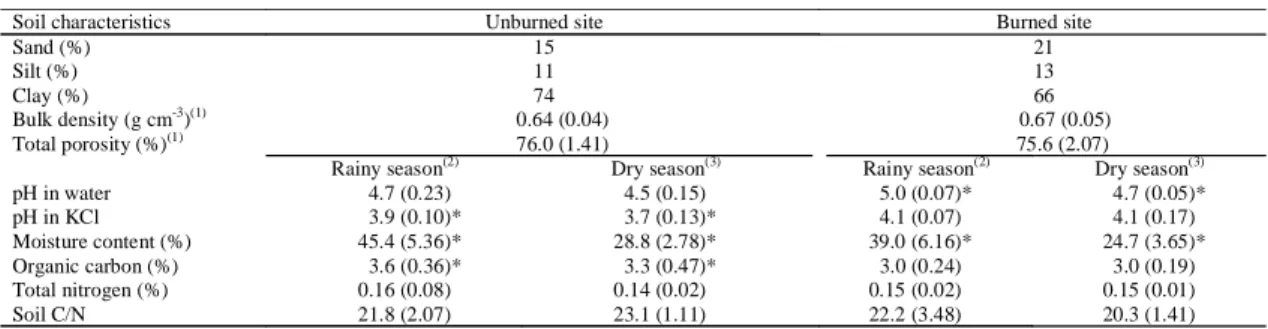
The C/N ratio of the soils studied (22/1) is larger
than the value (20/1) that has been proposed as the
threshold between net mineralization and net
immo-bilization (Killham, 1994) (Table 1). The soil
C/N ratio did not differ significantly between the rainy
and the dry season (P<0.05) in both sites. The
stud-ied soils presented low bulk density, high
permeabil-ity and good aeration as the cerrado soils described
by Luchiari Júnior et al. (1987). In general, the
physi-cal properties of these soils (0 to 5 cm depth) were
not affected by the fire regime applied in the studied
site (Table 1). Raison (1979) showed that severe fires
affected infiltration, water-holding capacity and the
thermal regime of the soil in other ecosystems. In the
Cerrado, however, the residence time of the fire front
is short and changes in soil temperature are small
because the fuel that accumulates is fine grass
(Miranda et al., 1993).
Annual rainfall was greater in 1997 (1,480 mm)
than in 1998 (1,333 mm) and in 1999 (1,207 mm).
Although in 1998 it rained more than in 1999, the
dry season was longer than in 1999, falling less than
13 mm between May and September 1998. Two
small rain events (<1 mm) occurred into the
follow-ing week after the prescribed fire in September 1998.
The first heavy rain event (26.2 mm) was reported
18 days after fire. The soil moisture content was
sig-nificantly higher in the rainy season (October to
April) in both sites (P<0.05) (Table 1). However,
tak-ing into account the whole period sampled, the
un-burned site had higher soil water content at the
0 to 5 cm depth than the burned site. Bustamante
et al. (1998) observed lower soil water content in a
burned cerrado site than in the unburned site until
15 months after the fire. The decrease of surface soil
moisture can be due to the replacement of woody
plants by grasses, which increases the use of water
on the surface layers (Carreira et al., 1994).
In the unburned site, no significant differences
in the pH values (pH in water) were found between
the rainy and dry season (Table 1). However, the
mean pH value (0 to 5 cm depth) for the rainy
pe-riod after the fourth prescribed fire was significantly
higher compared to the dry season (May to
Septem-ber) before fire. This was probably due to the
de-posit of ash on the soil surface at the burned site and
its incorporation into the soils (Kauffman et al.,
1992).
During the rainy season, the organic C at the
0 to 5 cm depth was significantly higher in the
un-burned site (P<0.05) (Table 1). No significant
dif-ference was found in soil total N (0 to 5 cm depth)
between the rainy and the dry season in both sites.
The mean concentration of total N was 0.15% for
both sites.
Four days after fire (September 1998) a
signifi-cant increase of inorganic-N due to an increase in
NH
4-N concentration was measured at the 0 to 5 cm
soil layer (P<0.05) (Figure 1). However, in the
fol-lowing months after the fire, NH
4-N concentration
decreased in comparison to prefire levels. The
NH
4-N concentration ranged between 3 and
34 mg kg
-1in the burned site and between 3 and
22 mg kg
-1in the unburned site. During the dry
pe-riod (May to September), the mean concentration of
NH
4-N at the 0 to 5 cm soil layer was 18.4 mg kg
-1for the burned site and 19.4 mg kg
-1for the unburned
site while in the rainy season it was 6.7 mg kg
-1for
both sites. The NO
3-N concentration showed no
sea-sonal variations in either of the sites, ranging from
1.5 to 2.8 mg kg
-1(Figure 1). This indicated that
inorganic-N levels were higher during the dry
sea-son due largely to accumulation of NH
4-N in the
soil.
Rates of net N mineralization varied along the
year and spatial variability was high within the
stud-ied sites, probably as a result of different deposition
Table 1. Soil physical and chemical characteristics of the cerrado soils studied (0 to 5 cm depth).
Soil characteristics Unburned site Burned site
Sand (%) 15 21
Silt (%) 11 13
Clay (%) 74 66
Bulk density (g cm-3)(1) 0.64 (0.04) 0.67 (0.05) Total porosity (%)(1) 76.0 (1.41) 75.6 (2.07)
Rainy season(2) Dry season(3) Rainy season(2) Dry season(3)
pH in water 4.7 (0.23) 4.5 (0.15) 5.0 (0.07)* 4.7 (0.05)* pH in KCl 3.9 (0.10)* 3.7 (0.13)* 4.1 (0.07) 4.1 (0.17) Moisture content (%) 45.4 (5.36)* 28.8 (2.78)* 39.0 (6.16)* 24.7 (3.65)* Organic carbon (%) 3.6 (0.36)* 3.3 (0.47)* 3.0 (0.24) 3.0 (0.19) Total nitrogen (%) 0.16 (0.08) 0.14 (0.02) 0.15 (0.02) 0.15 (0.01) Soil C/N 21.8 (2.07) 23.1 (1.11) 22.2 (3.48) 20.3 (1.41)
(1)Mean (n = 6; 1SD) values. (2)Mean (n = 21; 1SD) values from October 98 to April 99. (3)Mean (n = 18; 1SD) values from May 98 to September 98.
of organic matter and the nonuniformity of burnings.
Net N mineralization might be directly related to the
total content of N in the soil, to organic matter
qual-ity, to seasonal variations of organic substrates
as-sociated with litter production, and to
environmen-tal conditions (Hossain et al., 1995). Generally, net
N mineralization occurred during the first 30 days
of the in situ incubations (Figure 2). In contrast, the
rates calculated after two months of incubation were
frequently negative – that is, there was net N
immo-bilization. The in situ method is sensitive to
fluctua-tions in environmental condifluctua-tions that may affect the
rates of mineralization as the period of incubation
increases (Adams et al., 1989).
In both sites, variations found in net N
minera-lization rates were due more to availability of NH
4-N in
the soil rather than NO
3-N. Accumulation of NO
3-N
occurred in short periods during the rainy season
(Fig-ures 1 and 3). During the dry period (May to
Septem-ber) mineralization/imobilization processes were
vari-able. After strong net N immobilization in September,
mainly in the burned site, a period of mineralization
was reported during the rainy season, when
maxi-mum values of net N mineralization were found. In
November, the rates of net N mineralization began
to increase, reaching 12.4 mg kg
-1per 30 days in
December 1998 in the unburned site. In the burned
site, the maximum value of net N mineralization was
10.2 mg kg
-1per 30 days in February 1999 (Figure 2).
In general, the net N mineralization rates observed in
this study were similar to those determined for other
seasonal ecosystems (Adams & Attiwill, 1986;
Carreira et al., 1994) but were lower than the rates
found for tropical forests (Vitousek & Matson, 1988;
Verchot et al., 1999). Singh et al. (1989) also observed,
in savannas of Central India, the highest rates
dur-ing the rainy season and lowest rates in the dry
pe-riod, indicating that soil moisture was the control
factor of N mineralization in those ecosystems. Both
sites presented the same pattern for mineralization/
immobilization, but the amount of inorganic-N cycled
annually at the unburned site was 14.7 kg ha
-1per
0 5 10 15 20 25 30 35 40 45 50
Apr.May June JulyAug.Sept. B
Sept. A
Oct.Nov.Dec.Jan.Feb.Mar.Apr.May Time (month) N it rogen ( m g kg -1 ) 1998 1999 Burned 0 5 10 15 20 25 30 35 40 45 50 N it rogen ( m g kg -1) Unburned
Figure 1. Mean concentrations (n = 10; 1SD) of available inorganic-N (NO3--N: and NH4--N: ) at the 0 to 5 cm soil depth of the unburned and burned cerrado stricto sensu sites. The arrow indicates the prescribed fire and samples were taken before (Sept. B) and four days after (Sept. A) the burning.
Apr. May June July Aug. Sept. Oct. Nov. Dec. Jan. Feb. Mar. Beginning of incubation period(month)
N it rog en ( m g kg -1 ) 1999 1998 -30 -20 -10 0 10 20 30 B -30 -20 -10 0 10 20 30 N it rogen ( m g kg -1 ) A
Figure 2. Net N mineralization rates for 0 to 5 cm soil depth, determined from in situ soil samples after 30 days of incubation (n = 10; SE) (A) in the unburned ( ) and burned ( ) sites, and after 60 days of incubation (n = 10; SE) (B) in the unburned ( ) and burned ( ) sites between April 1998 and March 1999. The arrow indicates the pre-scribed fire.
year while at the burned site it was only 3.8 kg ha
-1per year, one year after the burning.
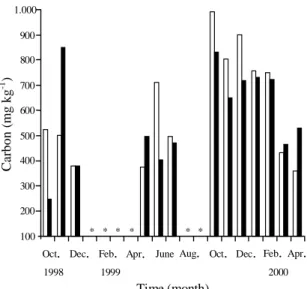
In 1998, the unburned site showed a reduction of
approximately 24% in soil microbial biomass C from
October to December while in the burned site (after
the fire in September) an increase of 3.4 times in
soil microbial biomass C was observed from
Octo-ber to NovemOcto-ber (maximum value of 850 mg kg
-1in
November) with a subsequent decrease of 55.2%
from November to December (Figure 4). In
Decem-ber 1998, both sites presented values of soil
micro-bial biomass C of 350 mg kg
-1. Concomitantly to the
decrease in soil microbial biomass, increases in N
mineralization from December to February occurred
in both sites suggesting a peak of microbial activity
with the first rain events and consequent
immobili-zation followed by a period of mineraliimmobili-zation.
A decrease of soil microbial biomass from October
to December was also observed in 1999 (one year
after the fire). In accordance with other studies
(Rashid, 1987; Bauhus et al., 1993), soils from
burned sites had initially higher soil microbial
ac-tivities than unburned soils, but pools of readily
avail-able C were rapidly depleted. In Californian annual
grassland, the period in which microbial NH
4+utili-zation exceeded production lasted for a month after
the first rain events, when the microbial N
require-ments were satisfied (Schimel et al., 1989). The soil
microbial biomass dynamics in tropical forests and
savannas allows accumulation and conservation of
nutrients in biologically active forms during the dry
period (high biomass, low turnover), when plant
activities are low. At the beginning of the rainy
pe-riod (low biomass, high turnover), nutrients are then
released, being rapidly taken up by plants (Singh
et al., 1989).
The low content in NO
3-N of the soil studied is
probably a consequence of the generally low
avail-ability of mineral N, even though significant
pro-duction of NH
4-N occurred during the incubation
periods. In the presence of plants, competition
be-tween plants and microorganisms for NH
4-N is
prob--5 -4 -3 -2 -1 0 1 2 3 4 5 N it rogen ( m g kg -1 ) A
Apr. May June July Aug. Sept. Oct. Nov. Dec. Jan. Feb. Mar.
Beginning of incubation period (month)
N it roge n ( m g kg -1) B 1998 1999 -5 -4 -3 -2 -1 0 1 2 3 4 5
Figure 3. Net nitrification rates at the 0 to 5 cm soil depth, determined from in situ soil samples after 30 days of in-cubation (n = 10; SE) (A) in the unburned ( ) and bur-ned ( ) sites, and after 60 days of incubation (n = 10; SE) (B) in the unburned ( ) and burned ( ) sites between April 1998 and March 1999. The arrow indicates the pre-scribed fire. 100 200 300 400 500 600 700 800 900 1.000
Oct. Dec. Feb. Apr. June Aug. Oct. Dec. Feb.Apr.
Time (month) C a rbon ( m g kg -1) 2000 1998 1999 * * * * * *
Figure 4. Soil microbial biomass C for 0 to 5 cm depth, in the unburned ( ) and burned ( ) sites, estimated from October 1998 to April 2000, using four replications of monthly composite samples (same soil samples collected for available inorganic-N in the 0 to 5 cm soil interval). The asterisks mean missing data.
ably intense. Hence, the population of nitrifying
bac-teria may be low and the incubation period was
in-sufficient for significant expansions of these
nitrifier populations. In soils of Mediterranean zone
and in Australia, similar results were also explained
by the low density of nitrifiers found in those soils,
and no increase in nitrification after fire was detected
(Prieto-Fernandez et al., 1993). Verchot et al. (1999)
also showed low rates for potential nitrification for
a Cerrado area. Possibly small increases in NO
3-production could be rapidly taken up by plants and
microorganisms, indicating N limitation in the
eco-system (Davidson et al., 1992).
Net N mineralization (Figure 2) and net
nitrifi-cation rates (Figure 3) were highest during the rainy
season but inorganic-N concentrations (Figure 1)
decreased during the rainy season, indicating that
plant uptake draws down inorganic-N stocks and
consumes the N released from net N mineralization
in a conservative N cycle.
Conclusions
1. Burned and unburned sites show the same
pat-tern for mineralization/immobilization, however, the
amount of inorganic-N cycled annually through
min-eralization process is lower in the burned site than
in the unburned site.
2. Variations in the net N mineralization rates are
largely due to availability of ammoniacal nitrogen.
3. Accumulation of nitric N occurs only in short
periods during the rainy season.
4. The peak in microbial activities occurs at the
beginning of the rains, with an initial period of net
N immobilization followed by a period of net N
min-eralization.
Acknowledgements
To Reserva Ecológica do IBGE, for the
precipi-tation data; to Dr. Heloísa Miranda (UnB) and the
staff of Reserva Ecológica do IBGE, for their help
with prescribed fires; to Maria Regina S. da Silva,
for the laboratory assistance and Fabiano Nardoto
and Ricardo Chiba, for their contributions in the
field; to Prof. Geraldo Boaventura (UnB), for the
laboratory facilities; to Dr. Eric Davidson (Woods
Hole Research Center), Dr. Iêda Mendes
(Embrapa-Centro de Pesquisa Agropecuária dos Cerrados) and
two anonymous reviewers, for helpful comments on
this work; to Capes, for the fellowship of Gabriela
Bielefeld Nardoto (Programa de Pós-graduação em
Ecologia – UnB); to FAP-DF, for partial support of
this work.
References
ADAMS, M. A.; ATTIWILL, P. M. Nutrient cycling and nitrogen mineralization in eucalypt forests of southeast-ern Australia – II: indices of nitrogen mineralization. Plant and Soil, Dordrecht, v. 92, p. 341-362, 1986.
ADAMS, M. A.; POLGLASE, P. J.; ATTIWILL, P. M.; WESTON, C. J. In situ studies of nitrogen mineralization and uptake in forest soils; some comments on methodol-ogy. Soil Biology & Biochemistry, Oxford, v. 21, n. 3, p. 423-429, 1989.
BAUHUS, J.; KHANNA, P. K.; RAISON, R. J. The ef-fect of fire on carbon and nitrogen mineralization and ni-trification in an Australian forest soil. Soil Biology & Bio-chemistry, Oxford, v. 31, p. 621-639, 1993.
BUSTAMANTE, M. M. C.; NARDOTO, F. B.; CASTRO, A. A. A.; GAROFALO, C. R.; NARDOTO, G. B.; SILVA, M. R. S. Effect of prescribed fires on the inorganic-N con-centration in soil of cerrado areas and on the assimilation of inorganic-N by woody plants. In: INTERNATIONAL CONFERENCE ON FOREST FIRE RESEARCH, 3., 1998, Coimbra. Proceedings… Coimbra: University of Coimbra, 1998. v. 2, p. 1361-1379.
CARREIRA, J. A.; NIELL, F. X.; LAJTHA, K. Soil ni-trogen availability and nitrification in Mediterranean shrublands of varying fire history and successional stage. Biogeochemistry, Dordrecht, v. 26, p. 189-209, 1994. CRUTZEN, P.; ANDREAE, M. O. Biomass burning in the tropics: impact on atmospheric chemistry and bio-geochemical cycles. Science, Washington, v. 250, p. 1669-1678, 1990.
DAVIDSON, E. A.; HART, S.; FIRESTONE, M. K. In-ternal cycling of nitrate in soils of a mature coniferous forest. Ecology, Washington, v. 73, p. 1148-1156, 1992. EITEN, G. Vegetação do Cerrado. In: PINTO, M. N. (Org.). Cerrado: caracterização, ocupação e perspectivas. Brasília: Ed. Universidade de Brasília, 1994. p. 17-73.
HOSSAIN, A. K.; RAISON, R. J.; KHANNA, P. K. Ef-fects of fertilizer application and fire regime on soil mi-crobial biomass carbon and nitrogen, and nitrogen miner-alization in an Australian subalpine eucalypt forest. Biol-ogy and Fertility of Soils, New York, v. 19, p. 246-252, 1995.
JENKINSON, D. S.; POWLSON, D. S. The effects of biocidal treatments on metabolism in soil – V: a method for measuring soil biomass. Soil Biology & Biochemistry, Oxford, v. 8, n. 3, p. 209-213, 1976.
KAUFFMAN, J. B.; TILL, K. M.; SHEA, R. W. Bio-geochemistry of deforestation and biomass burning. In: DUNRETTE, D. A. (Ed.). The science of global change: the impact of human activities on the environment. Wash-ington: American Chemical Society, 1992. p. 45-58. (Ameri-can Chemical Society Symposium Series, 483).
KILLHAM, K. Soil ecology. Cambridge, England: Uni-versity Press, 1994. 242 p.
KNOEPP, J. D.; SWANK, W. T. Comparison of available soil nitrogen assays in control and burned forested sites. Soil Science Society of American Journal, Madison, v. 59, p. 1750-1754, 1995.
LUCHIARI JÚNIOR, A.; RESENDE, M.; RITCHEY, K. D.; FREITAS JUNIOR, E. de; SOUZA, P. I. M. de. Manejo do solo e aproveitamento de água. In: GOEDERT, W. J. (Ed.). Solos dos cerrados: tecnologias de estratégias de manejo. Planaltina, DF: Embrapa-CPAC, 1987. p. 285-322.
MEIER, M. Nitratbestimmung in Boden-Proben (N-min-Methode). LaborPraxis, Würzburg, p. 244-247, 1991. MIRANDA, A. C.; MIRANDA, H. S.; DIAS, I. F. O.; DIAS, B. F. Soil and air temperatures during prescribed cerrado fires in Central Brazil. Journal of Tropical Ecol-ogy, New York, v. 9, p. 313-320, 1993.
MIRANDA, H. S.; SILVA, E. P. R. e; MIRANDA, A. C. Comportamento do fogo em queimadas de campo sujo. In: MIRANDA, H. S.; SAITO, C. H.; DIAS, B. F. S. (Ed.). Impactos de queimadas em áreas de cerrado e restinga. Brasília: UnB, 1996. p. 1-10.
MULVANEY, R. L. Nitrogen inorganic forms. In: SPARKS, D. L. (Ed.). Methods of soil analyses. Madi-son: Soil Science Society of America, 1996. pt. 3, p. 1123-1184.
POTH, M.; ANDERSON, I. C.; MIRANDA, H. S.; MIRANDA, A. C.; RIGGAN, P. J. The magnitude and persistence of soil NO, N2O, CH4 and CO2 fluxes from
burned tropical savanna in Brazil. Global Biogeochemi-cal Cycles, Washington, v. 9, p. 503-513, 1995. PRIETO-FERNANDEZ, A.; VILLAR, M. C.; CARBALLAS, M.; CARBALLAS, T. Short-term effects in a wildfire on the nitrogen status and its mineralization kinetics in an Atlantic forest soil. Soil Biology & Bio-chemistry, Oxford, v. 25, n. 12, p. 1657-1664, 1993. RAISON, R. J. Modification of the soil environment by vegetation fires, with particular reference to nitrogen trans-formations: a review. Plant and Soil, Dordrecht, v. 51, p. 73-108, 1979.
RASHID, G. H. Effects of fire on soil carbon and nitrogen in a Mediterranean forest of Algeria. Plant and Soil, Dordrecht, v. 103, p. 89-93, 1987.
SALGADO-LABOURIAU, M. L.; VICENTINI, K. R. F. Fire in the Cerrado 32,000 years ago. Current Research in the Pleistocene, Corvallis, v. 2, p. 85-87, 1994. SATO, M. N.; GARDA, A. A.; MIRANDA, H. S. Effects of fire on the mortality of woody vegetation in Central Brazil. In: INTERNATIONAL CONFERENCE ON FOR-EST FIRE RESEARCH, 3., 1998, Coimbra. Proceed-ings… Coimbra: University of Coimbra, 1998. v. 2, p. 1777-1784.
SCHIMEL, J. P.; JACKSON, L. E.; FIRESTONE, M. K. Spatial and temporal effects on plant microbial competi-tion for inorganic nitrogen in a California annual grass-land. Soil Biology & Biochemistry, Oxford, v. 21, n. 8, p. 1059-1066, 1989.
SINGH, J. S.; RAGHBANSHI, A. S.; SINGH, R. S.; SRIVASTAVA, S. C. Microbial biomass acts as a source of plant nutrients in dry tropical forest and savanna. Na-ture, London, v. 388, p. 499-500, 1989.
SOKAL, R. R.; ROHLF, F. J. Biometry: the principles and practice of statistics in biological research. 3rd ed. New York: W. H. Freeman, 1997. 887 p.
SPSS INC. (Chicago, United States). SYSTAT: version 7.0 for Windows. Chicago, 1997. 1 CD-ROM.
VERCHOT, L. V.; DAVIDSON, E. A.; CATTÂNIO, J. H.; ACKERMAN, I. L.; ERICSON, H. E.; KELLER, M. Land use change and biogeochemical controls of nitrogen ox-ide emissions from soils in eastern Amazonia. Global Bio-geochemical Cycles, Washington, v. 13, n. 1, p. 31-46, 1999.
VITOUSEK, P. M.; MATSON, P. M. Nitrogen transfor-mations in a range of tropical forest soils. Soil Biology & Biochemistry, Oxford, v. 20, p. 361-367, 1988.