Juliana Justino de Andrade
October of 2012Universidade do Minho
Escola de Ciências
UMinho|20 12Juliana Justino de Andr
ade
Self-assembled noncovalent hydrogels
based on dehydrodipeptides
Self-assembled nonco
valent h
ydrogels based on deh
ydrodipep
Juliana Justino de Andrade
October of 2012
Universidade do Minho
Escola de Ciências
This work was accomplished under the supervision of:
Paula Margarida Vidigal Soares Teixeira Ferreira
José Alberto Ribeiro Martins
Master dissertation in Medicinal Chemistry
Self-assembled noncovalent hydrogels
based on dehydrodipeptides
Autora:
Juliana Justino de Andrade
E-mail: [email protected]
Dissertação de Mestrado em Ciências. Área de Conhecimento: Química Medicinal.
Título: Hidrogéis preparados a partir da automontagem de desidrodipéptidos.
Ano de Publicação: 2012.
Orientadores:
Paula Margarida Vidigal Soares Teixeira Ferreira.
José Alberto Ribeiro Martins.
É AUTORIZADA A REPRODUÇÃO PARCIAL DESTA TESE APENAS PARA EFEITOS
DE INVESTIGAÇÃO, MEDIANTE DECLARAÇÃO ESCRITA DO INTERESSADO, QUE A TAL SE COMPROMETE;
Universidade do Minho, ___/___/______
“A felicidade aparece para aqueles que choram. Para aqueles que se machucam. Para aqueles que buscam e tentam sempre. E para aqueles que reconhecem a importância das pessoas que passam por suas vidas.” Clarice Lispector
v
Acknowledgements
I would like to thank my supervisors Paula Margarida Ferreira and José Alberto Martins for all the support during the development of this work. I definitely will keep a special place for them in my heart and will remember all the lessons taught by them.
I am grateful to the Chemistry Department and Chemistry Center of the University of Minho for providing the technical and human conditions that made this work possible. I take special pleasure in acknowledge Professor Rui Brito from the Department of Chemistry, University of Coimbra, for providing the conditions for the CD study.
I really owe sincere thankfulness to my laboratory colleagues Goreti and Helena who helped me with important discussions about the work and with some procedures that were crucial for having all work done successfully.
To my department friends Janaina, Alexandra, Raquel, Gonçalo and António I offer my gratitude for all special moments spent together and for receiving me open heartily during my mobility. These fellows really made it easier to accomplish this work and gave me courage to overcome difficulties.
I am truly indebted and thankful to my special friends Ana Luisa Rodrigues and Jorge Manuel Ferreira that were like rocks to me and with whom I could count during all my stay in Portugal. They are angels that appeared to light my way and to make my journey less arduous.
Finally, but not less relevant, I would like to thank my parents, my sister, my family and brazilian friends that always believed me and gave all the love and strength I needed to carry on following my dreams, mainly in the most difficult moments.
vi
Abstract
Self-assembly of nanometric structures from molecular building blocks is an effective way to make new functional materials for biological and technological applications. In this work we synthesized new N-modified dehydrodipeptides based on phenylalanine and dehydroamino acid units attached to aromatic modifiers, namely trimesoyl, terephtaloyl, diphenylacetyl and 2,2´-(1,3-phenylene)diacetyl in a pattern that afforded mono or polysubstitued organic molecules. The potential use of these new compounds as hydrogelators was evaluated. The results showed that most of the prepared compounds behave as efficient molecular hydrogelators forming hydrogels at minimum gelation concentrations of 0.3-0.8 wt%.
Two new compounds failed to form hydrogels probably due to unfavorable thermodynamic contribution of intermolecular interactions.
The self-aggregation pattern of the hydrogelators was investigated by STEM microscopy technique, revealing different shapes depending on the N-aromatic moiety. A circular dichroism analysis was also performed in order to evaluate if the peptides aggregate into any characteristic secondary structure, usually found in protein folding. We found that the 5 hydrogelators had characteristic signals, demonstrating the presence of organized structures even below the minimum gelation concentration. At elevated pH or for the non-hydrogelating compounds, it was not observed signals indicative of the presence of such structures.
vii
Resumo
A automontagem de estruturas manométricas, a partir de entes de dimensão molecular, consiste em uma alternativa eficiente para a síntese de novos materiais funcionais para aplicações biotecnológicas.
Neste trabalho, foram sintetizados novos desidrodipéptidos modificados em sua porção N-terminal. Os dipéptidos continham fenilalanina e desidroaminoácidos e os grupos modificadores foram grupos aromáticos (trimesoil, tereftaloil, difenilacetil e o 2,2´-(1,3-phenileno)diacetil) os quais foram conjugados de forma a gerar compostos mono ou polissubstituídos. A capacidade de gelificar em meio aquoso, destes novos compostos, foi avaliada e os resultados mostraram que a maioria deles conseguiram gelificar em meio aquoso em concentrações mínimas na faixa 0.3-0.8 m%.
Dois destes compostos não conseguiram originar hidrogéis, provavelmente devido a um balanço termodinamicamente desfavorável das interacções intermoleculares entre os constituintes do sistema.
O padrão morfológico resultante da auto-agregação dos compostos que geraram os hidrogéis foi investigado pela técnica de microscopia electrónica de transmissão por scaneamento (STEM). Esta análise revelou que houve a ocorrência de diferentes tipos de estruturas nos hidrogéis, dependendo de qual modificador aromático foi utilizado. Também realizou-se uma análise de Dicroísmo Circular para avaliar se os péptidos agregavam-se em algum padrão de estrutura secundária característica de enovelamento proteico. Detectou-se que nos 5 agentes gelificates haviam sinais característicos da presença de estruturas organizadas mesmo abaixo da concentração de gelificação mínima. Em pH elevado e nas moléculas não gelificantes, não se observam sinais indicativos da presença deste tipo de estruturas.
viii
Table of contents
Acknowledgements ... v Abstract ... vii Resumo ... viii Table of contents ... ixList of abbreviations and symbols ... xii
List of Illustrations ... xiv
List of Tables ... xvi
1. Introduction ... 1
1.1 Gels and Hydrogels ... 1
1.2 Classification of hydrogels. ... 3
1.3 LMWGs and self-assembly process ... 4
1.4 Design of LMWGs ... 6
1.5 Methods for the characterization of hydrogels ... 15
2. Objectives ... 21
3. Results and discussions ... 23
3.1 Synthesis of the modified α,β-insaturated peptides ... 23
3.2 Synthesis of the dehydropeptides ... 24
3.3 Peptide coupling to the aromatic modifiers ... 27
3.4 Attempt to reach the final compounds bearing the catecholamine derivatives (25) and (27) ... 35
3.5 Hydrogel preparation ... 39
3.6 Characterization of hydrogels ... 41
3.6.1 Scanning transmission electron microscopy (STEM) ... 41
3.6.2 Circular dichroism analysis ... 45
4. Conclusions and future perspectives ... 47
5. Experimental section ... 48
ix
5.1.1 Synthesis of H-L-Thr-OMe·HCl (3a): ... 49
5.1.2 Synthesis of H-DL-Phe(β-OH)-OMe·HCl (3b) ... 49
5.1.3 Synthesis of Boc-L-Phe-OH (4) ... 50
5.1.4 Synthesis of Boc-L-Phe-L-Thr-OMe (6a) ... 51
5.1.5 Synthesis of Boc-L-Phe-DL-Phe(β-OH)-OMe (6b) ... 51
5.1.6 Synthesis of Boc-L-Phe-∆Abu-OMe (7a) ... 52
5.1.7 Synthesis of Boc-L-Phe-∆Phe-OMe (7b) ... 53
5.1.8 Synthesis of H-L-Phe-Z-∆Abu-OMe,TFA (8a) ... 53
5.1.9 Synthesis of H-L-Phe-Z-∆Phe-OMe,TFA (8b) ... 54
5.2 Coupling of the dehydrodipeptides to the organic modifiers ... 54
5.2.1 Synthesis of compound 13a ... 54
5.2.2 Synthesis of compound 13b ... 55
5.2.3 Synthesis of compound 14a ... 56
5.2.4 Synthesis of compound 14b ... 57 5.2.5 Synthesis of compound 15 ... 57 5.2.5.1 Method 1 ... 57 5.2.5.1.1 Synthesis of 22 ... 58 5.2.5.1.2 Synthesis of 23 ... 59 5.2.5.1.3 Dehydration of 23 ... 59 5.2.5.2 Method 2 ... 60
5.2.6 Synthesis of compound 16a ... 61
5.2.7 Synthesis of compound 16b ... 61
x
5.2.8.1 Acetylation of the caffeic acid (CA) ... 62
5.2.8.2 Coupling of the diacetylated caffeic acyl chloride to the dehydrodipeptide 8b ... 63
5.2.9 Synthesis of compound 26 ... 64
5.2.9.1 Acetylation of the dihydrocaffeic acid (DHCA) ... 64
5.2.9.2 Coupling of the diacetylated dihydrocaffeic acyl chloride to the dehydrodipeptide 8b ... 64
5.3 Basic hydrolysis of the methyl esters ... 65
5.3.1 Synthesis of compound 17a ... 66
5.3.2 Synthesis of compound 17b ... 66
5.3.3 Synthesis of compound 18a ... 67
5.3.4 Synthesis of compound 18b ... 67
5.3.5 Synthesis of compound 19 ... 68
5.3.6 Synthesis of compound 20a ... 68
5.3.7 Synthesis of compound 20b ... 69
xi
List of Abbreviations and Symbols
% Percentage °C Celsius degrees 2D Bidimensional 3D Tridimensional aa Amino acid Abs Absorvance Abu Aminobutyric acid ACN Acetonitrile
Ar Aromatic
Boc tert-butylcarbonyl
Boc2O Di-tert-butyl dicarbonate br. s broad singlet
CD circular dichroism CDCl3 Deuterated chloroform
cgc Critical gelation concentration CH2Cl2 Dichloromethane d Doublet DCC Dicyclohexylcarbodiimide dd double doublet DHD Dehydrodipeptide DMAP 4-dimethylaminopyridine DMF Dimethylformamide
DMSO-d6 deuterated dimethylsulfoxide Fmoc 9-fluorenylmethoxycarbonyl g Grams G´ storage modulus G´´ loss modulus Gly Glycine h Hours
HMBC Heteronuclear Multiple Bond Coherence HOBt Hydroxybenzotriazole
HSQC Heteronuclear Multiple Quantum Coherence
Hz Hertz
J coupling constant
LMWGs Low molecular weight gelators m Multiplet
m Meta
M Molar (mmol/mL) m.p. melting point
xii mg Miligrams MHz Megahetz min Minutes mL Mililitre mmol Milimol Nap Naphtalene NHS N-hydroxysucinimide nm Nanometer
NMR Nuclear magnetic resonance 13
C-NMR Nuclear magnetic resonance of 13C 1
H-NMR Nuclear magnetic resonance of 1H
o Ortho
p Para
pH Hydrogenionic potencial Phe Phenylalanine
ppm Parts per million
q Quartet
r.t. Room temperature
s Singlet
STEM Scanning electron microscopy
t Triplet
TEA Triethylamine TFA trifluoracetic acid THF Tetrahydrofurane Thr Threonine
t.l.c Thin layer chromatography
TMG N,N,N,N’ – tetramethylguanidine
UV Ultraviolet Val Valine
δ Chemical shift
∆Abu Dehydroaminobutyric acid ∆Phe Dehydrophenylalanine µm Micrometer
xiii
List of Illustrations
Figure 1 Data retrieved from Web of science with the search “Self-Assembled Low
Molecular Weight Hydrogels” - until June of 2012. ... 1
Figure 2 Log-log plot of storage modulus, G'(ω), and loss modulus, G"(ω), versus angular frequency for a 13.9% (w/w) solution of polystyrene in
di(2-ethylhexyl) phthalate ... 2
Figure 3 Schematic representation of different aggregation modes for peptide-based
molecular hydrogelators. ... 6
Figure 4 Series of hierarchical structures based on β-sheet fibres depending on the
concentration. ... 7
Figure 5 β-harpin structure: (A) peptidic sequence; (B) cartoon scheme of the β-harpin
turn ... 8
Figure 6 Schematic representation of a dimeric coiled-coil ... 9 Figure 7 (A) Basic overall chemical structure of a peptide amphiphile. (B) Cartoon
representation showing the supramolecular arrangement of the peptide amphiphiles ... 9
Figure 8 Schematic diagram of nanotube assembly from cyclic D,L-peptides ... 10 Figure 9 Chemical structure of one amphiphile peptide synthesized by Hartgerink et al
... 11
Figure 10 Molecular modeling of the structures formed from the peptides with
negatively charged heads and glycine tail ... 11
Figure 11 Peptide I: amino acid sequence and molecular model of
RADA16-I ... 12
Figure 12 Examples of π-stacking inducing groups frequently employed in the
synthesis of hydrogelators. ... 13
Figure 13 CD spectra of poly-L-lysine and placental collagen. ... 16 Figure 14 Class of C2-symmetric compounds synthesized in this work as potential hydrogelators. ... 19
Figure 15 Class of C3-symmetric compounds synthesized in this work as potential hydrogelators. ... 19
Figure 16 DHD monosustitued derivatives containing diphenylacetyl N-capping
organic modifiers, synthesized in this work as potential hydrogelators. ... 20
Figure 17 Chemical structure of dihydrocaffeic acid (DHCA) and caffeic acid (CA)
molecules used as organic modifiers in this work. ... 20
Figure 18 Mechanism for the DMF-catalyzed conversion of the carboxylic acid
functional group into an acyl chloride via the Vilsmeier-Haack intermediate. ... 30
Figure 19 1H-NMR (400MHz) spectrum of compound 13b in DMSO... 33
Figure 20 1H NMR (400 MHz) spectrum of compound 20a in DMSO. ... 34
Figure 21 1H NMR (400 MHz, DMSO) spectrum for compound 19 with added TFA. 35
Figure 22 1H-NMR (400 MHz, DMSO) spectrum for compound 24... 36
xiv Figure 24 HRMS (ESI positive ionization) for the product obtained in the hydrolysis of
compound 24. ... 38
Figure 25 HRMS (ESI, positive ionization) for the product obtained in the hydrolysis of
the compound 27. ... 38
Figure 26 Structures of the modified peptides that were hydrogelators under the tested
conditions. ... 39
Figure 27 Hydrogels formed by hydrogelators 17b (A), 18a (B), 19 (C), 20a (D) and 20b (E). ... 41 Figure 28 STEM images of the hydrogels formed by compounds 17b, 18a, 19, 20a and 20b. ... 42 Figure 29 Reversible transition between peptide nanotubes and vesicle-like structure. 44 Figure 30 CD spectra of hydrogelators 17a, 17b, 18a, 8b, 19, 20a and 20b;
hydrogelator 17b at pH 6 , hydrogelator 17b at pH 12, hydrogel of compound 17b .... 45
Scheme 1 Schematic diagram for (A) polymeric hydrogel and (B) molecular hydrogel. 4 Scheme 2 Chemical structures of the synthesized dehydrodipeptide derivatives. ... 21 Scheme 3 Caffeic acid (25) and dihydrocaffeic acid (27) peptide derivatives designed in
this work as potential hydrogelators. ... 22
Scheme 4 Overview of the synthetic methodology employed for the synthesis of
potential dehydropeptide hydrogelators. ... 23
Scheme 5 Retrosynthetic analysis for the synthesis of the dehydrodipeptides
Boc-L-Phe-Z-∆Abu-OMe (8a) and Boc-L-Phe-Z-∆Phe-OMe (8b). ... 24
Scheme 6 Activation of the carboxylic acid group with a carbodiimide reagent and
possible side reactions. ... 26
Scheme 7 Mechanism for the DCC/HOBt coupling reaction. ... 26 Scheme 8 Structure of the compounds obtained from the coupling reaction of 8a and 8b
with organic modifiers. Isolated yields (%) are also indicated... 28
Scheme 9 Synthetic route to compound 15. ... 31 Scheme 10 Mechanism of DCC/NHS coupling. ... 31 Scheme 11 Synthetic route for the coupling of dehydropeptide 8b with caffeic acid
(CA) and dihydocaffeic acid (DHCA) leading to the compounds 24 and 26... 36
Scheme 12 Representation of the spherical packing hypothesis for compound 19. The
xv
List of tables
Table 1 Study of the effect of solvents on the isolated yield of the coupling reaction
between organic modifiers 9 and 10 and dehydrodipeptides 8a and 8b. ... 29
1
1.
Introduction
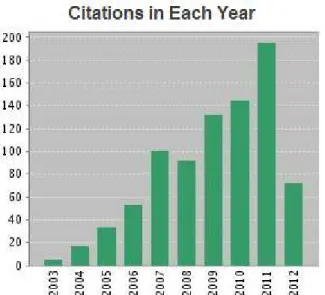
The search for new self-assembling low molecular weight hydrogelators is attracting an increasing interest of the scientific society1. Searching the web of science data base, with the topic “Self-Assembled Low Molecular Weight Hydrogels” reveals that the number of citations is getting higher over the years (Figure 1). This can be ascribed mainly to the versatility of these materials for biomedical purposesowing to their rapid response to external stimuli, thermoreversible nature, and potential biodegradability2, 3.
1.1. Gels and Hydrogels
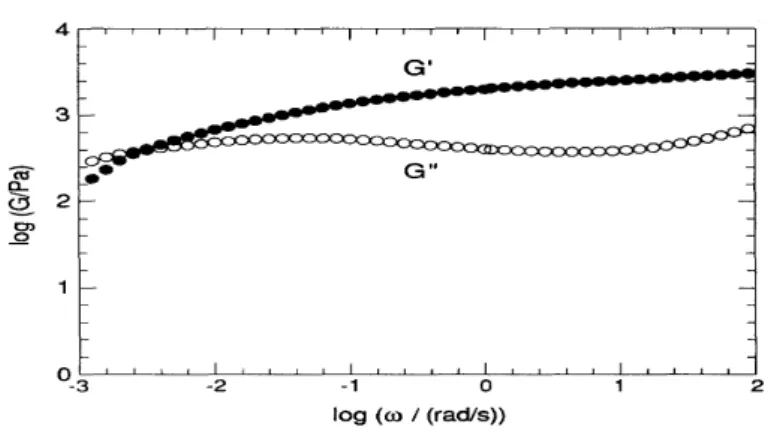
According to Almdal et al4 a gel is a soft solid or solid-like colloidal system composed of a solid dispersed in a liquid. From the rheology point of view, gels can be characterized by a well-pronounced plateau in G'(ω) with G'(ω) > G"(ω) in a wide range of frequencies. Besides this, the transition of the gel material to a liquid behavior must occur at sufficiently low frequencies, i.e. when the longest relaxation time is, at least, in the order of seconds. This behavior is observed in Figure 2 for a polymeric gel material:
Figure 1 Data retrieved from Web of science with the search “Self-Assembled Low Molecular
2
this material enters the terminal zone, i.e the region characteristic of the liquid-like behavior, at angular frequencies less than 10-3 rad/s, which corresponds to a terminal relaxation time in the order of 103 s; in this polymer, G'(ω) exhibits a plateau extending to frequencies lower than 1 rad/s, i.e. times longer than 1 s, and G'(ω) is much larger than G"(ω).
One specific type of gel are the hydrogels, which are soft materials composed of a three dimensional scaffold made of a hydrophilic network, capable of encapsulating water molecules, and retaining a large amount of fluids in the swollen state4. Their ability to absorb water is attributed to the presence of hydrophilic functional groups such as –OH, –CONH–, –CONH2–, and –SO3H in polymers forming hydrogel structures5.
Figure 2 Log-log plot of storage modulus, G'(ω), and loss modulus, G"(ω), versus
angular frequency for a 13.9% (w/w) solution of polystyrene in di(2-ethylhexyl) phthalate4.
3 1.2. Classification of hydrogels
Generally speaking, hydrogels can be classified taking into account many aspects, such as the nature of side groups (neutral or ionic), mechanical features, manufacture process (homopolymerization or co-polymerization), physical structure (amorphous, semicrystalline, hydrogen bonded, supramolecular and hydrocolloidal) and responsiveness to physiologic environment stimuli (pH, ionic strength, temperature, electromagnetic radiation, etc.).6,7
Based on the macromolecular architecture of the gel network, hydrogels can be divided into covalent or noncovalent hydrogels:
a) Covalent hydrogels or chemically cross-linked hydrogels are formed due to reticulation of hydrophilic polymers or by the irreversible cross-linking of the polymeric structure through covalent bonds. These links result from chemical or photo-initiated polymerization, disulfide bond formation, catalyzed metathesis or other chemical reaction8,9.
b) Noncovalent hydrogels or physically cross-linked hydrogels are composed most frequently of ribbons, fibers and tubules that aggregate by anisotropic self-assembly of structures guided by noncovalent inter or intramolecular interactions such as hydrogen bonds, Van der Waals, Coulombic or dipole interactions, π–π stacking or hydrophobic interactions9,10,11. The self-assembling units can be cross-linked polymers or low molecular weight gelators (LMWGs) and in this sense they are called molecular or supramolecular hydrogels (Scheme 1)12.
4
Scheme 1 Schematic diagram for (A) polymeric hydrogel and (B) molecular hydrogel.12
1.3. LMWGs and self-assembly process.
LMWGs include bioactive molecules such as amino acids or peptides, usually with molecular weight bellow 1000 Da. The literature13-15 reports that this kind of system is more biocompatible than the ones manufactured by the polymeric approach, being incorporated in a wide variety of biomedical devices in many areas such as:
- Cell scaffolding for tissue engineering – as media for cell differentiation, molecular hydrogels offer the advantage of a 3D scaffold for ex vivo growth of cultured tissue cells12. This is an expressive advantage compared to the usual 2D growth procedures, which fail to reproduce the in vivo environment for cell differentiation. For example, it is common to find serious perturbations in gene activation and protein expression processes with 2D growth procedures16. Authors mention that the success in using biocompatible molecular noncovalent hydrogels results from the dynamic nature of the network of fibrils which allows the material to spontaneously adjust to the surrounding environment12. Each type of cell culture requires a different medium with specific mechanical properties17, stimulating much research in the design and synthesis of structurally diverse LMWGs candidates.
5
- In the pharmaceutical technology field: the intrinsic network of hydrogels can protect drugs from environmental factors, like the presence of enzymes or different pH environments found in living organisms. Hydrogels can also control drug release through gel structural changes trigged by sol-gel phase transition processes18.
- In regenerative medicinal processes: this approach is based on the ability of this kind of colloidal systems to assist cell adhesion, promote growth of neurons or to direct bone mineralization19.
Molecular self-assembly can be described as the spontaneous formation of ordered structures under thermodynamic and kinetic control, through noncovalent interactions between molecules20,21. Hierarchical nanostructures or macroscale fragments arise from the self-association process.
Self-assembly is crucial for life maintenance processes, like the organization of phospholipids into biological membranes, DNA double helix assembly through hydrogen bond interactions, disposal of microtubules or microfilaments along the cellular life cycle phases. It also gives rise to the amyloid fibrils, which are proposed to be the cause of neurological diseases like Alzheimer´s21.
Despite the high number of publications reporting the preparation of noncovalent self-assembled hydrogels, there is a lack of understanding on how media composition determines the properties of colloidal network structures and about the laws that govern the dynamics of molecular gelation phenomena. In other words, there is a need for the development of a relationship between the noncovalent forces that drive self-assembly processes and hydrogelation22.
Amongst self-assembling LMWGs systems, peptide-based molecular hydrogelators attracted the most extensive research efforts, owing probably to its
versatile synthetic pathways, excellent gelation ability, good biocompatibility and easy tuning of bioactivity23-25.
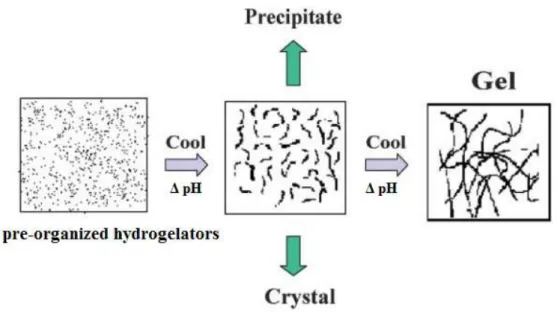
When peptide molecules start to assemble, in response to pH changes or by cooling super-saturated media, three situations are possible (Figure 3): (A) crystallization, in response to highly ordered packing; (B) formation of amorphous precipitate or (C) an aggregation process yielding a gel. The process of gelation involves self-association of
6
molecules to form long, polymer-like fibrous aggregates, which get entangled during the aggregation process leading to a matrix that traps solvent, mainly by surface tension. This process prevents the flow of solvent under gravity and the material appears like a solid26.
Figure 3 Schematic representation of different aggregation modes for peptide-based
molecular hydrogelators.26
1.4. Design of LMWGs.
Observing the protein motifs pattern, researchers realized that peptide self-assembly is driven by intermolecular interactions, such as hydrogen bonding, ionic, electrostatic, hydrophobic and Van der Waals interactions. Knowledge from molecular and structural biology has inspired the design and synthesis of increasingly complex self-assembled biomaterials for biomedicine and bionanotechnology. By engineering the amino acid sequence, the secondary structure of peptides can be manipulated to optimize interactions between adjacent peptides. Long-range organization of peptide monomers produces nanofibrils which aggregate into 3D fibrous networks27.
7
There are many strategies to design self-assembling molecular materials based on peptides and their derivatives. For peptides containing at least ten amino acids, the supra-molecular structures observed are more frequently coiled-coils (α helical based systems), β-sheets, β-hairpins, π-stacking systems and peptide amphiphiles 28a.
β-sheets consist of multiple peptide chains displaying an extended backbone arrangement that permits hydrogen bonding between the backbone amides and carbonyls. Each chain is referred to as a strand; the hydrogen bonded strands are referred to as a sheet. β-sheets can be orientated so that all their C-termini are at one end of the structure, described as a parallel structure, or so that the N and C termini alternate, described as an anti-parallel structure. β-sheets are well known for their ability to assemble into long fibrous structures. A number of different hierarchical structures can be formed from β-sheet peptides: tapes, ribbons, fibrils and fibres, all of which vary in the number of sheets that pack together to form the final structure28a (Fig 4). For a given peptide sequence, the formation of higher order structures is controlled by peptide and salt concentration. Increasing peptide concentration allows a higher assembly level.
Figure 4 β-sheet based fibres can form a series of hierarchical structures depending on
the concentration. These structures range from the basic peptide structure (a) as a monomer (b) which assembles into a tape (c and c´), two of which can bury hydrophobic residues by forming a ribbon (d and d´). Ribbons can further assemble by
8
lying face to face to form fibrils (e and e´) and additionally side by side to form fibres (f and f´). Adapted from Ref. 27a 28a.
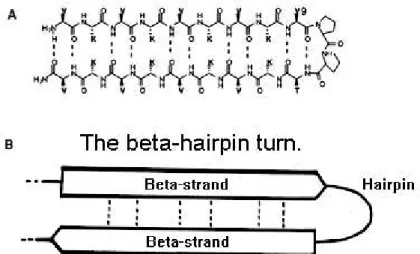
β-hairpins consist of two short β-sheet sequences linked by a turn sequence (Fig. 5). This motif consists of two antiparallel β-strands, adjacent in the primary structure, linked by a short loop of two to five amino acids. β-hairpins can occur isolated or as part of a series of hydrogen bonded strands that collectively compose a β-sheet.
Figure 5 β-harpin structure: (A) peptidic sequence showing hydrogen bonds and a
proline bridge which characterizes the harpine turn; (B) cartoon scheme of the β-harpin turn. Adapted from Reference 28a28a.
For the purpose of self-assembly, α-helices are used as components of coiled-coils. The coiled-coil has characteristic amino-acid heptad repeats designated as a to g in one helix and a´ to g´ in the other. The hydrophobic residues occupy positions at the interface of the two helices (a, d and a´, d´) whereas e, g and e´, g´, which are usually solvent exposed polar residues, give specificity between the two helices through electrostatic interactions (Fig. 6). Coiled-coils provide an opportunity to prepare peptide-based nanofibrous structures based on well established design rules derived from natural systems28b.
9
Figure 6 Schematic representation of a dimeric coiled-coil: (A) top view of the helical wheel
representation, down the axis of the α-helices from N-terminus to C-terminus; (B) side view. The residues are labeled a-g in one helix and a´-g´ in the other28b.
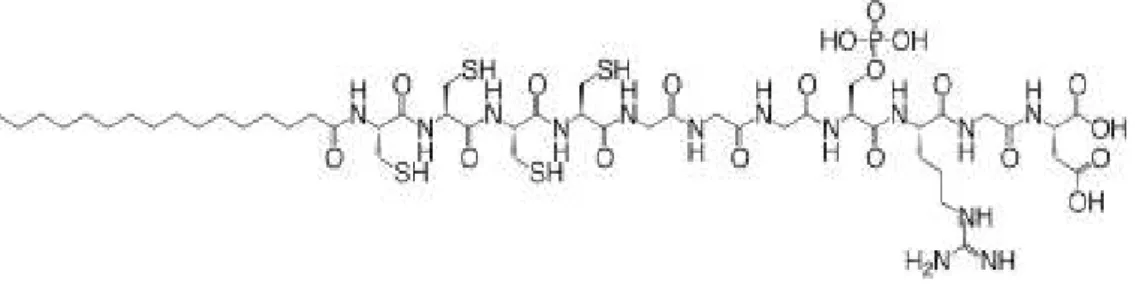
Peptide amphiphiles are oligo-peptides modified with a hydrophobic alkyl tail to form molecules with distinctly hydrophobic and hydrophilic ends, similar to lipids. The basic overall chemical structure of a peptide amphiphile and its self-assembly into macrostructures is shown in Figure 7. The alkyl tails form the hydrophobic core of the nanostructures. A glycine based sequence is required for providing hydrogen bonding links in order to put the structure together, whereas the outer polar residues ERGDS (glutamic acid, arginine, glycine, aspartic acid and serine) in the peptide are free to adopt a random structure.
Figure 7 (A) Chemical structure of a peptide amphiphile. (B) Cartoon representation showing
the supramolecular arrangement of the peptide amphiphiles: (a) the alkyl chains form the core; (b) glycine linker and (c) polar head groups28a.
10
Taking into account the motifs present in naturally occurring proteins, scientists have moved towards designing new short self-assembling peptides amenable to functionalization27.As peptides are so versatile building blocks, small peptides or even single modified amino acids can self-assemble into networks, capable of entrapping water and form hydrogels. This bottom-up approach lays its foundation on the high level of self-assembly specificity of peptides, which is mainly dependent on the recognition of intermolecular interactions between side chains in the peptide sequence.
Fibers29,30, tapes31, tubes32 and spheres33 are the main types of nanostructures designed and built from low molecular weight hydrogelator species. One possible approach to prepare supramolecular hydrogels from LMWGs is the use of cyclic peptides designed with an even number of alternating of D- and L-amino acids, that interact with each other to form nanotube arrays as shown by Ghadiri et al34a.When protonated, these compounds crystallize into tubular structures with hundreds of nanometers long and internal diameters of 7–8 Å (Figure 8).
Figure 8 Schematic diagram of nanotube assembly from cyclic D,L-peptides34b.
Amphiphilic peptides are also being used to prepare nano-assemblies as demonstrate by Hartgerink et al35. This author used self-complementary ionic peptides, which pack into a β-sheet conformation, to prepare self-assembled nano-fibers35 (Figure 9).
11
Figure 9 Chemical structure of one amphiphilic peptide synthesized by Hartgerink et al35.
Zhang et al36 investigated four GnD2 peptides, composed of a well-defined hydrophilic aspartic acid (D) sequence linked to a glycine (G) hydrophobic fragment (where n = 4, 6 or 8). They found that these surfactant-like peptides represent another example of hydrogelators that self-assemble into nanotubes and nanovesicles in water at neutral pH (Figure 10). The glycines are packed inside of the bilayer away from water and the aspartic acids are exposed to water, much like other surfactants.
Figure 10 Molecular modeling of the structures formed from the peptides with negatively
charged heads and glycine tail. (A)Peptide nanotube and B)Peptide nanovesicle. Color code: red, negatively charged aspartic acid heads; green, nonpolar glycine tail36.
In addition, Yokoi et al. reported the assembly of the ionic self-complementary peptide RADA16-I (Figure 11) into a nanofiber scaffold composed of β-sheet structures that eventually becomes a hydrogel consisting of more than 99.5% of water37.
12
Figure 11 Peptide RADA16-I: amino acid sequence and molecular model of RADA16-I; Ac:
acetyl moiety; A: alanine; D: aspartic acid and R: arginine37.
Nowadays, there is a trend for basing the design of LMWGs in the ability of peptide molecules to pack each other via aromatic-aromatic interactions. There are many examples in literature showing that the hydrogel forming ability of short peptides (di or tripeptides) or even single amino acids, is significantly enhanced by π-π stacking
interactions. Some works point out that this kind of aromatic interaction is likely to
impart the ideal balance between hydrophilicity of polar groups, responsible for solubility, and hydrophobicity attributed to non-polar groups which is relevant to the self-assembly of peptides38. π-π Stacking interactions are found in amyloid peptides, which contain the phenylalanylphenylalanine motif. This dipeptide is able, on its own, to self-assemble into stable peptide nanotubes39, believed to be the cause of Alzheimer´s disease.
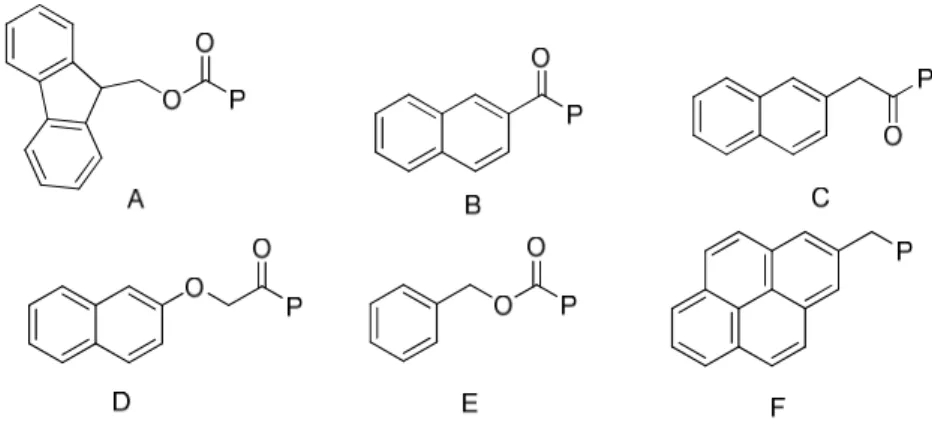
Amongst reports exploring the π-stacking feature, there are important results related to the chemical coupling of a variety of aromatic groups to short peptides. Linking aromatic groups such as fluorenyl24,40 (A), naphthyl19,41 (B, C and D), benzyl42,43 (E) or pyrenyl44 (F) to the N-terminus endows some peptides, and even single amino acids, with the ability to form stable hydrogels45(Fig. 12).
13
The hydrophobicity of the peptides is another relevant parameter determining gel formation capacity. Johnson et al. mention that dipeptides should display ideal hydrophobicity, expressed by the value of log P, to become potential hydrogelators43. These authors report that weak and unstable gels are formed by peptides with log P values below 2.8, whereas dipeptides with log P values above 5.5 appeared too hydrophobic to form homogeneous gels. At intermediate values of log P (3.4–5.5), all dipeptides assembled yielding gels of similar strengths46.
In addition to π-stacking and molecular hydrophobicity, there are many works demonstrating the importance of the hydrogen bonding interaction for the self-assembly process of supramolecular hydrogels. Many considerations have arisen in the literature about the pKa control of the hydrogelation process43,46. Some works show that carboxilated peptides form gels depending on the extent of protonation of this functional group and that gelification occurs when the carboxylic acid is protonated46,47. One interesting observation is that dipeptides cross-linked in a hydrogel network, display pKa values superior to the free solvated peptides in aqueous media. The incorporation of the carboxylic acids into an highly hydrophobic environment is a reasonable explanation48. Another theory is that the increment in pKa results from stabilization of the carboxylic acid group by the neighboring dispersed dipeptides43.
Another interesting observation is that seemingly minimal modifications, such as permutation of the C- and N-terminal amino acids in peptide sequences, can result in completely different materials as shown by Cheng et al49. These authors describe
Figure 12 Examples of π-stacking inducing groups frequently employed in the
14
that the hydrogel formed by tripeptide Fmoc-Lys-Leu-Val-OH is composed by a network of fibrils while the Fmoc-Val-Leu-Lys-OH hydrogel shows high level of alignment in its fibrils. An additional example is provided by Adams et al50, who found that the dipeptide Nap–Ala–Gly–OH is able to form hydrogels by just tuning pH, whilst Nap–Gly–Ala–OH precipitates under the same conditions. Molecular modeling based on X-ray diffraction studies, suggests that the different behavior observed for peptides Nap–Ala–Gly–OH and Nap–Gly–Ala–OH could be ascribed to different conformations and hydrogen bond preferences.
The degradation kinetics of hydrogels´s matrix has to be taken into account in the design of hydrogelators. In this context, it is reasonable to assume that hydrogels formed by natural proteinogenic peptide sequences are prone to degradation by endogenous proteolitic enzymes. Introducing non proteinogenic amino acids into peptide sequences could be useful to increase the proteolitic stability of hydrogels. Peptides bearing non proteinogenic amino acids are being investigated in our research group and in other research groups as potential hydrogelators. Non proteinous β-amino acids, namely β-alanine residues, have recently been incorporated into dipeptide hydrogelators. This modification yielded enzyme resistant hydrogels, which were used as matrix for controlled-release of vitamins B12 and B2 at physiologic conditions51. A supramolecular hydrogel based on (non natural) D-amino acids, resistant to proteinase K catalysed-hydrolysis and exhibiting, thus, long-term bio-stability and in vivo controlled drug release, was prepared by Xu et al.52
The introduction of non proteinogenic amino acids into peptides was also explored by Gupta et al53 who evaluated the self-assembly process of a dipeptide made
of phenylalanine and α,β-dehydrophenylalanine. This non-coded achiral amino acid is known to introduce constraints into molecular structures54,55,56. Non-proteinogenic peptides offer the advantage of being less susceptible to enzyme degradation. Moreover, non proteinogenic amino acids can add a positive contribution to the balance of the thermodynamic forces that modulate peptide aggregation and water swelling processes. More rigid structures should lead to a lower reduction in entropy when molecules self-assemble.
Hydrogels with intrinsic medicinal properties can be created by incorporating known therapeutic motifs, as organic modifiers, into hydrogelators. Anti-oxidants such
15
as catechol-derivatives have been introduced into chitosan/pluronic composite hydrogels. These materials revealed improved tissue adhesion, characteristic of this type of hydrogels, ideal for developing drug delivery systems, tissue engineering applications or even as tissue adhesives to arrest bleeding57.
1.5. Methods for characterization of hydrogels
The usual methods for characterizing the molecular arrangement of nanofibrils in hydrogels are inherently low-resolution9. UV-vis absorption, Fourier Transform Infrared spectroscopy (FTIR), fluorescence and circular dichroism (CD) spectroscopy can be used to evaluate the characteristics of the secondary structure and electronic properties of these materials58.
FTIR spectroscopy is employed to confirm the presence of H-bonds and determine the protonation state of carboxylic acids59-62. The C=O and N-H stretching vibration bands from terminal carboxyl and amide groups directly reflect their ionization state and potential involvement in hydrogen bonds62,63. Some bands of interest (like NH stretch) can appear overlapping the OH stretch of water. Thus, FTIR analysis of hydrogels is often performed using dehydrated samples. These outputs need to be analyzed with caution, since structural modifications may occur due to water loss.
UV/Vis characterization of hydrogels is usually conducted using two different approaches. One possibility is to incorporate spectroscopic fluorescent probes into gelators64,65. This is an effective design strategy; the large, flat aromatic surfaces of fluorophores are likely to promote aggregation and, at the same time, a powerful tool for evaluating the aggregation hydrophobic pockets66. UV/Vis is also used to detect changes of hydrophobicity in the surroundings of reporter groups. Both, intrinsic reporter groups, making part of the gelator molecule, or added extrinsic probes, can be used to identify π-π stacking or metal coordination trigged aggregation58.
The secondary structure content of protein aggregates is an important parameter as specific secondary structures are characteristic of different stages in aggregation
16
pathways. For example, in β-amyloid peptide, associated with Alzheimer´s disease, monomers and small oligomers have been found to consist of mainly disordered/α-helical structures; intermediate fibrillar oligomers are annular protofibril and ending fibril conformers contain mostly β-sheet secondary structure.
A single, straightforward protocol is not currently available to estimate the content of each type of secondary structure in self-assembled peptide structures. Instead, researchers employ a host of scientifically acceptable approaches to estimate secondary structure content from raw Circular Dichroysm (CD) and FTIR data. CD is an analysis technique that measures differential absorption of right and left polarized light while FTIR analyzes molecular bond vibration frequencies67-69. Comparing general features of CD or FTIR spectra with controls or “expected” results, often allows to infer secondary structure changes or to quantify overall secondary structure content of proteins70a. Illustrative examples of CD spectra characteristic of β-sheet, α-helix, and unordered/random coil secondary structures are shown in Figure 13 for the polypeptide poly-L-lysine and for the placental collagen protein70b.
In a typical protein CD spectrum, there is a weak but broad n-π* transition centered around 210 nm and an intense π-π* transition about 190 nm. Studies of far UV
Figure 13 CD spectra of poly-L-lysine: (1) α-helical conformation (black), (2) anti-parallel β-sheet
conformation at pH 11.1 (red), (3) extended conformation at pH 5.7 (green) and placental collagen: (4) native triple-helical (blue) and (5) denatured forms (cyan). Note that the extended conformation of poly-L-lysine was described as a random coil70b.
17
In a typical CD spectrum of a protein, there is a weak, but broad, n-π* transition centered around 210 nm and an intense π-π* transition about 190 nm. Studies of far UV CD can be used to assess quantitatively the overall secondary structure content of the protein, since it has been known for many years that the different forms of regular secondary structure found in peptides and proteins exhibit distinct spectra70c.
The near UV CD of proteins arises from the environments of each aromatic amino acid side chain as well as possible contributions from disulphide bonds or non-protein cofactors which might absorb in this spectral region. Small model compounds of the aromatic amino acids exhibit CD spectra because the chromophore is linked to the nearby chiral α-carbon atom. In the case of proteins in their native states, the side chains of these amino acids will be placed in a variety of asymmetric environments characteristic of the tertiary structure of the folded protein. A number of factors can influence the CD spectra of aromatic amino acids. Among these are: the rigidity of the protein, with the more highly mobile side chains having lower intensities; the nature of the environment in terms of hydrogen bonding, polar groups and polarizability. In addition the CD spectrum can be altered by interactions between aromatic amino acids which are especially significant if the distance between them is less than 1 nm. In the “exciton coupling” model, two excited states of chromophores, in close proximity, result from exciton mixing of the two strong transitions; the states correspond to symmetric and antisymmetric combinations of the excited state wave functions. The two resulting CD bands will overlap with some cancellation (the extent of which depends on the size of the interaction), giving rise to a sigmoidal CD curve. A final factor is the number of aromatic amino acids in a protein. Proteins with large numbers of such amino acids can have smaller CD bands than might be expected because of cancelling effects of positive and negative contributions70c.
TEM, cryo-TEM and SEM are electron microscopy techniques useful to elucidate fibril dimension and morphology, parameters relevant to infer length-to-mass information about fibril building blocks22. Diffraction methods, including small-and wide-angle X-ray, neutron and electron diffraction are appropriate to reveal the molecular packing distances in the nanostructures and its dimensions in situ9.
18
However, to establish a better relationship between monomer structure, assembled nanostructures and emergent hydrogel properties, it´s imperative to apply high-resolution structural characterization methodologies9.
Crystallographic techniques are suitable for characterizing the atomic structure of molecules. However, in order to be analyzed by these methods, the peptide hydrogelators have to be crystalline materials, which often is not the case, as observed for the amyloid peptides. That’s why sometimes is hard to implement this method for the characterization of peptide self-assembled materials22,71. Moreover, it is necessary to take into consideration that the scattering pattern obtained from single crystals differs from that obtained from the nanofibers that compose hydrogels. Despite these observations, it is accepted that single crystals provide good approximations of the hydrogel state and that crystallographic methods are a powerful tool to allow further insight into the architecture of self-assembled hydrogels at the molecular level72,73.
Solution phase NMR is ineffective for investigating self-assembled materials as hydrogelator assembly into higher order structures broadens NMR signals due to anisotropy effects74,75. On the other hand, the successful application of solid state (SS-NMR) to the analysis of amyloid fibrils76, gives rise to the possibility of using this methodology to analyze hydrogels on its native gel state. Isotopic labeling bidimensional SS-NMR methods have been shown effective for mapping β-strand motifs in several amyloid-forming proteins77-79. This opens the possibility of characterizing cross-β fibril structures, which have many similarities to the nanofibers observed in hydrogels´s network.
The information acquired through both low and high resolution techniques, can give more robust insight into the parameters that govern the self-assembling process. These techniques can provide constraints crucial for the development of computational models that can describe hydrogels systems and help to design new hydrogelators displaying desirable rheological properties or targeted behavior features. This kind of approach has been implemented to develop theoretical models to the amyloid systems, and seems satisfactory9.
This work reports the synthesis and characterization of new modified peptides that contain phenylalanine and a dehydroamino acid and investigates their potential as hydrogelator agents. The temperature and pH dependence of the gelification process
19
were also evaluated. The organic modifiers were chosen aiming to increase the aromatic character of the peptides, which could lead to more efficient hydrogelators suitable as biomaterials.
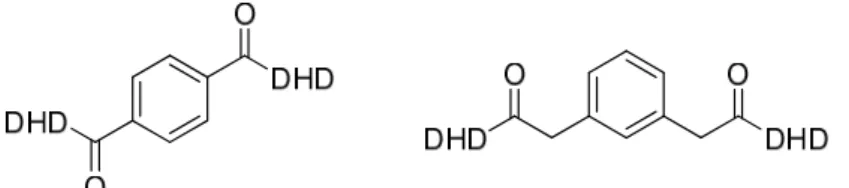
For this purpose, multi substituted (bi and tri substituted) benzene derivatives were designed by attaching the above mentioned dehydrodipeptides (DHD) to the modifiers trough amide linkages. The new molecules have C2 (Fig. 14) or C3 (Fig. 15) symmetry. These molecular architectures can be interesting for generating different patterns of cross-linked networks, which could influence the water trapping process. Moreover, the presence of multiple carboxylic domains can also make the hydrogels highly responsive to pH changes.
Figure 14 Class of C2-symmetric compounds synthesized in this work as potential
hydrogelators. O O O DHD DHD DHD
Figure 15 Class of C3-symmetric compounds synthesized in this work as potential
hydrogelators.
Recently, our research group discovered that conjugating dehydrodipeptides of these type with naphtyl motifs results in highly efficient hydrogelators with a monosubstitued pattern. In this sense, this work also includes the synthesis of monosubstitued molecules, where dehydrodipeptides are attached to the aromatic diphenylacetyl moiety
20
(Fig. 16). Our aim was to evaluate the effect of this different modifier on the gelation efficacy.
Figure 16 DHD monosustitued derivatives containing diphenylacetyl N-capping organic
modifiers, synthesized in this work as potential hydrogelators.
Another class of monosubstituted derivatives was designed using catechol-derivatives, caffeic acid (CA) and dihydrocaffeic acid (DHCA), as aromatic modifiers (Figure 17). The catechol moieties could impart therapeutic properties to hydrogels, as these anti-oxidant compounds are known to display anti-inflammatory, antimutagenic, and anticarcinogenic activities80. Another potential advantage is that chatecol motifs are known to enhance tissue adhesion, making the hydrogels suitable for incorporation into many biomaterials57.
The supra-molecular architecture of the prepared gels was studied using Scanning Transmission Electron Microscopy (STEM) and circular dichroism.
Figure 17 Chemical structure of dihydrocaffeic acid (DHCA) and caffeic acid (CA)
molecules used as organic modifiers in this work.
21
2. Objectives
Taking into account the experience of our research group in peptide chemistry, and especially in the synthesis of dehydroamino acids and dehydropeptides, we designed seven new modified dehydropeptides based on the attachment of different aromatic groups to dehydrodipeptides, through amide linkage.
The dipeptides synthesized in this work are composed of phenylalanine (Phe) linked to a dehydrophenylalanine (∆Phe) or dehydroaminobutyric acid (∆Abu) unit. Trimesoyl, terephtaloyl, 2,2´-(1,3-phenylene)diacetyl and diphenylacetyl derivatives were chosen as aromatic modifiers (Scheme 2). These modifiers were chosen aiming to take advantage of the thermodynamically favorable aromatic-aromatic interaction in water, which plays an important role in protein stabilization and probably is also important to direct the self-assembly of small molecules in water.
22
In addition, we have designed two other hydrogelators (Scheme 3) composed of the above mentioned dehydrodipeptide Phe-∆Phe, N-capped with caffeic and dihydrocaffeic acid. The catechol-derivatives were chosen owing to their known medicinal properties and their potential of improving tissue adhesion.
HO OH O N H H N O O OH HO OH O N H H N O O OH 25 27
Scheme 3 Caffeic acid (25) and dihydrocaffeic acid (27) peptide derivatives designed in this
work as potential hydrogelators.
We envisaged that the incorporation of the selected aromatic structures into dehydropeptides could enhance the propensity of the molecules to pack and form cohesive efficient hydrogel networks. Furthermore, we anticipated that hydrogels bearing more than one free carboxylic acid functional group could show an improved behavior towards water swallowing.
The non proteinogenic residues may make these structures more resistant to enzymatic hydrolysis. They could be also responsible for introducing conformational constraints into these new structures, leading to improved mechanical and chemical properties.
Finally, we expect that the information gained in the synthesis and characterization of the new materials will contribute to expand the understanding of the driving forces for self-assembly of peptide hydrogelators.
23
3. Results and Discussion
3.1. Synthesis of the modified α,β-insaturated peptides
The synthetic strategy employed in this work is based on coupling dehydrodipeptides to aromatic acyl chloride moieties, followed by ester hydrolysis under alkaline conditions, which resulted in the final dehydropeptides derivatives (Scheme 4).
Scheme 4 Overview of the synthetic methodology employed for the synthesis of potential
24 3.2. Synthesis of the dehydropeptides
The production of the α,β-dehydroamino acids was the key step in the synthetic
route. Amongst all the methods described in literature for the synthesis of α,β-dehydroamino acids, the most widespread is the dehydration of β-hydroxyamino
acids, like serine or threonine, which yield the corresponding ∆Ala and ∆Abu residues81-83. Other methodologies include the Hoffman degradation of α,β-diaminopropionyl residues84, hydrolysis of unsaturated oxazolinones, reduction of azidoacrylates85 or condensation of α-ketoacids with amines or nitriles86,87. However, most of these are low-yielding, multistep and non stereospecific methods, requiring a lot of effort to remove side products.
In this work, we have used methodologies developed in our research group for the synthesis of the α,β-dehydroamino acid synthetic blocks88. These consisted of 4-dimethylaminopyridine (DMAP) catalyzed reaction of β-hydroxyamino acids with tert-butyl pyrocarbonate [Boc2O], followed by treatment with N,N,N’,N’-tetramethylguanidine
(TMG), which is known to lead to dehydroamino acids in high yields. The retrosynthetic pathway for the synthesis of dehydropeptides 8a and 8b is presented in Scheme 5.
L-phenylalanine (1) was protected with the tert-butoxycarbonyl group (Boc) using Boc2O in a water/dioxane mixture. The methyl esters of DL-threonine (2a) and DL-3-phenylserine (2b) were prepared in high yields from the corresponding amino
acids.
Coupling, using the dicyclohexylcarbodiimide (DCC) and hydroxybenzotriazol (HOBT) standard procedure, between tert-butoxycarbonylphenylalanine (Boc-L-Phe– OH- 4) and methyl 3a and 3b afforded the corresponding dipeptides Boc-L-Phe-Thr(β-OH)-OMe (5a) and Boc-Phe-Phe(β-Boc-L-Phe-Thr(β-OH)-OMe (5b) with 52% and 78% yield, respectively. The byproduct dicyclohexylurea (DCU) precipitates from the reaction mixture as the reaction progresses.
25
Scheme 5 Retrosynthetic analysis for the synthesis of the dehydrodipeptides
Boc-L-Phe-Z-∆Abu-OMe (8a) and Boc-L-Phe-Z-∆Phe-OMe (8b).
Carbodiimide activation of amino acid derivatives often results in partial racemization of the amino acid. This happens because the intermediate O-acyl ureas are highly reactive and can lead to oxazolone intermediates, which rearrange giving undesired racemized products (Scheme 6).
26
Scheme 6 Activation of the carboxylic acid group with a carbodiimide reagent and possible side
reactions. I: rearrangement of the N-acyl urea derivative; II: racemization (P = protecting group, R = lateral chain of the amino acid, R2 = carbon chain of the coupling amino acid; R3 = alkyl
chain of the carbodiimide compound).
To avoid this problem is useful to add to the reaction mixture one molar equivalent of 1-hydroxybenzotriazole (HOBt). The active hydroxybenzotriazole esters, formed as intermediates, couple to primary amines with little racemization. The mechanism is shown in Scheme 7.
27
Dipeptides 5a and 5b were dehydrated by treatment with 1.1 molar equivalent of Boc2O in the presence of a catalytic amount of DMAP. Without being isolated, the resulting O-tert-butylcarbonyl peptides 6a and 6b were reacted with TMG affording dedydrodipeptides 7a and 7b in good yields. DMAP catalyzes the acylation process promoted by the di-tert-butyldicarbonate reactant to yield O-tert-butyl carbonates which finally were dehydrated (in a one pot reaction) by the use of TMG. This reaction step appears to be stereospecific towards the more thermodynamically stable Z-isomer.
The stereochemistry of the α,β-dehydroamino acids was elucidated by NOE difference experiments, irradiating the α-NH protons and observing a NOE effect on the β-methyl or β-phenyl protons.
The Boc group was removed by treatment with trifluoracetic acid (TFA) (which protonates the nitrogen in the amide functional group, resulting in release of CO2 and formation of t-butanol side-product) giving the desired products 8a and 8b as trifluoracetate salts with 87% and 92% yield, respectively.
3.3. Peptide coupling to aromatic modifiers
The N-deprotected dehydrodipeptides 8a and 8b were coupled to trymesoyl chloride (9), tereftaloyl chloride (10), 2,2´-(1,3-phenylene)diacetyl chloride (11) and diphenylacetyl chloride (12) to yield methyl esters 13a, 13b, 14a, 14b, 15, 16a and 16b (Scheme 8).
28
Scheme 8 Structure of the compounds obtained from the coupling reaction of 8a and 8b with
organic modifiers. Isolated yields (%) are also indicated.
It was anticipated that the synthesis of multi-substituted hydrogelators based on the organic modifiers trimesoyl (9) and terephtaloyl (10) could reveal more challenging than the synthesis of simpler mono-substituted hydrogelators owing to steric crowding and unfavorable entropy contribution to the process.
In order to optimize the reaction yield, four different solvents were tested in the coupling reactions between peptides and the multi-substituted organic modifiers 9 and
10. The best choice for both dehydrodipeptides was dry THF which afforded the highest
29 Table 1 Study of the effect of solvents on the isolated yield of the coupling reaction
between organic modifiers 9 and 10 and dehydrodipeptides 8a and 8b. The dielectric constants (ε) and dipole moments (µ) of the applied solvents are also exposed.
Solvent µ ε Yield* % 13a 13b 14a 14b Toluene 0.36 2.4 12 13 15 11 CH2Cl2 1.6 9.08 22 18 33 27 THF 1.75 7.6 52 46 67 59 Acetonitrile 3.92 38 30 23 43 37
Dielectric constants and dipole moments in debye units from the compilation of solvent properties in J. A. Riddick and W. B. Bunger, eds., Organic Solvents, Vol. II of Techniques of Organic Chemistry, 3rd Edition, Wiley-Interscience, New York, 1970.
*isolated yields.
For the reactions studied, solvents that display high dipole moment and high dielectric constant afforded the best yields, indicating that the tetrahedral charged quaternary intermediate is probably better stabilized during the reaction pathway. The highest solubility of the TFA salts in polar solvents is another factor that can validate these data. However, acetonitrile which has the highest values of the above mentioned physical properties is not the best choice. This may be because the triethylamine hydrochloride by-product is more soluble in this solvent. In THF this by-product precipitates and this may push the equilibrium into product direction.
Refluxing at 80 °C for several hours was necessary to accomplish full substitution of the “multivalent” organic modifiers, whilst monosubstitued products 16a and 16b were synthesized at room temperature in higher yield. This probably reflects unfavorable entropy contributions to this type of reaction: there are more reactants species than products.
Compound 11 was generated in situ from the corresponding carboxylic acid and used without any purification. In this step, the carboxylic acid was reacted with SOCl2 in the presence of DMF as catalyst to afford the Vilsmeier-Haack intermediate which reacts with the carboxylic acid to give the acyl chloride (Figure 18).
30
Figure 18 Mechanism for the DMF-catalyzed conversion of the carboxylic acid functional
group into an acyl chloride via the Vilsmeier-Haack intermediate.
Compound 15 was also generated by another route (Scheme 9): the carboxylic acid group of 2,2'-(1,3-phenylene)diacetic acid (21) was activated by DCC/NHS (N-hydroxysuccinimide) and the active ester intermediate was reacted with (L)-Phe-OH
(4). In the second step, compound 22 was coupled to (DL)-Phe-(β-OH)-OMe (3b) via
DCC/HOBt standard procedure. In the third step, compound 23 was dehydrated using the same procedure as described before.
31
Scheme 9 Synthetic route to compound 15: compound 21 was first reacted with L-H-Phe-OH
(4) in basic media, than the isolated product 22 was coupled with (DL)-Phe-(β-OH)-OMe (3b). The product 23 was dehydrated affording 15.
The DCC/NHS carboxylic activation process occurs according to the Scheme 10, where initially a reactive O-isoacyl urea (III) is formed which reacts with NHS (IV) to give a moderately stable ester (V) that react with the amine (VI) affording the correspondent amide (VII).
R O H O N N (H2C)5HC CH(CH 2)5 R O O N H N (H2C)5HC (H2C)5HC
Unstable reactive O-isoacyl urea
N O H O O N-hydroxylsuccinimide R O O N O O Semi-stable NHS ester N H2 R' R N H O R' AMIDE I II III IV V VI VII
32
The 1H-NMR spectrum showed clear evidence of amide linkage formation without any evidence of isomerization of the target compounds. In Figure 19 is presented the spectra of compound 13b. Characteristic signals and features, common to all dehydrodipeptide conjugates, are briefly discussed:
- The β protons (yellow) of phenylalanine appears as double doublets (dd) in the range of 3.0-3.3 ppm. These protons are classified as diasterotopic protons due to the presence of the chiral center at the α-carbon. There is a strong coupling between these geminal hydrogens and they couple with the α-proton with significantly different coupling constants. The α-proton and the β-protons have to be evaluated as an ABX system and the spectrum needs to be seen as a second order one. A and B represent the CH2 β-protons which have similar chemical shifts and X corresponds to the α-proton that displays a significantly different chemical shift. The one that is less shielded couples with a higher coupling constant with the α-proton and its dd have a more complicated pattern because the relation ∆νβH-αH/JβH-αH is lower than the one for the other germinal proton; - The ester protons (green) appear around 3.6-3.7 ppm as a singlet;
- The α-proton (orange) appears as multiplet in the range of 4.7-5.0 ppm and results from the couplings with the diasterotopic protons of the β-CH2 and with the α-NH
- The aromatic protons appear in the region of 7.0-8.4 ppm;
- The amide proton (blue), that results from the coupling, has its signal around 8.6-9.0 ppm and is a doublet, because it couples with the α-proton;
- The amide ∆Phe α-NH proton (red) or the ∆Abu α-NH one appears as a singlet between 9.5 and 10.0 ppm.
33 Figure 19 1H-NMR (400MHz) spectrum of compound 13b in DMSO.
One peculiarity of dehydropeptide derivatives composed of phenylalanine and dehydropenylalanine is that the signal of the β-CH of ∆Phe (pink) appears in the aromatic region as a broad singlet.
The dehydropeptide derivatives containing the dehydroaminobutyric amino acid display the same pattern in the 1H-NMR spectra as described above, with the difference that the β-CH of ∆Abu gives a quartet around 6.5-6.7 ppm and the γ-CH3 protons appear in the region between 1.5 and 1.7 ppm as a doublet. These protons can be considered an A3X system (two magnetic and chemically different groups of protons) originating a first order like spectrum with a coupling constant around 7.2 Hz in all compounds.
The final step in the synthesis involves ester hydrolysis under alkaline conditions in dioxane. The carboxylic acid derivatives were tested for hydrogel formation, as potential hydrogelators. In Figure 20 is shown the 1H-NMR spectrum for hydrogelator
20a. H N N O O N H O N O O O O O NH HN O O O O H H H H H H´ H
34 Figure 201H NMR (400 MHz) spectrum of compound 20a in DMSO.
The signal assigned to the methyl ester protons in its precursor compound 16a disappeared confirming the success of the hydrolysis reaction. In Fig. 20 are evidenced again the peculiar features described before for compounds that carry the ∆Abu motif. Apart the characteristic signals, the NMR spectrum shows a singlet around 5.0 ppm that is assigned to proton Hc, which appears also for compounds 16a, 16b and 20b.
The 1H-NMR spectra of compounds 15 and 19 display the same pattern discussed above, except for the fact that they contain signals assigned to the geminal CH2 protons linking the central ring to the amide carbonyl, relative to the coupling to the dehydrodipeptide. These protons appear as two sets of doublets in the range of 3.2-3.4 ppm with coupling constants of 13.8 Hz. These characteristic features can be seen in the 1
H-NMR spectrum of compound 19 in Figure 21. It is noteworthy that the doublet signals are only apparent in the 1H NMR spectrum after addition of one TFA drop into the NMR tube, in order to shift the water peak towards the low field region.
35 Figure 211H NMR (400 MHz, DMSO) spectrum for compound 19 with added TFA.
3.4. Attempt to synthesize the catechol-containing compounds 25 and 27.
The phenolic groups of caffeic acid and dihydrocaffeic acid were acetylated to avoid undesirable side reaction during the synthetic route. The next step was to activate the carboxylic acid group through the same procedure used for the synthesis of the compound 11, using SOCl2 and DMF as catalyst under a 80°C reflux for 4h. The correspondent acyl chlorides were taken without any purification and coupled with 8b. These steps are shown in Scheme 11 and the spectra of the compounds 24 and 26 are shown in Figure 22 and 23, respectively.
36
Scheme 11Synthetic route for the coupling of dehydropeptide 8b with caffeic acid (CA) and dihydocaffeic acid (DHCA) leading to the compounds 24 and 26.
37 Figure 231H NMR (400 MHz, DMSO) spectrum for compound 26.
Besides the characteristic signals assigned to the dehydopeptide moiety, the 1 H-NMR spectrum of the caffeic acid derivative (24) displays signals assigned to the Hi
proton at 6.67 ppm and to the Hh proton within the aromatic region. The protons Hg of
the acetyl motif are found as singlets at 2.28 and 2.27 ppm.
The 1H-NMR spectrum of the dihydrocaffeic derivative (26) shows that the couplings constants between the diasterotopic protons Hj and Hk or Hl and Hm are too
small to be seen giving give rise to two sets of triplets with a coupling constant of 7.9 Hz.
The final step on the synthetic sequence involved alkaline cleavage of the acyl protecting groups on the catechol moieties and of the methyl ester group using NaOH and dioxane. High resolution mass spectrometry analysis of the hydrolysis products of compounds 24 and 26 showed that besides the expected mass for target molecules 25 (m/z = calcd. for C27H24N2O6 472.1634; found 473.1707 [M + 1]) and 27 (m/z = calcd. for C27H26N2O6 474.1791; found 475.1864 [M + 1]), many more peaks displaying higher m/z values are apparent as clusters, strongly suggesting that polymerization