Original Article
RBAFSSOCIEDADE BRASILEIRA DE ATIVIDADE FÍSICA E SAÚDE Brazilian Journal of Physical Activity and Health
RBAFS
Revista Brasileira de Atividade Física & Saúde SOCIEDADE BRASILEIRA DE ATIVIDADE FÍSICA E SAÚDE Brazilian Journal of Physical Activity and Health
RBAFS
Revista Brasileira de Atividade Física & Saúde SOCIEDADE BRASILEIRA DE ATIVIDADE FÍSICA E SAÚDE
Brazilian Journal of Physical Activity and Health
Physical activity and gait kinematics
in the elderly
Atividade física e cinemática da marcha
em idosos
Victor Edgar Pitzer Neto1
Airton José Rombaldi1
Mirelle de Oliveira Saes2
Fernando Vinholes Siqueira1
AbstrAct
The paper proposed to analyze the gait kinematics of different physical activity levels. A cross-sectional study, with 60 seniors, divided according to level of physical activity into groups of active, insufficiently active and inactive seniors. The kinematic parameters inves-tigated in gait were stride length, gait speed, distance between the ground and the hallux and the angles of the hip, knee and ankle. Kinovea 0.8 and ImageJ were used for photo-grammetric data analysis and STATA 9.2 was used for statistical analysis. Average stride length, gait speed and distance between the hallux and the ground were significantly higher among physically active seniors. As for the ankle joint angle, during the gait phase referred to as toe-off, the angle was greater in the active group (82.98, SD 5.96) compared with the inactive group (86.05, SD 5.44) (p=0.025). Average knee joint angles in degrees during the toe-off phase were 151.02 (SD 10.03) in the active group, 151.12 (SD 7.79) in the insuffi-ciently active and 143.35 (SD 7.08) (p= 0.006) in inactive group. In the acceleration phase the results were 126.81 (SD 7.26), 123.81 (6.60) and 130.4 (6.94) in each group (p=0.015), respectively. Our findings demonstrated that physical activity is important to reduce chan-ges to gait caused by the natural aging process. Physical activity should therefore be wi-dely encouraged among the elderly as a preventive and health promotion in measure this population.
Keywords
Motor Activity; Photogrammetry; Elderly; Gait Kinematics.
resumo
O estudo objetivou analisar a cinemática da marcha de idosos de diferentes níveis de atividade física. Trata-se de um estudo transversal, com 60 idosos, divididos conforme o nível de prática de atividade física em ativos, insuficientemente ativos e inativos. Os parâmetros cinemáticos investigados na mar-cha foram o comprimento do passo, a velocidade da marmar-cha, a distância entre solo e o hálux e os ângu-los das articulações do quadril, joelho e tornozelo. Para análise dos dados fotogramétricos utilizou-se os programas Kinovea 0.8 e ImageJ e para as análises estatísticas foi utilizado o Programa STATA 9.2. Os resultados mostraram que o valor médio do comprimento do passo, da velocidade da marcha e da distância entre o hálux e o solo foram significativamente maiores entre os idosos fisicamente ativos. Quanto à angulação (graus) da articulação do tornozelo, observou-se que durante a fase da marcha denominada saída dos dedos, houve um aumento na angulação entre os idosos do grupo ativo (82,98; DP 5,96) quando comparado com os inativos (86,05; DP 5,44) (p=0,025). Na articulação do joelho, durante fase de saída dos dedos, as médias em graus foram de 151,02 (DP 10,03) no grupo ativo, 151,12 (DP 7,79) nos insuficientemente ativos e de 143,35 (DP 7,08) (p=0,006) nos inativos, e na fase de aceleração os resultados foram de 126,81 (DP 7,26), 123,81 (6,60) e 130,4 (6,94), entre os grupos avaliados (p=0,015), respectivamente. Nossos achados demonstram que a prática de atividade física é importante para diminuir as alterações da marcha oriundas do processo natural de envelhecimento.
PAlAvrAs-chAve
Atividade motora; Fotogrametria; Idoso; Cinemática da marcha.
Rev Bras Ativ Fís Saúde p. 243-251
DOI
http://dx.doi.org/10.12820/rbafs.v.20n3p243
1 Federal University of Pelotas, Postgraduate Program in Physical Education, Pelotas, Rio Grande do Sul, Brazil
2 Federal University of Rio Grande, Medicine Faculty, Postgraduate Program in Science Health, Rio Grande, Rio Grande do Sul, Brazil.
IntroductIon
The demographic and epidemiological transitions occurring in Brazil, char-acterized by a reduction in fertility and mortality rates, a reduction in mortal-ity associated with infectious agents and an increase in mortalmortal-ity from non-communicable chronic diseases, mean that there is an increasing number of functionally active elderly people in our society1,2. However, as people get
older, important physiological changes take place, such as decreased muscle strength and motor coordination, leading to alterations in locomotion and limitations in doing everyday activities3.
As we get older problems relating to gait become more frequent and as such observing gait is one of the resources most used to verify problems relating to locomotion4. Alterations in the gait of elderly people are an important factor
regarding limitations in performing everyday activities5. In physiological terms,
aging is accompanied by a decrease in muscle contraction capacity, principal-ly the quadriceps muscles, hip extensor muscles and ankle dorsiflexor muscles. This alters the amplitude of the movement of the lower limbs and results in a re-duction in gait efficiency, characterized by a decrease in gait length and speed6,7.
Studies report biomechanical alterations such as a reduction in the am-plitude of ankle joint movement and in stride length, height and speed. These are important predictors of falls among the elderly8,9. The prevalence of falls
among elderly Brazilians is around 30% and is in first place among external causes of death10-12.
Physical activity is one way of reducing gait alterations brought on by aging and it is indicated with the aim of improving balance and offering functional capacity enabling independence in everyday activities13. A study
conducted with 118 elderly people with different levels of physical activity found that fall prevalence was lower in the most active group of elderly people (47.4%) when compared to less active elderly people (71.4%)14. Another study
assessing the influence of physical activity on the gait of the elderly found that those who undertook physical activity showed a significant difference both in relation to gait and to balance13.
Furthermore, several different studies have shown that the frequent and systematic practicing of physical activity is beneficial to the aging process, miti-gates reduction in muscle strength, aerobic resistance, balance and flexibility15-17.
However, although the use of sensitive measures to physical activity, studies have using the variable in the dichotomized form (active versus inactive). In this sense it is necessary to evaluate the effects of insufficiently physical activity practice in relation to aspects of the gait, as some studies have shown to go from inactive to insufficiently active would be enough to obtain health benefits 18.
In view of the above and given the importance of evaluating gait and physical activity among the elderly, this study aims to analyze gait kinematics among active, insufficiently active and inactive elderly people.
methods
A quantitative, exploratory cross-sectional study was conducted with a sample of elderly people aged 60 or over having different levels of physical activity, i.e. active, insufficiently active and inactive.
The sample was selected from the database of the Elderly Physical Activ-ity Department of the Physical Education course of the Federal UniversActiv-ity of Pelotas (NATI - UFPEL). First, all the elderly people taking part in the study were characterized using the International Physical Activity Question-naire (IPAQ)–long form, with regard to their leisure time physical activity profile determined in minutes per week. Active elderly people were consid-ered to be those who achieved recommended physical activity of 150 minutes/ week19. Sample participants were systematically selected to comprise each of
the study’s groups. Those doing physical activities for 150 minutes or more a week were included in the active group, whilst those reporting 10 to 149 minutes of physical activity a week were included in the insufficiently active group. The selection of the elderly forming the inactive group used a strate-gy of pairing by neighbourhood, gender and age, taking the group of active elderly people as the reference. Starting from the household of each active elderly person, a search was made for an inactive elderly person meeting the age and gender criteria. The neighbourhood criterion was ensured given that the starting point for the search was the house of an active elderly person. To be selected, the inactive elderly person could not be more than 3 years older or younger than their active peer. As a selection criteria, the elderly should not present any decompensate disease, disability and sequels arising from previous diseases that alter the gait in the time of start of the study. As with the other groups, inactive elderly persons were characterized by applying the IPAQ leisure time physical activity questions.
The final sample was comprised of 60 elderly people distributed homo-geneously between the three study groups, with 20 in the active group, 20 in the insufficiently active group and 20 in the inactive group.
Three interviewers were trained to collect the data on physical activity lev-els. Just one evaluator gathered the photogrammetric data. International Phys-ical Activity Questionnaire was administered in places where NATI-UFPEL operates and the photogrammetric data was collected in a pre-established place having the physical structure necessary for setting up the required equipment. An appointment was made on a given day and at a given time for each elderly person for photogrammetric data collection. Collection took place individually with no more than three assessments per day.
The study measured both lower limbs. However, it was considered only the dominant member. The definition of dominance was operationalized by self report.
The variables of interest in relation to gait kinematics parameters in the elderly were: stride length in centimeters (cm), gait speed in meters per sec-ond (m/sec), distance between the ground and the hallux (cm) and the angles in degrees (º) of the hip, knee and ankle joints on the sagittal plane in the gait stance and swing phases. The following points were used as anatomical references for collecting the joint angles: acromion, greater trochanter, knee joint line, lateral and medial malleolus, calcaneus, upper region of the hálux, which were marked with reflective dots 20. All subjects used shorts and
sleeve-less shirts for better identification of anatomical points of interest.
The distance between the left lateral malleolus and the right medial malle-olus was used to assess the stride length variable when walking. Gait speed was measured by the time needed to walk four meters. The distance between the
ground and the hallux was measured in centimeters during the mid gait swing phase. The anatomical reference used to measure the hip angle were the ac-romion, greater trochanter and knee joint line. The knee angle was measured based on the greater trochanter, knee joint line and lateral malleolus. The knee joint line, calcaneus and hallux were used to measure the ankle angle21.
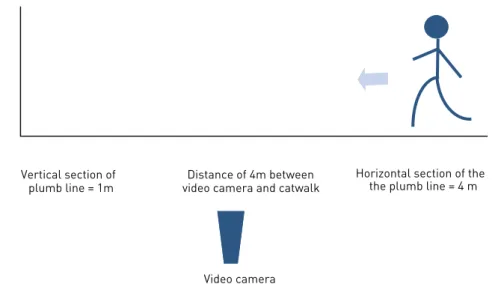
A Nikon D5100 digital video camera was used to collect the data with a film capcity of 30 frames per second. The camera was positioned on a Vivi-tar® WT-3710 professional tripod having horizontal and vertical level reg-ulation and reflective markers of anatomical points to enable the assessment of the angles of interest. The camera was positioned on the tripod at 1 meter from the floor and 4 meters from the catwalk. The catwalk on which the gait of the elderly was filmed was 4 meters long. A horizontal and vertical L-shaped plumb line was placed on the catwalk used for gait assessment. The horizontal part of the plumb line was 4 meters long and the vertical part was positioned at the end of the catwalk and was at least 1 meter high22 (Figure 1).
FIgure 1 – Scheme used to collect data on gait speed, stride length and hallux height in relation to the ground.
All data collected was entered twice on Epidata 3.1. With regard to the analysis of the photogrammetric data, first of all a selection was made of the images assessed using Kinovea 0.8 software. ImageJ software was then used to analyze the variables of interest using the selected images and produce a pho-tograph every 0.4 second. Reliability assessment of the method was confirmed in former study23. STATA 9.2 was used to perform statistical analysis.
The study’s descriptive analyses involved the calculation of average val-ues and respective standard deviations (SD), as well as proportions. Entry variance analysis was used to assess the differences between the averages and the respective P-values were used to assess linear trends and heterogeneity. The Bonferroni post-hoc test was used when necessary. The Research Ethics Committee of the Department of Physical Education of the UFPel approved the protocol for this study (Report No. 294192, dated June 5th 2013). The
results
Several sample size calculations were made in relation to the outcomes of inter-est. The largest sample size was that needed to assess the difference in average gait speed between the active, insufficiently active and inactive groups. Statistical power was close to 85% for the average values of 0.89 m/sec (SD 0.11) obtained in the active group and 0.76 m/sec (SD 0.20) in the inactive group. Statistical power was greater than 90% with regard to the identification of differences in stride length, hallux height in relation to the ground and joint angles.
Sixty elderly individuals divided into three groups according to level of physical activity were assessed. The selection of the inactive group took place through pairing with the active group based on the criteria of gender, age and administrative district of the city. 80% of the individuals were female. Average age was 67.6 years (SD 5.66) in the active group and 68.9 years (SD 5.16) in the inactive group (p= 0.20).
With regard to stride length, the average measurements for the right side were 45.3 cm (SD 5.3) for the active group, 42.5 cm (SD 5.1) for the insuffi-ciently active and 38.6 cm (SD 4,2) for the inactive group. Average measure-ments for the left side were 41.0 cm (SD 5.3); 38.9 cm (SD 5.1) and 32.4 cm (SD 6.4) for the active, insufficiently active and inactive groups, respectively. A statistically significant difference was found (linear trend T) for both the right side (p=0.000T) and the left side (p<0.001T). The heterogeneity (H) test revealed a significant difference between the stride length measurements of inactive individuals in relation to the insufficiently active (p=0.04H) and the active (p=0.000H). Differences of p=0.002H between the inactive and insuffi-ciently active groups and p=0.000H between the inactive and the active were found for the left stride.
In relation to gait speed, the results showed that average speed was 0.89 m/sec (SD 0.10) in the active group, 0.85m/sec (SD 0.14) in the insufficiently active group, and 0.75m/sec (SD 0.19) in the inactive group (p=0.02T). Dif-ferences were also observed between the average speed measurements of the inactive and active groups (p=0.02H).
The average distance between the hallux and the ground was 3.4 cm (SD 0.43) in the active group, 3.1 cm (SD 0.51) in the insufficiently active group and 2.3 cm (SD 0.65) in the inactive group (p<0.001T). The heterogeneity test found differences between the inactive and insufficiently active groups (p=0.000H) and the inactive and active groups (p=0.000H).
Assessment of the hip, knee and ankle joint angles during the gait stance and swing phases only found statistically significant differences in some of the knee and ankle joint angles.
During the toe-off phase there was an increase in the ankle joint angle between the elderly in the active group (82.98º; SD 5.96º), the insufficiently active group (80.94º - SD 5.97º) and the inactive group (86.05º - SD 5.44º) (p=0.025T). The difference related principally to the inactive and insufficient-ly active groups (p=0.022H).
Statistical differences were found in knee angles in the toe-off and ac-celeration phases. Average measurements in the toe-off phase were 151.02º (SD 10.03) in the active group, 151.12º (SD 7.79º) in the insufficiently active group and 143.35º (SD 7.08º) in the inactive group (p=0.006T). The
differ-ences occurred between the measurements obtained for the inactive group in relation to the insufficiently active (p=0,01H) and active (p=0,02H) groups.
Average results in the acceleration phase were 126.81º (SD 7.26º), 123.81º (6.60º) and 130.4º (6.94º), between the active, insufficiently active and inactive groups, respectively (p=0.015T). The heterogeneity test showed a difference between the inactive and insufficiently active groups (p=0.01H). The remain-ing results are shown in Table 1.
tAble 1 – Elderly hip, knee and ankle angle measurements, classified according to physical activ-ity: active, insufficiently active or inactive. Values expressed as mean (standard deviation).
Joint Gait phase# Angles - Active (º) Angles – Insufficiently active (º) Angles - Inactive (º) P Value(T) Hip Heel contact 162.58(8.03) 161.79(6.81) 161.88(6.93) 0.933 Foot flat 168.81(8.28) 167.10(5.58) 166.37(6.91) 0.534 Mid stance 169.12(6.38) 169.32(6.38) 170.52(6.48) 0.793 Heel off 167.46(8.01) 167.31(6.15) 169.29(6.62) 0.610 Toe off 169.41(8.30) 169.48(5.94) 172.92(5.56) 0.176 Acceleration 172.77(5.96) 174.68(5.34) 174.48(4.84) 0.474 Mid swing 162.53(6.27) 161.98(5.10) 160.45(7.75) 0.575 Deceleration 163.10(7.73) 164.00(6.13) 161.67(6.98) 0.571 Knee Heel contact 174.74(4.54) 174.01(3.23) 171.89(5.07) 0.108 Foot flat 167.62(5.67) 165.64(5.20) 167.30(6.73) 0.526 Mid stance 169.91(7.59) 169.98(4.66) 169.64(6.41) 0.984 Heel off 164.44(7.86) 165.39(6.04) 163.58(7.66) 0.733 Toe off 151.02(10.03) 151.12(7.79) 143.35(7.08) 0.006* Acceleration 126.81(7.26) 123.81(6.60) 130.4(6.94) 0.015* Mid swing 156.19(5.80) 156.14(5.59) 154.98(6.72) 0.775 Deceleration 174.63(3.51) 175.07(3.06) 175.52(6.28) 0.171 Ankle Heel contact 93.14(4.31) 93.47(4.09) 92.66(4.50) 0.835 Foot flat 93.24(4.35) 92.09(5.45) 94.24(4.41) 0.366 Mid stance 77.32(5.37) 75.76(4.00) 76.76(4.69) 0.577 Heel off 75.72(4.64) 74.46(3.84) 76.36(4.83) 0.396 Toe off 82.98(5.96) 80.94(5.97) 86.05(5.44) 0.025* Acceleration 85.34(6.52) 87.42(6.61) 89.65(5.01) 0.091 Mid swing 84.21(4.42) 86.81(4.26) 84.16(4.79) 0.113 Deceleration 88.86(4.93) 89.83(3.84) 90.39(4.50) 0.550 *Significant p-values; (T) Linear trend p-value. #Gait phases described in the table as per SULIVAN, 2010.
dIscussIon
In terms of public health the study the health conditions of elderly people and their risk factors are a growing need in terms of increased life expectan-cy. In this sense, to study of the gait components is important because of the consequences of the changes due to age. The worst performance of the gait indicates, among other things, impairment in activities of daily living, fragile sindromes, social isolation, falls, among others 4-7.
We found a significant decrease in average stride length, regardless of which side (left or right), depending on the level of physical activity, whereby the active elderly had larger stride length than the insufficiently active, and an even larger stride length than the inactive. Stride length decrease in the el-derly can be explained by progressive proprioceptive alterations arising from the loss of sensory fibres and proprioceptive receptors. As a result, a decrease in motor functions occurs, as well as a decrease in gait stride length and speed and loss of movement fluidity7,24-28.
A similar result was observed when gait speed between the groups was assessed, whereby the inactive elderly were slower than the active. The liter-ature suggests that decreased gait speed is a form of compensation to ensure that the balance is maintained and to reduce the risk of falling among the elderly26. One study shows that gait speed directly influences gait length and
that the latter increases or decreases depending on gait speed4.
As such, the literature reports the efficacy of the elderly doing physical activities, especially exercises that require them to walk quicker, in improving gait speed and balance, as well as improved muscle contraction speed, thus increasing stride size30.
The results of the assessment of the distance between the hallux and the ground when walking showed that the lower the level of physical activity among the elderly, the lower the average distance. The distance between the hallux and the ground when walking is an important predictor of falls among the elderly, given that the reduction in the amplitude of the functional move-ment of the joints decreases as age increases, thus limiting the capacity of the muscles to generate enough force to raise the hallux sufficiently to be able to walk on surfaces where there are obstacles31.
In relation to the differences found in knee and ankle joint measurements, our results suggest that they are due to the decrease in muscle strength and the reduction in the availability of joint movement amplitude, as explained by the potential hardening of the soft tissues surrounding the joints which causes greater joint restriction among the inactive elderly31.These limitations result
in the lower limbs being more extended when walking, increasing the risk of a variety of accidents, including falls, especially in this stage of life.
The results we found showed that with regard to some of the variables, doing physical activities can result in benefits even when the activities are insufficient to reach the cut-off point for being considered active. This can be observed in relation to stride length and the distance of the hallux from the ground. The same is true regarding the maintenance of better ankle and knee joint amplitudes. This does not mean that it is not important to achieve the level of physical activity considered to be active, but rather that even though physical activity is not sufficient to achieve the recommended level, it is suf-ficient to result in benefits. This, however, is not the case in relation to gait speed, when the difference is only found in those who managed to reach the cut-off point considered to be active.
Among the positive factors is that the study conducted measurements with three comparison groups regarding practicing physical activity, consid-ering not only the active and inactive, but also those who do physical activity without reaching the recommended cut-off point of 150 min/week. Howev-er, this study has some limitations that need to be taken into consideration.
Anthropometric measurements were not considered to sample selection and we would like to emphasize that the IPAQ was not developed with the aim of measuring physical activity among the elderly, although it is used a great deal for this purpose in diverse studies in the current literature.
Finally, the strategy chosen for the study based on selecting groups with different levels of physical activity enabled a clearer understanding of the re-sults obtained in relation to the outcomes studied regarding gait in the elderly. The results showed that practicing physical activities, even when not sufficient to reach the cut-off point of 150min/week, maintains good parameters in re-lation to stride size, gait speed and distance of the hallux from the ground, in addition to providing better knee and ankle joint angles in an important phase during walking, thus ensuring the prevention of a variety of adverse effects on the health of the elderly.
reFerences
1. United Nations (2002). International plan of actionon aging. Institutional Series in Human Rights, (1).
2. Siqueira FV, Facchini LA, Piccini RX, Tomasi E, Thumé E, Silva SM et al. Prevalence of falls in elderly in Brazil: a countrywide analysis. Cad Saúde Pública. 2011; 27(9):1819-26.
3. David MW, Jaime BT, Jennifer B, Jessie VS. Characteristics of walking, activity, fear of falling, and falls in community-dwelling older adults by residence. J Geriatr Phys Ther. 2014; 33(1):41-5.
4. Santos DM. Características da marcha de idosos considerando a atividade física e o sexo. Rev Fisioter Mov. 2008;22(4):137-48.
5. Cesari M, Kritchevsky SB, Newman AB, Simonsick EM, Harris TB, Penninx BW et al. Added value of physical performance measures in predicting adverse health-related events: results from the Health, Aging And Body Composition Study. J Am Geriatr Soc. 2009; 57(2):251-59.
6. Kemoun G, Thoumie P, Boisson D, Guieu JD. Ankle dorsiflexion delay can predict falls in the elderly. J Rehabil Med. 2002; 34: 278-83.
7. Kreisel SH, Blahak C, Bäzner H, Inzitari D, Pantoni L, Poggesi A, et al. Deterioration of gait and balance over time: the effects of age-related white matter change-the LADIS study. Cerebrovasc Dis. 2013;35(6):544-53.
8. Laufer Y. Effect of age on characteristics of forward and backward gait at preferred and accelerated walking speed. J Gerontol A Biol Sci Med Sci.2005;60:627-32.
9. Espy DD, Yang F, Bhatt T, Pai YC. Independent influence of gait speed and step length on stability and fall risk. Gait Posture. 2010;32(3):378-82.
10. Perracini MR, Ramos LR. [Fall-related factors in a cohort of elderly community residents]. Rev Saúde Pública. 2002;36:709-16.
11. Siqueira FV, Facchini LA, Piccini RX, Tomasi E, Thumé E, Silveira DS, et al. [Prevalence of falls and associated factors in the elderly]. Rev Saúde Pública. 2007;41:749-56.
12. Motta LB, Aguiar AC, Silva FCE, Huf G. [Prevalence and factors associated to falls in elderly in a country from Rio de Janeiro, Brazil]. Rev Bras Geriatr Gerontol.2010;13:83-92.
13. Figliolino JAM,Morais TB,Berbel AM, Dal Corso S. Analysis of the influence of physical exercise on balance, motion and activity of daily living in elderly people. Rev Bras Geriatr Gerontol.2009. 12(2):227-38
14. Perracini MR, Teixeira LF, Ramos JLA, Pires RS, Najas MS. Fall-related factors among less and more active older outpatients. Rev Bras Fisioter.2012;16(2):166-72.
15. Gauchard GC, Jeandel C. Physical and sporting activities improve vestibular afferent usage and balance human subjects. Gerontology. 2001;47:263-70.
16. Carvalho J, Oliveira J. Efeito de um programa de treino em idosos: comparação da avaliação isocinética e isotônica. Rev Paul Educ Fís. 2003, 17(1):74-84.
CorresPonding author Fernando Vinholes siqueira
Postgraduate Program in Physical Education, Federal University of Pelotas.
R. Luís de Camões, 625 - Três Vendas, Pelotas - RS, Brazil, 96055-630 Phone number (55 53) 32733851 e-mail: [email protected] reCebido 11/12/2014 reVisado 05/05/2015 aProVado 13/05/2015 17. Kim WS, Kim EY. Comparing selected speed walking of the elderly with
self-selected slow, moderate, and fast speed walking of young adults. Ann Rehabil Med.2014;38(1):101-8.
18. Arem H, Moore SC, Patel A, Hartge P, Gonzalez AB, Visvanathan K et al. Leisure time physical activity and mortality: A detailed Pooled analysis of the dose-response relationship. JAMA Int Med. 2015 (Epub ahead of print).
19. US Department of Health and Human Services. Physical Activity Guidelines for Americans. Washington, DC: US Department of Health and Human Services 2008.
20. Silva GG, Silva AC, Soares AS, Avellar MC, Miranda VCR. Análise biomecânica da marcha e capacidade funcional de idosos praticantes e não praticantes de musculação. Col Pesq Educ Fís. 2012; 11(3):17-24.
21. Cândido PE, Teixeira JV, Moro AR, Gontijo LA. Biomechanical strain of goldsmiths. Work. 2012;41( Suppl 1):2506-9.
22. Basso D, Corrêa E, Silva AM. Efeito da reeducação postural global no alinhamento corporal e nas condições clínicas de indivíduos com disfunção têmporo-mandibular associada a desvios posturais. Fisioter Pesq. 2010;17(1):63-8.
23. Carneiro PR, Teles LCS, Cunha CM, Cardoso BS. Confiabilidade e inter e intraexaminador da avaliação postural da cabeça por fotogrametria computadorizada. Fisioter Pesq. 2014;21(3):217-22.
24. Swinnen E, Baeyens JP, Pintens S, Buyl R, Goossens M, Meeusen R, et al. Walking more slowly than with normal velocity: The influence on trunk and pelvis kinematics in young and older healthy persons. Clin Biomech.2013; 28:8006.
25. Hurt CP, Rosenblatt N, Crenshaw JR, Grabiner MD. Variation in trunk kinematics influences variation in step width during treadmill walking by older and younger adults. Gait Posture.2010;31: 461-4.
26. Menz HB, Lord SR, Fitzpatrick RC. Age-related differences in walking Stability. Age Ageing.2003; 32:137-42.
27. Senden R, Savelberg HH, Adam J, Grimm B, Heyligers IC, Meijer K. The influence of age, muscle strength and speed of information processing on recovery responses to external perturbations in gait. Gait Posture. 2014;39(1):513-7.
28. Hausdorff JM, Edelberg HK, Cudkowicz ME, Singh MA,Wei JY. The relationship between gait changes and falls. J Am Geriatr Soc. 1997;45(11): 1406-10.
29. Santos DM. Características da marcha de idosos considerando atividade física e o sexo. Rev Fisioter Mov. 2008; 22(4):13748.
30. Fernandes AMBL, Ferreira JJA, Stolt LROG, Brito GEG, Clementino ACCR, Sousa NM. Efeitos da prática de exercício físico sobre o desempenho da marcha e da mobilidade funcional em idosos. Rev Fisioter Mov. 2012;25(4):821-30.
31. Arnold JB, Mackintosh S, Jones S, Thewlis D. Differences in foot kinematics between young and older adults during walking. Gait Posture.2014;39:689-94.