Braz. J. of Develop., Curitiba, v. 6, n. 7, p. 46365-46379, jul. 2020. ISSN 2525-8761
Quality of minimally processed table cassava cultivated in southeastern Pará,
brazilian Amazonian
Qualidade da mandioca de mesa minimamente processada cultivada no sudeste
do Pará, Amazônia brasileira
DOI:10.34117/bjdv6n7-314
Recebimento dos originais: 10/06/2020 Aceitação para publicação: 14/07/2020
Cleiton Moraes de Abreu
Engenheiro Agrônomo pela Universidade Federal Rural da Amazônia Instituição: Universidade Federal Rural da Amazônia
Endereço: Rodovia PA 275 s/n – Km 13, Zona Rural, Parauapebas – PA, Brasil. CV: http://lattes.cnpq.br/1599676355131339
E-mail: [email protected]
João Paixão dos Santos Neto
Doutor em Agronomia pela Universidade Estadual Paulista Instituição: Instituto Nacional de Investigação Agrária e Veterinária
Endereço: Distrito de Leiria s/n, Concelho de Alcobaça, Potugal CV: http://lattes.cnpq.br/2828947517814190
E-mail: [email protected]
Luiza Helena da Silva Martins
Doutora em Engenharia Química pela Universidade Estadual de Campinas. Instituição: Universidade Federal Rural da Amazônia
Endereço: Avenida Presidente Tancredo Neves, 2501 – Terra Firme, Belém – PA, Brasil. CV: http://lattes.cnpq.br/1164249317889517
E-mail: [email protected]
Wilton Pires da Cruz
Doutor em Agronomia (Entomologia Agrícola) pela Universidade Estadual Paulista Júlio de Mesquita Filho
Instituição: Universidade Federal Rural da Amazônia
Endereço: Rodovia PA 275 s/n – Km 13, Zona Rural, Parauapebas – PA, Brasil. CV: http://lattes.cnpq.br/0264246887772951
E-mail: [email protected]
José Nilton da Silva
Doutor em Agronomia na Universidade Federal Rural da Amazônia. Instituição: Universidade Federal Rural da Amazônia
Endereço: Rodovia PA 275 s/n – Km 13, Zona Rural, Parauapebas – PA, Brasil. CV: http://lattes.cnpq.br/1354740041680681 - ORCID: http://orcid.org/0000-0003-0298-9126
Braz. J. of Develop., Curitiba, v. 6, n. 7, p. 46365-46379, jul. 2020. ISSN 2525-8761 Vicente Filho Alves Silva
Doutor em Agronomia (Produção Vegetal) Instituição: Universidade Federal Rural da Amazônia
Endereço: Rodovia PA 275 s/n – Km 13, Zona Rural, Parauapebas – PA, Brasil.
CV: http://lattes.cnpq.br/6408302249362919 - ORCID: http://orcid.org/0000-0003-2396-6986 E-mail: [email protected]
Fabio Israel Martins Carvalho
Doutor em Química (Química Analítica) pela Universidade Federal do Pará. Instituição: Universidade Federal Rural da Amazônia
Endereço: Rodovia PA 275 s/n – Km 13, Zona Rural, Parauapebas – PA, Brasil. CV: http://lattes.cnpq.br/8221002637257793 - ORCID: http://orcid.org/0000-0002-8995-2141
E-mail: [email protected]
Priscilla Andrade Silva
Doutora em Agronomia (Produção Vegetal) pela Universidade Federal Rural da Amazônia. Instituição: Universidade Federal Rural da Amazônia
Endereço: Avenida Presidente Tancredo Neves, 2501 – Terra Firme, Belém – PA, Brasil CV: http://lattes.cnpq.br/7666887041806711 - ORCID: http://orcid.org/0000-0002-2774-3192
E-mail: [email protected]
ABSTRACT
This paper aimed to assess the quality of the cassava roots of the variety Cacau minimally processed. Physical characterization of 100 root samples was carried out by measuring the weight of roots, weight of roots without bark, weight of bark, root yield, length and diameter. The following treatments were performed: T1: roots was washed in running water; T2: sanitized roots (150 mg. L
-1); T3: sanitized roots (150 mg. L-1) and acidified roots (1% citric acid) and T4: sanitized roots (150
mg. L-1) and bleached (55ºC/10 min). The physicochemical characterization of leaves, stems and roots were performed through the analysis of pH, total titratable acidity (TTA), moisture, ashes, protein content, lipids, carbohydrates and total energy value (TEV). For the variables of plant growth, the number of roots (9.10 units) and dry matter of the roots (1312.15 g), in addition the yield of the unshelled root (80.95 kg or 61.80 %) was close to the values reported in the literature. As for the physicochemical parameters of minimally processed cassava roots, they were in accordance with those established by the Brazilian Table Food Composition.These parameters are considered the most important for the industry, so they explain the reasons for the agroindustrial potential this feedstoock.
Keywords: manihot esculenta crantz, physicochemical characterization, agroindustrial potential RESUMO
O objetivo deste estudo é avaliar a qualidade das raízes de mandioca da variedade Cacau minimamente processada. A caracterização física de 100 amostras de raízes foi realizada através da medição do peso das raízes, peso das raízes sem casca, peso da casca, rendimento da raiz, comprimento e diâmetro. Foram realizados os seguintes tratamentos: T1: raízes lavadas em água corrente; T2: raízes higienizadas (150 mg. L-1); T3: raízes higienizadas (150 mg. L-1) e raízes
acidificadas (1% de ácido cítrico) e T4: raízes higienizadas (150 mg. L-1) e branqueadas (55ºC/10 minutos). A caracterização físico-química das folhas, caules e raízes foi realizada através da análise de pH, acidez titulável total (ATT), umidade, cinzas, teor de proteínas, lipídios, carboidratos e valor energético total (VET). Para as variáveis de crescimento das plantas, o número de raízes (9,10 unidades) e a matéria seca das raízes (1312,15 g), além disso, o rendimento da raiz sem casca (80,95 kg ou 61,80%) estão próximos dos valores relatados na literatura. Quanto aos parâmetros
Braz. J. of Develop., Curitiba, v. 6, n. 7, p. 46365-46379, jul. 2020. ISSN 2525-8761 químicos das raízes de mandioca minimamente processadas, estão próximos aos estabelecidos pela Tabela Brasileira de Composição de Alimentos. Estes parâmetros são considerados os mais importantes para a indústria, logo explicam os motivos do potencial agroindustrial das raízes da mandioca. Palavras-chave: manihot esculenta crantz, caracterização físico-química, potencial agroindustrial
Palavras-chave: manihot esculenta crantz caracterização fisico-química, potencial agroindustrial.
1 INTRODUCTION
Cassava (Manihot esculenta Crantz) is classified as the sixth most important food in the world, being consumed by more than 800 million families worldwide. All this is certainly generated by the possibility of being produced in rustic environments, poorly fertile soils, tolerance to drought, and flexibility in the harvest period, as well as a major source of energy in human and animal food. The commercialization of table cassava for culinary use takes place worldwide in the most varied forms, including chilled, frozen, pre-cooked and cooked, in the form of "chips", "in natura", minimally processed and roasted (SARAVANAN et al., 2016).
However, it is observed that the root has high postharvest perishability. Due to the high moisture content of the cassava roots, which varies between 60% and 65% in dry weight, limiting the use of the fresh roots when stored (GIRMA et al., 2015).
This has become a challenge for producers and industries seeking to conserve and provide an increase in the useful life of this product. Cassava roots, when compared to other staple food crops, have a higher post-harvest physiological deterioration in a short period. After root, damage during harvest occurs the balance of the physiological process of exposed cells, causing the oxidative stress of food and consequently deterioration of tissues (DJABOU et al., 2017).
It is found as a viable alternative to reduce post-harvest losses, minimal processing of roots and their packaging in vacuum packs still on the farm or in supermarkets, since there is currently growth in this market, since consumers are looking for products that besides everything, have practicality (MENEZES, 2012).
With this study, we aim to determine the physical and chemical characteristics of minimally processed table cassava, produced by the Center of Family Agriculture Technology of Parauapebas (CETAF-Parauapebas, State of Pará, Brazil), and submitted to different treatments to assess the quality of this raw material.
Braz. J. of Develop., Curitiba, v. 6, n. 7, p. 46365-46379, jul. 2020. ISSN 2525-8761 2 MATERIALS AND METHODS
2.1 CHARACTERIZATION OF EXPERIMENTAL AREA
The plants and cassava roots of the variety Cacau were collected at the Center of Family Agriculture Technology of Parauapebas-PA, with the following geographical coordinates: 06º 03' 30" South latitude and 49º 55' 15" West longitude harvested at 11 months after planting.
After soil analysis, was made a correction on November 2017 as described bellow: initially the soil was prepared with plowing and gradation, followed by correction with dolomitic limestone (100 kg ha-1) and foundation fertilization with NPK 8-18-26 (100 kg ha-1). On January 2018 the cuttings with approximately 12 centimeters long were planted at 1m x 1m spacing, the planting received the crop treatments such as weeding, pruning and phytosanitary control when necessary.
2.2 CASSAVA PLANT GROWTH VARIABLES
The growth variables related to the morphology of the aerial parts and root system were determined: i. Relative height of the plants; the region between the stem of the plant and the apex of the leaves was measured by means of a trine attached to a wooden ruler; ii. Number of leaves; iii. Number of branches, iv. Number of stems and v. number of roots, all were determined by counting their numbers in the plant after harvesting; vi. Stem diameter, were measured with the aid of a 300 mm analog caliper with an accuracy of 0.01 mm; vii. Total leaf area (TLA), determined using the digital image processing program Image J (Wayne Rasband at the National Institute of Mental Health, USA, 2010); viii. The dry mass of the plant parts (stems, leaves, and roots), which were obtained by drying the parts in a kiln at 72ºC until constant mass; ix. The specific leaf area (SLA), calculated as the ratio of SFA to MS of the leaf, x. the total plant biomass, calculated as the sum of the dry masses of the parts (leaves, stems, and roots), and xi. The aerial root-to-root ratio, calculated as the quotient of the dry mass of the root system and the dry mass of the aerial parts (leaves and stems).
2.3 PHYSICAL CHARACTERIZATION AND ROOT YIELD
After collecting the roots, a random sample containing 100 roots was performed for the physical characterization. This procedure consisted in determining the measurements of weight of pulp with bark (WPWB), weight of pulp without bark (PWB), weight of bark (WB). Moreover, the yield of the cassava roots was carried out by separating the pulp and the husk manually and the yields were determined by their respective masses, using a semi-analytical scale (Model ARD110 and Brand OHAUS Adventurer).
Braz. J. of Develop., Curitiba, v. 6, n. 7, p. 46365-46379, jul. 2020. ISSN 2525-8761 The length was made with the aid of a trine and the diameter of the roots were measured with the aid of an analogical caliper 300 mm with a precision of 0.01 mm and the results were expressed in centimeter.
2.4 OBTENTION OF MINIMALLY PROCESSED CASSAVA AND DESCRIPTION OF ALL TREATMENTS
The selected roots were washed with running water, sanitized by immersion in solution with sodium hypochlorite (NaClO) (150 mg.L-1) for 10 min and again immersed in solution with sodium
hypochlorite (50 mg.L-1) for 10 min, with the exception of Treatment 1, in which the roots were only washed in running water. Then, the root samples were manually separated from the shell, packed in 1 kg polyethylene plastic bags and frozen at -20 ºC to be used for physicochemical analysis and differentiation of treatments from the minimum processing.
The following treatments were performed: T1: roots washed in running water; T2: sanitized roots (150 mg.L-1); T3: sanitized roots (150 mg.L-1) and acidified roots (1% citric acid) and T4: sanitized roots (150 mg.L-1) and bleached (55ºC/10 min). In the different formulations of cassava minimally processed (T1, T2, T3 and T4), roots were washed in running water with the aid of a brush to remove the impurities (soil particles). Then sample were peeled off manually, as well as the removal of the tips, then the cuts were applied approximately 10 cm long, followed by immersion in cold water (5ºC) (completion of pre-treatment for T1). For T2, T3 and T4 treatments, the following steps were followed: root sanitization (150 mg.L-1/10 min), rinsing with chlorinated water (50 mg.L
-1/10 min), and drainage with sieves and light drying with paper towels (finishing the pre-treatment
for T2). Only for the T3 treatment, the roots were immersed in a 1% solution of citric acid for 24 hours. The T4 treatment, after rinsing with chlorinated water at 50 mg.L-1 and draining, the roots were bleached by immersing them in water at 55ºC for 10 min.
2.5 PHYSICOCHEMICAL CHARACTERIZATION OF MINIMALLY PROCESSED PARTS OF PLANTS AND ROOTS
The following analyses were performed in triplicate (n=3) on the leaves, stems and roots of cassava, as well as on the minimally processed products prepared:
- pH: determined in a Hanna Instruments potentiometer, Model HI9321, previously calibrated with buffered solutions of pH 4 and 7, according to method 981.12 of AOAC (1997).
- Total titratable acidity (TTA): performed by titulometry with 0.1 N sodium hydroxide solution until the first persistent pink coloration for approximately 30 seconds, and citric acid conversion factor was 64.02 (AOAC, 1997).
Braz. J. of Develop., Curitiba, v. 6, n. 7, p. 46365-46379, jul. 2020. ISSN 2525-8761 - Moisture: determined by gravimetry, in an oven of the Tecnal model TE - 395, according to
method 920.151 of AOAC (1997).
- Ash: the samples were incinerated in a muffle furnace at 550 °C in accordance with method 930.05 of the AOAC (1997).
- Proteins: they were determined according to the Biuret Method described by Layne (1957). It is a colorimetric method, the color of which varies from pink to purple and is formed due to the copper ion complex and the nitrogen from the peptidic bonds, obtained when protein solutions in a strongly alkaline medium are treated with diluted copper ion solutions. These compounds have maximum absorption at 540 nm and were read in a uv-visible spectrophotometer (Bio Spectrum Mark, Model SP-220).
- Lipids: determined by cold solvent mixture extraction, Bligh and Dyer method (1959). - Carbohydrates: was calculated by difference, according to Resolution No. 360 of December
23, 2003 (ANVISA, 2003). Carbohydrates (%): [100 - (% moisture + % protein + % lipids + % ashes)].
- Total energy value (TEV): was estimated (kcal/100g) using Atwater conversion factors: 4 kcal/g for carbohydrates and proteins and 9 kcal/g for lipids according to Anderson et al. (1988) and Resolution nº. 360 of December 23, 2003 (ANVISA, 2003).
2.6 STATISTICAL ANALYSIS
The results of physical and physico-chemical plant analyses (leaves, stems and roots) were analyzed by descriptive statistics using measures of central tendency (mean) and data variability (standard deviation). The results of the physical-chemical analysis of minimally processed cassava products were submitted to analysis of variance (ANOVA), and the means were compared by the Tukey's 5% probability test using the SAS® software version 9.4 (SAS INSTITUTE, 2013).
3 RESULTS AND DISCUSSION
For the evaluated height parameter, an average value of 2.52 m was observed (Table 1). Close values were found by Albuquerque et al. (2009) characterizing in their experiments 10 varieties of cassava at 13 months in the state of Roraima, the plant heights ranged from 1.33 to 2.62 m.
Braz. J. of Develop., Curitiba, v. 6, n. 7, p. 46365-46379, jul. 2020. ISSN 2525-8761 Table 1. Growth variables of cassava plants of the variety Cacau (n=30)
Variables Mean ± Standard deviation
Height (m) 2.52 ± 0.33
Number of leafs (pcs.) 466.17 ± 89.06 Number of branches (pcs.) 4.90 ± 1.40
Stem diameter (cm) 2.73 ± 0.35
Number of stems (unit) 1.70 ± 0.75
Number of roots (unid.) 9.10 ± 1.44 Dry mass of stem (g) 887.02 ± 174.97 Dry mass of leafs (g) 195.59 ± 29.28 Dry mass of roots (g) 1,312.15 ± 276.68
Roots/aerial parts 1.21 ± 0.30
TLA (m2) 6.25 ± 1.30
SLA (m2. kg-1) 31.95 ± 3.05
TLA: total leaf area, SLA: specific leaf area.
As for the parameter, mean number of leaves 466.17 units (Table 1) found in this study, it was higher than that obtained by Zanetti (2016) when he found value for this same variable of 229.45 units when studying the morphological and nutritional characteristics of table cassava in the state of São Paulo. Streck et al. (2014) evaluating the effect of planting spacing on the growth, development and productivity of cassava, observed that the highest average value for the number of leaves was 115 units.
Silva et al. (2017) the emergence of more than one branch is characterized as a negative factor in production, because there will certainly be greater competition for water, nutrients and photoassimilates among plants. On the other hand, plants with smaller amounts of branches concentrate their photoassimilates to the roots.
The mean 9.10 units, observed in this study for the variable number of roots, is similar to the result (10.78 units) found by Streck et al. (2014) when studying the effect of planting spacing on growth, development and productivity of cassava.
For the characteristic number of stems per plant, the average value observed in this study (1.70 units) is within the range observed (1.52 to 3.75 units) by Guimarães et al. (2017) evaluating morphologically cassava genotypes. According to Guimarães et al. (2017) in order to obtain higher yielding plantings, it is fundamental to know the number of stems of the variety to be planted and conducted.
The mean value of dry matter from the roots (1,312.15 g) found in the study is within the range obtained by Streck et al. (2014) studying the effect of spacing on cassava plants, observed the variation between 840 and 1,890 g.
According to Coelho Filho et al. (2017), the translocation of starch and other substances from the leaves and stems to the roots causes the accumulation of dry matter mainly in the roots followed
Braz. J. of Develop., Curitiba, v. 6, n. 7, p. 46365-46379, jul. 2020. ISSN 2525-8761 by stems and leaves. As for the value verified for the roots/aerial parts ratio, the result expressed in Table 1 (1.21) was similar to that described by Silva et al. (2014) (1.22) when analyzing the accumulation of dry matter and micronutrients and cassava consortium with banana tree.
The value obtained for the total leaf area (6.25 m²) (Table 1), is well below that observed by Coelho Filho et al. (2017) when studying the growth and productivity of the consortium cassava and caupi beans, found a maximum leaf area value of 3.10 m². It can be inferred from this result that factors such as spacing, time of harvest, soil type, may have influenced the achievement of greater leaf area in this study.
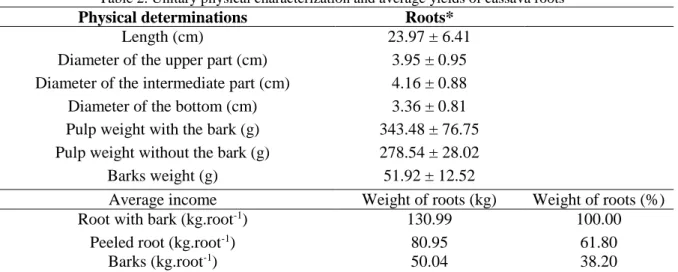
The evaluated variable length (23.97 cm) (Table 2) is close to the observed range (22.10 cm and 23.51 cm) by Albuquerque et al. (2012) evaluating the variety Cacauzinha consortium with beans in Coimbra - MG and within the observed range (23.20 cm and 30.69 cm). In their studies in Rio Branco, Acre,
Table 2. Unitary physical characterization and average yields of cassava roots
Physical determinations Roots*
Length (cm) 23.97 ± 6.41
Diameter of the upper part (cm) 3.95 ± 0.95 Diameter of the intermediate part (cm) 4.16 ± 0.88
Diameter of the bottom (cm) 3.36 ± 0.81
Pulp weight with the bark (g) 343.48 ± 76.75 Pulp weight without the bark (g) 278.54 ± 28.02
Barks weight (g) 51.92 ± 12.52
Average income Weight of roots (kg) Weight of roots (%)
Root with bark (kg.root-1) 130.99 100.00
Peeled root (kg.root-1) 80.95 61.80
Barks (kg.root-1) 50.04 38.20
* Descriptive statistical analysis, the values represent the mean ± standard deviation of 30 plants and 273 roots (n1 = 30 and n2 = 273).
The values found in this study for the variables diameter of the upper part (3.95 cm), intermediate (4.16 cm) and lower (3.36 cm) (Table 2) are close to the range observed by Silva (2011). This author when evaluating the physical characteristics of three varieties of cassava, found values for the diameter of the upper part (4.52 to 6.16 cm), intermediate (5.21 to 6.45 cm) and lower (2.84 to 2.98 cm).
Guimarães et al. (2017) studying 28 cassava genotypes found a mean value of 530 g for the weight of the roots, which is higher than the weight analyzed in this study (Table 2).
Braz. J. of Develop., Curitiba, v. 6, n. 7, p. 46365-46379, jul. 2020. ISSN 2525-8761 The average yield for pulp (61.80%) and bark (38.20%) are presented in (Table 2). According to Sousa et al. (2017), pulp yield is the most important characteristic desired by industries, where in general, cassava varieties always show efficiency in pulp production.
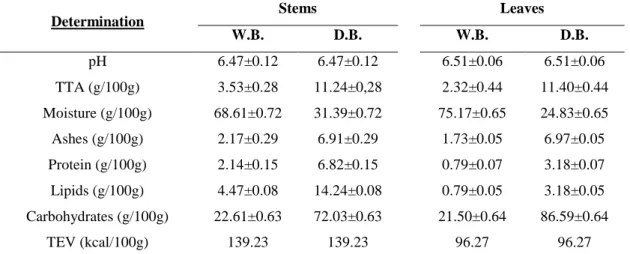
The pH content (6.47) (Table 3) found in this study for the leaves on a wet basis is close to the value (6.90) found by Trombini and Leonel (2014) when analyzing the centesimal composition of cassava leaf meal.
Table 3. Physicochemical characterization of the leaves and stems of the cassava
Determination Stems Leaves
W.B. D.B. W.B. D.B. pH 6.47±0.12 6.47±0.12 6.51±0.06 6.51±0.06 TTA (g/100g) 3.53±0.28 11.24±0,28 2.32±0.44 11.40±0.44 Moisture (g/100g) 68.61±0.72 31.39±0.72 75.17±0.65 24.83±0.65 Ashes (g/100g) 2.17±0.29 6.91±0.29 1.73±0.05 6.97±0.05 Protein (g/100g) 2.14±0.15 6.82±0.15 0.79±0.07 3.18±0.07 Lipids (g/100g) 4.47±0.08 14.24±0.08 0.79±0.05 3.18±0.05 Carbohydrates (g/100g) 22.61±0.63 72.03±0.63 21.50±0.64 86.59±0.64 TEV (kcal/100g) 139.23 139.23 96.27 96.27
TTA - Total titratable acidity. TEV - Total Energy Value. W.B. - Results on wet basis. D.B. - Results on dry basis. Descriptive statistical analysis, the values represent the mean ± standard deviation of three replicates (n = 3).
The dry basis acidity value reached in this study for the leaves (11.24 g/100g) (Table 3) was slightly above the content found by Trombini and Leonel (2014) (9.2 g/100g).
The wet leaf moisture value found (68.61 g/100g) (Table 3) is close to the mean verified by Wobeto et al. (2006) in the fresh leaves of cultivars studied for nutritional verification of cassava leaf meal (70.46 g/100g). For stems, a value of 75.17 g/100g (Table 3) was found for the same attribute, being slightly above that reported by Carvalho (2005) in his study with several solid cassava by-products, a value of (65.00 g/100g).
Regarding the values of ash for leaves (6.91 g/100g) and stems (6.97g/100 g) (Table 3) on a dry basis found in this study, they corroborate with the results found by Carvalho (2005), of 6.15 and 7.22 for stems and leaves on a dry basis, respectively.
Protein values (6.82 g/100 g) (Table 3) for leaves on dry basis are below the values reported in the literature by Trombini and Leonel (2014), that found 23.0 g/100 g and Carvalho (2005) found 30.68 g/100 g on dry basis. For stems, the value of protein found in this study of 3.18 g/100 g on a dry basis is below the amount reported by Carvalho (2005) when he studied the various solid by-products of cassava and found 6.25 g/100 g in dry matter.
Braz. J. of Develop., Curitiba, v. 6, n. 7, p. 46365-46379, jul. 2020. ISSN 2525-8761 Each variety of cassava has specific capacity to accumulate protein in different parts of the plant, which can be observed when there is variation in concentration for each variety (MOREIRA et al., 2017), this variation in the chemical content of cassava leaves is influenced mainly by the genotype and age of the plant (TROMBINI and LEONEL, 2014).
The lipid content for leaves (14.24 g/100 g) and stems (3.18 g/100 g) on a dry basis are above the values observed by Carvalho (2005) for leaves and stems, 7.15 and 1.78 g/100 g, respectively. Trombini and Leonel (2014) found a lipid value of 7.22 g/100g for leaves in dry matter, when they analyzed the nutritional composition of cassava leaf flour.
The carbohydrate content of leaves and stems found in this study (22.61 g/100 g) (Table 3) is close to the value (22.27 g/100 g) found by Trombini and Leonel (2014) in their studies on the physical-chemical composition and technological properties of cassava leaf meal. The value in relation to the same parameter for stems (21.50 g/100 g) (Table 3) is slightly below the average (31.91 g/100 g) observed by Carvalho (2005) in his work evaluating the composition of solid residues in cassava plants.
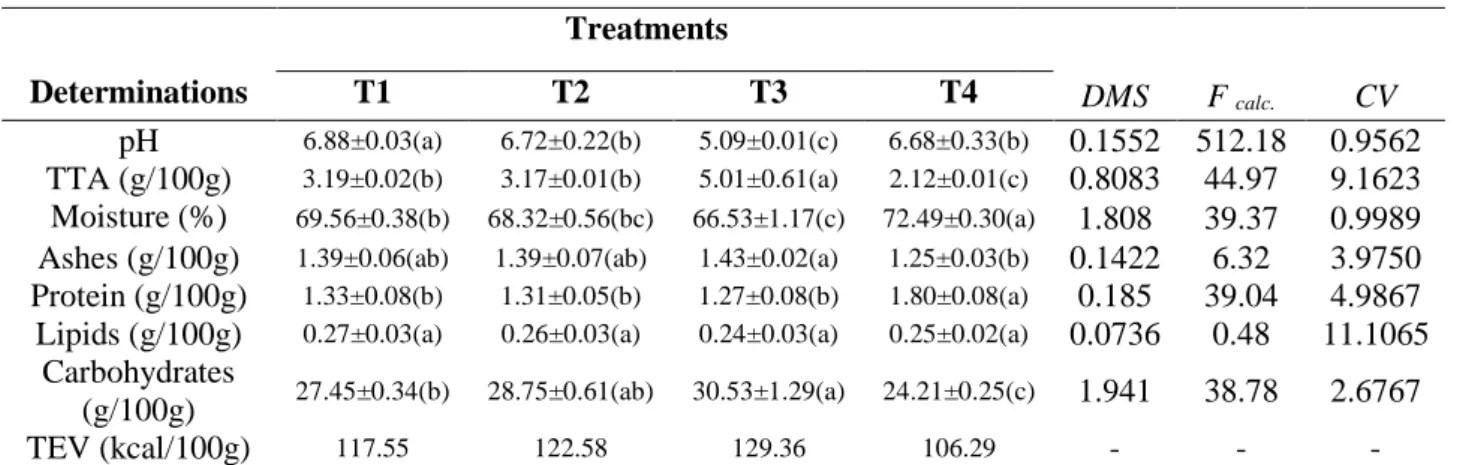
The mean values obtained for the ash and lipid parameters did not differ (p>0.05) (Table 4) between the treatments. The protein parameter was higher in the T4 treatment (p<0.05) (Table 4).
Table 4. Physicochemical characterization of manioc roots minimally processed Treatments
Determinations T1 T2 T3 T4 DMS F calc. CV
pH 6.88±0.03(a) 6.72±0.22(b) 5.09±0.01(c) 6.68±0.33(b) 0.1552 512.18 0.9562
TTA (g/100g) 3.19±0.02(b) 3.17±0.01(b) 5.01±0.61(a) 2.12±0.01(c) 0.8083 44.97 9.1623 Moisture (%) 69.56±0.38(b) 68.32±0.56(bc) 66.53±1.17(c) 72.49±0.30(a) 1.808 39.37 0.9989 Ashes (g/100g) 1.39±0.06(ab) 1.39±0.07(ab) 1.43±0.02(a) 1.25±0.03(b) 0.1422 6.32 3.9750 Protein (g/100g) 1.33±0.08(b) 1.31±0.05(b) 1.27±0.08(b) 1.80±0.08(a) 0.185 39.04 4.9867 Lipids (g/100g) 0.27±0.03(a) 0.26±0.03(a) 0.24±0.03(a) 0.25±0.02(a) 0.0736 0.48 11.1065
Carbohydrates
(g/100g) 27.45±0.34(b) 28.75±0.61(ab) 30.53±1.29(a) 24.21±0.25(c) 1.941 38.78 2.6767
TEV (kcal/100g) 117.55 122.58 129.36 106.29 - - -
T1: roots washed in running water; T2: sanitized roots (150 mg.L-1); T3: sanitized roots (150 mg.L-1) and acidified roots (1% citric acid) and T4: sanitized roots (150 mg.L-1) and bleached (55ºC/10 min). TTA - Total titratable acidit. TEV - Total Energy Value. DMS - Minimum significant difference. CV - experimental coefficient of variation. Means followed by the same letter in the same line do not differ statistically by Tukey's test at 5% probability level. Results on wet basis. The values represent the mean ± standard deviation of three replicates (n = 3).
Moisture, ashes, protein, lipid, carbohydrate and total energy values for cassava root (Table 4) are close to the values recommended by the Brazilian Table of Food Composition (TACO). Which recommends that in 100 g of cooked cassava be found 68.7% moisture; 0.4 g/100 g ashes; 0.6 g/100 g protein; 0.3 g/100 g lipids; 30.1 g/100 g carbohydrates and 125kcal (TACO, 2011).
Braz. J. of Develop., Curitiba, v. 6, n. 7, p. 46365-46379, jul. 2020. ISSN 2525-8761 The value found for pH was (5.09) T3 (Table 4). This value (3.95 and 6.43) is close to that analyzed by Rinaldi et al. (2017) using 1.0% citric acid in the post-harvest conservation of cassava. According to the same author, it can be inferred that the lower pH value as found in T3 was influenced by the action of citric acid used in treatment. Rinaldi et al. (2015) when analyzing the effect of freezing on cassava roots found pH values between 6.09 and 6.47 when frozen at -18 °C, results similar to those found at T1, T2 and T4 (Table 4). According to Rinaldi et al. (2017), the pH is a factor that has great importance in food conservation, since it can act as a barrier to the development of microorganisms, so it is ideal that the pH should not exceed 4.5.
Regarding the behavior for ATT, T1 and T2 were statistically equal. The highest value found for this parameter was at T3 (5.01) when citric acid was used, confirming that this acid causes acidification of the product. This value is slightly above that observed by Andrade et al. (2016) who found values between 0.96 and 3.80 g/100 g when using citric acid in post-harvest treatment to extend the useful life of yellow cassava. It is understood that this difference was generated by the short storage time in the study, since according to Rinaldi et al. (2015) the use of acids in the respiratory processes of stored and chilled products causes the titratable acidity to decrease over time. Sanches et al. (2015) explain that storage is responsible for a decrease in the acidity content, due to the breathing process and the conversion of acids into sugars.
The value obtained in the T4 treatment for ATT (2.12 g/100 g) is within the range (1.00 and 3.80 g/100 g) observed by Andrade et al. (2016) when verifying the effect of bleaching on the quality and conservation of minimally processed yellow cassava.
Regarding the root water content, values of 69.56; 68.32; 66.53 and 72.49% for T1, T2, T3 and T4 treatments, respectively, were found (Table 4). Ceni et al. (2009) studying the nutritional composition of minimally processed cassava varieties found moisture between 64 and 70%. Rinaldi et al. (2015) found moisture values ranging from 57.60 to 61.00%.
The importance of moisture maintenance is related to the reduction of enzymatic reactions that can change the visual characteristics of the product. In addition, high moisture values caused by inadequate packaging and centrifugation may accelerate the multiplication of pathogens in the product and consequently decrease shelf life (RINALDI et al., 2015).
For the ashes content, there was a significant difference for T3 and T4 treatments, with values of 1.43 and 1.25 g/100 g, respectively (Table 4). These results are similar to those found by Carvalho et al. (2017) characterizing cassava genotypes in the state of Pará, highlighting values of 1.52 to 3.09 g/100 g for the ashes variable.
These authors emphasize that the average values found are considered high, and work as an indication of significant concentration of minerals in cassava roots. Furthermore, there is no defined
Braz. J. of Develop., Curitiba, v. 6, n. 7, p. 46365-46379, jul. 2020. ISSN 2525-8761 mineral composition for each variety, as the values may vary with the age of the plant, the environment and genetic factors. In this context, the authors report that climatic conditions during the development of the crop and at the time of harvest may influence the accumulation and mobilization of substances in the roots, and thus manipulate the quality and chemical composition of the product mainly if the roots are submitted to cooking.
The protein content analysis ranged from 1.27 to 1.80 g/100 g, statistically differing only the T4 treatment, in which it has a higher value for this variable (Table 4). Carréra et al. (2014) analyzing cassava roots in a physicochemical way, witnessed values between 0.5 and 1.3 g/100 g of protein on a wet basis. The investigating the physicochemical variability of cassava roots by Carvalho et al. (2017) who found values between 1.20 and 2.93 g/100 g.
This low protein value found in cassava roots is characterized as undesirable, especially for families that make cassava a subsistence food, and may generate health problems due to protein deficiency. Thus, it is clear that higher levels of protein are essential precisely to provide better nutrition to consumers, making it necessary to consider the protein content in cassava root genetic improvement programs (Caravalho et al., 2017).
Regarding lipid levels, there was no statistical difference between the treatments analyzed in the study. Values of (T1: 0.27; T2: 0.26; T3: 0.24; and T4: 0.25 g/100 g) are observed (Table 4). Carréra et al. (2014) studying twelve genotypes of cassava on a wet basis, found that the content of the lipid fraction varied between 0.3 and 1.9 g/100 g. Carvalho et al. (2017) analyzed twenty-two cassava genotypes and found values ranging from 0.24 to 0.46 g/100 g.
The determination of carbohydrate concentration in foods is important since they have a nutritional function, as raw material for many foods of plant origin, as ingredient of cereals and as natural sweeteners (Cecchi, 2003).
According to the carbohydrate indices, the levels are statistically different for all treatments, with values of 27.45; 28.75; 30.53 and 24.21 g/100 g, for treatments T1, T2, T3 and T4, respectively (Table 4). However, the treatment with citric acid presented the highest value.
The root energy value was 117.55 (T1), 122.28 (T2), 129.36 (T3), 106.29 kcal/100 g (T4) (Table 4). Treatment T3 presented higher energy content, consistent with the higher carbohydrate value.
4 CONCLUSION
The number of branches that we found is characterized as something negative, since competition can occur between plants, making it difficult to establish the harvest. The number of stems and number of roots presented by the variety is within what is recommended by the literature.
Braz. J. of Develop., Curitiba, v. 6, n. 7, p. 46365-46379, jul. 2020. ISSN 2525-8761 In relation to the values obtained in length, diameter of the intermediate part and weight of the pulp with shell, characterize the roots as suitable for consumption "in natura", because, in these conditions, there are no problems with transportation, storage, and cooking.
As for the average values of moisture, ash, lipids, proteins, carbohydrates, and total energy value, obtained are in line with what is stipulated by TACO. In addition, minimally processed cassava presents itself as a viable alternative, as it presents high nutritional quality, organoleptic, freshness, aroma, and flavor, in addition to practicality and timesavings in daily preparation, winning consumer preference. In addition, it can be used by the Family Technological Center of Parauapebas, as a possibility to encourage family farmers in the Southeast of Pará, to strengthen their production and, therefore, intensify the sale of this product in the region.
REFERENCES
AGUIAR, L. P.; FIGUEIREDO, R. W.; ALVES, R. E.; MAIA, G. A.; SOUZA, V. A. B. Caracterização física e físico-química de frutos de diferentes genótipos de bacurizeiro (Platonia insignis Mart.). Revista Ciência e
Tecnologia de Alimentos. Campinas, p.423-428, 2008.
ALVES, D. P. Determinação de características físico-químicas de polpas de cupuaçu (Treobroma
grandiflorum Schum) congeladas comercializadas em Ariquemes, Rondônia, Brasil. Monografia
(Graduação em Farmácia) – Faculdade de Educação e Meio Ambiente, 2013.
ALVES, R. E.; MENEZES, J. B.; SILVA, S. M. Colheita e pós-colheita de acerola. In: SÃO JOSÉ, A. R., ALVES, R. E. Acerola no Brasil: Produção e mercado. Vitória da Conquista: Universidade Estadual do Sudoeste da Bahia (UESB), 1995, cap.5, p.77- 89.
ANDERSON, L.; DIBBLE, M. V.; TURKKI, P. R.; MITCHEL, H. S.; RYNBERGEN, H. J. Satisfazendo as normas nutricionais. In: Nutrição. 17 eds. Rio de Janeiro: Guanabara, 1988. p.179-187.
ALBUQUERQUE, A. A. J.; SEDIYAMA, T.; SILVA, A. A.; SEDIYAMA, S. C.; ALVES, A. M. J.; NETO, A. F. Caracterização morfológica e agronômica de clones de mandioca cultivados no Estado de Roraima.
Revista Brasileira de Ciências Agrárias. v.4, n.4, p.388-394, 2009.
http://www.agraria.pro.br/ojs-2.4.6/index.php?journal=agraria&page=index. 05 fev. 2020. doi: http://doi.org/10.5039/agraria.v4i4a3.
ALBUQUERQUE, A. A. J.; SEDIYAMA, T.; SILVA, A. A.; ALVES, A. M. J.; FINOTO, E. L.; NETO, A. F.; SILVA, G. R. Desenvolvimento da cultura de mandioca sob interferência de plantas daninhas. Planta
Daninha, v.30, n.1, p.37-45, 2012. https://www.scielo.br/scielo.php?script=sci_
serial&pid=0100-8358&lng=en&nrm=iso. 05 fev. 2020. doi: http://doi.org/10.1590/S0100-83582012000100005.
ANDERSON, L.; DIBBLE, M. V.; TURKKI, P. R.; MITCHEL, H. S.; RYNBERGEN, H. J. Satisfazendo as normas nutricionais. In: Nutrição. 17 ed. Rio de Janeiro: Guanabara, 1988. cap.10, p.179-187.
ANDRADE, U. A.; SANCHES, G. A.; PIACENTINI, C. L.; CORDEIRO, M. A. C. Tratamento pós-colheita na extensão da vida útil da mandioca de mesa polpa branca e amarela minimamente processada e frigoconservada. Acta Iguazu. Cascavel, v.5, n.4, p.1-14, 2016. http://e-revista.unioeste.br/index.php/actaiguazu. 20 jan. 2020.
Braz. J. of Develop., Curitiba, v. 6, n. 7, p. 46365-46379, jul. 2020. ISSN 2525-8761 ANVISA - Agência Nacional de Vigilância Sanitária. Resolução RDC n° 360, de 23 de dezembro de 2003. Aprova o Regulamento Técnico sobre rotulagem nutricional de alimentos embalados. Diário Oficial [da República Federativa do Brasil]. Brasília, p.4, dez. 2003.
AOAC - Association of Official Analytical Chemists. Official methods of analysis of the Association of
Official Analytical Chemists. 16th ed. Washington, DC, 1997.
BLIGH, E. C.; DYER, W. J. A rapid method of total lipid and purification. Canadian Journal Biochemistry
Physiology. Ottawa, v. 37, p. 911-917, 1959.
CARVALHO, J. O. M. Subprodutos da mandioca – composição dos resíduos sólidos. Empresa Brasileira de
Pesquisa Agropecuária (EMBRAPA). Porto velho – RO, 2005.
CARVALHO, A. V.; CUNHA, E. F. M.; NETO, J. T. F. Caracterização físico-química de genótipos de macaxeira cultivados no estado do Pará. Boletim de pesquisa e desenvolvimento. Embrapa Amazônia
Oriental. Belém – PA, 1 edição, 2017.
CECCHI, H. M. Fundamentos teóricos e práticos em análise de alimentos. 2° ed. rev. – Campinas-SP. Editora unicamp, 2003.
CENI, G. C.; COLET, R.; PERUZZOLO, M.; WITSCHINSKI, F.; TOMICKI, L.; BARRIQUELLO, A. L.; VALDUGA, E. Avaliação de componentes nutricionais de cultivares de mandioca (Manihot esculenta Crantz).
Alimento e Nutrição. Araraquara – SP, v.20, n.1, p.107-111, 2009.
COELHO FILHO, M. A.; GUIMARAES, M. J. M.; JUNIOR, F. A. G.; OLIVEIRA, L. B. Crescimento e produtividade do consórcio de mandioca e feijão caupi em diferentes arranjos de cultivo e condições irrigadas.
Water Resources and Irrigation Management, v.6, n.3, p. 151-159, 2017.
https://www3.ufrb.edu.br/seer/index.php/wrim/index. 20 Jan. 2020.
DJABOU, S. A.; CARVALHO, J. L.; LI, X. Q.; NIEMENAK, N.; CHEN, S. Cassava postharvest physiological deterioration: a complex phenomenon involving calcium signaling, reactive oxygen species and programmed cell death. Acta Physiologiae Plantarum, v.39, n.4, p.91-101, 2017. https://www.springer.com/journal/11738/. 09 Dez. 2018. doi: 10.1007/s11738-017-2382-0.
GIRMA, G.; BULTOSA, G.; ABERA, S. Effect of cassava (Manihot esculenta Crantz) variety, drying method and blending ratio on the proximate composition and sensory properties of cassava-wheat composite bread.
European Journal of Food Science and Technology, v.3, p.41-54, 2015.
https://www.springer.com/journal/217/. 10 jan. 2019.
GUIMARÃES, G. D.; PRATES, N. J. C.; VIANA, S. E. A.; CARDOSO, D. A.; TEIXEIRA, G. R. P.; CARVALHO, D. K. Caracterização morfológica de genótipos de mandioca (Manihot esculenta Crantz).
Scientia Plena, v.13, n.9, 2017. https://www.scientiaplena.org.br/sp/article/view /3467. 10 Jan. 2019. doi:
10.14808/sci.plena.2017.090201.
LAYNE, E. Spectrophotometric and turbidimetric methods of measuring proteins. In: Colowick, S.P. E Kaplan, N.O. eds. Methods in enzymology, New York, Academic Press, v. 3, 447-454, 1957.
MENEZES, J. B. C. Caracterização, avaliação e processamento mínimo de seis variedades de mandioca
cultivadas no nordeste de Minas Gerais. 2012. Dissertação (Título de Mestre em ciências agrárias).
Universidade Federal de Minas Gerais – UFMG, Montes Claros, 2012.
MOREIRA, P. L. G.; PRATES, N. J. C.; OLIVEIRA, M. L.; VIANA, S. E. A.; JÚNIOR, C. S. N.; FIGUEIREDO, P. M. Composição bromatológica de mandioca (Manihot esculenta) em função do intervalo entre podas. Revista de Ciências Agrárias, v.40, n.1, p.144-153, 2017. https://revistas.rcaap.pt/rca/about. 10 jan. 2019. doi: http://dx.doi.org/10.19084/RCA16022.
Braz. J. of Develop., Curitiba, v. 6, n. 7, p. 46365-46379, jul. 2020. ISSN 2525-8761 RINALDI, M. M.; FIALHO, J. F.; VIEIRA, E. A.; OLIVEIRA, T. A. R.; ASSIS, S. F. O. Utilização de ácido cítrico para conservação pós-colheita de raízes de mandioca. Brazilian Journal of Food and Technology. Campinas, v.20, e2017072, p.1-9, 2017. http://bjft.ital.sp.gov.br/. 10 Jan. 2019. doi: http://dx.doi.org/10.1590/1981-6723.07217.
RINALDI, M. M.; VIEIRA, A. E.; FIALHO, F. J.; MALAQUIAS, V. J. Efeitos de diferentes formas de congelamento sobre raízes de mandioca. Brazilian Journal of Food and Technology. Campinas, v. 18, n. 2, p. 93-101, 2015. http://bjft.ital.sp.gov.br/. 12 Jan. 2019. doi: http://dx. doi. org/10.1590/1981-6723.3414.
SAS INSTITUTE. SAS for Windows, versão 9.4 SAS®: SAS User guide. Carry, 2013.
SANCHES, G. A.; SILVA, M. B.; MOREIARA, E. G. S.; CORDEIRO, C. A. M. Relação entre a embalagem e a temperatura de armazenamento na conservação do pimentão vermelho cv. Rubi. Acta Iguazu. Cascavel, v. 4, n. 4, p. 1-12, 2015.
SARAVANAN, R.; RAVI, V.; STEFHEN, R.; THAJUDHIN, S. Deterioração fisiológica pós-colheita de mandioca (Manihot esculenta Crantz) – Uma revisão. Indian Journal of Agricultural Sciences, v.86, n.11, p.1383-1390, 2016.
SILVA, C. C. D.; RIBEIRO, F. C.; FILGUEIRAS, C. G.; OLIVEIRA, C. D. C.; SILVA, S. E. O arranjo produtivo da mandioca e análise da sazonalidade de preços da farinha no estado do Pará. CEPEC/UFPA – Centro de pesquisa econômica. Cadernos CEPEC, v. 3, n. 5, maio de 2014.
SILVA, P. A. Estudo do processamento e da qualidade física, fisíco-química e sensorial da farinha de
tapioca. Dissertação (Título de Mestre em ciência e tecnologia de alimentos) Universidade Federal do Pará,
Belém – PA, 2011.
SILVA, D. C. O.; ALVEZ, J. M. A.; UCHÔA, S. C. P.; SOUSA, A. A.; BARRETO, G. F.; SILVA, C. N. Curvas de crescimento de plantas de mandioca submetidas a dose de potássio. Amazon Journal of
Agricultural and Environmental Sciences, Rev. Ciênc. Agrar., v.60, n.2, p.158-165, 2017.
SOUSA, M. D. A.; BARROS, B. I.; PALOMINO, C. E.; JESUS, M. L.; OLIVEIRA, C. W.; SILVA, V. T.; FERREIRA, A. B. J.; SOUSA, S. U. H. Avaliação da qualidade de raízes e taxa de sobrevivência de diferentes variedades de mandioca de mesa. Agroecossistemas. Santarém – PA, v.9, n.2, p.42-53, , 2017.
STRECK, N. A.; PINHEIRO, D. G.; ZANON, J. A.; GABRIEL, F. L.; ROCHA, T. S. M.; SOUZA, A. T.; SILVA, M. R. Efeito do espaçamento de plantio no crescimento, desenvolvimento e produtividade da mandioca em ambiente subtropical. Bragantia. Campinas, v.73, n.4, p.407-415, 2014.
TACO - Tabela Brasileira de Composição de Alimentos. 4. ed. rev. e ampliada. Campinas: NEPA - UNICAMP, 2011, p.164.
TROMBINI, M. R. F.; LEONEL, M. Composição fisico-química e propriedades tecnológicas da farinha de folhas de mandioca. Revista Energia na Agricultura, vol. 29, n. 1, p. 76-81, 2014.
WOBETO, C.; CORRÊA, D. A.; ABREU, P. M. C.; SANTOS, D. C.; ABREU, R. J. Nutrients in the /cassava (Manihot esculenta Crantz) leaf meal at three ages of the plant. Ciência e Tecnologia de Alimentos. Campinas, v.26, n.4, p.865-869, 2006.
ZANETTI, S. Caracterização morfológica e nutricional em diferentes estádios fenológicos da mandioca
de mesa IAC 576-70 sob deficiência hídrica. 2016. Dissertação (Título Mestre em Agronomia) Universidade