BJRS
RADIATION SCIENCES
07-02B (2019) 01-12ISSN: 2319-0612 Accepted: 2019-02-19
Human factors engineering and participatory design in the
project of a nuclear research reactor control centre
L. P. Farias
1; I.J.A.L. Santos
1; P. V. R. Carvalho
1; B. G. Monteiro
21 Laboratório de Usabilidade e Confiabilidade Humana / DENN-SEESC / Instituto de Engenharia Nuclear - IEN,
21945-906, Ilha do Fundão, Rio de Janeiro, RJ, Brazil [email protected]
2 Departamento de Desenho Industrial / Universidade Federal do Rio Janeiro - UFRJ, 21941-590, Cidade
Universitá-ria, Ilha do Fundão, Rio Janeiro, RJ, Brazil
ABSTRACT
The Human Factors Engineering (HFE) program is an essential aspect for the design of nuclear installations. The over-all aim of the HFE program is the improvement of the operational reliability and safety of plant operation. The HFE program main purpose is to ensure that human factor practices are incorporated into the plant design, emphasizing man-machine interface issues and design improvement of the nuclear reactor Control Centre. The Control Centre of nuclear reactor is a combination of control rooms, control suites and local control stations, which are functionally connected and located on the reactor site. The objective of this paper is to present a participatory design approach, including human factor issues, for the Control Centre of a nuclear research reactor used to produce radioisotopes and for nuclear re-search. The design approach is based on participatory design principles, using human factor standards, ergonomic guidelines, and the participation of a multidisciplinary team during all design phases. Using the information gathered, an initial sketch 3D of the Control Centre was developed.
1.
INTRODUCTION
The complexity of advanced technological systems has been generating new demands for human performance in process control. In this scenario, people have been increasingly efficient in adapting new tasks and working conditions, however their capacity is limited. Constantly, human beings are responsible for the management and control situations, even if the automatic systems assist them in routine tasks and emergency situations. In addition, operators have cognitive skills that are relevant to dealing with severe accidents mitigating their consequences for life of the living being and in the environment, if they are able to get adequate information in time.
Thus, centralized control of complex processes requires technical systems that quickly and reliably transmit information between the plant and operators located in the Control Centre. The Control Centre design of a nuclear reactor aims to provide the necessary arrangement so that operators can monitor and evaluate the data of the nuclear reactor, to plan and execute the necessary actions for its control. To improve human performance, it is important to design the Control Centre taking into account operators’ activities [1]. Therefore, it demands a system project focused on operators and their activity. A human centered design, including human factors guidelines, should improve the quality and system acceptance by the operators.
Human factors is a group of information related to the abilities, limitations and other human charac-teristics that are relevant to the system design [2]. Human Factors Engineering (HFE) programs for nuclear industry aim to include human factors issues in the various phases of the installation design [3]. HFE seeks to obtain data on human characteristics through laboratory experiments and simula-tion techniques. The aim is to use this data into the design systems, interfaces, equipment, for effec-tive use by humans in comfortable and safe conditions [3].
One way to obtain data on human performance in early design phases is using 3D modeling tech-nology that allows the immersion of people into the environment. Based on 3D models, experts and operators are able to better understand the environment, and to propose modifications even at an early stage of the project, which is very important for the HFE program [1]. It is also possible, after the 3D modeling the whole arrangement of built environments, to simulate virtually the entire pro-ject through specific equipment.
In this article we describe the development of a 3D virtual environment Control Centre of a nuclear research reactor through information obtained from operational experience of experts, similar con-trol rooms analysis, and approaches based on human factors standards and guidelines. The main guidelines used were NUREG 700 [2], 711[3] and ISO 11064 [4]. The ISO 11064 focus on the us-er-centered design of control rooms and on the human-system interfaces (HSI). NUREG 700 de-scribes guidelines for human-machine interface systems for nuclear industry, such as control system information, interaction and human-system interfaces. Workstations and design criteria for the workplace, such as the arrangement of the work environment, control and layout of devices and panels, were also considered. Meanwhile, NUREG 711 is related to the HFE program that should be followed during the various life cycle stages of the nuclear reactor.
1.1
Participatory Design and Human Factors Engineering
One of the user-centered design concerns is that the end user to be able to understand and even en-joys what is designed [5]. Therefore, the activities can be carried with more efficiency and the pos-sibilities of operation errors minimized. The design approaches techniques, processes, methods, and procedures for user-centered design and usable systems put the user at the center of the develop-ment process [5]. Complex systems, such as nuclear reactor control rooms, should consider the user and the system in all phases of the design process according to a user-centered design framework [1]. The design seeks to emphasize the needs and abilities of the users and improve the usability of what is designed, integrating the user as a partner throughout the design development process [6]. Feedback from the user participating in this design process is used to refine the project. Therefore, to have efficiency and effectiveness in usability, it is essential to incorporate them into the entire project development cycle.
Planning and analysis of information are the first phase parts of the design. It looks at the needs and understanding points of user conflicts through searches and observations and it is commonly inte-grated by the definition of necessary user requirements. The second stage, which is an ideation phase, seeks to create alternative solutions. In this phase, solutions were created based on the needs of the users and the sketches were developed using computational tools. Thus, for the design to get
proportions and be viewed in an immersive way, a parametric software is used to incorporate the 3D model of the Control Centre of a nuclear reactor.
The 3D modeling of the environment allows the users to be involved in the project to suggest changes in the arrangement and better understand the layout. After developing the entire virtual composition, the project is simulated through technologies that provide immersive reality. This pro-cess that enables the visualization of the plant design is part of a detailed design, supporting usabil-ity tests and ergonomic evaluations.
Therefore, the user-centered design framework is closely related to the HFE program requirements. The design considers aesthetic, symbolic and cognitive concepts, uses tools that promote the visual representativeness of design and contemplates the ergonomic requirements, so that the final design to be efficient and effective.
1.2
Control Centre Design
A nuclear plant includes a complex system that controls thermodynamic processes with purpose of producing electrical energy or radioisotopes. This system can be considered a shared cognitive sys-tem involving people and machines ranging from a set of interconnected equipment, components, and systems to a large organization that includes its operators, aspects of the operation, production, training, maintenance, and administration.
According to ISO 11064, the Control Centre is a combination of control rooms and local control stations, functionally connected and located on the same plant [4]. The Main Control Room (MCR) of a nuclear reactor centralizes the information about the systems and presents the necessary in-structions for the control of the operational conditions of a reactor, so as to ensure its reliable and safe operation and shutdown, on both normal and accident situations. [2].
The operators control and monitor the information coming from the plant instrumentation systems through a series of graphical interfaces and monitoring stations. In this scenario, the human-system interfaces have a significant importance for plant operation and its safety. Based on these interfac-es, operators interpret the information of systems and define the activities to be carried out [4]. The plant is operated under acceptable conditions of safety and efficiency, so that the actions of the op-erators are based on previously defined operational tasks [4].
Therefore, the operation team of a Control Centre of a reactor interacts with the processes through a variety of control means, commands, panels and displays distributed in a large MCR related to other adjacent rooms. Thus, it is necessary that the layout of the control rooms to be designed in such a way as to effectively support the activities of all these operators and supporting teams.
2.
METHODS
The methodological framework is based on user-centered design concepts and precepts to support the conceptual and basic design of the Control Centre of a research reactor. This includes human factors guidelines, ergonomic standards, and the participation of a multidisciplinary team, which brings together different sources of information and fundamental principles to the project. The pro-ject aims to elaborate a 3D modeling of the Control Centre of a research reactor, using 3D computa-tional tools. The virtual conception will allow a better user participation, a better understanding of operators’ displacements around the Control Center, contributing, also, to the licensing process. According to [3], verification and validation (V&V) evaluations determine that the final Human factors engineering (HFE) design conforms to accepted design principles, and enables personnel to successfully and safely perform their tasks to achieve operational goals. In this case, three evalua-tions are carried out: Human-system interfaces (HSI) Verification; HFE Design Verification and Integrated System Validation. The 3D modeling of the Control Centre can support the HSI verifica-tion and HFE design verificaverifica-tion. HFE Design Verificaverifica-tion proves that control room and HSI de-sign provide workstations, consoles, controls and meters defined by tasks analysis needed for opera-tors to perform their tasks. HFE Design Verification proves that design of the control center and HSI design conform to HFE guideline and take in account anthropometric and physiological factors and include factors such as visibility of displays, accessibility of control devices, and ease of ma-nipulating the control device. To achieve the objective defined in item one, the following steps were taken.
2.1
Definition of Multidisciplinary Team Tasks
This stage consisted of a description of the work process, presentation of functions and schedule of activities. For each team member, different tasks were assigned according to their technical capabil-ities. HFE specialists were responsible for coordinating, managing conflicts, implementing the methodology and applying ergonomics standards, and the industrial designer was responsible for drafting and modeling, integrating the ergonomic requirements during the development.
2.2
Similar Control Centre Analysis
Based on available documents of other research reactors, data were collected on the design of Con-trol Centers. Nuclear research operators were interviewed to talk about their operational experience and the operation of the Argonauta nuclear reactor of IEN was observed.
2.3
Data Analysis and Recommendations
The data obtained by different experts were treated and considered before the discussions during the development of the reactor Control Centre. The main recommendations were also prioritized.
2.4
Definition of tools for modeling Control Centre
In addition to the tools used to obtain data, a computational tool was defined to be used in the mod-eling of the Control Centre.
2.4.1 Requirements specification
The 3D modeling followed the criteria defined by specialists who determined parameters such as the space required and the intended use (kitchen and restrooms), support rooms to the MCR, corri-dors, windows, ceilings, and walls. The Control Center dimensions considered users with ergonom-ic percentiles of 5% and 95%. The nuclear safety and radiation protection requirements for the use of a research reactor were considered. The Control Centre modeling of a research reactor comprised the following arrangement:
• The MCR is the main area to control the reactor. However, there are other control points distribut-ed in plant, groupdistribut-ed according their functions and systems. All control points have the necessary attributes and information for operators to perform their tasks correctly;
• Operational support room and visitants’ room to accommodate meetings;
• Communication room, where operational communications are performed between control room operators;
• Auxiliary room to house keys, documents, files and belongings of control room operators;
• Living room with pantry/kitchen and bathrooms near MCR to ensure comfort to the operators, due to the easy access in relation to the main area where they perform their functions. There are also restrooms in other Control Centre areas;
• Surveillance room, where there are security guards who monitor the entry and exit of the MCR operators;
• Circulation areas.
2.5
Control Centre Validation Process
After selecting relevant requirements for project improvement, it was validated by team specialists.
2.6
Control Centre 3D Modeling
After the validation of the project, the modeling was done.
3.
RESULTS AND DISCUSSION
The Control Center 3D model was obtained following the method described above. After the model of each solution, all team specialists suggested modifications to the Control Centre arrangement. The modeling project proposed to provide the necessary devices and means to ensure a safe and intuitive operation of the reactor through criteria related to functional requirements, human factors, and design concepts. Figure 1 shows the 3D model of the Control Centre, containing the MCR and others auxiliary rooms defined by the specialists during the design method. The Control Centre modeling showed that the rooms, equipment, furniture, and operators should be disposed,
consider-ing the proper positionconsider-ing of the MCR consoles and the proper view of the reactor pool in order to ensure good handling during routine operations or emergency situations.
Figure 1: Top View of the Control Centre Model
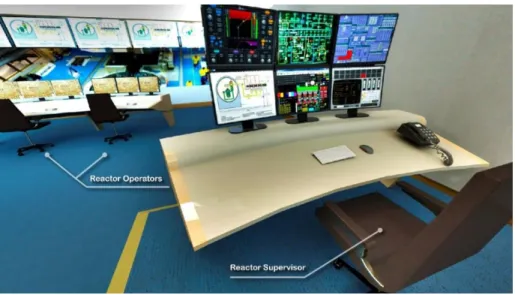
The MCR, showed in Figure 2, has workplaces for the reactor operators and the reactor supervisor. Each workplace contains workstations for reactor control with alarms, safety panels for the reactor protection, HSI for reactor control systems, post-accident monitoring systems and a suitable envi-ronment to house three operators for this room, because according to the standards analysis, inter-views, and validation of specialists, the MCR must be operated by three users: two operators that use reactor control consoles to monitor and control operations, and perform routine inspections and tests. The third operator is the Supervisor, responsible for the operation that uses communication systems to inform the nuclear reactor status and supervises the operations through the HSI from his workstation that contain the same information presented in the consoles of the two other operators. According to the team experts, it is necessary that the MCR to provide the proper view of the hall where the reactor pool is located, through windows, that the operators can visualize the operations and the progress of studies carried out in that area. Above the reactor pool window there are 4 LCD displays with cameras to monitor different parts of the installation.
Figure 2: The main control room
The MCR is strategically positioned in the plant in relation to the Emergency Control Room [7]. The Emergency Control Room (which was not modeled in this project) has panels with the neces-sary information for the safe shutdown of the plant when the operators have to leave the MCR. In the Communication room, Figure 3, resources are available, as communication and emergency equipment for use in the management and communication between MCR and other sectors of the installation.
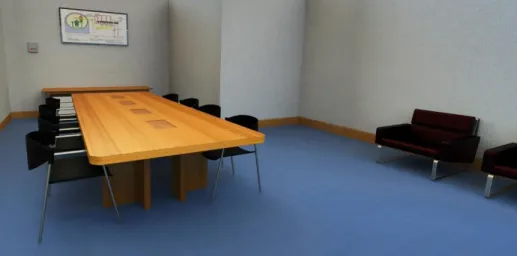
The operational support room, Figure 4, provides resources for the management and technical sup-port of the nuclear plant during emergency situations. Peripheral tasks, not directly related to plant operation, meetings, and control of access to the MCR are managed in operational support room.
Figure 4: The technical support room
4.
CONCLUSION
The participatory design approach used enables the inclusion of knowledge from several areas, in-cluding engineering, ergonomics, and industrial design, seeking to ensure that end users operate safely and efficiently in all operational states of the nuclear plant and in abnormal or accidental sit-uations. Based on a participatory design approach, including operator interviews, use of project guidelines, standards, and expert consultation, the project aimed to provide an environment suitable for the safe and pleasant operation of nuclear plant for operators to carry their tasks with satisfac-tion. In this article, we show how these concepts were applied to develop a 3D model of the nuclear reactor Control Center.
The methodology applied in this project has shown that the design concepts and HFE requirements are closely related, so that both consider that the end users of the Control Centre perform their activ-ities properly. Since a nuclear reactor includes complex processes and requires technical systems,
the design solutions and HFE requirements have contemplated the appropriate use of the Control Centre, analyzing and allocating the functions of the operators and emphasizing the participation of users in all phases of development of the Control Centre Design. Therefore, the methods and their activities contributed to the development of the 3D model of the Control Centre and the results achieved allowed the end users to visualize the project with immersive reality.
Thus, the project carried out suggests that the participatory design methodology improves the HFE requirements applied in the development of a 3D modeling. Moreover, the results of this involve-ment of participatory design with HFE stimulate the immersion of the project team and promote future studies with the application of simulation techniques from the modeling.
5.
ACKNOWLEDGMENT
The authors are grateful for the support of National Advice of Scientific and Technological Devel-opment - CNPQ. This project was performed at Instrumentation and Human Reliability Division of the Nuclear Engineering Institute, Laboratory of Usability and Human Reliability - LABUCH), Rio de Janeiro, Brazil (DICH / IEN).
REFERENCES
1. CARVALHO, P.V.; SANTOS, I.L.; GOMES, J.O.; BORGES, M.R.S.; GUERLAIN, S. Human factors approach for evaluation and redesign of human-system interfaces of a nuclear power plant simulator. In Displays, v. 29, p. 273-284, 2008.
2. NUREG 700, Revision 2. Human System Interface Design Review Guideline, US Nuclear Regulatory Commission, 2002.
3. NUREG 711, Revision 3. Human Factors Engineering Program Review Model, US Nuclear Regulatory Commission, 2012.
4. ISO 11064, International Organization for Standardization ISO. Design of Control Centers –
Part 1: Principles for the Design of Control Centers, 2000.
5. RUBIN, J.; CHISNELL, D. Handbook of usability testing: how to plan, design, and conduct
effective tests, 2rd ed. Indianapolis, IN: Wiley Publishing, Inc, 2008.
6. FARIAS M. S.; SANTOS, I. L.; GRECCO, C. H.; PEDROSA, P. S.; COLTHURST C. M.; SZABÓ, A, P. The users centered design of a new digital fluorometer, In: INTERNATIONAL
NUCLEAR ATLANTIC CONFERENCE, 2009, Rio de Janeiro. Annals. Rio de Janeiro:
Comis-são Nacional de Energia Nuclear, 2009.
7. GONÇALVES, G. L. Definição dos requisitos de posicionamento da sala de controle
Princi-pal e de Emergência em um reator nuclear de pesquisa, Master’s Thesis, Instituto de Engenharia