RADIATION SCIENCES
07-02A (2019) 01-15ISSN: 2319-0612
Accept Submission: 2018-12-12
BJRS
222
Rn Determination in Water and Brine Samples Using
Liquid Scintillation Spectrometry
Oliveira
aT. C., Monteiro
bR. P. G.
,
Moreira
bR. M. and Oliveira
aA. H.
a Departamento de Engenharia Nuclear, UFMG/DEN, 31270-901, Belo Horizonte, Minas Gerais, Brazil b Centro de Desenvolvimento da Tecnologia Nuclear,CDTN/CNEN, 31270-901, Belo Horizonte, Minas Gerais Brazil
[email protected] (Oliveira T. C.)
ABSTRACT
Liquid scintillation spectrometry (LSC) is the most common technique used for 222Rn determination in
environ-mental aqueous sample. In this study, the performance of water-miscible (Ultima Gold AB) and immiscible (Optiscint) liquid scintillation cocktails has been compared for water and brine samples. 241Am, 90Sr and 226Ra standard solutions were used for LSC calibration. 214Po region was defined as better for both cocktails.
Counting efficiency of 76 % and optimum PSA level of 95 for Ultima Gold AB cocktail, and counting efficiency of 82 % and optimum PSA level of 85 for Optiscint cocktail were obtained. Both cocktails showed similar results when applied for determining 222Rn activity in water and brine samples. However, the Optiscint is recommended
due to its quenching resistance. Limit of detection of 0.08 and 0.06 Bq l−1 were obtained for water samples using a sample:cocktail ratio of 10:12 mL for Ultima Gold AB (UGAB) and Optiscint (OPSC) cocktails, respectively. Limit of detection of 0.08 and 0.04 Bq l−1 were obtained for brine samples using a sample:cocktail ratio of 8:12 mL for Ultima Gold AB and Optiscint cocktails, respectively.
1. INTRODUCTION
Radon, 222Rn, is a radioactive noble gas that occurs as natural isotope derived from 238U
radio-active decay series. Radon is an alpha-particle emitter (5.48 MeV) with a half-life of 3.8 days and decays to a series of short-lived daughter products (218Po, 214Pb, 214Bi, 214Po). 222Rn concentrations
are quite lower in surface waters, whereas values in groundwater can be many orders of magnitude greater [1, 2, 3].
Radon is an important natural partitioning tracer [1], mainly in oil reservoirs. Information about the reservoir structure may be obtained by produced water composition which is a salty brine gen-erated during the oil production. The salts content is usually higher than the seawater salinity and varies widely between fields or even within the same field.
Liquid scintillation spectrometry (LSC) is a technique widely utilized for radon determination in water [2, 3, 4]. A lower limit of detection (LLD) of 1 Bq l−1 is sufficient for these surveys in most cases, easily achieved through LSC [5]. The two main advantages of this technique are the high α counting efficiency and a simple sample preparation.
This solvent is nonflammable, biodegradable, safer to use and enables good alpha/beta discrimi-nation. The first cocktail, Ultima Gold AB, is aqueous-miscible and specifically designed for al-pha/beta discrimination while the second one, Optiscint, is suitable for all organic samples.
The analyses have been carried to verify the performance of two DIN based (di-isopropylnaphthalene) liquid scintillation cocktails for radon determination and its behavior in sa-line samples.
2. MATERIALS AND METHODS
Measurements were carried out in a low background liquid scintillation spectrometer Quantulus 1220 from Perkin Elmer equipped with an anticoincidence guard counter. Polyethylene vials, Ulti-ma Gold AB and Optiscint cocktails were supplied by Perkin Elmer.
226Ra standard solution (activity 2.18 ±0.66 Bq mL−1) was used to spectrometer calibration. This
solution was prepared by gravimetrical dilution of 226Ra standard reference material [6]. Total α
emission (222Rn, 218Po and 214Po) and high α emitter (214Po) regions were defined for radon determi-nation. Window channels regions have been defined analyzing the efficiency in total α and 214Po regions.
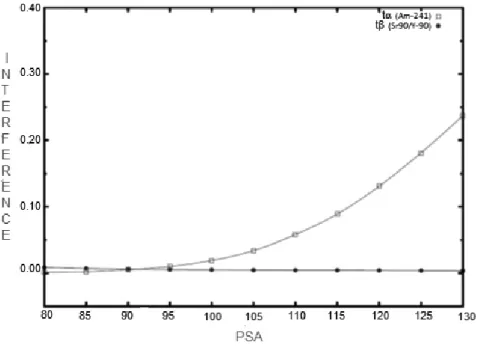
Optimum PSA level for Ultima Gold AB cocktail was selected for minimizing the interferences of α emitters in the β window and vice-versa [7]. Radioactive standard solutions of 241Am [8] and 90Sr [9] were used for optimization of α/β separation, i.e., setting the pulse shape analyzer (PSA) at
an adequate value. Optimum PSA level for Optiscint cocktail was determined using 226Ra standard solution, thereby analyzing the variation of efficiency in function of PSA [2].
Sample channels ratio (SCR) was used to assess whether the PSA level has been adjusted cor-rectly for radon. It indicates interferences by count rates registered in different regions. The theoret-ical value of 214Po region/total α regions (222Rn, 218Po and 214Po) count rates is 0.33, when
consider-ing α particle efficiency of approximately 100 %. Experimentally the SCR value is slightly lower than the theoretical value due to the lower efficiency of 214Po compared with others alphas [10].
Tap water samples collected at CDTN/CNEN were analyzed for radon determination using both cocktails. The sample was prepared by collected water with a glass pipette directly into a vial con-taining the cocktail. No pipette filler was used to avoid suction and 222Rn release. The sam-ple/cocktail ratio for water sample was 10/12 mL for both cocktails. Due to the salts content in brine samples, the sample/cocktail ratio was 8/12, which is usually applied to saline water as seawater samples.
In order to verify the salinity effect in radon determination using LSC, high brine samples (40 to 120 g L−1) were prepared using “pro analysis” grade reagents. Among the ions present in brine samples of Campos Basin, Na+ (30 %), K+ (1 %), Mg2+ (3.7 %), Cl− (55 %) and SO4−2 (7.7 %) were considered the most important [11].
After sampling, the vial was agitated approximately one minute. It was kept in a dark chamber and under refrigeration for radon equilibration with its short-lived daughters and counted 3-4 h later [5].
Total counting time was divided in three cycles of two repetitions of 20 minutes for each sam-ple. Prepared samples were counted again after about 25-30 days in order to evaluate the supported radon activity and presence of interferences due to α emitter nuclides. Background was determined counting 10 mL of distilled water and 12 mL of cocktail. For calibration, a blank was established by N2 bubbling through a 226Ra standard solution (1 Bq) during about 4 hours in order to know the
contributions of 226Ra and 210Po in α spectrum. The standard:cocktail samples of both cocktails were
kept under refrigeration over 25-30 days prior to determination of radon counting efficiency [12].
Radon activity was calculated using the Equation 1.
f V EFA C = At α s α 60 C - Bg (1)
Where At is the activity of 222Rn at sampling date (Bq L-1), Csα is the α counting rate of the sample (cpm), CBgα is the α counting rate of the background (cpm), EFA is the α efficiency, V is the sample volume (0.01 L), 60 is the second to minute conversion factor, f - (e−λRn·te) and (1 − e−λRn·tp), for the first and second measurements respectively for no-supported and supported radon
determination. Where λRn is the radon decay constant, te and tp are the time between sampling and counting for each measure.
Limit of detection was calculated using Equation 2 [13], where tc is the total counting time
(mi-nute). f V EFA T BqL Ld c + = − 60 T C 4.65 2.71 ) ( c Bg 1 (2)
The uncertainty in the activity (μAt) was calculated by the Equation 3, considering the
uncertain-ties of the counting (μcpm), efficiency (μEFA) and volume of the sample (μv).
2 2 2 Bg s Bg s ) ( ) ( ) C C ( C C V EFA T Tc T Tc At EFAV c c At
−
+ + + = (3) .3. RESULTS AND DISCUSSION
The main settings for Ultima Gold AB and Optiscint cocktails, such as level of PSA, window channel and alpha efficiency, were studied for radon determination.
Optimum PSA value is 95 for Ultima Gold AB cocktail due to in this level the mutual α/β inter-ferences are minimized (Figure 1). 226Ra standard solution was prepared for establishing of alpha efficiency.
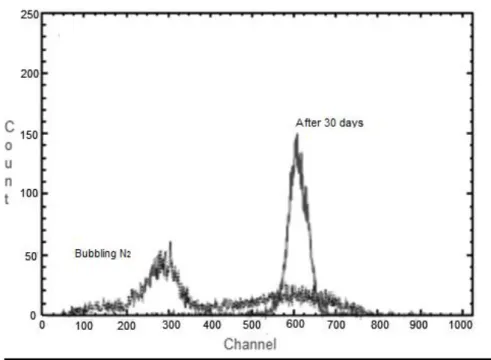
Figure 2 shows its α/β spectra, bubbling with N2 during 4 hours (the blank spectrum) and after
30 days for 226Ra/222Rn equilibrium. After bubbling only 226Ra and its daughters, 210Po, 210Pb and
210Bi are presents.
It is observed in Figure 3 that total α and 214Po regions correspond to window channels 500-800 and 700-800 respectively. Alpha counting efficiencies were 257 % and 76 % for total α and 214Po regions, respectively. The value of SCR obtained was 0.296, which differs a little of theoretical val-ue (0.33).
Figure 2 - α/β spectra, sample bubbling with N2 during 4 hours and after 30 days for 226Ra/222Rn
Figure 3 - 226Ra/222Rn equilibrium spectra using Ultima Gold AB and PSA 95
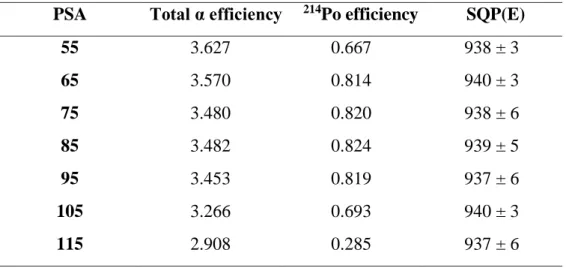
Due to the Optiscint cocktail being water immiscible, the PSA level was established using 226Ra
Table 1). The medium value of 85 was defined as the optimum PSA level with an alpha efficiency of 348 % and 82 % for total α and 214Po regions, respectively. Although the PSA level of 85 had been properly defined, the value of SCR obtained was 0.237 which differs significantly of theoreti-cal value (0.33) at the 95% confidence level. In addition, a higher efficiency than 300 % was ob-served in total α counting region. This is indicative of interference on α counting that needs to be investigated.
Table 1 - Optimum PSA value using Optscint cocktail PSA Total α efficiency 214Po efficiency SQP(E)
55 3.627 0.667 938 ± 3 65 3.570 0.814 940 ± 3 75 3.480 0.820 938 ± 6 85 3.482 0.824 939 ± 5 95 3.453 0.819 937 ± 6 105 3.266 0.693 940 ± 3 115 2.908 0.285 937 ± 6
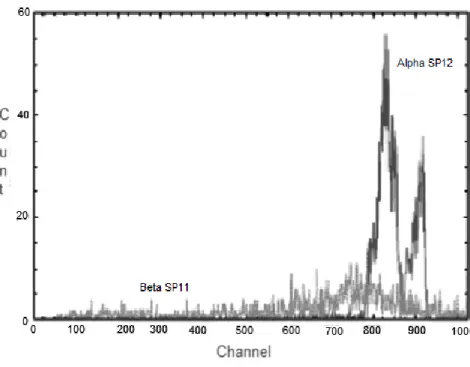
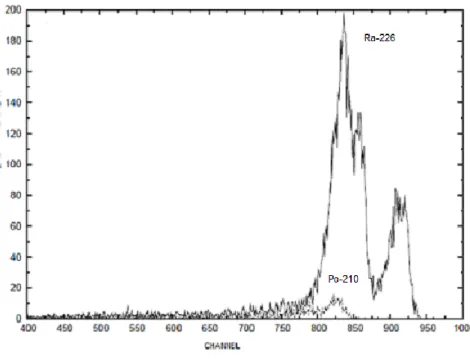
The increase of the efficiency in total α region can be due to beta spillover or 210Po which is an alpha emitter with energy of 5.30 MeV and is also soluble in the organic phase. This radionuclide is contained in 226Ra standard solution that was not purification recently. The α/β spectra of 226Ra standard solution at PSA 85 shows in the Figure 4. It was observed that total α and 214Po regions correspond to window channels 750-950 and 900-950 respectively.
In order to evaluate the 210Po interference was prepared a vial containing 210Pb standard solution (1 Bq) in equilibrium with 210Po which was compared with a 226Ra standard solution (1 Bq) using Optiscint cocktail. Figure 5 shows 210Po spectra interference in total α region.
The results indicate that 222Rn content must be calculated from 214Po region for both cocktail.
For Ultima Gold AB cocktail, due to the possible interference of alpha emitters as 226Ra, 210Po and
238U and for Optiscint cocktail, due to interference in total α region. Furthermore, the background
count rate in 214Po is lower than for total α region and thus a lower limit of detection can be achieved. The main parameters for radon determination in water using both cocktail are shown in Table 2.
Table 2 – Main parameters for Ultima Gold AB and Optiscint cocktails
Parameter Ultima Gold AB Optscint
PSA 95 85
214Po region 700-800 900-950
214Po efficiency 76 % 80 %
Detection limit 0.08 Bq L−1 0.06 Bq L−1
Both cocktails were applied to radon determination in tap water collected at CDTN/CNEN. Ta-ble 3 shows some results obtained in triplicate. Similar values of 222Rn activity were observed for both cocktails. This examples show the good repeatability of the methods. The counting of the sam-ples after 30 days not indicated the presence of the supported radon.
Cocktail α Total Bq L-1 214Po Bq L-1 SQP(E) Ultima Gold AB 0.2 ± 0.18 0.2 ± 0.17 775 ± 2 0.3 ± 0.26 0.3 ± 0.25 765 ± 3 0.1 ± 0.10 0.1 ± 0.10 763 ± 3 Optscint 0.3 ± 0.17 0.4 ± 0.3 919 ± 2 0.3 ± 0.18 0.4 ± 0.3 921 ± 4 0.3 ± 0.18 0.4 ± 0.3 913 ± 8
Salinity effect in radon determination shows in Table 4. It was observed a phase separation and a non-transparent emulsion for all samples when Ultima Gold AB cocktail was used. Then, a crease in counting efficiency is expected due to the inhomogeneous distribution. However, the de-crease in radon counting efficiency was significant only for high salts concentration.
Table 4 – Salinity effect in radon determination using Ultima Gold AB and Optscint cocktails Cocktail Salinity (g L-1) Efficiency (%) Background (cpm) SQP(E) LLD (Bq L-1) Ultima Gold AB 40 80 120 87 86 61 0.05 0.02 0.10 795 795 790 0.04 0.03 0.08 Optiscint 40 80 120 68 68 64 0.02 944 937 942 0.04
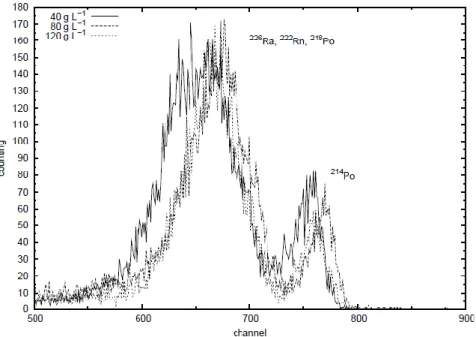
We consider that decrease using the Ultima Gold AB cocktail occurred mainly due to the physi-cal quenching. The poor resolution observed in sample spectra (Figure 6) is typiphysi-cal of quenching presence.
On other hand, Optiscint cocktail showed high SQP (E) quenching parameter that was evi-denced by good resolution presented to all samples (Figure 7). Lower counting efficiency compared to Ultima Gold AB cocktail is due to the partitioning radon between the organic and aqueous phases into vial.
Figure 7 – Alpha spectra of 226Ra standard using Optiscint cocktail for brine samples
Two methods for radon determination in water using water-miscible and immiscible liquid scin-tillation cocktails, Ultima Gold AB and Optscint, respectively, showed similar results. Both cock-tails were recommended to radon determination in water but Optiscint cocktail is more recommend-ed for the brine samples due to its quenching resistance. The same calibration procrecommend-edure for effi-ciency determination, i.e., N2 bubbling for standard solution blank establishment, is recommended
for both cocktails. 214Po region should be chosen for radon activity calculation due to minimize the interferences of other radionuclides and beta spillover. In order to improve the understanding the interferences in alpha region using Optiscint, new assay should be performed.
5. ACKNOWLEDGMENT
The research was sponsored by Coordination for the Improvement of Higher Education Personel (CAPES). In addition the authors wish to thank the staff of Center of Development of Nuclear Technology (CDTN/CNEN) and Fundação de Amparo à Pesquisa de Minas Gerais (FAPEMIG) for their support and assistance.
1. Semprini, L., Hopkins, S. O., Tasker, R. B., 2000. Laboratory, field and modeling studies of
radon-222 as a natural tracer for monitoring (napl) contamination. Transport in Porous Media
38, 223-240.
2. López, M. G., Sánchez, A. M., Escobar, V. G., 2004. Application of ultra-low liquid scintillation of the determination of 222Rn in groundwater. J. Radioanal. Nucl. Chem. 261 (3), 631-636.
3. Pates, J. M., Mullinger, N. J., 2006. Determination of 222Rn in fresh water: Development of a robust method of analysis by α/β separation liquid scintillation spectrometry. Appl. Radiat. Isot. 65, 92-103.
4. Forte, M., Rusconi, R., Di-Caprio, E., Bellinzona, S., Sgorbati, G., 2003. Natural radionuclides measurements in drinking water by liquid scintillation counting. methods and results. In: Warwick, P. (Ed.), Environmental Chemical Analysis. Vol. II. Royal Chemical Society, pp. 128-142.
5. Salonen, L., 1993a. Measurement of low levels of 222Rn in water with diffferent commercial liquid scintillation counters and pulse-shape analysis. In: Noakes, J. E., Schönhofer, F., Polach,
H. A. (Eds.), Liquid Scintillation Spectrometry 1992 - Int. Conf. on Advances in LSC. RADIO-CARBON, pp. 361-372.
6. Ra-226 Radioactive Standard, 2003. Standard reference material 4967A. National Institute of Standards & Technology - NIST, reference date September 01, 2003.
7. Salonen, L., Hukkanen, H., 1997. Advantages of low-background liquid scintillation alpha-spectrometry and pulse shape analysis in measuring 222Rn, uranium and 226Ra in groundwater sam-ples. J. Radioanal. Nucl. Chem. 226 (1-2), 67-74.
8. Am-241 Radioactive Standard, 2004. Certificado de calibração C/07/A04, fonte 26L04. Co-missão Nacional de Energia Nuclear - CNEN, Instituto de Radioproteção e Dosimetria - IRD, Labo-ratório Nacional de Metrologia das Radiações Ionizantes - LNMRI, data de referência 15 de
Março, 2004.
9. Sr-90 Radioactive Standard, 2006. Certificado de calibração C/24/A06, fonte 81L06. Comissão Nacional de Energia Nuclear - CNEN, Instituto de Radioproteção e Dosimetria - IRD, Laboratório Nacional de Metrologia das Radiações Ionizantes - LNMRI, data de referência 10 de Agosto, 2006.
10. Salonen, L., 2006b. Alpha spillover depends on alpha energy: a new finding in alpha/beta
liquid scintillation spectrometry. In: Chalupnik, S., Schönhofer, F., Noakes, J. (Eds.), LSC2005,
Advances in Liquid Scintillation Spectrometry. RADIOCARBON, pp. 135-148.
11. Rocha, A. A., Miekeley, N., Silveira, C. L. P., Bezerra, M. C. M., 1998. Determinação de fósfo-ro orgânico em águas de pfósfo-rodução petfósfo-rolífera por icp- aes e icp- ms após pré-concentração em colu-na de sílica-c18. Quim. Nova 21.
12. D. Al-Azmi, B. Snopek, A. S., Domanski, T., 2004. A simple bubbling system for measuring
radon (222Rn) gas concentrations in water samples based on the high solubility of radon in olive oil.
13. Currie, L. A., 1968. Limits for qualitative detection and quantitative determination: application to radiochemistry. Anal. Chem. 40 (3), 586-593.