DOCTORAL CONGRESS
in ENGINEERING
Book of Abstracts
1
st
Symposium on Mining Engineering
Porto
June 2019
Editors:
Maria de Lurdes Dinis, Janine Figueiredo, Rui Sousa
Book of Abstracts
of the
1
st
Symposium on Mining
Engineering and
Geo-Resources
This volume contains the abstracts presented at the Symposium on Mining Engineering and Geo-Resources, within the 3rd Doctoral Congress in Engineering - DCE19, held in Porto, between June 27th and 28th, 2019.
Title: Book of Abstracts of the 1st Symposium on Mining Engineering and Geo-Resources
Edited by: Maria de Lurdes Dinis, Janine Figueiredo and Rui Sousa
Published by: FEUP Edições
https://paginas.fe.up.pt/~dce/2019/symposia/symposium-on-mining-and-geo-resources/
https://sigarra.up.pt/feup/pt/pub_geral.pub_view?pi_pub_base_id=331009
First edition: June 2019 ISBN. 978-972-752-248-4
Universidade do Porto, Faculdade de Engenharia, Departamento de Engenharia de Minas, Rua Dr. Roberto Frias s/n 4200-465 Porto, Portugal
| 5 The Organizing Committee of the Symposium on Mining Engineering and Geo-Resources welcome you to the 3rd Doctoral Congress in Engineering (DCE19), FEUP, Porto, Portugal. We are pleased to host the 1st Symposium on Mining Engineering and Geo-Resources in the Faculty of Engineering of Porto University organized in collaboration with the Instituto Superior Técnico (IST). This is an excellent opportunity for doctoral and master students to share and discuss on-going research with peers, professors, and industry and develop networking opportunities with other researchers. The Symposium on Mining Engineering and Geo-Resources focus on a multidisciplinary, advanced and comprehensive approach to scientific or technological issues involved in the life cycle of a mineral resource. Research is preferentially concerned with the fundamental understanding of the basic processes that support the sciences and technologies involved in the application of engineering principles to the Earth Sciences.
Topics for submission for the Symposium on Mining Engineering and Geo-Resources were focused on: Mineral Exploration and Feasibility, Mining Extraction, Mineral Processing, Environmental Mining Impact and, Mining Life Assessment (including: Resources Assessment, Mining Planning, Mine Closure, Recycling, Life Cycle Assessment, Occupational Assessment, etc.).
The responses to the call-for-papers were much higher than expected. We would like to express our gratitude and appreciation for all of the reviewers who helped us maintain the high quality of manuscripts included in this Symposium Book of Abstracts. We would also like to extend our thanks to the members of the organizing team for their hard work, in particular, Janine Figueiredo and Rui Sousa.
Let us wish that all the participants of the Symposium on Mining Engineering and Geo-Resources will have a wonderful and fruitful time at the Symposium. We hope that you will find it useful, exciting, and inspiring.
Symposium Chair Maria de Lurdes Dinis, CERENA-Polo FEUP, Faculty of Engineering, Porto University. On behalf of the Co-Chair, Organizing Committees and Scientific Committee 27 - 28 June, 2019 FEUP, Porto, Portugal
| 9
COMMITTEES... 11
Scientific Committee ... 13
Organizing Committee ... 13
PROGRAMME ... 15
Symposium on Mining Engineering and Geo-Resources ... 17
KEYNOTE SPEAKERS ... 21 Anabela Magalhães ... 23 António Fiúza ... 24 Ernesto Fernandes ... 25 Fernando Noronha ... 26 Francisco Leite ... 27 Luís Martins ... 28
Mário Machado Leite ... 29
ORAL PRESENTATIONS ... 31
Design of a Lepidolite flotation pilot plant based on lab scale tests ... 33
An assessment of Cabeço do Pião tailings aiming its recovery of metals as a sustainable alternative ... 37
Separation of PS and ABS using froth flotation combined with a heating treatment ... 41
Strategies to integrate geological consistent information into geostatistical seismic inversion methods ... 45
Pore Pressure prediction and modeling using seismic velocities ... 49
Inferring subsurface acoustic properties through different seismic inversion methodologies for reservoir characterization ... 53
Grade uncertainty integration into STPS ... 57
Exploration Data Analysis and Mineral Grade Estimation of Calcium fluoride of the Okorusu Ore Deposit, Namibia: A Case Study ... 61
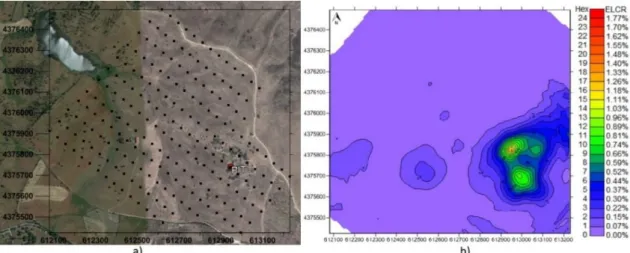
Simultaneous mine exploitation with environmental recovery-circular economy concept .... 65
Bioburden and Radon in Indoor Spas Air Project - BRISA ... 69
Radioactivity and risk assessment in the Nisa area applying basic geostatistical methods .... 73
Borehole Deviation Control Using Electronics: An Euler’s Approach... 77
Modelling two-dimensional steady non-ideal detonations ... 81
Diamond exploration and mining in Angola: technical and economic issues ... 85
The Future of the Angolan Diamond Industry: a Clash Between External Disruptive Forces, a New Government Policy and Heritage Problems ... 87
Risk undervaluation in mineral projects: first approach to a solution ... 91
Responsible Mining Towards Sustainable Legacy ... 95
| 10 Reprocessing the tailings from the Cabeço do Pião Dam – recovery of copper and zinc by differential flotation ... 101 Use of accelerometers for the measurement of vibrations from rock blasting: a Taylor’s approach ... 103 Depression of Galena using dextrin in a Chalcopyrite flotation circuit: optimization of operational conditions for an Industrial Trial at SOMINCOR’s Copper plant ... 105 Feasibility of establishing a landfill of inert waste in karst zones. Proof of concept from an industry perspective 4.0. ... 107 Study of the structure cost of the Extractive Industry in Portugal - Optimization of the mortar Plants ... 109 Development of software platform for dimensioning of mineral processing equipment ... 112 Methodology for Optical Control of Aggregate Calibration in Raw Materials Processing – Masters Dissertation ... 114 Modelling the transport and fate of radionuclides in a sludge heap from the processing of phosphate ores... 116 Mapping the International Standards and Guidelines in Exploration Results, Mineral Resources, Reserves and Value Reporting ... 118 Reporting in the Mineral Industry: Exploration, (E)Valuation and (Social, Environmental and Source) Responsibility ... 120 The Circular Economy of the Portuguese Natural Stone Industry: conceptual model and first results ... 123 AWARDS ... 125 Best student oral communication award for the Symposium on Mining Engineering and Geo-Resources ... 127 Best student poster presentation award for the Symposium on Mining Engineering and Geo-Resource ... 127 AUTHORS INDEX ... 128
| 13 Scientific Committee
Chair: Maria de Lurdes Dinis (FEUP/CERENA-Polo FEUP) Co-Chair: Teresa Carvalho (IST/CERENA)
Fernando Durão (IST/CERENA) Matilde Costa e Silva (IST/CERENA)
Organizing Committee
Chair: Maria de Lurdes Dinis (FEUP/CERENA-Polo FEUP)
Janine Figueiredo (FEUP/CERENA-Polo FEUP) Rui Sousa (FEUP/CERENA-Polo FEUP)
José Alexandre (FEUP/Junior Member) Paula Lacerda (FEUP/Junior Member) Paula Lima (DEM/FEUP)
| 17 Symposium on Mining Engineering and Geo-Resources
Chair: Maria de Lurdes Dinis Location: B033
Time for oral presentation: 10 min + 5 min discussion
Session I (27th June, 10:30h-13:00h) | Moderated by Teresa Carvalho
Invited Speaker:
Mário Machado Leite, Member of Board of Directors of the new LNEG (National Laboratory for Energy and Geology). Autogenous Grinding: A Mathematical Model.
• Rui Sousa, Aurora Futuro, António Fiúza and Mário Machado Leite. Design of a Lepidolite flotation pilot plant based on lab scale tests (#47).
• Janine Figueiredo, Maria Cristina Vila, Joaquim Góis, Bárbara Biju, Diogo Martins, Aurora Futuro, Maria de Lurdes Dinis, Alexandre Leite and António Fiúza. An assessment of Cabeço do Pião Tailings aiming its recovery of metals as a sustainable alternative (#13).
• Francisca Rey and Teresa Carvalho. Separation of PS and ABS using froth flotation combined with a boiling treatment (#119).
Invited Speaker:
António Fiúza, Scientific Coordinator of R&D Center: Centro de Recursos Naturais e Ambiente – CERENA-Polo FEUP
Session II (27th June, 14:30h-17:00h) | Moderated by Maria João Pereira & Maria de Lurdes Dinis
Invited Speaker:
Fernando Noronha, Emeritus Professor at Faculty of Sciences of the University of Porto. The Santa Helena Breccia: A New Tungsten Orebody in Portugal.
• Pedro Pereira, Strategies to integrate geological consistent information into geostatistical seismic inversion methods (#73).
• João Narciso, Matilde Costa e Silva and Amílcar Soares. Pore Pressure prediction and modeling using seismic velocities tomography Studies (#121).
• Mariano Martinho, Tim Taylor-Jones and Leonardo Azevedo. Inferring subsurface acoustic properties through different seismic inversion methodologies for reservoir characterization (#120). • João Vermelho Neves and Amílcar Soares. Grade uncertainty integration into STPS (#186). • Andreas Tuhafeni Salom and Jorge Carvalho. Exploration Data Analysis and Mineral Grade
Estimation of Calcium fluoride of the Okorusu Ore Deposit, Namibia: A Case Study (#56). Invited Speaker:
António Fiúza, Scientific Coordinator of R&D Center: Centro de Recursos Naturais e Ambiente – CERENA-Polo FEUP. Hydrometallurgical Processing of Scheelite.
• Rania Rebbah, J. Duarte, Omar Djezairi, Mohamed Fredj and João Santos Baptista. Simultaneous mine exploitation with environmental recovery – circular economy concept (#59).
• Ana Silva, Maria de Lurdes Dinis, Alcides Pereira, Ana Monteiro, Beatriz Almeida and Carla Viegas Bioburden and Radon in Indoor Spas Air Project – BRISA (#189).
| 18 • Vitor Colombo, António Sobral, Jorge Carvalho and Elsa Ramalho. Radioactivity and risk
assessment in the Nisa area applying geostatistical methods (#12).
Session III (28th June, 9:00h-10:30h) | Moderated by Francisco Leite
Invited Speaker:
Ernesto Fernandes, Mining Engineer at Lundin Mining – SOMINCOR. Neves Corvo Mine: A Past with Future!
• Paulo Couceiro. Modeling two-dimensional steady non-ideal (#41).
• Gean Frank Faustino and Vinicius Miranda. Borehole Deviation Control Using Electronics: An Euler’s Approach (#74).
• Vinicius Miranda, Gean Frank Faustino and Auã Kiahla. Use of accelerometers for the measurement of vibrations from rock blasting: a Taylor’s approach (#131).
• Luís Chambel, José Abranches and Adriano Xavier. Diamond exploration and mining in Angola: technical and economic issues (#202).
Poster Session (28th June, 10:30h-11:30h)
Catarina Mendes, Rui Sousa, Diogo Martins and Aurora Futuro. Reprocessing the tailings from the Cabeço do Pião Dam – recovery of copper and zinc by differential flotation (#67).
Inês Matos Luís, João Prazeres and Rita Santos. Depression of Galena using dextrin in a Chalcopyrite flotation circuit: optimization of operational conditions for an Industrial Trial at SOMINCOR’s Copper plant (#133).
Lisandra Santana, João Baptista and Joana Duarte. Feasibility of establishing a landfill of inert waste in karst zones. Proof of concept from an industry perspective 4.0 (#135)
Paulo Rocha, Miguel Tato Diogo and Jorge Guedes. Study of the structure cost of the Extractive Industry in Portugal - Optimization of the mortar Plants (#139).
Flávio Rodrigues, Aurora Futuro and M. R. Machado Leite. Development of software platform for dimensioning of mineral processing equipment (#141).
Joana Silva, José Soeiro and Aurora Futuro. Methodology for Optical Control of Aggregate Calibration in Raw Materials Processing – Masters Dissertation (#170).
Octávia Vieira and Maria de Lurdes Dinis. Modeling the transport and fate of radionuclides in a sludge heap from the processing of phosphate ores (#176).
Luís Chambel. Mapping the International Standards and Guidelines in Exploration Results, Mineral Resources, Reserves and Value Reporting (#191).
Luís Chambel and Teresa Burguete. Reporting in the Mineral Industry: Exploration, (E)Valuation and (Social, Environmental and Source) Responsibility (#192).
Luís Caetano and Luís Chambel. The Circular Economy of the Portuguese Natural Stone Industry: conceptual model and first results (#203).
| 19 Session IV (28th June, 11:30h-12:45h) Moderated by António Fiúza
Invited Speaker:
Luis Martins, President of the Cluster Portugal Mineral Resources. Mineral Resources of Portugal and the global and European raw materials context.
• José Abranches, Luís Chambel and Orquidia Neves. The Future of the Angolan Diamond Industry: a Clash Between External Disruptive Forces, a New Government Policy and Heritage Problems (#190). • Luís Chambel. Risk undervaluation in mineral projects: first approach to a solution (#195).
• Teresa Burguete. Responsible Mining Towards Sustainable Legacy (#184).
Closing of the Mining Engineering and Geo-resources Symposium (28th June, 12:45)
Session V (28th June, 14:00h-15:30h)
• Workshop I: Francisco Leite (O-Pitblast), Drones for Mining Topographic Control and Fragmentation Analysis (O-Pitblast).
• Workshop II: Anabela Magalhães (Assimagra). Technical Responsibility in Quarries: Challenges and Opportunities.
| 23 Anabela Magalhães
Executive Director at North Delegation of Assimagra
Topic: Technical Responsibility of Quarries: Challenges and Opportunities
Anabela Magalhães is a Mining Engineer graduated by Porto University, Engineering Faculty (FEUP) in1997. During the academic course of five years (Pre-Bologna System), she spent 6 months in Denmark where she developed research work in the field of environmental biotechnology and water treatment systems for underdeveloped countries. In 2001 she completed the postgraduate course in Health and Safety at Work at Instituto Superior de Línguas e Administração (ISLA). For more than 20 years, she has provided technical advice to companies in the extractive and natural rock processing sector, contributing to the technological and economic development of the sector, intervening in a consolidated way with the official organizations, in the defense and representation of the sector. Between 1998 and 2017 she held the technical position of Head of the Northern Delegation of CEVALOR - Technological Center for the Valorization of Ornamental and Industrial Stones and since 2017 to the present she is the Executive Director of the Northern Delegation of ASSIMAGRA - the Mineral Resources Association of Portugal.
She has been the External Technical Responsible in dozens of Quarries since 2008, assisting companies in the execution of the approved quarry plan and responding jointly with the exploring company on all issues related to with the technical management and execution of the official quarry plan in its various components.
| 24 António Fiúza
Emeritus Professor at Faculty of Engineering of the University of Porto.
Scientific Coordinator of R&D Center Centro de Recursos Naturais e Ambiente – CERENA-Polo FEUP
Topic: Hydrometallurgical Processing of Scheelite
António Fiúza is Emeritus Professor at University of Porto since 2018. He was the director of the Mining Engineering department, and of the Mining Engineering and Environment Engineering Courses (Master and PhD).
He was graduated technician at the “Junta de Energia Nuclear” and head of the planning and project division at the “Empresa Nacional de Urânio, EP”, and consultant in several projects for national and multinational organizations. He taught several courses in many Universities in Europe and South America. As a researcher, he was member of the Scientific Commission of several international conferences, he created and coordinated a research center – CIGAR (Centro de Investigação em Geo-Ambiente e Recursos) and was Coordinator and participant of several research projects with national and European funding. He is the author of several scientific publications in peer review journals in different area of interest.
Actually, he is the coordinator of the division Matérias-Primas of the “Centro de Recursos Naturais e Ambiente” (CERENA).
| 25 Ernesto Fernandes
Head of Operational Coordination at SOMINCOR - Lundin Mining
Topic: Neves Corvo Mine: A Past with Future!
Ernesto Fernandes is Master’s in Mining and Geo-Environment Engineering by Faculty of Engineering and full member nº 39543 of Engineers Order. He started his career at Fundifer, working on tunnels for water caption in the Madeira Island. Between 1985 and 2002, he was Production Engineer at Gré-Granitos and Production Engineer and Services Responsible at Pirites Alentejanas, SA. Since 2002, he was Production Engineer, Department Head and Director for the underground projects at Somincor. In 2017 he was Responsible for the development and production of the Lombador Project (phase 1) and for the starting of the underground works in the Zinc Expansion Project. Since 2018 he is the Head of the Operational Coordination.
| 26 Fernando Noronha
Emeritus Professor at Faculty of Sciences of the University of Porto.
Topic: The Santa Helena Breccia: a new tungsten orebody in Portugal
Fernando Noronha is an Emeritus Professor at Faculty of Science of the University of Porto since 2017. He graduated in Geology (1970) and has a PhD in Economic Geology (1984) from the Faculty of Science of University of Porto. He was Full Professor (1991- 2016) of Ore Deposits, scientific coordinator of GIMEF (Metallogeny and Fluids research team 1993), Coordinator of “Centro de Geologia da Universidade do Porto” (2003-2014) and Co-ordinator of "Instituto de Ciências da Terra-Polo Porto" (2015-2018). His most relevant experience was in mining geology (1971-1983), in field study of the geological setting of ore deposits associated with granites and responsible on the elaboration of the geological map (5 sheets) of Portugal (1/50 000) and also in the two Maps of Geological Resources (1/200 000) in collaboration with Geological Survey of Portugal (IGM) and in fluid inclusion studies. In 1976 organized the first microthermometry laboratory in Portugal at “Centro de Geologia da Universidade do Porto” and since 1983 has the responsibility for a team "Fluids and Metallogeny" which works essentially in geology, metallogeny, geochemistry and paleofluids.
Since 1993, he is the scientific leader of the team "Grupo de Investigação em Metalogenia e Fluidos- GIMEF" (Research Group on Metallogeny and Fluids) who works essentially on geology, metallogeny, geochemistry and fluid inclusions.
He has participated in several scientific projects, being the author of more than 100 publications in peer review journals.
| 27 Francisco Leite
Technical Service Director at O-ptiblast
Topic: The use of Drone for Mining Topographic Control and Fragmentation
Francisco Leite is Master’s in Mining and Geo-Environment Engineering by Faculdade de Engenharia da Universidade do Porto (2013), O-Pitblast co-founder, COO and Technical Services Director. Previously worked with Maxam International S.L. as Project Engineer and Pit Supervisor at Tasiast Kinross Mine – Mauritania. Has experience in International Mining Projects (Spain, Brasil and Mauritania), where was responsible for technical services, project management, control and optimization of rock blasting.
| 28 Luís Martins
President of the Board - Portugal Mineral Resources Cluster
Laboratório Nacional de Energia e Geologia/LNEG - Advisor of the Board
Topic: Mineral Resources of Portugal and the global and European raw materials context
Luis Martins is a geologist with more than 30 years of experience in the exploration and mining sector. He graduated from the Faculty of Sciences of Lisbon (1973) and has a MsC in Economic Geology from the same faculty (1995) and also several national and international post-graduation courses. He was a former Director of the Mineral Resources Department at the Geology and Mining Institute (the Geological Survey) and a former Director of the Mines and Quarries Department at the Directorate-General of Energy and Geology (the Mining Authority). He was the Portuguese representative on the “Raw Materials Supply Group” of DG Enterprise and Industry of the European Commission (June 2010-August 2012) and coordinator of the CYTED Ibero-American Network “Land Use Planning and Mineral Resources”. He was also Colt Resources Inc. Vice-President Business & Development and CEO of Ozdogu Portugal Mining and Exploration Lda.
Currently is also Vice-President of Assimagra, a Portuguese mining association and President of the Cluster Portugal Mineral Resources.
He has published 110 papers in peer review publications and presenting oral communications in about 400 national and international events.
| 29 Mário Machado Leite
Cathedratic Professor at Faculty of Engineering of the University of Porto.
Laboratório Nacional de Energia e Geologia/LNEG - Member of the Administration Board, Head of
the Geology and Mines Laboratory and Head of the Science and Mineral Technology Unit.
Topic: Autogenous griding: A mathematical model
Mário Machado Leite got his PhD in Mineral Processing in 1984 at the Mining Department, Faculty of Engineering, University of Porto (Portugal) where he is full Professor of Mineral Processing. In 1996 he started a collaboration with the Institute of Geology and Mining as Director of the Laboratories of Chemistry, Mineralogy and Technology of geological materials, where he launched a system of analytical quality assurance. In 2009 it was created in Portugal the National Laboratory for Energy and Geology (LNEG) that received all the competencies and missions of National Geological Survey and the undersigned was nominated member of Board of Directors of the new LNEG, a position that holds until the present. He has been working in several research projects and contracts with mining companies. In the European H2020 FAME Project, he was WP leader contributing with his knowledge and experience, being also the responsible for the development of a continuous pilot plant, at LNEG facilities, aiming at producing Li-Mica concentrates by froth flotation. He continues teaching mineral processing at the University of Porto in graduation, master and PhD syllabus. His experience and personal interest are modeling of unit operations of mineral processing, mainly comminution, mineral liberation and flowsheet analysis.
| 33
Design of a Lepidolite flotation pilot plant based on lab
scale tests
Rui Sousa1,2, Aurora Futuro2, António Fiúza2 Mário Machado Leite1 1Laboratório Nacional de Energia e Geologia, Rua da Amieira, São Mamede Infesta,
Portugal
2CERENA - Polo FEUP - Centre for Natural Resources and the Environment, Faculty of
Engineering, University of Porto, Rua Dr. Roberto Frias, 4200-465 PORTO, ([email protected])
Abstract
Lithium is a strategic element with a key role for storage in the energy transition systems. The extraction of Li from hard-rocks deposits is fundamental to answer to the market requirements adequately. Froth flotation is the most promising technology for the beneficiation of lithium minerals, being able to produce high-grade concentrates suitable for the metallurgical extraction. Several studies have been conducted to demonstrate the potential of froth flotation for the beneficiation of different lithium ores. In this study, laboratory-scale flotation tests were carried out, together with other preliminary tests to assess the production of lithium concentrates using a lepidolite ore from Alvarrões deposit, Center Portugal. This preliminary work was the basis for the design of a processing flowsheet, demonstrated then in a pilot scale plant, allowing for the assessment of the process feasibility, but also to produce concentrates for metallurgical tests.
Author Keywords. Mineral Processing, Pilot Plant tests, Froth Flotation, Lithium-Mica Minerals. Type: Oral Communication
Open Access Peer Reviewed CC BY
1. Introduction
Lithium (Li) is a key material for modern life due to its distinctive properties, having an important role in the global energy demand (Forster and Rutherford 2011), essentially for energy storage, electrical mobility, and wireless devices. The beneficiation of hard-rock Li minerals is fundamental for the Li supply chain. Froth Flotation is the most applied technique for Li concentrates production, being able to produce high-grade concentrates (Sousa et al. 2018a, Sousa et al. 2019b, Vieceli et al. 2016). Under the scope of FAME (Flexible and Mobile Economic Processing Technologies) H2020 project, a flotation pilot plant was designed to produce Li concentrates. This work aims at demonstrating the importance of preliminary laboratory tests to design the flowsheet for pilot plant demonstration adequately.
2. Materials and Methods
A Lepidolite (Li-Mica Mineral) from the Alvarrões deposit, located in Gonçalo, south of Guarda (Central Portugal) was used in this study. Sample mineralogical characterization, size and grade analysis, froth flotation laboratory-scale tests and non-metallic by-products recovery and gravity separation for other metallic by-products recovery were carried out to evaluate the overall market potential of the ore. Finally, based on preliminary lab tests, a flotation pilot plant was designed and adjusted to run several trials of ores mined in the Alvarrões deposit.
| 34 3. Discussion
Laboratory scale tests allowed for the following remarks: i) in situ lepidolite grain size in the texture pointed out for the ore to be ground to below 0.300 mm; ii) in a roughing stage is possible to obtain concentrate grades in the range of 4% Li2O under recoveries of 65% Li;
iii) final upgrading should be performed in a separated stage, but it seems that concentrates above 4.5% Li2O would be difficult to obtain due to very fine inclusions of silicate minerals
inside lepidolite aggregates; iv) Li recovery is optimized in scavenging stages by incrementing collector dosage; v) fines removal by desliming is crucial for flotation performance and leads to the enrichment of the flotation feed; vi) heavy minerals in the paragenesis can be recovered by gravity separation. Based on these previous findings the flowsheet of a flotation pilot plant aiming the production of lepidolite concentrates was designed. A brief summary of the content of the flowsheet may be indicated as follows: material crushed below 8 mm is ground in a rod mill in closed circuit with a spiral hydroclassifier located in the mill feed to avoid overgrinding. The rod mill discharge goes to a Wilfley shaking table to recover heavy minerals, which tailings go to the spiral hydroclassifier, closing the mill circuit. The hydroclassifier overflow is deslimed in a 2-inch hydrocyclone. Then, a double conditioning stage is used for pH adjustment and collector addition. The flotation stage is composed by 6 flotation cells (35 L each), that produce a lepidolite rough concentrate and final tailings.
4. Conclusions
Mineral Processing Laboratory scale tests are crucial to assess the feasibility of concentration methods for Li hard-rock minerals upgrading. On the other hand, pilot-scale tests are important to demonstrate the applicability of these methods. This work pretends to claim the importance of laboratory scale tests for the pilot plant flowsheet design, giving valuable information for the equipment selection and future setup.
References
Forster, J., and T. Rutherford. 2011. "A Lithium Shortage: Are Electric Vehicles Under Threat." Swiss Federal Institute of Technology Zurich: Zurich, Switzerland.
Sousa, R, V Ramos, A Guedes, A Botelho de Sousa, F Noronha, and M Machado Leite. 2019b. "Flotation of lithium ores to obtain high-grade Li2O concentrates. Are there any mineralogical limitations?" International Journal of Mining, Materials, and
Metallurgical Engineering 5:7-18.
Sousa, R., V. Ramos, A. Guedes, F. Noronha, A. Botelho de Sousa, M.R. Machado Leite, R. Seltmann, and A.; Dolgopolova. 2018a. "The Alvarrões-Gonçalo Li project: An example of sustainable lithium mining." Advances in Geoscience 45.
Vieceli, Nathália, Fernando O. Durão, Carlos Guimarães, Carlos A. Nogueira, Manuel F. C. Pereira, and Fernanda Margarido. 2016. "Grade-recovery modelling and optimization of the froth flotation process of a lepidolite ore." International Journal
| 35 Acknowledgments
Author R. Sousa also acknowledges the “Fundação para a Ciência e Tecnologia” for financing the scholarship programme with the reference SFRH/BD/114764/2016.
| 37
An assessment of Cabeço do Pião tailings aiming its
recovery of metals as a sustainable alternative
Janine Figueiredo1,2, M. Cristina Vila1,2, Joaquim Góis1,2, Bárbara
Biju1,2, Diogo Martins2, Aurora Futuro1,2, M. Lurdes Dinis1,2,
Alexandre Leite1,2 António Fiúza1,2
1CERENA - Polo FEUP - Centre for Natural Resources and the Environment, Faculty of
Engineering, University of Porto, Rua Dr. Roberto Frias, 4200-465 PORTO, Portugal, ([email protected])
2Faculty of Engineering, University of Porto, Rua Dr. Roberto Frias, 4200-465 PORTO,
Portugal
Abstract
The present work is under development within the scope of ERA-MIN/0007/2015 REMinE project, aiming to assess the recovery of metals present in an abandoned mine tailings deposit, located in central Portugal, named as Cabeço do Pião. These materials have been exposed to atmospheric conditions through the last 90 years posing a risk to the environment in general. Nevertheless, they may contain significant content of valuable metals, such as tungsten. The multivariate analysis was applied to the elemental chemical data of the tailings, and it allowed to establish mineralogical associations, proving to be a useful planning tool in a future re-mining of the tailings deposit. Re-mining these tailings can be considered as a solution that minimizes environmental impacts recovering some essential metals at the same time.
Author Keywords. Tailings disposal, re-mining, tungsten, multivariate data analysis, geostatistics. Type: Oral Communication
Open Access Peer Reviewed CC BY
1. Introduction
Many mining abandoned sites, in Europe and worldwide, have an old dam which has been generated high impacts and several potential risks to the environment and the local community. Tailings from metallic mining when are indiscriminately deposited, due to their sulfide content, could result in the spread of heavy metal contamination material through air or water streams to the surrounding regions. These deposits also may contain significant valuable metals, considering the current market prices for some metals and the availability of those commodities.
This paper aims to be useful in the assessment of re-mining tailings as a secondary raw ore source. The geostatistics and multivariate data analysis treatment were adopted to understand the spatial distribution of each element analyzed and to infer the zonation of metal grades present in the tailings.
2. Site Description
Cabeço do Pião is an abandoned mine site, located in Castelo Branco district and belongs to the Municipality of Fundão. The site is composed of mine waste and tailings originated by a former tungsten processing plant (“Rio”), which belonged to the Panasqueira Mine Complex. The large volume of the dam configures an altered landscape with an average height of 90 m and a steep slope gradient up to 35 °, constituted by a total volume of waste rock and tailings of roughly 1.900.000 m3. A fine tailings product of the wolframite
| 38 concentration was discharged into the top of Cabeço do Pião dam, until 1996. The volume of tailings is around 731.034 m3 with high heavy metal(loid) content, like As, Cu, Zn, and W.
3. Materials and Methods
A sample campaign was conducted in the surface of Cabeço do Pião area, submitted to a designed as a regular rectangular mesh, at two different levels (depths and superficial). A total of 66 samples were analyzed and studied for physical-chemical characterization. Based on the chemical analysis characterization (Energy Dispersive X-ray Fluorescence) results, 23 locations were selected, totalizing 46 samples considering both depth levels. These data were submitted to geostatistical and multivariate data analysis comprehensive study using appropriate software tools, as Surfer® 15 and Andad® 7.10.
4. Results
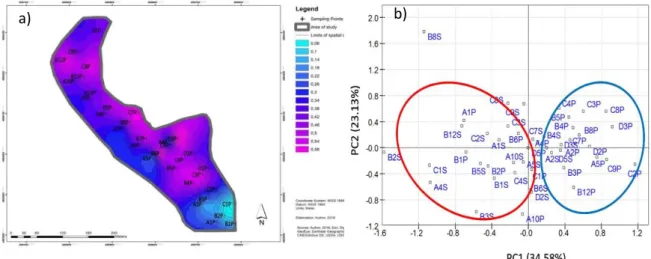
The XRF analysis detected, in all the samples, the presence of some toxic elements as well as valuable metals. The analysis of grades shows that the tailings have economic potential in tungsten; however, the dam represents an environmental threat due to the high arsenic concentrations. The best-fit variogram model, based on cross-validation, was selected to assess the spatial distribution of the grades for the main elements. The spatial distribution of tungsten on deep samples is shown in (Figure 1a) (Figueiredo et al. 2018).
Figure 1: a) Contour map of tungsten of deep samples. b) Projection of the samples in the factorial planes
The projection of the samples on the principal components analysis (PCA) PC1 and PC2 (Figure 1b) allows the distinction between surface and deep samples. This evidence leads to separate the analysis of the samples for each depth level studied. The elements variables were (Mn, Fe, Cu, Zn, As, W), which are interesting for a future re-mining project.
5. Conclusions
Multivariate data analysis and the geostatistical study showed potential as an approach to identifying regions of high element content present in the dam, and in the planning of re-mining, according to the metal of interest. Further, the PCA may be considered a useful
| 39 tool to understand the behavior of the tailings compared with original geology, industrial processing ore from Panasqueira Mine, and adverse weather conditions.
References
Figueiredo, Janine, M. Cristina Vila, Joaquim Góis, Bárbara Pavani Biju, Aurora Futuro, Diogo Martins, M. Lurdes Dinis, and António Fiúza. 2018. “Bi-Level Depth Assessment of an Abandoned Tailings Dam Aiming Its Reprocessing for Recovery of Valuable Metals.” Minerals Engineering 133 (December 2018): 1–9. https://doi.org/10.1016/j.mineng.2018.12.016.
Acknowledgments
This work was financially supported by The Portuguese Foundation for Science and Technology, (FCT) [grants: ERA-MIN/0007 “Improve Resource Efficiency and Minimize Environmental Footprint (REMinE)”, and UID/ECI/04028/2013 Centro de Recursos Naturais e Ambiente (CERENA)].
The first author is grateful for the financial support from the National Council for Scientific and Technological Development (CNPq)/Brazil [grant: 201144/2015-8].
| 41
Separation of PS and ABS using froth flotation
combined with a heating treatment
Francisca Rey1 and Teresa Carvalho2
1Department of Civil Engineering, Architecture and Georesources, Instituto Superior
Técnico, University of Lisbon, Avenida Rovisco Pais, 1049-001 LISBOA, Portugal ([email protected])
2CERENA, Instituto Superior Técnico, Universidade de Lisboa, Avenida Rovisco Pais,
1049-001 LISBOA, Portugal ([email protected])
Abstract
This study proposes the study of the separation of PS and ABS plastics from the waste of electrical and electronic equipment using froth flotation combined with a heating treatment (HT). Froth flotation, commonly used in mineral processing, is a promising technique to separate plastics with similar density. In the present study, the separation of PS and ABS, with size ranging from 2 to 4 mm, was addressed. Due to the hydrophobic nature of both plastics, a boiling treatment was used prior to flotation to physically modify the surface of ABS and render this polymer hydrophilic. It was developed an L16 Orthogonal Array of Experiments using the Taguchi experimental with seven manipulated variables: HT time, HT temperature, elapsed time between the end of the HT and the start of the flotation test, frother concentration, air flow rate, impeller speed and pH. The results obtained show the ability of the proposed treatment to separate PS from ABS while obtaining products with high purity. Furthermore, the experimentation methodology allows the correct evaluation of the effect of several operating variables and some interactions on the flotation results.
Author Keywords. Plastics separation, ABS, PS, WEEE plastics, froth flotation, Taguchi design of experiments Type: Oral Communication
Open Access Peer Reviewed CC BY
1. Introduction
The use of froth flotation for the separation of plastic mixtures is referred by several authors as a simple and effective method (Wang et al., 2015). However, it is necessary to manipulate the natural wettability of the plastics in order to provide a selective separation. Wang et al. (2014) developed a physical conditioning method by boiling in water a mixture of acrylonitrile-butadiene-styrene (ABS) and polystyrene (PS), produced a hydrophilic surface ABS. Salerno et al. (2018), proposed the use of factorial experimental designs to evaluate the separation of plastics by froth flotation. This study proposes using a Taguchi Experimental Design to study the impact of the froth flotation combined with a heating treatment on the separation of PS and ABS plastics.
2. Materials and Methods
The PS and ABS samples were from WEEE, and it was used the size range of 2 to 4 mm. The samples were heated in tap water using a heating plate with magnetic stirring. The treatment followed (Wang et al. 2014) boiling treatment procedure. After the treatment, the samples were cooled by water directly and left (or not) to rest for a certain period before flotation tests. The flotation tests were carried out in a single separation stage in a
| 42 Leeds Flotation Cell using tap water. The reagents used were Methyl Isobutyl Carbinol as frother agent and for the pH modification solutions of 25% of sodium hydroxide and 20% of sulfuric acid. The variables chosen for manipulation were related to the heating treatment (HT) applied to the plastics, namely the treatment time, temperature and time between the end of the HT and the flotation test and flotation operational variables, such as frother concentration, air flow rate, impeller speed, and pH. According to the Taguchi design, two levels for each parameter were chosen. To study the main effects of the factors as well as some expected interactions, an L16 (27) orthogonal array (OA) of experiments
was chosen, with 16 tests plus three tests on a centre point. All tests were randomly performed to ensure the independence of observations and errors.
3. Results and Discussion
In (Figure 1) it is shown an overview of the experimental results. The ultimate recovery in the floated product is higher in the ABS samples, particularly in the treated samples tests (Figure 1b), indicating that under the treatment conditions PS was depressed while the overall floatability of ABS was slightly altered, unlike (Wang et al. 2014) results.
Figure 1: ABS and PS recovery in the floated product over time, without heating
treatment (a) and with the heating treatment (b)
It was possible to achieve both floated and sunken products with high purity in ABS and PS, respectively. After two minutes of flotation, it was possible to achieve 91% ABS in the floated product and 97% PS in the sunken product. The statistical significance of the variables main effects and interactions were confirmed by analysis of variance effects (ANOVA). The models with statistical significance that better fit the responses to the factors were linear models, both presenting an adequate signal-to-noise ratio. For the PS response model, the most significant factors were frother concentration, air flow rate, treatment temperature, impeller speed, time occurred between HT and flotation test, and treatment time. The ABS response model shows that the most significant terms were air flow rate, pH, time occurred between HT and flotation test. The predicted interactions presented high significance, namely frother concentration, and air flow rate, frother concentration and pH, frother concentration and impeller speed, as well as some confounded interactions yet to be disclosed.
| 43 4. Conclusions
This work shows the efficiency of the froth flotation combined with the heating treatment to the separate the PS and ABS plastics. The Taguchi method presents as an adequate experimentation methodology to correctly identify and evaluate the effect of several operating variables and their predicted interactions on the flotation results.
References
Salerno, Davide, Helga Jordão, Floriana La Marca, and M. Teresa Carvalho. 2018. “Using Factorial Experimental Design to Evaluate the Separation of Plastics by Froth
Flotation.” Waste Management 73: 62–68.
https://doi.org/10.1016/j.wasman.2017.12.001.
Wang, Chong Qing, Hui Wang, Jian gang Fu, and You nian Liu. 2015. “Flotation Separation of Waste Plastics for Recycling: A Review.” Waste Management 41: 28–38. https://doi.org/10.1016/j.wasman.2015.03.027.Wang, Chong Qing, Hui Wang, Bao xin Wu, and Qun Liu. 2014. “Boiling Treatment of ABS and PS Plastics for Flotation
Separation.” Waste Management 34 (7): 1206–10.
| 45
Strategies to integrate geological consistent
information into geostatistical seismic inversion
methods
Pedro Pereira1, Leonardo Azevedo1 and Amílcar Soares1 1CERENA/ DECivil, Arquitetura e Georrecursos, Instituto Superior Técnico, Universidade de
Lisboa, Av. Rovisco Pais 1, 1049-001 LISBOA, Portugal ([email protected]; [email protected]; [email protected])
Abstract
During the last years, numerical models have been the preferable tool to characterize the Earth subsurface geology. These are often inferred using seismic inversion as a common geo-modelling technique. While these methods allow reliable inferences of the spatial distribution of the subsurface rock properties, there are always discrepancies between the simulated models and the reality. The main goal of this work is the development of methodologies to integrate uncertainty and auxiliary geological information in a geostatistical framework of seismic inversion. The several strategies developed under this scope were successfully applied to synthetic and real case studies allowing for the improvement of subsurface models while reducing the uncertainty associated with the spatial distribution of elastic properties.
Author Keywords. Geostatistical inversion, reservoir modelling, stochastic simulation Type: Oral Communication
Open Access Peer Reviewed CC BY
1. Introduction
Seismic inversion techniques play an important role for a quantitative evaluation of hydrocarbon reservoir characterization and monitoring studies. The existing seismic inversion techniques may be divided into deterministic and stochastic (Bosch et al. 2010). Iterative geostatistical seismic inversion (Azevedo and Soares 2017) is a stochastic inversion technique that allows the integration of both direct (i.e., well-log data) and indirect (i.e., seismic reflection data) measurements, the inference of small-scale variability and the modelling of uncertainty related to the spatial continuity patterns of rock properties. The inverted models are always approximations of reality due to several factors such as the complexity of subsurface geology, the non-uniqueness of seismic data (inverse problem) or measurement errors in data acquisition (Tarantola 2005). In this work, different strategies are presented to incorporate uncertainty (Pereira et al. 2019) and prior geological knowledge in seismic inversion procedure. These methods aim at increasing the geological reliability of the inverted models while quantifying the spatial uncertainty in the final elastic models.
2. Methods
Traditional iterative geostatistical seismic inversion uses stochastic sequential simulation and co-simulation technique (Soares 2001) as model perturbation and where the spatial patterns of rock properties are described by a single global variogram model. However,
| 46 these methods struggle to reproduce the subsurface properties when challenged to highly non-stationary geological environments (e.g., curvilinear geological structures as channels). This work presents the inference of elastic properties incorporating local anisotropies, which acts as steering volumes when the model parameter space is perturbed to generate the models. These local anisotropies, directly computed from seismic reflection data using seismic attribute analysis, account for both local structural (azimuth and dip) and spatial (variogram ranges) information.
3. Discussion
The results of inverted models for a synthetic application example are shown in (Figure 1). The integration of a data-driven but geological consistent approach (Figure 1b) allows handling better non-stationary patterns when compared with conventional approaches (Figure 1a) that rely on a global variogram model to express the spatial continuity pattern of the true geology.
Figure 1: Comparison of vertical time sections of inverted Ip using stochastic simulation with a global
variogram (Figure 1a) and with local anisotropies corrections (Figure 1b); and the reference acoustic impedance section (Figure 1c)
4. Conclusions
This work proposes consistent methods to improve the reproduction of relevant and non-stationary geological features in inverted models resulting from geostatistical seismic inversion. The development and application of proposed methods under a geostatistical framework allowed the uncertainty assessment of spatial continuity patterns of inverted elastic properties.
References
Azevedo, Leonardo, and Amílcar Soares. Geostatistical methods for reservoir geophysics. Springer International Publishing, Advances in Oil and Gas Exploration & Production. Edition 1, 2017.
Bosch, Miguel, Tapan Mukerji, and Ezequiel F. Gonzalez. “Seismic inversion for reservoir properties combining statistical rock physics and geostatistics: A review”. Geophysics, 75 no. 5, (September 2010): 1SO-Z116. https://doi.org/10.1190/1.3478209.
Pereira, Pedro, Fernando Bordignon, Leonardo Azevedo, and Amílcar Soares. “Strategies for integrating uncertainty in iterative geostatistical seismic inversion”. Geophysics 84 no. 2, (March 2019): 1-49. https://doi.org/10.1190/geo2017-0758.1.
| 47 Soares, Amílcar. “Direct Sequential Simulation and Cosimulation”. Mathematical Geology
33 no. 8, (November 2001): 911–926. doi: 10.1023/A:1012246006212.
Tarantola, Albert. Inverse Problem Theory and Methods for Model Parameter Estimation. SIAM, 2005.
Acknowledgments
The author would like to acknowledge CERENA (strategic project FCT-UID/ECI/04028/2019), Instituto Superior Técnico, and Universidade de Lisboa to support his Ph.D. work.
| 49
Pore Pressure prediction and modeling using seismic
velocities
João Narciso1, Matilde Costa e Silva1, Amílcar Soares1 1 CERENA/DECivil, Instituto Superior Técnico, Universidade Técnica de Lisboa, Av. Rovisco
Pais 1, 1049-001 Lisboa, Portugal ([email protected];
[email protected]; [email protected]) Abstract
A quantitative predrill prediction of pore pressure is critical when drilling in overpressured formations and for an effective reservoir simulation and management. Accurate pore pressure prediction can be obtained from elastic wave velocities using a velocity-to-pore-pressure transformation model, calibrated with laboratory measurements or offset well data. This work presents a methodology for three-dimensional pore pressure prediction using a refined velocity field built from seismic velocities measured at the laboratory. Pore pressure models are then inferred based on Eaton’s and Bowers’ pore pressure estimation methods. Because seismic velocities correlate with formation’s effective stress, these were inferred from triaxial compression tests performed on rock samples from the Codaçal limestones, the Portuguese geological unit analogues of the reservoir formations of Brazilian pre-salt, and was assessed the variation between vertical effective stress and porosity at depth.
Author Keywords. Pore Pressure, effective stress, elastic wave velocities, triaxial compression test, Eaton’s
method, Bowers method.
Type: Oral Communication
Open Access Peer Reviewed CC BY
1. Introduction
Abnormal pore pressures are encountered worldwide, often resulting in drilling problems such as borehole instability, stuck pipe, lost circulation, kicks, and even blowouts. Predict the spatial extent of overpressured formations is required to drill wells safely and with reduced costs. Typically, the pore pressure predictions use models based on porosity and stress values available from existing well-log data. A pre-drill estimate of pore pressure can be obtained from seismic velocities using a velocity-to-pore-pressure model calibrated from offset well data. In this work, we propose the use of laboratory measurements acquired using rock samples to calibrate the velocity-to-pore-pressure transform model. 2. Methodology
Laboratory tests were developed to measure simultaneously porosity, seismic waves propagation velocities, and deformability parameters, E and ν, respectively. These experiments used rock samples from Codaçal limestone’s geological unit through triaxial compression tests. Twenty-five core samples were tested at IST’s GeoLab (Laboratory of Geosciences and Geotechnologies). These measurements allowed relating the porosity and seismic wave velocities with the effective stress and pore pressure, to further develop a compaction trend model. The pore pressure (Pp) can be calculated from the relation
| 50 1975) and (Bowers 1995) are the most used methods in the oil and gas industry to predict Pp using vertical effective stress. The models proposed herein using the laboratory
measurements have been developed to use the Eaton and Bowers methods in an efficient pore pressure prediction.
3. Results
Laboratory measurements allowed to build P-wave (Vp) and S-wave (Vs) velocities models in depth. These are important to define the normal compaction trends needed to predict pore pressure using Eaton’s method. The calibrated Vp versus depth model (Formula 1) from the laboratory experiments is:
V𝑁𝑜𝑟𝑚𝑎𝑙 = 2081.2 + 0.9711𝑧 (1)
The calibrated Vp versus effective stress trend model (Formula 2) from Bowers equation
was also defined:
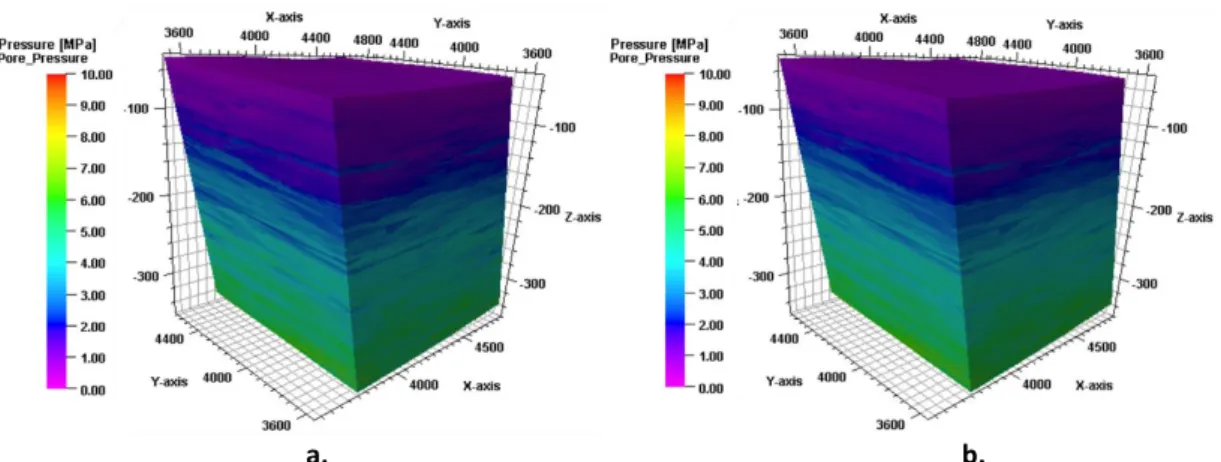
V𝑁𝑜𝑟𝑚𝑎𝑙 = 1976 + 326.3𝜎𝑣′ 0.3646 (2) These experimental models were applied to a synthetic P-wave velocity cube (Pinto 2014) developed for a carbonated sedimentary basin to assess the reliability of the proposed approach to estimate pore pressure. Using the seismic velocities, the physical and mechanical parameters and the vertical effective stresses, 3D models were generated for normal compaction, overburden stress, hydrostatic pressure, porosity, vertical effective stress, density and Vp in normal compaction conditions. Finally, pore pressure models
(Figure 1) were developed using Eaton’s and Bowers’ methods, the synthetic P-wave velocity cube, and the analysis from the lab results.
a. b.
Figure 1: a. Pore pressure prediction cube using the Eaton method; b. Pore pressure
prediction cube using the Bowers method
4. Conclusion
A qualitative and quantitative analysis of the proposed methodology was performed by comparing the laboratory results with empirical relationships from other authors, and distinct trends between lower and higher confining pressures were found. Using the Eaton method and the Bowers method, it was concluded that in the Eaton method, the
| 51 compaction trend model dependence is huge and can induce underestimated Pp
estimations. The Bowers method has a higher sensitivity in Pp estimation from seismic
velocities. Finally, it is concluded that this methodology, using triaxial tests, enables a more robust approach to Pp prediction.
References
Bowers, G. 1995. “Pore pressure estimation from velocity data: Accounting for pore pressure mechanisms besides undercompaction.” SPE Drilling and Completion, 10: 89-95.
Eaton, B. A. 1975. “The equation for geopressure prediction form wells logs.” SPE.
Pinto, P. 2014. “Dynamic simulation on the synthetic reservoir CERENA I: Compositional fluid flow simulation with 4D seismic monitoring on a reservoir with a large content of CO2”. Master Thesis, Instituto Superior Técnico.
Acknowledgments
The authors gratefully acknowledge the support of the CERENA (strategic project FCT-UID/ECI/04028/2019) at IST, Prof. Leonardo Azevedo and Prof. Gustavo Paneiro.
| 53
Inferring subsurface acoustic properties through
different seismic inversion methodologies for reservoir
characterization
Mariana Martinho1,2, Tim Tylor-Jones2, Leonardo Azevedo1 1CERENA/Departamento de Engenharia Civil, Arquitectura e Georrecursos, Instituto
Superior Técnico, Universidade de Lisboa, Avenida Rovisco Pais 1, 1049-001 Lisboa, Portugal ([email protected]; [email protected])
2DownUnder GeoSolutions, Level 2, 80 Victoria Street, London, SW1E 5JL, United Kingdom
Abstract
Reservoir characterization relies on the understanding of the spatial distribution of subsurface rock properties. However, the inference of those properties from seismic data is not a direct process requiring the use of inversion algorithms to transform the observed seismic data into subsurface elastic and/or rock properties. This work focuses on the application of deterministic and stochastic inversion methodologies to a real case application. Results are compared and contrasted aiming for the best characterization possible of an oil reservoir.
Author Keywords. Stochastic seismic inversion, deterministic seismic inversion, reservoir characterization,
rock properties
Type: Oral Communication
Open Access Peer Reviewed CC BY 1. Introduction
The prediction of the spatial distribution of the subsurface elastic properties can be made using seismic reflection data, which allows having a better knowledge of the reservoir. The understanding of the spatial distribution of the reservoir’s petrophysical properties reveals to be a key aspect for reliable characterization. This study can be done by the generation of subsurface models with properties of interest conditioned spatially to the seismic reflection and locally to well-log data. Solutions for seismic inverse problems can be achieved through different methodologies, namely, deterministic and stochastic approaches. While in deterministic approaches it is obtained a single solution that best fits the data by the minimization of an objective function, stochastic methodologies provide multiple solutions and allow uncertainty assessment and quantification by the use of probability density functions on the model parameter space (Bosch et al. 2010).
2. Materials and Methods
This work compares a deterministic model-based seismic inversion method against an iterative global geostatistical acoustic seismic inversion one (Azevedo and Soares 2017). Both methods are used to infer the spatial distribution of acoustic impedance and facies with different parameterizations. The best-fit inverted models are compared in terms of spatial continuity, geological reliability and against a blind well not used to constrain the inversions.
| 54 3. Discussion
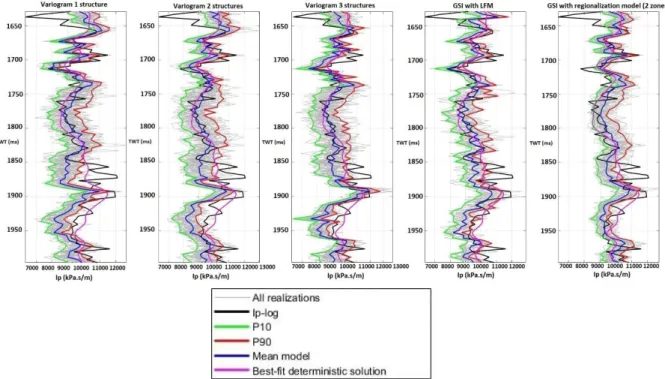
Five seismic inversions were run over the dataset with different a priori conditions (Figure 1). Variograms with one, two, and three structures, low-frequency models from the deterministic inversion and a regionalization model with two different zones were considered to compare the results of the two seismic inversion methods.
Figure 1: Different scenarios were considered in order to explore the
uncertainty in spatial continuity model
Generally, the results from the different scenarios encapsulate the P-impedance upscaled logs and are constrained within the P10-P90 interval. When the low-frequency model is considered, the results are closer to the mean value while in the regionalization model, more geological information is added, which can provide a result closer to the real geology. 4. Conclusions
Comparing the two different seismic inversion methodologies, deterministic inversion results are smoother and closer to the mean value while in stochastic inversion the results not only can incorporate more geological information but also ensure the reproduction of the extreme values which allow a better reservoir characterization.
References
Azevedo, Leonardo, and Amílcar Soares. 2017. Geostatistical Methods for Reservoir
Geophysics. Switzerland: Springer International Publishing.
Bosch, Miguel, Tapan Mukerji, and Ezequiel F. Gonzalez. 2010. ‘Seismic Inversion for Reservoir Properties Combining Statistical Rock Physics and Geostatistics: A Review’.
| 55 Acknowledgments
I would like to thank Energean Oil & Gas for providing me the data and also to DownUnder GeoSolutions and staff for all the support in the development of this work. I would like to offer my special thanks to Tim, Owen, Nathan for all the suggestions and insights to this project.
| 57
Grade uncertainty integration into STPS
João Vermelho Neves1, Amílcar Soares1
1CERENA/DECivil, Instuto Superior Técnico, Universidade de Lisboa, Lisboa, Portugal
([email protected]; [email protected])
Abstract
Short-term production scheduling (STPS) characterizes the time sequencing of reserves mining for a short horizon. These reserves are inherently uncertain, both due to high spatial grade variability and data scarcity. Most underground mines use Krige estimation to model reserves, however, while this provides good grade estimates it does not characterize spatial uncertainty. Hence, production sequencing is often scheduled without uncertainty characterization, resulting in unpredicted deviations from scheduled production. This work proposes a method enabling reserves model uncertainty characterization and its integration onto STPS. The method leverages on the usage of Direct Sequential Simulation (DSS) combined with Gaussian Mixture Models (GMM) to retain reserves model uncertainty into the STPS, enabling uncertainty to be used as an STPS optimization criterion.
Author Keywords. Short-term production scheduling, underground mine planning, Uncertainty Integration Type: Oral Communication
Open Access Peer Reviewed CC BY 1. Introduction
Stochastic simulation has already been applied in surface mines for long-term production scheduling (Ramazan and Dimitrakopoulos 2013), and to solve the underground equivalent (Carpentier et al., 2016). The short-term approach consists of optimizing mining sequence to each simulated realization, followed by unitary period uncertainty characterization. This practice has two drawbacks: (i) the need to retains all simulated models and calculate an optimal mining sequence for each one, highly impractical for large block models; (ii) the period uncertainty is only known after the optimum mining sequence is applied to all simulated models, so cannot be used for STPS optimization. The proposed method converts static into dynamic uncertainty of reserves via GMM. For each simulated block, only local mean and variance are retained. Then, a GMM is applied to characterize the uncertainty of the scheduled production. Once grade uncertainty for a candidate period is evaluated, it can be used as an STPS optimization parameter.
2. Methodology
2.1. Reserves Model generation
Reserves Model is generated using DSS with point distributions (Horta and Soares 2010). This algorithm allows the integration of uncertain data into the model, and due to the enabled higher data density, produces a model with overall reduced uncertainty (Neves et al. 2018).
| 58
2.2. Grade uncertainty aggregation into STPS
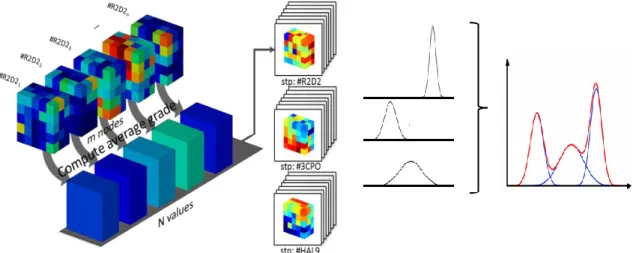
Grade uncertainty is aggregated into STPS’ period via a GMM as is illustrated in (Figure 1). The 𝑚 × 𝑁 × 𝑏 values characterizing the period’s blocks uncertainty are turned into a GMM parametrization with 2 × 𝑏 parameters. From there, values can be easily drawn to serve as optimization criteria in an STPS optimization algorithm.
Figure 1: Grade uncertainty aggregation from model to STPS period
3. Results
The method enables the preservation of uncertainty characterization in STPS and its usage in the optimization routine. (Figure 2) shows the resulting STPS integrating uncertainty.
Figure 2: STPS integrating grade uncertainty, grey lines show upper and lower
uncertainty bounds, blue line is expected production, red line P50, black line actual production, green line target production
4. Conclusions
The method allows grade model uncertainty integration into STPS optimization. The resulting STPS retains grade uncertainty characterization. In addition, STPS with uncertainty integration has tighter uncertainty bounds than traditional schedules would,
| 59 as uncertainty is minimized during optimization, yielding smaller deviations to scheduled production.
References
Carpentier, Sabrina, Michel Gamache, and R Dimitrakopoulos. 2016. “Underground Long-Term Mine Production Scheduling with Integrated Geological Risk Management.”
Mining Technology 125 (2). Taylor & Francis:93–102.
Horta, Ana, and Amílcar Soares. 2010. “Direct Sequential Co-Simulation with Joint Probability Distributions.” Mathematical Geosciences 42 (3):269–92.
Neves, João, Maria João Pereira, Nelson Pacheco, and Amilcar Soares. 2018. “Updating Mining Resources with Uncertain Data.” Mathematical Geosciences.
Ramazan, Salih, and Roussos Dimitrakopoulos. 2013. “Production Scheduling with Uncertain Supply: A New Solution to the Open Pit Mining Problem.” Optimization and
Engineering 14 (2):361–80.
Acknowledgments
We acknowledge the support of CERENA (strategic project FCT-UID/ECI/04028/2019) at IST, and the H2020 Real Time Mining project, Grant Agreement no. 641989
| 61
Exploration Data Analysis and Mineral Grade
Estimation of Calcium fluoride of the Okorusu Ore
Deposit, Namibia: A Case Study
Andreas T Salom1, Jorge Carvalho 1
1CERENA - Polo FEUP - Centre for Natural Resources and the Environment, Faculty of
Engineering, University of Porto, Rua Dr. Roberto Frias, 4200-465 PORTO, Portugal ([email protected]; [email protected])
Abstract
A reliable mapping and understanding of the spatial distribution of the ore grade in a mineral deposit is a critical issue in ore reserve estimation, previously and during its exploitation, as it assists geologists and mining engineers in delineating an optimized exploitation project. In this paper, the objective is to illustrate and compare the application of a geostatistical method (ordinary kriging estimation) and a common geometrical estimation method (inverse square distance) as mineral resource estimation methods, using the georeferenced data obtained from an exploration and geochemical prospecting process at Okorusu Mine fluorite ore deposit in Namibia. Surfer software was used as a 2D mapping tool to evaluate the spatial distribution and compare the estimation error of two interpolation methods applied to calcium fluoride (CaF2)
borehole sampled data. Estimates from both methods have descriptive statistics closed to the measured sample set, although different spatially distributed estimation models.
Author Keywords. Geostatistics, variogram, resource estimation, ordinary kriging, inverse square distance. Type: Oral Communication
Open Access Peer Reviewed CC-BY
1. Introduction
The accuracy of mineral resource and ore reserve estimation is necessary for the process of mining deposit evaluation; planning and mine design (Shahbeik et al. 2014). The complexity of the geological processes and the limitation of financial resources are some of the difficulties that geologists and mining engineers face in the process of mineral resource estimation. This results in many failure projects around the world. Currently, there are two common methods developed and used for the estimation of spatial data: geostatistics, specifically kriging and simulation (probabilistic interpolator) recommend by several researchers (Shahbeik et al. 2014) and inverse square distance (deterministic interpolator) favored in some research work (Arfaoui and Inoubli 2013). This paper aims to evaluate calcium fluoride (CaF2) spatial distribution and compare the estimation error of
the two referred interpolation methods based on an analysis of subsurface geochemical data.
2. Materials and Methods
This study relates to the geochemical exploration data from Okorusu Mine, which has an open pit mine of CaF2 located approximately 60 km northwest of Otjiwarongo in
Otjozondjupa region, Namibia. The data set used in this study comprises 749 sample points from 43 boreholes. The samples have the following attributes: HoleID, x, y, from, to and CaF2 concentration measurement, where x, y, and z are the longitude, latitude and