https://doi.org/10.1177/0269215520968054
Clinical Rehabilitation 1 –11
© The Author(s) 2020 Article reuse guidelines: sagepub.com/journals-permissions DOI: 10.1177/0269215520968054 journals.sagepub.com/home/cre
CLINICAL REHABILITATION
Measurement properties of step
tests for exercise capacity in
COPD: A systematic review
Rui Vilarinho
1,2, Cátia Caneiras
2,3and António Mesquita Montes
1,4Abstract
Objective: To determine the level of evidence of the measurement properties (validity, reliability,
and responsiveness) and interpretability of the step tests available for assessing the exercise capacity in patients with chronic obstructive pulmonary disease.
Data sources: The data sources Web of Science, MEDLINE, PubMed, PEDro, CENTRAL of Cochrane
Library, and Scopus were searched up to June 26, 2020.
Review methods: Studies of any design that reported results for any measurement property of the
step tests for assessing the exercise capacity in COPD patients were selected. One reviewer extracted the data, and two reviewers independently rated the level of evidence by using the Consensus-Based Standards for the Selection of Health Measurements Instruments recommendations.
Results: Thirty-one studies were included in the data synthesis. Chester Step Test, Modified Incremental
Step Test, two-, three-, four-, and six-Minute Step Test, Paced Step Test, and six-Minute Stepper Test were identified. A step test protocol was also found. The level of evidence of their results for the measurement properties was mostly determined as “low” to “very low.” The best level of evidence found was for the six-minute stepper test: “high” on construct validity (r = 0.56–0.71); and “moderate” on criterion validity (r = 0.36–0.69), and responsiveness (r = 0.26–0.34).
Conclusion: The general level of evidence of the measurement properties of the step tests is “low”
to “very low” for assessing exercise capacity in patients with chronic obstructive pulmonary disease, which can limit their application in clinical practice. The six-minute Stepper Test is currently the most appropriate step test available.
Keywords
Step testing, validity, reliability, responsiveness, pulmonary rehabilitation
Received: 13 June 2020; accepted: 2 October 2020
1 Department of Physiotherapy and Center for Rehabilitation
Research, School of Health, Polytechnic Institute of Porto, Porto, Portugal
2 Healthcare Department, Nippon Gases Portugal, Lisbon,
Portugal
3 Microbiology Research Laboratory on Environmental Health,
Institute of Environmental Health, Faculty of Medicine, University of Lisbon, Lisbon, Portugal
Original Article
4 Department of Physiotherapy, Santa Maria Health School,
Porto, Portugal Corresponding author:
Rui Vilarinho, Department of Physiotherapy and Center for Rehabilitation Research, School of Health, Polytechnic Institute of Porto, Rua Dr. António Bernardino de Almeida 400, Porto 4200-072, Portugal.
Introduction
The assessment of exercise capacity is an important clinical measure of the functional status in people with chronic obstructive pulmonary disease.1 It is
defined as one’s physiological maximal response to exercise, including the exercise tolerance tests, or the body structure’s maximal ability to fulfill its function, including the measurement of maximal muscle contractions.2 The gold standard tests used
for its assessment are the cardiopulmonary exercise testing, on a treadmill or a cycloergometer,3 and the
one-repetition maximum.4 Additionally, in
pulmo-nary rehabilitation, the field walking tests are also considered valid options, especially the six-minute walk test and the incremental or endurance shuttle walk test.2,5
However, these mentioned tests require a large amount of space, aside from the expensive equip-ment for the cardiopulmonary exercise testing,3,5
which may limit their application in the new mod-els of pulmonary rehabilitation suggested in the literature, like the community- and home-based programs.6 These new models are important
strat-egies to enhance population access to pulmonary rehabilitation services, from the moment that their benefits are already comparable to those obtained with the hospital-based.7,8 Also, as a result of this
time of COVID-19 pandemic, the transition of the hospital services to community and home is necessary,9 and, for that, the search for tests with
minimal space requirements for exercise testing is necessary.
The step testing could be a promising tool, as it requires less physical space, the equipment is feasi-ble, and it is representative of the daily activities (stair climbing). A wide variety of step tests have been described not only with different equipment, such as the use of a step or a stepper,10 but also with
different aims, according to the self-paced, con-stant, or externally paced work rate. In a recent review, to identify exercise tests that are suitable outside the traditional hospital-based pulmonary rehabilitation programs, step testing was consid-ered a useful resource in people with chronic res-piratory diseases.9
In chronic obstructive pulmonary disease, the identification of the measurement properties and
the interpretability of step testing have been ana-lyzed in the last years,11,12 however, it is important
to assess the quality of the current level of evidence of the measurement properties before the full imple-mentation of the step testing in clinical practice. Therefore, this study aimed to determine the level of evidence of the measurement properties (valid-ity, reliabil(valid-ity, and responsiveness) and interpreta-bility of the step tests available for assessing the exercise capacity in people with chronic obstructive pulmonary disease.
Methods
This systematic review was conducted in accord-ance with the Preferred Reporting Items for Systematic Reviews and Meta-Analyses guidelines (PRISMA),13 and was registered in the International
Prospective Register of Systematic Reviews (PROSPERO) (CRD42020155872).
The literature search was conducted in the fol-lowing electronic databases: Web of Science, MEDLINE, PubMed, Physiotherapy Evidence-Based Database, Cochrane Central Register of Controlled Trials, and Scopus. The search was per-formed between 21st and 26th of June 2020. The key terms used were “step test,” “stepper test,” “stepping,” “COPD,” and “chronic obstructive pul-monary disease.” The search strategy is available in Supplemental Appendix 1.
For this review, a step test was defined as a test where people are instructed to step up and down on a platform (step or stepper) with a specific height, and in a self-paced and/or externally paced work rate. Studies of any design that reported results for any measurement property (validity, reliability, responsiveness), and interpretability of the step tests for assessing the exercise capacity in people with chronic obstructive pulmonary disease were selected. For this review, we assumed the identifi-cation of the step tests that provided the maximum amount of physical exertion that a patient can sus-tain according to the aim of each test. Another important inclusion criterion was the diagnosis of the chronic obstructive pulmonary disease based on the Global Initiative for Chronic Obstructive Lung Disease criteria.14 Studies not written in
journals and abstracts in conference proceedings were excluded. One reviewer (R.V.) performed the initial screening of the articles based on type of publication and relevance for the review. Then, the full-text of each relevant study was screened for content to decide its eligibility. Selection of studies was checked by a second reviewer (A.M.M.).
Data extraction focused on the measurement properties (validity, reliability, and responsive-ness) and interpretability defined according to the Consensus-Based Standards for the Selection of Health Measurements Instruments (COSMIN) def-initions (Supplemental Appendix 2).15–17 For
crite-rion validity, we assumed the comparisons of the step tests with the cardiopulmonary exercise test-ing and the one-repetition maximum, considered the gold standard measures for exercise capacity.2
For construct validity, we considered the compari-sons with the six-minute walking test, incremental shuttle walk test, endurance shuttle walk test, and other tests available to assess muscle strength. For reliability, studies of test-retest reliability or of measurement error were considered. On the other hand, for responsiveness, we considered the stud-ies that used the step tests to analyze the effects of any intervention, with changes over time and through comparisons with changes in other out-comes. The interpretability was included accord-ing to the qualitative meanaccord-ing of the tests, for example, with norm scores and minimal impor-tant difference.18 According to Schunemann et al.,
minimal important difference provides the small-est change in the outcome of intersmall-est that patients perceive as important, either beneficial or harmful, and that would lead the patient or clinician to con-sider a change in management.19
The methodological quality of the studies included was assessed by the Consensus-Based Standards for the Selection of Health Measurements Instruments risk-of-bias checklist (box 6, 7, 8, 9, and 10), based on a rating score system of four-point rating scale (“very good,” “adequate,” “doubtful” or “inadequate”).15 For each study, the
score per box is obtained by taking the lowest rat-ing of any item in a box. Accordrat-ing to the recom-mendations by Terwee et al.,20 we assumed for the
reliability and measurement error studies, that the step tests conducted on the same day were not
appropriate (item 2 of box 6 and 7). Furthermore, the studies on responsiveness that used only the paired sample T-test or Wilcoxon signed-rank test to measure significant changes were also not appropriated (item 6, 9, and 12 of box 10).21
Another rating was performed for the quality of the measurement properties using the rating system proposed by Terwee et al.,22 where one or more
cri-teria was used to define a “sufficient” (+), “inde-terminate” (?) or “insufficient” (−) rating depending on the designs, methods, and outcomes of the studies. The definition and criteria for each meas-urement property are described in Supplemental Appendix 2.
After rating the methodological and measure-ment properties qualities, the modified Grading of Recommendations Assessment, Development, and Evaluation (GRADE) approach was applied to grade the level of evidence, as “high,” “moderate,” “low,” or “very low.”15 The level of evidence was
based in four factors: risk of bias, inconsistency, imprecision, and indirectness.15
For all ratings, each study was reviewed and assessed by two independent investigators (R.V. and A.M.M.) and discordances in scoring between the two reviewers were resolved by consensus. Some studies were analyzed in more than one measurement property and, in this case, the quality assessment and data extraction of each property were made separately.
Consensus-Based Standards for the Selection of Health Measurements Instruments has no scoring system for interpretability.
Descriptive synthesis of the types and the char-acteristics of the step tests identified was conducted. Besides, in each study, the name of the authors, country, the published year, measurement proper-ties assessed, sample characteristics (number of participants and age), study aims, and the outcomes measures were retrieved. To determine each meas-urement property on each step test identified, we also summarized its quality and level of evidence.
Results
The literature search provided a total of 856 records. After duplicates were removed, 637 records were screened for content through title and abstract.
From these, 561 were excluded. The full-text of 76 articles was assessed for eligibility and 45 articles were excluded. In total, 31 articles were included (Figure 1) all published in English. The studies were conducted in South America – Brazil (n = 11), North America – Canada (n = 3), and Europe – France (n = 14), Ireland (n = 1), the Netherlands (n = 1), and United Kingdom (n = 1). The flowchart of the study is presented in Figure 1.
The tests identified were the Chester Step Test,23
Modified Incremental Step Test,24 two-minute Step
Test,25 three-minute Step Test,26 four-minute Step
Test,27 six-minute Step Test,28 Paced Step Test,29
and six-minute Stepper test.10 A Step Test Protocol
was also included.30 The characteristics of the tests
are available in Table 1.
Eleven articles included validity,29,31–40 seven
articles included reliability,30,31,33,35,41–43 13 articles
included responsiveness,36,37,43–53 and five articles
included interpretability33,34,37,54,55 of the step tests.
Details on each article included in this review are presented in Supplemental Appendix 3.
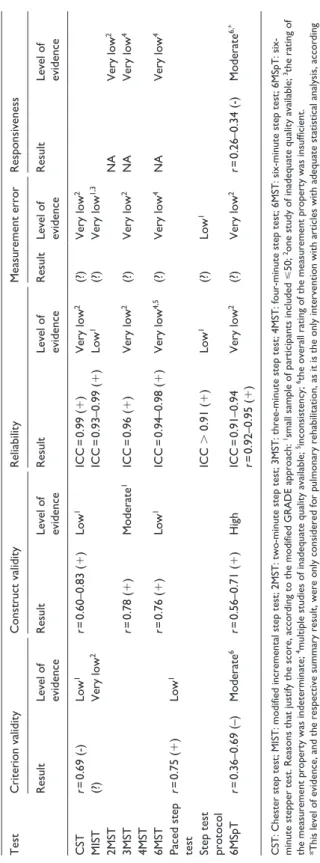
For each step test identified, the summary result of the measurement properties and the overall level of evidence, according to the modified Grading of Recommendations Assessment, Development, and Evaluation approach, are presented in Table 2.
Criterion validity was evaluated for the Chester Step Test,31 Modified Incremental Step
Test,33 Paced Step Test,29 and six-minute Stepper
Test36,38,39 by comparison with the
cardiopulmo-nary exercise testing. The six-minute Stepper Test also presented a comparison with the quadriceps one-repetition maximum.40 Construct validity was
evaluated for the Chester Step Test,31,32
three-min-ute Step Test,35 six-minute Step Test,34 and
six-minute Stepper Test36,37,39 by comparison with the
six-minute walk test. The Chester Step Test also presented a comparison with the Incremental shut-tle walk test.32
On reliability, the Modified Incremental Step Test and the Step Test Protocol were the only tests with an appropriate time interval,30,33 with tests
conducted on different days.
Figure 1. Flowchart of the study.
Responsiveness for the step tests was evaluated in patients undergoing pulmonary rehabilitation (six-minute Step Test,46 and six-minute Stepper
Test),36,37,43,50,52,56–59 physical training program
(three-minute Step Test,48 and six-minute Step Test45,47),
pharmacological treatment – bronchodilator (three-minute Step Test49), physical activity counseling
program (two-minute Step Test),44 and
photobio-modulation therapy (six-minute Stepper Test51).
However, only the six-minute Stepper Test presented appropriate statistical analysis in two articles,36,37
according to the correlations between the changes in the number of steps and changes in the six-minute walk test (distance) in pulmonary rehabilitation.
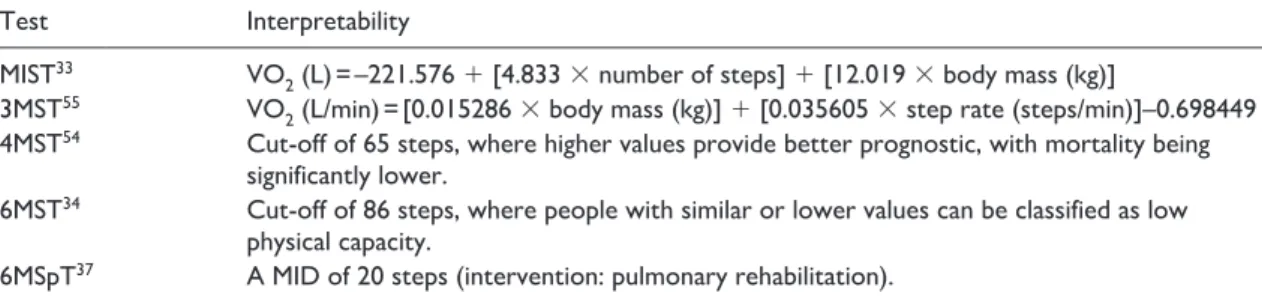
The data available on the interpretability of the step tests are presented in Table 3.
The methodological quality of each article, and the quality of each measurement property included in this review are presented in Supplemental Appendix 4.
Discussion
This systematic review identified nine step tests and showed that the level of evidence of their measure-ment properties for assessing the exercise capacity in people with chronic obstructive pulmonary disease is mostly “low” and “very low.” According to the mod-ified Grading of Recommendations Assessment, Development, and Evaluation approach, the main reasons for these ratings were based in the small samples of participants included in the articles, and the presence of one or multiple articles of “inade-quate” methodological quality.15 However, despite
our great effort to rate the methodological quality of the articles, we cannot assume these results as an absolute result, considering that we included stud-ies that reported results for the measurement prop-erties of the tests even if they were not specifically designed for it.
In general, reliability and responsiveness were the measurement properties with the worst level
Table 1. Characteristics of the step and stepper tests identified.
Name of
the test Characteristics
Stages Initial work
rate Increments Duration Profile Original reference
CST 5 stages 15 steps/min 5 steps/min
(every 2 min) 10 min Incremental Sykes et al.
23
MIST – 10 steps/min 1 step/min
(every 30 sec) Up to the limit of tolerance Incremental de Andrade et al.
24
2MST – Free work rate (targeting the
maximum number of steps) 2 min Self-paced Rikli et al.
25
3MST – Free work rate or externally
paced stepping rates (targeting the maximum number of steps)
3 min Self-paced
or constant YMCA
26
4MST – Free work rate (targeting the
maximum number of steps) 4 min Self-paced Stephan et al.
27
6MST – Free work rate (targeting the
maximum number of steps) 6 min Self-paced Dal Corso et al.
28
Paced step
test – Stepping every four seconds Up to the limit of tolerance Constant Swinburn et al.
29
Step test
protocol 4 stages 4 stages of three-minute (18, 22, 26, and 32 steps/min) 12 min Constant Perrault et al.
30
6MSpT – Free work rate (targeting the
maximum number of steps) 6 min Self-paced Borel et al.
10
CST: Chester step test; MIST: modified incremental step test; 2MST: two-minute step test; 3MST: three-minute step test; 4MST: four-minute step test; 6MST: six-minute step test; 6MSpT: six-minute stepper test.
Table 2.
Level of evidence synthesis of measurement properties of the step tests.
Test Criterion validity Construct validity Reliability Measurement error Responsiveness Result Level of evidence Result Level of evidence Result Level of evidence Result Level of evidence Result Level of evidence CST r = 0.69 (-) Low 1 r = 0.60–0.83 (+ ) Low 1 ICC = 0.99 (+ ) Very low 2 (?) Very low 2 MIST (?) Very low 2 ICC = 0.93–0.99 (+ ) Low 1 (?) Very low 1,3 2MST NA Very low 2 3MST r = 0.78 (+ ) Moderate 1 ICC = 0.96 (+ ) Very low 2 (?) Very low 2 NA Very low 4 4MST 6MST r = 0.76 (+ ) Low 1 ICC = 0.94–0.98 (+ ) Very low 4,5 (?) Very low 4 NA Very low 4
Paced step test
r = 0.75 (+ ) Low 1
Step test protocol
ICC > 0.91 ( + ) Low 1 (?) Low 1 6MSpT r = 0.36–0.69 (–) Moderate 6 r = 0.56–0.71 (+ ) High ICC = 0.91–0.94 r = 0.92–0.95 (+ ) Very low 2 (?) Very low 2 r = 0.26–0.34 (-) Moderate 6,*
CST: Chester step test; MIST: modified incremental step test; 2MST: two-minute step test;
3MST: three-minute step test; 4MST: four-minute step test; 6MST: minute step test; 6MSpT:
six-minute stepper test. Reasons that justify the score, according to the modified GRADE app
roach:
1small sample of participants included
⩽
50;
2one study of inadequate quality available; 3the rating of
the measurement property was indeterminate;
4multiple studies of inadequate quality available; 5inconsistency; 6the overall rating of the measurement property was insufficient.
*This level of evidence, and the respective summary result, were only considered for pulm
onary rehabilitation, as it is the only intervention with articles with adequate statistical analysis, according
of evidence, where most of the step tests pre-sented “very low” rating, explained by the test-retest studies performed on the same day, the non-determination of the minimal important dif-ferences for measurement error, and only the use of the paired sample T-test or Wilcoxon signed-rank test for responsiveness.15,21
Another finding in our review was the heteroge-neity found on the evidence available for the step tests, where some tests showed fewer results in iso-lated articles (Modified Incremental Step Test, two-minute Step Test, four-minute Step Test, Paced Step Test, and Step Test Protocol), which repre-sents a weakness to determine their measurement properties. This poor quality of evidence reflects the lack of application of this type of exercise test-ing in evidence, and, consequently, in clinical prac-tice, especially in the new models of pulmonary rehabilitation. Despite the proven benefits of the community- and home-based programs, the assess-ment of their results in exercise capacity outcome is still widely performed in a hospital or clinical setting, mostly with the field walking tests.7,8 Given
the example of the six-minute Stepper Test, this test gathers results for all the measurement proper-ties and presents the best ratings for the level of evidence due to its large implementation not only in hospital settings36,37,43 but also in home-based
programs, where the assessment of its results was performed in the people’ homes.52 In fact, the
“moderate” to “high” level of validity of the six-minute Stepper Test is reflected by the good cor-relations found with cardiopulmonary exercise testing, one-repetition maximum and the six-minute walk test, proven that this test can be an alternative to assess exercise capacity in people with chronic
obstructive pulmonary disease. The same test was also rated as “moderate” responsiveness to pulmo-nary rehabilitation, due to the overall rating of the measurement property determined as “insufficient” (r = 0.26–0.34). This finding suggests a low corre-lation between the changes of the six-minute Stepper Test and the changes in the six-minute walk test, but one recommendation should be high-lighted. The inclusion of the stepping as a type (mode) of exercise training could be an interesting option in endurance training, since the physiologic adaptations to exercise are specific to the type of exercise performed.60 Thus, further studies on
responsiveness should include this type of exercise training.
Another good rating was the “moderate” level of evidence on the construct validity of the three-Minute Step Test, due to its strong correlation with the six-minute walk test. In fact, despite the “low” ratings of level of evidence, other step tests that were compared with six-minute walk test (Chester Step Test, six-minute Step Test) also presented a consistent strong correlation. These correlations were mostly analyzed with performance variables of the tests (number of steps and six-minute walk distance), which support the conceptualization of these step tests as an important option to assess functional exercise performance.61 This finding is
supported by the fact that the measurement prop-erties of the six-minute walk test qualify it as a more targeted test to assess functional exercise performance.2,61 In fact, according to the step tests
identified and their type of performance (self-paced, incremental, and/or constant work rate), we can assume that the different aims between the tests can reflect the assessment of different outcomes.
Table 3. Interpretability of the step tests.
Test Interpretability
MIST33 VO
2 (L) = –221.576 + [4.833 × number of steps] + [12.019 × body mass (kg)]
3MST55 VO
2 (L/min) = [0.015286 × body mass (kg)] + [0.035605 × step rate (steps/min)]–0.698449
4MST54 Cut-off of 65 steps, where higher values provide better prognostic, with mortality being
significantly lower.
6MST34 Cut-off of 86 steps, where people with similar or lower values can be classified as low
physical capacity.
Given the example of the six- and three-minute Step Tests, these ones are clearly stepping versions of the six-minute walking test, which they could provide more results about functional exercise per-formance. On the other hand, the step tests with an incremental profile (Chester Step Test and Modified Incremental Step Test), given the similarity of the aims with the shuttle walk test, could be also con-sidered a symptom-limited maximal exercise capacity tests. However, the results in this review cannot fulfill these statements. Future research is recommended for the development of studies on validity of the step tests including cardiorespira-tory response and the comparison with the gold standard tests for exercise capacity, and other phys-iological variables.
To the best of our knowledge, there is no review available in evidence that determined the level of evidence of the measurement properties of step test-ing in chronic respiratory diseases. Even so, the application of step testing has also been applied in other chronic respiratory diseases, with promising results, especially on validity. As an example, the Modified Incremental Test, Chester Step Test, three- and six-minute Step Test present good cor-relations mostly with the field walking tests in people with Bronchiectasis,62,63 Interstitial Lung
Disease,28 and Asthma.64 This is also the first
sys-tematic review that includes step tests using differ-ent equipmdiffer-ent (step and stepper). Another strength of this review is the inclusion of studies that reported measurement properties of the test even if they were not specifically designed for it, which allowed us to identify a broad range of studies.
There were some study limitations. First, this systematic review only included articles written in English and Portuguese, which led to the exclu-sion of relevant studies. Second, during the litera-ture search we found abstracts in congresses with potential measurement properties for step and stepper tests, but according to exclusion criteria these studies were not included. Another limita-tion refers to the involvement of one reviewer in the initial screening of articles, although two reviewers worked in close collaboration with sev-eral meetings throughout the selection process.
Future research is important to improve the level of evidence of the step tests, where future studies
should be conducted following the recommenda-tions of the Consensus-Based Standards for the Selection of Health Measurements Instruments to develop appropriate results.
In conclusion, the general level of evidence of the measurement properties of the step tests identi-fied is “low” to “very low” for assessing exercise capacity in people with chronic obstructive pul-monary disease, which can limit their current application in clinical practice. On the available evidence, the six-minute Stepper Test is currently the most appropriate step test available. Future well-designed studies are necessary to improve the quality of the measurement properties of the step tests.
Clinical Messages
•
• The current level of evidence of the meas-urement properties of the step tests is “low” to “very low” for assessing exercise capacity in people with chronic obstruc-tive pulmonary disease.
•
• Robust methods should be designed and implemented to get a higher quality of the measurement properties of the step tests.
Acknowledgements
We would like to thank Jean-Marie Grosbois from FormAction Santé and Claudine Fabre, from Faculté des Sciences du Sport et de l’Education Physique (Université de Lille) for providing additional information about his studies.
Author contributions
R.V. conceived and designed the project. R.V. write the review. R.V. and A.M.M. collected and analyzed the data. R.V., A.M.M., and C.C. wrote the paper. R.V. is responsible for quality control of the study.
Declaration of conflicting interests
The author(s) declared no potential conflicts of interest with respect to the research, authorship, and/or publica-tion of this article.
Funding
The author(s) received no financial support for the research, authorship, and/or publication of this article.
ORCID iDs
Rui Vilarinho https://orcid.org/0000-0002-4422-8440
Cátia Caneiras https://orcid.org/0000-0002-3735
-8554
Supplemental material
Supplemental material for this article is available online. References
1. Spruit MA, Singh SJ, Garvey C, et al. An official American Thoracic Society/European Respiratory Society statement: key concepts and advances in pulmonary rehabilitation.
Am J Respir Crit Care Med 2013; 188: e13–e64.
2. Bui KL, Nyberg A, Maltais F, et al. Functional tests in chronic obstructive pulmonary disease, part 1: clinical relevance and links to the international classification of functioning, disability, and health. Ann Am Thorac Soc 2017; 14: 778–784.
3. American Thoracic Society; American College of Chest Physicians. ATS/ACCP Statement on Cardiopulmonary Exercise Testing. Am J Resp Crit Care Medicine 2003; 167: 211–277.
4. Zeng Y, Jiang F, Chen Y, et al. Exercise assessments and trainings of pulmonary rehabilitation in COPD: a litera-ture review. Int J Chron Obstruct Pulmon Dis 2018; 13: 2013–2023.
5. Holland AE, Spruit MA, Troosters T, et al. An official European respiratory society/American thoracic society technical standard: field walking tests in chronic respira-tory disease. Eur Respir J 2014; 44: 1428–1446. 6. Rochester CL, Vogiatzis I, Holland AE, et al. An official
American thoracic society/European respiratory society policy statement: enhancing implementation, use, and delivery of pulmonary rehabilitation. Am J Respir Crit
Care Med 2015; 192: 1373–1386.
7. Neves LF, Reis MH and Goncalves TR. Home or com-munity-based pulmonary rehabilitation for individuals with chronic obstructive pulmonary disease: a system-atic review and meta-analysis. Cad Saude Publica 2016; 32(6): S0102-311X2016000602001.
8. Wuytack F, Devane D, Stovold E, et al. Comparison of outpatient and home-based exercise training programmes for COPD: a systematic review and meta-analysis.
Respirology 2018; 23: 272–283.
9. Holland AE, Malaguti C, Hoffman M, et al. Home-based or remote exercise testing in chronic respiratory disease, during the COVID-19 pandemic and beyond: a rapid review. Chron Respir Dis 2020; 17: 1479973120952418. 10. Borel B, Fabre C, Saison S, et al. An original field
evalu-ation test for chronic obstructive pulmonary disease popu-lation: the six-minute stepper test. Clin Rehabil 2010; 24: 82–93.
11. Bisca GW, Morita AA, Hernandes NA, et al. Simple lower limb functional tests in patients with chronic obstructive
pulmonary disease: a systematic review. Arch Phys Med
Rehabil 2015; 96: 2221–2230.
12. Johnston KN, Potter AJ and Phillips A. Measurement properties of short lower extremity functional exercise tests in people with chronic obstructive pulmonary dis-ease: systematic review. Phys Ther 2017; 97: 926–943. 13. Moher D, Liberati A, Tetzlaff J, et al. Preferred
report-ing items for systematic reviews and meta-analyses: the PRISMA statement. BMJ 2009; 339: b2535.
14. GOLD. Global strategy for the diagnosis, management and prevention of COPD. 2020.
15. Mokkink LB, de Vet HCW, Prinsen CAC, et al. COSMIN risk of bias checklist for systematic reviews of patient-reported outcome measures. Qual Life Res 2018; 27: 1171–1179.
16. Prinsen CAC, Mokkink LB, Bouter LM, et al. COSMIN guideline for systematic reviews of patient-reported out-come measures. Qual Life Res 2018; 27: 1147–1157. 17. Terwee CB, Prinsen CAC, Chiarotto A, et al. COSMIN
methodology for evaluating the content validity of patient-reported outcome measures: a Delphi study. Qual Life Res 2018; 27: 1159–1170.
18. Mokkink LB, Prinsen CA, Bouter LM, et al. The Consensus-based standards for the selection of health measurement instruments (COSMIN) and how to select an outcome measurement instrument. Braz J Phys Ther 2016; 20: 105–113.
19. Schunemann HJ, Puhan M, Goldstein R, et al. Measurement properties and interpretability of the Chronic respiratory disease questionnaire (CRQ). Copd 2005; 2: 81–89. 20. Terwee CB, Mokkink LB, Knol DL, et al. Rating the
methodological quality in systematic reviews of stud-ies on measurement propertstud-ies: a scoring system for the COSMIN checklist. Qual Life Res 2012; 21: 651–657. 21. Mokkink LB, Terwee CB, Knol DL, et al. The COSMIN
checklist for evaluating the methodological quality of studies on measurement properties: a clarification of its content. BMC Med Res Methodol 2010; 10: 22.
22. Terwee CB, Bot SD, de Boer MR, et al. Quality criteria were proposed for measurement properties of health status questionnaires. J Clin Epidemiol 2007; 60: 34–42. 23. Sykes K and Roberts A. The Chester step test—a simple
yet effective tool for the prediction of aerobic capacity.
Physiotherapy 2004; 90: 183–188.
24. de Andrade CH, de Camargo AA, de Castro BP, et al. Comparison of cardiopulmonary responses during 2 incremental step tests in subjects with COPD. Respir Care 2012; 57: 1920–1926.
25. Rikli RE and Jones CJ. Development and validation of a functional fitness test for community-residing older adults. 1999; 7: 129.
26. Golding LE. YMCA fitness testing and assessment
man-ual. Champaign (IL): Human Kinetics Publishers, 2000.
27. Stephan S, Pereira C, Coletta E, et al. Oxygen desatura-tion during a 4-minute step test: predicting survival in idi-opathic pulmonary fibrosis. Sarcoidosis Vasc Diffuse Lung
28. Dal Corso S, Duarte SR, Neder JA, et al. A step test to assess exercise-related oxygen desaturation in interstitial lung disease. Eur Respir J 2007; 29: 330–336.
29. Swinburn CR, Wakefield JM and Jones PW. Performance, ventilation, and oxygen consumption in three different types of exercise test in patients with chronic obstructive lung disease. Thorax 1985; 40: 581–586.
30. Perrault H, Baril J, Henophy S, et al. Paced-walk and step tests to assess exertional dyspnea in COPD. Copd 2009; 6: 330–339.
31. de Camargo AA, Justino T, de Andrade CH, et al. Chester step test in patients with COPD: reliability and correlation with pulmonary function test results. Respir Care 2011; 56: 995–1001.
32. Karloh M, Correa KS, Martins LQ, et al. Chester step test: assessment of functional capacity and magnitude of cardi-orespiratory response in patients with COPD and healthy subjects. Braz J Phys Ther 2013; 17: 227–235.
33. Dal Corso S, de Camargo AA, Izbicki M, et al. A symp-tom-limited incremental step test determines maxi-mum physiological responses in patients with chronic obstructive pulmonary disease. Respir Med 2013; 107: 1993–1999.
34. Pessoa BV, Arcuri JF, Labadessa IG, et al. Validity of the six-minute step test of free cadence in patients with chronic obstructive pulmonary disease. Braz J Phys Ther 2014; 18: 228–236.
35. Beaumont M, Losq A, Peran L, et al. Comparison of 3-minute step test (3MStepT) and 6-minute walk test (6MWT) in patients with COPD. Copd 2019; 16: 266–271. 36. Grosbois JM, Riquier C, Chehere B, et al. Six-minute
stepper test: a valid clinical exercise tolerance test for COPD patients. Int J Chron Obstruct Pulmon Dis 2016; 11: 657–663.
37. Pichon R, Couturaud F, Mialon P, et al. Responsiveness and minimally important difference of the 6-minute step-per test in patients with chronic obstructive pulmonary disease. Respiration 2016; 91: 367–373.
38. Bonnevie T, Gravier FE, Leboullenger M, et al. Six-minute stepper test to set pulmonary rehabilitation inten-sity in patients with COPD - a retrospective study. Copd 2017; 14: 293–297.
39. Fabre C, Chehere B, Bart F, et al. Relationships between heart rate target determined in different exercise testing in COPD patients to prescribed with individualized exer-cise training. Int J Chron Obstruct Pulmon Dis 2017; 12: 1483–1489.
40. Bonnevie T, Allingham M, Prieur G, et al. The six-minute stepper test is related to muscle strength but cannot substi-tute for the one repetition maximum to prescribe strength training in patients with COPD. Int J Chron Obstruct
Pulmon Dis 2019; 14: 767–774.
41. da Costa JN, Arcuri JF, Goncalves IL, et al. Reproducibility of cadence-free 6-minute step test in subjects with COPD.
Respir Care 2014; 59: 538–542.
42. Munari AB, Venancio RS, Klein SR, et al. Physiological responses to the 6-min step test in patients with chronic
obstructive pulmonary disease. J Cardiopulm Rehabil
Prev 2020; 40: 55–61.
43. Coquart JB, Lemaitre F, Castres I, et al. Reproducibility and sensitivity of the 6-minute stepper test in patients with COPD. Copd 2015; 12: 533–538.
44. de Blok BM, de Greef MH, ten Hacken NH, et al. The effects of a lifestyle physical activity counseling program with feedback of a pedometer during pulmonary rehabili-tation in patients with COPD: a pilot study. Patient Educ
Couns 2006; 61: 48–55.
45. Marrara KT, Marino DM, Jamami M, et al. Responsiveness of the six-minute step test to a physical training program in patients with COPD. J Bras Pneumol 2012; 38: 579–587. 46. de Souza Y, da Silva KM, Condesso D, et al. Use of a
home-based manual as part of a pulmonary rehabilitation program. Respir Care 2018; 63: 1485–1491.
47. Kovelis D, Gomes ARS, Mazzarin C, et al. Effectiveness and safety of supervised home-based physical training in patients with COPD on long-term home oxygen therapy: a randomized trial. Chest 2020; 158(3): 965–972.
48. Murphy N, Bell C and Costello RW. Extending a home from hospital care programme for COPD exacerbations to include pulmonary rehabilitation. Respir Med 2005; 99: 1297–1302.
49. Borel B, Wilkinson-Maitland CA, Hamilton A, et al. Three-minute constant rate step test for detecting exer-tional dyspnea relief after bronchodilation in COPD. Int J
Chron Obstruct Pulmon Dis 2016; 11: 2991–3000.
50. Coquart JB, Grosbois JM, Olivier C, et al. Home-based neuromuscular electrical stimulation improves exercise tolerance and health-related quality of life in patients with COPD. Int J Chron Obstruct Pulmon Dis 2016; 11: 1189–1197.
51. Miranda EF, Diniz WA, Gomes MVN, et al. Acute effects of photobiomodulation therapy (PBMT) combining laser diodes, light-emitting diodes, and magnetic field in exer-cise capacity assessed by 6MST in patients with COPD: a crossover, randomized, and triple-blinded clinical trial.
Lasers Med Sci 2019; 34: 711–719.
52. Grosbois JM, Heluain-Robiquet J, Machuron F, et al. Influence of socioeconomic deprivation on short- and long-term outcomes of home-based pulmonary rehabilitation in patients with chronic obstructive pulmonary disease. Int J
Chron Obstruct Pulmon Dis 2019; 14: 2441–2449.
53. Bonnevie T, Medrinal C, Combret Y, et al. Mid-term effects of pulmonary rehabilitation on cognitive function in people with severe chronic obstructive pulmonary disease. Int J Chron Obstruct Pulmon Dis 2020; 15: 1111–1121.
54. Vieira EB, Degani-Costa LH, Amorim BC, et al. Modified BODE index to predict mortality in individuals with COPD: the role of 4-min step test. Respir Care 2020; 65: 977–983.
55. Lewthwaite H, Koch EM, Ekström M, et al. Predicting the rate of oxygen consumption during the 3-minute constant-rate stair stepping and shuttle tests in people with COPD.
56. Grosbois JM, Charlet Deffontaines L, Caron A, et al. Influence of DISC behavioral profile on the short- and long-term outcomes of home-based pulmonary rehabilita-tion in patients with chronic obstructive pulmonary dis-ease. Respir Med Res 2020; 77: 24–30.
57. Grosbois JM, Coquart J, Fry S, et al. Long-term effect of home-based pulmonary rehabilitation in severe asthma.
Respir Med 2019; 157: 36–41.
58. Grosbois JM, Gicquello A, Langlois C, et al. Long-term evaluation of home-based pulmonary rehabilitation in patients with COPD. Int J Chron Obstruct Pulmon Dis 2015; 10: 2037–2044.
59. Coquart JB, Le Rouzic O, Racil G, et al. Real-life feasibil-ity and effectiveness of home-based pulmonary rehabili-tation in chronic obstructive pulmonary disease requiring medical equipment. Int J Chron Obstruct Pulmon Dis 2017; 12: 3549–3556.
60. Kasper K. Sports training principles. Curr Sports Med Rep 2019; 18: 95–96.
61. Singh SJ, Puhan MA, Andrianopoulos V, et al. An offi-cial systematic review of the European respiratory soci-ety/American thoracic society: measurement properties of field walking tests in chronic respiratory disease. Eur
Respir J 2014; 44: 1447–1478.
62. Camargo AA, Lanza FC, Tupinambá T, et al. Repro- ducibility of step tests in patients with bronchiectasis.
Braz J Phys Ther 2013; 17: 255–262.
63. José A and Dal Corso S. Step tests are safe for assessing functional capacity in patients hospitalized with acute lung diseases. J Cardiopulm Rehabil Prev 2016; 36: 56–61.
64. Basso RP, Jamami M, Pessoa BV, et al. Assessment of exercise capacity among asthmatic and healthy adoles-cents. Rev Bras Fisioter 2010; 14: 252–258.