Resumo
Palavras-chave:
Abstract
In this paper the authors tried to compare the representations of «teaching quality» between African portuguese speakers and portuguese native students’ throughout an attempt of intercultural education course. The students had answered to a questionnaire made specially for that propose and although the pilot character of the study, the analysis of the result seems to show that, in opposite to the expected, the concept of «teaching quality» does not present significative differences between them.
About Representations of «Quality Teaching»
among European and African Portuguese
Speakers, at Évora’s University: An intercultural experience
*.
Jorge Manuel Bonito1 e Vítor Manuel Trindade2
*. The authors want to thanks the sponsor and support of FCT and POCI – 2010.
1. Departamento de Pedagogia e Educação da Universidade de Évora (www.uevora.pt). Centro de Investigação em Educação e Psicologia (CIEP) da Universidade de Évora (www.ciep.uevora.pt) [[email protected]]
2. Centro de Investigação em Educação e Psicologia (CIEP) da Universidade de Évora www.ciep.uevo-ra.pt. [[email protected]]
EDUCAÇÃO | TEMAS E PROBLEMAS, 6, 2008, pp. 113-123 113
Representações, Qualidade de ensino, Educação intercultural
Relata-se um estudo empírico sobre as diferentes representações de "qualida-de "qualida-de ensino" encontradas entre estudantes da Universida"qualida-de "qualida-de Évora, naturais de Portugal e estudantes oriundos de países africanos de língua portuguesa,
frequentando uma mesma disciplina, onde se procurava aplicar estratégias interculturais. Os estudantes responderam a um questionário elaborado e vali-dado propositadamente para o efeito, e, apesar do carácter piloto do estudo, as análises dos resultados mostraram que parece não existir, ao contrário do espera-do, diferenças estatisticamente significativas entre os dois grupos de estudantes, sobre o conceito de "qualidade de ensino".
(ISSN: 1646-2831)
Keywords: teaching quality, intercultural education, students’ representations.
1. Introduction
One of the most important educational issues in the modern and develo-ped countries is the high level of academic failure presented by the students in the different levels of schooling. In Portugal this is a huge problem, since we have one of the highest score of failure within the European countries. The public pressure for institutional accountability brings the academic authorities to face a new challenge trying to justify the amounts of money that citizens pay for education. No dough that education and development walk side by side in the course of live, and everybody wants more education in order to get more and better well-being. However, for those who are used to see the edu-cation public institutions as an area of “freedom without barriers”, the simple fact to be asked for accountability of their work, provoke irritability and some wonder. But it must be seen as natural, more than a liberal mark, that people wants to know where his money are spent and with what results. This subject is very sensitive within Évora’s University, a portuguese public institution of higher education, not only by the introduction of the referred innovation, but also because it presents a very low global «survival rate» – 39,6 %3
. We got the notion of «survival rate» from OECD, where it is defined as follows:
«Survival rate at the tertiary level is defined as the proportion of new entrants to the specified level of education who successfully complete a first qualification. It is calculated as the ratio of the number of students who are awarded an initial degree to the number of new entrants to the level n years before, n being the number of years of full-time study required to complete the degree.»
This «survival rate» becomes one of the major institutional concerns, and the Educational Department can not be inattentive to it. In order to give a con-tribution for its solution we have design a research project, titled “The influence of personal and contextual variables in academic performance – a study in HE public institution from Alentejo” who was submit to the EU funding POCI 3. According to the Direcção de Serviços de Estatística e de Indicadores do Observatório da Ciência e do Ensino Superior, do Ministério da Ciência, Tecnologia e Ensino Superior, Alentejo region, where are located Évora’s University and the Beja’ and Portalegre’ Politechnic Intituts is the one who pre-sents the lowest survival rate in the country: 39,6%, 42,9% and 43,6%, respectively. This is so more preoccupant once, according to the Human Development Map, this region is one of more depressed and undeveloped within Europe.
– 2007-2008. In this project we are interested to found out the influence of personal and contextual variables in the representations of teaching professio-nal practices, seen as indicator of teacher quality, and their correlation with the academic success of the students.
We will to present you some results already got in the study.
2. The project
2.1. Some theoretical features
This research project intends to contribute for a dialectical meeting among the students’ representations on teaching quality and theirs academic success. The previous studies have been revealing that this dialectic meeting is strongly influenced by context variables, which are especially relevant for the learners.
Therefore, we intended to verify if the students’ representations about the teaching quality change, and how, in different context, in concrete, in di-fferent courses from the superior level. The variables that we will consider, result of the deepened rising of the specialized literature, added with that ones that our own experience has revealed exercise some influence. We assume the presupposition that teachers possess the domain of the substantive, declarative and procedural knowledge of that subject matter. So, we will consider only the following variables: intrinsic and extrinsic motivation; self-effectiveness believes; dedicated time to study; teaching quality representation; assisting teaching time; organization of the subject-matters; family support; previous and actual academic success; relationship teacher/student; learning ambience; institutional organization of resources, spaces and studies times; leadership of the responsible of the group/course.
The research centred in the students’ learning in the higher education grows in a notorious form since the decade of 1970. Nowadays it’s easy to verify, that most of the research works, still happen in a fragmented way, disconnecting the emotional, social, intellectuals and learning processes in what concerns to the subject-matter that he/she must learned to get academic success. We had a certain difficulty in a holistic focalisation of the teaching that, not only it integrates the own subject’s aspects that he/she learns as well as consider the contextual features, such as the structure of the material to be taught and teaching culture, which include aspects of the academic and social community.
In the present times is known that the cognitive, social and emotional aspects are strongly interlinked influencing the quality of the accomplished
teaching, and consequently of the learning, and the success obtained by the students. In this research we will already centre ourselves in some of the aspects identified as critical factors in the students’ academic success that we will start to enunciate.
The quality of teaching has been, in the last decade mainly, one of the subjects of first line in the programs of education research of the most advan-ced countries of the scientific and technological point of view. Concerned in not losing the top place that reached in the ranking of the economical and so-cial development and recognizing that the Education of their youths played a fundamental role in that positioning, countries as distant as the United States of America, New Zealand, Japan, Israel and almost all of the countries of Europe, they have made efforts to developed the research in the educational knowled-ge, investing important sums of money in this area. Grounded in the results of the researchers accomplished that in their countries appear to exist a strong and positive correlation between the students’ academic success and the teaching quality that is made available to them (Newmann, Marks and Gamoran, 1995; Stiggins, 2001). These world potencies, worried, then, to identify and to define the factors that, clearly, characterize the teaching quality. The used methodo-logy was been multivariate, since cases studies of academic success, to the de-bate of ideas about the “quality”, retaking Aristotle’s perspective, deepening it and trying to adapt it to the ideas of the modern times. Having been possible to reach a consensus about the definition of “teaching quality” that, with the variants of the context in that it is applied, it is followed in all of the countries.
The concept of “teaching quality” can be found in the 2004 OCDE Report and could be summarized in the following way: “a teaching is of qua-lity when it gets to reach the objectives that one’s intended.” To reach that, implicates, at least, three issues: (a) that all the subject of teaching and lear-ning’ acts must know the objectives which they intend to reach; (b) that those same actors must do an effort for reaching those objectives; and that (c) the “quality” can be quantified (the ratio among the accomplished objectives by those that might be reached). Based in this concept, it will be possible to verify if a certain system or sub-system, have a larger quality than other.
Naturally there are already some indicators of the quality for the sup-plied teaching system offered by any component – one’s must read “school” or “teacher” – of a certain educational system. We have decided, for practical reasons, to limited ourselves to the two most considered indicators mentioned in the specialized literature (Riley and Nuttall, 1994): the context where the teaching is developed, characterized by the organizational varia-bles of the School; and the characteristics of the supplied teaching methods, limiting them just to the organization of the teaching matters, to the resources made available for teaching the same ones and to the easiness of it use, as for
teachers, as for the students and to the relationships teacher/student. The other variable to be considered is the “academic success.” Some times it’s confused with educational success or with school success, although it possesses, however, different significances from these last two concepts. While “educa-tional success”, means that the established objectives for the educa“educa-tional sys-tem were pursued by and during the teaching process, having been learning, the “school success” restricts those objectives to the pursued by the School. In general, these just contemplate the factual and substantive knowledge of the matters in study, neglecting not only the procedural knowledge, as the nurturing, personal and professional process of the students. The concept of “academic success” is still more restrictive, because it just considers the final classifications (marks) obtained by the students in the different disciplines, cycles or teaching levels. The fact of chosen terms like this last one, as depen-dent variable, lies on the relevance that the institutions and the studepen-dents attri-bute to it; therefore, without gotten it, it is not possible to get none of the other two. Let us say, therefore, that the “academic success” constitutes a necessary but no enough condition to reach any one of the considered “successes.”
The relationship between the teaching quality and the students’ school success has been studied with some depth along the last decade by Darling-Hammond (2000).
In this project we intend to cross the information collected the students nearby, regarding the mentioned variables, with the information collected about the quality of the teaching which everyone of them were subject. We hoped to be able to identify relationships among the obtained results, which allow us to establish a significant relationship between the quality of the tea-ching and the students’ academic success in higher education level.
In the continuation of this line of action the National Staff Development Council (NSDC), from USA, recommends that for to assure the quality of the teaching, essential for the Program “No Child Left Behind”, promulgated by the Congress of the United States of America, at 2001, it is necessary to assure, among other things, a good leadership and the indispensable minimum resour-ces for the teaching of the matters. Then, our concern with context variables.
2.2. Project objectives
In order to be succeeded in this work we have established the following objectives for the project:
• To identify the students’ representations about “teaching quality”; • To identify personal and contextual variables that influence students’
• To correlate the context and personal variables considered, with the representations of teaching quality;
• To identify good practices able to produce positive academic results in higher education;
• To elaborate theoretical models of training teachers to be able to provi-de teaching quality that can lead higher education stuprovi-dents to visible academic success.
2.3. Research design
For this study, present here, we have built a two groups sample, one with the students from the three courses with best results in term of aca-demic success and other with the students from the three worse courses in that terms4
. We intended to know if the student’s representations of teaching practices are different, with statistical significance, from each other. Within the referenced courses, we have chosen the subject matters where the students present the best and worse results and submit them to an inquiry. We got a total of 210 students, which 140 of them belong to the best courses and remaining 70, belong to the worse courses. In this last group there are 5 black students, coursing the same subject, citizens from ancient portuguese colonies, who are in Portugal, at Évora’s University, studying at higher education level.
In this paper, we will present the results from an exploratory study made with that 5 black students and the 37 colleagues studying the referred subject matter.
3. Building up the inquiry
The Figure 1 presents variables that we have considered
Fig. 1. Variables considered in the inquiry Teaching professional practices
Subject organization Classroom environment
- Spaces - Professor attitude towards teaching
- Time - Interaction’s professor-student
- Resources - Teaching methods
- Plan lessons - Extrinsic motivation
4. The three courses with a survival rate (sr) more then 80% – The best courses – and the courses with a sr less then 30% are the worse courses.
After that, we had build a written inquiry, whit 82 question and submit it to other group of students, for validation and intern validity. The obtain results were analyzed with the SPSS and selected all of them with a Chronback’s alfa equal or superior to 0,75. Finally, we got the remaining 48 question.
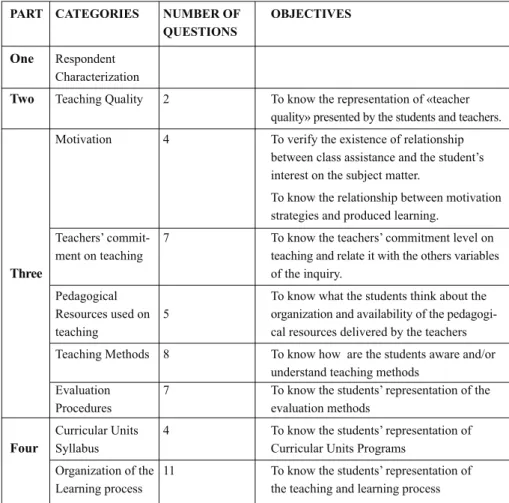
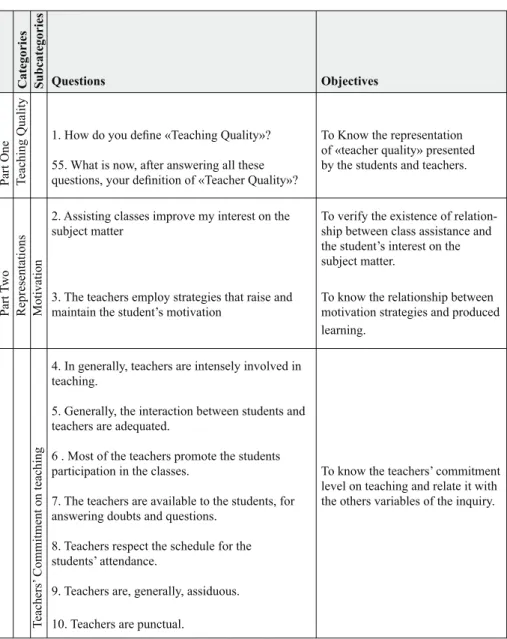
In Table 1 we present the Inquiry matrix and the distribution of the num-ber of question by categories and in the Table 2, some examples of questions made.
Table 1. Inquiry Matrix PART CATEGORIES NUMBER OF OBJECTIVES
QUESTIONS
One Respondent
Characterization
Two Teaching Quality 2 To know the representation of «teacher quality» presented by the students and teachers. Motivation 4 To verify the existence of relationship
between class assistance and the student’s interest on the subject matter.
To know the relationship between motivation strategies and produced learning.
Teachers’ commit- 7 To know the teachers’ commitment level on ment on teaching teaching and relate it with the others variables
Three of the inquiry.
Pedagogical To know what the students think about the Resources used on 5 organization and availability of the pedagogi-teaching cal resources delivered by the teachers Teaching Methods 8 To know how are the students aware and/or
understand teaching methods
Evaluation 7 To know the students’ representation of the
Procedures evaluation methods
Curricular Units 4 To know the students’ representation of
Four Syllabus Curricular Units Programs
Organization of the 11 To know the students’ representation of Learning process the teaching and learning process
Categories Subcategories
Part One Teaching Quality
Part
Two
Representations Motivation
Teachers’
Commitment on teaching
Table 2. Some examples of questions
Questions Objectives
1. How do you define «Teaching Quality»? To Know the representation of «teacher quality» presented 55. What is now, after answering all these by the students and teachers. questions, your definition of «Teacher Quality»?
2. Assisting classes improve my interest on the To verify the existence of relation- subject matter ship between class assistance and
the student’s interest on the subject matter.
3. The teachers employ strategies that raise and To know the relationship between maintain the student’s motivation motivation strategies and produced
learning.
4. In generally, teachers are intensely involved in teaching.
5. Generally, the interaction between students and teachers are adequated.
6 . Most of the teachers promote the students
participation in the classes. To know the teachers’ commitment level on teaching and relate it with 7. The teachers are available to the students, for the others variables of the inquiry. answering doubts and questions.
8. Teachers respect the schedule for the students’ attendance.
9. Teachers are, generally, assiduous. 10. Teachers are punctual.
4. Results
Applied to the two groups – African students (5) and European students (37) – the inquiry provide the following results
Table 3. Inquiry results
Part Categories Number of European African Objectives Questions Students Students
N = 37 N = 5 One Respondent
Characterization
Two Teaching Quality 2 To know the
representa-tion of «teacher quality» presented by the students and teachers.
Motivation 2 M = 4,7 M = 6,8 To verify the existence (M = 5) σ = 1,7 σ = 1,0 of relationship between
class assistance and the student’s interest on the subject matter. Teachers’ 7 M = 19, 6 M = 21,8 To know the teachers’ commitment on (M = 20) σ = 2,6 σ = 1,4 commitment level on
teaching teaching and relate it
with the others variables
Three of the inquiry.
Pedagogical 5 M = 20,1 M = 17,2 To know what the stu-Resources used (M = 15) σ = 2,3 σ = 0,9 dents think about the
on teaching organization and
availa-bility of the pedagogical resources delivered by the teachers
Teaching Methods 8 M = 18,4 M = 14,8 To know how are the (M = 22,5) σ = 2,9 σ = 3,2 students aware and/or
understand teaching methods
Evaluation 7 M = 20,1 M = 23,8 To know the students’ Procedures (M = 20) σ = 2,9 σ = 1,8 representation of the
evaluation methods Curricular Units 4 M = 17,8 M = 18,3 To know the students’ Syllabus (M = 12,5) σ = 1,8 σ = 0,8 representation of
Curri-Four cular Units Programs
Organization of the 11 M = 42,6 M = 36,1 To know the students’ Learning process (M = 30) σ = 2,3 σ = 1,8 representation of the
tea-ching and learning process
5. A possible interpretation
We have made the hypothesis that because the African students are living during three years with us, studying at Évora’s University, suffering an intense
and deep intercultural process, interacting with teachers and students, most of them with a very different way of living, living as the portuguese do and plunged in a melting pot of cultures, mainly european, their representations of teaching does not differ significantly from that one presented by their collea-gues in the course. However, to “read” the numbers we must attend to some limits and be cautious. Thus, we must consider the small size of the sample, its weak representativeness and the use of stereotypes for the interpretation task. Indeed, we have not made any attempt to characterize, in a socio-cultural way, our sample. So, we will have some hints, with a high degree of error.
Any way, we have found that African students seem to be:
• more satisfied with traditional teaching (content and/or teacher cen-tred)
• more exigent with study conditions and organization of the learning process
• more satisfied with evaluation procedures
And both, African and European students, seem to be neither aware to the teaching methods, nor to the relevance of the act of teaching. It seems that they face teaching as a minor task.
References
Boyd, V. & Mcgree, K. (1995). LeadingChange from the Classroom: (4), Austin, TX, Sou-thwest Educational Development Laboratory. Arquivo disponível em URL: http://www. sedl.org/change/issues/issues44.html
Darling-Hammond, L. (2000). Teacher Quality and Student Achievement: A Review of State Policy Evidence, Education Policy Analysis Archives, 1(8). Arquivo disponível em http:// epaa.asu.edu/epaa/v8n1/ consultado em 30 de Julho de 2006.
Gracia, E. & De La Iglesia, C. (2006). Sobre la Opinión que los Alumnos tienen de la Efectivi-dad de la Docencia, Revista Iberoamericana de Educación. Arquivo disponível em URL: http://www.rieoei.org/investigacion.htm consultado em 25 de Julho de 2006.
MCTES (2004). Observatório da Ciência e do Ensino Superior, Direcção de Serviços de Esta-tística e de Indicadores.
NCLB – No Child Left Behind Act (2005). Teacher Quality Improves Student Achievement, Illinois, Learning Point Associates. Arquivo disponível em URL: http://www.learningpt. org.
OCDE – Organisation de Coopération et de Développement Économiques (2004). Repport 2004, OCDE, Arquivo disponível em URL: http://www.oecd.org/publications/0,2743,fr_ 2649_201185_1_1_1_1_1,00.html, consultado em 1 de Agosto de 2006
OCDE (2003). Education at a Glance: OECD Indicators. ISBN 92-64-10233-7.
Riley, K. & Nuttall, D. (eds.) (1994). Measuring Quality: Education Indicators, London, Fal-mer Press.
Recebido em: Julho de 2008. Aceite em: Outubro de 2008. Publicado em: Dezembro de 2008.
Notas biográficas:
Vítor Manuel de Sousa Trindade é Professor Catedrático aposentado da Uni-versidade de Évora. Licenciado em Ciências Geológicas e Doutor em Educação, possui o título de Agregado em Didácticas das Ciências. Foi Professor Convida-do e Professor Visitante em várias universidades europeias e brasileiras e exer-ceu cargos dirigentes na Universidade de Évora. É fundador do Centro de Inves-tigação em Educação e Psicologia da Universidade de Évora, onde continua a dar a sua contribuição para a investigação que o mesmo desenvolve, e fundou a Revista EDUCAÇÃO: Temas e Problemas. Tem numerosas obras publicadas na sua especialidade e dirigiu vários projectos de investigação.
Jorge Manuel Rodrigues Bonito é Professor Auxiliar na Universidade de Évo-ra. Licenciado em Ensino de Biologia e Geologia, Mestre em Geociências e Doutor em Educação, tem desenvolvido intensa actividade de docência e de envestigação nas áreas de Didáctica das Ciências e da Educação para a Saúde. Autor de várias dezenas de artigos da sua especialidade e de manuais para os estudantes, alguns dos quais constituíram como referência a nível nacional.