Agriculture:
Can Sustainability Practices Enhance Firm
Competitiveness? A Case Study
Bruno Longo
Dissertation written under the supervision of Professor Ricardo Reis.
Dissertation submitted as partial fulfilment of the requirement for the Master of
Science in Management with Specialization in Strategy and Entrepreneurship at
Universidade Católica Portuguesa, January 2018
Abstract
This dissertation is a case study on a Portuguese example on how sustainability practices enhances the competitiveness of the firm. The case is kept anonymous, but it deals with a fruit producing company in the South of Portugal that exports almost all of its production to Northern European countries. We aim to research the extent of sustainability in agriculture and its relationship with the competitive advantage.
Therefore, through a qualitative approach, a semi structured interview was conducted with the CEO of an agriculture company. Moreover, a standardized Food and Agriculture Organization (FAO) questionnaire was answered to access the company level of compliance with sustainability practices.
The gathered data, has shown that even though there is an agreement with the definition followed in the literature review, there is an appropriation to suit the company interests. Furthermore, the questionnaire revealed that the company in this case study presents a high level of sustainability. Regarding, the competitive advantage, it was discovered that a differentiation strategy based on the resource based view is the one that best leverages practices into a superior performance.
In the last years the topic sustainability has become a tendency, however there was a lack of research in the connection with competitive advantage. This dissertation provides a different point of view about sustainability connecting both concepts, based on the evaluation of a Portuguese agriculture company.
Resumo
Esta dissertação é um estudo de caso sobre uma empresa Portuguesa e aborda o seguinte tema: como é que as práticas de sustentabilidade melhoram a competitividade de uma empresa. O caso é anónimo, mas considera uma produtora de frutos, a sul de Portugal que exporta praticamente toda a sua produção para os países a norte da Europa. O nosso objetivo com esta dissertação é estudar o nível de sustentabilidade na agricultura, bem como a relação com uma vantagem competitiva
Desta forma e através de uma análise qualitativa, foi feita uma entrevista
semiestruturada a um diretor geral de uma empresa do setor agrícola. Para além disso, foi elaborado um questionário que permite analisar os níveis de conformidade entre a empresa e as suas práticas sustentáveis.
Através dos métodos descritos, foi possível demonstrar que apesar de haver
concordância entre a definição de sustentabilidade da revisão de literatura, existe também uma apropriação da definição de modo a favorecer os interesses da empresa. Com a análise do questionário foi possível constatar que a empresa em estudo tem elevados níveis de sustentabilidade. Quanto à vantagem competitiva, foi concluído que uma estratégia de diferenciação baseada na Resource Based View é a melhor forma transformar as práticas sustentáveis num desempenho superior.
Nos últimos anos o valor dado à temática da sustentabilidade tem vindo a aumentar, no entanto ainda existe pouca informação quanto à sua relação com uma vantagem
competitiva. Esta dissertação permite ao leitor ter um ponto de vista diferente quanto à sustentabilidade, baseado numa perspetiva empresarial.
Acknowledgements
This dissertation culminates two years of learning in the Master of Science in Management with specialization in Strategy and Entrepreneurship at Católica Business School. It surely contributed to my development as a person in terms of knowledge and maturity. For that reason, I would like to thank all the members of this university that I had the opportunity to meet and that provided me with the necessary tools to thrive.
For the Master Thesis per se, firstly I would like to express my sincere thanks to my family and friends who have supported me with all the possible means to accomplish this journey.
Secondly, to the professor Ricardo Reis for the patience, tools and advices that allowed me to complete and pursue my objectives with this Master Thesis and specially grow academically.
Last but not least, to the participant in the interview and questionnaire, who went through the trouble gave me valuable insights on the topic in study.
Table of Contents
1. Introduction 11 2. Literature Review 13 2.1. Agriculture Overview 13 2.2 Sustainability 14 2.2.1 - Sustainability Context 14 2.2.2 - Agriculture Sustainability 152.2.3. Measuring Sustainable Agriculture 17
2.3. Competitive Advantage 18
2.3.1. Porter's Generic Competitive Strategies 18
2.3.2. Resources Based Theory 20
2.3.3. Sustainability and Agriculture related to Porter's Generic Strategies 20 2.3.3. Sustainability and Agriculture Related to Resource Based View (RBV) 22
2.4. Literature Review Conclusions 25
3. Methodology 27
3.1. Design of the Interview 28
3.2. Data Collection 28
3.3. Qualitative Content Analysis 29
4. Data and Results 31
4.1 Demographics of the interview and questionnaire 31
4.2. Sustainability Level 32
4.3. Perception of Sustainability in Agriculture Industry 33
4.3.1. Importance of Sustainability 34
4.3.2. Benefits and Costs of Sustainability 35
4.4. Competitive Advantage 36
4.4.1. Differentiation Strategy 36
4.4.2. Cost Leadership 37
5. Conclusions and Contributions 39
6. Limitations 41
7. Future Research 43
8. References 45
List of Abbreviations
GDP - Gross Domestic ProductOECD - Organization for Economic Co-operation and Development FAO - Food and Agriculture Organization
WCED - World Commission on Environment and Development EU - European Union
INE - Instituto Nacional de Estatística
IFOAM - International Federation of Organic Agriculture Movements TQEM - Total Quality Environmental Management
EPA - Environmental Protection Agency
List of Table and Figures
Table 1 - Participant’s Characteristics 31
Figure 1 - Agro systems categories, (FAO, 2017) 13
Figure 2 - Sustainability Dimensions. Own Illustration 14
Figure 3 - Agriculture Dimensions and Levels. (FAO, 2017) 16
Figure 4 - Porter’s Five Forces. Own Illustration. 19
Figure 5 - Generic Strategies. Own Illustration. 19
Figure 6 - Resource Based View. Own Illustration. 20
11
1. Introduction
Portuguese Agriculture ever since its beginnings has been of a great importance to the growth of the national economy and history. However, the World has been facing a reduction of the economic weight on agriculture in the developed countries, with the respective GDP reaching historical minimum levels (OECD, 2016). Portugal, similar to the World’s trend, has a 2.2% GDP on Agriculture (OECD, 2016), also explained by the development of the socio-economic level (Martino & Marchini, 1996). Overall, the competitiveness in the agriculture sector is increasing which also explains the growth in productivity levels (Porter, 1990), where Asia and Africa lead the net production (FAO, 2017). Nevertheless, the European countries represent the continent with smaller production and in these group of countries Portugal was accounted for having one of the lowest levels of competitiveness (Nowak & Kamińska, 2016). Hence, the Portuguese agriculture needs to overcome the future challenges in order to increase its competitiveness. Portugal has a unique set of conditions, from the diversity of the soil to the climate characteristics, allied with the Europe €4.2 billion funding for agriculture that can help boost the agriculture-economy (European Commission, 2016). During the past years, we have witnessed huge developments on technology which have proven by its usage, and can continue to influence the agriculture sector. A more sustainable view over the natural resources and farms is now on the spotlight and the most recent technologies can be crucial to restructure the current agriculture system, which englobes environmental safety and food security and safety (Ventura-Lucas, Marques, & Martins, Fragoso, 2011).
The topic of sustainability plays an important role on the agriculture world. Issues like overpopulation, food waste, climatic changes and hunger have been the main concerns over the future of both developed and developing countries. Thus, it is important to understand that sustainable agriculture it’s not only a creation of the present but a view over the future of the nations.
Moreover, sustainability should not be approached as an interesting and attractive feature to include in the agribusiness. Its role on agriculture provides a way of increase productivity without compiling to the deterioration of the environment and thus secure a future for the next generations (FAO, 2014). Our proposal with this research is to analyze if a competitive advantage can be achieved through sustainability and how can it influence the competitiveness of the farms. In order to answer the problem statement, the following research questions aim to provide a more systematic analysis over this theme:
12 The first research question has the objective of providing information on the recent opinions on sustainability and its definition within this industry. There are many farmers and agriculture companies worldwide and we intend to study to what extent they understand the role of sustainability on agriculture. Sustainability is a broad theme, present in many fields, but represents an international concern on the agriculture industry. Moreover, understanding the path of the Portuguese agriculture companies on sustainability will provide us with valuable insights on whether or not Portugal is following the global trend of compliance with sustainability goals.
2. How can a sustainability strategy lead to a competitive advantage?
The second research question aims to study how a sustainable agriculture can provide a competitive advantage on the international markets and enhance the competitiveness of agriculture in Portugal. A key strategic goal for most corporations is to achieve a competitive advantage. On agriculture there is no difference and the benefits of a sustainable strategy can play a major role in offering a long-term competitive advantage. We also aim to study to which extent Portuguese agricultural and sustainable companies found advantages following this strategy.
The research paper will follow a structure inspired in a recent thesis on Sustainable Viticulture by Julian Blome, in order to help the reader, understand the successive steps of the present study (Blome, 2017).
After this brief introduction, the literature review will be presented. This chapter aims to compile a set of previous studies in similar fields of work, in order to analyze to which extent, the current research provides a novel contribution to the chosen topic. Then, the methodology is introduced, where the specific case study will be addressed. Finally, the conclusion will sum up the results of the research and the most important findings. The recommendations on future research will be the last topic of this study.
13
2. Literature Review
2.1. Agriculture Overview
Spedding (1979) defines agriculture as a producing activity of goods through the usage of plants and animals. It comprises a set of distinctive areas such as forestry, livestock, fisheries, poultry, crops, among others (FAO, 2017). Maybe because it has its origins more than 10 thousand years ago we tend to forget that it represents the main cause of environmental deterioration (Napel, Van der Veen, Oosting, & Koerkamp, 2011). It is so rooted in our World view, that we perceive rural environment to be the “natural” landscape. Nowadays the agricultural land covers a total of 37% of the Earth’s landmass (excluding Antartica) and accounted for a total of 80% of the deforestation (Reytar, Hanson, & Henninger, 2014). The agricultural systems are divided and considered by tiers, from a global view to the singularity of systems such as cropping and livestock.
Figure 1 - Agriculture systems categories, (FAO, 2017)
In Portugal, agriculture plays an important role, both socially and economically and it is critical for the sustainable development of the rural areas. The total agricultural area covers a total of 47% and the forestry represents 39% of the country (EU-Commission, 2016). Regarding the biodiversity, Portugal accounts 30% of high nature value farmland, more than half of the agricultural area. The number of agricultural producers is decreasing due to rural exodus and the overall conditions, nonetheless the number of farms with more than 100 hectares has increased (Marques, 2015). However, the recent statistics have been overwhelming with Portugal performing poorly. Over the last six decades, the agricultural value added did not change considerably (Marques, 2015). The trade deficit on agricultural goods reached €7
14 billion. However, exportations experienced an increase of 5.7%, reaching a total of €3.8 billion since 2014 (INE, 2015).
2.2. Sustainability
2.2.1 - Sustainability Context
Nowadays, we are witnessing a continuous growth of the global economies boosted by the development of major technologies. This path of evolution, focused on the economic outcome, is starting to deteriorate our environment and issues like pollution, Global Warming and species extinction are arising (Brown, Flavin, & French 2000). These issues are directly related to the concept of sustainability.
Despite the difficulty to explain the term sustainability, due to its complexity, ambiguity and lack of acceptance of a single definition, the concept offers us an undoubtedly image of its purpose (Phillis & Andriantiatsaholiniaina, 2001; White, 2013). The terminology of sustainability was apart from other historical mentions introduced in the Brundtland Report on The World Commission on Environment and Development, where the following definition emerged: “Sustainable development is development that meets the needs of the present without
compromising the ability of future generations to meet their own needs” (WCED, 1987, p.41).
Figure 2 - Sustainability Dimensions. Own Illustration
The present definition had two major concerns: needs vs resources and short vs long-term; and three dimensions to reach a sustainable development: social, economic and environmental (Kuhlman & Farrington, 2010). Regarding those dimensions or pillars, researchers argue that on the social side there has to be a welfare consideration, presently, but also to the future
15 generations. On the economic angle, an enterprise should remain viable and focus on a long-term performance. And finally, environmentally, a firm has to manage its physical resources and ensure consideration on nature concerns (Bruyn & Drunen, 2004; Glavič & Lukman, 2007; Bonn & Fischer, 2011). However, such complex dimensions raise a wide number of limitations for instance measurement difficulties and sustainability evaluation problems, since there is a broad number of possible linkages between the determinants (Pater & Cristea, 2016).
Afterwards, contributions to the well-known Brundtland’s report started to appear, one made the linkage between human development and the environment capacities across generations (Kates, Parris, & Leiserowitz, 2005). Promptly it started to receive critics on how could exist a development of something that it is supposed to remain steady, sustainable?
Undoubtedly, there are many visions on this behalf and, probably over two thousand definitions exist on sustainability. Even though there is a dissension on its definition, the concept is not purely fulfilled by negative aspects, it also has allowed a common agreement that is wrong to treat the World as a business liquidation (Daly, 1991). Moreover, those definitions have similarities and apart from the huge ambiguity, terms such as allocation of resources, equitable distribution and sustainable scale can be found on the wide range of possibilities (Costanza & Patten, 1995).
Also, on the business side, and similar to the dilemmas on creating a worldwide definition, it is difficult to find a perfect allocation of a sustainable strategy. In order to be a sustainable enterprise, a multi-level integration is required and it’s surely complex. For those who aspire this strategy, more than compile with the needed basic requirements, it is also ultimately necessary to linkage the vision with the many internal and external determinants (Bonn, Fischer, 2011). On the agriculture sector an important role is played by sustainability especially due to its connection with environmental issues and the usage of natural resources.
2.2.2 - Agriculture Sustainability
The practical concern with sustainable agriculture only took place in the 21st century, when the population became aware of the difficulties in meeting the desirable productivity without deteriorate the environment (Feher & Beke, 2013). Similar to the singular concept of sustainability, sustainable agriculture does not escape the controversy around the right definition, comprising many different opinions and a wide range of parties involved (Hansen, 1996; Tilman, Cassman, Matson, Naylor, & Polasky, 2002). Moreover, the role of stakeholders, in pursuing their particular interests when defining and exploiting sustainable agriculture, led
16 researchers to question the validity and usefulness of the concept (Dunlap, Beus, Howell, & Waud, 1993; Allen, Dusen, Lundy, & Gliessman, 1991; Binder, Feola, & Steinberger, 2010). Still, the development on the definition continued to evolve, with many authors proposing their views on the principles and goals of sustainable agriculture, aiming to reduce its ambiguity. However, to base the whole concept of sustainable agriculture development in some studies or opinions creates a particular conflict in meeting the differences between the spatial levels with other dimensions of sustainability (FAO, 2017).
Figure 3 - Agriculture Dimensions and Levels. (FAO, 2017)
Nonetheless, Francis, Sander and Martin (1987), described sustainable agriculture as a strategy to address problems like food quality and the environment. On the other hand, Ikerd (1993) focus on the maintenance of productivity over time. A more recent approach, Gafsi, Legagneux, Nguyen and Robin (2006), refers to sustainable agriculture as the capacity to adapt to future changes. Thus, the FAO report on sustainable agriculture (2014), points out the sustainability concept defined on the Brundtland’s report, describing sustainable agriculture as, “...agriculture must meet the needs of present and future generations for its products and
services, while ensuring profitability, environmental health, and social and economic equity”
(FAO, 2014, p.14). Even though there are many definitions for this concept, it is still possible to find an overall agreement on the pillars mentioned on the Brundtland report: Environmental, Economic and Social (Lichtfouse, Navarrete, Debaeke, Souchère, & Alberola, 2009).
The incremental increase on the population and the 9 billion forecasts to 2020, question the previous path conducted by the agricultural industry. The conventional agriculture system with the special focus on productivity is proven to be outdated. Moreover, recent studies show that despite the advanced studies in many fields, the current system is no longer suited for the people and the ecosystem. However, sustainable agriculture could be the alternative to improve the current paradigm by inputting different components, such as promoting the values
17 of farming, to the agricultural formula which aims to prevent the degradation of the environment (Lal, 2008).
Thus, in order to reach a sustainable agriculture, some strategies have been conceived. Among many authors, the creators of the Sustainable Agriculture book define three as the main ones: The first one is the substitution strategy, where instead of completely change the farming systems, there is only small modifications in the components. Although, this only works for the short-term (Altieri & Rosset 1996). A more complex example is the Agroecological strategy, since the focus is on the biological regulations and the usage of production schemes to take advantage of the biodiversity. Last but not least, the Global Strategy aims to rethink societal global issues and the agriculture role, in order to create a better suited strategy by merging the sustainable farming systems with the other determinants, such as marketing, food systems and relations between farms (Lichtfouse et al., 2009). However, how to achieve a sustainable agricultural strategy remains uncertain, the compliance with societal, environmental and economic issues is then, what should drive this type of strategy.
2.2.3. Measuring Sustainable Agriculture
Recently, worldwide, academics and policy makers have concentrated their thoughts over the concepts of Sustainable Environment and Sustainable Development (Zhen & Routray, 2003). Moreover, there is a current pursuit on the best tools and practices to enable the measurement of this concepts in the different agricultural areas, where the human being depends on (FAO, 2017). However, the measurement of any spatial level of sustainable agriculture system is very challenging. Currently, different measurement tools and methodologies, in different situations, have been used in order to assess sustainability. Thus, this is limiting the comparison across farms, regions and countries and creating a difficulty in the procurement of the best practices. (Gerdessen, & Pascucci, 2013). Hence, the problem of discovering an effective way to measure sustainability emerges. Ikerd (1993) and Webster (1999) claim that due to the different perspectives on measuring sustainability, finding a solution is then, impossible. However, even though it is impossible to set a universal measurement mechanism, it is still feasible to understand the trends fluctuations (Hayati, Ranjbar, & Karami 2010) At least, there is a shared vision that, “...erode soil, destroy the habitats of insect predators and cut trees down without replacing…” (FAO, 2017, p.14) is an unsustainable practice (FAO, 2017)
18 and so, it is possible to, to improve biological stability by selecting better suited cultivation systems (Altieri, 1995).
Apart from the controversial side, the development of measurement tools and mechanisms is increasing in order to aid agriculture judgments (Gasparatos, 2010; Marchand, Debruyne, Triste, Gerrard, Padel, & Lauwers, 2014). As mentioned before, frameworks do not provide a robust global comparative system, which urges the need of set up prevailing information on the evaluated determinants, such as, food waste, land degradation, among others to allow a better suited evaluation (United Nations Sustainable Development Solutions Network, 2014). Still, the pillars of sustainability: environmental, social and economic seem to have a higher importance as components to measure sustainability within the existing frameworks (Binder et al., 2010; Schader, Grenz, Meier, & Stolze, 2014).
2.3. Competitive Advantage
A question that urges on strategy and the many industries around the globe is: “Why do some firms persistently outperform others?” (Barney & Clark, 2007, p.14). The most common answer lead to the definition of competitive advantage, or its meaning, when a company outperform another through a set of core competencies and opportunities (Learned, Andrews, Christensen, & Guth 1965; Hrebiniak & Snow 1980; Hitt & Ireland 1985; Business Dictionary, 2017).
There is a panoply of opinions regarding what provides this desirable competitive advantage for companies (Foss & Mahnke, 1998). On this literature the focus will be held by the Porter’s Generic Competitive Strategies (Porter, 1980) and the Resource Based Theory (Barney, 1991; Grant, 1991) which turn to be the most well-known and revised strategies. On one hand, the Porter’s Generic Competitive Strategies has its focus on the environment of the industry or more specifically in the industry external factors influencing a company. On the other hand, the Resource Based Theory concentrates its attention on the internal drivers of a company. This are, in fact, two opposed examples of how to pursue a competitive strategy.
2.3.1. Porter's Generic Competitive Strategies
As mentioned before Porter’s framework takes a deep view into the environment surrounding a company. The basis of this model is to evaluate the external forces and pursue one of the Porter’s delineated strategies in order to outperform the competitors (Ormanidhi & Siringa, 2008). Since the industry where the firm belongs to plays a crucial role on the pursued strategy,
19 Porter defined five forces to determine the overall competitiveness: “Threat of New Entry”, “Rivalry among Existing Firms”, “Substitute Products”, “Bargaining Power of Buyers” and “Bargaining Power of Suppliers” (Porter, 1980), (Figure 1). Porter (1980) claimed that only by understanding these forces, the company could decide whether to adopt offensive or defensive actions.
Figure 4 - Porter’s Five Forces. Own Illustration.
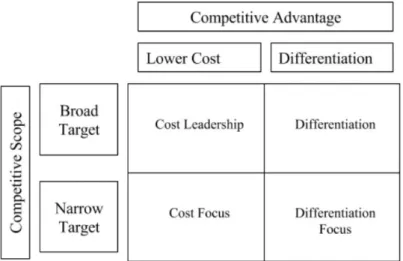
In order to achieve a higher profitability, the following strategies were suggested: “Cost Leadership” or “Lower Cost”, “Differentiation”, and “Focus” which can be divided into, “Cost Focus”, “Differentiation Focus” and “Cost and Differentiation Focus”, (Figure 2).
20 To this extent Porter (1980) claims that: "Effectively implementing any of these generic strategies usually requires total commitment and supporting organizational arrangements that are diluted if there is more than one primary target". The framework is divided by the type of strategy and the respective scope of analysis that can secure a favorable position in the industry (Ormanidhi & Siringa, 2008).
2.3.2. Resources Based Theory
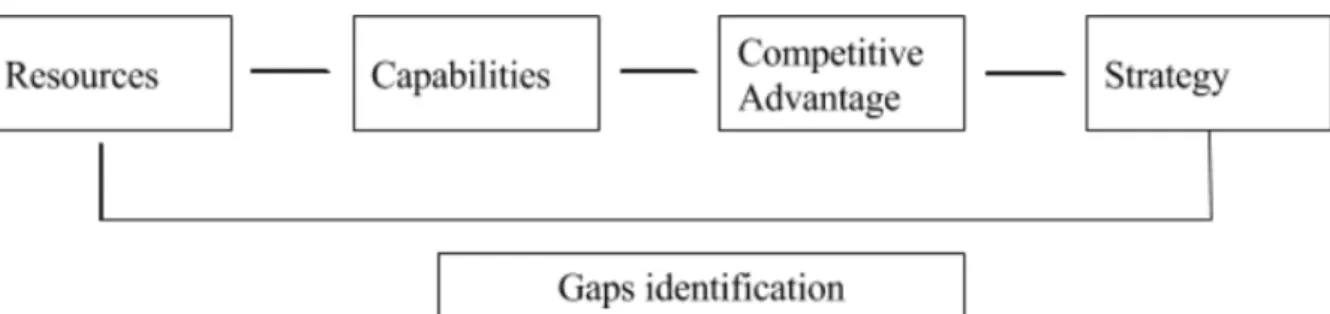
A different perspective is the Resources based model which states that during a fluctuation on the external environment, the resources and capabilities of a firm, represent a much more reliable basis to access a competitive advantage (Grant, 1991). Therefore, this framework focus is on the role of the Resources and Capabilities within the firm’s strategy (Figure 1).
Figure 6 - Resource Based View. Own Illustration.
In this context, resources are defined as inputs to the production which varies across industries, examples are: Capital, Skills, Finance, among others. However, a resource by itself does not represent a big deal to achieve a competitive advantage, the symbiosis with Capabilities which are the capacity of exploiting the resources, define the extent in which the competitive advantage can be achieved (Grant,1991).
2.3.3. Sustainability and Agriculture related to Porter's Generic
Strategies
In the agriculture sector there are three possibilities of strategies that appeared with Porter’s Research, which are, offering an undifferentiated or common product with an affordable price (Cost Leadership), focus on a product with a unique set of attributes (Differentiation Strategy) and a specialized approach with a focus on niche markets (Focus Strategy) (Porter, 1980; Phillips & Peterson, 2004). This latter example of strategy will not be covered on this topic of
21 competitive advantage analysis since it derives from the first two strategies (Cost leadership and Differentiation) but focused on a niche market.
Several studies on the field of sustainability already shown that there is a positive correlation between sustainable initiatives and the overall performance of a company (Klassen & McLaughlin, 1996; Fouts & Russo, 1997). Thus, this positive linkage can be the source of competitive advantage provided by sustainable practices on international markets (Aragón-Correa & Sharma, 2003; Kramer, 2006).
A cost leadership strategy is related with a special focus over productivity, achieve cost reductions through economies of scale and a product standardization (Porter, 1980; Phillips & Peterson, 2004). On a sustainable strategy, studies showed that through ecological efficiencies it is possible to reduce the operating costs and achieve a competitive advantage (Shrivastava, 1995). Methods such as reducing waste disposal, conserving the energy and reutilize materials are examples of means of exploiting efficiencies (Shrivastava, 1995). Also, the usage of renewable energies, electricity through solar panels or biogas from biological compost provide a sustainable practice to prevent the ecosystem (Starik & Carroll, 1991; Stead & Stead, 2009; Lichtfouse et al., 2009). The usage of biogas can even be used as a fertilizer which is considered to improve the quality of the soil (IFOAM EU, 2015). Moreover, both sustainable practices/usages provide a cost reduction for the farmers. Pollution, a matter of concern Worldwide which is usually associated with a poorly usage of inputs, can, through the influence of politics, practices and efficient technologies, prevent a cause of environmental deterioration, as well as create lower costs with raw materials and waste disposal when compared to the competitors (Smart, 1992; Schmidheiny, 1992; Hart & Ahuja, 1994; Romm, 1994). A more practical approach to a sustainable agriculture is the intercropping method. It relies on mixing different species of plants in order to reduce pest damages, diseases and increase soil fertility and quality. An effective usage of this model can produce interesting outcomes at the economic level, such as reducing the costs related with pest management, increase profitability and productivity for the farmers (Mousavi & Eskandari, 2011). Different programs have been developed regarding the continued importance of the sustainability concept in the many industries, with a special focus on the Total Quality Environmental Management (TQEM) which promotes the relation and reutilization across enterprises (Shrivastava, 1995). The several examples of sustainable practices and its outcomes sustain the cost leadership strategy since it allows companies to create a price flexibility which promotes the creation of a competitive advantage (Shrivastava, 1995).
22 A different approach is the differentiation strategy where the main focus concerns the relation with the clients, a product's orientation from the top to the bottom and higher levels of marketing skills and flexibility towards the consumer (Shrivastava, 1995; Phillips & Peterson, 2004). Vesala and Vesala (2010), claimed that the future of the agricultural industry will be based on the value added in the production and the direct marketing efforts. Studies shown that, when a firm complies with a sustainability strategy, in the sense of over perform the regulations, associations with a better financial performance could be perceived (Judge & Douglas, 1998; Klassen & McLaughlin, 1996). Moreover, sustainability awards usually provide an increase of stock prices and investment (Judge & Douglas, 1998; Klassen & McLaughlin, 1996). Important features such as an ecological friendly product, packaging and management practices can provide a competitive advantage (Shrivastava, 1995). In particular, products that need huge amounts of packaging gain a differentiation advantage (Shrivastava, 1995). Nowadays, we are experiencing a huge consumer approach towards companies that genuinely operate sustainability practices (Shrivastava, 1995). Also, this witnessed interest of customers in a company’s sustainability practices is in the origin of purchase intentions, moreover, sales are becoming highly influenced by those who are sensitive to these issues (Murray & Montanari, 1986). Thus, an effective management towards sustainability is a source to increasing the reputation of a company and a market advantage vis-á-vis its competitors (Russo & Fouts, 1997). Regarding the food quality and sustainable food, the interest is also growing, with consumers spending on the internet for special food (Kouwenhoven & Nalla, 2016). Furthermore, consumers are available to pay premium prices and express loyalty for those who include elements of sustainability practices into their business models (Kouwenhoven & Nalla, 2016).
2.3.3. Sustainability and Agriculture Related to Resource Based View
(RBV)
Accordingly, to Hill and Jones (2010), to gain a competitive advantage over the competitors, two prominent strategies take place in the field of Resource Based View, lower cost and differentiation.
23
Cost Advantage relation with Sustainability and Agriculture
Technology and Physical Resources
Studies on the effect of firm level resources on sustainability practices have shown that physical resources can represent a manner of pursuing a competitive advantage (Russo & Fouts, 1997). In some cases, the reduction of a firm’s footprint on resource depletion represents a source of protecting the environment and a mean to a faster replacement of the natural resources (Brodt & Thrupp, 2009). Technology plays a crucial role on resources management and in the agribusiness sector supports the idea of reducing environmental degradation (Edwards, Lai, Madden, Miller, & House, 1990). Furthermore, the pursuit of clean technologies and innovation processes enhances an energy conservation and a reduction of both raw materials and waste disposal (Shrivastava, 1995; Thomas & Raja, 2005). Therefore, the application of innovations and technologies into the firm processes can further imply a cost advantage (Gemmrich & Arnold, 2007; Atkin, Gilinsky, & Newton, 2012). Although, incurring in such costs with clean technologies without any government agencies support can represent a high risky for a company, due to the investment significance. Plus, being an early adopter usually aggravates the amount of investment, as result of the technology uncertain quality (Groenewegen & Vergragt, 1991). Moreover, it is always an unknown field when it comes to predicting the viability of these technologies and its economic consequences (Sbrivastava, 1995). Taking into consideration Sale (1986), an utterly modification to an ecological production may be irreversible, therefore small modifications are advised. However, in a discounted cash flow analysis, high investments represent an increased payoff expectation (Abernatby & Utterback, 1978; Brealey & Myers, 1991). In addition, companies that do not pursue similar approaches can suffer henceforth (Abernathy & Utterback, 1978; Brealey & Myers, 1991).
Access to low cost inputs
The usage of clean technologies, such as the previously mentioned, pollution prevention systems and other alternative technologies, already reduce some of the basic inputs used in the agriculture industry. Nonetheless, the access to low cost inputs cover a domain of components not so evident as the basic ones. Alongside with the importance of sustainability in Agriculture, the European Commission is supporting the farmers of the European nations that comply with sustainable practices (EU-Commission, 2017). Moreover, on the financial aspect, disclosure on environmental practices affect the risk profile of companies, which can be sustained by the increased scrutiny in sustainable policies by the investors (Belkaoui, 1974; Sparkes & Cowton,
24 2004). Such measures represent a facilitated access to cash by those who pursue a sustainable strategy.
The human resources of a firm play an important role, representing the firm’s goals and culture. An environmental concern requires commitment and coordination by those who embrace such practice (Shrivastava, 1995). Additionally, some studies have shown that the relation between sustainable practices and a firm is in some cases a source of attractiveness for possible candidates (Dutton & Dukerich, 1991; Starik & Rands, 1995; Koch & McGrath, 1996). In practice it represents a mean for companies to “acquire” and retain the best employees (Russo & Fouts, 1997). Dechant and Altman (1994) based on a panoply of different studies, stated that there is a diminished willingness of candidates to work at companies with poor sustainability performance and a graduates’ preference towards working in morally developed firms. Furthermore, greater productivity and motivation comes from companies who possess this moral attachment with the workers (Gemmrich & Arnold, 2007).
Differentiation relation with Sustainability and Agriculture
Brand Image
A brand is usually seen as a representation of company, it can be a logo, a symbol, or other component that at the eye of a customer creates a connection with a company (Tuominen, 1999). The preference of customers for a certain brand is usually associated with the term brand equity and it represents a source of value for a company. Brand knowledge, which is divided into brand awareness and imagery is how customers respond to the marketing efforts. Furthermore, it represents the perceived image of the company (Keller, 1993; Woodruff, 1997). Through its brand equity a company is able to have a powerful advantage over its competitors. However, perceptions of value change quickly in a competitive environment and an updated strategy and well determined leverage of this resource is, therefore, crucial (Flint, Woodruff, & Gardial, 2002; Flint, 2006). Flint and Golicic (2009) stated that, more than a simple practice, a sustainable strategy plays a major role on brand equity, offering an advantage by influencing the associations of the customers. Moreover, sustainability improves the image, reputation and creates legitimacy for a company (Sbrivastava, 1995). Also, when included in the value proposition, it creates onwards loyalty from the customers (Kouwenhoven & Nalla, 2016)
Product Technology and Quality
In the previous topic, we discussed the effect that sustainability has on the reducing of costs. However, sustainability can actually improve the quality of agricultural products through soil,
25 water and air management (Rembiałkowska, 2007). Organic farming is known for not using pollution components in the agriculture, which effectively produces modifications on the quality of the components mentioned above (soil, water, air) and therefore the quality of products (Rembiałkowska, 2007). Intercropping has a similar approach since it uses a mixture of cultivation plants in order to create a protective environment for each plant (Mousavi & Eskandari, 2011). Moreover, due to a lower use of pesticides, it influences the soil quality (Mousavi & Eskandari, 2011). This preoccupation with improving food quality has shown a trend on the environmental market, with the environmental market growing 200 billion per year (EPA, 1991; Council on Economic Priorities, 1991).
2.4. Literature Review Conclusions
The Sustainability theme is starting to play a major role on how businesses developing themselves. However, there is still a lack of accordance about the right definition and how it should be measured worldwide, which creates difficulties in the comparison of different companies and farms. Nonetheless, the definition proposed on the Brundtland report is the more accepted and well-known explanation of the thematic. Regarding the relation with competitive advantage it is clear that this association is not fully covered, at least not in the agriculture industry. There are some studies on how determined practices can improve the three pillars of Sustainability: Environment, Social and Economic, but it is dispersed information. Therefore, when relating with a superior performance of a company, the theme gets even more blurred. The Porter Generic Strategies and the Resource Based View or any other model are rarely mentioned as examples of strategies to leverage Sustainability practices into a competitive advantage. Then, this study aims to exploit those notions through the lens of a sustainable company in the agriculture industry.
27
3. Methodology
The main approach used for this methodology is known as Case Study. The option for this method relies on the objectives of the research questions since in this case “how” or “why” represent the core of questions in study (Yin, 2009). Moreover, when the investigator has little control of the events and the thematic is a contemporary event within a real life situation this method is considered adequate (Yin, 2009). In this study, the research will be focused on one case with multiple units of analysis, represented by two different data collection methods. On one hand and based on the SAFA Tool, produced by FAO, the sustainability performance of a Portuguese Farm will be analyzed, focusing on four categories: Governance, Environmental, Economical and Social. On the other hand, the author will use a qualitative exploratory interview to study the relation between sustainability and a competitive advantage.
Concluded the literature review, we clarified the objectives and goals which enabled the process of achieving the required data. When doing research on an unknown field, a qualitative method approach towards the objective is highly recommended (Ritchie, Lewis, Lewis, Nicholls, & Ormston, 2013). Therefore, the purpose of a qualitative research method mainly consists on understanding the substance of a determined theme. Since the objective of this research is understanding to which extent agriculture companies can develop and achieve a competitive advantage through sustainability, a qualitative method with open questions, provide a better source for gathering valuable information (Persson, 2015). Moreover, the method in equation allows the researcher to explore the interviewee reflections on the phenomena as well as the intrinsic motivations, beliefs and decisions (Ritchie et al., 2013).
On the panoply of types of interview in the qualitative research methods: structured, semi-structured and unstructured, the semi structured interview are considered for this study the more appropriate method since it allows to search for different insights related to the research. Moreover, the semi structured interview sets a conversational tone that enables to gather the pretended specific information as well as explore the surrounding of each topic (Walle, 2015). However, semi structured interview can be usually associated with a lack of reliability and some bias which influence its quality (Opdenakker, 2006). Nonetheless, using the chosen method allows the researcher to extinguish the answer delays as well as the nature of the responses (Opdenakker, 2006).
As explained above the SAFA tool method from FAO will be used to address the sustainability of the interviewed farms and to understand to which extent Portuguese companies
28 already comply and give importance to the topic in study. In order to obtain the data, a survey will be conducted following the guidelines provided by FAO.
3.1. Design of the Interview
The interview follows a semi structured mechanism which allows the author to create a guide to control the flow of the session, maintaining a certain degree of freedom. In order to define the structure of the interview, the focus relies on the concepts and the topics that were less exploited in the literature review, and in the pre-defined research questions. We decided to divide the interview on 3 main chapters that will cover the interview:
1. Demographics and overall characteristics 2. Sustainability Perception
3. Agriculture Sustainability and Competitive Advantage
The demographics function as an introduction and as an overall description of each interviewee. Furthermore, the sustainability perception chapter will cover the issues of the specific industry and explore the thoughts of the participants about the topic. Last but not least the Relation between Agriculture Sustainability and Competitive Advantage involves the advantages and disadvantages of being Sustainable as well as the practices regarding the different dimensions of the concept: Economic, Environmental and Social.
In the case of the questionnaire, the questions were copied and translated from the SAFA Tool. It was necessary to conduct small adjustments in order to reduce the length and respective duration of the survey as well as to facilitate the answering. The questions focus on four dimensions: Governance, Environmental, Economic and Social. The first one (Governance) was not exploited during the literature review since it was not mentioned as a pillar of Sustainability according to the Brundtland report but it was still assessed in order to explore a different notion of Sustainable Agriculture.
3.2. Data Collection
In order to undertake the interview and the survey, the participant was contacted during a meeting and furtherly by email where the purpose of the study was explained in detail. Therefore, the date of the interview was scheduled at the best interest of both parts. The interview took around 45 minutes and were recorded with a smartphone for the purpose of
29 analyzing and collecting the results. The chosen language for the interview was Portuguese since it was both parties’ native language.
The interview was then transcribed through a selective process, and carefully analyzed. Usually there is a loss of information when an interview is transcribed, in order to prevent it and focus on the important information for the research a transcription method seems crucial (Mayring, 2014). The selective process of transcription is an economic procedure that relies on transcription only the relevant information for the study. Therefore, introductory parts, discussions apart from the interview or topics that do not add any substance can be avoided for further analysis (Mayring, 2014).
In the case of the survey, the data gathered was inserted in the SAFA tool and automatically analyzed by the program, allowing the researcher to conduct an analysis of the outcomes.
3.3. Qualitative Content Analysis
The qualitative content analysis as a mixed method approach was defined by (Mayring, 2014) and aims to facilitate and increase the quality of the analysis of qualitative content methods. Therefore, in this study the mentioned method of analysis will be included in order to evaluate the content gathered.
Mayring (2014) claims that both deductive and inductive procedures should be assessed in order to reduce the material, provided in this case by semi structured interviews. Therefore, and on one hand the Content Structure/Theme Analysis, a deductive procedure, will be addressed in order to organize categories/themes considered in the literature review. The data gathered can then be summarized and coded in the specific categories (Mayring, 2014). On the other hand, the inductive category formation, an inductive procedure, will be used in order to diminish the information in each category, in other words, treat the specific information of each interview (Mayring, 2014).
The inductive category formation (Mayring, 2014), follows 8 steps:
● Step 1 and Step 2, define the research question, theoretical background and establishment of criterion, categories and level of abstraction were predefined in the introduction and literature review.
● Step 3 to 7 consists on the process of transcription the semi structured interviews and defining the categories. In this case, since the head categories were previously
30 determined in the literature review, both steps can be skipped. However, if parts of the material cannot be included in any of the built categories, new ones can be included. ● Step 8 provides the final results; the interpretations can be produced in order to address
31
4. Data and Results
The following chapter aims to assemble the results and analysis of the semi structured interview and questionnaire. Therefore, the presentation of the results will begin with the demographics and characterization of the interviewee, following by the assessment of the company sustainability. Furthermore, the interpretation of the semi structured interview which combines the perspective of sustainability and relation with competitive advantage will be presented.
4.1 Demographics of the interview and questionnaire
In order to proceed with the study, a horticulture company in the South of Portugal was chosen due to its relevance in terms of sustainable practices. The participant in question was referred through an institutional contact who intermediated the first meeting. Since the participant had advanced knowledge about the topic of sustainability and experience on managing a company in the agriculture business it seemed perfectly suited for the research. In this case, the participant of both questionnaire and interview was the CEO of the company.
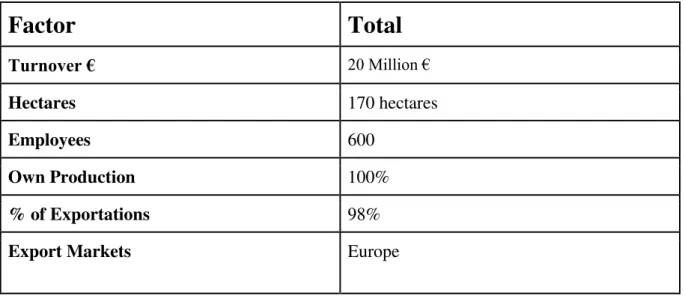
Factor
Total
Turnover € 20 Million € Hectares 170 hectares Employees 600 Own Production 100% % of Exportations 98%Export Markets Europe
Table 1 – Participant’s Characteristics
The company in study has an estimated turnover of 20 million € and it possesses a 170 hectares production area that is expected to grow in the following years. During certain periods of the year the company accounts for 600 employees which can fluctuate due to the business seasonality, ranging between 350 and 600, low season and high season respectively. The company in study does not outsource any of its production, maintaining its total
production by themselves in the region the south of Portugal. Almost the total of its
32 the Scandinavian countries. During the introductory phase of the interview, Demographics, it was also mentioned that there is a tendency of growth in sales.
4.2. Sustainability Level
In order to help understanding at which level the Portuguese company incorporated sustainability practices within its operations the researcher conducted a questionnaire based on the SAFA tool. The referred questionnaire, is divided in four sections: Governance, Environment, Economic and Social. These sections represent the pillars of sustainability discussed in the literature review, with the inclusion of the Governance section. Each of the themes represented in the diagrams are directly related with each of the pillars of sustainability. ● Governance: Corporate Ethics, Accountability, Participation, Rule of Law and Holistic
Management.
● Environment: Atmosphere, Water, Land, Biodiversity, Materials and Energy and Animal Welfare.
● Economic: Investment, Vulnerability, Product Quality and Information and Local Economy.
● Social: Decent Livelihood, Fair Trading Practices, Labor Rights, Equity, Human Safety and Health and Cultural Diversity.
Certain sub-themes/themes, due to inadequacy with the participant company were not considered in this evaluation. Therefore, some of the scores of the themes represented in the diagrams below were affected: Rule of Law, Materials and Energy, Investment, Vulnerability, Decent Livelihood, Labor Rights (Affected by subtheme removal) and Animal Welfare (Total theme removal).
33
Figure 7 - SAFA Tool results Diagram
The figure represents the results related to the evaluated company sustainability practices. Overall, and considering all variables, subthemes removal included, the company demonstrates high levels of sustainability. In this case the worst pillar is the environmental, with most of the themes within it scoring a yellow/moderate level. Nonetheless, it represents a possibility of increasing sustainable practices in this field. The remaining pillars, Governance, Economic and Social score green/good level and in some themes dark green/ very good levels. Even though one company does not nearly represent the sample size of Portugal, it is a good indicator that agriculture companies are starting to pay attention at sustainability issues.
It is important to point out that, although this is a proper, and reliable framework to analyze the sustainability of agricultural firms, it is not fully adapted to the Portuguese industry which can create some bias in presented results.
4.3. Perception of Sustainability in Agriculture Industry
During the semi structured interviews, the participant was asked to describe his own and the company definition of sustainability. The purpose of this question is related with one of the research questions employed by this study as well as the literature review. The definition of the participant has its basis related to the Brundtland definition in the “Our Common Future” report:
34 “I believe that Sustainability is mainly focused on a growth with careful focus on the usage of
the global resources.”. Even though the pillars of sustainability were not mentioned at the beginning, the participant demonstrated an overall agreement with the ones evaluated in the questionnaire. As explained in the literature review, the topic of sustainability is ambiguous and different approaches to topic are considered by different authors. Although the participant showed an agreement it is clear that the company like many authors appropriated the definition at the best of its interests.
Furthermore, when exploited the importance of sustainability pillar, the participant revealed that the focus is on the Social and Environmental dimensions, not forgetting that the company should be economically viable. “Roughly our company focus on two main pillars
which are Social and Environmental”. On a social perspective, the justification relies on the
importance of the workforce on an agricultural business as well as the maintenance of the culture heritage. The environmental dimension since there is a growth preoccupation with preserving and controlling the quality of the water as well as allowing a preservation of the habitats and plants culture in the region.
4.3.1. Importance of Sustainability
In order to evaluate the future perspective of the topic sustainability and to understand what drives and motivates the participant of investing and applying sustainable practices, a few questions were employed. Overall the participant described two main motives for practicing sustainability: Culture and Market, “What mainly drives us is the market and the culture of the
company”. Firstly, the culture since this company has been developing sustainable practices
since its early stages, “This company started developing actions and plans of sustainability long
time ago it is within the company culture”. Secondly because it is important to understand the
market and be one step ahead of the consumer. The participant pointed out that the consumer is getting more exigent with the time and there are certain aspects which he considered important, “The consumer knows what he wants, and he is starting to be more and more exigent.
We need to be one step ahead of what he thinks it is important”. On the future perspectives over
Sustainability, the participant agreed that it will become mandatory and the importance of the topic will increase, “It is no longer just a competitive advantage but will become a mandatory”. To prove this statement to examples were given: On one hand the European consumer is becoming more aware of the importance of food security and safety, healthy food and lower impacts on the environment. On the other hand, the retailers are increasing the importance given
35 to sustainable practices, pesticide levels, water control and security margins, mainly influenced by the final consumer.
4.3.2. Benefits and Costs of Sustainability
Sustainability is often associated with a costly practice that can influence negatively the financial side of a company. However, through the interview it was possible to clarify some aspects on this field. The participant revealed that sustainability is not expensive, “Definitely
not, it depends on what we are talking about but being sustainable is not expensive”. The reason
behind this misconception is the fact that sustainability usually requires significant initial investments. Although, these investments are amortized in the long term, becoming beneficial for the company. The example given is related with water management, in order to have efficient irrigation systems an initial investment has to be made but it will influence the losses in the process, compensating the cost. Furthermore, sustainability can provide benefits in numerous ways, on a market perspective, practicing sustainability demonstrates a behavioral pattern and a responsible activity which influences positively the brand image of the company, “We can transmit to the market that we have this behavioral pattern with a responsible activity
at many levels”. For the company in study it is also important to ensure and create a bound with
the community in a serious manner, it is not just exploiting the resources and leave the region empty handed. Besides being beneficial for the company and providing a differencing personality of the company, there are some practices necessary to remain alive in the market, “Being sustainable at social and environmental level is a question of being differentiator in
some levels and in others necessary to be alive”.
During the interview some aspects that influence positively the production were also mentioned. At a social level, providing a fair remunerations, accommodation and decent healthy conditions stimulates the productivity. Moreover, it provides better relations with the stakeholders, “In this way, sustainability affects primarily the productivity, but it can also
provide advantageous relations with the community and the stakeholders”. On a product level
the participant characterized its products by having a healthy influence and aspect. It was also mentioned that a lower usage of pesticides combined with an effective control and supply of water provide a greater quality to the products.
36
4.4. Competitive Advantage
Throughout the interview the participant related that it is possible to achieve a superior performance/competitive advantage by practicing a Sustainability strategy, “Definitely, I
believe that by adopting superior politics of sustainable practices, maintaining a sustainable growth without compromising the production cost, creates a source of competitive advantage”. Even though sustainability is starting to become the new normal and a necessity of the industry, a higher dynamization of the dimensions of sustainability still allows to achieve the desirable competitive advantage.
4.4.1. Differentiation Strategy
Regarding the differentiation strategy, the participant related through the interview that being sustainable is a differentiation strategy, “I believe that being sustainable is being
differentiator”. In his opinion the main element of a differentiation strategy is offering a
superior product quality. However, there is a similarity between the big players of the market in terms of product quality. Nonetheless, the participant considers that there are other forms of differentiation, especially on the social dimension since it has more relevance on a day to day basis, specially the relations with the stakeholders such as government agencies, syndicates, environmental agencies, “For all the reason mentioned before, being sustainable allows us to
work with diverse top retailers, to contact with official entities and solve problems easier”. As
mentioned before being sustainable also influences the perspective that the market has on the company, providing credibility and increasing the brand equity, “We can transmit to the market
that we have this behavioral pattern with a responsible activity at many levels”. The technology
utilized in the production, such as the irrigation systems which supplies the water when the plant needs influence the overall quality of the product “when we associate with better usage
of water and pesticides it can provide better quality”. On the side of the human resources the
participant verified that whoever practices sustainability has a facilitated access to better employees, “Being sustainable attracts people since it provides more appealing projects”. Overall there are a few differences with the literature review, on the participant point of view being sustainable is automatically using a differentiation strategy. Moreover, it does not allow an access to lower cost labor but to a more skilled and interested group of employees. On a general context the described differentiation strategy is more related to the Resource based theory, since the resources and capabilities of the firm, allow the company to leverage its market position. Due to the similarity in terms of product, the differentiation strategy based on the
37 Porter Generic Strategy, more related to a product with unique set of conditions is less considered as a strategy option.
4.4.2. Cost Leadership
Regarding the relation between a cost leadership and a competitive advantage, the participant was clear that it does not provide a superior performance, “I do not believe that sustainability
offers us a cost leadership advantage”. Even though, it is possible to reduce the cost in the
utilization of pesticides, it will then require a more effective and specialized control on the plants. Another example relies on the reutilization and savings of water. It is possible to make investments that will be amortized and reduce the future costs but there are many variables to take into consideration. The main reason behind a cost leadership through sustainability, not providing a competitive advantage is that all the players at this level have the same mass production and similar equipment’s, “If you interview the companies in the region they will all
tell you the same, there are rules that have to be followed in order to not be left out”. Overall
sustainability reduces costs; however, it is not possible to gain a competitive advantage through this type of strategy.
39
5. Conclusions and Contributions
This dissertation topic aimed to evaluate the sustainability topic and furtherly its relationship with a competitive advantage. In order to structure and follow a line thinking, two main levels were approached: Perception of Sustainability and Competitive advantage through Sustainability.
Firstly, it was possible to confirm that the definition provided by the evaluated company, is similar to the general accepted definition discussed in the literature review. Nonetheless, it was clear that there is an appropriation of the definition for the company best interests, which was also covered in the literature review, since Sustainability is considered an ambiguous topic with many possible definitions. Regarding what motivates this company to conduct sustainability practices two perspectives were employed: On one hand, there is an external perspective which combines the market - understanding what the consumer wants, food security and safety, the continuous growth of the population and climate change issues. On the other hand, an internal perspective that relies within the company culture and the importance given to the social and environmental dimensions of sustainability. Moreover, being sustainable, pays-off. The investments on sustainable practices usually compensate on the long term.
Secondly, the conducted analysis with the SAFA tool framework showed that the company complies and demonstrates satisfactory levels of sustainability on the different dimensions evaluated: Governance, Environmental, Economic and Social. Even though it is not a fair sample size to evaluate the entire agriculture industry in Portugal, it surely demonstrates a growth of importance given to this topic and a possible work path.
At last the research allowed to understand that it is possible to make a relation between a competitive advantage and Sustainability practices. During the interview four possible strategies were approached in order to leverage the sustainability practices into a competitive advantage: Porter Generic Strategies (Differentiation and Cost Leadership) and Resource Based Theory (Differentiations and Cost Leadership). Regarding the cost leadership, the existence of similarities on the production cost is the main reason behind not being possible to achieve a competitive advantage through this strategy. Nonetheless, the usage of sustainable practices, allows the company to reduce costs. On the differentiation strategy point of view, the paradigm is different. The data gathered demonstrated a stronger compliance with the Differentiation strategy (Resource Based Theory), since the Differentiation (Generic Strategy) considers a product with a unique set of features which can be difficult in such an established market. On the other hand, the differentiation strategy (Resource based theory) represents a stronger option.
40 The data obtained revealed that complying with sustainable practices affects the brand equity, access to human resources, quality of the product, relation with stakeholders and access to international markets. As practical implications this research allowed the participant to rethink about some sustainability practices, “Your questionnaire provided me ideas to develop the
sustainability of the company and allowed me to gather some pieces of the puzzle”. Moreover,
the findings on competitive advantage revealed that the benefits of a complying with Sustainability can be leveraged through a differentiation strategy. This analysis could be helpful for companies that aim to develop Sustainability practices or even more for those who still do not understand the benefits of being sustainable. Furthermore it demonstrates how this thematic should be approached on a Strategy level.
Today, achieving a superior performance through sustainable practices is possible since it creates a group of essential benefits. However, being sustainable is becoming the “new normal” of the market and in order to achieve to gain a competitive advantage there has to be a truly commitment and effort in the several sustainability dimensions.
41
6. Limitations
For the purpose of this research some constraints and difficulties have appeared during the process of gathering data.
One of the main issues is the sample size, in the interviews and questionnaire. Since we chose the case study methodology and due to time constraints, the study covers only one company in the agriculture sector, more specifically, the horticulture industry. Moreover, Sustainability is a broad topic which requires extensive evaluation of many determinants that were not possible to cover during the analysis. The format of questionnaire employed, based on the SAFA Tool from FAO was changed to facilitate the process of answering for the participants. Those modifications and chosen format could lead to bias in the results, due to the lack of understanding by the participants. Moreover, the questionnaire was not specifically tailored to the Portuguese Industry. In the interviews, the results obtained are dependent on the integrity and accuracy of the participants. In this case, the sample size can influence the perspective and conclusions of the study, especially in understanding if there is a connection between competitive advantage and sustainable practices. Also, the participant of both methods was chosen due to its relationship with sustainability practices.
Overall, the sustainability concept, in agriculture, still lacks a proper definition, and it is possible to find ambiguity on the topic. Even though, the method utilized for sustainability assessment is recognized, different authors and organizations support different frameworks which creates some issues on a proper evaluation.
43
7. Future Research
During the conception of this dissertation some topics beyond the actual research revealed to be interesting topics of future research. Moreover, the limitations create some gaps that could be further developed into a more sustained study.
Firstly, the sample size used in the research is considerably small which does not provide an overall view of the Portuguese agriculture industry and its relationship with sustainability. Also, a more in-depth view with a bigger sample size could provide more prominent evidences if higher performance (competitive advantage) can be achieved through companies who use sustainable practices with effort.
Secondly, the SAFA tool from FAO, represent one of the many frameworks available to access the sustainability of a company. An adaption of the model to the Portuguese industry could allow a more consistent basis to analyze and compare on a national level.
Thirdly, this dissertation only studies the corporate side of sustainability, a view into the consumers’ perspective on this topic would provide greater insights on the perception and how sustainability may influence variables such as purchase intention and brand image.
Last but not least, this research only covers the Resource Based Theory and the Porter’s Generic Strategies, understand the relation with the concepts of Dynamic Capabilities could be interesting.