http://dx.doi.org/10.1590/2317-1545v40n1184456 Licence Creative Commons CC BY 4.0
Physiological potential of maize seeds submitted to different
treatments and storage periods
1Giovanna Emanuelle Gonçalves Mariucci
*2, Andréia Kazumi Suzukawa
2,
Alessandro Lucca Braccini
2, Carlos Alberto Scapim
2, Luiz Henrique da Silva Lima
2,
Priscila Angelotti
2, Raissa Marrafon Ponce
3, Danilo Cesar Volpato Marteli
2ABSTRACT - The aim of the study was to evaluate seed germination and vigor of maize subjected to different products and storage
periods. The experimental design was completely randomized in a split plot on time. In the plots were distributed nine treatments:
an untreated control, one treatment called “standard treatment”, with addition of fungicide (fludioxonil + metalaxyl-M) and insecticide (thiamethoxam). From the standard treatment, six treatments with combinations of inoculant (Azospirillum brasilense),
micronutrients (nitrogen + potassium + zinc + boron + copper + iron + manganese + molibdenium) and bioregulator. Lastly, a
treatment called “complete treatment” including all products. In subplots the storage periods of zero, 15, 30, 45, 60 and 90 days were
evaluated. Seed vigour of maize was reduced by seed treatments and storage. Micronutrients addition resulted in higher fitotoxicity
in comparison to the addition of other products, regardless of storage period. The treatment with the combination of fungicide,
insecticide and inoculant proved to be feasible, and was the most promising seed treatments. None of the studied treatments affected
the germination in up to 45 days of storage, however the complete treatment with 3200 mL .100 kg-1 reduced seed vigour.
Index terms: Zea mays, chemical treatment, germination, vigour.
Potencial fisiológico de sementes de milho submetidas a diferentes tratamentos
e períodos de armazenamento
RESUMO - O objetivo do trabalho foi avaliar a germinação e vigor das sementes de milho submetidas a diferentes produtos e períodos de armazenamento. O delineamento experimental foi inteiramente casualizado em esquema de parcelas subdivididas no tempo. Na parcela foram distribuídos nove tratamentos: uma testemunha não tratada, um tratamento denominado de “tratamento padrão”,
com adição de fungicida (fludioxonil + metalaxyl-M) e inseticida (thiamethoxam). A partir do tratamento padrão, seis tratamentos
com combinações de inoculante (Azospirillum brasilense), micronutrientes (nitrogen + potassium + zinc + boron + copper + iron
+ manganese + molibdenium) e biorregulador. Por fim, um tratamento denominado de “tratamento completo”, incluindo todos os
produtos. Na subparcela, os períodos de armazenamento 0, 15, 30, 45, 60 e 90 dias foram avaliados. O vigor das sementes de milho
foi reduzido pelos tratamentos de sementes e pelo armazenamento. A adição de micronutrientes resultou em maior fitotoxicidade em
comparação à adição de outros produtos, independente do período de armazenamento. O uso de fungicida, inseticida e inoculante se mostram viáveis, como os mais promissores tratamentos de sementes. Nenhum dos tratamentos estudados afetaram a germinação até 45 dias de armazenamento, porém o tratamento completo, com 3200 mL. 100 kg-1 reduziu o vigor de sementes.
Termos para indexação:Zea mays, tratamento químico, germinação, vigor.
1Submitted on 08/25/2017. Accepted on 12/21/2017.
2Departamento de Agronomia, Universidade Estadual de Maringá, Av.
Colombo, 5790, 87020-900 - Maringá, PR, Brasil.
3Departamento de Agronomia, Universidade Estadual de Londrina, Rod.
Celso Garcia Cid, km 380, 86057-970 - Londrina, PR, Brasil. *Corresponding author < [email protected]>
Introduction
Maize seeds are routinely treated, since the advantages of using protected seeds are undeniable. However, the contact of
used (Deuner et al., 2014).
Several studies involving seed treatment reports the
efficiency of products, separating them by purpose, whether they are insecticides (Dan et al., 2011), fungicides (Alves and Juliatti, 2010), bioregulators (Silva et al., 2008), fertilizers (Dias et al., 2015) and some combinations of them (Avelar et al., 2011). However, the constant search for new options for
chemical treatment is necessary.
The fungicide Maxin® was efficient in preserving the
vigour of maize seeds for up to three months of storage,
besides reducing the mycelial growth (Resende et al., 2005). However, treatment of maize seeds with fluquinconazole
on sowing day reduced the emergence percentage by 2.4%
(Alves and Juliatti, 2010).
When evaluating seeds of three maize hybrids, Tonin et
al. (2014) observed a reduction in seed vigour treated with thiamethoxam for up to 270 days of storage. Castro et al. (2008)
observed greater vigour of soybean seeds treated with imidacloprid. This indicates that results are dependent on plant species.
Seed treatment has also become an alternative for application of micronutrients. Operational ease, low cost, greater uniformity of distribution, as well as availability of nutrients in the initial stage of plant growth, are some of the advantages. Levels of zinc and copper in plant tissues are higher
in the initial growth phase (Farooq et al., 2012). Increased yield
of maize was obtained when seed treatment with zinc sulfate
was used (Harris et al., 2007). Doses of copper did not affect
physiological quality of seeds during four months of storage
(Dias et al., 2015). This practice is a viable and effective
alternative for supplying these elements to maize plants. In seed treatment with Stimulate®, for the inbred line L57,
the product reduced germination by 38%; however, for the hybrid GNZ 2004 there was a 29% increase in germination
(Silva et al., 2008). In high and medium vigour maize seeds,
lower intensity in the reduction of vigour during 180 days of storage was observed in lots of high vigour. In medium vigour
lots, the major benefits of the bioregulator occurred within 60 days of storage (Dan et al., 2014).
In seed processing units, it is common to adopt anticipated treatment, before bagging or when the seeds are delivered to the grower. However, anticipated treatment can
cause problems, such as a possible phytotoxic effect. Studies
concerning chemical treatment of seeds are usually carried out
on the efficiency of isolated products. However, information on the effect of combination of products and their respective
spray volumes on the physiological quality of maize seeds is
scarce in the literature. Furthermore, storage influence on this
type of seed treatment has been little studied.
The hypothesis of the study is the increasing number
of phytosanitary products added to the chemical treatment
have a negative influence on the physiological quality of the
maize seeds, as well as the spray volume resulting from these combinations, and is aggravated by storage. The aim of this work was to evaluate the physiological potential of maize
seeds submitted to different combinations of products and
spray volumes in stored seeds.
Material and Methods
The evaluations of seeds physiological quality were carried out at the Seed Technology Laboratory of the Applied Research Center for Agriculture, of the Agricultural Sciences Center of State University of Maringá.
The study involved nine seed treatments: an untreated
control (T1); a treatment called “standard treatment” (T2),
which included fungicide and insecticide; from the standard treatment, six treatments included combinations between
inoculant, micronutrients and bioregulator and finally, a treatment called “complete treatment” (T9), which included
the addition of all products, simulating a situation of high
investment in seed treatment (Table 1).
The products used in the present study were the fungicide
Fludioxonil + Metalaxyl - M (Maxim XL®, 0.15 L. 100 kg-1 of
seeds), the insecticide Thiametoxam (Cruiser 350FS®, 0.6 L.
100 kg-1 of seeds) , the inoculant with Azospirillum brasilense
(AzoTotal®, 0.4 L. 100 kg-1 of seeds), the liquid fertilizer containing
nitrogen, potassium, zinc, boron, copper, iron, manganese and molybdenum (Awaken® 16-0-2, 0.8 L. 100 kg-1 of seeds) and
the bioregulator containing kinetin, gibberellic acid and 4-indole 3-butyric acid (Stimulate®, 1.25 L. 100 kg-1 of seeds).
Seeds of commercial hybrid maize ‘CD 324 PRO’ were
used, which received different spray volumes resulting from
the combinations of products used. Seed coating was done manually using 3 kg of seeds for each treatment, in plastic bags. Agitation was done until complete distribution of products and total coating of seeds, with subsequent drying in the shade.
After treatment, part of the seeds were submitted to initial
evaluations (period zero), while the other parts were packed
in kraft paper bags and stored under laboratory conditions. The following evaluations were performed at 15, 30, 45, 60 and 90 days after initiating storage:
Germination test: Four subsamples of 50 seeds for each treatment were used, according to the criteria established in
the Rules for Seed Testing (Brasil, 2009). The evaluation was
Table 1. Scheme of the seed treatments consisting of different combinations of products and respective spray volumes.
N. Seed Treatment Spray Volume
(L. 100 kg-1of seeds)
T1 Control 0.00
T2 Fungicide1 Insecticide2 (Standard) 0.75
T3 Fungicide1 Insecticide2 Inoculant3 1.15
T4 Fungicide1 Insecticide2 Micronutrients4 1.55
T5 Fungicide1 Insecticide2 Bioregulator5 2.00
T6 Fungicide1 Insecticide2 Inoculant3 Micronutrients4 1.95 T7 Fungicide1 Insecticide2 Inoculant3 Bioregulator5 2.40 T8 Fungicide1 Insecticide2 Micronutrients4 Bioregulator5 2.80 T9 Fungicide1 Insecticide2 Inoculant3 Micronutrients4 Bioregulator5 3.20 1Maxim XL® (Fludioxonil + Metalaxyl-M) 0.15 L. 100 kg-1 of seeds.
2Cruiser® (Thiamethoxam) 0.60 L. 100 kg-1 of seeds. 3AzoTotal® (Azospirillum brasilense) 0.40 L. 100 kg-1 of seeds.
4Awaken® 16-0-2 (nitrogen + potassium + zinc + boron + copper + iron + manganese + molibdenium) 0.80 L. 100 kg-1 of seeds. 5Stimulate® (kinetin + gibberellic acid + 4-indole 3-butyric acid), 1.25 L. 100 kg-1 of seeds.
Table 2. Non-orthogonal contrasts for mean comparison of seed treatments.
C1 ctrl1 vs all= 8T1 – T2 – T3 – T4 – T5 – T6 –
T7 – T8 – T9
C2 ctrl vs std2= T1 – T2
C3 ctrl vs cplt3= T1 – T9
C4 std vs (std + I1)= T2 – T3 C5 std vs (std + M1)= T2 – T4 C6 std vs (std + B1)= T2 – T5 C7 (std + I) vs (std + I + M) = T3 – T6 C8 (std + I) vs (std + I + B)= T3 – T7 C9 (std + M) vs (std + I + M)= T4– T6 C10 (std + M) vs (std + M + B)= T4 – T8 C11 (std + B) vs (std + I + B)= T5 – T7 C12 (std + B) vs (std + M + B)= T5 – T8 C13 (std + I + M) vs cplt= T6 – T9 C14 (std + I + B) vs cplt= T7 – T9 C15 (std + M + B) vs cplt= T8 – T9
1ctrl = control; I = inoculant; M = micronutrient; B = bioregulator; 2std = standard (fungicide + insecticide);
3cplt= complete (fungicide + insecticide + inoculant + micronutrient +
bioregulator). Modified cold test: The test was conducted similarly to
the germination test. However, the rolls were wrapped in plastic bags, remaining in a germination chamber at 10 ± 1 ºC for seven days. Rolls were then taken to a germinator
at 25 ± 1 °C for four more days (Barros et al., 1999). The
percentage of normal seedlings followed the same criteria for
the germination test (Brasil, 2009).
Seedling length: The test was conducted as described
for the germination test, remaining for four days. Five
subsamples of 20 seeds were used for each treatment. Results were expressed in cm seedling-1 (Nakagawa, 1999).
Emergence speed index: The test was conducted in a greenhouse with four subsamples of 50 seeds for each treatment, in trays containing washed and sterilized sand. Seedlings were counted daily. The results were expressed in the emergence speed index, according to the equation
proposed by Maguire (1962).
The experimental design was a completely randomized,
with split-plot in time, with four or five replications, according
to the variable analyzed. The untreated control and the eight treatments of seeds and spray volumes were distributed in the plots. In the subplots, storage periods of 0, 15, 30, 45,
60 and 90 days were evaluated. For comparison among the
seed treatments, non-orthogonal contrasts were established
(Table 2) and submitted to the “t” test of Bonferroni. The regression analysis was used to verify the fit of polynomial models (linear and quadratic) for the dependent variables, as
a function of the storage periods.
Results and Discussions
The interaction between seed treatment and storage
period was significant for all analyzed variables: germination test (GT), seedling length (SL), modified cold test (CT) and emergence speed index (ES). The study of the contrasts allowed to isolate the effect of products, in order to investigate which products influenced the physiological potential of seeds of the hybrid maize ‘CD 324 PRO’ (Tables 3 and 4).
The comparison of the control with the other treatments, observed through the C1 contrast, indicated that, on average,
Table 3. Results of the contrasts for the germination test (GT) and seedling length (SL), in relation to the nine seed treatments
in six storage periods.
Contrast
Storage (days)
0 15 30 45 60 90
GT SL GT SL GT SL GT SL GT SL GT SL
C1 ctrl1 vs all ns 33.9* ns 39.9* ns 48.0* ns 66.3* 61.5* 51.3* 67.0* 62.2*
C2 ctrl vs std2 ns ns ns ns ns ns ns ns ns ns ns 4.5*
C3 ctrl vs cplt3 ns 6.3* 8.0* 8.3* 14.5* 8.4* 14.0* 11.4* 18.5* 8.5* 22.0* 9.7*
C4 std vs (std + I1) ns ns ns ns ns ns ns ns ns ns ns ns
C5 std vs (std + M1) ns ns ns 4.6* ns ns ns 6.0* ns ns ns 4.0*
C6 std vs (std + B1) ns ns ns ns ns ns ns ns ns ns ns 4.3*
C7 (std + I) vs (std + I + M) ns 4.4* 2.5* 4.5* ns ns ns 4.7* ns ns 11.0* ns C8 (std + I) vs (std + I + B) ns ns ns ns ns ns ns ns ns ns ns ns C9 (std + M) vs (std + I + M) ns ns ns ns ns ns ns ns ns ns ns ns C10 (std + M) vs (std + M + B) ns 2.0* 7.0* ns ns ns 8.5* ns 13.5* ns 14.0* ns C11 (std + B) vs (std + I + B) ns ns ns ns ns ns ns ns ns ns ns ns C12 (std + B) vs (std + M + B) ns 4.8* 8.5* 5.0* 9.0* ns 12.5* ns 18.5* ns 18.5* ns
C13 (std + I + M) vs cplt ns ns ns ns ns ns 9.0* ns 10.5* ns 10.0* ns
C14 (std + I + B) vs cplt ns ns 7.0* 4.8* 13.5* ns 14.0* * 16.0* ns 20.0* ns
C15 (std + M + B) vs cplt ns ns ns ns ns ns ns ns ns ns ns ns
1ctrl = control; I = inoculant; M = micronutrient; B = bioregulator; 2std = standard (fungicide + insecticide); 3cplt= complete (fungicide + insecticide + inoculant +
micronutrient + bioregulator).
*significant at 5% probability by the Bonferroni “t” test (p < 0.05); ns non significant (p > 0.05).
Table 4. Results of the contrasts for the modified cold test (CT) and the emergence speed index (ES), in relation to the nine
seed treatments in six storage periods.
Contrast
Storage (days)
0 15 30 45 60 90
CT ES CT ES CT ES CT ES CT ES CT ES
C1 ctrl1vs all 82.5* 14.3* 226.0* 21.6* 237.0* 19.5* 238.5* 29.8* 241.0* 26.0* 303.0* 34.2*
C2 ctrl vs std2 ns ns ns ns ns ns ns 1.9* ns ns ns ns
C3 ctrl vs cplt3 23.0* 3.5* 58.0* 4.0* 59.5* 4.5* 58.0* 6.6* 61.5* 7.0* 69.5* 8.3*
C4 std vs (std + I1) ns ns ns ns ns ns ns ns ns ns ns ns
C5 std vs (std + M1) 12.0* ns 31.5* ns 30.5* ns 33.5* ns 30.0* 1.9* ns ns
C6 std vs (std + B1) ns ns ns ns ns ns 13.0* ns ns ns ns ns
C7 (std + I) vs (std + I + M) 18.5* 2.3* 28.5* 2.0* 33.0* 2.4* 40.5* 2.1* 38.5* 2.5* 37.0* 3.2* C8 (std + I) vs (std + I + B) ns ns ns ns 11.0* ns 13.5* ns 12.0* ns 20.0* 3.0* C9 (std + M) vs (std + I + M) ns ns ns ns ns ns ns ns ns ns ns ns C10 (std + M) vs (std + M + B) 13.5* ns 25.0* 1.9* 25.5* ns 25.5* 2.5* 28.0* 2.6* 17.5* 3.9* C11 (std + B) vs (std + I + B) ns ns ns ns 2.5* ns ns ns ns ns ns ns C12 (std + B) vs (std + M + B) 22.0* 2.1* 47.5* 2.5* 47.5* 1.8* 46.0* 3.0* 48.5* 3.3* 51.0* 6.5*
C13 (std + I + M) vs cplt ns ns 24.0* ns 21.0* ns 14.5* 2.4* 18.5* 3.3* 22.0* 4.2*
C14 (std + I + B) vs cplt 20.0* 2.4* 42.5* 1.9* 43.0* ns 41.5* 4.3* 45.0* 4.5* 39.0* 4.5*
C15 (std + M + B) vs cplt ns ns ns ns ns ns ns ns ns ns ns ns
1 ctrl = control; I = inoculant; M = micronutrient; B = bioregulator; 2std = standard (fungicide + insecticide); 3cplt = complete (fungicide + insecticide + inoculant +
micronutrient + bioregulator).
* significant at 5% probability by the Bonferroni “t” test (p < 0.05); ns non significant (p > 0.05).
speed index (Table 4), for all storage periods, with positive
values for the contrasts. In this sense, the addition of any product to the seeds reduced seed vigour, even in period zero, that is,
soon after treatment. On the other hand, for the germination
germination of the treated seeds were maintained, regardless of the treatment received, during the said periods.
However, because the C1 contrast involves a large group
of treatments, the results were influenced by the means of those treatments that affected the quality of the seeds with greater
intensity. This fact is clearly observed when comparing the results of contrast C2, which compares the control with the standard
treatment (fungicide + insecticide), indicating that there were no significant differences for all variables in all periods studied. In this sense, maize seeds treated with fludioxonil + metalaxyl-M + thiamethoxam can be stored for up to 90 days, maintaining
the physiological quality. These results showed that besides the treatment of maize seeds with fungicide and insecticide being
consolidated, it is also an effective practice. Results observed by Dan et al. (2011) also indicate adequate levels of germination
and vigour with the treatment of soybean seeds, using the same
insecticide. In relation to the fungicide fludioxonil + metalaxyl-M, Resende et al. (2005) verified the efficiency in preserving
the vigour for up to three months of storage. On the other
hand, Deuner et al. (2014) reported that treatments containing
thiametoxam showed a greater reduction in maize seed vigour during storage period compared to treatments with deltamethrin,
pirimiphos-methyl, fludioxonil and fenitrothion. These results can be explained by Tonin et al. (2014) who concluded that the
physiological quality of treated maize seeds is dependent on the hybrid used.
The results of contrast C3, which compares the control with the
complete treatment, indicate that there were significant differences
for all the characteristics, in all periods, except for germination in the period zero. Thus, the addition of all products (fungicide
+ insecticide + inoculant + micronutrient + bioregulator) and,
consequently, higher spray volume (3200 mL. 100 kg-1 of seeds),
reduced seed vigour immediately after treatment. This indicates that the complete treatment can maintain germination, however the seed vigour is decreased.
When analyzing the contrast results that isolate the effect
of the inoculant, either in combination with the standard
treatment (contrast C4), with the standard + micronutrient (contrast C9), standard + bioregulator (contrast C11) or standard + bioregulator + micronutrient (contrast C15), there were no significant differences (p>0.05) for all variables at
all storage periods. Thus, the addition of the inoculant did not
affect the quality of the maize seeds throughout 90 days of storage. This fact can be justified by the inoculant being a
biological product and not a synthetic molecule.
On the effect of the addition of bioregulator on seed
treatment, for the C6 (in comparison with the standard
treatment) and C8 contrasts (comparison with the standard + inoculant), no significant differences were observed for the
GT, PL and ES. Seed germination, vigour and emergence
were not affected by these combinations during the entire
storage period, except for PL and ES at 90 days. However,
from the 15th day for CT, there were significant differences indicating that seed vigour is affected by the addition of
bioregulator after 15 days of storage. Results obtained by Dan
et al. (2014) demonstrate that, for periods of up to 60 days
of storage, the bioregulator was able to maintain the initial
performance of maize seeds. Also, Castro and Vieira (2001) observed efficiency in the application of bioregulator in seed
treatment, resulting in a greater number of normal seedlings on the germinative performance of maize seeds.
For contrast C10, in comparison with the standard treatment + micronutrients, when the bioregulator was added, significant differences were observed after 15 days of storage,
for most variables. Thus, it is inferred that in the presence of micronutrients, vigour, germination and emergence are
affected by this combination, after the storage period quoted.
In contrast, for contrast C13, in comparison with the standard
treatment + inoculant + micronutrients, no significant differences for most variables up to 30 days of storage were
noticed. After this period, the addition of the bioregulator,
which resulted in the complete treatment, negatively affected
the physiological quality of maize seeds.
The addition of micronutrients with the standard treatment
(contrast C5) did not influence germination and emergence
of seeds, based on the results of GT and SE variables, except for 60 days of storage for the last variable. Thus, the micronutrients did not lead to the reduction of germination and emergence during storage. However, the vigour evaluated by the CT variable, simulating cold conditions with high
humidity, presented a significant reduction from period zero. Still on micronutrients, significant differences were
observed for C7 (comparison of micronutrients with standard
+ inoculant), C12 (comparison of micronutrients with standard + bioregulator) and C14 (comparison with standard + inoculant + bioregulator). For all of these comparisons, the CT and SE variables were affected in most storage periods.
This indicates that seed vigour, expressed by the percentage of normal seedlings or by the velocity index was reduced when the micronutrients were added to these seed treatments.
Variations were observed in germination and emergence according to the combination studied. The micronutrients in the presence of the inoculant maintained the germination until 60 days. On the other hand, in the presence of bioregulator or of all the products, with consequent increase of spray volume, both germination and emergence were maintained only in period zero.
For all the contrasts that evaluate the effect of micronutrients,
periods. However, it is possible to infer that, in general, the product reduced the size of the seedlings. The addition of micronutrients to maize seed treatment, mainly in the presence of bioregulator, caused phytotoxicity, reducing vigour and germination of the seeds in a greater intensity. Combinations of boron and zinc can be harmful to normal seedlings formation
and to germination speed (Acha et al., 2016).
However, disagreeing with the results of the present study,
maize seeds treated with copper were not affected during four months of storage (Dias et al., 2015). Similarly, an increase in
grain yield of maize, can be obtained when using zinc sulfate
(Harris et al., 2007). Contradictory results observed in the
treatment of seeds with micronutrients are possibly due to the formulation of the nutrient used, the dosage, the formulation combinations, the species, the cultivar and the initial quality
of the treated seeds (Farooq et al., 2012).
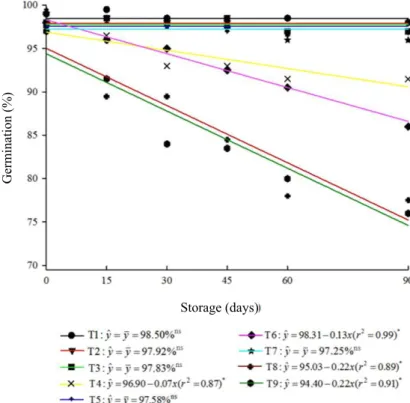
Regression analysis was performed to evaluate the behaviour
of seed treatments over the storage periods (Figure 1). The T4 (standard treatment + micronutrients), T6 (standard treatment + inoculant + micronutrient), T8 (standard treatment + micronutrient + bioregulator) and T9 treatments (complete treatment) affected
vigour the most presenting greater reductions, compared to the other treatments, even in period zero. Moreover, it is possible
to infer that the deleterious effect of the solution composition
prevailed and not the volume, since these treatments constitute
different spray volumes. Thus, another approach should be used to quantify the real effect of spray volume, such as characteristics and methodologies that isolate the effect of the aqueous solution.
In relation to the germination (GT), regressions were non-significant to T1 (control), T2 (standard treatment), T3 (standard + inoculant), T5 (standard + bioregulator) and T7 (standard + inoculant + bioregulator) (Figure 2), ie germination was maintained throughout the storage period. For treatments T4 (standard + micronutrients), T6 (standard + inoculant + micronutrient), T8 (standard + micronutrient + bioregulator) and T9 (complete treatment), the models were significant and
with linear adjustments. The reductions were in 0.07%, 0.13%, 0.22% and 0.22%, for each storage day, respectively. Again, the addition of the micronutrients to the solution possibly
caused a notable phytotoxic effect throughout the storage
period, drastically reducing the germinative capacity of seeds.
In addition, the deleterious effect of the solution composition
prevailed, not the volume, since these treatments constitute
different spray volumes. The results of the regression analysis
also allow us to infer that germination up to 45 days of storage for all treatments remained within the standards of Normative Instruction n°. 25, of the Ministry of Agriculture, Livestock
and Supply, being equal to or above 85% (Brasil, 2005). After
this period, only treatments T8 and T9 presented germination below the standard for commercialization.
Figure 1. Percentage of normal seedlings in the germination test as a function of storage periods.
*significant regression at 5% probability (p < 0.05); ns non significant regression (p > 0.05).
Germination (%)
Conclusions
The seed vigour of the maize hybrid ‘CD 324 PRO’ was reduced by the treatments studied. The reduction intensity is dependent on the product used in the treatment and storage period. The addition of micronutrients resulted in a higher
phytotoxic effect on the seeds compared to other products, from
period zero and increasing over time. Treatments with fungicide, insecticide and inoculant were feasible, as they maintained acceptable levels of vigour, germination and emergence. All seed treatments did not interfere with seed germination for
up to 45 days of storage. Finally, the treatment of maize seeds
with complete treatment and 3200 mL. 100 kg-1 of seeds can
maintain germination however seed vigour is decreased.
References
ACHA, A.J.; VIEIRA, H.D.; FREITAS, M.S.M. Perennial soybean
seeds coated with high doses of boron and zinc. African Journal of Biotechnology, v.15, n.37, p.1998-2005, 2016. https://www.ajol.
info/index.php/ajb/article/viewFile/144449/134095
ALVES, V.M.; JULIATTI, F.C. Tratamento de sementes de híbridos de milho com fluquinconazol. Bioscience Journal, v.26, n.6, p.930-939, 2010. http://www.seer.ufu.br/index.php/biosciencejournal/ article/view/7240/6614
AVELAR, S.A.G.; BAUDET, L.; PESKE, S.T.; LUDWIG, M.P.; RIGO, G.A.; CRIZEL, R.L.; OLIVEIRA, S. Armazenamento de sementes de soja tratadas com fungicida, inseticida e micronutriente
e recobertas com polímeros líquido e em pó. Ciencia Rural, v.41, n.10, p.1719-1725, 2011. http://www.scielo.br/pdf/cr/v41n10/ a13211cr4818.pdf
BARROS, A.S.R.; DIAS, M.C.L.L.; CÍCERO, S.M.;
KRZYZANOWSKI, F.C. Teste de frio. In: KRZYZANOWSKI, F.C.; VIEIRA, R.D.; FRANÇA-NETO, J.B. (Eds.). Vigor de sementes: conceitos e testes. Londrina: ABRATES, 1999. p.1-5.
BRASIL. Ministério da Agricultura, Pecuária e Abastecimento. Regras para análise de sementes. Ministério da Agricultura, Pecuária e Abastecimento. Secretaria de Defesa Agropecuária. Brasília: MAPA/ACS, 2009. 395p. http://www.agricultura.gov.br/arq_editor/
file/2946_regras_analise__sementes.pdf
BRASIL. Instrução Normativa n. 25, de 16 de dezembro de 2005. Diário Oficial da União, Brasília, DF, 16 dez. 2005. p.18.
CASTRO, P.R.C.; VIEIRA, E.L. Aplicações de reguladores vegetais na agricultura tropical. Guaíba: Livraria e Editora Agropecuária, 2001. 132 p.
CASTRO, G.S.A; BOGIANI, J.C.; SILVA, M.G.; GAZOLA, E.; ROSOLEM, C.A.; Tratamento de sementes de soja com inseticidas e um bioestimulante. Pesquisa Agropecuária Brasileira, v.43, n.10, p.1311-1318, 2008. http://www.scielo.br/pdf/pab/v43n10/08.pdf
DAN, L.G.M.; BRACCINI, A.L.; PICCININ, G.G.; DAN,
H.A.; RICCI, T.T.; SCAPIM, C.A. Influence of bioregulator on
physiological quality of maize seed during storage. Comunicata Scientiae, v.5, n.3, p.286-294, 2014. https://comunicatascientiae. com.br/comunicata/article/view/373/269
DAN, L.G.M.; DAN, H.A.; BRACCINI, A.L.; ALBRECHT, L.P.; RICCI, T.T.; PICCININ, G.G. Desempenho de sementes de soja tratadas com inseticidas e submetidas a diferentes períodos de
armazenamento. Revista Brasileira de Ciências Agrárias, v.6, n.2, p.215-222, 2011. http://www.agraria.pro.br/sistema/index.php?-journal=agraria&page=article&op=view&path%5B%5D=agraria_ v6i2a939&path%5B%5D=904
DEUNER, C.; ROSA, K.C.; MENEGHELLO, G.E.; BORGES, C.T.; ALMEIDA, A.D.S.; BOHN, A. Physiological performance during storage of corn seed treated with insecticides and fungicide. Journal of Seed Science, v.36, n.2, p.204-212, 2014. http://www. scielo.br/pdf/jss/v36n2/v36n2a09.pdf
DIAS, M.A.N.; CICERO, S.M.; NOVEMBRE, A.D.L.C. Uptake
of seed-applied copper by maize and the effects on seed vigor.
Bragantia, v.74, n.3, p.241-246, 2015. http://www.scielo.br/pdf/ brag/v74n3/0006-8705-brag-167844990044.pdf
FAROOQ, M.; WAHID, A.; SIDDIQUE, K.H.M. Micronutrient
application through seed treatments: a review. Journal of Soil Science and Plant Nutrition, v.12, n.1, p.125-142, 2012. http://www. scielo.cl/pdf/jsspn/v12n1/art11.pdf
HARRIS, D.; RASHID, A.; MIRAJ, G.; ARIF, M.; SHAH, H. ‘On-farm’ seed priming with zinc sulphate solution: A cost effective way
to increase the maize yields of resource-poor farmers. Field Crops
Research, v.102, n.2, p.119-127, 2007. http://www.sciencedirect. com/science/article/pii/S0378429007000342
MAGUIRE, J.D. Speed of germination aid in selection and evaluation for seedling emergence and vigor. Crop Science, v.2, n2, 1962.
NAKAGAWA, J. Testes de vigor baseados no desempenho das
plântulas. In: KRZYZANOWSKI, F.C.; VIEIRA, R.D.; FRANÇA- NETO, J.B. (Eds.). Vigor de sementes: conceitos e testes. Londrina: ABRATES, 1999. cap.3, p.1-24.
RESENDE, M.L.; PEREIRA, C.E.; OLIVEIRA, J.A.;
GUIMARÃES, R.M. Qualidade de sementes de milho (Zea mays) tratadas com fungicida e inoculadas com Trichoderma harzianum. Revista Ciência Agronômica, v.36, n.1, p.60-66, 2005. http://www. ccarevista.ufc.br/seer/index.php/ccarevista/article/view/8/9
SILVA, T.T.A.; VON PINHO, E.V.R.; CARDOSO, D.L.;
FERREIRA, C.A.; ALVIM, P.O.; COSTA, A.A.F. Qualidade fisiológica de sementes de milho na presença de bioestimulante. Ciência e Agrotecnologia, v.32, n.3, p.840-846, 2008. http://www. scielo.br/pdf/cagro/v32n3/a21v32n3.pdf
TONIN, R.F.B.; LUCCA FILHO, O.A.; LABBE, L.M.B.;