Evalua on of permanent deforma on of asphalt
rubber using mul ple stress creep recovery tests and
flow number tests
Luis Miguel Gu errez Klinsky1, Vivian Silveira dos Santos Bardini2, Valeria Cris na De Faria3 1Grupo CCR -Centro de Pesquisas Rodoviárias, [email protected]
2Ins tuto de Ciência e Tecnologia – UNESP, [email protected] 3Grupo CCR - Centro de Pesquisas Rodoviárias, [email protected]
Recebido:
2 de julho de 2019
Aceito para publicação:
30 de outubro de 2019
Publicado:
15 de maio de 2020
Editor de área:
Francisco Thiago Aragão
ABSTRACT
This study used the Mul ple Stress Creep Recovery Test (MSCR) and the Flow number test to analyze the characteris cs of asphalt rubber and its use in hot mix asphalt (HMA) regarding to their ability to withstand permanent deforma on. MSCR tests were done in three commercial asphalt rubber and in the tradi onal asphalt binder 50/70. Flow number tests were performed in twenty four specimens of asphalt rubber mixtures and eight specimens of conven onal asphalt mixtures. The results of these tests showed that all the asphalt rubber samples had lower compliance values (Jnr) in the MSCR test, which denotes that these modified binders improved the ruDng resistance of HMA. This behavior was confirmed with flow number results, since the HMA produced with asphalt rubber had always higher flow number values, when compared to the conven onal as-phalt mixtures. The analysis of the data showed excellent correla on between Jnr values and FN values.
Keywords:
Flow number test, Asphalt rubber mixture, Permanent deforma on.
DOI:10.14295/transportes.v28i2.2110
1. INTRODUCTION
The use of rubberized asphalts has been was doing for the past 50 years in the United States and for past 15 years in Brazil. Since then, the methodologies have been enhanced to increase the use of waste rubber in asphalt pavements. The experience around the world shows that the rubberized hot mix asphalt (RHMA) has higher durability, since it has better resistance to fa-tigue cracking, to re*lective cracking and lower temperature susceptibility, withstanding better to permanent deformation.
Regarding the contribution of the asphalt binder to the rutting resistance, the investigation of the rheological parameters can help to estimate this behaviour. For example, the original USA Superpave system selected the correlation between complex modulus and phase angle (G*/sinδ) as the parameter to estimate rutting resistance. However, this parameter measured at low strain during oscillatory loading in the Dynamic Shear Rheometer (DSR) and could not accurately represent the ability of a modi*ied binder to resist rutting (FHWA, 2011).
The Multiple Stress Creep Recovery (MSCR) test is the latest improvement to the Superpave Performance Graded (PG) Asphalt Binder speci*ication. In this test, higher levels of stress and strain are applied to the binder, better representing what occurs in an actual pavement, mainly at the stress of 3.2 kPa, (D’Angelo et al., 2007). A major bene*it of the MSCR test is that can be applied to any type of modi*ied asphalt, independently of the level and type of modi*ication (D’Angelo et al, 2007). The test speci*ication parameter “Jnr” has an improved correlation with rutting resistance in hot mix asphalt (FHWA, 2011). Asphalt binders modi*ied with ground tire rubber have lower compliance values (Jnr) in this test, (Tabatabaee and Tabatabaee, 2010; Ji et al 2012), which denotes good resistance to permanent deformation.
Table 1 show the Jnr requirements for different Equivalent Single Axle Load (ESAL) and traf-*ic speed whereas Table 2 shows the limits values of recovery for ranges of Jnr values to evaluate
delayed elastic response in the MSCR test.
Table 1 – Jnr requirements for different ESAL and traffic speed (AASHTO M332-14)
Traffic Level Descrip on Maximum Jnr3.2
Standard (S) Less than 10 million ESAL and greater than 70 km/h traffic speed 4.5 Heavy (H) 10-30 million ESAL and between 20-70 km/h traffic speed 2.0 Very Heavy (V) Greater than 30 million ESAL and less than 20 km/h traffic speed 1.0 Extreme (E) As for very heavy but around toll plazas and port facili es 0.5
Table 2 – Minimum recovery values from the MSCR test for ranges of Jnr values Jnr @ 3.2 kPa Minimum % Recovery
2.0 – 1.01 30%
1.0 – 0.51 35%
0.50 – 0.251 45% 0.25 – 0.125 50%
Rutting or permanent deformation of hot mix asphalt (HMA) is not only related to the asphalt binder and is also associated to poor selection of aggregates gradation, poor mix design, inap-propriate quality control, high temperatures of pavement and heavy traf*ic loads (KANDHAL AND MALLIK, 2001; ASPHALT INSTITUTE, 1996; BROSSEAUD, DELORME, AND HIERNAUX, 1993; NETEMEYER, 1998). Laboratory tests can be performed to estimate the HMA permanent deformation potential. The most popular tests are wheel simulators, such as LCPC (Laboratoire
Central des Ponts et Chausseés) and Hamburg, and creep tests, applying static or cyclic loads,
such as the *low number test.
The *low number (FN) test uses HMA specimens that are compressed axially applying a hav-ersine waveform with a wavelength of 0.1 seconds followed by a rest or period of 0.9 seconds, performed at temperatures usually ranging from 50°C to 60°C (Bonaquist, 2012). The number of cycles and the accumulated strain is recorded during the test until 10.000 cycles, or until the specimen reach 5% of axial strain, or until tertiary *low occurs, whichever comes *irst.
The accumulated permanent deformation or plastic strain can be de*ined by a primary, sec-ondary and tertiary region. In the primary region the permanent deformation increases rapidly, but at a decreasing rate. At the secondary region, the permanent deformation rate is constant until it starts to increase, which indicates that the tertiary region or tertiary stage was reached.
The cycles number of the beginning of the tertiary stage is the Flow Number (FN). Table 3 shows minimum *low number cycles recommended for different traf*ic level.
Table 3 – Recommended minimum flow number requirements (NCHRP 673)
Traffic Level Million ESALs Minimum Flow Number Cycles
< 3 -
3 to < 10 53
10 to < 30 190
≥ 30 740
In Brazil, some *ield studies were developed to analyse the rutting resistance of RHMA (Ba-laguer, 2012; Camargo, 2016; Nascimento, 2008). The conclusions always indicate that the use of rubberized asphalt enhance the resistance to permanent deformation. Laboratory research also has been performed to predict the ability of RHMA to withstand rutting (Specht, 2004). However, there are few records about the use of the con*iguration of Flow Number Test to assess these types of mixtures.
In this study, the multiples stress creep recovery test and the *low number test were used to analyse the rutting properties of three commercial asphalt rubber available in Brazil. So that the main objective was achieved: (1) the asphalt binder was tested before and after the aging; and (2) a wide range of hot mix asphalt with different gradation, different aggregates, contain-ing the asphaltic binders characterized.
2. TESTS AND MATERIALS
Since the 1960s, asphalt rubber has been used to improve the global performance of asphalt pavements. It has been added directly to de asphalt mixture as a *ine aggregate or to the asphalt binder as a modi*ier, (Lo Presti, 2013).
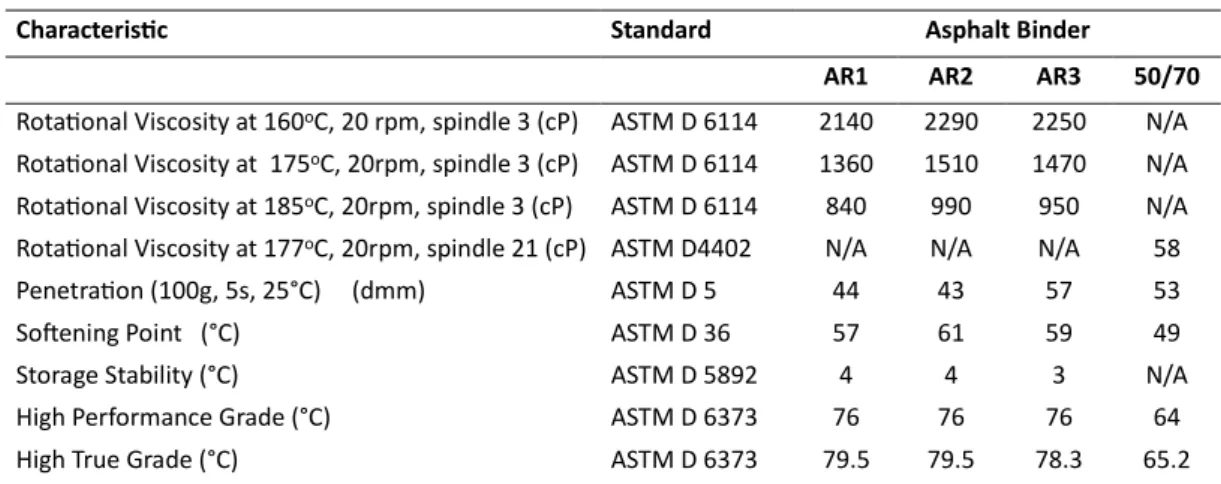
In Brazil, terminal blending is the most used methodology to produce asphalt rubber (AR) industrially. Three samples were obtained from commercial suppliers (AR1, AR2, AR3) and their characteristics are shown in Table 4. Also, a conventional asphalt cement was used to pro-duce control asphalt mixes, speci*ied as 50/70 (PG 64-10) as shown in Table 4.
Table 4 – Asphalt binder characteristics
Characteris c Standard Asphalt Binder
AR1 AR2 AR3 50/70
Rota onal Viscosity at 160oC, 20 rpm, spindle 3 (cP) ASTM D 6114 2140 2290 2250 N/A Rota onal Viscosity at 175oC, 20rpm, spindle 3 (cP) ASTM D 6114 1360 1510 1470 N/A Rota onal Viscosity at 185oC, 20rpm, spindle 3 (cP) ASTM D 6114 840 990 950 N/A Rota onal Viscosity at 177oC, 20rpm, spindle 21 (cP) ASTM D4402 N/A N/A N/A 58
Penetra on (100g, 5s, 25°C) (dmm) ASTM D 5 44 43 57 53
SoRening Point (°C) ASTM D 36 57 61 59 49
Storage Stability (°C) ASTM D 5892 4 4 3 N/A
High Performance Grade (°C) ASTM D 6373 76 76 76 64
The MSCR test was performed following recommendations of ASTM (D7405-15) and AASHTO (T350-14), in samples with diameter of 25mm and 1mm of gap. Twenty cycles of creep and recovery were applied at the stress of 100 Pa followed by ten cycles at the stress of 3,200 Pa. Each cycle consists of one second of creep and nine seconds of recovery. The samples were aged at the rolling thin *ilm oven test (RTFOT) and then tested following the MSCR procedure at four temperatures, 58°C, 64°C, 70°C and 76°C. The parameters determined in the test are the compliance value (Jnr) and recovery (R), calculated by equations given in the standards (D7405-15; T350-14).
The rubber particles used in this study pass entirely through 600 mm sieve. ASTM D 7175 method describe how to use DSR and its use is limited to asphalt binders that contain particles with largest dimension less than 250µm. Even though, many researchers are using 1mm gap for the measurements of MSCR with asphalt rubber samples, such as Mandal and Bahia (2015) have used the MSCR test with similar size gradation. Goli et al (2016) used the test to assess the ad-dition of crumb rubber passing through 1,41mm.
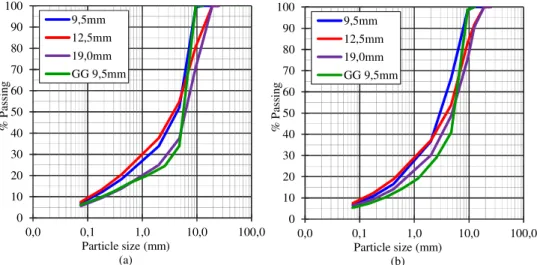
Three dense gradation, speci*ied as 19mm, 12.5mm and 9.5mm, accordingly to the aggregate Nominal Maximum Size and a 9.5mm gap graded (GG) gradation were used in this study to pre-pare the mixtures. Different gradations, aggregates sources, granitic and basaltic, and four as-phalt binders were employed in this study which resulted in the analysis of 32 asas-phalt mixtures and Table 5 shows their characteristics.
0 10 20 30 40 50 60 70 80 90 100 0,0 0,1 1,0 10,0 100,0 % P as si n g Particle size (mm) (a) 9,5mm 12,5mm 19,0mm GG 9,5mm 0 10 20 30 40 50 60 70 80 90 100 0,0 0,1 1,0 10,0 100,0 % P as si n g Particle size (mm) (b) 9,5mm 12,5mm 19,0mm GG 9,5mm
Figure 1. Hot mix asphalt gradation; a) granitic aggregates; b) basaltic aggregates Table 5 – Characteristics of granitic and basaltic aggregates
Characteris c Standard Aggregates
Granite Basalt
"Los Angeles" Abrasion Loss (%) ASTM C 131 30 17 Flat and Elongated Par cles (Ra o 1:5) (%) ASTM D4791 3 7 Soundness of aggregates (5 cycles) (%) AASHTO T-104-99 1.5 0.9
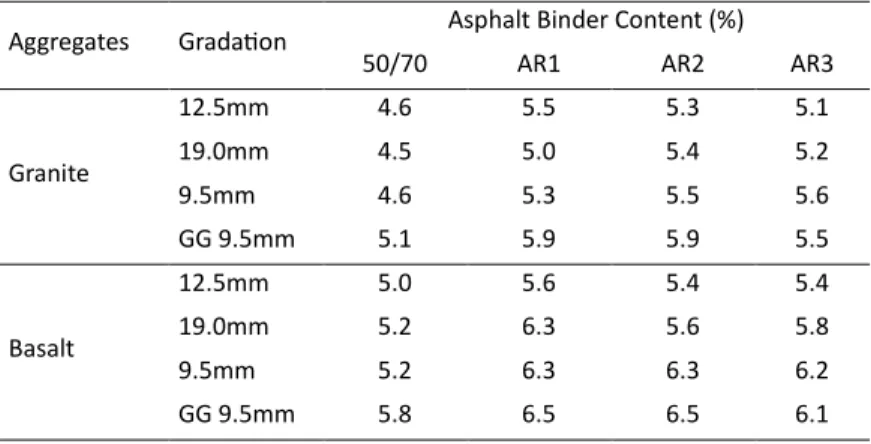
The use of four gradations, two aggregates sources and four asphalt binders generated 32 asphalt hot mixes. The Marshall compactor was used for the volumetric mix design of the as-phalt mixes, using 75 blows on each side of the specimen. The design binder content was de-*ined to obtain air voids of 4% for dense gradations and 5% for gap graded (GG). The selected binder content for the asphalt mixes is shown in Table 6.
Table 6 – Selected binder content for the hot mix asphalts
Aggregates Grada on Asphalt Binder Content (%)
50/70 AR1 AR2 AR3
Granite 12.5mm 4.6 5.5 5.3 5.1 19.0mm 4.5 5.0 5.4 5.2 9.5mm 4.6 5.3 5.5 5.6 GG 9.5mm 5.1 5.9 5.9 5.5 Basalt 12.5mm 5.0 5.6 5.4 5.4 19.0mm 5.2 6.3 5.6 5.8 9.5mm 5.2 6.3 6.3 6.2 GG 9.5mm 5.8 6.5 6.5 6.1
Three specimens were compacted using the Superpave gyratory compactor at 150mm of di-ameter and 175mm of height and then cored to obtain 100mm of didi-ameter and 150mm of height, for the *low number test, according to AASHTO T 342-11. Originally is recommended to use specimens compacted to 7,0% in the *low number tests, because this is the upper critical value usually permitted to compact dense gradations of asphalt concrete pavement layers. How-ever, in this study the target air voids was 5.5%, since this is the upper limit observed in appli-cations of these mixes in a speci*ic highway in Brazil. The specimens were conditioned at 54°C and then tested applying an uncon*ined cyclic load of 600kPa. The *low number value obtained in this test corresponds to the number of cycles at which the tertiary *low starts or the number of cycles at which the rate of change of compliance is minimum (NCHRP, 2016).
3. RESULTS
Table 7 shows the results of the MSCR test performed at the temperatures of 58°C, 64°C, 70°C and 76°C, using the three asphalt rubber samples and the conventional 50/70 binder. In Figure 2 is noted that the compliance value (Jnr) is increased in the asphalt rubber samples, as the temperature of the test increases, as expected. The three asphalt rubber samples showed almost the same values at the stress 3,2kPa that were lower than the values obtained at the conven-tional 50/70. This behaviour denotes the better resistance of asphalt rubber to resist rutting when used in a hot mix asphalt. According to Table 1, for example, all asphalt rubber samples are suitable to be used at highways with PG-70 and Heavy Traf*ic (H).
In Figure 3 is noted that the recovery of the asphalt rubber binders is reduced when the tem-perature is increased, as expected. The Jnr values at 58°C were below 0.25kPa-1, at the stress of
3.2kPa, and the recovery values were close to 50%, meeting the requirements of Table 3. However, is observed that when the temperature is increased, the recovery is reduced to val-ues below the criteria in Table 3. This could indicate that the network created between rubber particles and the asphalt is damaged at higher temperatures, reducing the elastic properties of the rubber asphalt. Some studies have studied the interaction between bitumen and rubber materials (Specht, 2004; Faxina, 2006). It is reported that this interaction depends on a number of basic factors, such as temperature, time of mixture, bitumen source, processing methods, par-ticle size and the use of oil extenders. Rubber parpar-ticles swell when added to the asphalt binder and due to the long exposure to high temperatures and then this swelling can be replaced by depolymerisation and devulcanisation which causes dispersion of the rubber. For example, Abdelrahman and Carpenter (1999) af*irm that if temperature is high or time is long enough,
depolymerisation will continue causing more destruction of the binder networking and so the modi*ication is lost.
Table 7 – MSCR results at different temperatures
Binder Stress (Pa) 58°C 64°C 70°C 76°C R (%) Jnr (kPa-1) R (%) Jnr (kPa-1) R (%) Jnr (kPa-1) R (%) Jnr (kPa-1) AR-1 100 74.1 0.09 67.4 0.22 57.7 0.55 48.7 1.20 3.200 50.5 0.18 28.9 0.51 17.0 1.29 6.4 2.89 AR-2 100 73.6 0.11 64.8 0.28 55.9 0.66 47.0 1.41 3.200 47.8 0.24 27.2 0.61 15.0 1.54 5.4 3.32 AR-3 100 67.6 0.11 64.9 0.23 57.7 0.51 49.9 1.11 3.200 53.5 0.17 33.1 0.45 21.8 1.10 9.3 2.55 50/70 100 0.0 2.97 0.0 7.11 0.0 15.52 0.0 31.82 3.200 0.0 3.15 0.0 7.52 0.0 16.40 0.0 33.64
Figure 2. Results of compliance (Jnr) in the MSCR test at the stress of 3.2kPa
Mandal and Bahia (2015) also performed MSCR test at 70˚C to assess the behavior of binders modi*ied with coarse crumb rubber particles (100% passing the 0,6mm sieve). They obtained Jnr close to 0.25 kPa-1 when they added 10% of rubber to the asphalt binder, and when the
increased this contents to 20% they noted an increase in the compliance value, reaching values of about 1,5 kPa-1. The authors also noted that increasing the rubber content decreases the
re-covery obtained in the MSCR test. The Jnr values obtained in this study are very similar to the Jnr values obtained by Mandal and Bahia (2015) when they added about 20% of crumb rubber to the asphalt binder. Regarding the recovery parameter, the results here are quite similar to those obtained in samples with 15% of crumb rubber.
Goli et al. (2016) also found values of Jnr at 70˚C close to 1.0 kPa-1 when they modi*ied a neat
binder by the addition of 15% of crumb rubber, very close to the results obtained in this study in all rubberized asphalts. Willis et al (2014) performed the MSCR at 64˚C in a rubber modi*ied asphalt and obtained Jnr of 0.43 kPa-1, again, very close the results shown in this study.
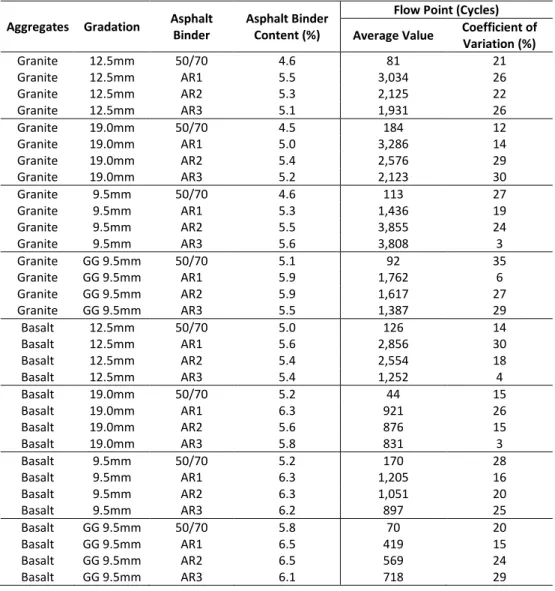
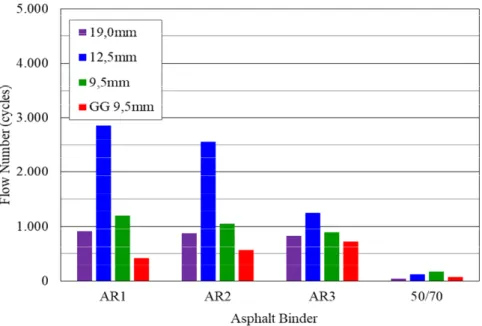
Table 8 shows the average results of the *low number test performed in the 32 HMA and the coef*icient of variation, since the tests were performed using three specimens for each hot mix asphalt. These results are also shown in Figure 4 and 5, for asphalt mixes using granitic aggre-gates and basaltic aggreaggre-gates, respectively.
Figures 4 and 5 show that hot mix asphalts produced with conventional asphalt binder (50/70), had always the lowest *low number value, independently of the size gradation and ag-gregate source. On the other hand, the mixes produced with rubberized asphalt had the higher *low number values, ranging from 400 to 3.800. It is well accepted that, the higher *low number, the higher the rutting resistance of the asphalt mix. Then, the rubberized asphalt mixes have higher resistance to withstand distresses associated to permanent deformation. According to the recommendations of Table 3, for example, all the dense graded mixes with any asphalt rub-ber of this study could be used in highways with ESALs higher than 30 million.
The asphalt mixes produced with granitic aggregates had higher *low number values than asphalt mixes produced with basaltic aggregates. This behaviour can be associated to the per-centage of *lat and elongated particles of the basaltic aggregates, which is higher when com-pared to the granitic aggregates. However, is also noted that basaltic aggregates have higher asphalt absorption, when compared to granitic aggregates. Additionally, Table 6 showed that hot mix asphalt with basalt had always higher binder content, this could have in*luenced to obtain a lower *low number value in these mixes.
The in*luence of the size gradation of hot mix asphalt in the *low number values was not very clear. However, the GG 9.5mm had the lowest rutting resistances, except the hot mix asphalt with granitic aggregates and AR1. Regarding the source of the rubberized asphalt binder, there was not a very clear tendency that showed a better behaviour of one of the three samples. Willis et al obtained *low number values of 600 cycles in asphalt 12.5mm dense asphalt mixes, using a PG 64-22 rubberized asphalt. Values are much lower than the ones obtained here, maybe because that study used 7,0% air voids specimens and the test was performed at 60oC.
Khalili et al (2016) performed an extensive research to evaluate the properties of rubber modi*ied binders used in the State of Nevada (United States of America). The authors collected several samples from different modi*ication processes. They found values of *low number at 59˚C varying from 600 to almost 5000 cycles, according to the gradation and the process used to obtain the rubberized asphalt. Similar values and variations where also obtained in this study.
Table 8 – Flow number test results Aggregates Gradation Asphalt
Binder
Asphalt Binder Content (%)
Flow Point (Cycles) Average Value Coefficient of
Variation (%) Granite 12.5mm 50/70 4.6 81 21 Granite 12.5mm AR1 5.5 3,034 26 Granite 12.5mm AR2 5.3 2,125 22 Granite 12.5mm AR3 5.1 1,931 26 Granite 19.0mm 50/70 4.5 184 12 Granite 19.0mm AR1 5.0 3,286 14 Granite 19.0mm AR2 5.4 2,576 29 Granite 19.0mm AR3 5.2 2,123 30 Granite 9.5mm 50/70 4.6 113 27 Granite 9.5mm AR1 5.3 1,436 19 Granite 9.5mm AR2 5.5 3,855 24 Granite 9.5mm AR3 5.6 3,808 3 Granite GG 9.5mm 50/70 5.1 92 35 Granite GG 9.5mm AR1 5.9 1,762 6 Granite GG 9.5mm AR2 5.9 1,617 27 Granite GG 9.5mm AR3 5.5 1,387 29 Basalt 12.5mm 50/70 5.0 126 14 Basalt 12.5mm AR1 5.6 2,856 30 Basalt 12.5mm AR2 5.4 2,554 18 Basalt 12.5mm AR3 5.4 1,252 4 Basalt 19.0mm 50/70 5.2 44 15 Basalt 19.0mm AR1 6.3 921 26 Basalt 19.0mm AR2 5.6 876 15 Basalt 19.0mm AR3 5.8 831 3 Basalt 9.5mm 50/70 5.2 170 28 Basalt 9.5mm AR1 6.3 1,205 16 Basalt 9.5mm AR2 6.3 1,051 20 Basalt 9.5mm AR3 6.2 897 25 Basalt GG 9.5mm 50/70 5.8 70 20 Basalt GG 9.5mm AR1 6.5 419 15 Basalt GG 9.5mm AR2 6.5 569 24 Basalt GG 9.5mm AR3 6.1 718 29
Figure 5. Flow number values of asphalt mixtures with basaltic aggregates y = -777,28x + 2564,5 R² = 0,9943 y = -366,9x + 1252,7 R² = 0,9081 0 500 1.000 1.500 2.000 2.500 3.000 0,00 1,00 2,00 3,00 4,00 F N ( cy cl es ) Jnr (kPa-1) (a) Granite Basalt y = -328,02x + 2583,5 R² = 0,9937 y = -154,74x + 1261,5 R² = 0,9064 0 500 1.000 1.500 2.000 2.500 3.000 0,00 2,00 4,00 6,00 8,00 F N ( cy cl es ) Jnr (kPa-1) (b) Granite Basalt y = -152,12x + 2611,2 R² = 0,9939 y = -71,884x + 1275,2 R² = 0,9097 0 500 1.000 1.500 2.000 2.500 3.000 0,00 5,00 10,00 15,00 20,00 F N ( c y cl es ) Jnr (kPa-1) (c) Granite Basalt y = -74,686x + 2629,8 R² = 0,9937 y = -35,256x + 1283,6 R² = 0,9076 0 500 1.000 1.500 2.000 2.500 3.000 0,00 10,00 20,00 30,00 40,00 F N ( cy cl es ) Jnr (kPa-1) (d) Granite Basalt
The average *low number values obtained at each sized gradation and which each aggregate type at 54°C where used to correlate with the Jnr values obtained at the MSCR test at different test temperatures.
Figure 6 shows that mixes containing Granite aggregates had higher *low number values at lower Jnr values, when compared to mixes containing Basalt aggregates. Even both aggregate sources attended to AASHTO R 35 recommendations, Granite aggregates are more cubic than Basalt aggregates, as showed in Table 5. Thus, this parameter may have in*luenced in the behav-iour of mixes in the *low number test. However, at higher Jnr values, the aggregate source seems not to in*luence the FN values.
It is observed also in Figure 6 that the linear correlation between FN and Jnr were excellent, since the coef*icient of determination were higher than 0.90 (Witczak et al, 2002). This behav-iour reveals the asphalt binder contribution to rutting resistance could be accurately predicted by MSCR test. Others studies (LAUKKANEN et al., 2015; ADORJAPNYI AND FUQLEK, 2013; DOMIN-GOS, FAXINA AND BERNUCCI, 2017) con*irm that the MSCR test method is capably to predict mixture rutting’ behaviour.
4. CONCLUSIONS
This study performed a laboratory program to assess the contribution of asphalt rubber in hot mix asphalt to resist rutting. The MSCR test was performed in three asphalt rubber and in a conventional 50/70 asphalt binder. The *low number test was selected to analyse 32 mixtures, with different source of aggregates, gradation and asphalt binder source.
The Jnr values obtained at the MSCR showed that asphalt rubber have better potential to withstand permanent deformation in hot mix asphalt at different temperatures. However, the recovery values at 64°C, 70°C and 76° were lower than recommended by FHWA (2010). This behaviour may denote that at higher temperatures there is not a well de*ined crosslink between the rubber particles and the asphalt binder
The *low number was dependant on the source of aggregates. In this study, it was noted that granite produced mixtures with higher resistance to permanent deformation, than mixtures produced with basalt. This behaviour can be associated to the shape of aggregates particles and asphalt binder content.
It was noted that hot mix asphalts produced with rubberized asphalt have higher *low num-ber values, when compared to conventional mixtures. This means that the use of asphalt rubnum-ber can enhance the resistance to permanent deformation of hot mix asphalt. This behaviour was noted in all three rubberized asphalts, collected from commercial suppliers.
Finally, the linear correlation between the *low number results and the Jnr values at different temperatures was strong, which denotes that the Jnr is a good parameter to estimate the con-tribution of the asphalt binder in the HMA rutting resistance.
ACKNOWLEDGEMENTS
This study was supported by the “Agencia Nacional de Transportes Terrestres (ANTT)”.
REFERENCES
Abdelrahman MA, Carpenter SH. The mechanism of the interaction of asphalt cement with crumb rubber modi*ier (CRM). Transport Res Rec 1999;1661: 106–13.
ASPHALT INSTITUTE (1996) “Superpave Mix Design”, Superpave Series No. 2 (SP-2), Lexington, Kentucky, 1996.
Balaguer, M. (2012). Avaliação estrutural de um pavimento lexível executado em asfalto-borracha, elaborado pelo Processo de Produção Contínua em Usina. Master Dissertation. Instituto Militar de Engenharia. Rio de Janeiro, RJ.
Bonaquist, R. (2012). Evaluation of Flow Number (Fn) as a Discriminating HMA Mixture Property. Final Report WHRP 12-01 for the Wisconsin Department of Transportation. Wisconsin.
BROSSEAUD, Y., DELORME, J.L.; HIERNAUX, R. (1993) “Use of LPC Wheel-Tracking Rutting Tester to Select Asphalt Pavements Resistant to Rutting”, Transportation Research Record #1384, TRB, National Research Council, Washington, D.C
Camargo, F. F. (2016). Field and laboratory performance evaluation of a ield-blended rubber asphalt. Doctoral Thesis. Escola Politécnica da Universidade de São Paulo. São Paulo, SP.
D’Angelo, J.; Kluttz, R.; Dongré, R.; Stephens, K.; Zanzotto, L. (2007). Revision of the Superpave high temperature binder speci i-cation: the multiple stress creep recovery test. Journal of the Association of Asphalt Paving Technologists, Vol. 76, pp. 123-162. 2007.
Domingos, M. D. I.; Faxina, A. L.; Bernucci, L. L. B. (2017). Characterization of the rutting potential of modi ied asphalt binders and its correlation with the mixture’s rut resistance. Construction and Building Materials, Vol. 144, pp. 207-213.
FAXINA, A. L. (2006). Estudo da viabilidade técnica do uso do resı́duo de óleo de xisto como extensor em ligantes asfalto-bor-racha. Tese de Doutorado. Escola de Engenharia de São Carlos da Universidade de São Paulo, São Carlos, SP.
FHWA.(2010). The multiple stress creep recovery (MSCR) procedure. Federal Highway Administration Tech Brief FHWA-HIF-11-038. Washington, D.C.
Goli, A.; Ziari, H.; Amini, A. (2016) Evaluating the Performance of Crumb Rubber Modi*ied Binders used in Isfahan Province. In: International Journal of Transportation Engineering, Vol.4/No.2. Autum 2016.
Khalili, M.; Amirkhanian, S.; Karakouzian, M.; Xiao, F.; Jadidi, K. (2016). Evaluation of New Innovations in Rubber-Modi*ied Asphalt Binders and Rubberized Asphalt Mixes for Nevada DOT. NDOT Research Report No. 513-13-803. Carson City, NV, USA.
KANDHAL, P.S.; MALLIK, R.B. (2001) “Effect of Mix Gradation on Rutting Potential of Dense-Graded Asphalt Mixtures”, Trans-portation Research Record #1767, TRB, National Research Council, Washington, D.C.
LAUKKANEN, O.V.; SOENEN, H.; PELLINEN, T. HEYRMAN, S.; LEMOINE, G. Creep-recovery behavior of bituminous binders and its relation to asphalt mixture rutting. Materials and Structures (2015) 48:4039–4053
DOI 10.1617/s11527-014-0464-7.
LO PRESTI, D. (2013). Recycled Tire Rubber Modi ied Bitumens for road asphalt mixtures: A literature review. Construction and Building Materials Journal. Volume 49, Pp. 863-881. doi:10.1016/j.conbuildmat.2013.09.007.
Mandal. T. and Bahia, U. (2015). Effect of Crumb Rubber on Rheological Properties of Asphalt Binder and Aggregate Packing of Asphalt Mixtures. In: Road Materials and Pavements Design. Volume X – No X/2015.
NASCIMENTO, L.A.H. Nova Abordagem da Dosagem de Misturas Asfálticas Densas com Uso do Compactador Giratório e Foco na Deformação Permanente Master Thesis dissertation.Rio de Janeiro: UFRJ/COPPE, 2008.
NCHRP (2016). Simple Performance Tests: Summary of Recommended Methods and Database. Final Report. National Coopera-tive Highway Research Program NCHRP 09-19, National Research Council. DOI: 10.17226/13949. Washington, D. C. NCHRP. (2011). A Manual for Design of Hot Mix Asphalt with Commentary. National Cooperative Highway Research Program
NCHRP 673. Washington, D.C.
NETEMEYER, R.L. (1998) “Rutting Susceptibility of Bituminous Mixtures by the Georgia loaded Wheel Tester”, Missouri De-partment of Transportation, Field Of*ice Investigation F.O. 95-06, SPR Study No. SPR 96-03, Jefferson City, Missouri, May, 1998.
Specht, L.P. (2004). Avaliação de misturas asfálticas com incorporação de borracha reciclada de pneus. Doctoral Thesis. Univer-sidade Federal de Rio Grande do Sul, Porto Alege, RS.
Willis, J. R.; Rodezno, C.; Taylor, A.; Tran, N. (2014). Evaluation Of A Rubber---Modi*ied Mixture In Alabama. Interim NCAT Re-port 14---03. Auburn, Alabama.
Witczak, M.; Kaloush, K.; Pellinen, T.; El-Basyouny, M.; Von Quintus, H. (2002). Simple Performance Test for Superpave Mix De-sign. NCHRP, Report 465. Washington, D.C.